IMAGE COMPRESSION
TECHNIQUE
SUBMITTED TO:
MAHMUDUL HASAN
ASSISTANT PROFESSOR,DEPT. OF CSTE.
SUBMITTED BY:
GROUP:06
SHUDEB BABU SEN OMIT
ROLL:ASH1501003M
PRANTO CHANDRA SAHA
ROLL: ASH1501040
MOHAMMAD FORHAD
ROLL: ASH1501033M
Our slide contains:
1.What is image compression.
2.Objectives of image compression.
3.Basic problems.
4.Image compression models.
5.Different ways of image compression.
6.Discussion on compression technique and application.
7.Image representation formats
8.Challenges in compression.
9.Conclusion.
1.What is image compression?
Reduce of irrelevant and redundant image data in a efficient form.
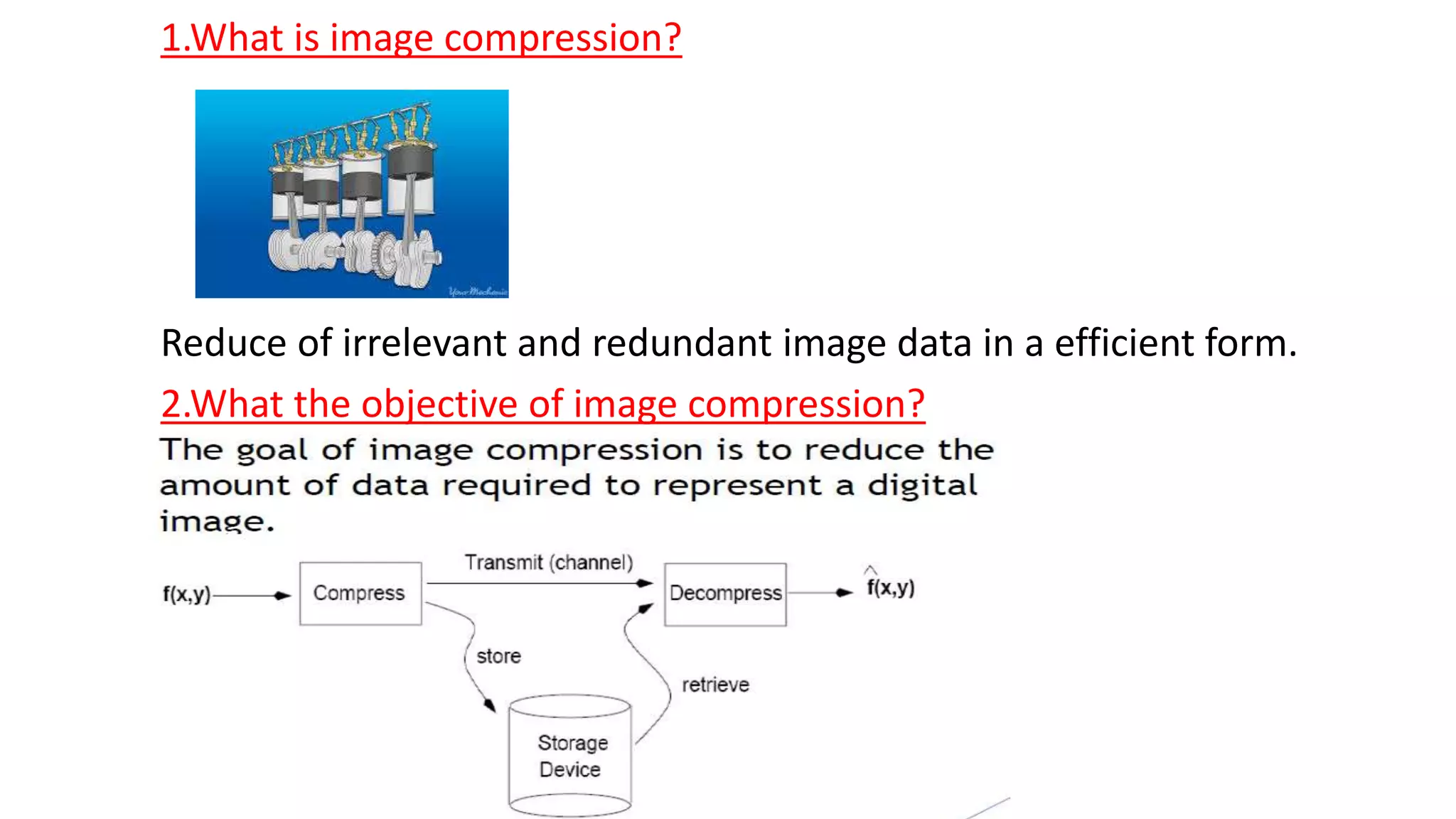
2.What the objective of image compression?
3.Basic problems:
Data and information are not same,data used to represent the
information.Redundant data can be used to represent same
information.So need to remove redundant data.
Three types of redundancy:
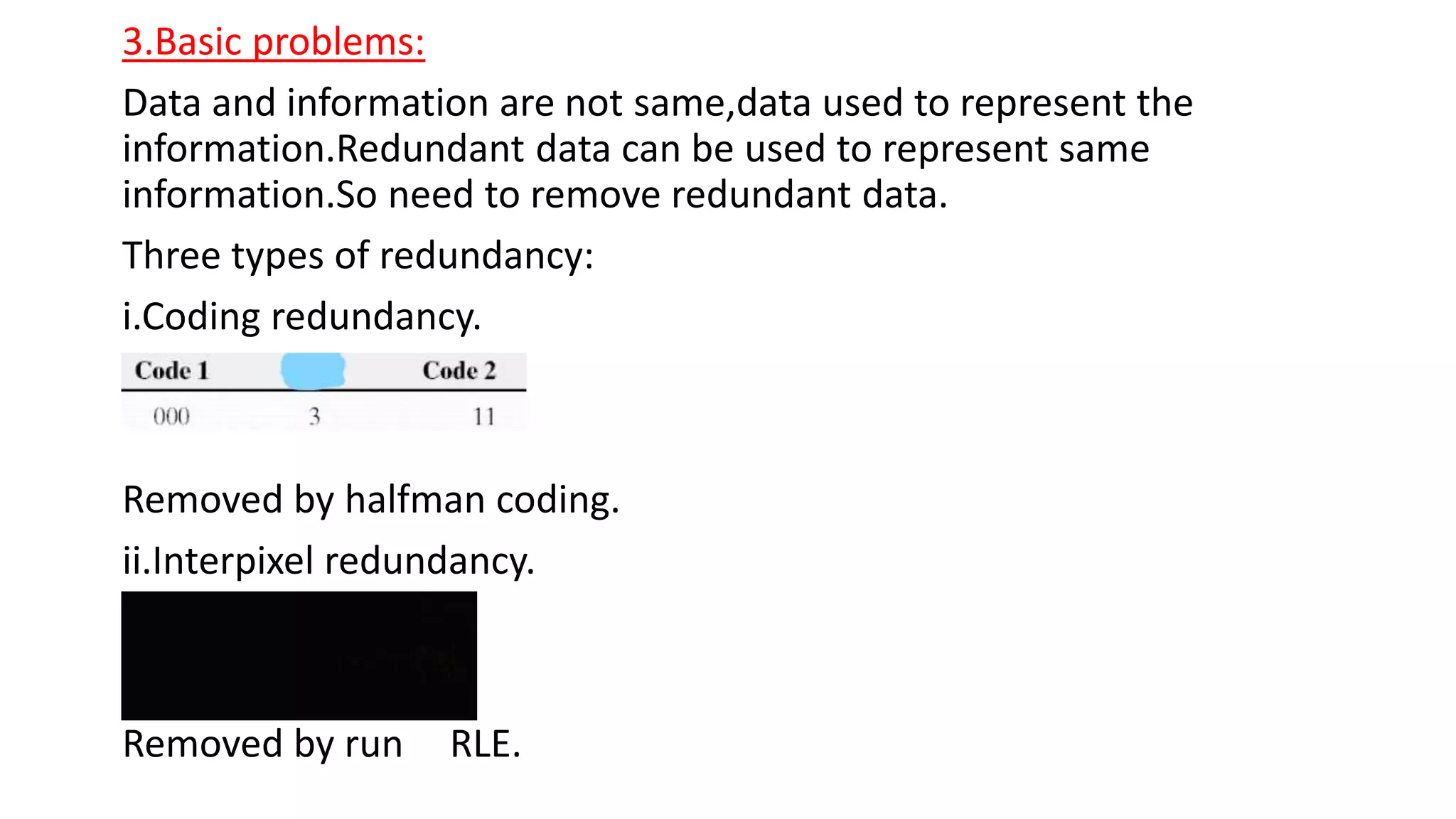
i.Coding redundancy.
Removed by halfman coding.
ii.Interpixel redundancy.
Removed by run RLE.
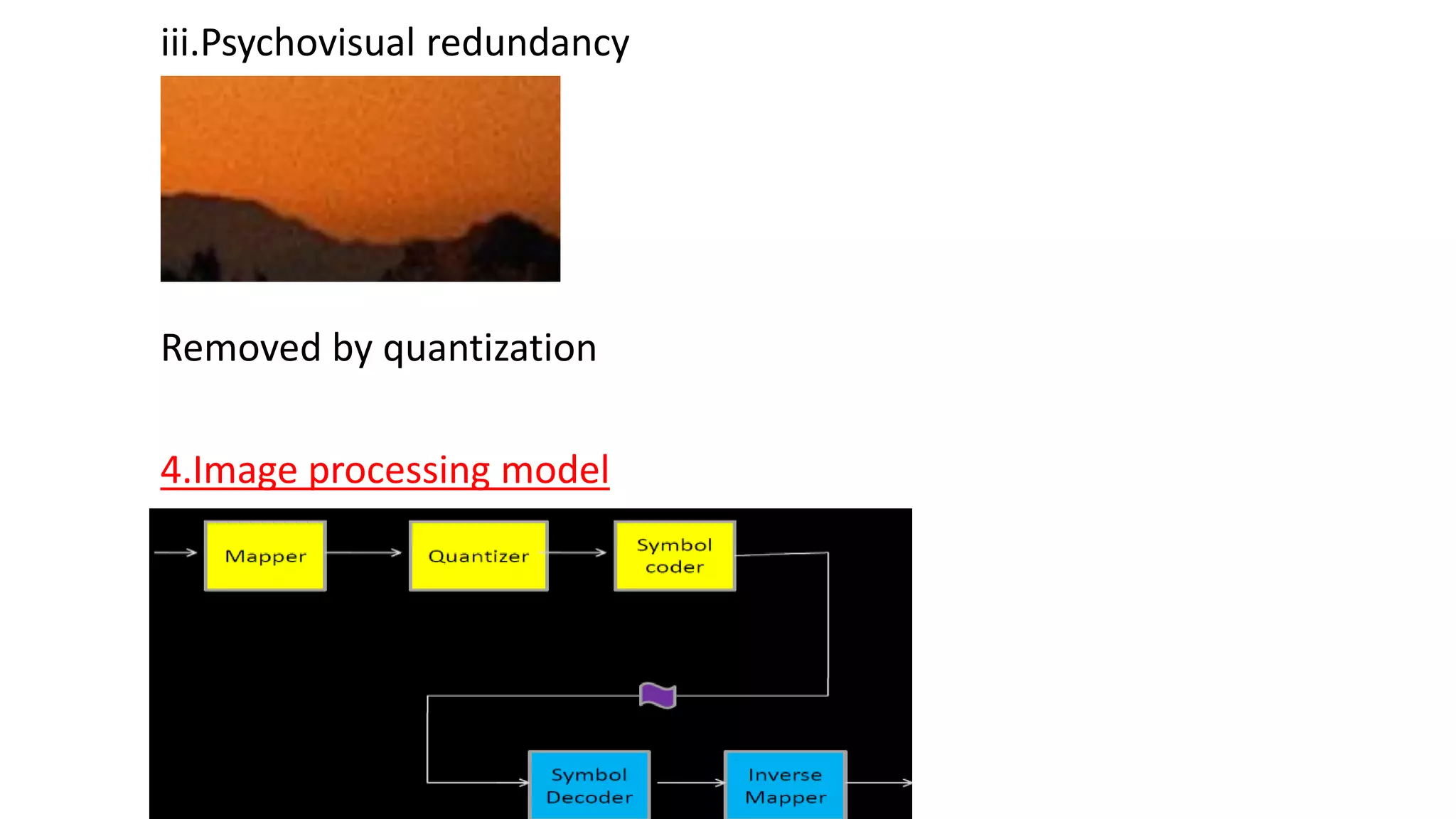
iii.Psychovisual redundancy
Removed by quantization
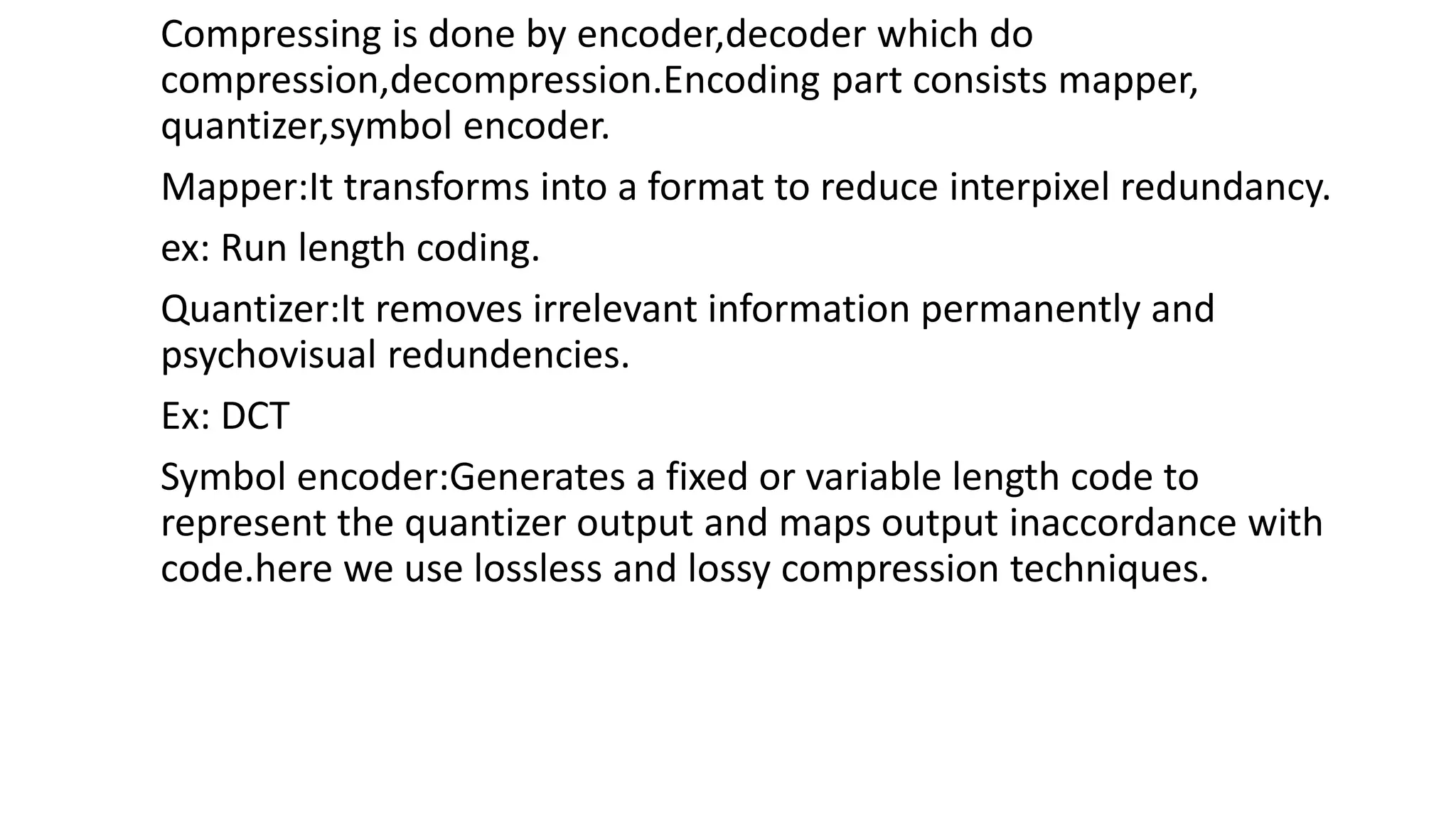
4.Image processing model
Compressing is done by encoder,decoder which do
compression,decompression.Encoding part consists mapper,
quantizer,symbol encoder.
Mapper:It transforms into a format to reduce interpixel redundancy.
ex: Run length coding.
Quantizer:It removes irrelevant information permanently and
psychovisual redundencies.
Ex: DCT
Symbol encoder:Generates a fixed or variable length code to
represent the quantizer output and maps output inaccordance with
code.here we use lossless and lossy compression techniques.
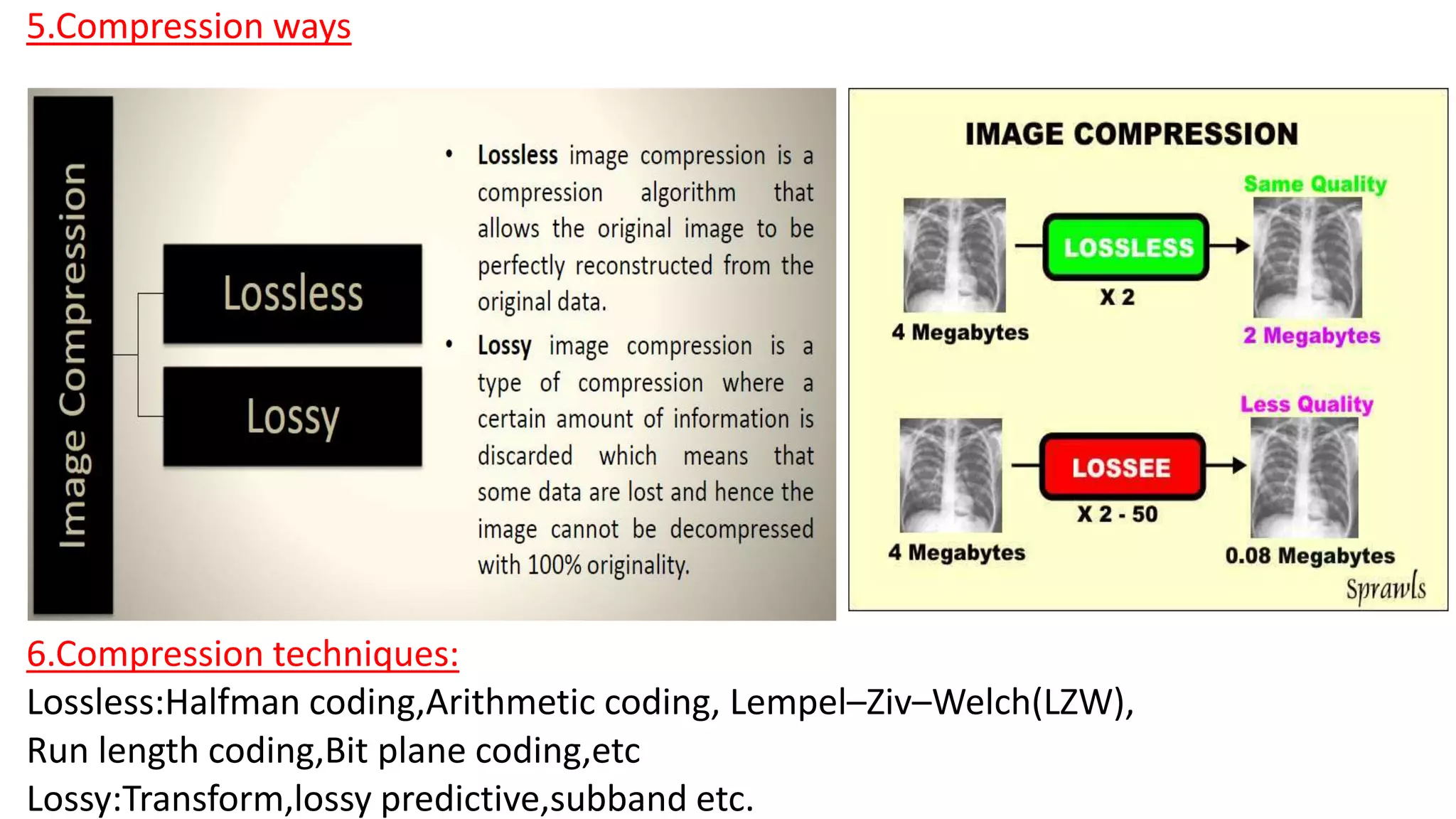
5.Compression ways
6.Compression techniques:
Lossless:Halfman coding,Arithmetic coding, Lempel–Ziv–Welch(LZW),
Run length coding,Bit plane coding,etc
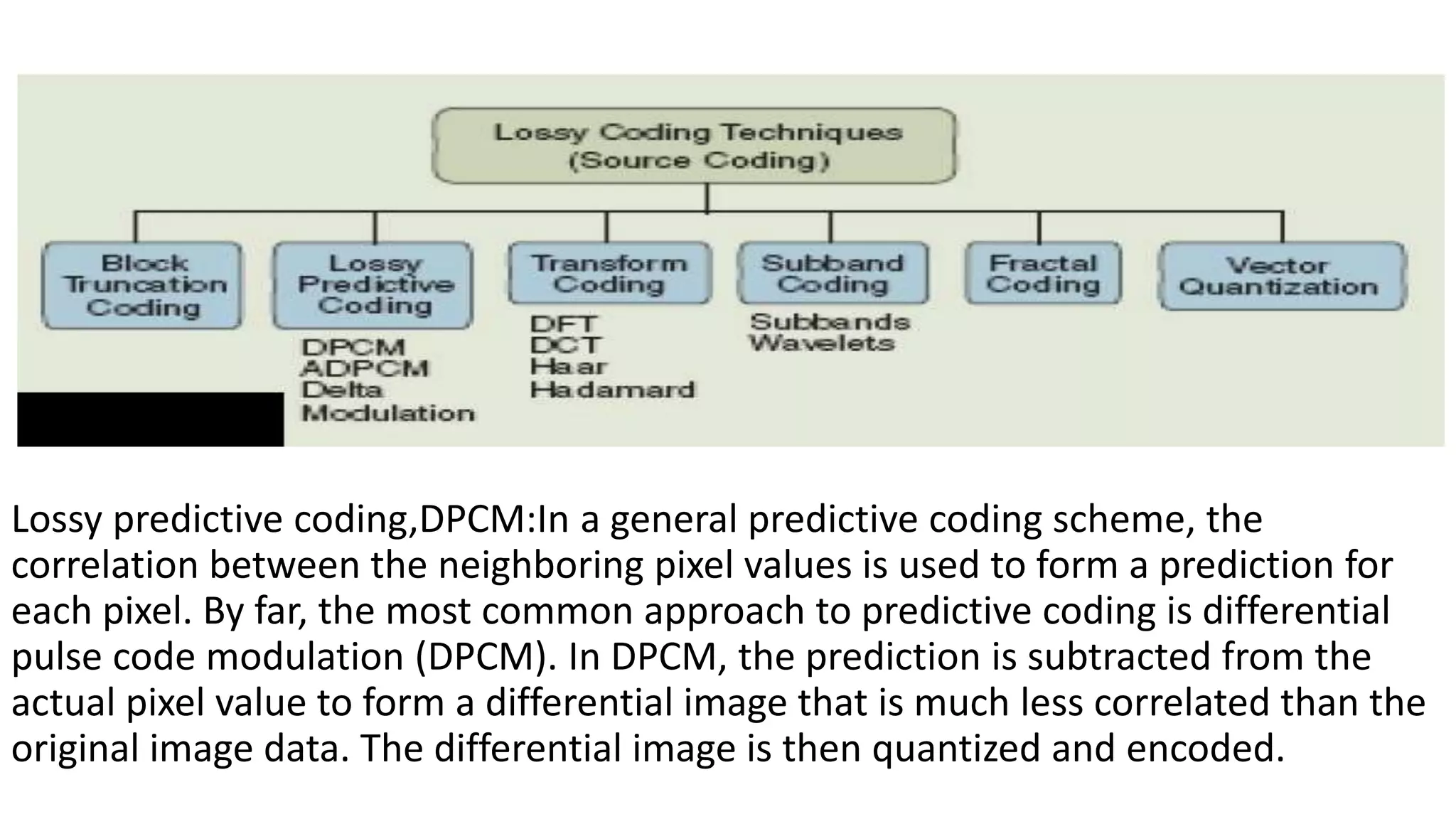
Lossy:Transform,lossy predictive,subband etc.
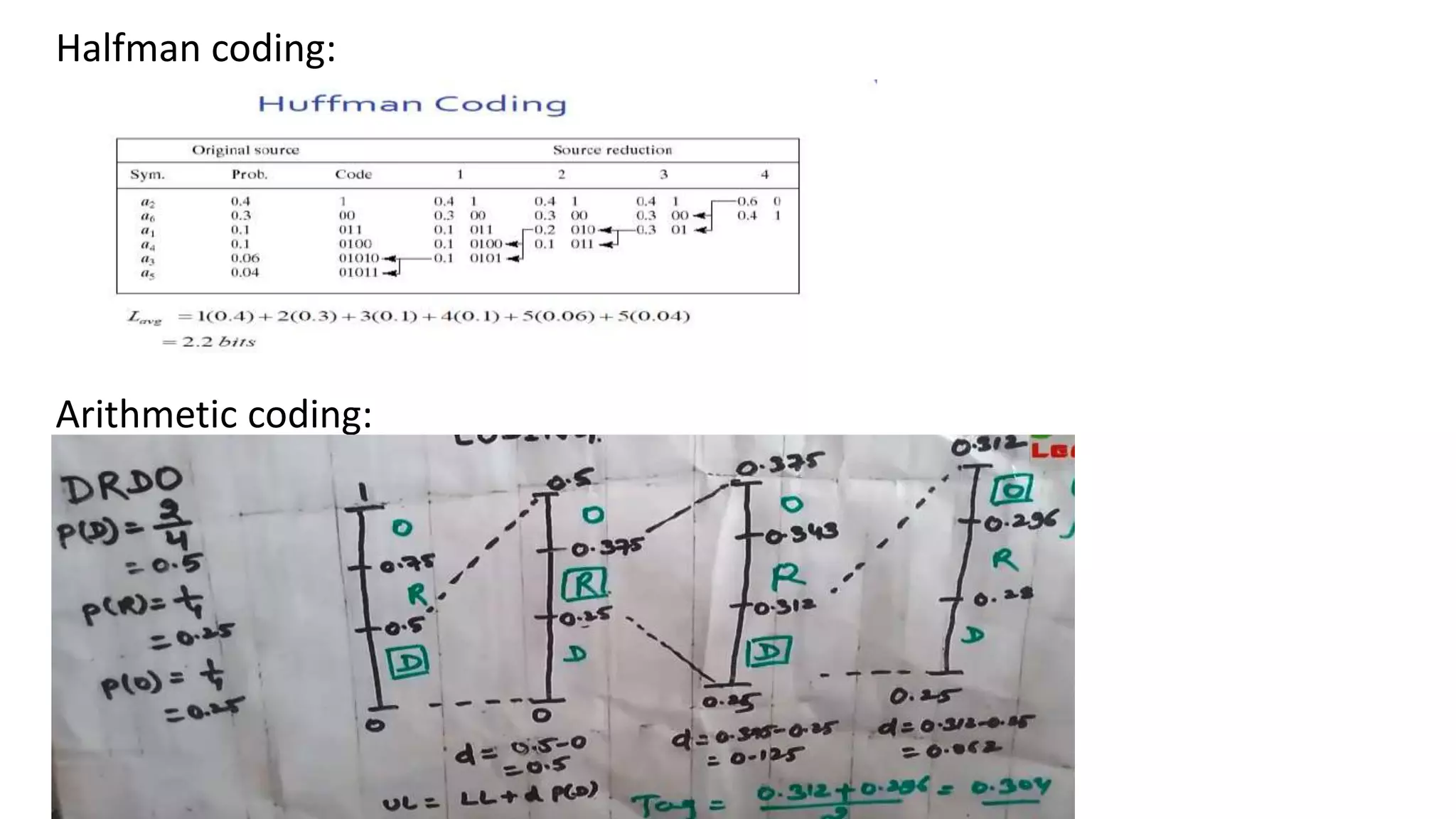
Halfman coding:
Arithmetic coding:
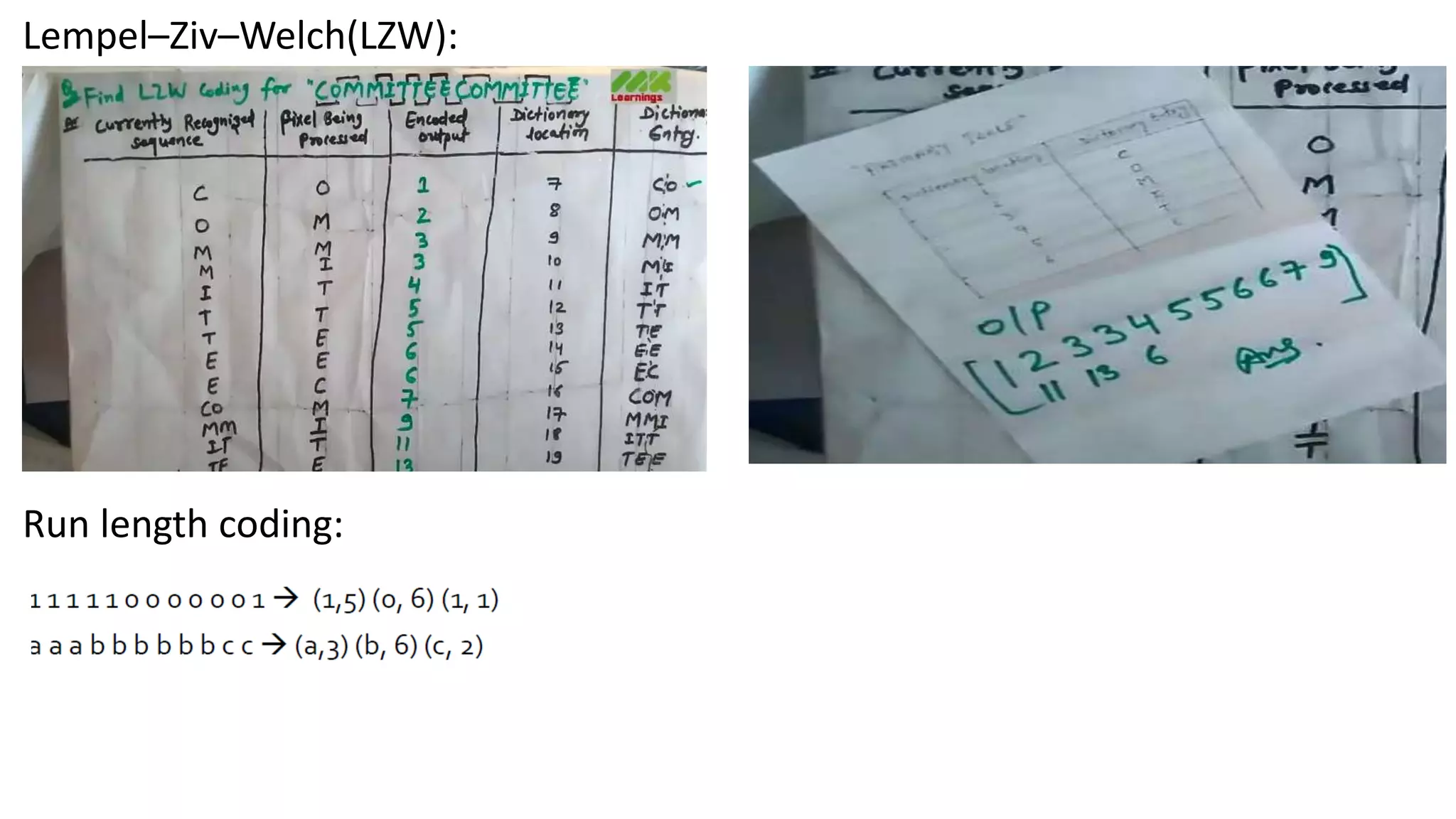
Lempel–Ziv–Welch(LZW):
Run length coding:
Lossy predictive coding,DPCM:In a general predictive coding scheme, the
correlation between the neighboring pixel values is used to form a prediction for
each pixel. By far, the most common approach to predictive coding is differential
pulse code modulation (DPCM). In DPCM, the prediction is subtracted from the
actual pixel value to form a differential image that is much less correlated than the
original image data. The differential image is then quantized and encoded.
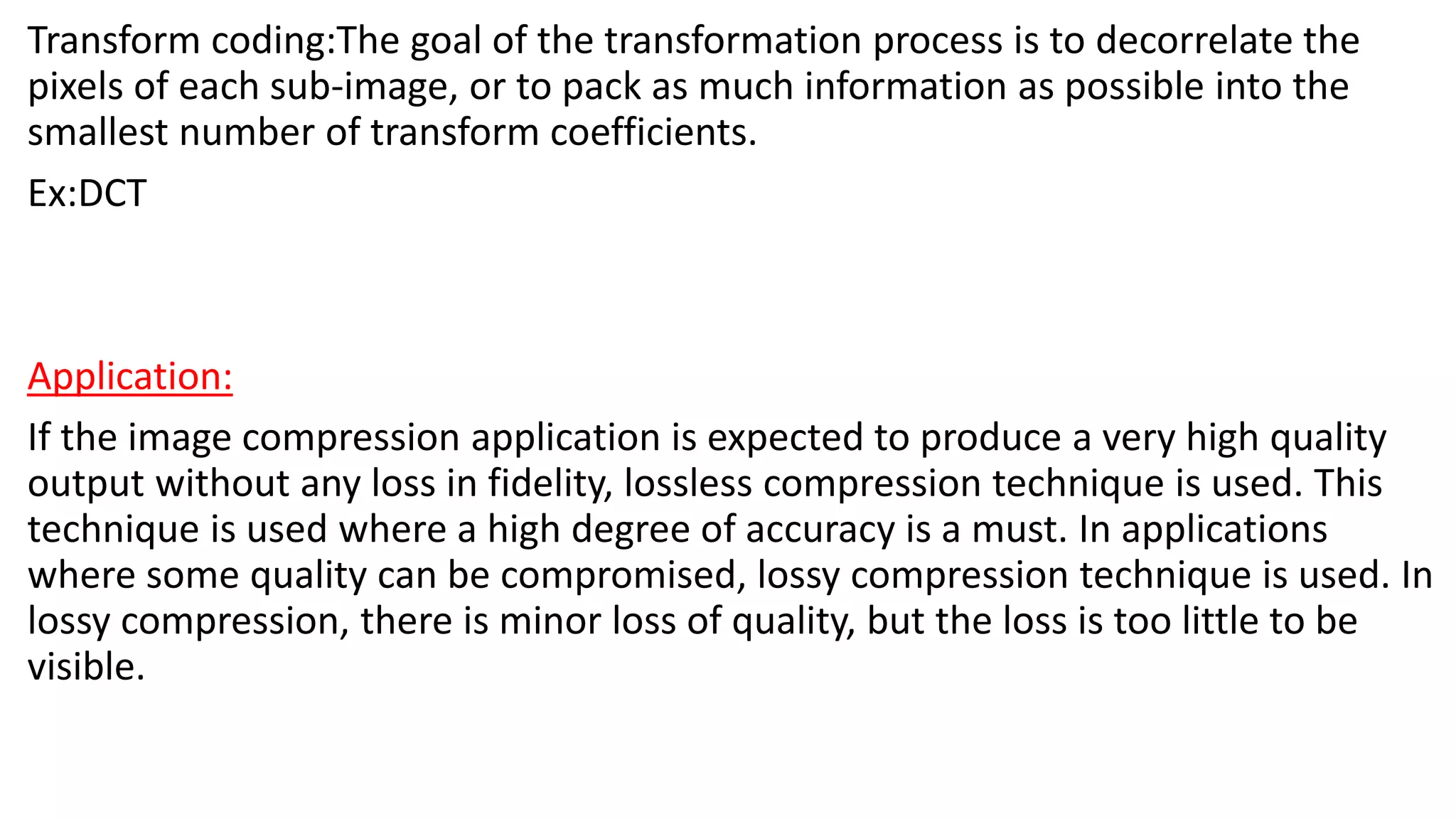
Transform coding:The goal of the transformation process is to decorrelate the
pixels of each sub-image, or to pack as much information as possible into the
smallest number of transform coefficients.
Ex:DCT
Application:
If the image compression application is expected to produce a very high quality
output without any loss in fidelity, lossless compression technique is used. This
technique is used where a high degree of accuracy is a must. In applications
where some quality can be compromised, lossy compression technique is used. In
lossy compression, there is minor loss of quality, but the loss is too little to be
visible.
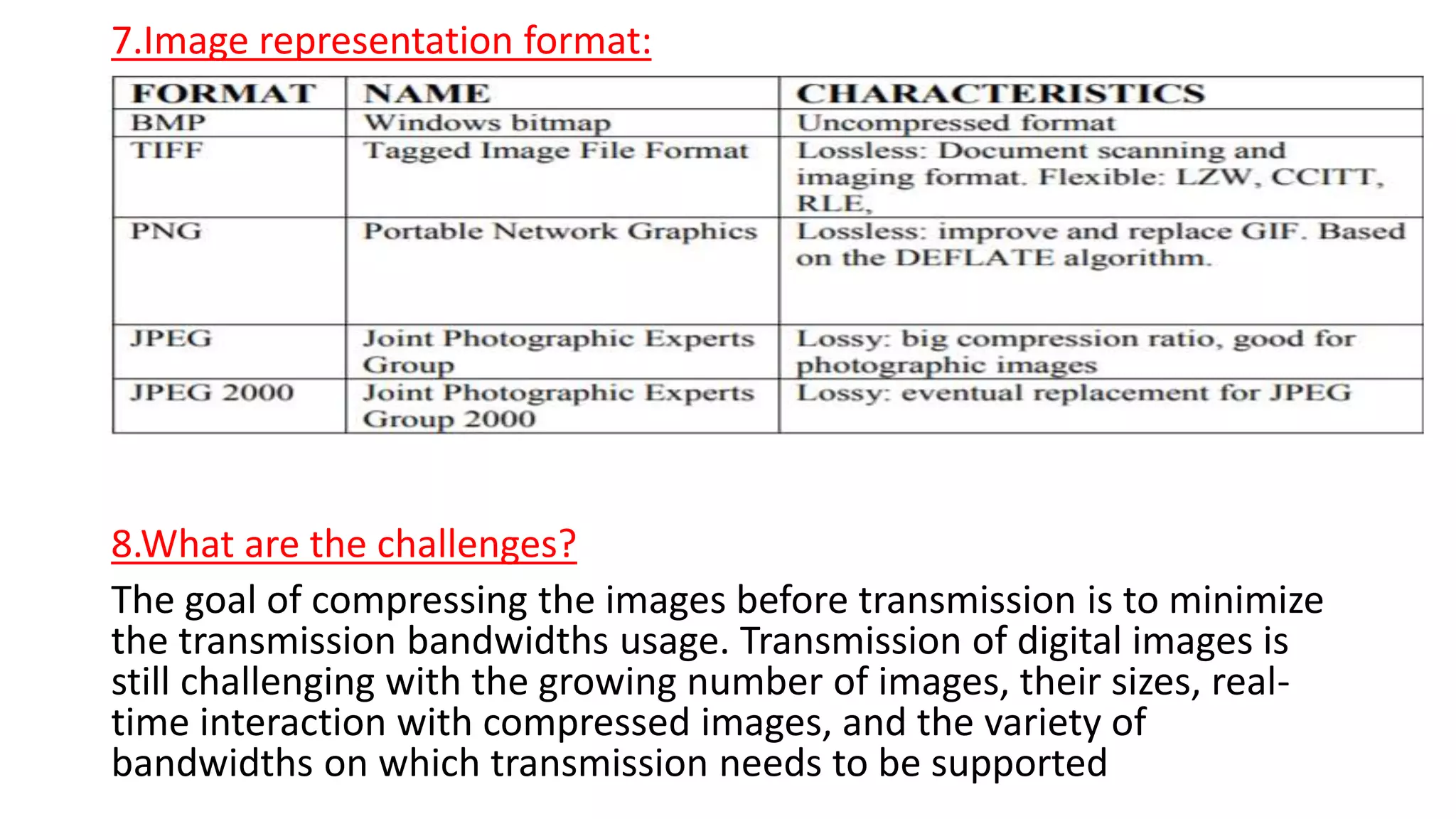
7.Image representation format:
8.What are the challenges?
The goal of compressing the images before transmission is to minimize
the transmission bandwidths usage. Transmission of digital images is
still challenging with the growing number of images, their sizes, real-
time interaction with compressed images, and the variety of
bandwidths on which transmission needs to be supported
9.Conclusion:
Our resources are limited,storage,bandwidth,transmission speed.For the sake of
compression technique it becomes easy for transmission ,storage and save our
time.Day by day different algorithm and techniques are added in our technology
and make our work easy and smooth.

Image compression (4)

  • 1.
    IMAGE COMPRESSION TECHNIQUE SUBMITTED TO: MAHMUDULHASAN ASSISTANT PROFESSOR,DEPT. OF CSTE. SUBMITTED BY: GROUP:06 SHUDEB BABU SEN OMIT ROLL:ASH1501003M PRANTO CHANDRA SAHA ROLL: ASH1501040 MOHAMMAD FORHAD ROLL: ASH1501033M
  • 2.
    Our slide contains: 1.Whatis image compression. 2.Objectives of image compression. 3.Basic problems. 4.Image compression models. 5.Different ways of image compression. 6.Discussion on compression technique and application. 7.Image representation formats 8.Challenges in compression. 9.Conclusion.
  • 3.
    1.What is imagecompression? Reduce of irrelevant and redundant image data in a efficient form. 2.What the objective of image compression?
  • 4.
    3.Basic problems: Data andinformation are not same,data used to represent the information.Redundant data can be used to represent same information.So need to remove redundant data. Three types of redundancy: i.Coding redundancy. Removed by halfman coding. ii.Interpixel redundancy. Removed by run RLE.
  • 5.
    iii.Psychovisual redundancy Removed byquantization 4.Image processing model
  • 6.
    Compressing is doneby encoder,decoder which do compression,decompression.Encoding part consists mapper, quantizer,symbol encoder. Mapper:It transforms into a format to reduce interpixel redundancy. ex: Run length coding. Quantizer:It removes irrelevant information permanently and psychovisual redundencies. Ex: DCT Symbol encoder:Generates a fixed or variable length code to represent the quantizer output and maps output inaccordance with code.here we use lossless and lossy compression techniques.
  • 7.
    5.Compression ways 6.Compression techniques: Lossless:Halfmancoding,Arithmetic coding, Lempel–Ziv–Welch(LZW), Run length coding,Bit plane coding,etc Lossy:Transform,lossy predictive,subband etc.
  • 8.
  • 9.
  • 10.
    Lossy predictive coding,DPCM:Ina general predictive coding scheme, the correlation between the neighboring pixel values is used to form a prediction for each pixel. By far, the most common approach to predictive coding is differential pulse code modulation (DPCM). In DPCM, the prediction is subtracted from the actual pixel value to form a differential image that is much less correlated than the original image data. The differential image is then quantized and encoded.
  • 11.
    Transform coding:The goalof the transformation process is to decorrelate the pixels of each sub-image, or to pack as much information as possible into the smallest number of transform coefficients. Ex:DCT Application: If the image compression application is expected to produce a very high quality output without any loss in fidelity, lossless compression technique is used. This technique is used where a high degree of accuracy is a must. In applications where some quality can be compromised, lossy compression technique is used. In lossy compression, there is minor loss of quality, but the loss is too little to be visible.
  • 12.
    7.Image representation format: 8.Whatare the challenges? The goal of compressing the images before transmission is to minimize the transmission bandwidths usage. Transmission of digital images is still challenging with the growing number of images, their sizes, real- time interaction with compressed images, and the variety of bandwidths on which transmission needs to be supported
  • 13.
    9.Conclusion: Our resources arelimited,storage,bandwidth,transmission speed.For the sake of compression technique it becomes easy for transmission ,storage and save our time.Day by day different algorithm and techniques are added in our technology and make our work easy and smooth.