iMedPub Journals
This article is available from: http://www. ojmedicine.com OPEN JOURNAL OF MEDICINE
2011
Vol. 1 No. 1:3
doi: 10:3823/502
© Under License of Creative Commons Attribution 3.0 License 1
IL-1 and its role in osteoarthritis
Alejandro Melo-Florián
Abstract
Given the high and rising figures of people with osteoarthritis, knowledge of new
factors defining course and evolution of the disease are important, when consider-
ing new pharmacological targets. IL-1 is a very important cytokine in the early steps
of osteoarthritis, giving the high sensitivity of the chondrocytes to this cytokine,
and it can be considered the bridge permiting the dialogue between the different
structures of the articulation, in such a way that the cartilage is not the only tissue
affected in OA. IL-1 increases the destruction of the extracellular matrix of the carti-
lage increasing the collagenolytic activity of metalloproteases, increasing activity of
nytric oxide ON, wich can induce apoptosis of chondrocytes. Interestingly, IL-1 further
induces changes in the homeostasis of the cartilage, lessening activity of growth
factors, such as TGF-beta.
Key words: IL-1 - osteoarthritis - MMP - nytric oxide - cartilage homeostasis.
Osteoarthritis impact and magnitude
Osteoarthritis (OA) is the most common joint disease and it
is ranked among the most frequent and symptomatic caus-
ing health-problems disease for middle-aged people as well
as in the elderly. The main characteristic of OA is an imbalance
between chondrocyte anabolic and catabolic activities, as it is
described in the section of cartilage homeostasis. 
 
The implications of this burden are poor quality of life, restric-
tions in daily activities and progressive disability (van der Waal
JM et al, 2005).
 
The biggest condition causing disability is osteoarthritis, and
altogether with joint pain in older people—will be an increas-
ingly important public health concern in the elderly.
Osteoarthritis pathophysiology
 
Degenerative articular disease is best characterized by a lost of
the equilibrium or changes in the cartilage homeostasis, and
it means further degradation of the molecules of the cartilage
matrix.
 
The lost of proteoglycans and another macromolecules from
cartilage yields in a progresive tisular destruction, causing de-
terioration of the smooth cartilage surface (Pujol JP, 1998).
 
Synovitis in osteoarthritis
Synovial inflamation occurs early in OA and can be subclinical,
as arthroscopic studies suggest that localized proliferative and
inflammatory changes of the synovium occur in up to 50%
of OA patients (many of whom do not appear to have active
inflammation) (Krasnokutsky S et al, 2007).
Internal Medicine specialist. Bogotá D.C
Colombia; Colombia.
E-mail: alejandromeloflorian@gmail.com
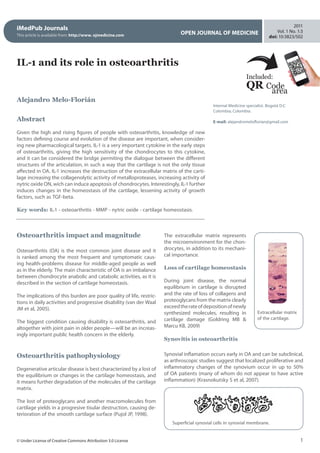
Extracellular matrix
of the cartilage.
The extracellular matrix represents
the microenvironment for the chon-
drocytes, in addition to its mechani-
cal importance.
 
Loss of cartilage homeostasis
During joint disease, the normal
equilibrium in cartilage is disrupted
and the rate of loss of collagens and
proteoglycans from the matrix clearly
exceedtherateofdepositionofnewly
synthesized molecules, resulting in
cartilage damage (Goldring MB &
Marcu KB, 2009)
Superficial synovial cells in synovial membrane.
Included:
QR Code
area
iMedPub Journals
This article is available from: http://www. ojmedicine.com OPEN JOURNAL OF MEDICINE
2011
Vol. 1 No. 1:3
doi: 10:3823/502
2 © Under License of Creative Commons Attribution 3.0 License
The synovium produces some of the chemokines and
metalloproteinases that degrade cartilage, even though the
chondrocytes produces mostly of these destructive molecules.
This picture is attributted to the presence of IL-1 in the
synoviocites.
Synovitis plays a stablished role in the progression of osteo-
arthritis and the overproduction of cytokines specially inter-
leukin 1 and growth factors from the inflamed synovium can
influence the production of degradative enzymes such as
matrix metalloproteases causing the destruction of cartilage
(Bondeson J et al, 2006)
 
Chondrocyte role in cartilage
maintenance
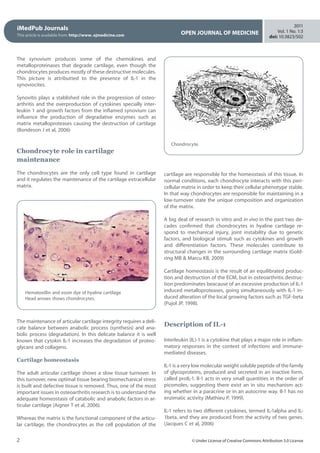
The chondrocytes are the only cell type found in cartilage
and it regulates the maintenance of the cartilage extracellular
matrix.
cartilage are responsible for the homeostasis of this tissue. In
normal conditions, each chondrocyte interacts with this peri-
cellular matrix in order to keep their cellular phenotype stable.
In that way chondrocytes are responsible for maintaining in a
low-turnover state the unique composition and organization
of the matrix.
A big deal of research in vitro and in vivo in the past two de-
cades confirmed that chondrocytes in hyaline cartilage re-
spond to mechanical injury, joint instability due to genetic
factors, and biological stimuli such as cytokines and growth
and differentiation factors. These molecules contribute to
structural changes in the surrounding cartilage matrix (Gold-
ring MB & Marcu KB, 2009)
 
Cartilage homeostasis is the result of an equilibrated produc-
tion and destruction of the ECM, but in osteoarthritis destruc-
tion predominates beacause of an excessive production of IL-1
induced metalloproteases, going simultaneously with IL-1 in-
duced alteration of the local growing factors such as TGF-beta
(Pujol JP, 1998).
 
Description of IL-1
Interleukin (IL)-1 is a cytokine that plays a major role in inflam-
matory responses in the context of infections and immune-
mediated diseases.
 
IL-1 is a very low molecular weight soluble peptide of the family
of glycoproteins, produced and secreted in an inactive form,
called proIL-1. Il-1 acts in very small quantities in the order of
picomoles, suggesting there exist an in situ mechanism act-
ing whether in a paracrine or in an autocrine way. Il-1 has no
enzimatic activity (Mathieu P, 1999).
 
IL-1 refers to two different cytokines, termed IL-1alpha and IL-
1beta, and they are produced from the activity of two genes.
(Jacques C et al, 2006)
Hematoxillin and eosin dye of hyaline cartilage
Head arrows shows chondrocytes.
Chondrocyte.
The maintenance of articular cartilage integrity requires a deli-
cate balance between anabolic process (synthesis) and ana-
bolic process (degradation). In this delicate balance it is well
known that cytokin IL-1 increases the degradation of proteo-
glycans and collagens.
 
Cartilage homeostasis
The adult articular cartilage shows a slow tissue turnover. In
this turnover, new optimal tissue bearing biomechanical stress
is built and defective tissue is removed. Thus, one of the most
important issues in osteoarthritis research is to understand the
adequate homeostasis of catabolic and anabolic factors in ar-
ticular cartilage (Aigner T et al, 2006).
Whereas the matrix is the functional component of the articu-
lar cartilage, the chondrocytes as the cell population of the
iMedPub Journals
This article is available from: http://www. ojmedicine.com OPEN JOURNAL OF MEDICINE
2011
Vol. 1 No. 1:3
doi: 10:3823/502
3© Under License of Creative Commons Attribution 3.0 License
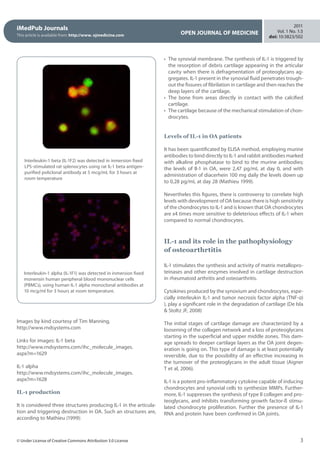
Images by kind courtesy of Tim Manning,
http://www.rndsystems.com
Links for images: IL-1 beta
http://www.rndsystems.com/ihc_molecule_images.
aspx?m=1629
IL-1 alpha
http://www.rndsystems.com/ihc_molecule_images.
aspx?m=1628
 
IL-1 production
It is considered three structures producing IL-1 in the articula-
tion and triggering destruction in OA. Such an structures are,
according to Mathieu (1999):
• The synovial membrane. The synthesis of IL-1 is triggered by
the resorption of debris cartilage appearing in the articular
cavity when there is defragmentation of proteoglycans ag-
gregates. IL-1 present in the synovial fluid penetrates trough-
out the fissures of fibrilation in cartilage and then reaches the
deep layers of the cartilage.
• The bone from areas directly in contact with the calcified
cartilage.
• The cartilage because of the mechanical stimulation of chon-
drocytes.
 
 
Levels of IL-1 in OA patients
It has been quantificated by ELISA method, employing murine
antibodies to bind directly to IL-1 and rabbit antibodies marked
with alkaline phosphatase to bind to the murine antibodies;
the levels of Il-1 in OA, were 2,47 pg/mL at day 0, and with
administration of diacerhein 100 mg daily the levels down up
to 0,28 pg/mL at day 28 (Mathieu 1999).
Nevertheles this figures, there is controversy to correlate high
levels with development of OA because there is high sensitivity
of the chondrocytes to IL-1 and is known that OA chondrocytes
are x4 times more sensitive to deleterious effects of IL-1 when
compared to normal chondrocytes.
 
 
IL-1 and its role in the pathophysiology
of osteoarthrtitis
IL-1 stimulates the synthesis and activity of matrix metallopro-
teinases and other enzymes involved in cartilage destruction
in rheumatoid arthritis and osteoarthritis.
 
Cytokines produced by the synovium and chondrocytes, espe-
cially interleukin IL-1 and tumor necrosis factor alpha (TNF-α)
), play a significant role in the degradation of cartilage (De Isla
 Stoltz JF, 2008)
 
The initial stages of cartilage damage are characterized by a
loosening of the collagen network and a loss of proteoglycans
starting in the superficial and upper middle zones. This dam-
age spreads to deeper cartilage layers as the OA joint degen-
eration is going on. This type of damage is at least potentially
reversible, due to the possibility of an effective increasing in
the turnover of the proteoglycans in the adult tissue (Aigner
T et al, 2006).
 
IL-1 is a potent pro-inflammatory cytokine capable of inducing
chondrocytes and synovial cells to synthesize MMPs. Further-
more, IL-1 suppresses the synthesis of type II collagen and pro-
teoglycans, and inhibits transforming growth factor-ß stimu-
lated chondrocyte proliferation. Further the presence of IL-1
RNA and protein have been confirmed in OA joints.
 
Interleukin-1 beta (IL-1F2) was detected in inmersion fixed
LPS-stimulated rat splenocytes using rat IL-1 beta antigen-
purified policlonal antibody at 5 mcg/mL for 3 hours at
room temperature
Interleukin-1 alpha (IL-1F1) was detected in inmersion fixed
monensin human peripheral blood mononuclear cells
(PBMCs), using human IL-1 alpha monoclonal antibodies at
10 mcg/ml for 3 hours at room temperature.
iMedPub Journals
This article is available from: http://www. ojmedicine.com OPEN JOURNAL OF MEDICINE
2011
Vol. 1 No. 1:3
doi: 10:3823/502
4 © Under License of Creative Commons Attribution 3.0 License
IL-1 further diminishes expression in the cartilage matrix of
the type II and IX collagens (Pujol JP 1998). IL-1 beta has been
shown to be predominantly involved in the pathophysiology
and progression of osteoarthritis.
 
 
IL-1 and its effects in chondrocyte
  
Nitric oxide (NO) is a pleiotropic mediator that has been shown
to be intimately involved in the OA and its inhibition can in-
duce a significant reduction in the progression of structural
changes of the disease.
In another hand, OA chondrocytes have been shown to ex-
press iNOS the enzume sintetizing ON and consequently to
produce large amounts of NO, especially upon stimulation by
proinflammatory cytokines (Boileau C et al, 2002)
 
Therefore, the oxidant molecule nitric oxide plays multiple
roles with respect to chondrocytes because it promotes carti-
lage degradation, including inhibition of collagen and proteo-
glycan synthesis, it activates MMP and increased susceptibility
to other oxidant injury. nitric oxide further induces oxidative
injury int he chondrocyte resulting in premature senescence
and apoptosis (Krasnokutsky S et al, 2007)
 
Growth factors
Growth factors such as transforming growth factor beta stim-
ulate collagens and proteoglycans synthesis by chondrocyte,
and reduce the activity of IL-1β stimulated metalloproteases.
By its capability to reduce IL-1 effects and to stimulate TGF-β
expression in cultured articular chondrocytes, drugs such as
diacerein could elicitate the anabolic processes in the OA car-
tilage, contributing to delay the progression of the disease, and
supporting structure modification in osteoarthritis (DMOAD)
(De Isla NG  Stoltz JF 2008).
 
Metalloproteases
In OA, synthesis of the enzymes called metalloproteases
(MMPs) is greatly enhanced and the available inhibitors (tissue
inhibitors of MMP or TIMPs) are overwhelmed, resulting in net
degradation of cartilage.
In OA, these degradative enzymes are produced primarily by
chondrocytes due to inductive stimuli, including a wide variety
of stimules such as mechanical stress, injury with destabiliza-
tion,  cell-matrix interactions, oxidative stress,and changes in
growth factor responses (such as TGF-β) during the aging pro-
cess (Goldring MB  Marcu KB, 2009).
 
Ways to demonstrate IL-1 is elevated in
OA
There is recent research with imaging techniques of magnetic
resonance in which significant correlation between IL-1β (r =
0.48, P  0.05) and fractional anisotropy of the magnetic reso-
nance and inverse correlations between planar anisotropy of
the magnetic resonance and IL-1β and soluble intercelular ad-
hesion molecule (sICAM) (r = 0.48, P  0.05 and r = 0.49, P  0.05,
respectively) were observed (Aggarwal V et al, 2009).
Mathieu (1999) describe ELISA in synovial fluid of knee OA pa-
tients, with range between 2,47 and 0,28 pg/mL.
QR
Watch
this free
Video
¿Why is IL-1 important in the pathogenesis of
osteoarthritis?
Because chondrocyte is very sensitive to the effects of IL-1.
Barely 1% of the receptors of IL-1 occupied in the surface of
the cartilage, changes the fenotype of the chondrocyte to a
catabolic one. Further the osteoarthritic chondrocyte is 3-4
times more sensitive to the effects of IL-1 (Mathieu P, 1999) 
 
ICE enzyme and IL-1 beta production
IL-1 gives origin to an active moiety of IL-1 through the action of
Interleukin 1 converting enzyme or ICE. This enzyme produce
active, mature IL-1beta.
 
The level of ICE has been demonstrated to be increased in OA
tissues and according to investigative work of Boileau et al, it
has been found to increase the production of active IL-1beta as
well as IL-18. ICE is a crucial enzyme in the activation process of
IL-1beta and IL-18, two important pro-inflammatory cytokines
involved in the progression of OA. (Boileau C et al, 2002)
 
Nitric oxide and IL-1
The production of nitric oxide (NO), which is stimulated by pro-
inflammatory cytokines, is involved in cartilage catabolism and
also may induce the apoptosis of chondrocytes. The NO pro-
duced by iNOS in activated chondrocytes in diseased cartilage
may modulate disease progression in OA (Studer RK et al, 1999)
iMedPub Journals
This article is available from: http://www. ojmedicine.com OPEN JOURNAL OF MEDICINE
2011
Vol. 1 No. 1:3
doi: 10:3823/502
5© Under License of Creative Commons Attribution 3.0 License
Pharmacological Inhibition of IL-1: use-
fulness as treatment in OA
Drugs such as diacerein could inhibit catabolic responses like
NO synthesis as well as MMP activity but it could also increase
anabolic responses like collagen type II synthesis.
Furthermore, diacerein can inhibit the binding of NF-κB and
AP-1 transcription factors, two key factors involved in the ex-
pression of several pro-inflammatory genes by chondrocytes,
such as the inducible nitric oxide synthase gene, supporting
the anti-osteoarthritic effects. (De Isla NG  Stoltz JF 2008). 
 
 
Conclusions
IL-1 is a glycoprotein of very low molecular weight, acting in
paracrine or autocrine pathways in the sensitive cells. Chon-
drocytes are very sensitive to the actions of IL-1 because with
barely 1% of the receptors occupied in the surface, it turns into
catabolic fenotype.
IL-1 induces synthesis of matrix metalloproteases which are
the main enzymes implicated in destruction of the ECM com-
ponents. Further it induces the synthesis of ON, implicated in
aging and apoptosis of chondrocytes.
Homeostasis of the cartilage depends on the equilbrium be-
tween destruction and synthesis of the components of ECM,
and when IL-1 levels are superior to normal, grow factors such
as TGF-beta are affected, halting the anabolic fenotype of the
chondrocyte.
Although determination of IL-1 is not easy because it is pres-
ent at picomolar levels, some surrogates are being progresively
available, such as imaging techniques with magnetic reso-
nance.
QR
Watch
this free
Video
“A live version of this article can be found on the net at: http://knol.google.com/k/il-1-and-its-role-in-osteoarthritis”
iMedPub Journals
This article is available from: http://www. ojmedicine.com OPEN JOURNAL OF MEDICINE
2011
Vol. 1 No. 1:3
doi: 10:3823/502
6 © Under License of Creative Commons Attribution 3.0 License
References
	 1.	Agarwal V, Kumar M, Singh JK, Rathore RK, Misra R, Gupta RK.
(2009) Diffusion tensor anisotropy magnetic resonance imaging:
a new tool to assess synovial inflammation. Rheumatology
(Oxford). 48(4):378-82. Epub 2009 Jan 27. http://www.ncbi.nlm.
nih.gov/pubmed/19174567
	 2.	Aigner T, Soeder S, Haag J. (2006) IL-1beta and BMPs--interactive
players of cartilage matrix degradation and regeneration. Eur
Cell Mater; 12:49-56 http://www.ecmjournal.org/journal/papers/
vol012/pdf/v012a06.pdf 
	 3.	Boileau C, Martel-Pelletier J, Moldovan F Jouzeau JY, Netter
P, Manning PT Pelletier JP (2002) The In Situ Up-Regulation
of Chondrocyte Interleukin-1–Converting Enzyme and
Interleukin-18 Levels in Experimental Osteoarthritis Is Mediated
by Nitric Oxide. Arthritis  Rheumatism; 46(10): 2637–2647
	 4.	Bondeson J, Wainwright SD, Lauder S , Amos N, Hughes E ( 2006).
The role of synovial macrophages and macrophage-produced
cytokines in driving aggrecanases, matrix metalloproteinases,
and other destructive and inflammatory responses in
osteoarthritis. Arthritis Research  Therapy 8:R187 (doi:10.1186/
ar2099) http://www.ncbi.nlm.nih.gov/pmc/articles/PMC1794533/
pdf/ar2099.pdf
	 5.	De Isla NG  Stoltz JF (2008): In vitro inhibition of IL-1β catabolic
effects on cartilage: A mechanism involved on diacerein anti-OA
properties. Biorheology 45: 433–43
	 6.	Goldring MB  Marcu KB (2009): Cartilage homeostasis in health
and rheumatic diseases Arthritis Res  Ther 11:224 (doi:10.1186/
ar2592) http://www.ncbi.nlm.nih.gov/pmc/articles/PMC2714092/
pdf/ar2592.pdf
	 7.	Jacques C, Gosset M, Berenbaum F, Gabay C (2006). The role of
IL-1 and IL-1Ra in joint inflammation and cartilage degradation.
Vitam Horm. 74: 371-403.
	 8.	Krasnokutsky S, Samuels J, Abramson SB (2007). Osteoarthritis in
2007. Bull NYU Hosp Jt Dis. 65(3):222-8. http://www.ncbi.nlm.nih.
gov/pubmed/17922674
	 9.	Mathieu P. (1999) L´interleukine 1. Son role, son dosage, ses
difficulties d´approche dans l´arthrose. Resultats d´un etude
pilote avec la diacerheine (ART 50) dans la gonarthrose. Rev Prat
(Paris); 49: S15-S18
	10.	Pujol JP (1998): Physiopathologie du cartilage arthrosique Rev
Prat (Paris) 46: (Suppl 19) S8-S10
	11.	Studer RK, Jaffurs D, Stefanovic R.M, Robbins P.D. and Evans C.H.
(1999) Nitric oxide in osteoarthritis. Osteoarthr Cartilage 7:377–
379.
	12.	Van der Waal JM, Terwee CB, van der Windt DA. (2005) Health-
related and overall quality of life of patients with chronic hip and
knee complaints in general practice. Qual Life Res 14:795–803 .
[CrossRef][Web of Science][Medline]
Open Journal of Medicine is a revolutionary because it combines
the easiness and efficiency of Knol with the advantages of
traditional publishing.
The mission of Open Journal of Medicine is to facilitate the
equitable, global dissemination of high-quality health research; to
promote international dialogue and collaboration on health
issues; to improve clinical practice; and to expand the understand-
ing of medicine and health care.
Submit your manuscript here:
http://www. ojmedicine.com
Publish with iMedPub
http://www.imedpub.com

Il 1 and-its_role ojm[1]

  • 1.
    iMedPub Journals This articleis available from: http://www. ojmedicine.com OPEN JOURNAL OF MEDICINE 2011 Vol. 1 No. 1:3 doi: 10:3823/502 © Under License of Creative Commons Attribution 3.0 License 1 IL-1 and its role in osteoarthritis Alejandro Melo-Florián Abstract Given the high and rising figures of people with osteoarthritis, knowledge of new factors defining course and evolution of the disease are important, when consider- ing new pharmacological targets. IL-1 is a very important cytokine in the early steps of osteoarthritis, giving the high sensitivity of the chondrocytes to this cytokine, and it can be considered the bridge permiting the dialogue between the different structures of the articulation, in such a way that the cartilage is not the only tissue affected in OA. IL-1 increases the destruction of the extracellular matrix of the carti- lage increasing the collagenolytic activity of metalloproteases, increasing activity of nytric oxide ON, wich can induce apoptosis of chondrocytes. Interestingly, IL-1 further induces changes in the homeostasis of the cartilage, lessening activity of growth factors, such as TGF-beta. Key words: IL-1 - osteoarthritis - MMP - nytric oxide - cartilage homeostasis. Osteoarthritis impact and magnitude Osteoarthritis (OA) is the most common joint disease and it is ranked among the most frequent and symptomatic caus- ing health-problems disease for middle-aged people as well as in the elderly. The main characteristic of OA is an imbalance between chondrocyte anabolic and catabolic activities, as it is described in the section of cartilage homeostasis.    The implications of this burden are poor quality of life, restric- tions in daily activities and progressive disability (van der Waal JM et al, 2005).   The biggest condition causing disability is osteoarthritis, and altogether with joint pain in older people—will be an increas- ingly important public health concern in the elderly. Osteoarthritis pathophysiology   Degenerative articular disease is best characterized by a lost of the equilibrium or changes in the cartilage homeostasis, and it means further degradation of the molecules of the cartilage matrix.   The lost of proteoglycans and another macromolecules from cartilage yields in a progresive tisular destruction, causing de- terioration of the smooth cartilage surface (Pujol JP, 1998).   Synovitis in osteoarthritis Synovial inflamation occurs early in OA and can be subclinical, as arthroscopic studies suggest that localized proliferative and inflammatory changes of the synovium occur in up to 50% of OA patients (many of whom do not appear to have active inflammation) (Krasnokutsky S et al, 2007). Internal Medicine specialist. Bogotá D.C Colombia; Colombia. E-mail: alejandromeloflorian@gmail.com Extracellular matrix of the cartilage. The extracellular matrix represents the microenvironment for the chon- drocytes, in addition to its mechani- cal importance.   Loss of cartilage homeostasis During joint disease, the normal equilibrium in cartilage is disrupted and the rate of loss of collagens and proteoglycans from the matrix clearly exceedtherateofdepositionofnewly synthesized molecules, resulting in cartilage damage (Goldring MB & Marcu KB, 2009) Superficial synovial cells in synovial membrane. Included: QR Code area
  • 2.
    iMedPub Journals This articleis available from: http://www. ojmedicine.com OPEN JOURNAL OF MEDICINE 2011 Vol. 1 No. 1:3 doi: 10:3823/502 2 © Under License of Creative Commons Attribution 3.0 License The synovium produces some of the chemokines and metalloproteinases that degrade cartilage, even though the chondrocytes produces mostly of these destructive molecules. This picture is attributted to the presence of IL-1 in the synoviocites. Synovitis plays a stablished role in the progression of osteo- arthritis and the overproduction of cytokines specially inter- leukin 1 and growth factors from the inflamed synovium can influence the production of degradative enzymes such as matrix metalloproteases causing the destruction of cartilage (Bondeson J et al, 2006)   Chondrocyte role in cartilage maintenance The chondrocytes are the only cell type found in cartilage and it regulates the maintenance of the cartilage extracellular matrix. cartilage are responsible for the homeostasis of this tissue. In normal conditions, each chondrocyte interacts with this peri- cellular matrix in order to keep their cellular phenotype stable. In that way chondrocytes are responsible for maintaining in a low-turnover state the unique composition and organization of the matrix. A big deal of research in vitro and in vivo in the past two de- cades confirmed that chondrocytes in hyaline cartilage re- spond to mechanical injury, joint instability due to genetic factors, and biological stimuli such as cytokines and growth and differentiation factors. These molecules contribute to structural changes in the surrounding cartilage matrix (Gold- ring MB & Marcu KB, 2009)   Cartilage homeostasis is the result of an equilibrated produc- tion and destruction of the ECM, but in osteoarthritis destruc- tion predominates beacause of an excessive production of IL-1 induced metalloproteases, going simultaneously with IL-1 in- duced alteration of the local growing factors such as TGF-beta (Pujol JP, 1998).   Description of IL-1 Interleukin (IL)-1 is a cytokine that plays a major role in inflam- matory responses in the context of infections and immune- mediated diseases.   IL-1 is a very low molecular weight soluble peptide of the family of glycoproteins, produced and secreted in an inactive form, called proIL-1. Il-1 acts in very small quantities in the order of picomoles, suggesting there exist an in situ mechanism act- ing whether in a paracrine or in an autocrine way. Il-1 has no enzimatic activity (Mathieu P, 1999).   IL-1 refers to two different cytokines, termed IL-1alpha and IL- 1beta, and they are produced from the activity of two genes. (Jacques C et al, 2006) Hematoxillin and eosin dye of hyaline cartilage Head arrows shows chondrocytes. Chondrocyte. The maintenance of articular cartilage integrity requires a deli- cate balance between anabolic process (synthesis) and ana- bolic process (degradation). In this delicate balance it is well known that cytokin IL-1 increases the degradation of proteo- glycans and collagens.   Cartilage homeostasis The adult articular cartilage shows a slow tissue turnover. In this turnover, new optimal tissue bearing biomechanical stress is built and defective tissue is removed. Thus, one of the most important issues in osteoarthritis research is to understand the adequate homeostasis of catabolic and anabolic factors in ar- ticular cartilage (Aigner T et al, 2006). Whereas the matrix is the functional component of the articu- lar cartilage, the chondrocytes as the cell population of the
  • 3.
    iMedPub Journals This articleis available from: http://www. ojmedicine.com OPEN JOURNAL OF MEDICINE 2011 Vol. 1 No. 1:3 doi: 10:3823/502 3© Under License of Creative Commons Attribution 3.0 License Images by kind courtesy of Tim Manning, http://www.rndsystems.com Links for images: IL-1 beta http://www.rndsystems.com/ihc_molecule_images. aspx?m=1629 IL-1 alpha http://www.rndsystems.com/ihc_molecule_images. aspx?m=1628   IL-1 production It is considered three structures producing IL-1 in the articula- tion and triggering destruction in OA. Such an structures are, according to Mathieu (1999): • The synovial membrane. The synthesis of IL-1 is triggered by the resorption of debris cartilage appearing in the articular cavity when there is defragmentation of proteoglycans ag- gregates. IL-1 present in the synovial fluid penetrates trough- out the fissures of fibrilation in cartilage and then reaches the deep layers of the cartilage. • The bone from areas directly in contact with the calcified cartilage. • The cartilage because of the mechanical stimulation of chon- drocytes.     Levels of IL-1 in OA patients It has been quantificated by ELISA method, employing murine antibodies to bind directly to IL-1 and rabbit antibodies marked with alkaline phosphatase to bind to the murine antibodies; the levels of Il-1 in OA, were 2,47 pg/mL at day 0, and with administration of diacerhein 100 mg daily the levels down up to 0,28 pg/mL at day 28 (Mathieu 1999). Nevertheles this figures, there is controversy to correlate high levels with development of OA because there is high sensitivity of the chondrocytes to IL-1 and is known that OA chondrocytes are x4 times more sensitive to deleterious effects of IL-1 when compared to normal chondrocytes.     IL-1 and its role in the pathophysiology of osteoarthrtitis IL-1 stimulates the synthesis and activity of matrix metallopro- teinases and other enzymes involved in cartilage destruction in rheumatoid arthritis and osteoarthritis.   Cytokines produced by the synovium and chondrocytes, espe- cially interleukin IL-1 and tumor necrosis factor alpha (TNF-α) ), play a significant role in the degradation of cartilage (De Isla Stoltz JF, 2008)   The initial stages of cartilage damage are characterized by a loosening of the collagen network and a loss of proteoglycans starting in the superficial and upper middle zones. This dam- age spreads to deeper cartilage layers as the OA joint degen- eration is going on. This type of damage is at least potentially reversible, due to the possibility of an effective increasing in the turnover of the proteoglycans in the adult tissue (Aigner T et al, 2006).   IL-1 is a potent pro-inflammatory cytokine capable of inducing chondrocytes and synovial cells to synthesize MMPs. Further- more, IL-1 suppresses the synthesis of type II collagen and pro- teoglycans, and inhibits transforming growth factor-ß stimu- lated chondrocyte proliferation. Further the presence of IL-1 RNA and protein have been confirmed in OA joints.   Interleukin-1 beta (IL-1F2) was detected in inmersion fixed LPS-stimulated rat splenocytes using rat IL-1 beta antigen- purified policlonal antibody at 5 mcg/mL for 3 hours at room temperature Interleukin-1 alpha (IL-1F1) was detected in inmersion fixed monensin human peripheral blood mononuclear cells (PBMCs), using human IL-1 alpha monoclonal antibodies at 10 mcg/ml for 3 hours at room temperature.
  • 4.
    iMedPub Journals This articleis available from: http://www. ojmedicine.com OPEN JOURNAL OF MEDICINE 2011 Vol. 1 No. 1:3 doi: 10:3823/502 4 © Under License of Creative Commons Attribution 3.0 License IL-1 further diminishes expression in the cartilage matrix of the type II and IX collagens (Pujol JP 1998). IL-1 beta has been shown to be predominantly involved in the pathophysiology and progression of osteoarthritis.     IL-1 and its effects in chondrocyte    Nitric oxide (NO) is a pleiotropic mediator that has been shown to be intimately involved in the OA and its inhibition can in- duce a significant reduction in the progression of structural changes of the disease. In another hand, OA chondrocytes have been shown to ex- press iNOS the enzume sintetizing ON and consequently to produce large amounts of NO, especially upon stimulation by proinflammatory cytokines (Boileau C et al, 2002)   Therefore, the oxidant molecule nitric oxide plays multiple roles with respect to chondrocytes because it promotes carti- lage degradation, including inhibition of collagen and proteo- glycan synthesis, it activates MMP and increased susceptibility to other oxidant injury. nitric oxide further induces oxidative injury int he chondrocyte resulting in premature senescence and apoptosis (Krasnokutsky S et al, 2007)   Growth factors Growth factors such as transforming growth factor beta stim- ulate collagens and proteoglycans synthesis by chondrocyte, and reduce the activity of IL-1β stimulated metalloproteases. By its capability to reduce IL-1 effects and to stimulate TGF-β expression in cultured articular chondrocytes, drugs such as diacerein could elicitate the anabolic processes in the OA car- tilage, contributing to delay the progression of the disease, and supporting structure modification in osteoarthritis (DMOAD) (De Isla NG Stoltz JF 2008).   Metalloproteases In OA, synthesis of the enzymes called metalloproteases (MMPs) is greatly enhanced and the available inhibitors (tissue inhibitors of MMP or TIMPs) are overwhelmed, resulting in net degradation of cartilage. In OA, these degradative enzymes are produced primarily by chondrocytes due to inductive stimuli, including a wide variety of stimules such as mechanical stress, injury with destabiliza- tion,  cell-matrix interactions, oxidative stress,and changes in growth factor responses (such as TGF-β) during the aging pro- cess (Goldring MB Marcu KB, 2009).   Ways to demonstrate IL-1 is elevated in OA There is recent research with imaging techniques of magnetic resonance in which significant correlation between IL-1β (r = 0.48, P 0.05) and fractional anisotropy of the magnetic reso- nance and inverse correlations between planar anisotropy of the magnetic resonance and IL-1β and soluble intercelular ad- hesion molecule (sICAM) (r = 0.48, P 0.05 and r = 0.49, P 0.05, respectively) were observed (Aggarwal V et al, 2009). Mathieu (1999) describe ELISA in synovial fluid of knee OA pa- tients, with range between 2,47 and 0,28 pg/mL. QR Watch this free Video ¿Why is IL-1 important in the pathogenesis of osteoarthritis? Because chondrocyte is very sensitive to the effects of IL-1. Barely 1% of the receptors of IL-1 occupied in the surface of the cartilage, changes the fenotype of the chondrocyte to a catabolic one. Further the osteoarthritic chondrocyte is 3-4 times more sensitive to the effects of IL-1 (Mathieu P, 1999)    ICE enzyme and IL-1 beta production IL-1 gives origin to an active moiety of IL-1 through the action of Interleukin 1 converting enzyme or ICE. This enzyme produce active, mature IL-1beta.   The level of ICE has been demonstrated to be increased in OA tissues and according to investigative work of Boileau et al, it has been found to increase the production of active IL-1beta as well as IL-18. ICE is a crucial enzyme in the activation process of IL-1beta and IL-18, two important pro-inflammatory cytokines involved in the progression of OA. (Boileau C et al, 2002)   Nitric oxide and IL-1 The production of nitric oxide (NO), which is stimulated by pro- inflammatory cytokines, is involved in cartilage catabolism and also may induce the apoptosis of chondrocytes. The NO pro- duced by iNOS in activated chondrocytes in diseased cartilage may modulate disease progression in OA (Studer RK et al, 1999)
  • 5.
    iMedPub Journals This articleis available from: http://www. ojmedicine.com OPEN JOURNAL OF MEDICINE 2011 Vol. 1 No. 1:3 doi: 10:3823/502 5© Under License of Creative Commons Attribution 3.0 License Pharmacological Inhibition of IL-1: use- fulness as treatment in OA Drugs such as diacerein could inhibit catabolic responses like NO synthesis as well as MMP activity but it could also increase anabolic responses like collagen type II synthesis. Furthermore, diacerein can inhibit the binding of NF-κB and AP-1 transcription factors, two key factors involved in the ex- pression of several pro-inflammatory genes by chondrocytes, such as the inducible nitric oxide synthase gene, supporting the anti-osteoarthritic effects. (De Isla NG Stoltz JF 2008).      Conclusions IL-1 is a glycoprotein of very low molecular weight, acting in paracrine or autocrine pathways in the sensitive cells. Chon- drocytes are very sensitive to the actions of IL-1 because with barely 1% of the receptors occupied in the surface, it turns into catabolic fenotype. IL-1 induces synthesis of matrix metalloproteases which are the main enzymes implicated in destruction of the ECM com- ponents. Further it induces the synthesis of ON, implicated in aging and apoptosis of chondrocytes. Homeostasis of the cartilage depends on the equilbrium be- tween destruction and synthesis of the components of ECM, and when IL-1 levels are superior to normal, grow factors such as TGF-beta are affected, halting the anabolic fenotype of the chondrocyte. Although determination of IL-1 is not easy because it is pres- ent at picomolar levels, some surrogates are being progresively available, such as imaging techniques with magnetic reso- nance. QR Watch this free Video “A live version of this article can be found on the net at: http://knol.google.com/k/il-1-and-its-role-in-osteoarthritis”
  • 6.
    iMedPub Journals This articleis available from: http://www. ojmedicine.com OPEN JOURNAL OF MEDICINE 2011 Vol. 1 No. 1:3 doi: 10:3823/502 6 © Under License of Creative Commons Attribution 3.0 License References 1. Agarwal V, Kumar M, Singh JK, Rathore RK, Misra R, Gupta RK. (2009) Diffusion tensor anisotropy magnetic resonance imaging: a new tool to assess synovial inflammation. Rheumatology (Oxford). 48(4):378-82. Epub 2009 Jan 27. http://www.ncbi.nlm. nih.gov/pubmed/19174567 2. Aigner T, Soeder S, Haag J. (2006) IL-1beta and BMPs--interactive players of cartilage matrix degradation and regeneration. Eur Cell Mater; 12:49-56 http://www.ecmjournal.org/journal/papers/ vol012/pdf/v012a06.pdf  3. Boileau C, Martel-Pelletier J, Moldovan F Jouzeau JY, Netter P, Manning PT Pelletier JP (2002) The In Situ Up-Regulation of Chondrocyte Interleukin-1–Converting Enzyme and Interleukin-18 Levels in Experimental Osteoarthritis Is Mediated by Nitric Oxide. Arthritis Rheumatism; 46(10): 2637–2647 4. Bondeson J, Wainwright SD, Lauder S , Amos N, Hughes E ( 2006). The role of synovial macrophages and macrophage-produced cytokines in driving aggrecanases, matrix metalloproteinases, and other destructive and inflammatory responses in osteoarthritis. Arthritis Research Therapy 8:R187 (doi:10.1186/ ar2099) http://www.ncbi.nlm.nih.gov/pmc/articles/PMC1794533/ pdf/ar2099.pdf 5. De Isla NG Stoltz JF (2008): In vitro inhibition of IL-1β catabolic effects on cartilage: A mechanism involved on diacerein anti-OA properties. Biorheology 45: 433–43 6. Goldring MB Marcu KB (2009): Cartilage homeostasis in health and rheumatic diseases Arthritis Res Ther 11:224 (doi:10.1186/ ar2592) http://www.ncbi.nlm.nih.gov/pmc/articles/PMC2714092/ pdf/ar2592.pdf 7. Jacques C, Gosset M, Berenbaum F, Gabay C (2006). The role of IL-1 and IL-1Ra in joint inflammation and cartilage degradation. Vitam Horm. 74: 371-403. 8. Krasnokutsky S, Samuels J, Abramson SB (2007). Osteoarthritis in 2007. Bull NYU Hosp Jt Dis. 65(3):222-8. http://www.ncbi.nlm.nih. gov/pubmed/17922674 9. Mathieu P. (1999) L´interleukine 1. Son role, son dosage, ses difficulties d´approche dans l´arthrose. Resultats d´un etude pilote avec la diacerheine (ART 50) dans la gonarthrose. Rev Prat (Paris); 49: S15-S18 10. Pujol JP (1998): Physiopathologie du cartilage arthrosique Rev Prat (Paris) 46: (Suppl 19) S8-S10 11. Studer RK, Jaffurs D, Stefanovic R.M, Robbins P.D. and Evans C.H. (1999) Nitric oxide in osteoarthritis. Osteoarthr Cartilage 7:377– 379. 12. Van der Waal JM, Terwee CB, van der Windt DA. (2005) Health- related and overall quality of life of patients with chronic hip and knee complaints in general practice. Qual Life Res 14:795–803 . [CrossRef][Web of Science][Medline] Open Journal of Medicine is a revolutionary because it combines the easiness and efficiency of Knol with the advantages of traditional publishing. The mission of Open Journal of Medicine is to facilitate the equitable, global dissemination of high-quality health research; to promote international dialogue and collaboration on health issues; to improve clinical practice; and to expand the understand- ing of medicine and health care. Submit your manuscript here: http://www. ojmedicine.com Publish with iMedPub http://www.imedpub.com