The API Contract is Dead
LONG LIVE THE API CONTRACT
                 Clint Byrum
       Canonical – Ubuntu Server Team
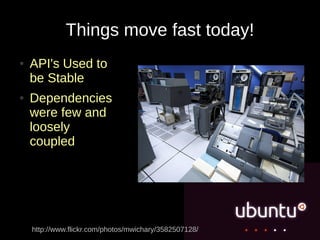
Things move fast today!
●   API's Used to
    be Stable
●   Dependencies
    were few and
    loosely
    coupled


    http://www.flickr.com/photos/mwichary/3582507128/
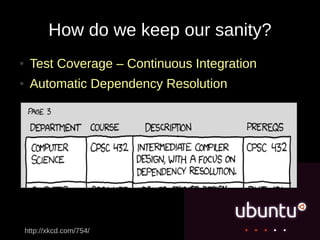
How do we keep our sanity?
●    Test Coverage – Continuous Integration
●    Automatic Dependency Resolution


    http://xkcd.com/754/
Reality CHECK
●   Test coverage is not automatic – Unless it is
    part of your culture
●   The consumers of a library tend to over-trust
    the upstream's tests to ensure things are
    working.
●   On the fly dependency resolution often makes
    for an unrepeatable build (YO, Maven, this
    means you!)
GOOD things about FAST change
●    Newer versions often
     add stability AND
     performance
●    Progress – Without
     constraints,
     developers are able
     to add features and
     refactor at will
●    v*.0 is bad, but v0.* is
     t3h awesome!
    http://www.flickr.com/photos/metallirat/217984892/
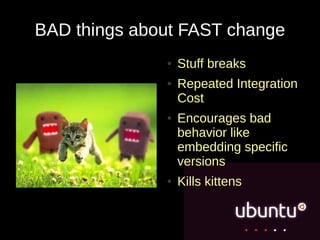
BAD things about FAST change
              ●   Stuff breaks
              ●   Repeated Integration
                  Cost
              ●   Encourages bad
                  behavior like
                  embedding specific
                  versions
              ●   Kills kittens
Case Study: libmemcached
●   0.31 released almost 1 year ago
●   0.40 current release
●   Somewhere between 0.31 and 0.40, the API
    changed enough to break everything, requiring
    porting of most apps.
●   1 year of development added features like
    SASL support and 'memcapable' test tool
MongoDB
●   v1.2.3 released Feb 23 2010
●   Ubuntu 10.04 Lucid ships with v1.2.2 Apr 29
    2010.
●   v1.4.3 released May 24 2010
Cassandra
●   Very new, gaining traction quickly
●   So far, releasing about 4 times per year
●   Huge number of dependencies, all ship
    embedded at specific working versions
●   Old releases are deprecated very quickly
So why do we bother packaging?
●   Stability? NO
●   Predictibility, “Stasis”
●   Uniformity – Easier to support just one version
What can authors do?
●   Think twice about breaking an API that has
    been published for a while
●   Consider that just because it is v0.x doesn't
    mean only power users will end up using it.
●   Use bold and <blink> for the “THIS IS GOING
    TO CHANGE” link on the download page..
What can distributors do?
●   Cry
●   Refuse to move forward at the pace of these
    projects
●   Refuse to support old library versions
●   Try to support all versions
●   All of the above get done in Ubuntu regularly
How about a better idea?


Something sysadmins already do...
NO not more hand waving!


http://www.flickr.com/photos/igalko/4690480668/
Leverage YOUR Core
              Competencies
●   Python people don't want distro python
●   Perl people don't want distro perl
●   And MySQL in the distro is ok, but I need
    percona!
●   Most sysadmins just install with the OS, then
    build everything important from source and drop
    it in /usr/local
Rather than build..
●   PPA or “Personal Package Archive”
●   Launchpad service to easily build packages
    then make the built packages available in a
    special apt repository.
●   Easy to add on ubuntu: 'add-apt-repository
    ppa:user_or_team/ppaname
PPA details
●   Once a PPA is established, Server Team would
    upload packages into it for an upstream
●   Allows upgrades to be made available to
    Ubuntu users very quickly.
●   Users who utilize it can upgrade instantly with
    'apt-get upgrade'
Author Participation
●   Upstream can be granted upload access very
    easily.
●   Our first “blessed” team with a PPA:
    https://lanchpad.net/~cassandra-ubuntu
Derivitives Made Easy?
●   Kubuntu is Ubuntu w/ KDE as the default
●   How about “Youbuntu” which has your
    packages added on top of the distro.
●   What if we made this easy?
Got any good ideas about this?


   I want to hear what you think!

    #ubuntu-server on Freenode
        clint@ubuntu.com
         http://fewbar.com

Ignite Devops Fast Moving Software

  • 1.
    The API Contractis Dead LONG LIVE THE API CONTRACT Clint Byrum Canonical – Ubuntu Server Team
  • 2.
    Things move fasttoday! ● API's Used to be Stable ● Dependencies were few and loosely coupled http://www.flickr.com/photos/mwichary/3582507128/
  • 3.
    How do wekeep our sanity? ● Test Coverage – Continuous Integration ● Automatic Dependency Resolution http://xkcd.com/754/
  • 4.
    Reality CHECK ● Test coverage is not automatic – Unless it is part of your culture ● The consumers of a library tend to over-trust the upstream's tests to ensure things are working. ● On the fly dependency resolution often makes for an unrepeatable build (YO, Maven, this means you!)
  • 5.
    GOOD things aboutFAST change ● Newer versions often add stability AND performance ● Progress – Without constraints, developers are able to add features and refactor at will ● v*.0 is bad, but v0.* is t3h awesome! http://www.flickr.com/photos/metallirat/217984892/
  • 6.
    BAD things aboutFAST change ● Stuff breaks ● Repeated Integration Cost ● Encourages bad behavior like embedding specific versions ● Kills kittens
  • 7.
    Case Study: libmemcached ● 0.31 released almost 1 year ago ● 0.40 current release ● Somewhere between 0.31 and 0.40, the API changed enough to break everything, requiring porting of most apps. ● 1 year of development added features like SASL support and 'memcapable' test tool
  • 8.
    MongoDB ● v1.2.3 released Feb 23 2010 ● Ubuntu 10.04 Lucid ships with v1.2.2 Apr 29 2010. ● v1.4.3 released May 24 2010
  • 9.
    Cassandra ● Very new, gaining traction quickly ● So far, releasing about 4 times per year ● Huge number of dependencies, all ship embedded at specific working versions ● Old releases are deprecated very quickly
  • 10.
    So why dowe bother packaging? ● Stability? NO ● Predictibility, “Stasis” ● Uniformity – Easier to support just one version
  • 11.
    What can authorsdo? ● Think twice about breaking an API that has been published for a while ● Consider that just because it is v0.x doesn't mean only power users will end up using it. ● Use bold and <blink> for the “THIS IS GOING TO CHANGE” link on the download page..
  • 12.
    What can distributorsdo? ● Cry ● Refuse to move forward at the pace of these projects ● Refuse to support old library versions ● Try to support all versions ● All of the above get done in Ubuntu regularly
  • 13.
    How about abetter idea? Something sysadmins already do...
  • 14.
    NO not morehand waving! http://www.flickr.com/photos/igalko/4690480668/
  • 15.
    Leverage YOUR Core Competencies ● Python people don't want distro python ● Perl people don't want distro perl ● And MySQL in the distro is ok, but I need percona! ● Most sysadmins just install with the OS, then build everything important from source and drop it in /usr/local
  • 16.
    Rather than build.. ● PPA or “Personal Package Archive” ● Launchpad service to easily build packages then make the built packages available in a special apt repository. ● Easy to add on ubuntu: 'add-apt-repository ppa:user_or_team/ppaname
  • 17.
    PPA details ● Once a PPA is established, Server Team would upload packages into it for an upstream ● Allows upgrades to be made available to Ubuntu users very quickly. ● Users who utilize it can upgrade instantly with 'apt-get upgrade'
  • 18.
    Author Participation ● Upstream can be granted upload access very easily. ● Our first “blessed” team with a PPA: https://lanchpad.net/~cassandra-ubuntu
  • 19.
    Derivitives Made Easy? ● Kubuntu is Ubuntu w/ KDE as the default ● How about “Youbuntu” which has your packages added on top of the distro. ● What if we made this easy?
  • 20.
    Got any goodideas about this? I want to hear what you think! #ubuntu-server on Freenode clint@ubuntu.com http://fewbar.com