
harnessing the power of place.
PHYSICAL
ENVIRONMENTS
TO SUPPORT
Agile Teams
hi there.
ROSHELLE RITZENTHALER
DESIGN STRATEGIST, GENSLER
ROSHELLE_RITZENTHALER@GENSLER.COM
@RoRitzen
JORGEN HESSELBERG
DIRECTOR, AGILE ENTERPRISE TRANSFORMATION
MCAFEE
JORGEN@HESSELBERG.ORG
@JHesselberg
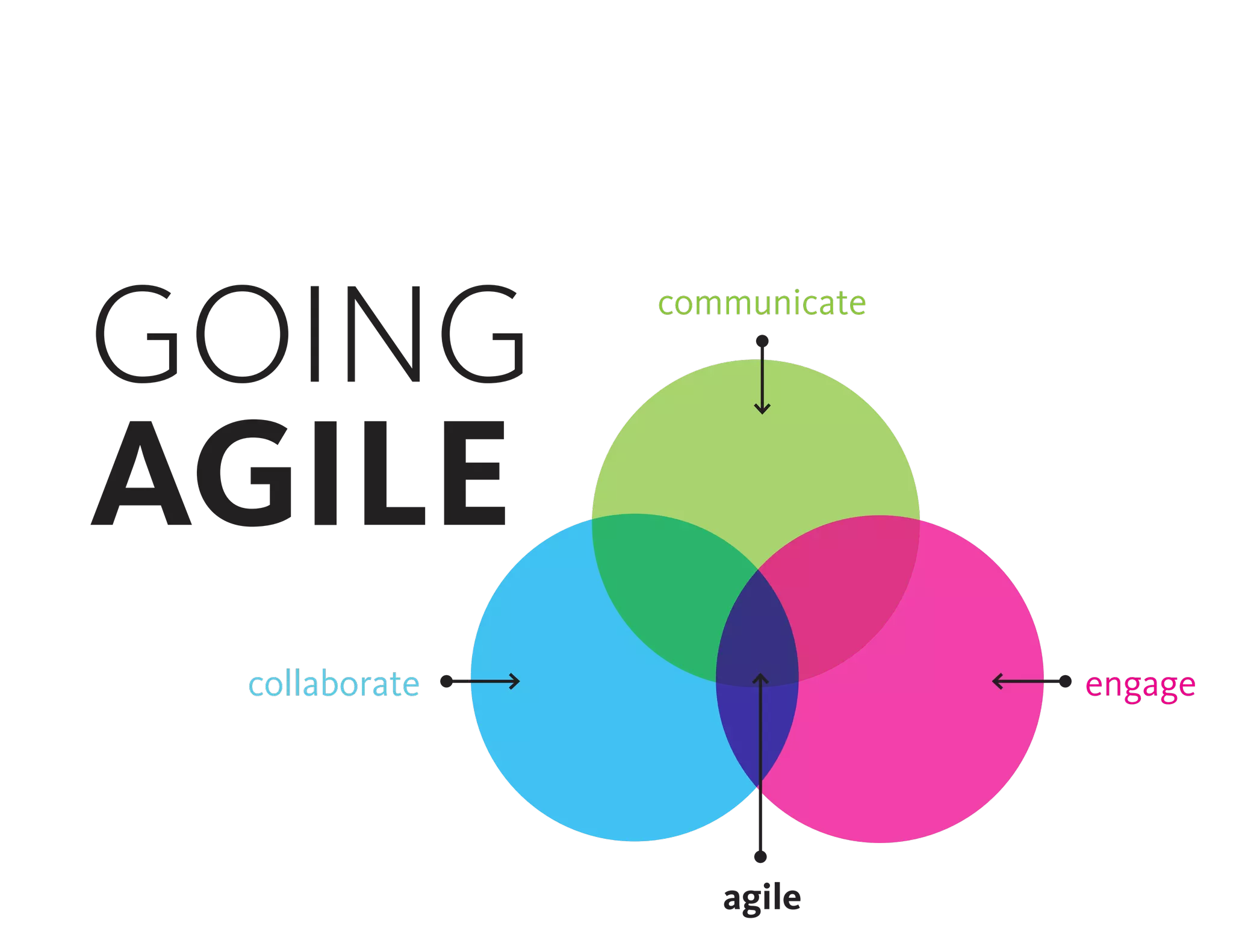
communicate
collaborate engage
agile
GOING
AGILE
communicate
collaborate engage
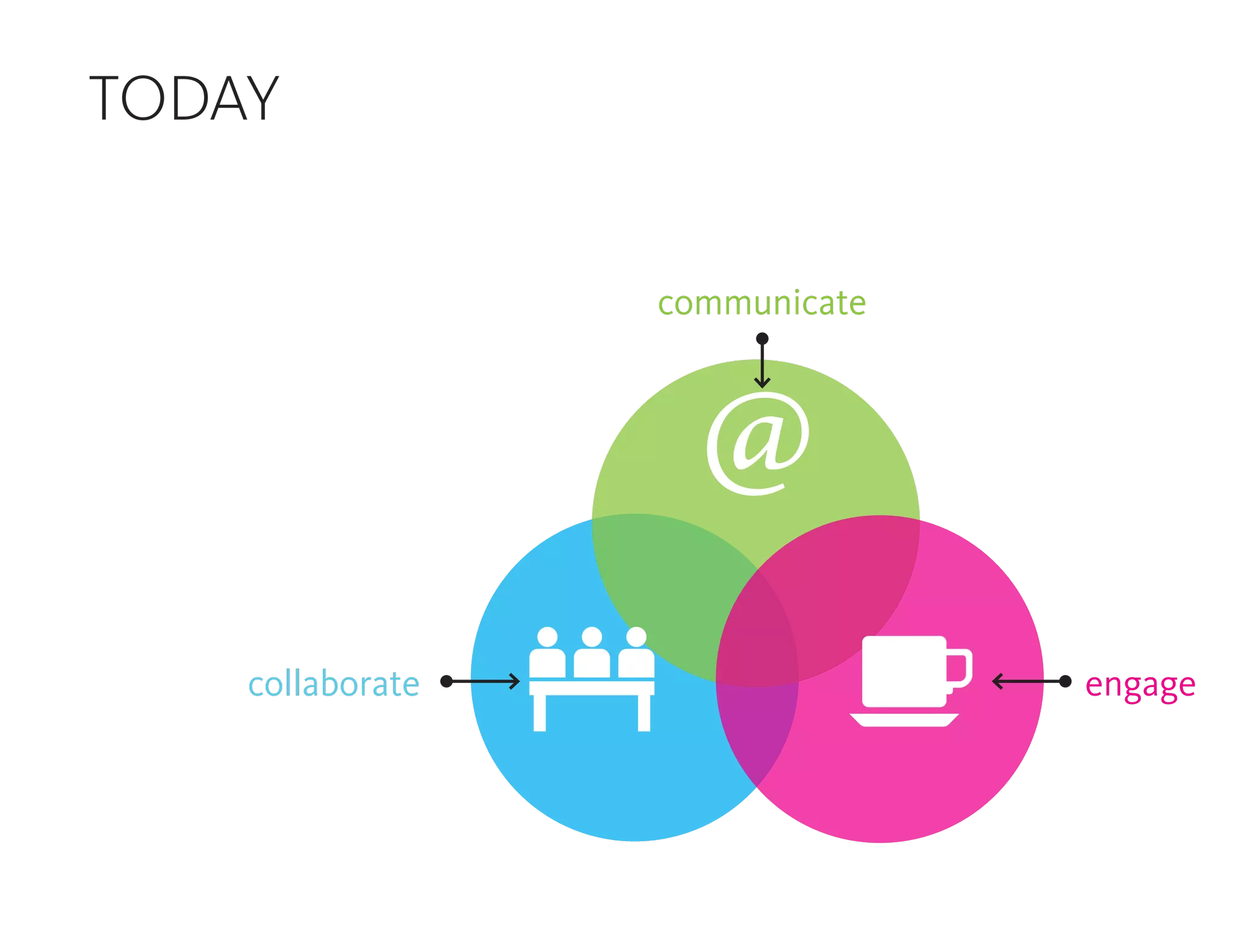
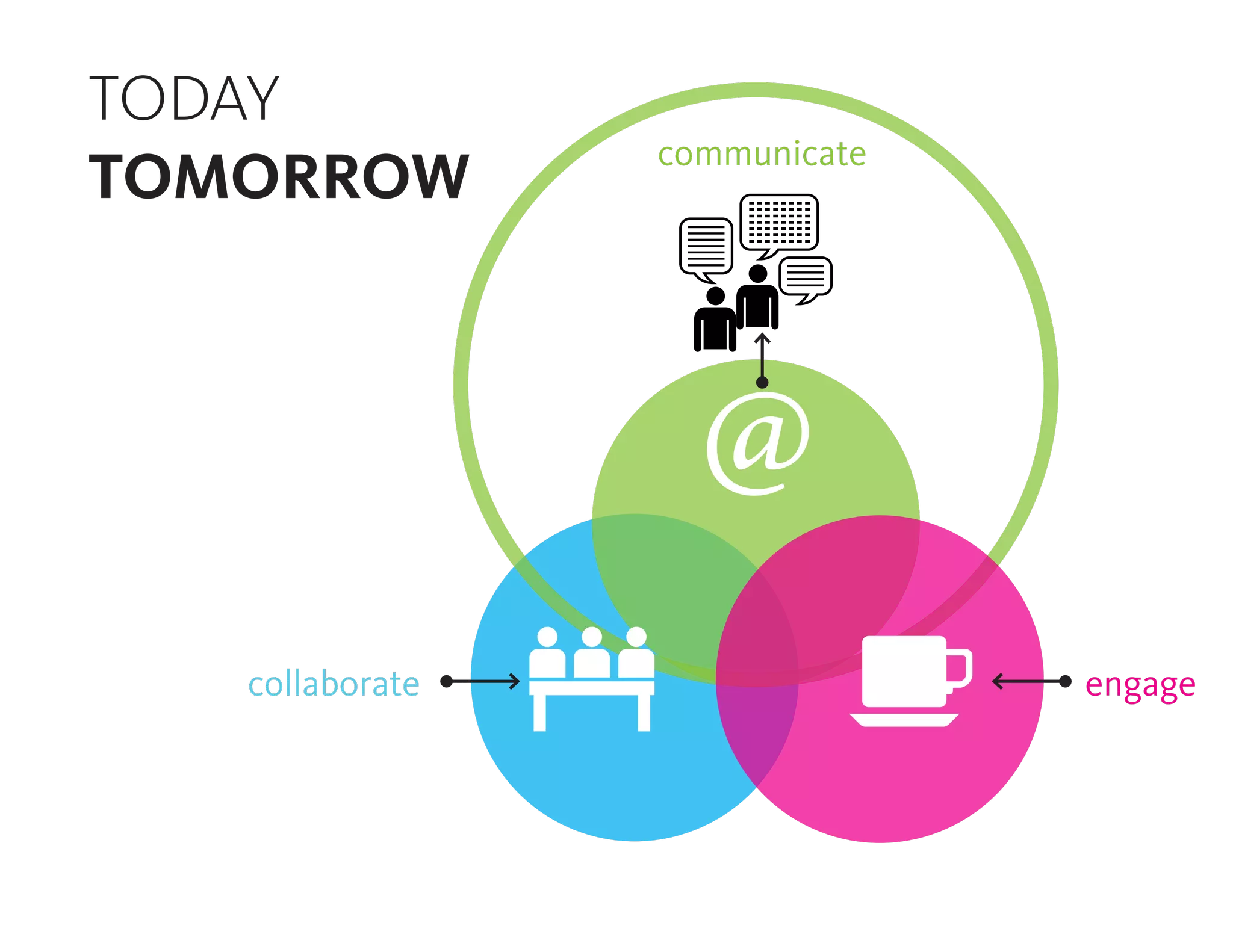
TODAY
@
communicate
collaborate engage
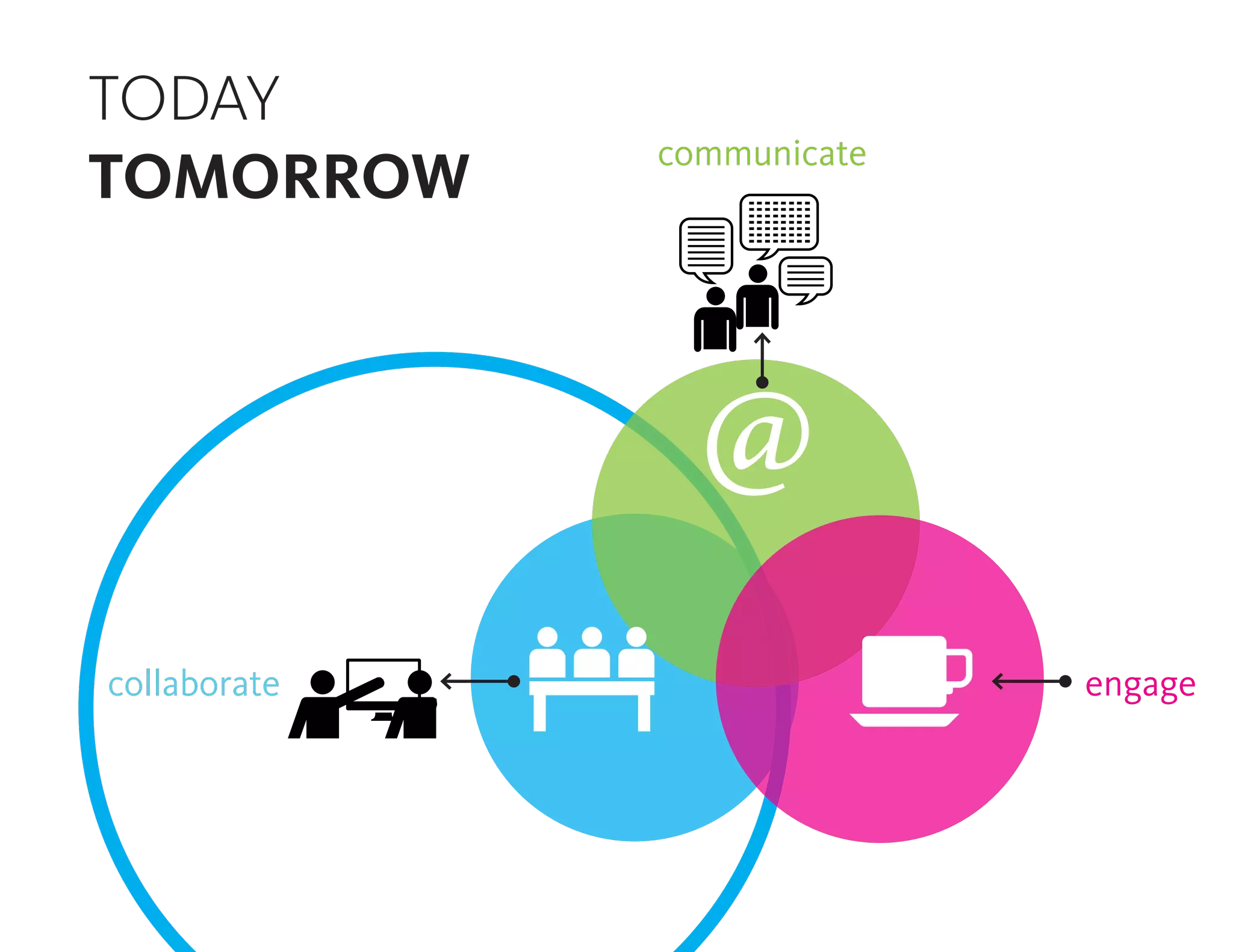
TODAY
TOMORROW
@
communicate
collaborate engage
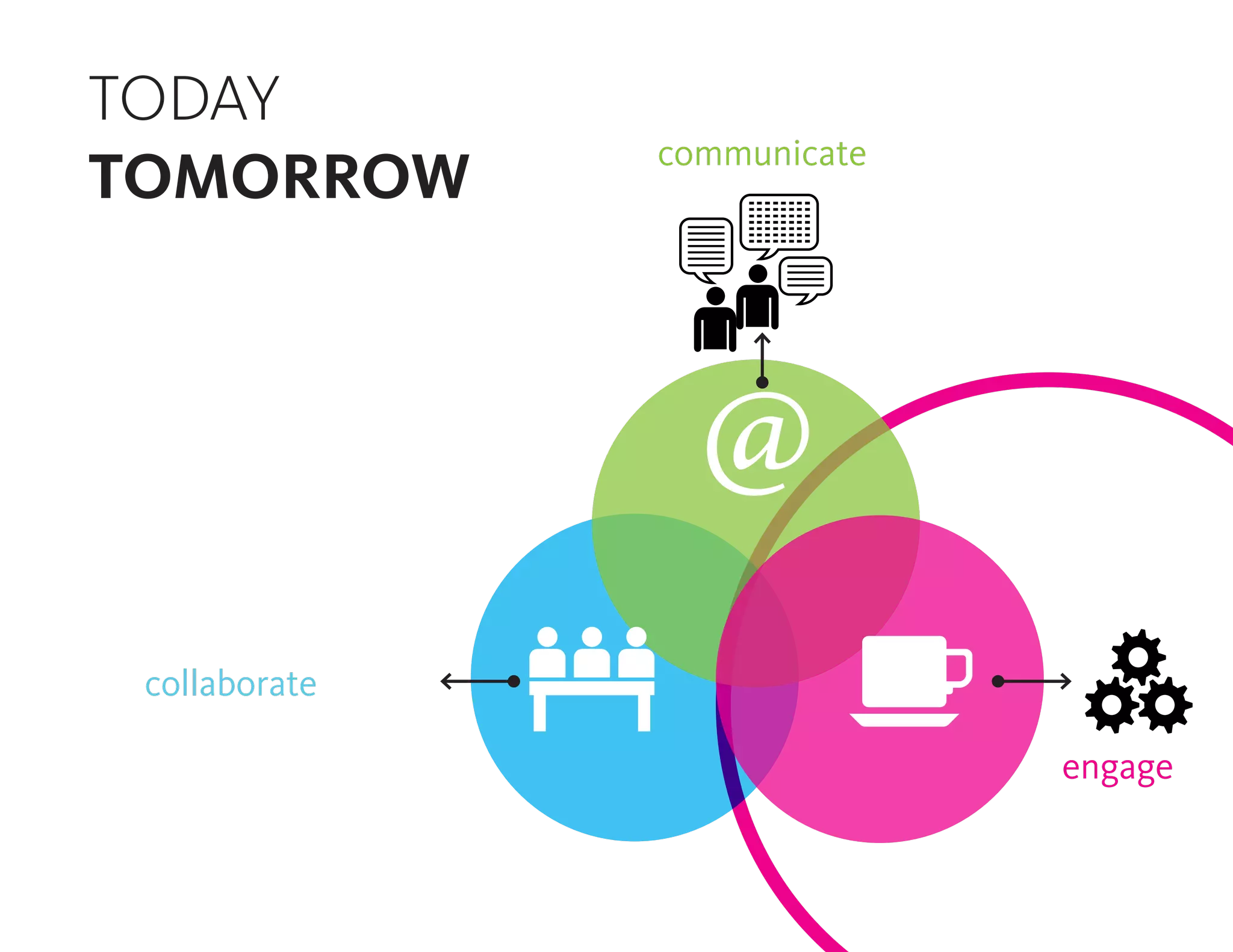
TODAY
TOMORROW
@
communicate
collaborate
engage
TODAY
TOMORROW
@
BUT HOW DO
WE GET FROM
STANDARD...
@
@
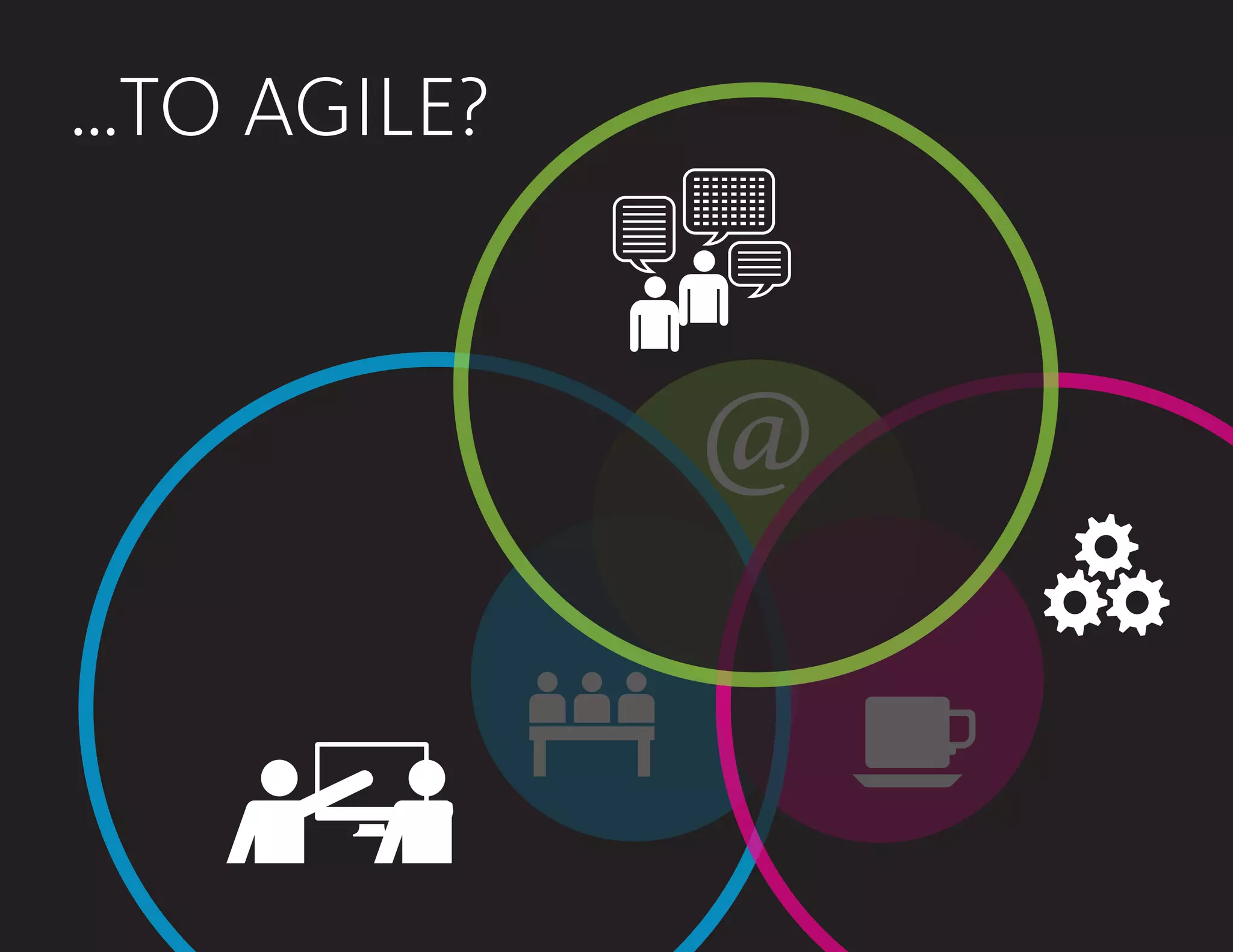
...TO AGILE?
HOW DOES
SPACE FOSTER
AGILITY?
12 Gensler 2008 Workplace Survey / United States / Working Differently 13Gensler 2008 Workplace Survey / United States / Working Differently
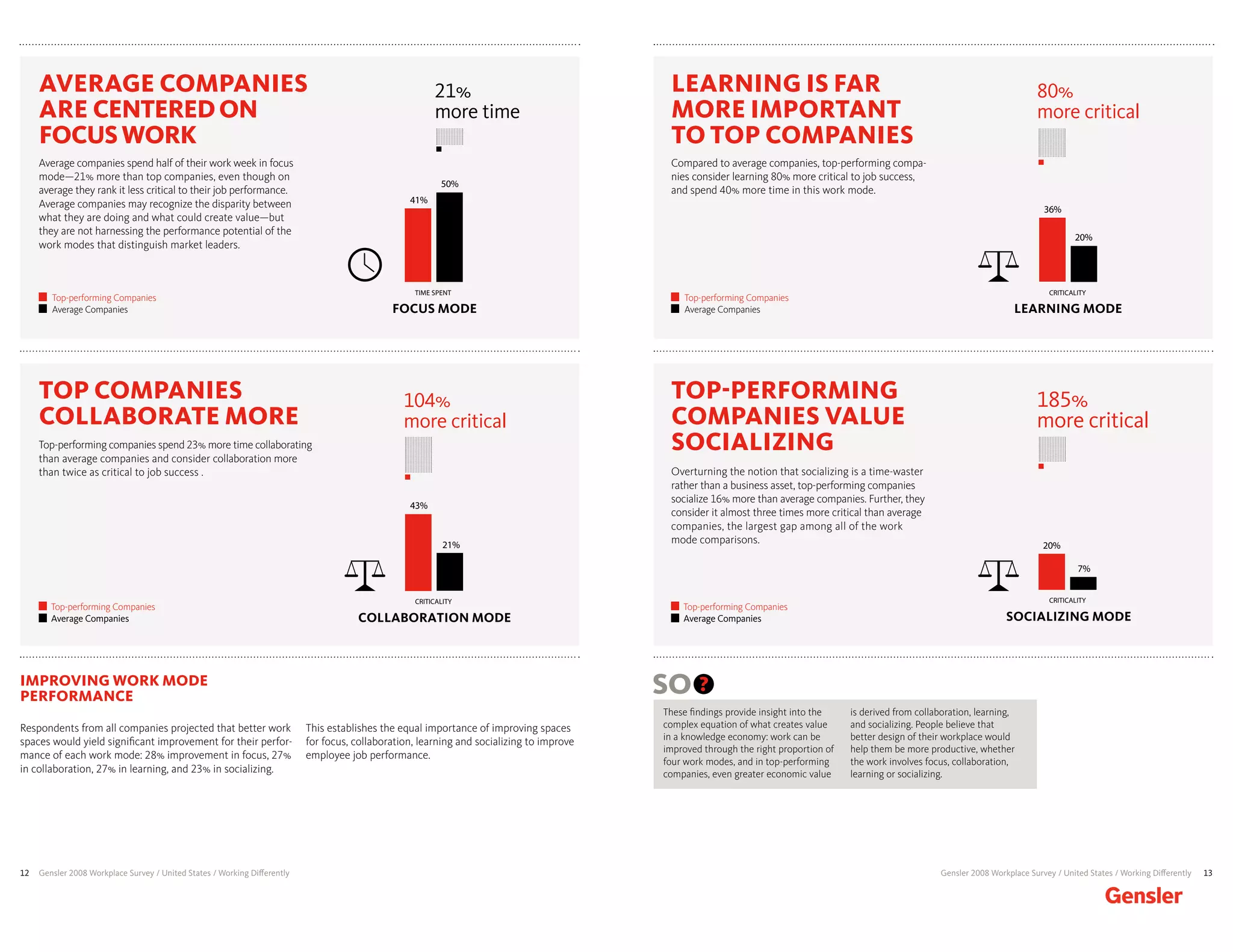
LEARNING IS FAR
MORE IMPORTANT
TO TOP COMPANIES
Compared to average companies, top-performing compa-
nies consider learning 80% more critical to job success,
and spend 40% more time in this work mode.
TOP-PERFORMING
COMPANIES VALUE
SOCIALIZING
Overturning the notion that socializing is a time-waster
rather than a business asset, top-performing companies
socialize 16% more than average companies. Further, they
consider it almost three times more critical than average
companies, the largest gap among all of the work
mode comparisons.
80%
more critical
185%
more critical
Top-performing Companies
Average Companies
Top-performing Companies
Average Companies
CRITICALITY
CRITICALITY
SOCIALIZING MODE
0
20
40
60
80
100
0
20
40
60
80
100
C
36%
20%
LEARNING MODE
20%
7%
CRITICALITY
CRITICALITY
SOCIALIZING MODE
0
20
40
60
80
100
0
20
40
60
80
100
C
36%
20%
LEARNING MODE
20%
7%
These findings provide insight into the
complex equation of what creates value
in a knowledge economy: work can be
improved through the right proportion of
four work modes, and in top-performing
companies, even greater economic value
is derived from collaboration, learning,
and socializing. People believe that
better design of their workplace would
help them be more productive, whether
the work involves focus, collaboration,
learning or socializing.
AVERAGE COMPANIES
ARE CENTEREDON
FOCUSWORK
Average companies spend half of their work week in focus
mode—21% more than top companies, even though on
average they rank it less critical to their job performance.
Average companies may recognize the disparity between
what they are doing and what could create value—but
they are not harnessing the performance potential of the
work modes that distinguish market leaders.
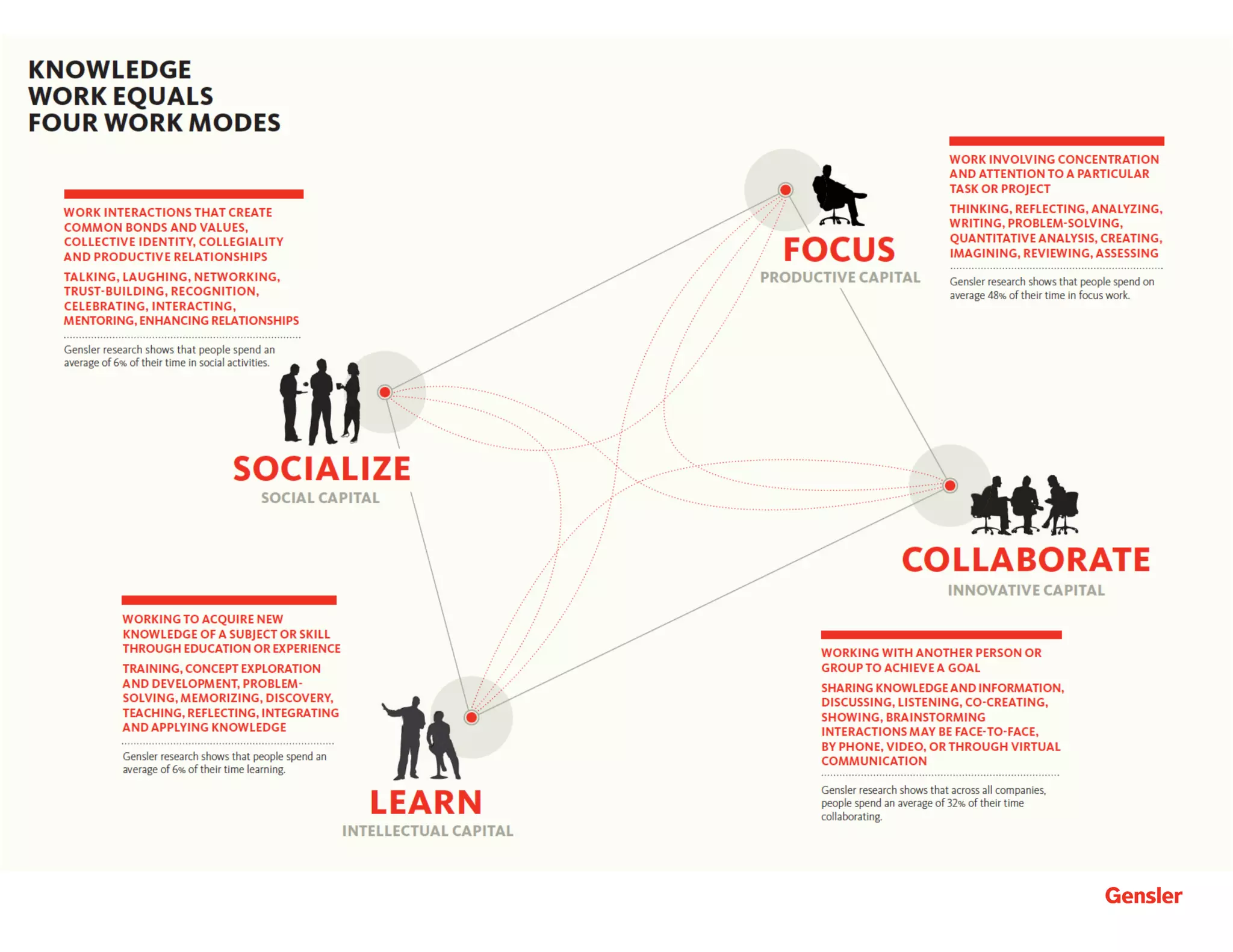
Respondents from all companies projected that better work
spaces would yield significant improvement for their perfor-
mance of each work mode: 28% improvement in focus, 27%
in collaboration, 27% in learning, and 23% in socializing.
This establishes the equal importance of improving spaces
for focus, collaboration, learning and socializing to improve
employee job performance.
IMPROVING WORK MODE
PERFORMANCE
TOP COMPANIES
COLLABORATE MORE
Top-performing companies spend 23% more time collaborating
than average companies and consider collaboration more
than twice as critical to job success .
Top-performing Companies
Average Companies
104%
more critical
21%
more time
Top-performing Companies
Average Companies
CRITICALITY
CRITICALITY CRITICALITY
SOCIALIZING MODE
0
20
40
60
80
100
0
20
40
60
80
100
50%
41%
COLLABORATION MODE
FOCUS MODE
36%
20%
LEARNING MODE
20%
7%
21%
43%
TIME SPENTCRITICALITY
CRITICALITY CRITICALITY
SOCIALIZING MODE
0
20
40
60
80
100
0
20
40
60
80
100
50%
41%
COLLABORATION MODE
FOCUS MODE
36%
20%
LEARNING MODE
20%
7%
21%
43%
TIME SPENT
Investmentspace
Workplace
Betaspace
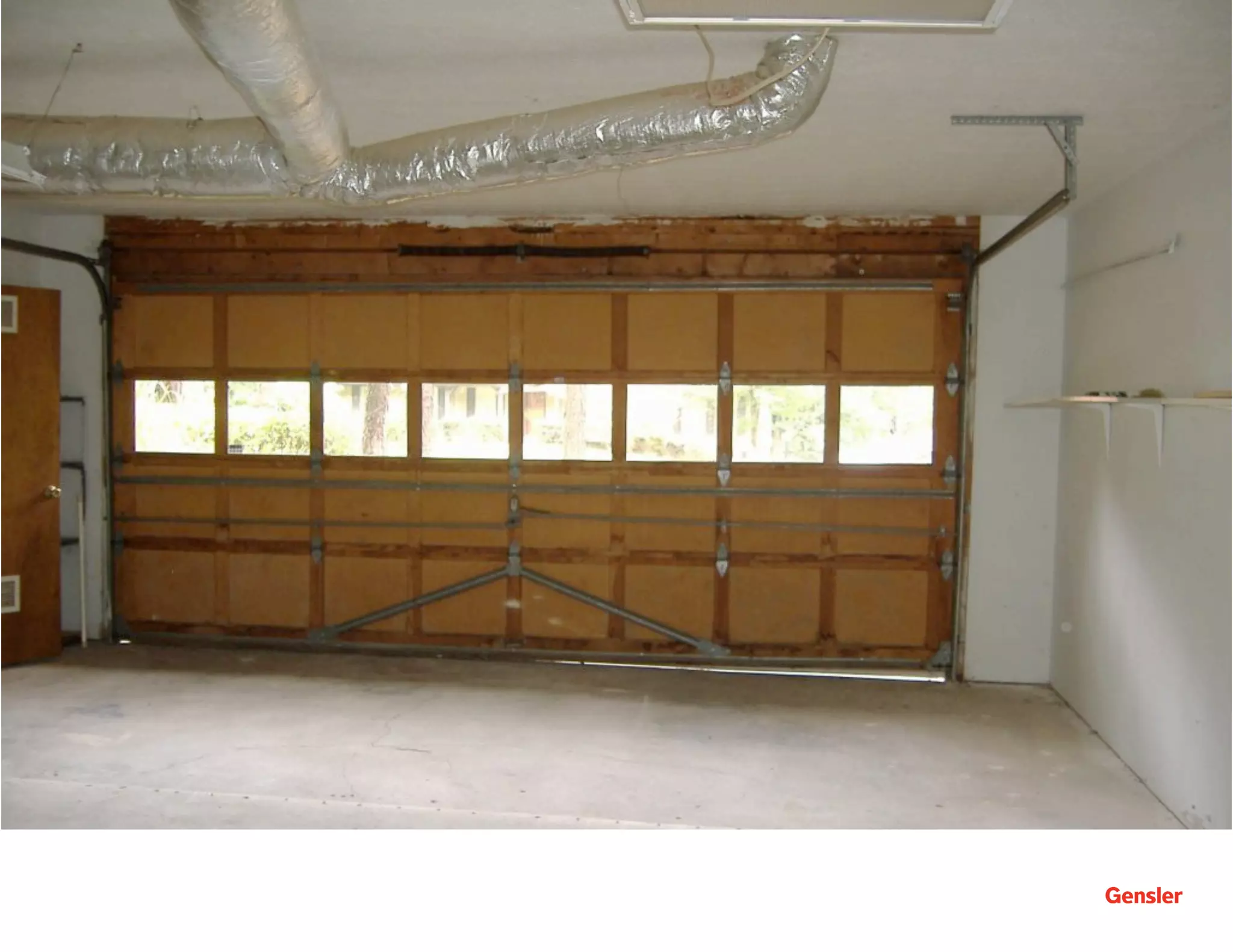
Microsoft started in Bill Gates'
garage.

His high-school friend Paul convinced him to drop out of
Harvard to start the company. They moved to Arizona and
wrote a BASIC programming language for Altair computers
out of Bill's garage.
Speed
Transparency
Flexibility
Alternative Work Modes
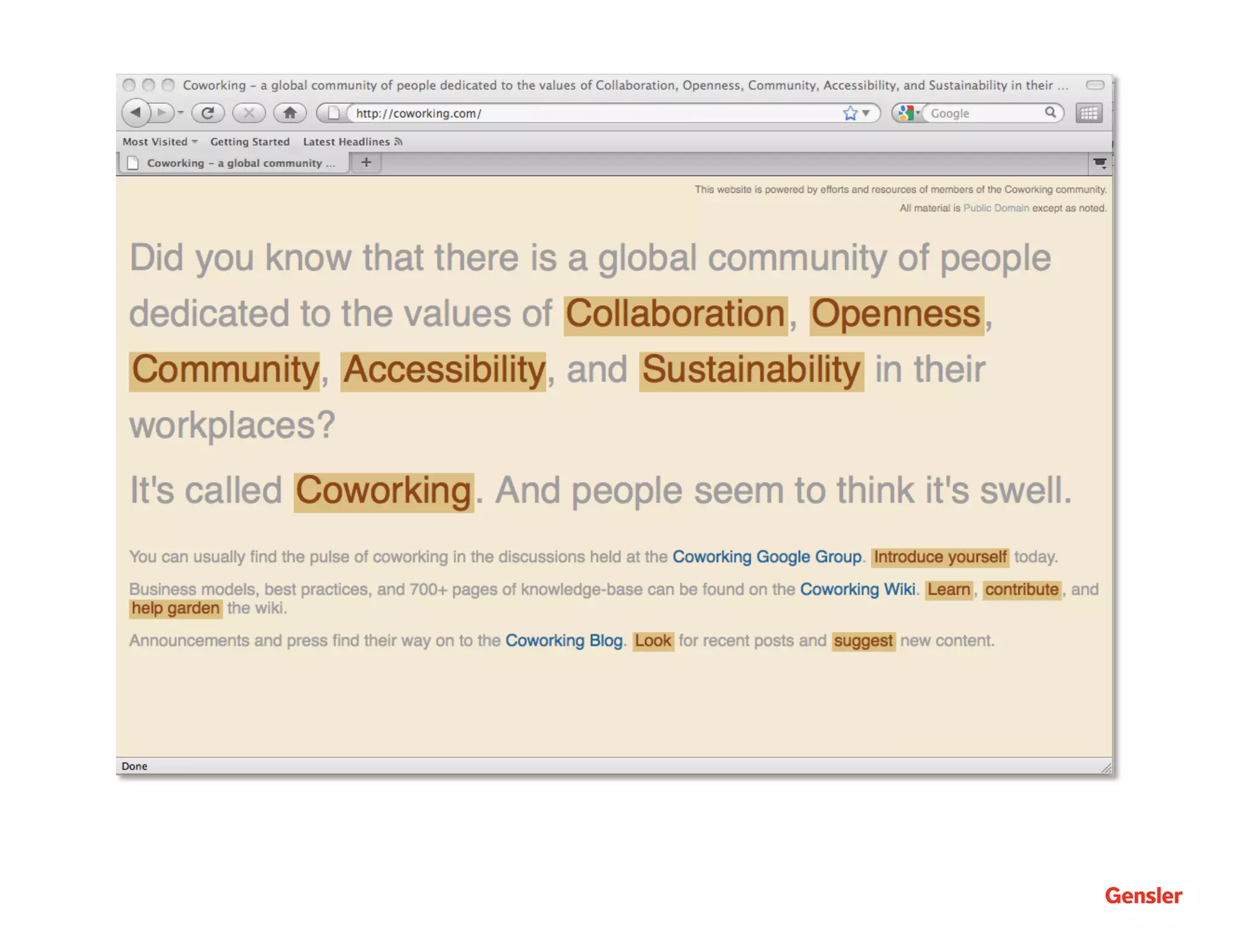
COWORKING
…instead, we are learning from this
movement in order to apply their
successes to larger companies
seeking to promote innovation and
recruit or retain talent.
We are learning from this movement
in order to draw on the energy and
success of start-ups in larger more
established corporations seeking to
promote innovation and recruit and retain
top talent.
COWORKING
principles
respond to a
new generation
of work.
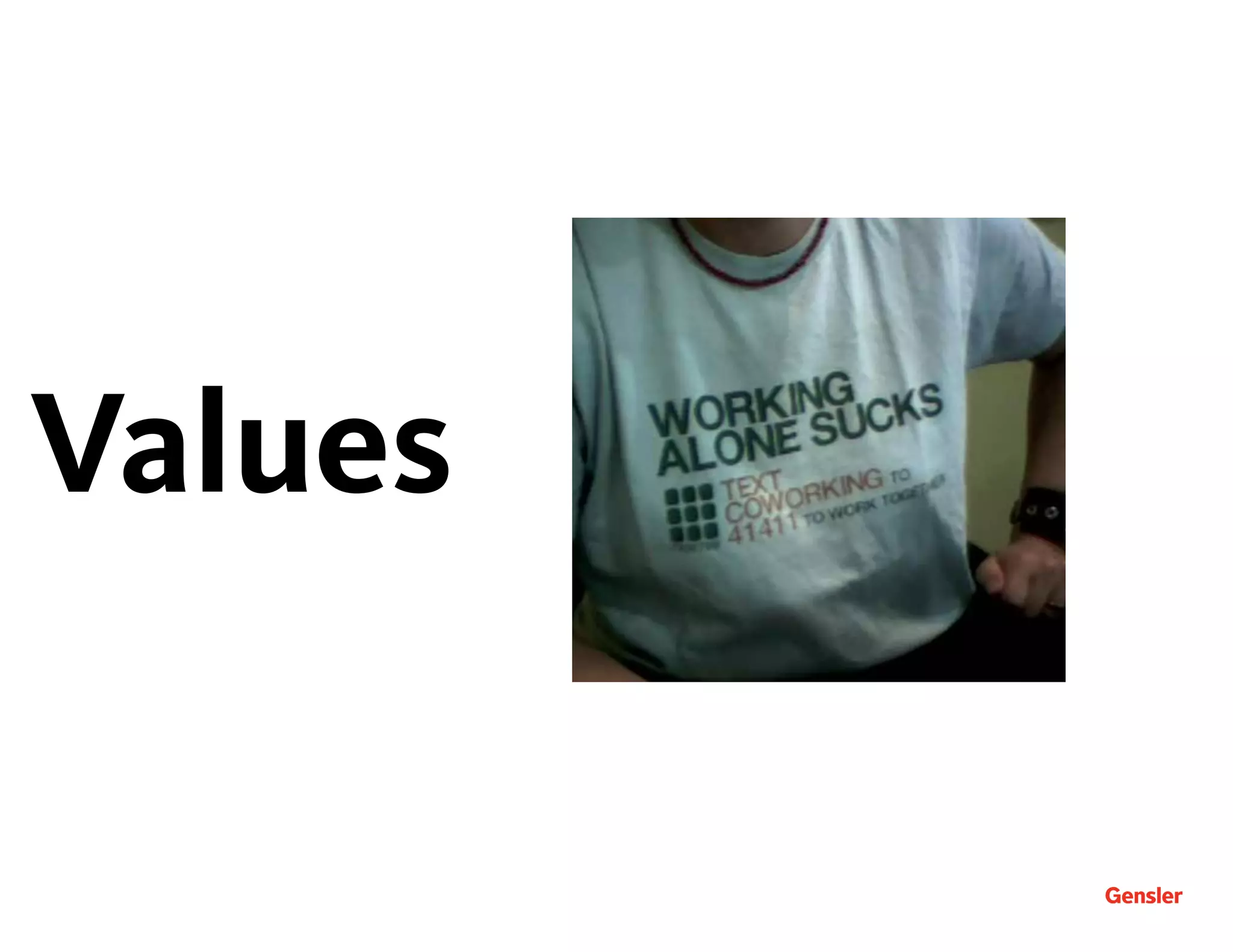
Values
AUTHENTIC
Space
AUTHENTIC
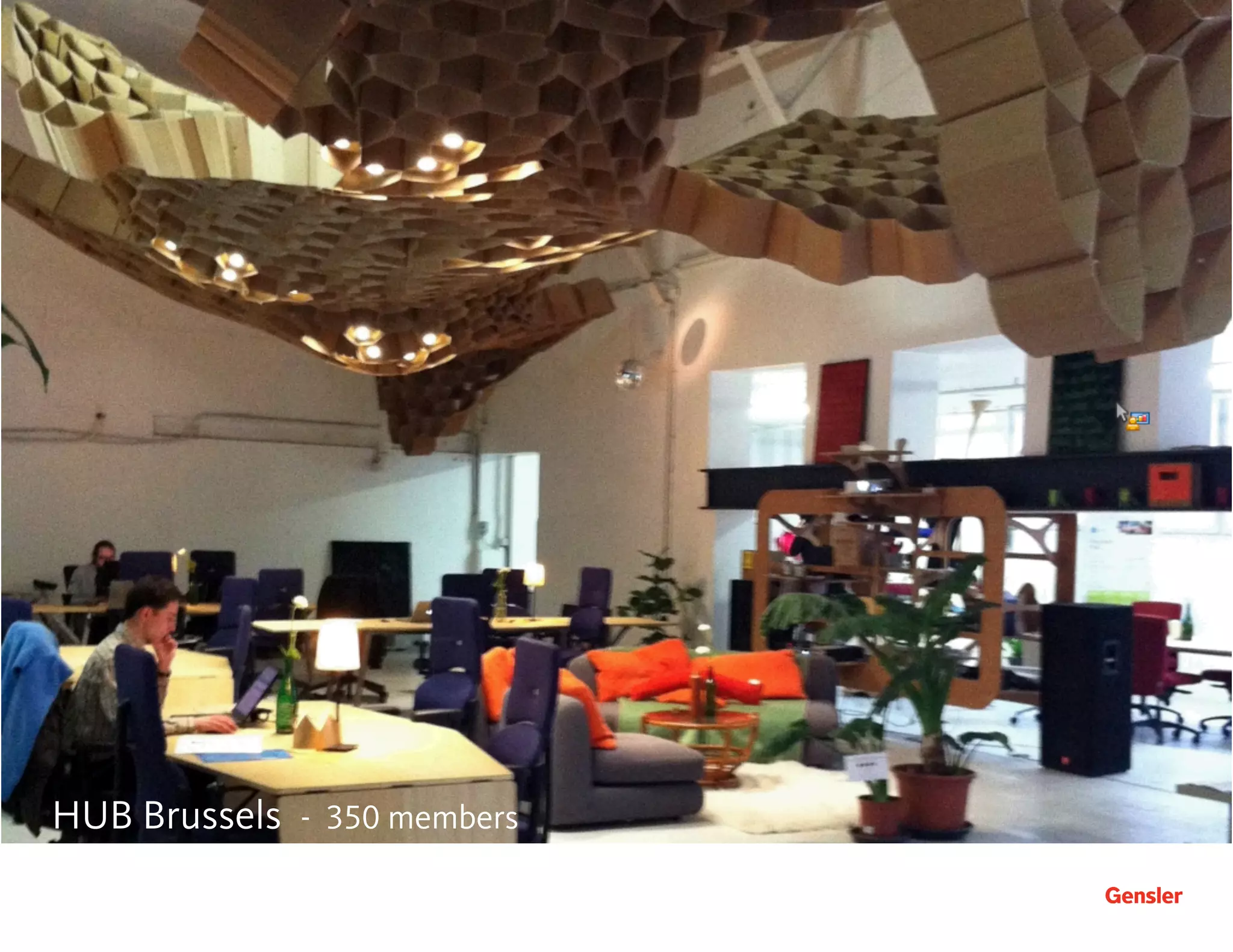
AUTHENTICHUB Brussels - 350 members
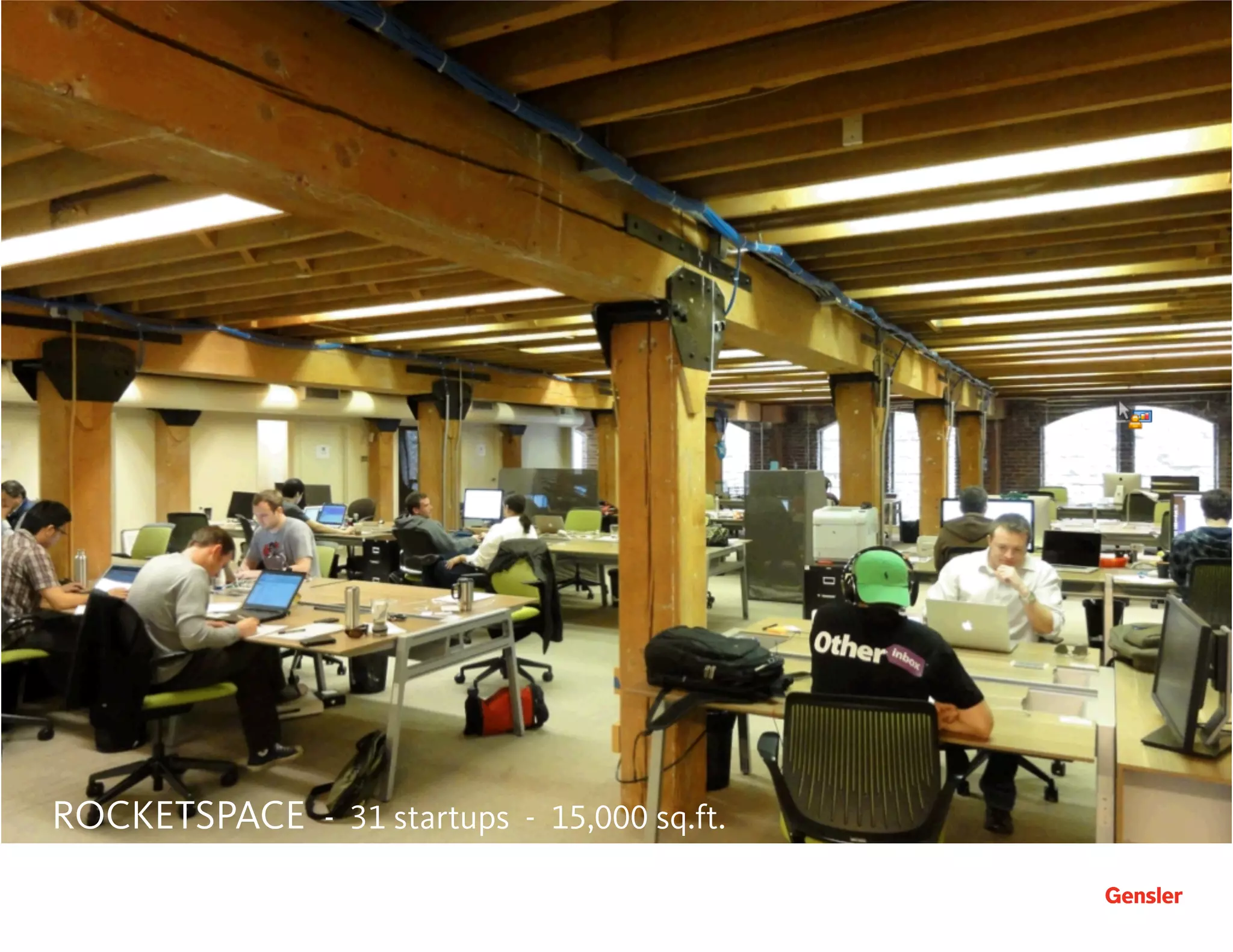
AUTHENTICROCKETSPACE - 31 startups - 15,000 sq.ft.
This is a global phenomenon, with
fairly identified user expectations
of space and technology
requirements.
Early Research Findings
“Office is a state of mind”
Early Research Findings
In these spaces, every space is a
“group” space. Collaboration
defines the interactions in the
environment.
Early Research Findings
87% of coworkers have started
new projects with other
coworkers they met in their space.
Evidence suggests that the specific
characteristics of coworker
behavior foreshadows changes in
corporate work.
Early Research Findings
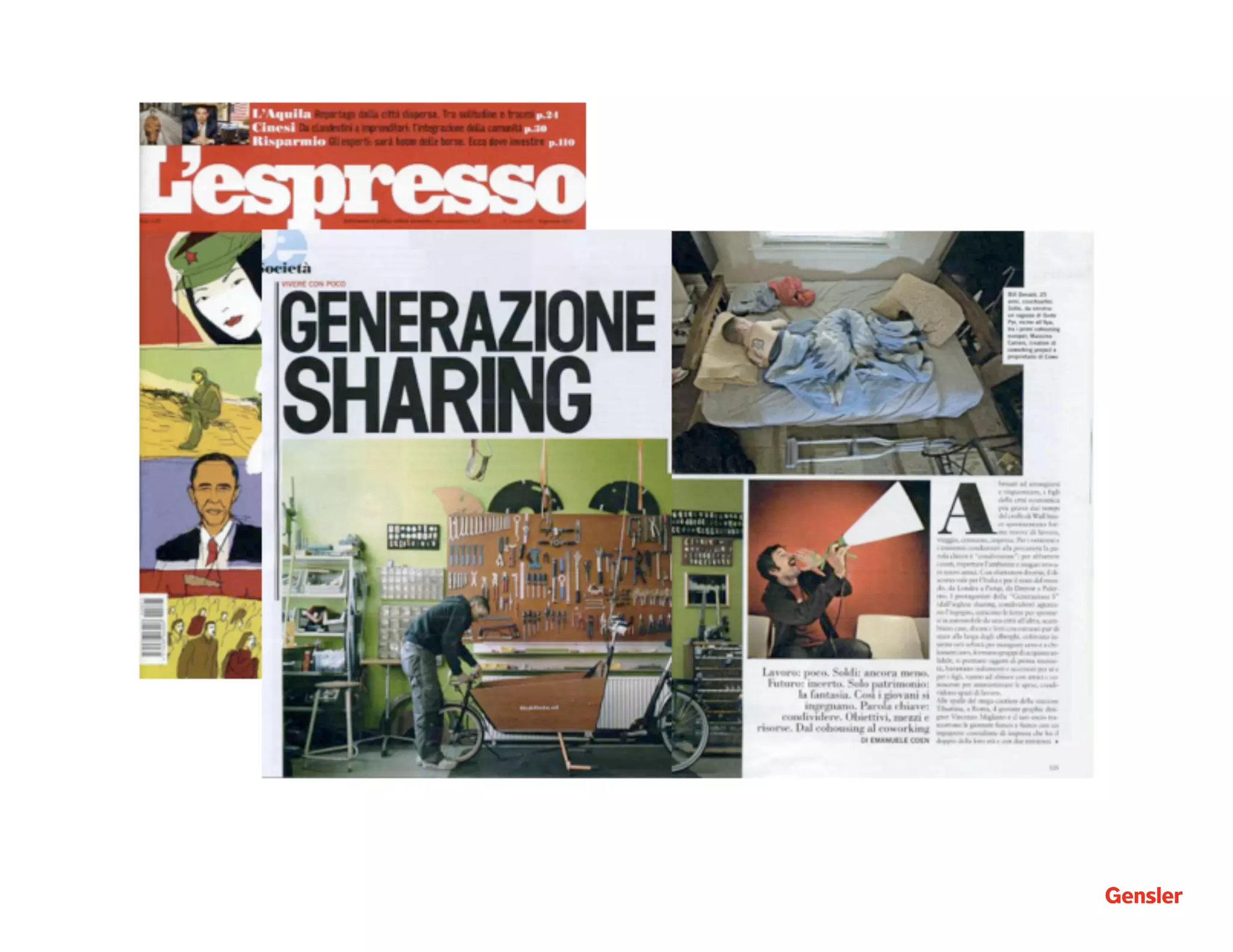
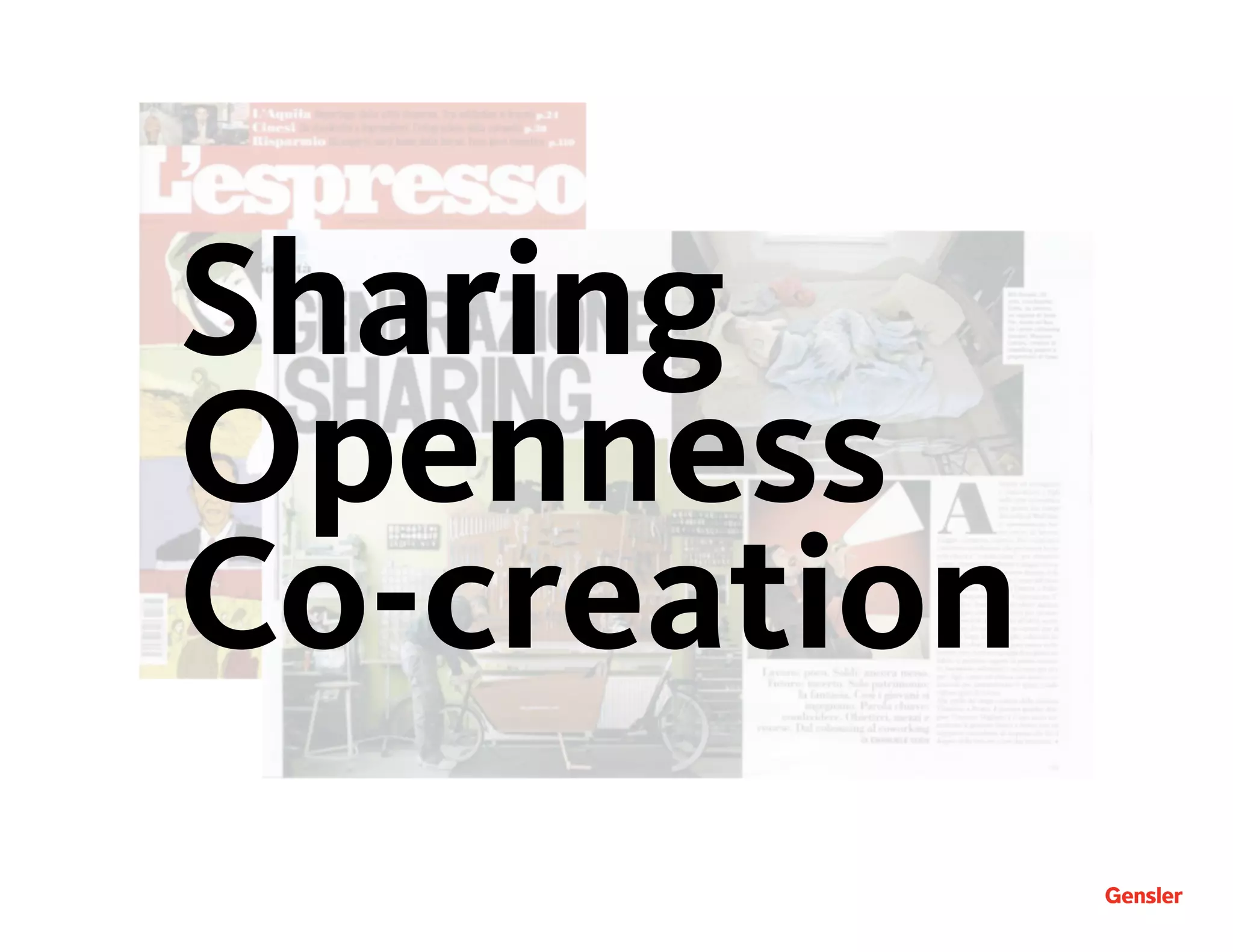
Sharing
Openness
Co-creation
…delivers accelerated
serendipity. If we are around
interesting people, interesting
things usually happen.
How did Nokia do it?
guiding
principles...
From the start, we agreed to
adhere to certain values when
implementing our Co-location
strategy...
4
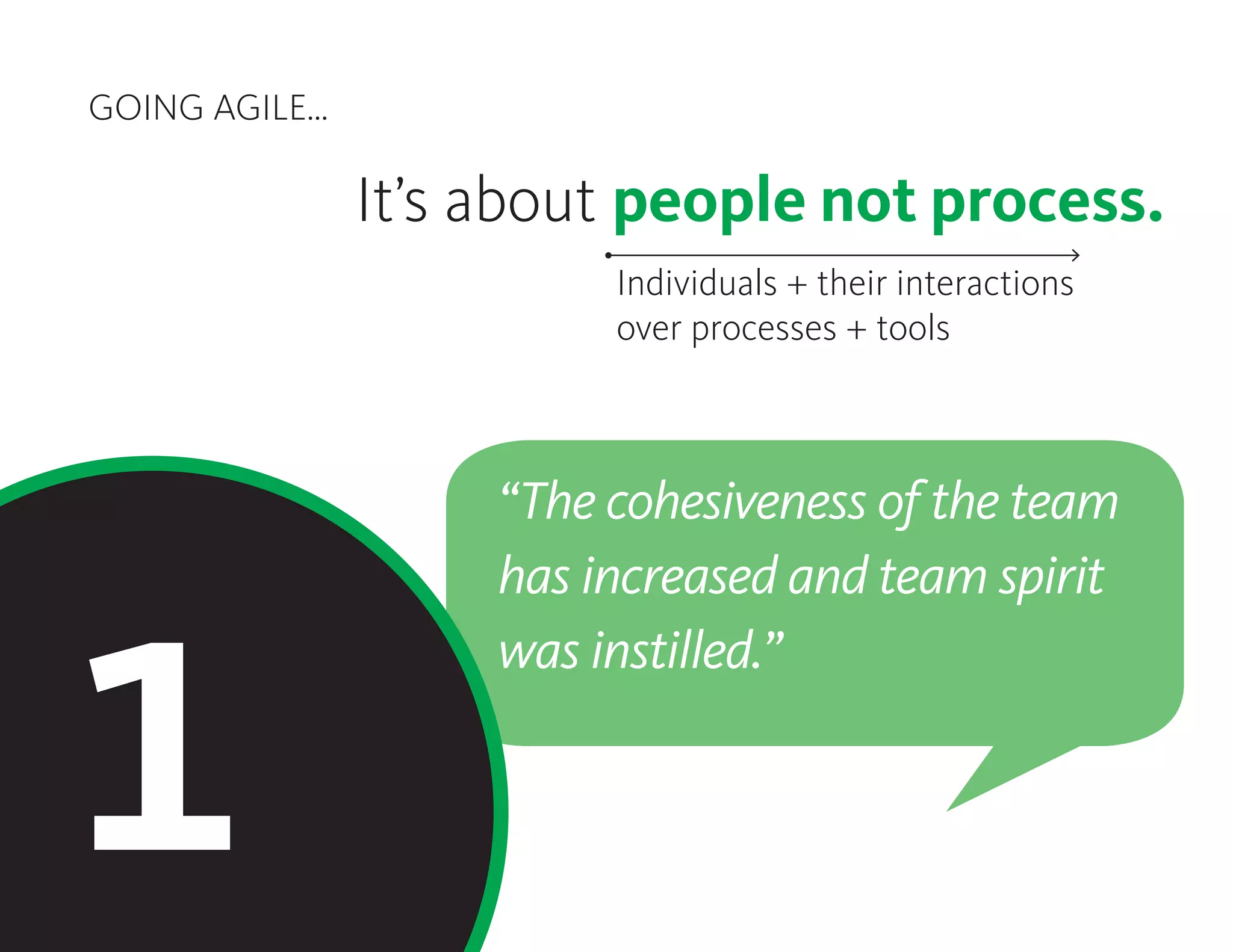
GOING AGILE...
1
It’s about people not process.
Individuals + their interactions
over processes + tools
“The cohesiveness of the team
has increased and team spirit
was instilled.”
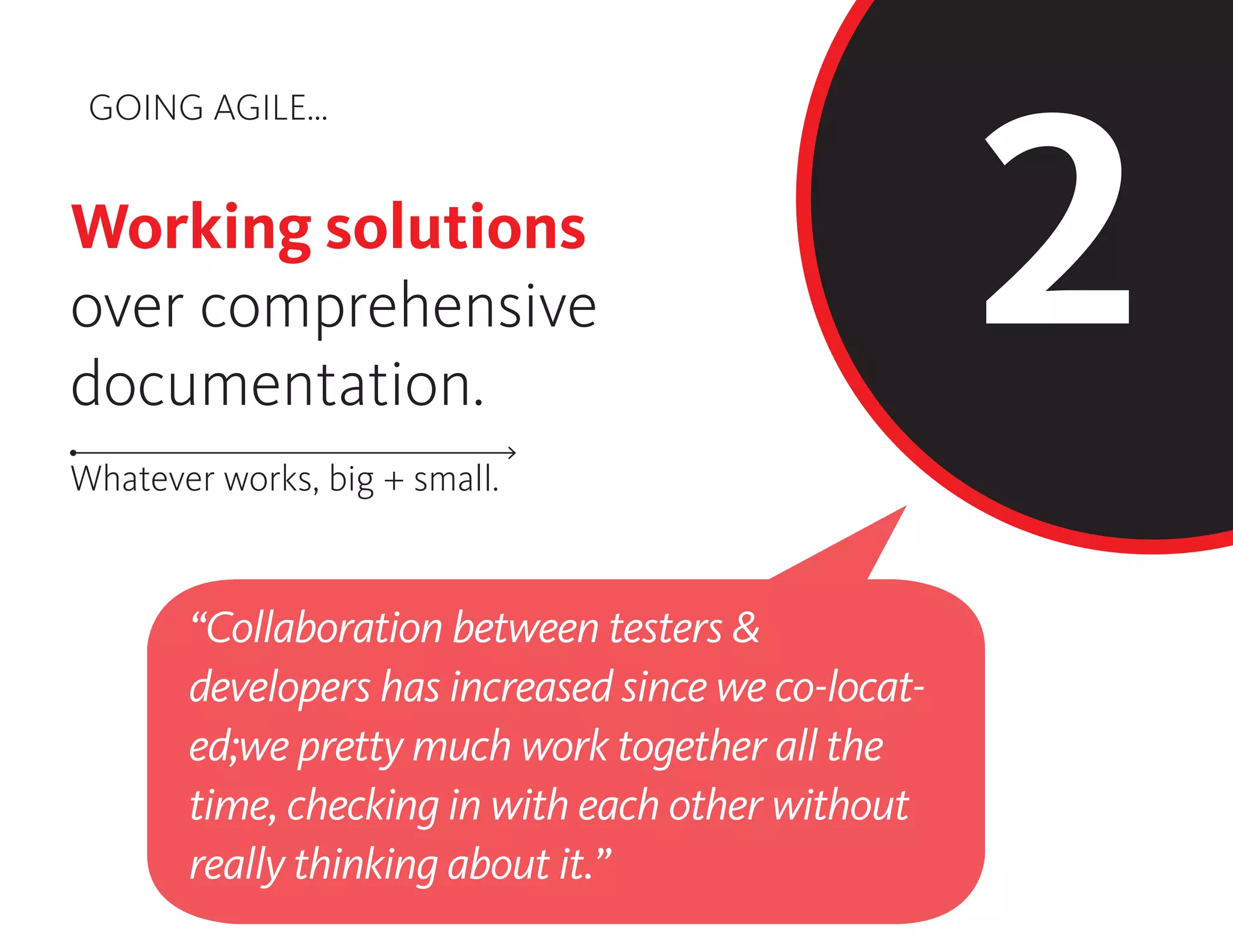
GOING AGILE...
2Working solutions
over comprehensive
documentation.
Whatever works, big + small.
“Collaboration between testers &
developers has increased since we co-locat-
ed;we pretty much work together all the
time, checking in with each other without
really thinking about it.”
GOING AGILE...
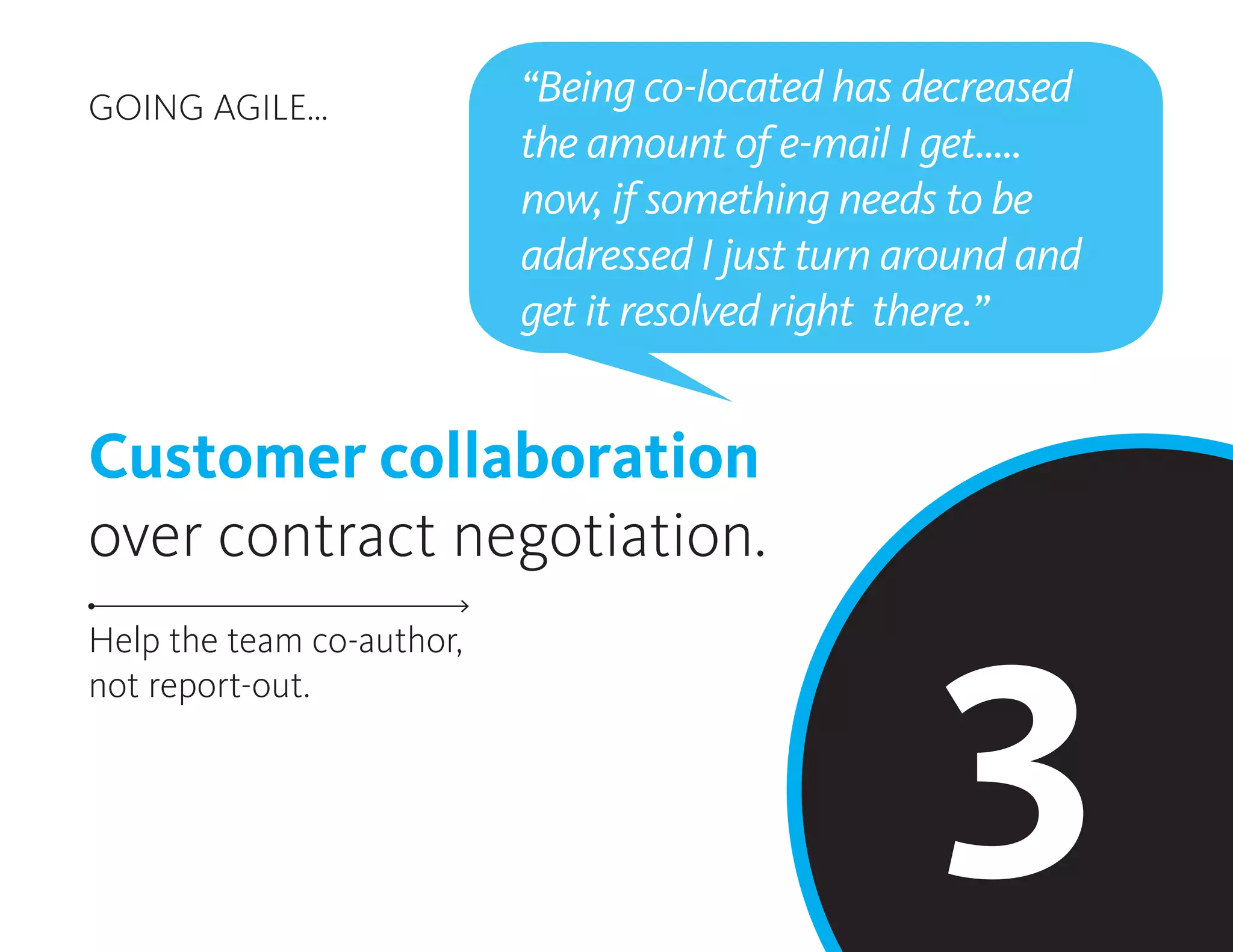
Customer collaboration
over contract negotiation.
Help the team co-author,
not report-out.
“Being co-located has decreased
the amount of e-mail I get.....
now, if something needs to be
addressed I just turn around and
get it resolved right there.”
3
GOING AGILE...
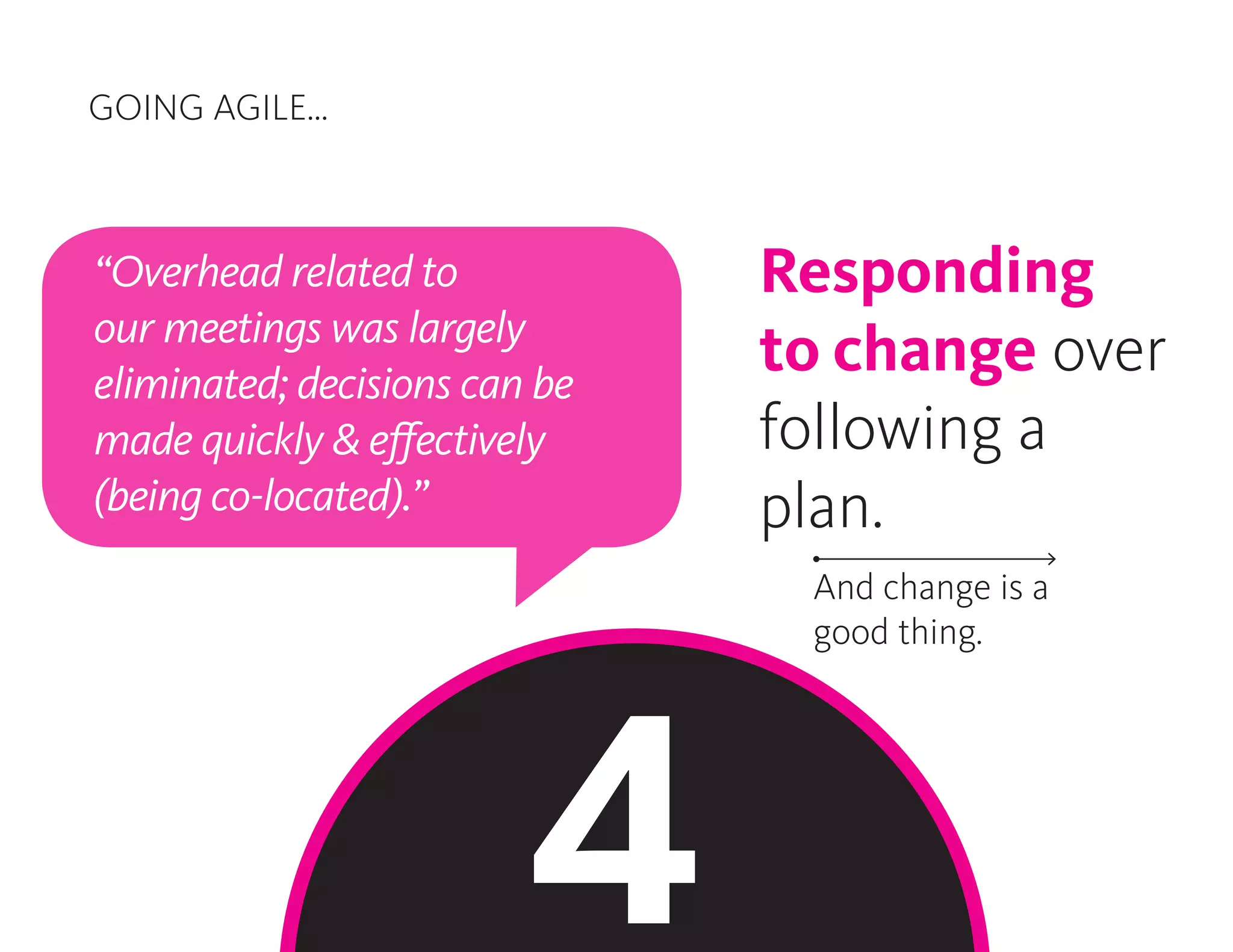
Responding
to change over
following a
plan.
And change is a
good thing.
“Overhead related to
our meetings was largely
eliminated; decisions can be
made quickly & effectively
(being co-located).”
4
the
experiment.
GOING AGILE...
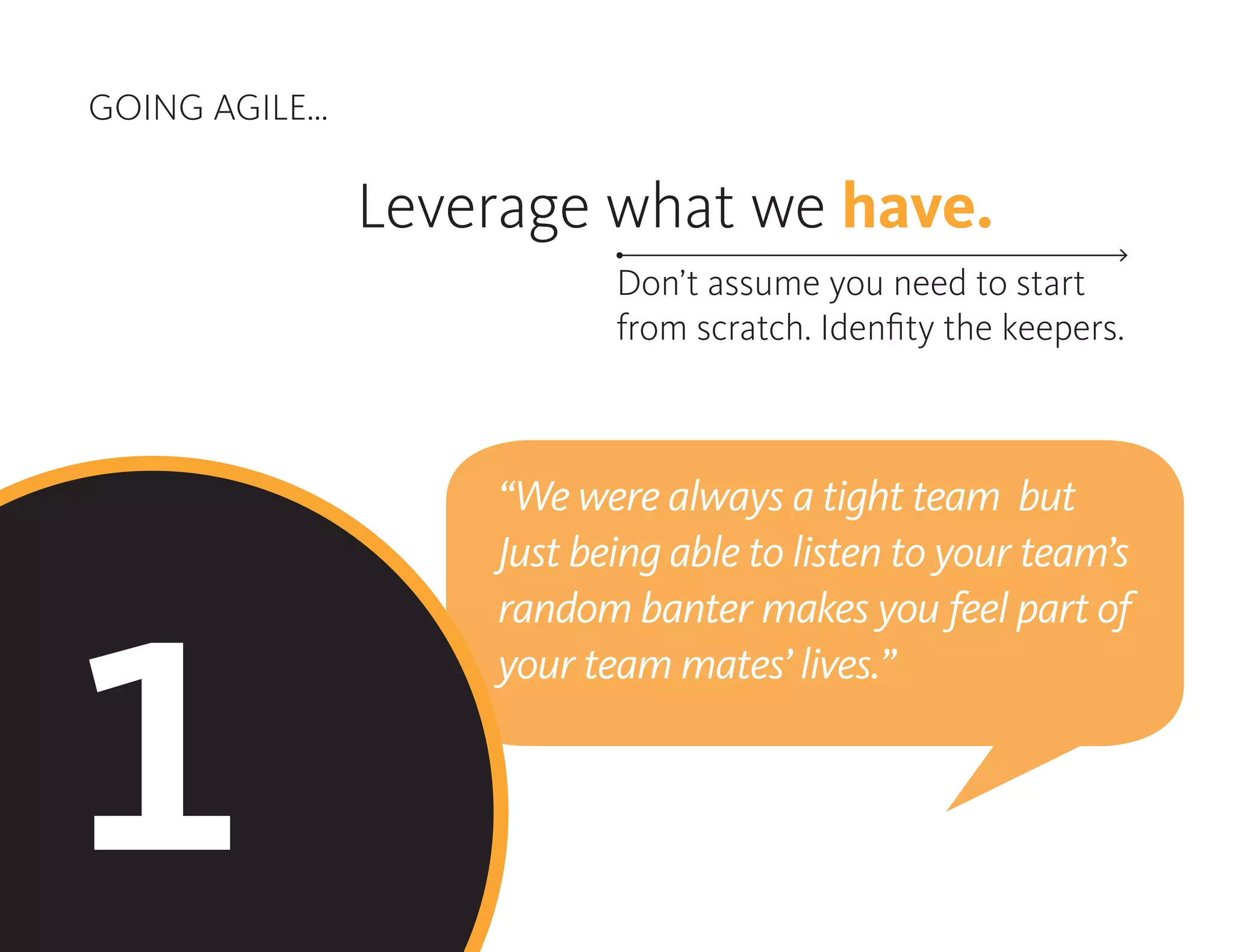
1
Leverage what we have.
Don’t assume you need to start
from scratch. Idenfity the keepers.
“We were always a tight team but
Just being able to listen to your team’s
random banter makes you feel part of
your team mates’ lives.”
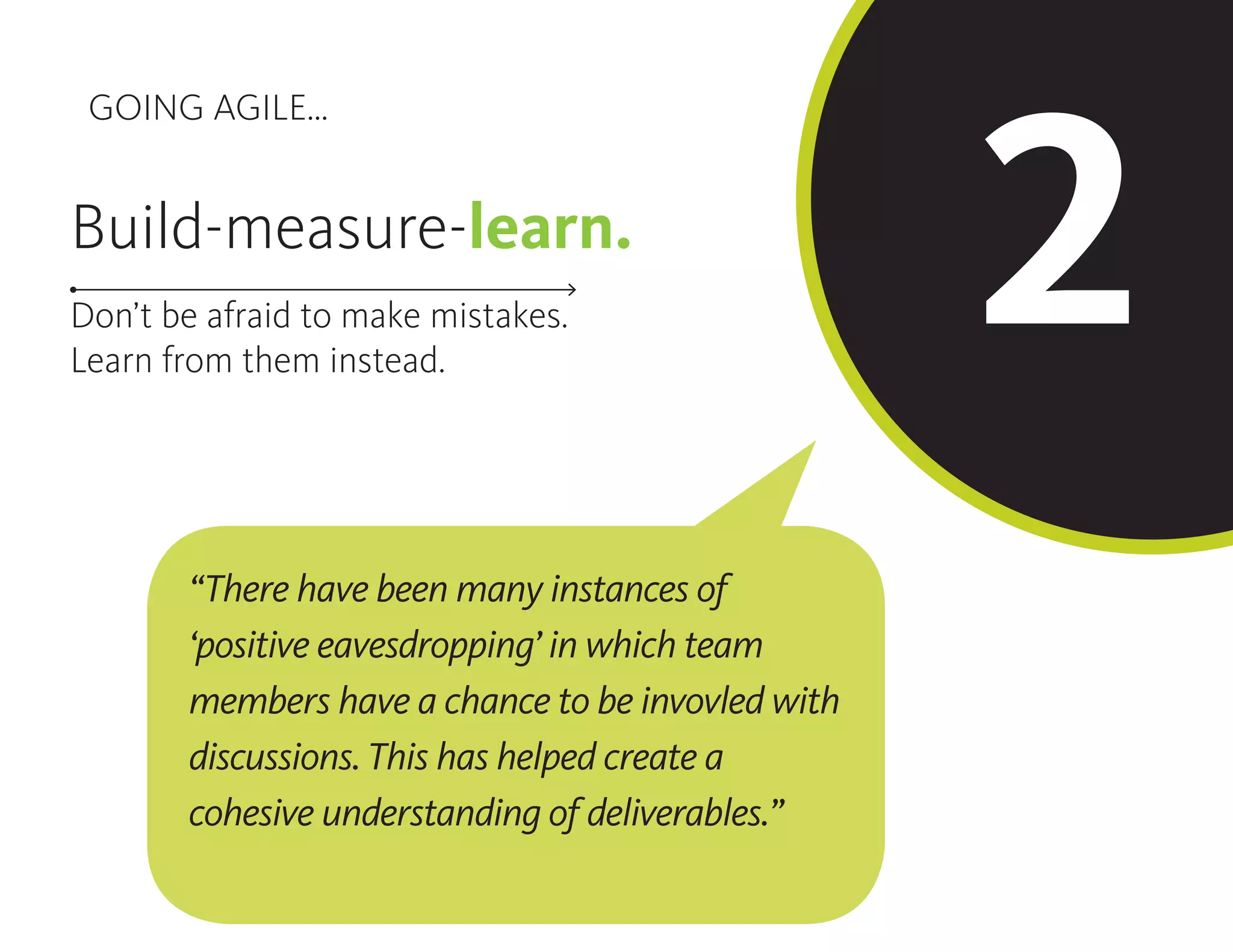
GOING AGILE...
2Build-measure-learn.
Don’t be afraid to make mistakes.
Learn from them instead.
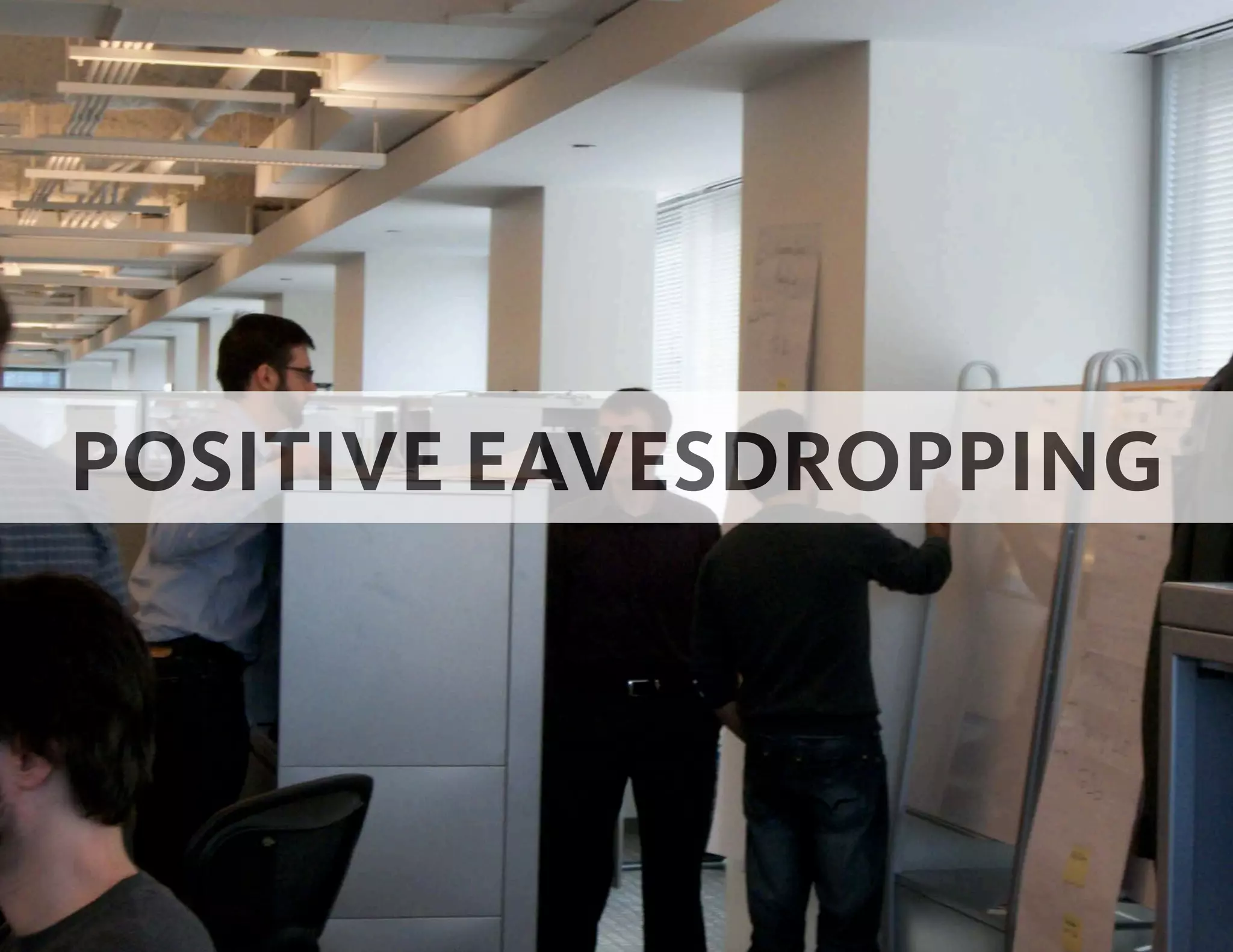
“There have been many instances of
‘positive eavesdropping’ in which team
members have a chance to be invovled with
discussions. This has helped create a
cohesive understanding of deliverables.”
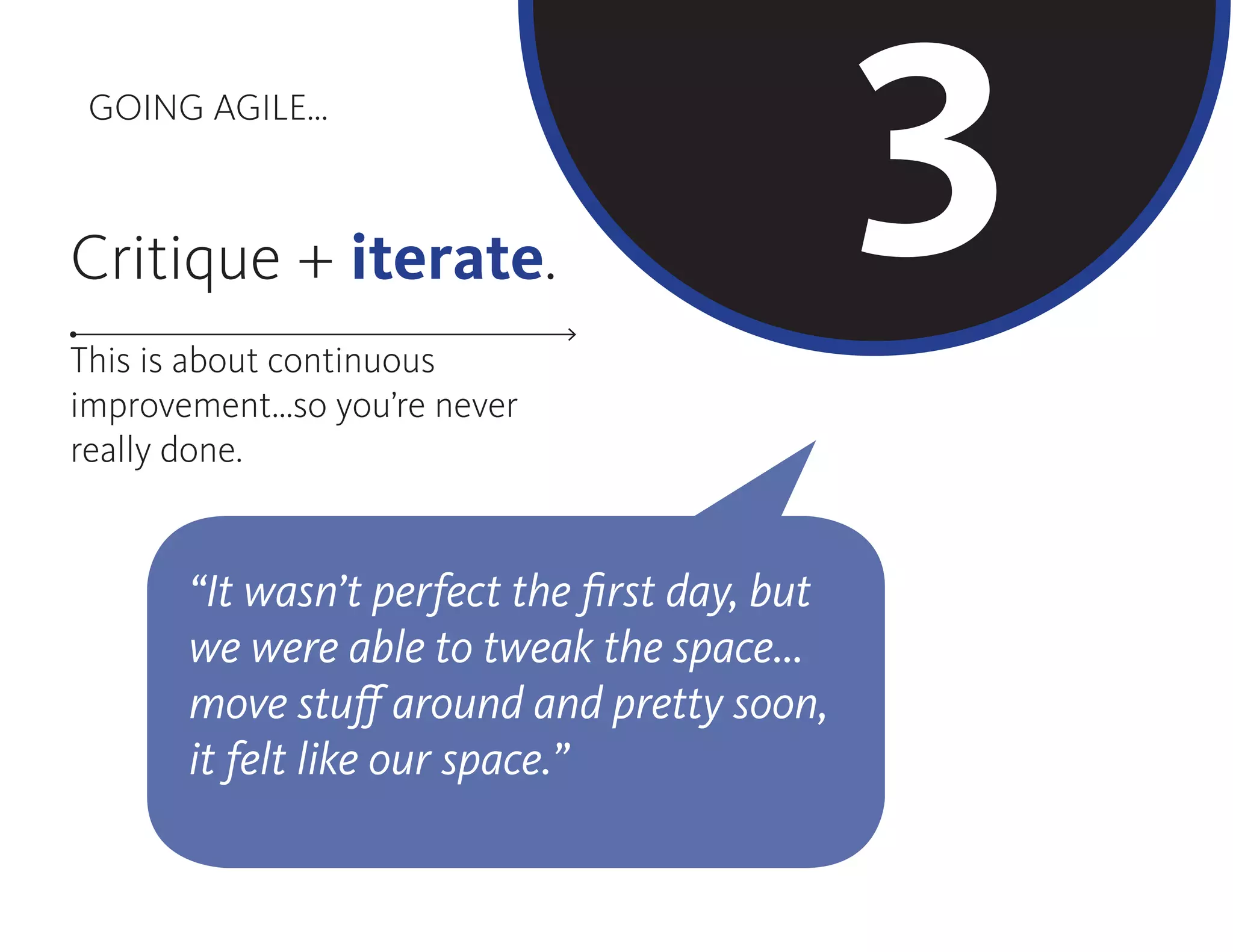
GOING AGILE...
33Critique + iterate.
This is about continuous
improvement...so you’re never
really done.
“It wasn’t perfect the first day, but
we were able to tweak the space...
move stuff around and pretty soon,
it felt like our space.”
WHAT DID WE
LEARN?
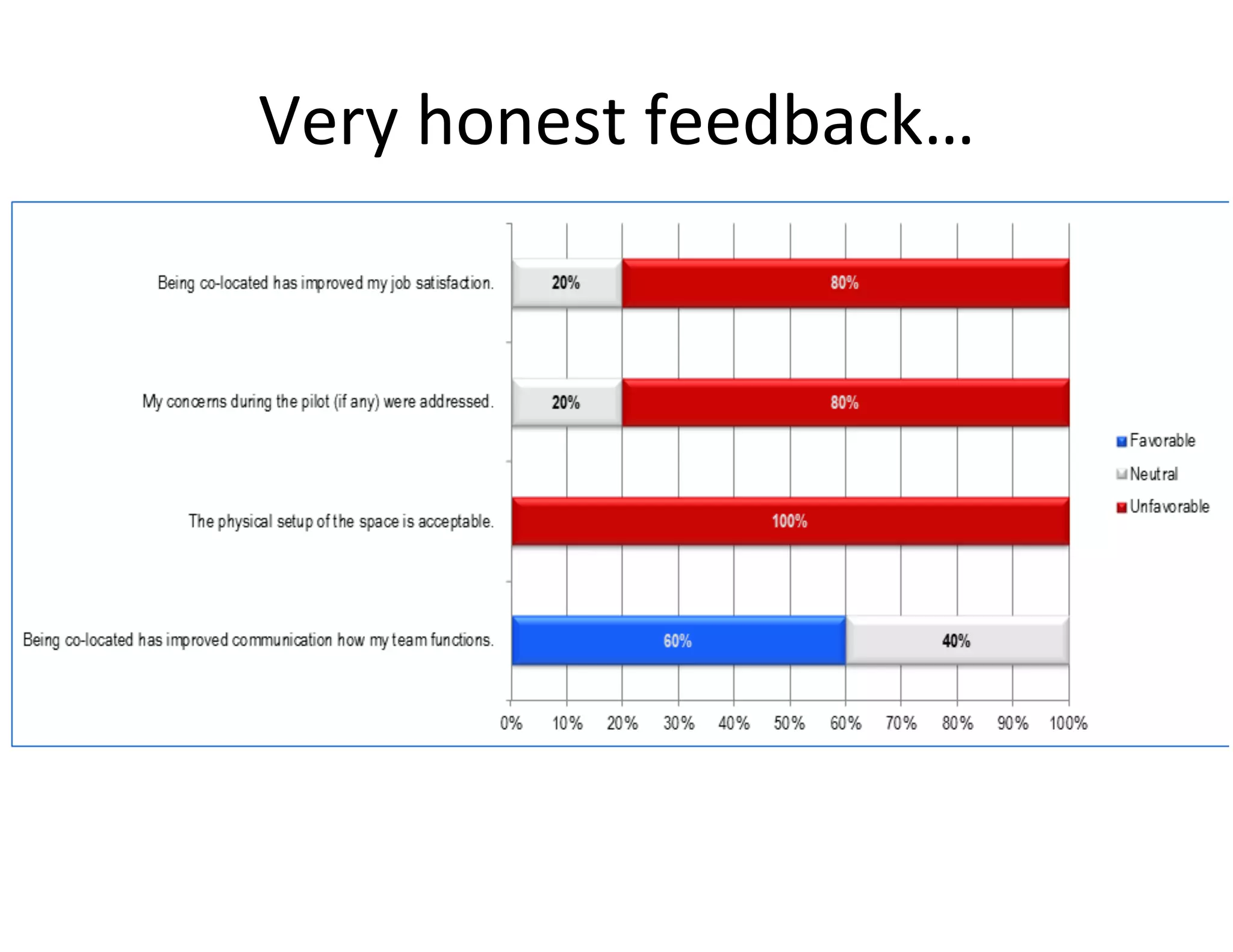
Very	
  honest	
  feedback…	
  
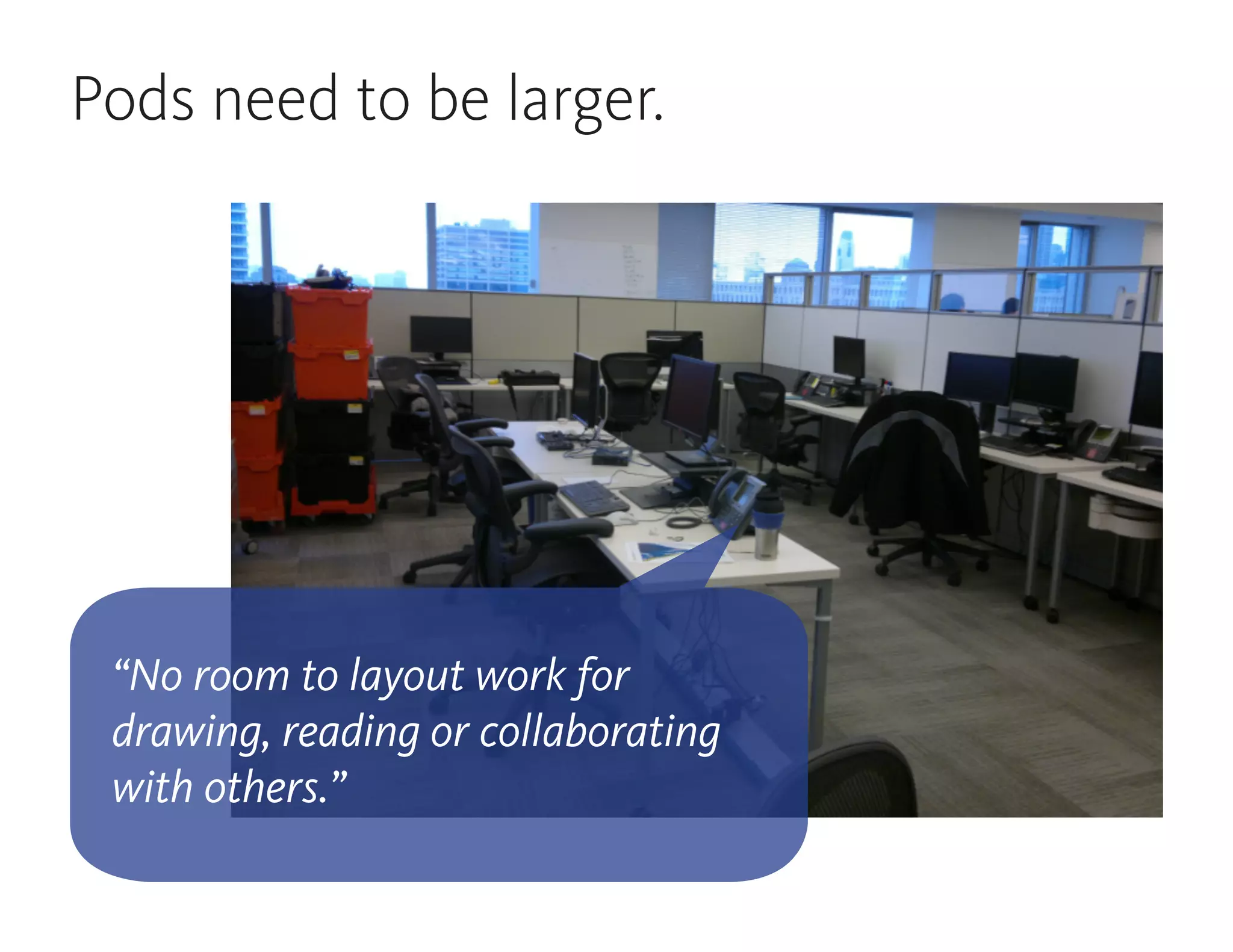
Pods need to be larger.
“No room to layout work for
drawing, reading or collaborating
with others.”
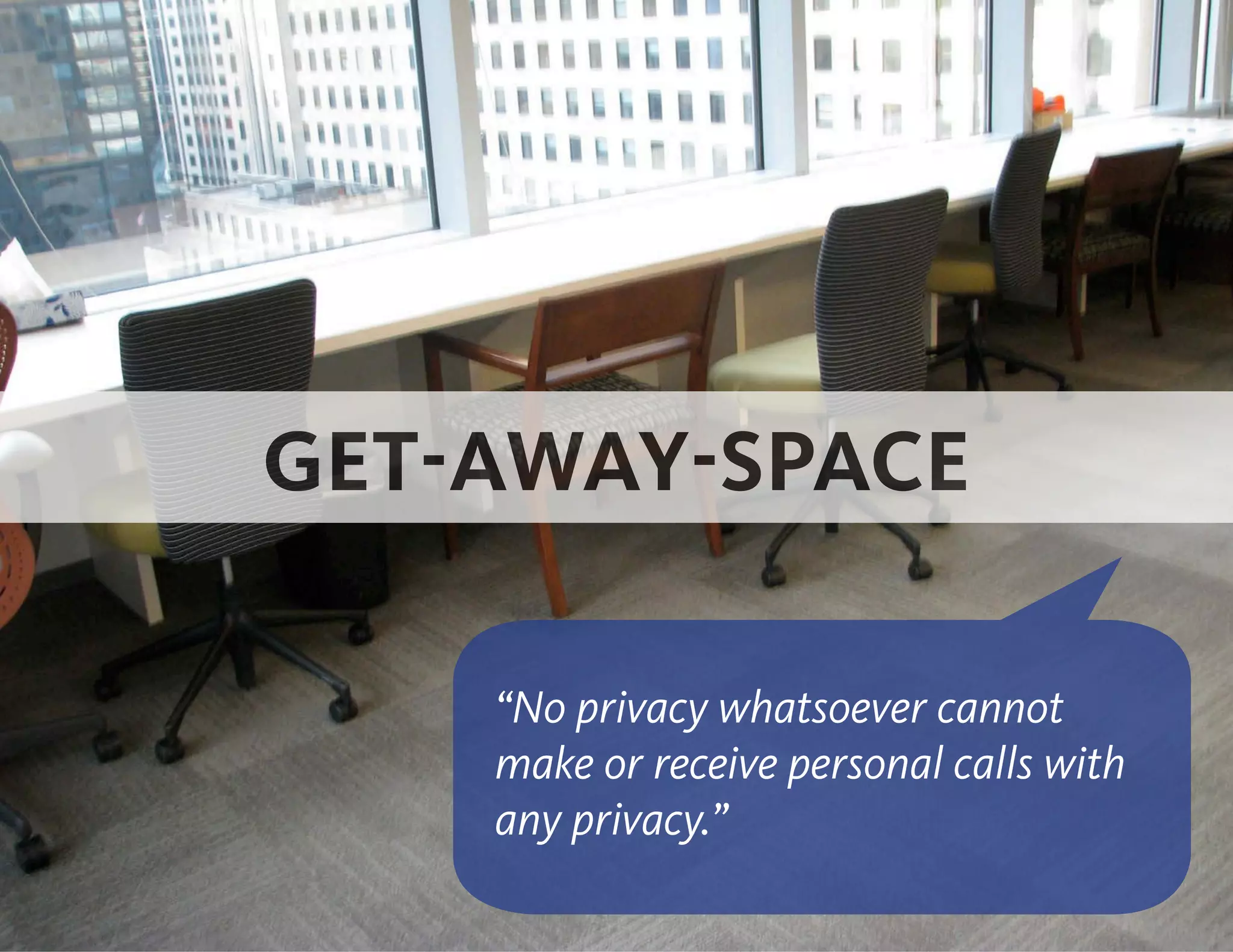
GET-AWAY-SPACE
“No privacy whatsoever cannot
make or receive personal calls with
any privacy.”
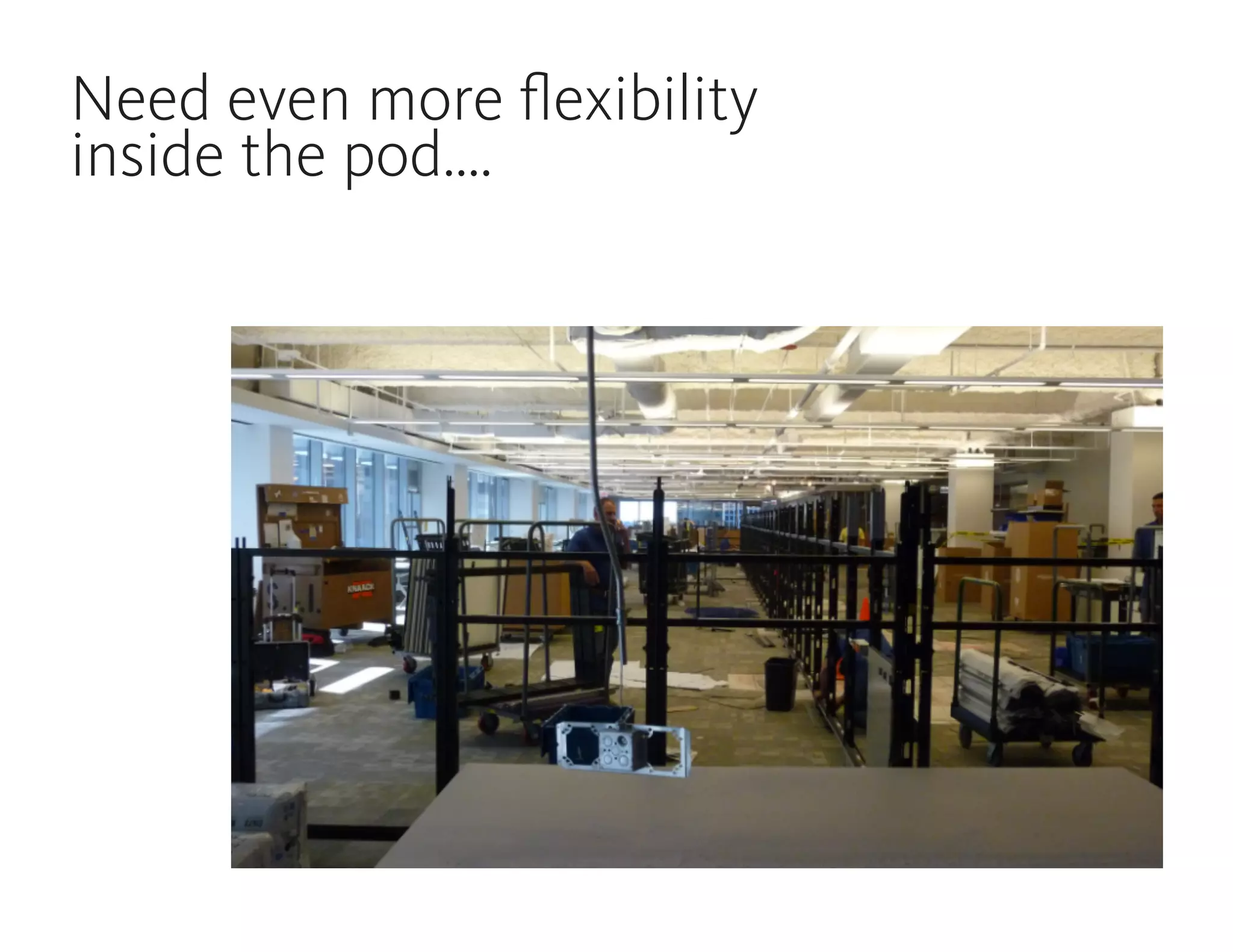
Need even more flexibility
inside the pod....
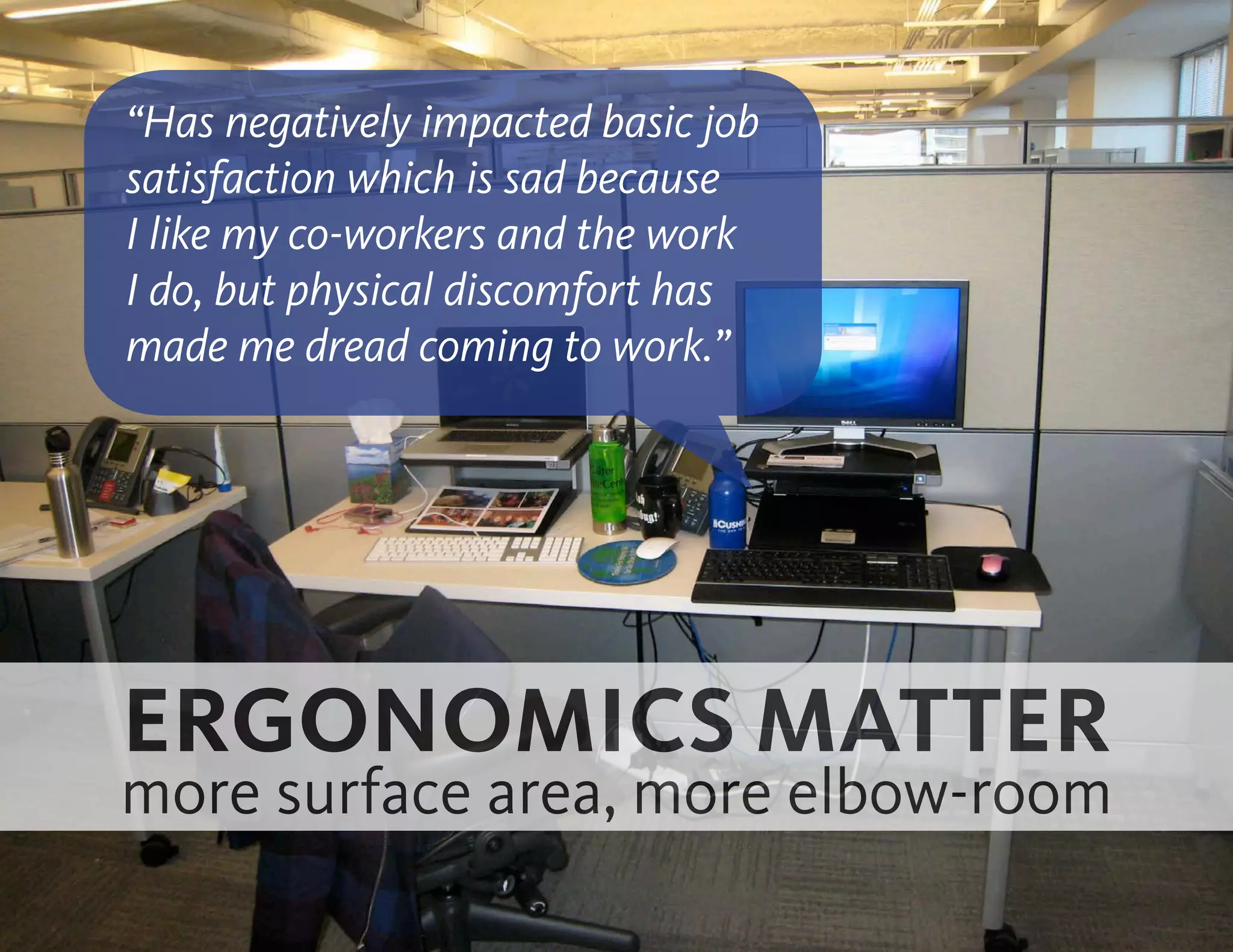
ERGONOMICS MATTER
more surface area, more elbow-room
“Has negatively impacted basic job
satisfaction which is sad because
I like my co-workers and the work
I do, but physical discomfort has
made me dread coming to work.”
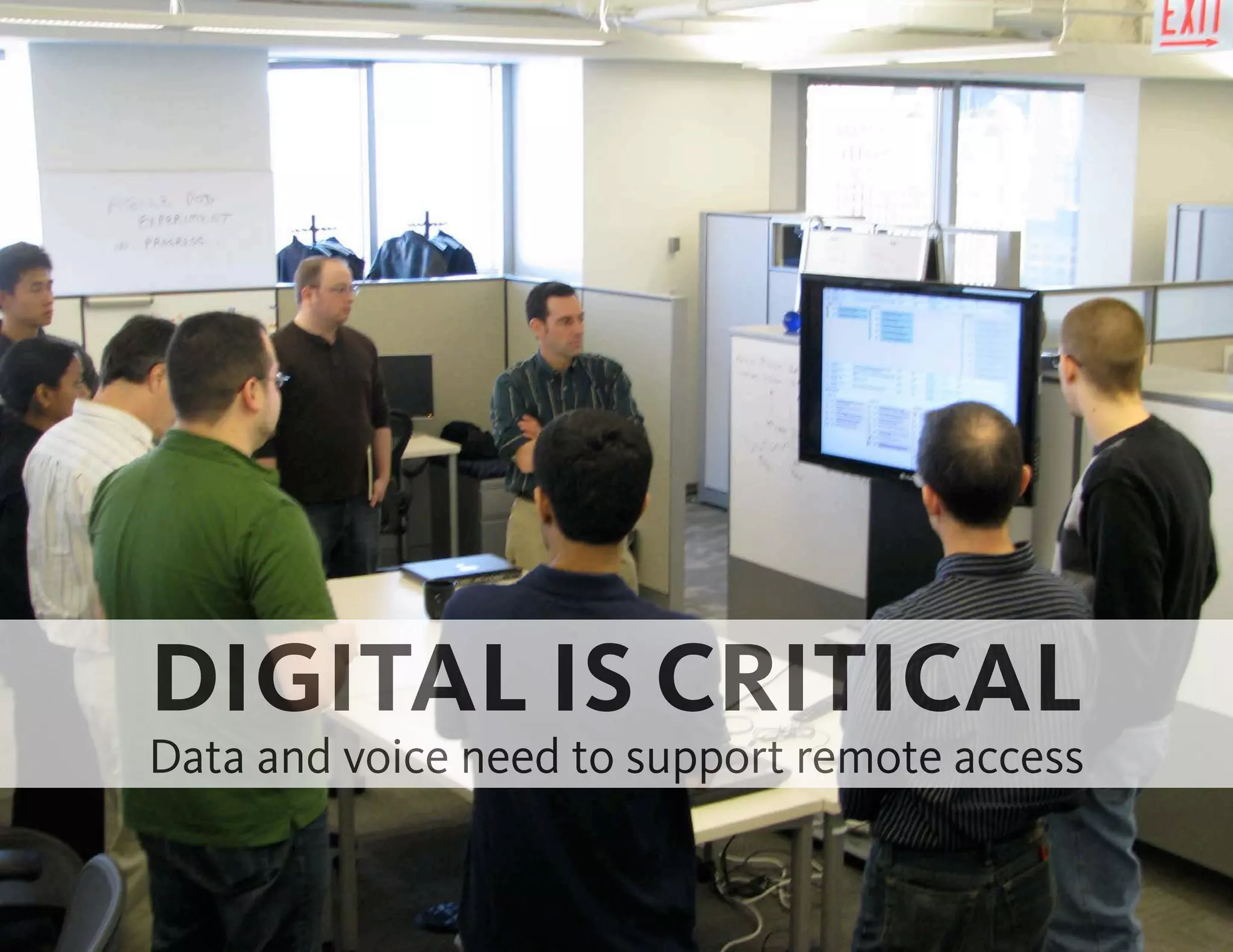
DIGITAL IS CRITICAL
Data and voice need to support remote access
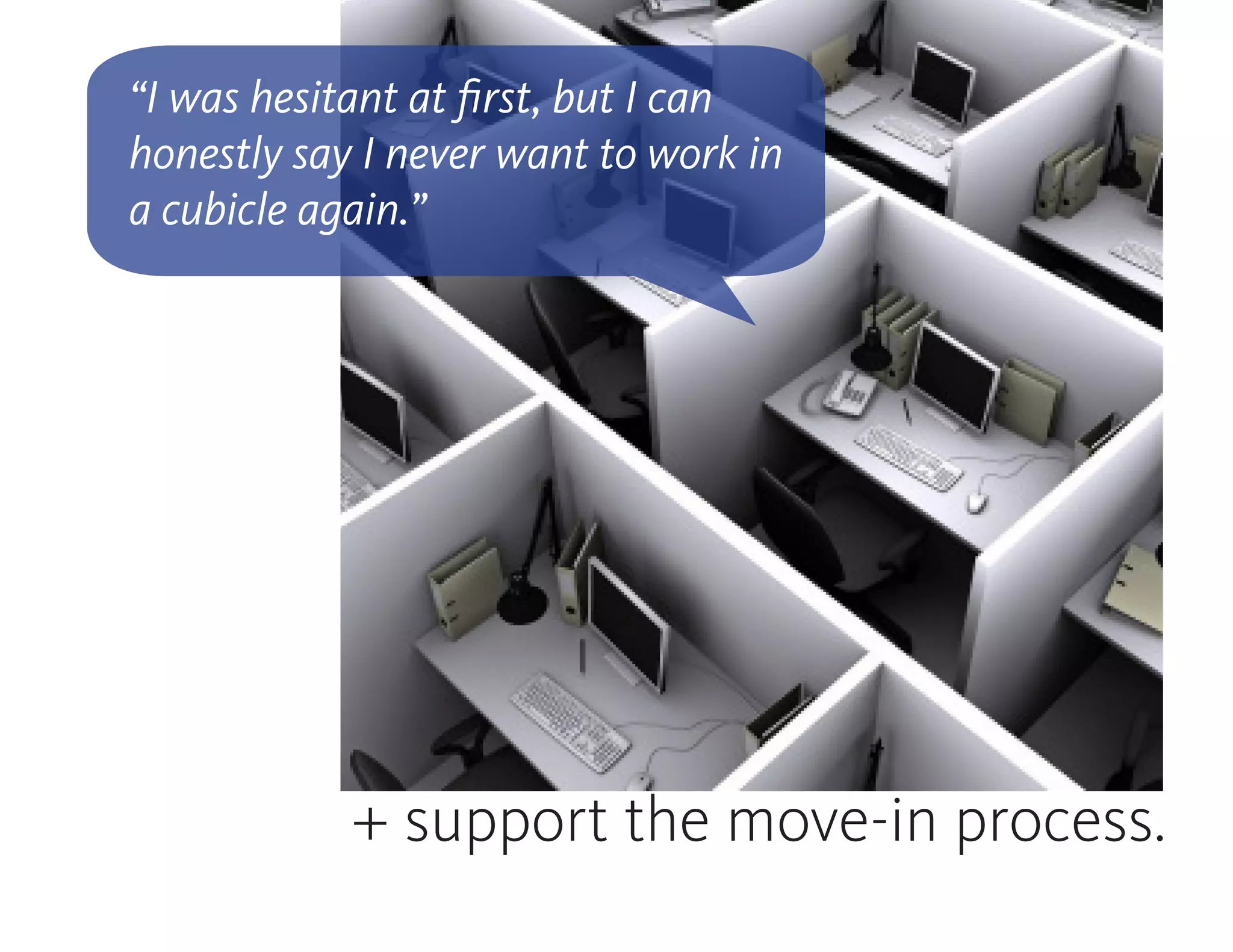
+ support the move-in process.
“I was hesitant at first, but I can
honestly say I never want to work in
a cubicle again.”
WHAT ARE THE
CHALLENGES?
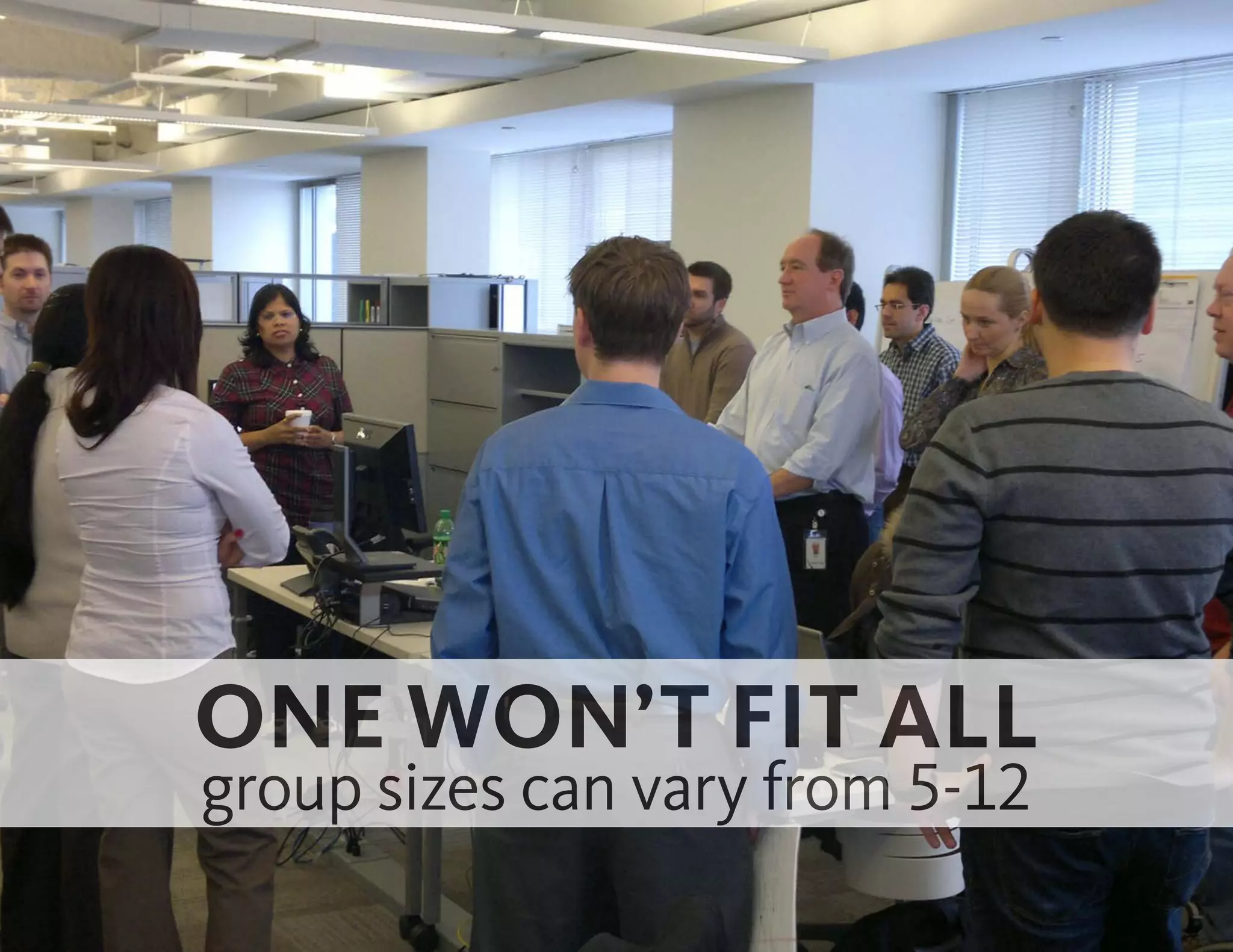
ONE WON’T FIT ALL
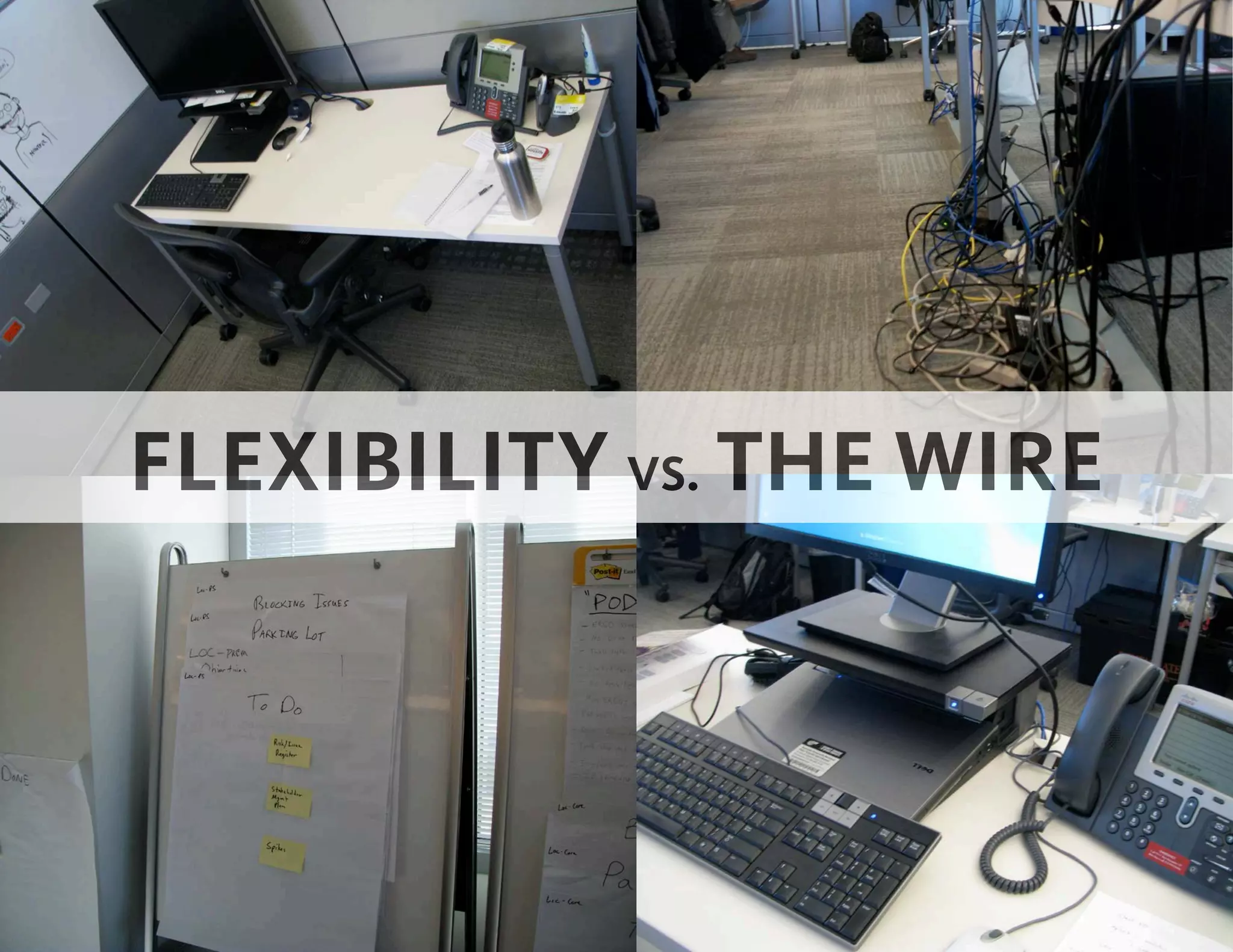
group sizes can vary from 5-12
FLEXIBILITY VS. THE WIRE
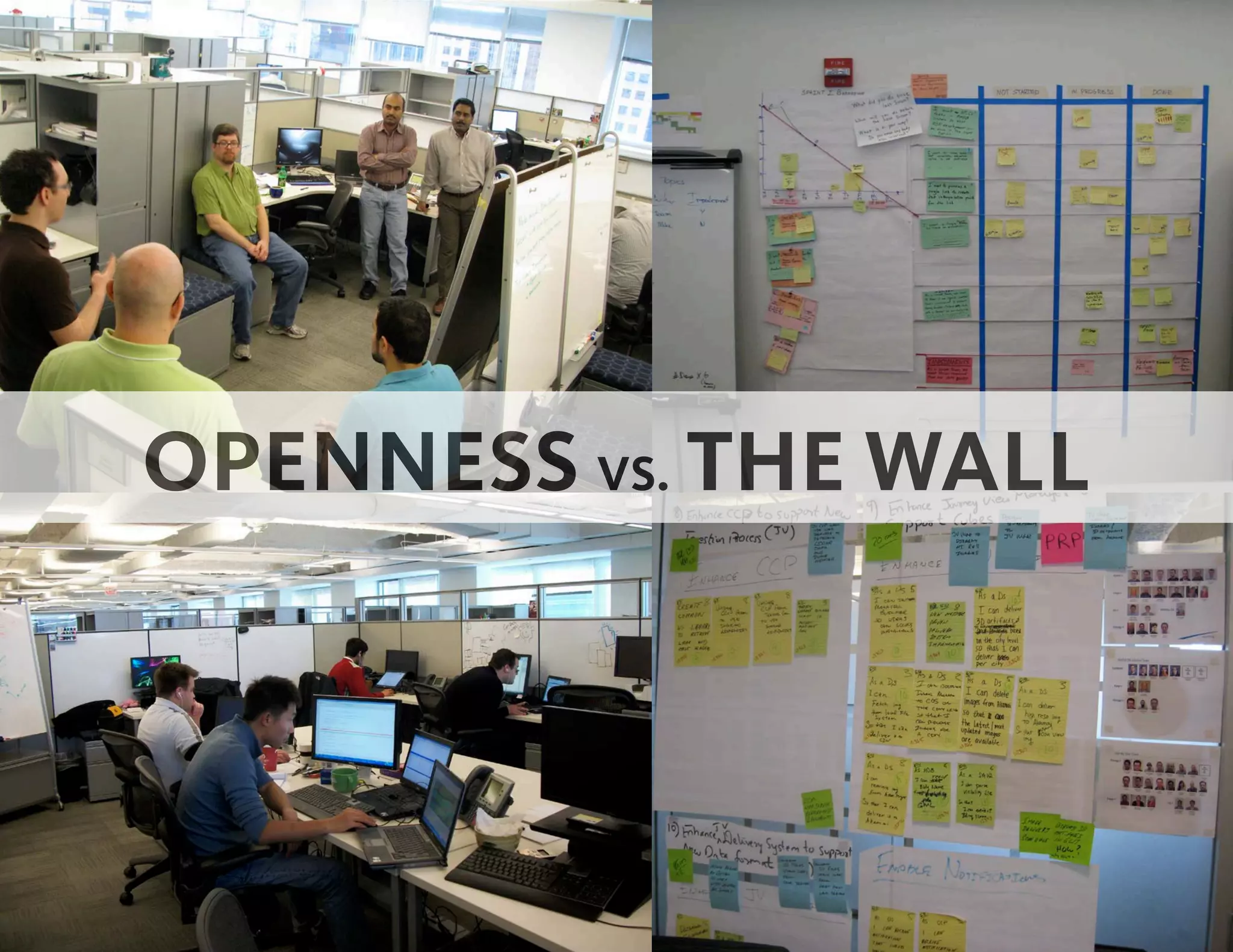
OPENNESS VS. THE WALL
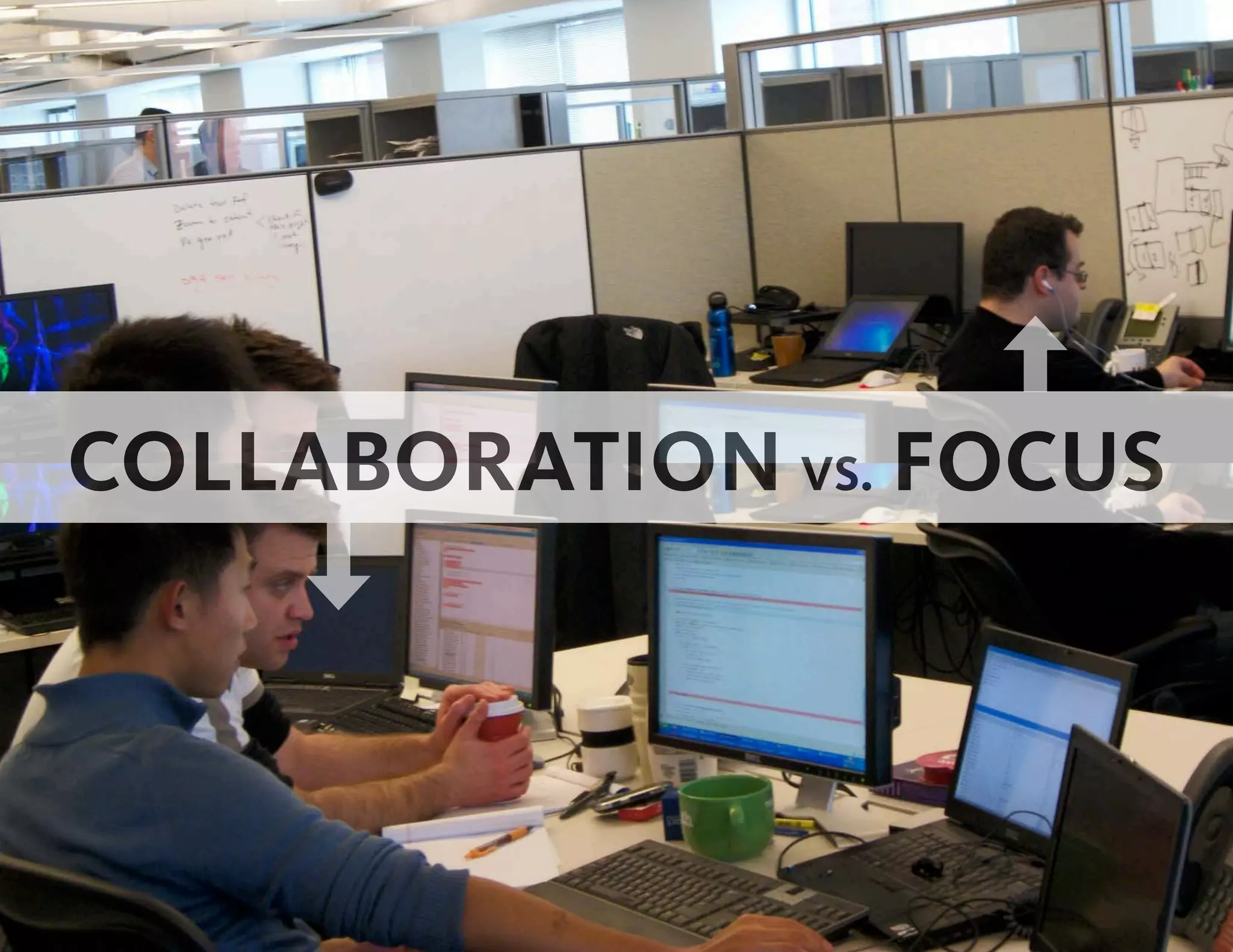
COLLABORATION VS. FOCUS
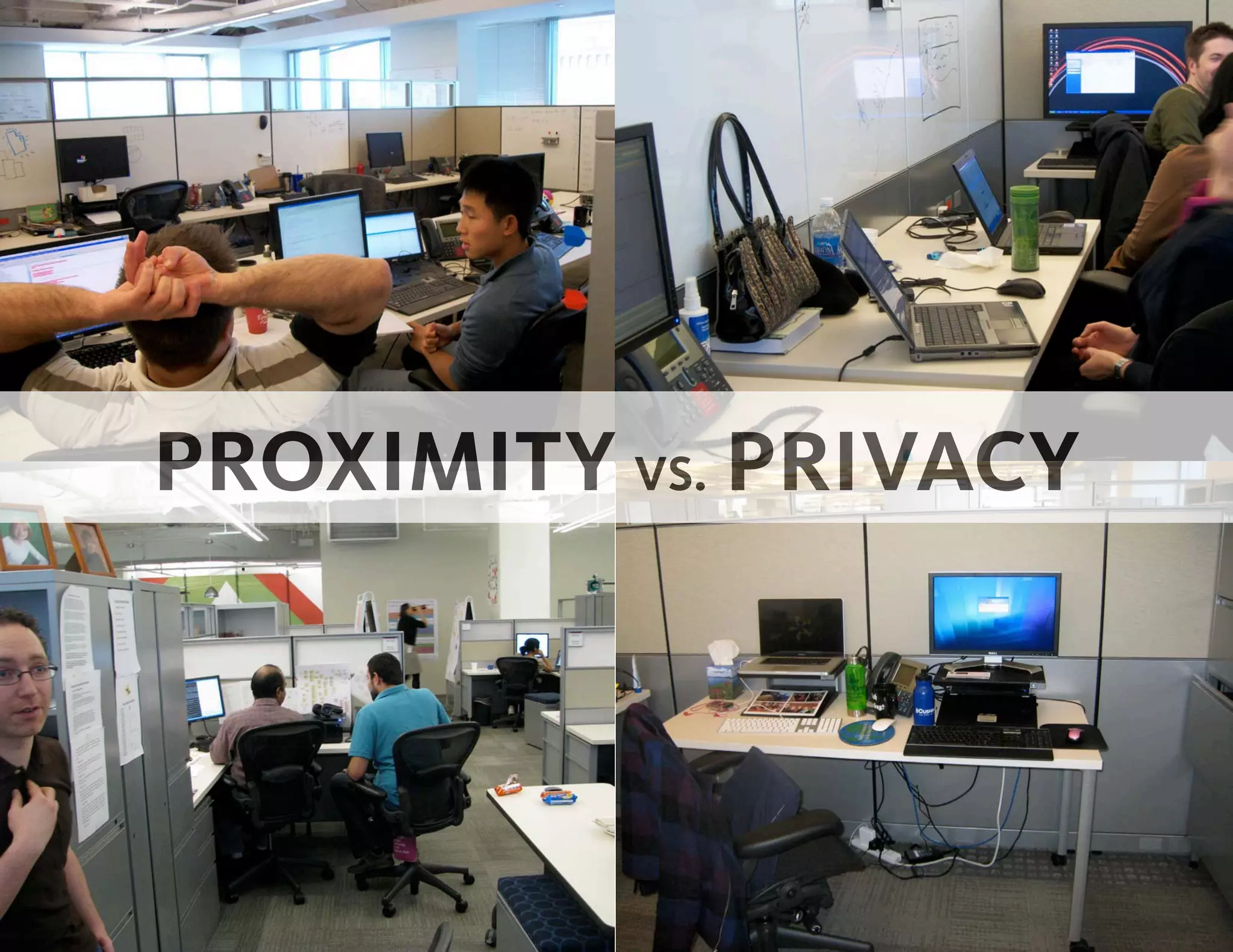
PROXIMITY VS. PRIVACY
WHAT DOES
SUCCESS
LOOK LIKE?
7NAVTEQ | Agile Team Workspaces Chicago, IL | 04.07.2011 | ©2011 Gensler |
What We Learned
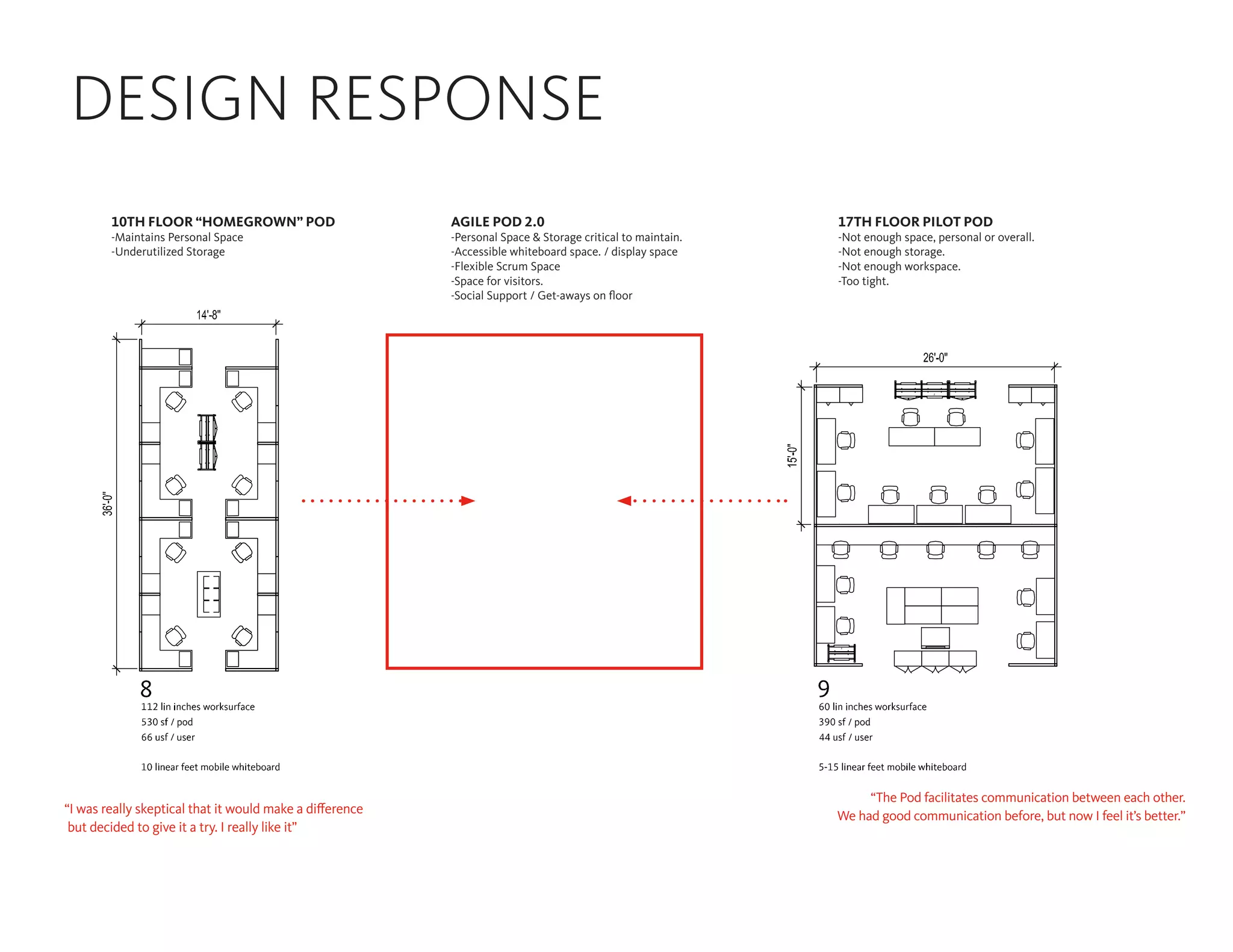
10TH FLOOR “HOMEGROWN” POD
-Maintains Personal Space
-Underutilized Storage
17TH FLOOR PILOT POD
-Not enough space, personal or overall.
-Not enough storage.
-Not enough workspace.
-Too tight.
AGILE POD 2.0
-Personal Space & Storage critical to maintain.
-Accessible whiteboard space. / display space
-Flexible Scrum Space
-Space for visitors.
-Social Support / Get-aways on floor
“I was really skeptical that it would make a difference
but decided to give it a try. I really like it”
“The Pod facilitates communication between each other.
We had good communication before, but now I feel it’s better.”
DESIGN RESPONSE
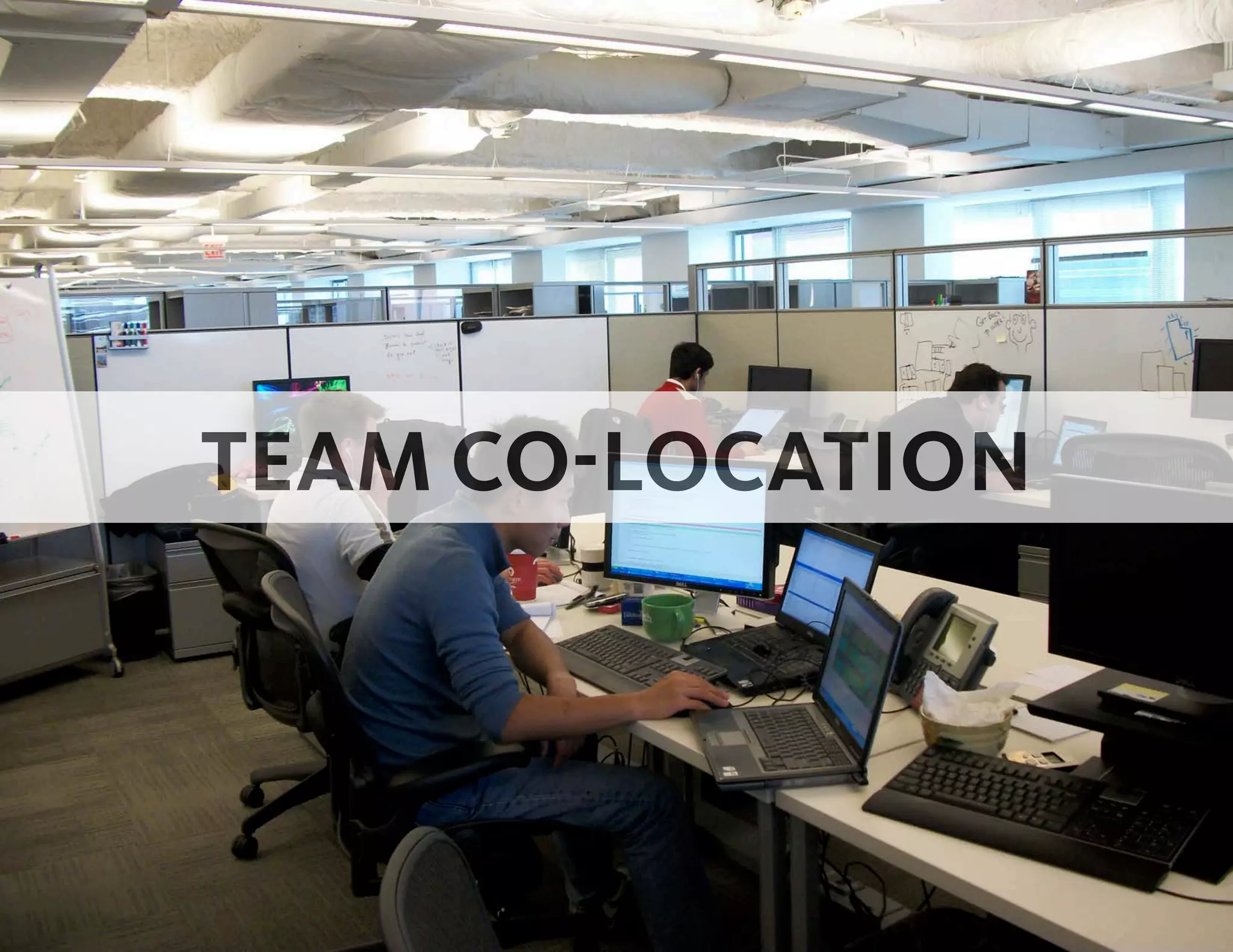
TEAM CO-LOCATION
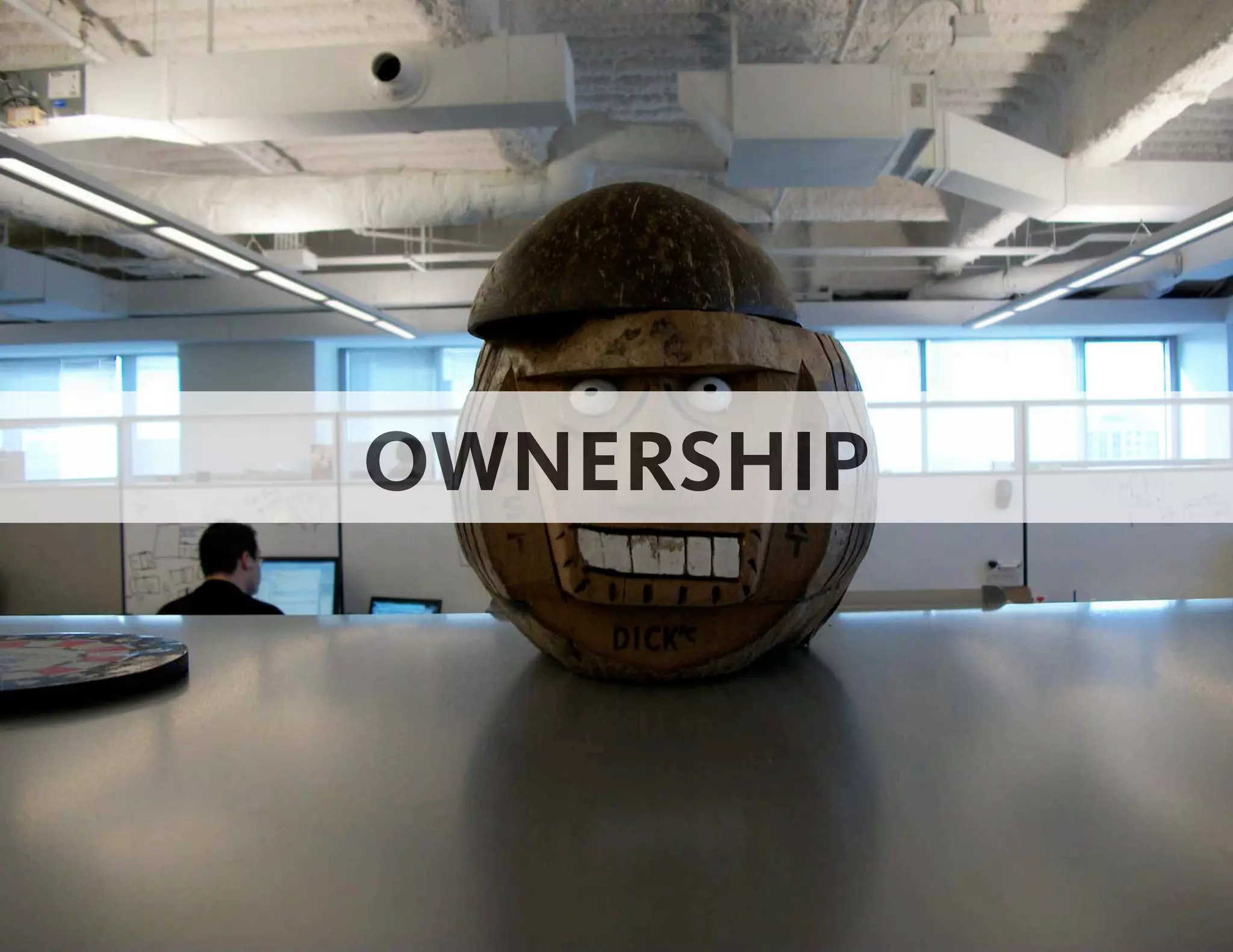
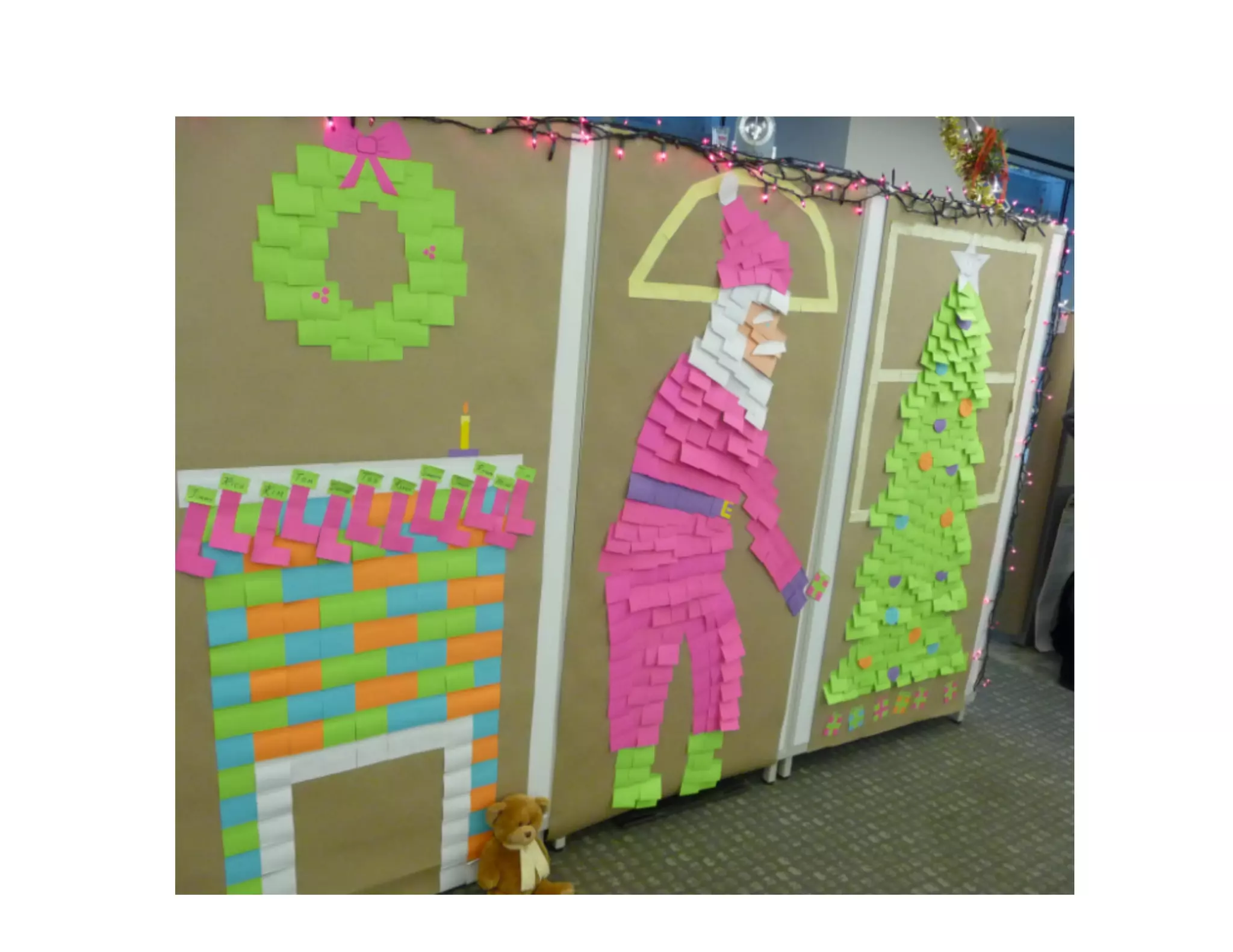
OWNERSHIP
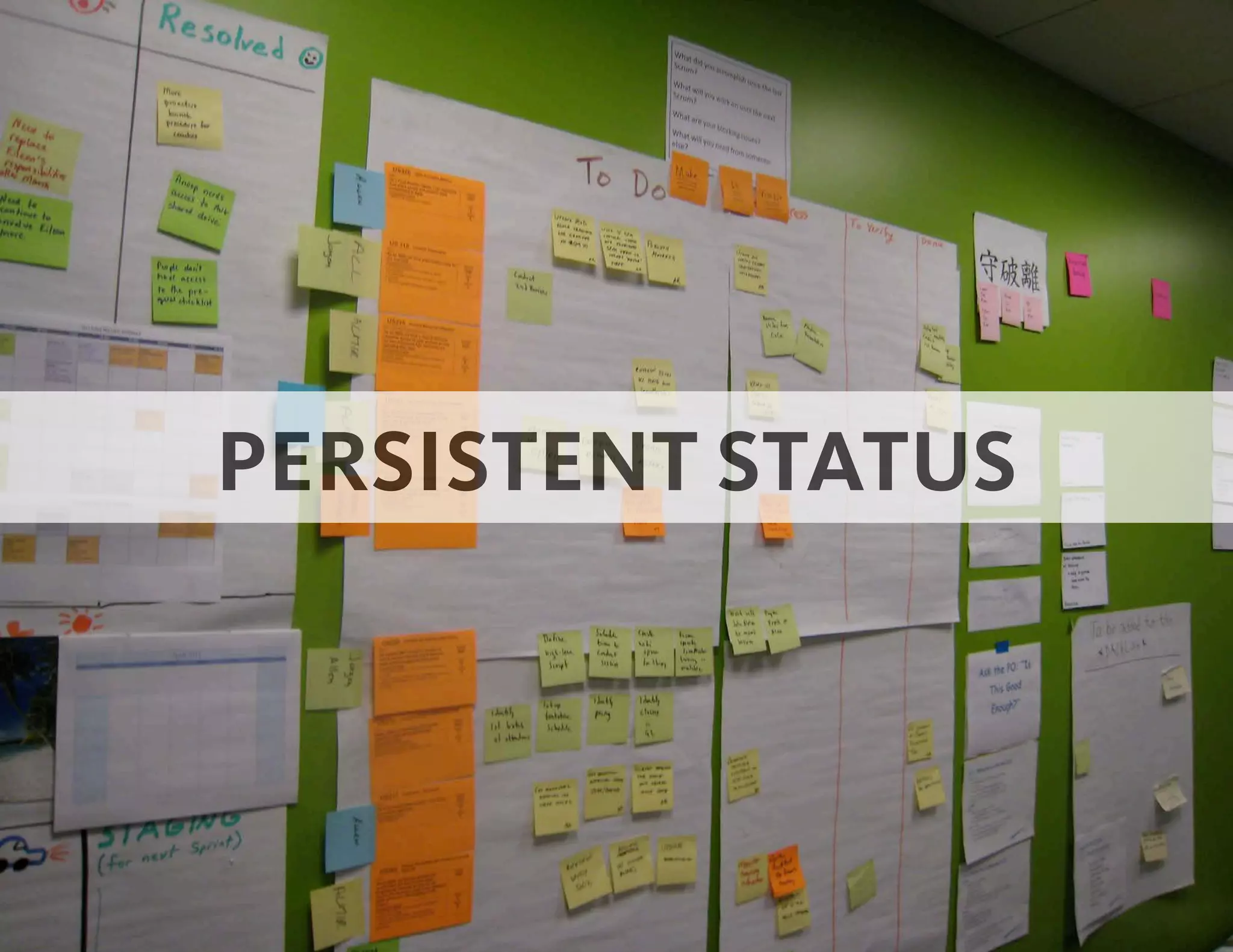
PERSISTENT STATUS
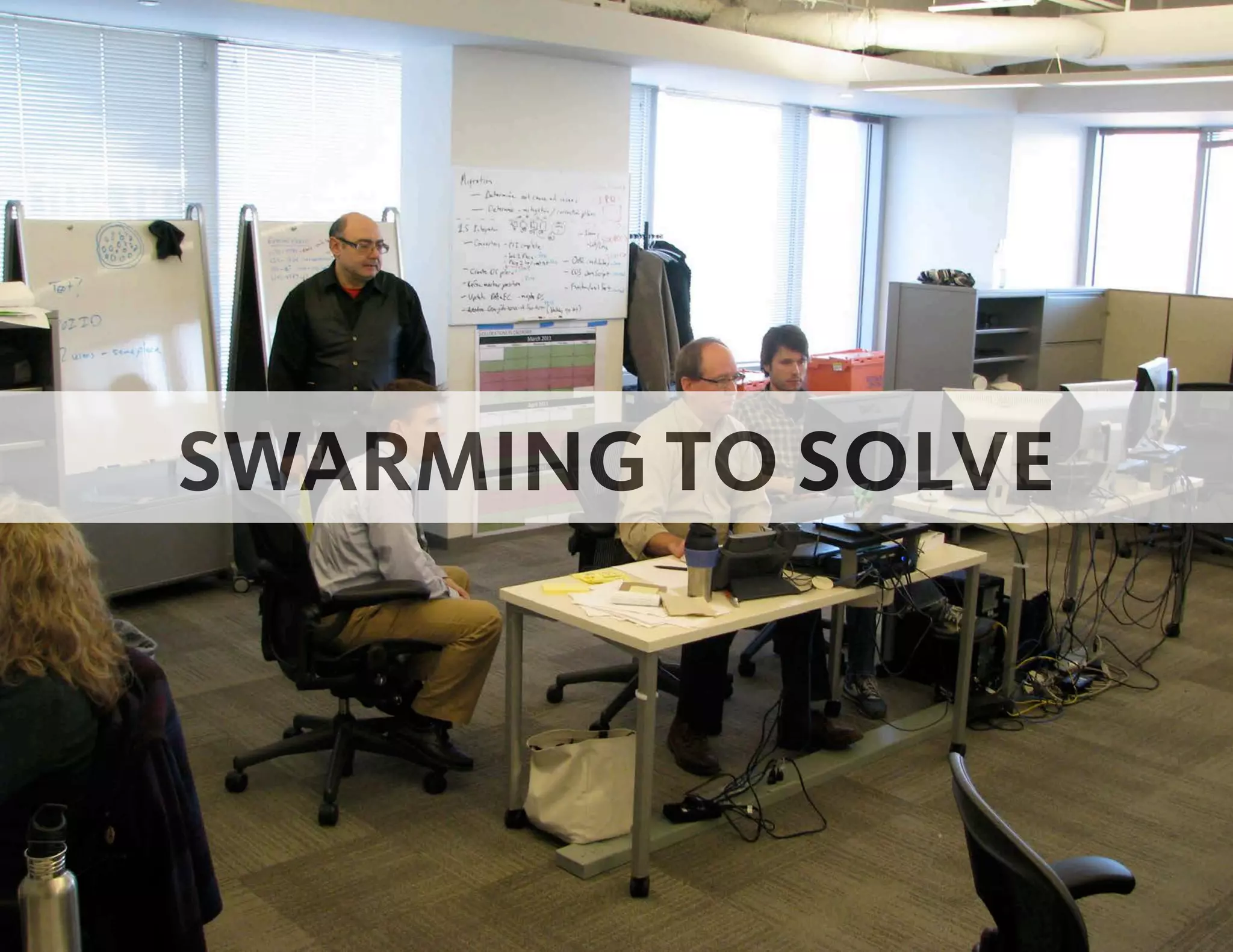
SWARMING TO SOLVE
POSITIVE EAVESDROPPING
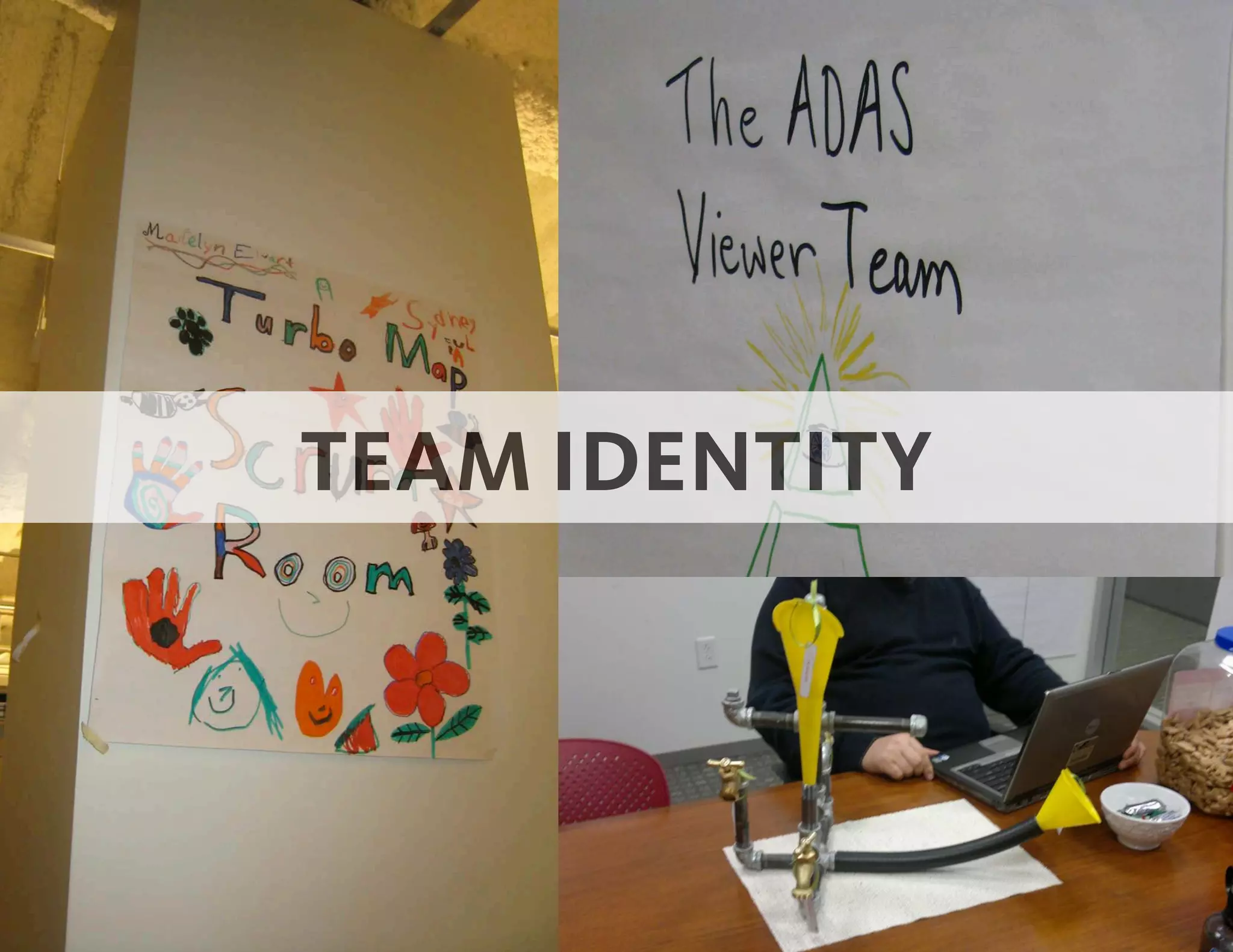
TEAM IDENTITY
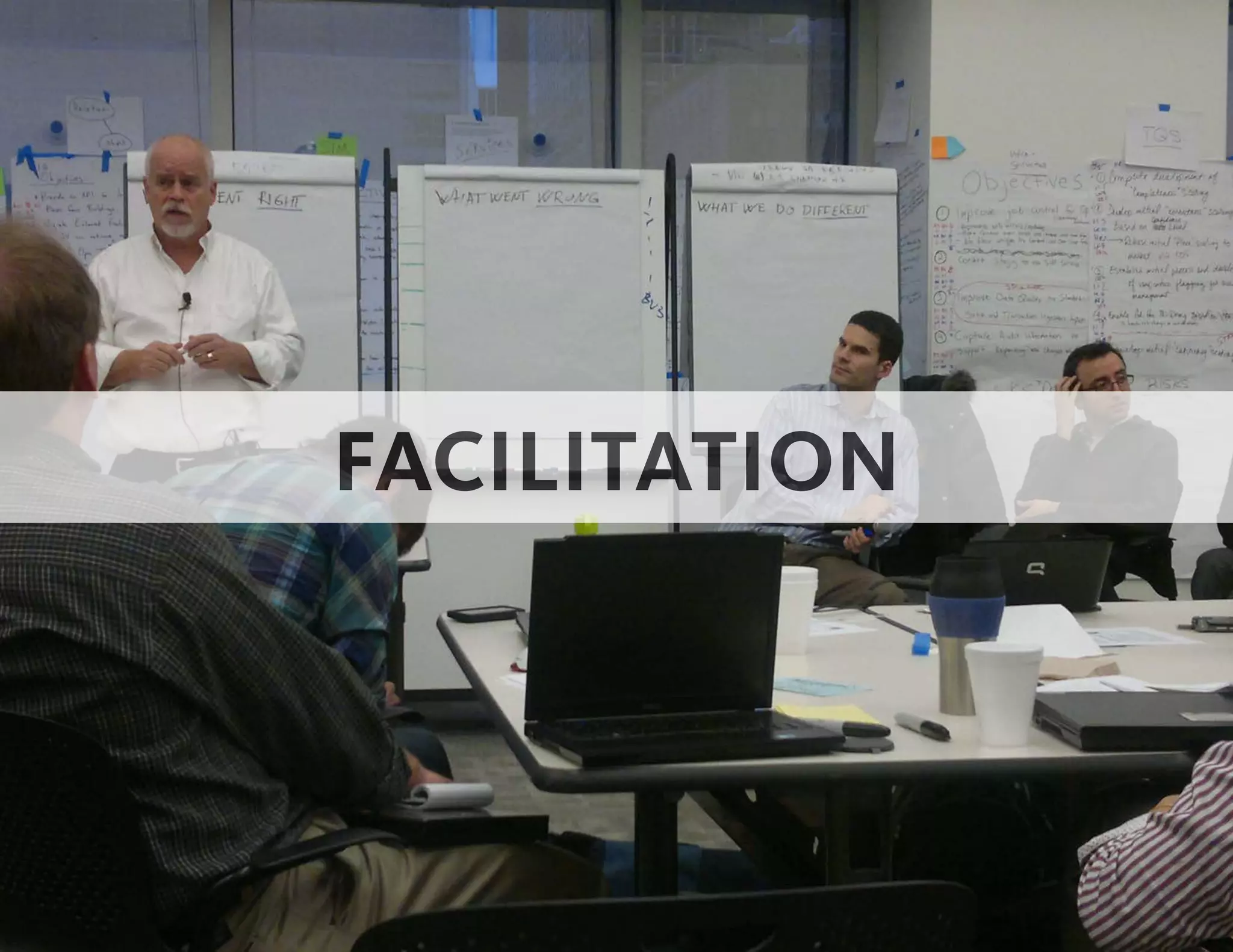
FACILITATION
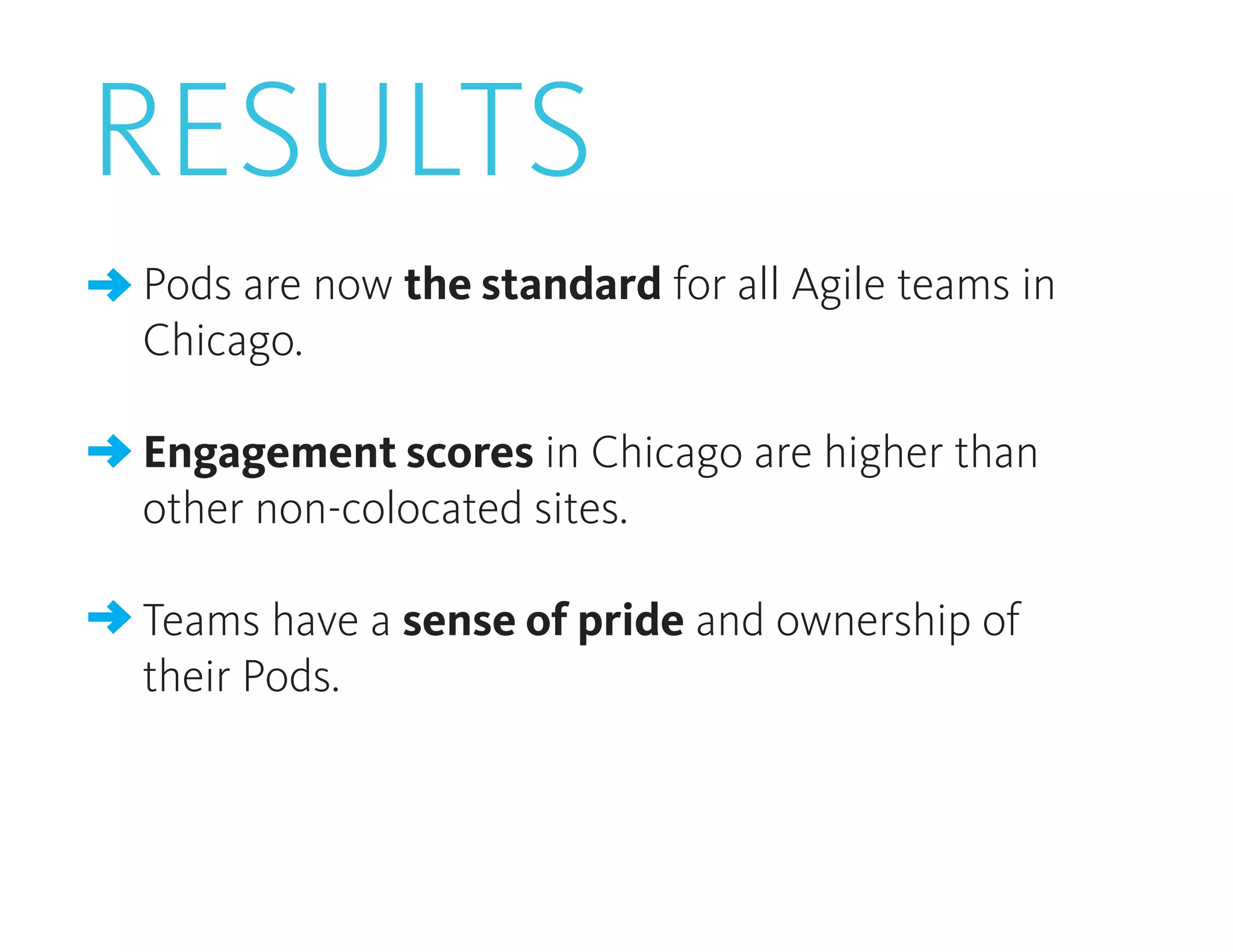
RESULTS
Pods are now the standard for all Agile teams in
Chicago.
Engagement scores in Chicago are higher than
other non-colocated sites.
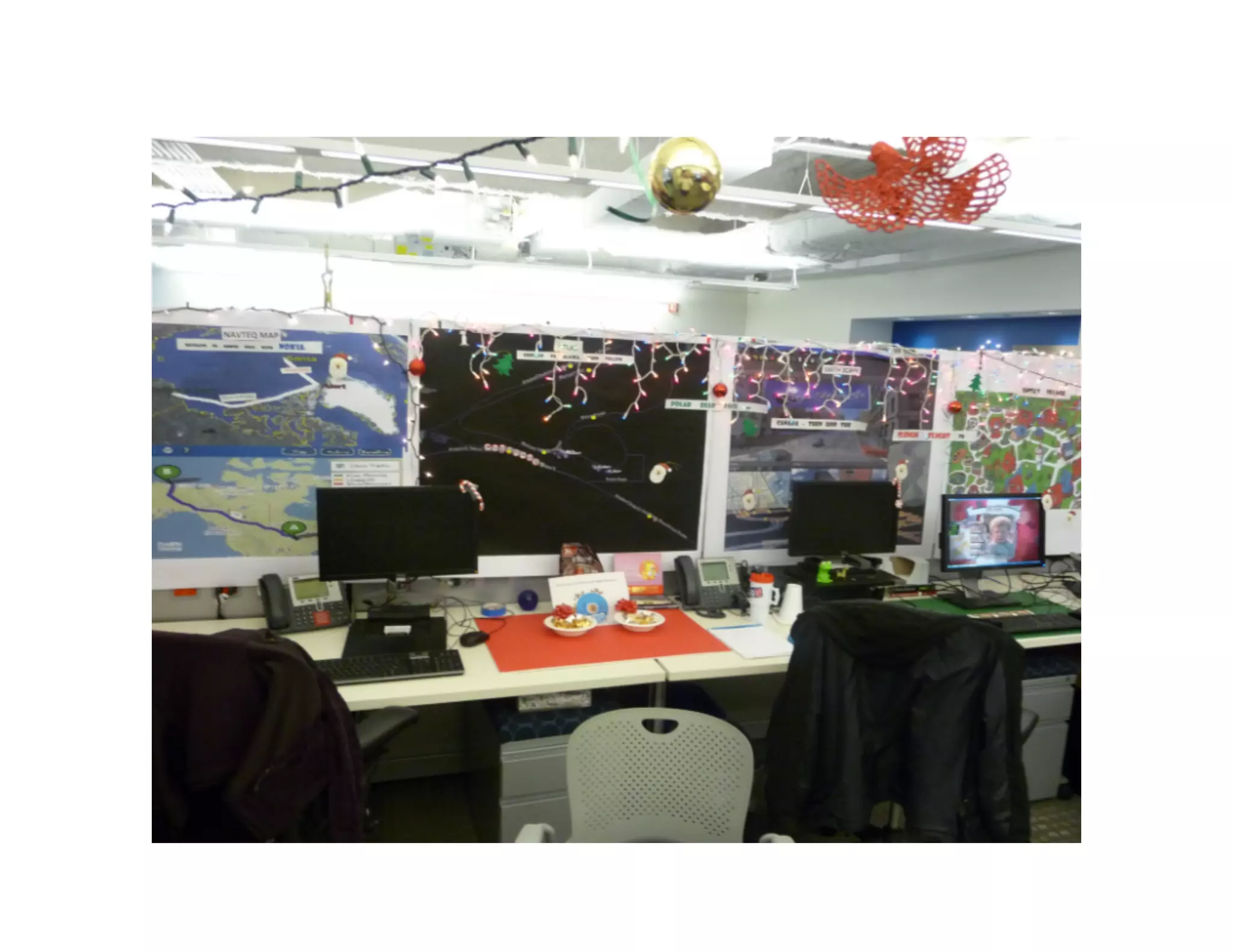
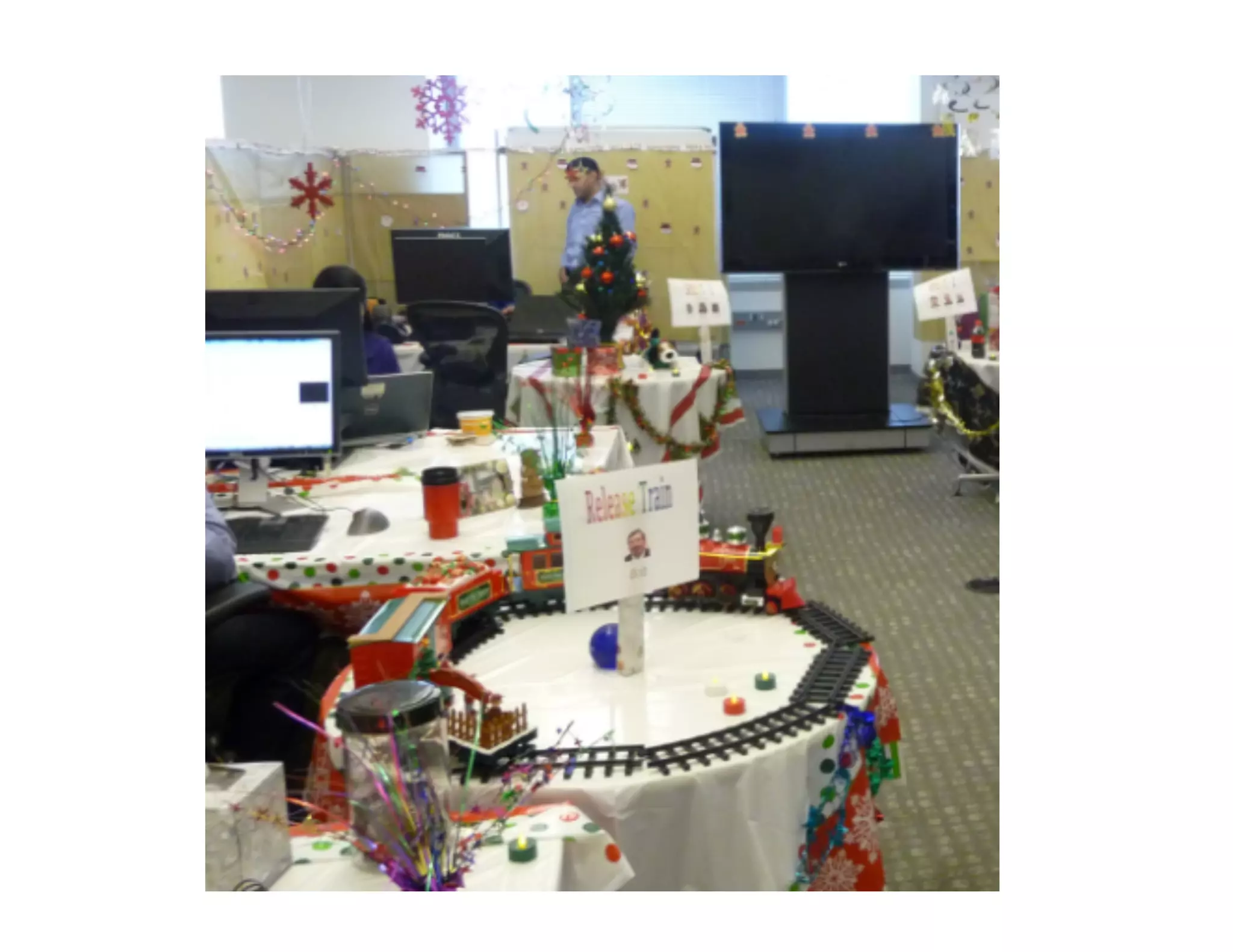
Teams have a sense of pride and ownership of
their Pods.
WHAT’S
NEXT?
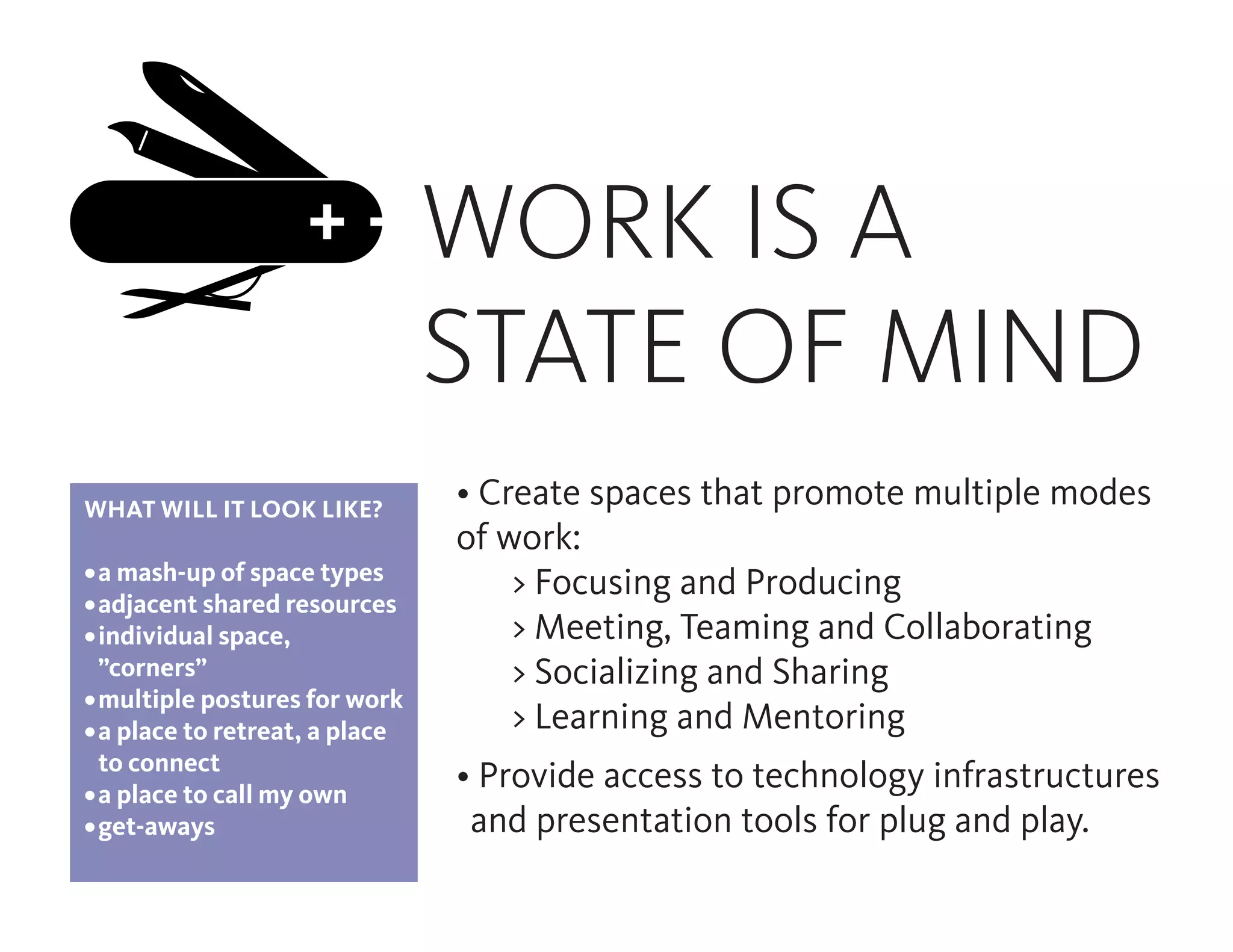
WORK IS A
STATE OF MIND
WHAT WILL IT LOOK LIKE?
•	a mash-up of space types
•	adjacent shared resources
•	individual space,
”corners”
•	multiple postures for work
•	a place to retreat, a place
to connect
•	a place to call my own
•	get-aways
• Create spaces that promote multiple modes
of work:
	 > Focusing and Producing
	 > Meeting, Teaming and Collaborating
	 > Socializing and Sharing
	 > Learning and Mentoring
• Provide access to technology infrastructures
and presentation tools for plug and play.
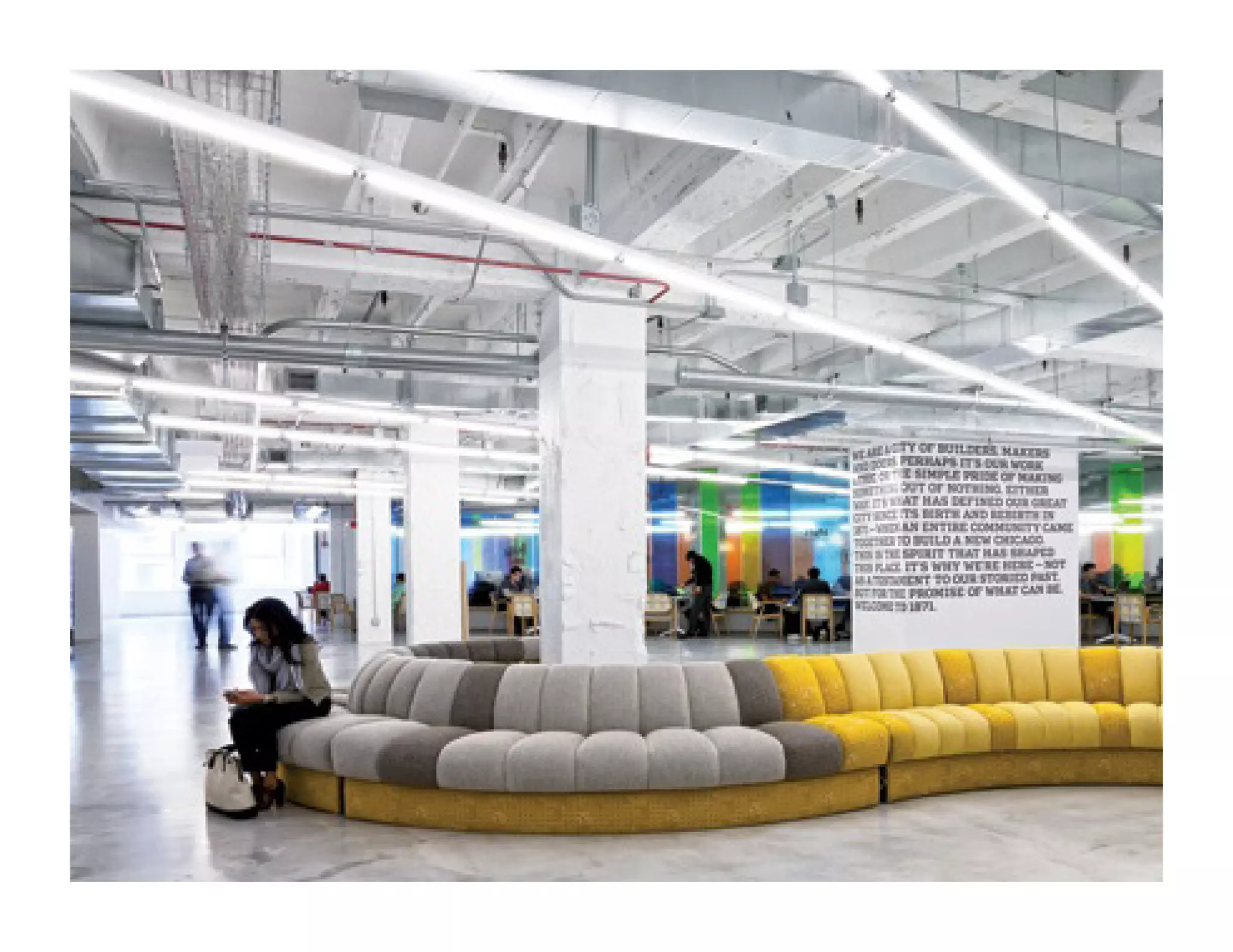
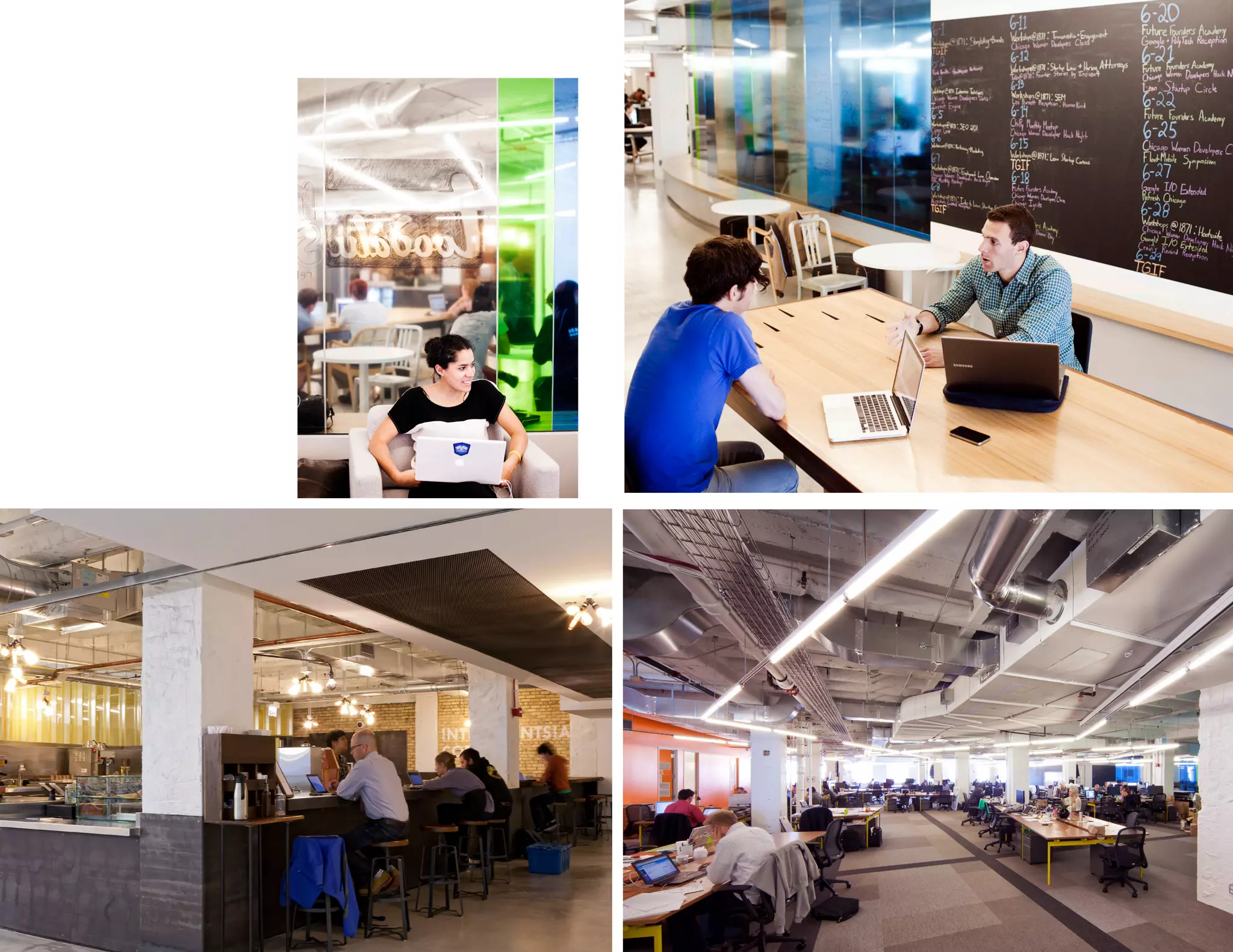
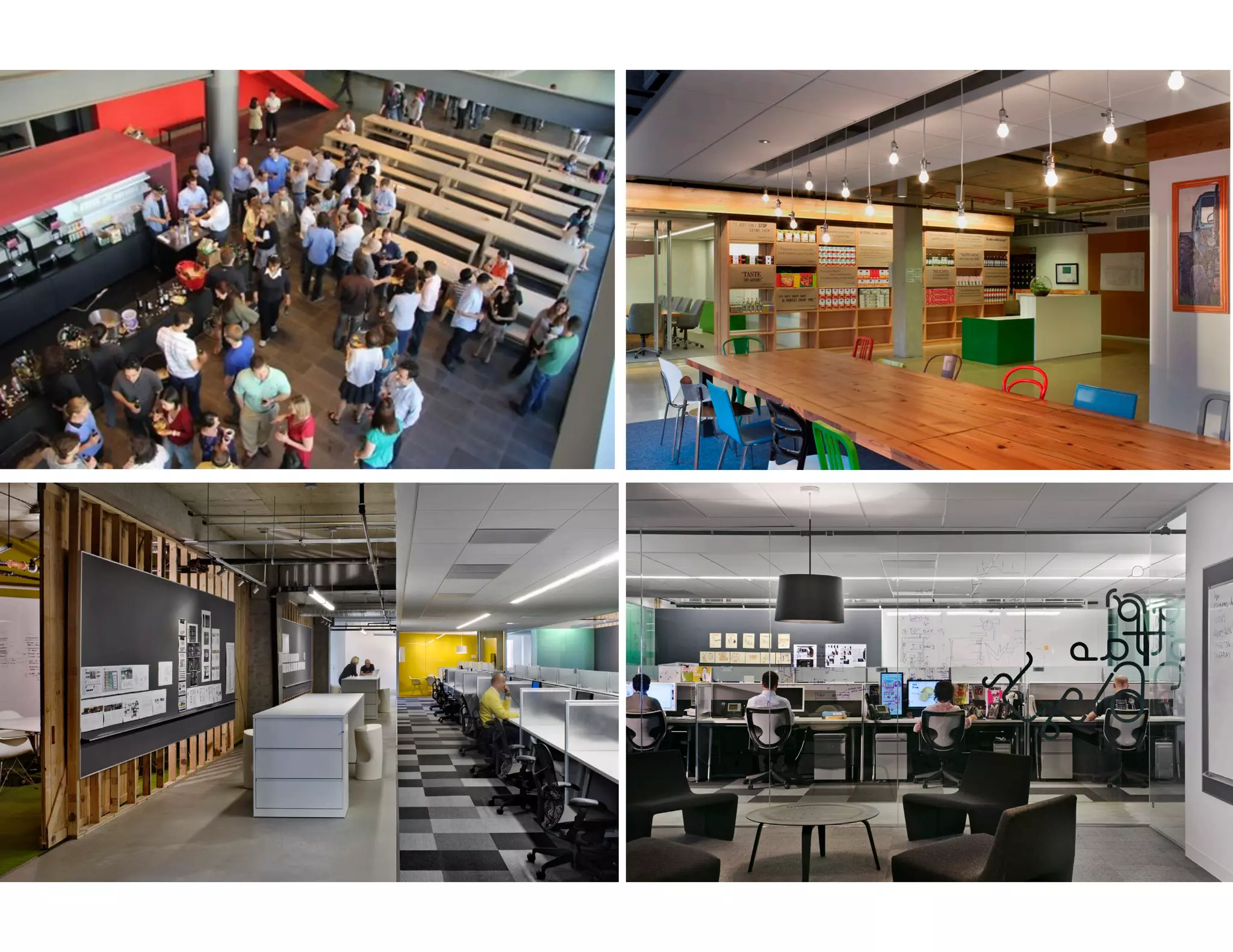
SPACE SHOULD
COMMUNICATE A
SHARED PURPOSE.
WHAT WILL IT LOOK LIKE?
•	people space
•	display space
•	opportunities for team
•	social support
•	learning support
• Create spaces that feature and make
big ideas and people visible.
• Use the space as a storyteller about the
team.
• Designate programs and spaces that
promote social and learning activities—
allow these spaces to be visible and part
of the culture.
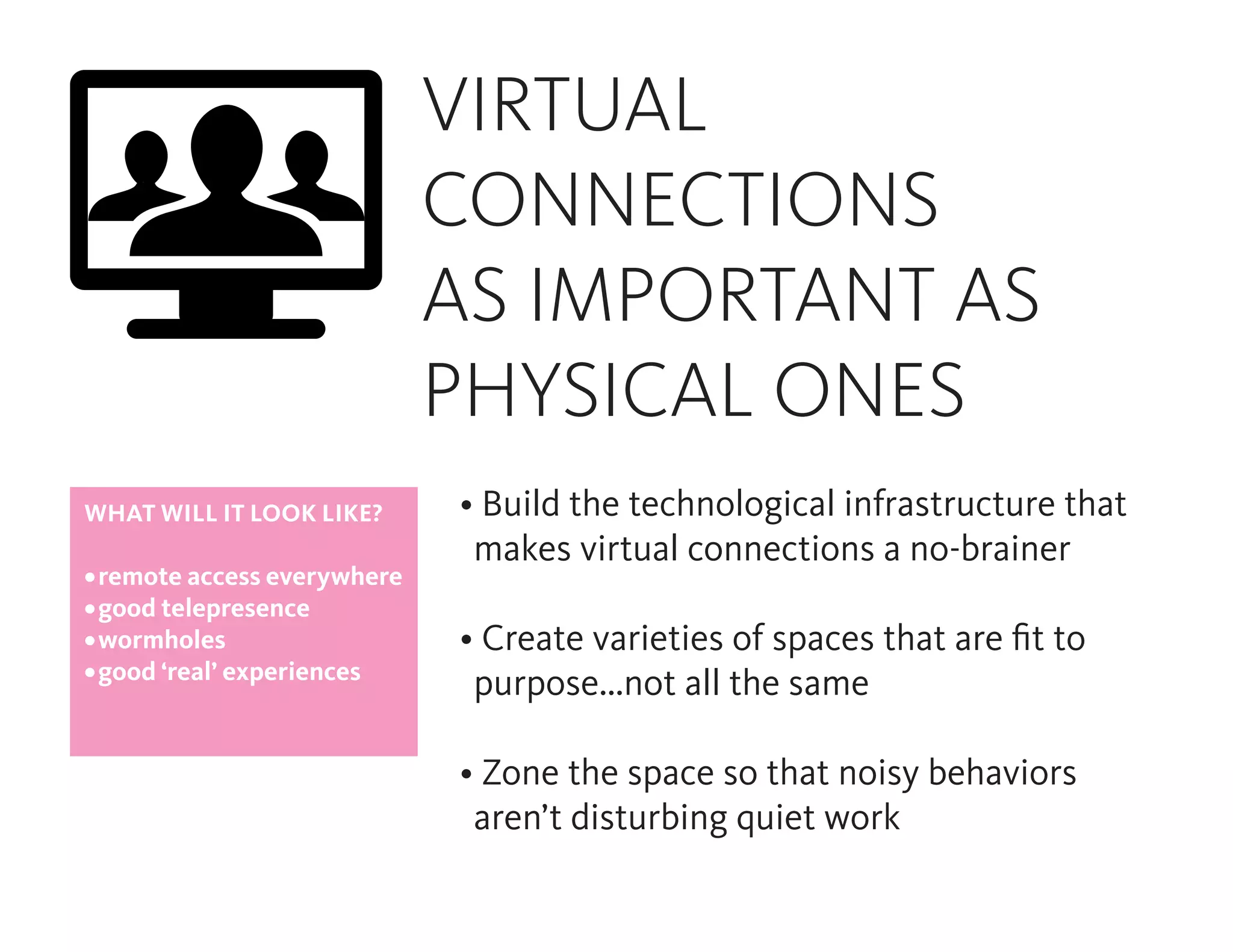
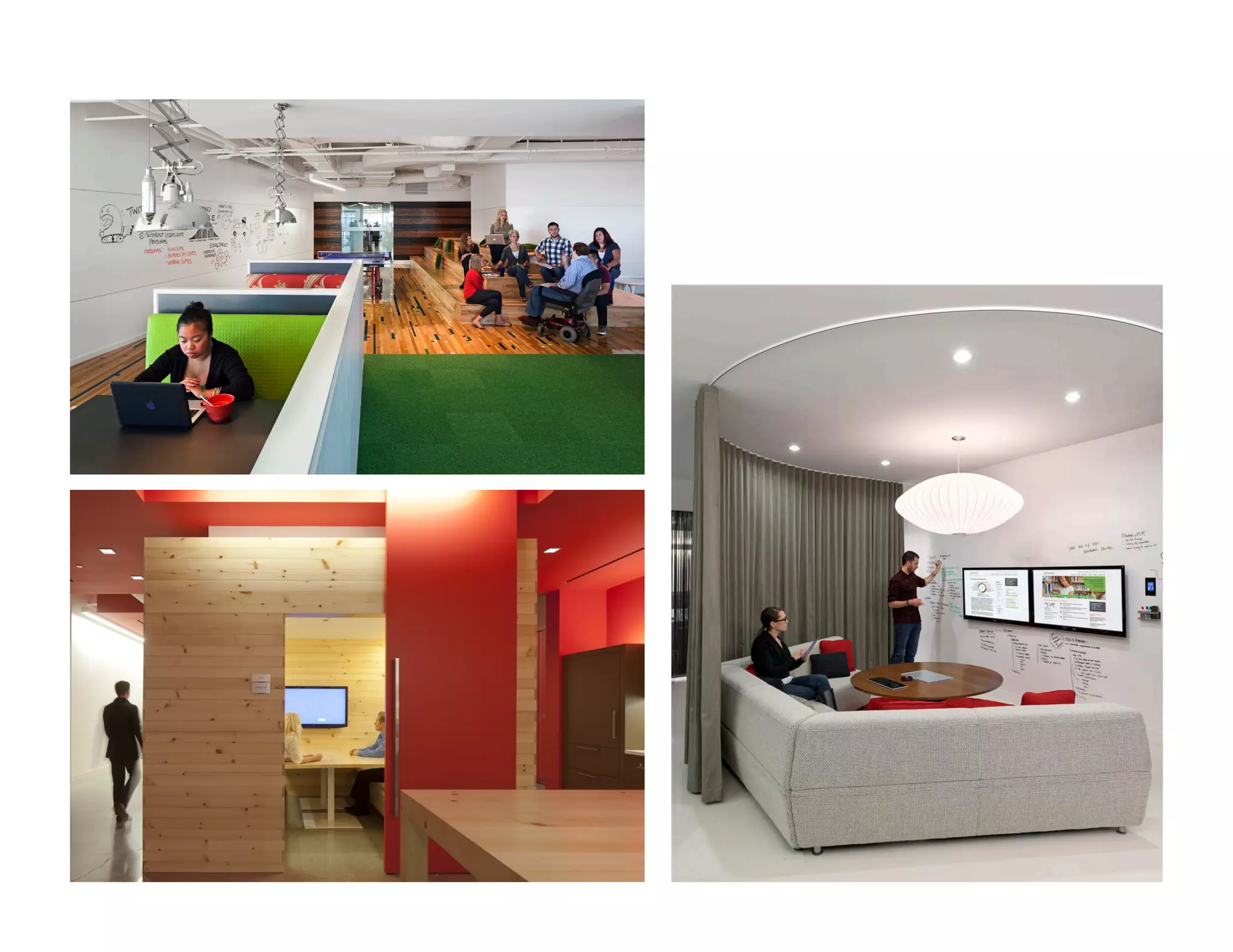
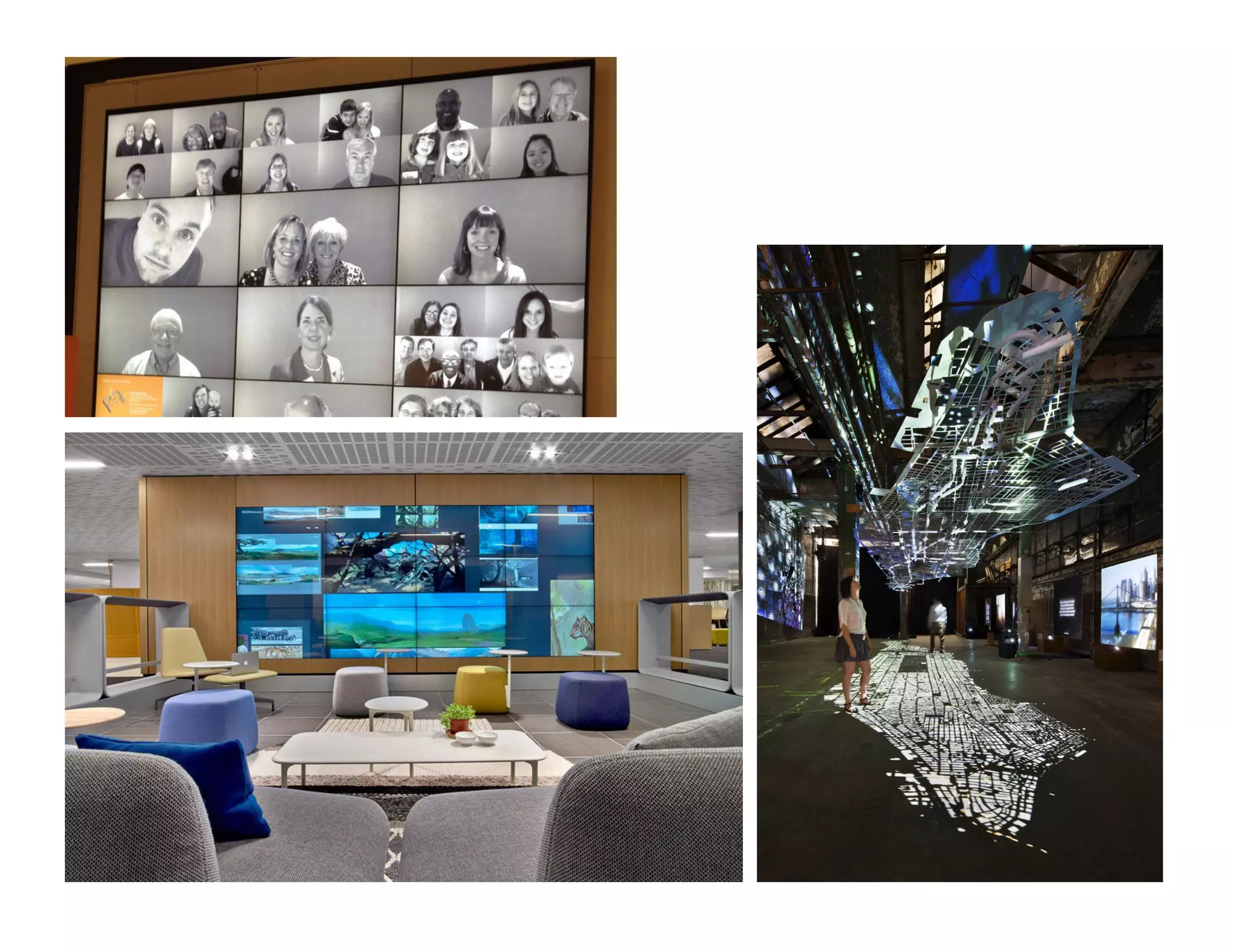
VIRTUAL
CONNECTIONS
AS IMPORTANT AS
PHYSICAL ONES
WHAT WILL IT LOOK LIKE?
•	remote access everywhere
•	good telepresence
•	wormholes
•	good ‘real’ experiences
• Build the technological infrastructure that
makes virtual connections a no-brainer
• Create varieties of spaces that are fit to
purpose...not all the same
• Zone the space so that noisy behaviors
aren’t disturbing quiet work
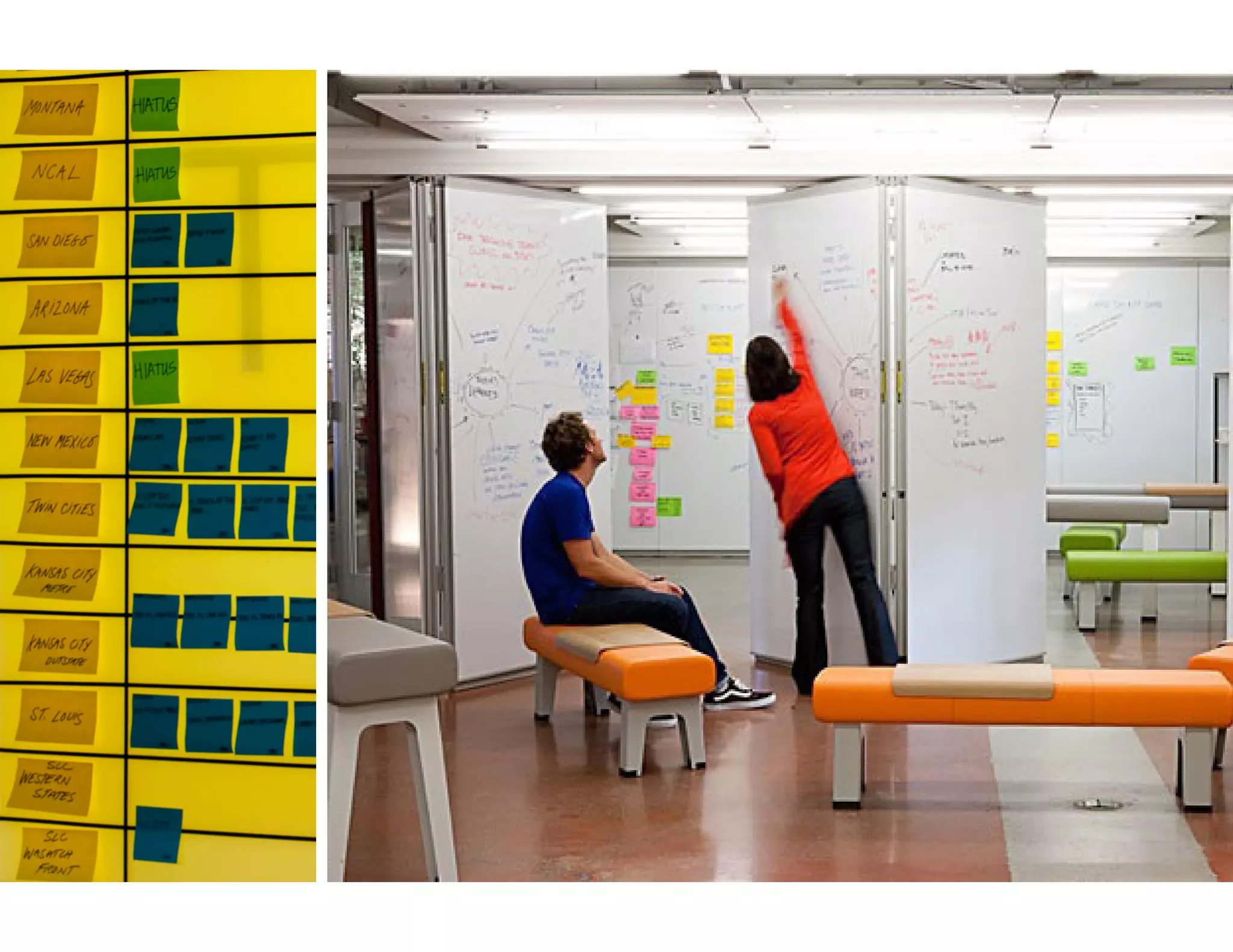
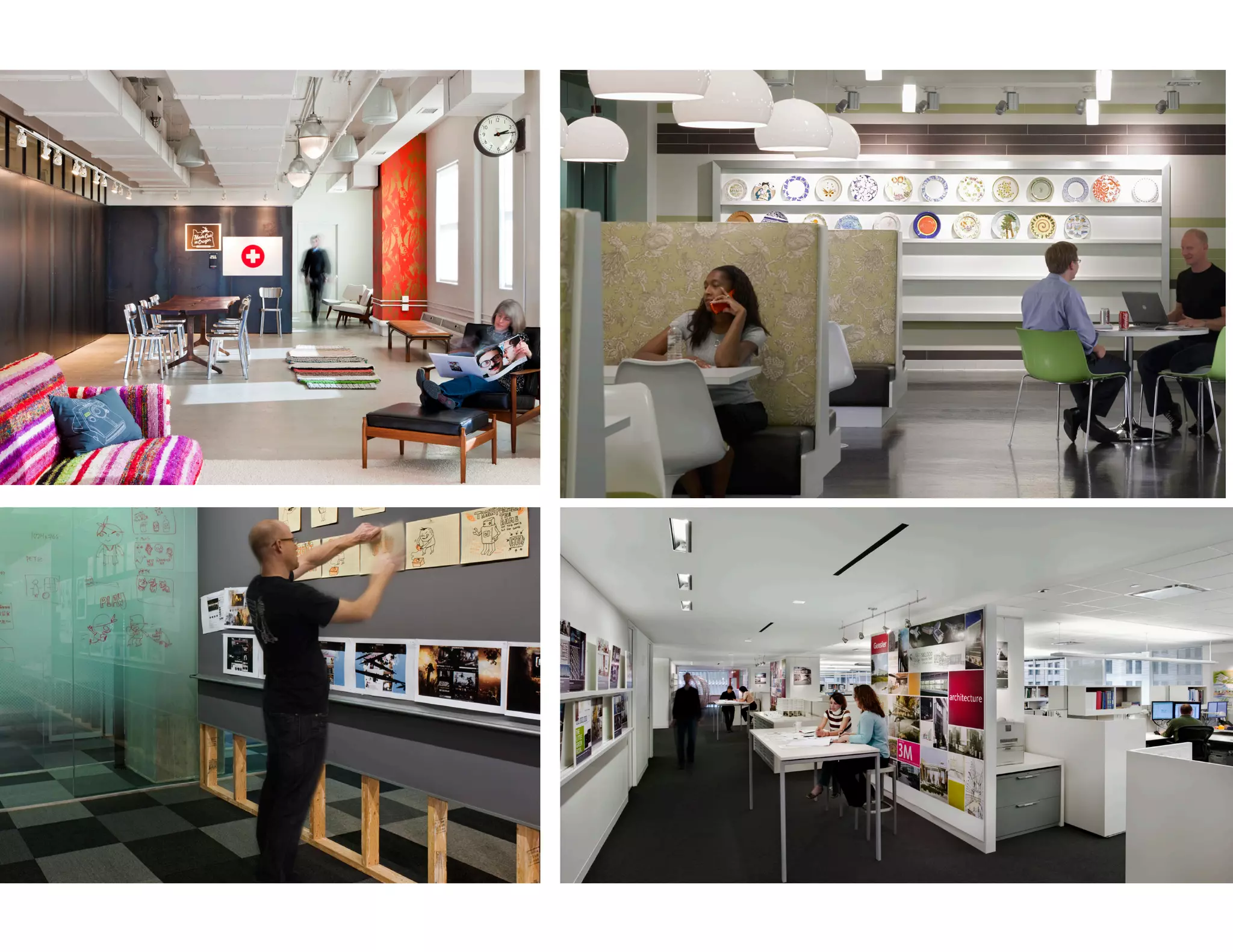
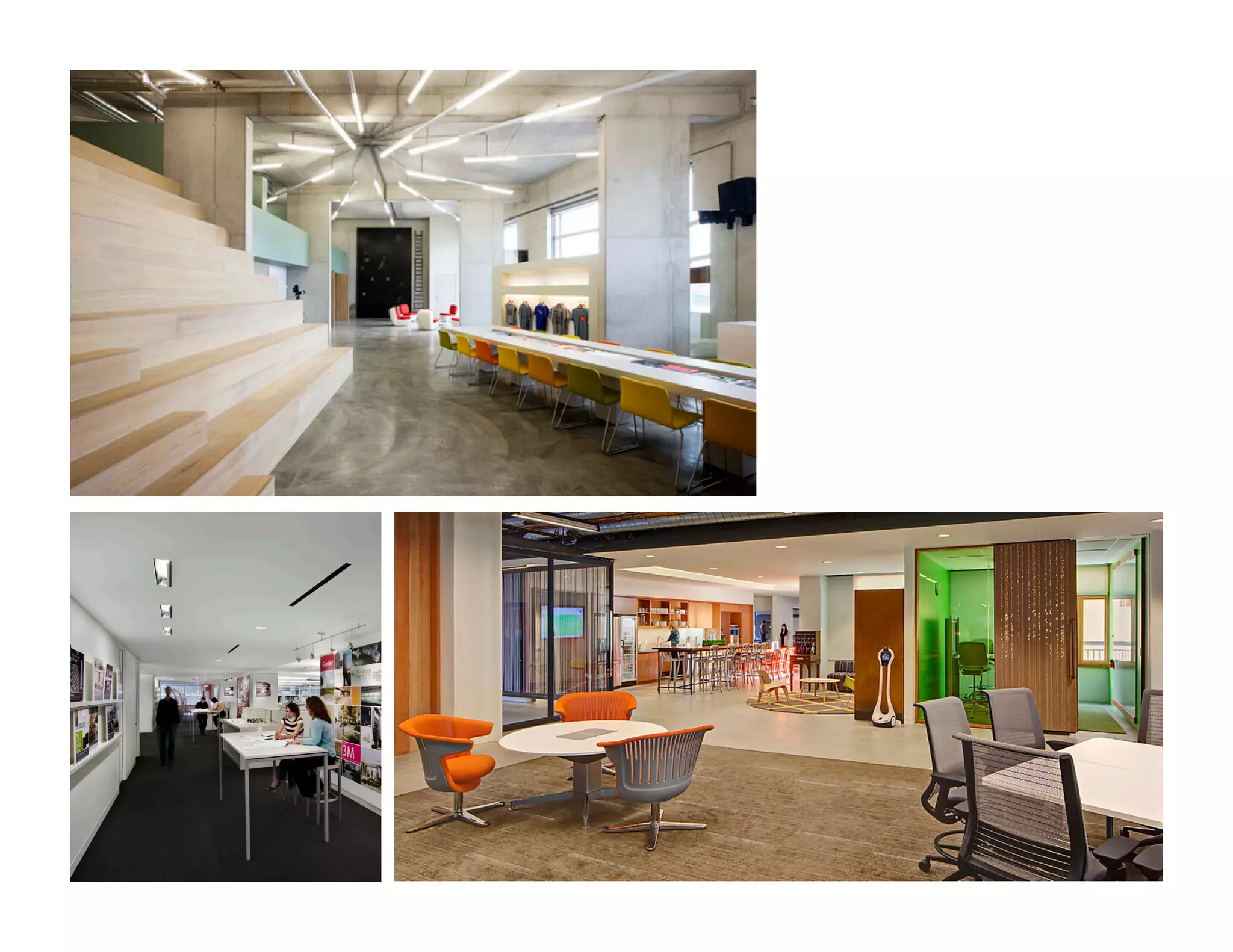
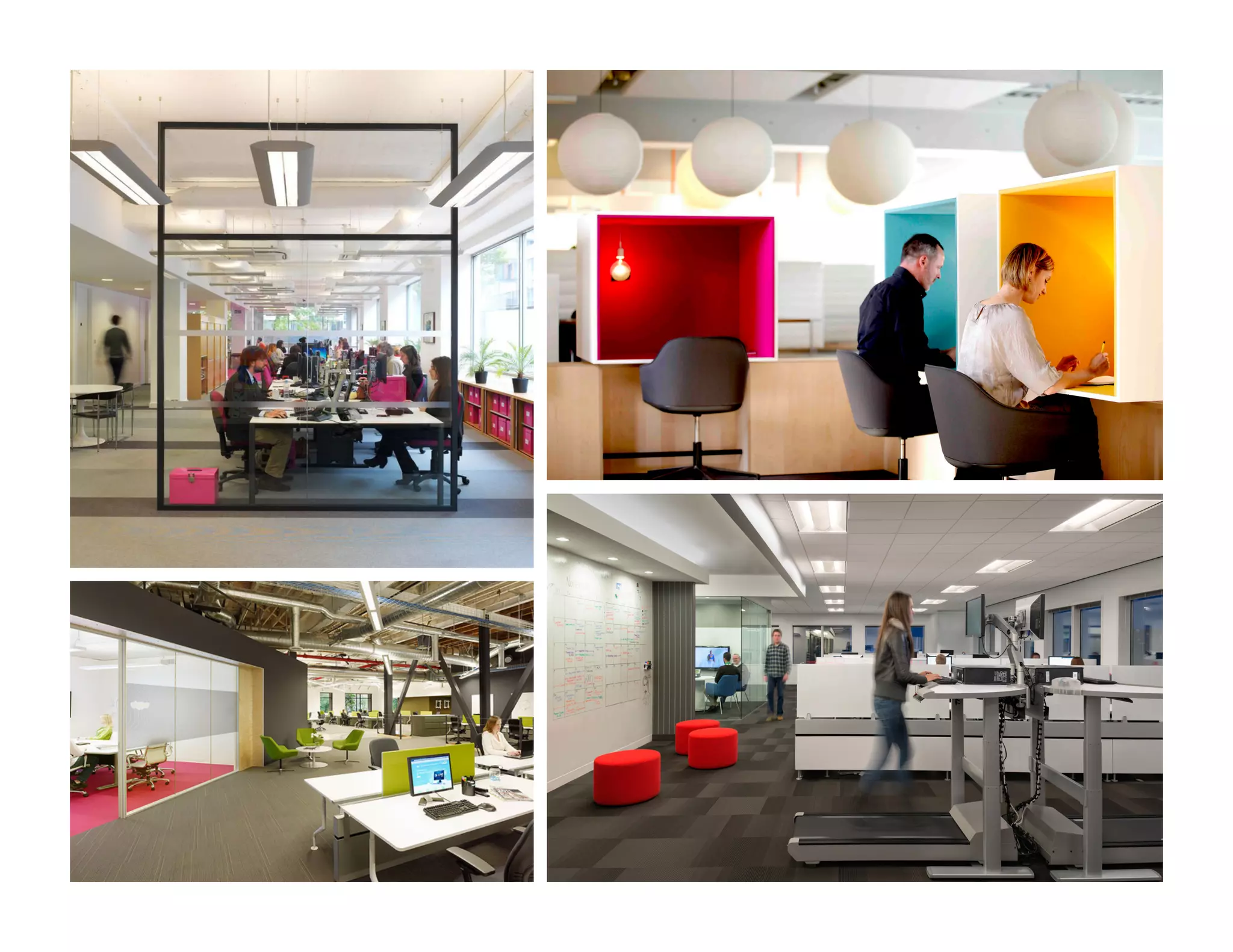
SHIFT ‘ME’ SPACE TO
BECOME ‘WE’ SPACE
WHAT DOES IT LOOK LIKE?
•	hackable spaces that
people own
•	layered spaces with great
resources
•	transparency to see and
be seen
• Activity based work spaces that gets people
moving to the task
• Create varieties of spaces that appeal to all
types of people: introverts and extroverts
• Thickly program spaces so that circulation is
lively and serves multiple functions
THANK
YOU.
QUESTIONS?
ROSHELLE RITZENTHALER
DESIGN STRATEGIST, GENSLER
ROSHELLE_RITZENTHALER@GENSLER.COM
@RoRitzen
JORGEN HESSELBERG
DIRECTOR, AGILE ENTERPRISE TRANSFORMATION
MCAFEE
JORGEN@HESSELBERG.ORG
@JHesselberg

Agile power of place

  • 1.
    harnessing the powerof place. PHYSICAL ENVIRONMENTS TO SUPPORT Agile Teams
  • 2.
    hi there. ROSHELLE RITZENTHALER DESIGNSTRATEGIST, GENSLER ROSHELLE_RITZENTHALER@GENSLER.COM @RoRitzen JORGEN HESSELBERG DIRECTOR, AGILE ENTERPRISE TRANSFORMATION MCAFEE JORGEN@HESSELBERG.ORG @JHesselberg
  • 3.
  • 4.
  • 5.
  • 6.
  • 7.
  • 8.
    BUT HOW DO WEGET FROM STANDARD... @
  • 9.
  • 10.
  • 13.
    12 Gensler 2008Workplace Survey / United States / Working Differently 13Gensler 2008 Workplace Survey / United States / Working Differently LEARNING IS FAR MORE IMPORTANT TO TOP COMPANIES Compared to average companies, top-performing compa- nies consider learning 80% more critical to job success, and spend 40% more time in this work mode. TOP-PERFORMING COMPANIES VALUE SOCIALIZING Overturning the notion that socializing is a time-waster rather than a business asset, top-performing companies socialize 16% more than average companies. Further, they consider it almost three times more critical than average companies, the largest gap among all of the work mode comparisons. 80% more critical 185% more critical Top-performing Companies Average Companies Top-performing Companies Average Companies CRITICALITY CRITICALITY SOCIALIZING MODE 0 20 40 60 80 100 0 20 40 60 80 100 C 36% 20% LEARNING MODE 20% 7% CRITICALITY CRITICALITY SOCIALIZING MODE 0 20 40 60 80 100 0 20 40 60 80 100 C 36% 20% LEARNING MODE 20% 7% These findings provide insight into the complex equation of what creates value in a knowledge economy: work can be improved through the right proportion of four work modes, and in top-performing companies, even greater economic value is derived from collaboration, learning, and socializing. People believe that better design of their workplace would help them be more productive, whether the work involves focus, collaboration, learning or socializing. AVERAGE COMPANIES ARE CENTEREDON FOCUSWORK Average companies spend half of their work week in focus mode—21% more than top companies, even though on average they rank it less critical to their job performance. Average companies may recognize the disparity between what they are doing and what could create value—but they are not harnessing the performance potential of the work modes that distinguish market leaders. Respondents from all companies projected that better work spaces would yield significant improvement for their perfor- mance of each work mode: 28% improvement in focus, 27% in collaboration, 27% in learning, and 23% in socializing. This establishes the equal importance of improving spaces for focus, collaboration, learning and socializing to improve employee job performance. IMPROVING WORK MODE PERFORMANCE TOP COMPANIES COLLABORATE MORE Top-performing companies spend 23% more time collaborating than average companies and consider collaboration more than twice as critical to job success . Top-performing Companies Average Companies 104% more critical 21% more time Top-performing Companies Average Companies CRITICALITY CRITICALITY CRITICALITY SOCIALIZING MODE 0 20 40 60 80 100 0 20 40 60 80 100 50% 41% COLLABORATION MODE FOCUS MODE 36% 20% LEARNING MODE 20% 7% 21% 43% TIME SPENTCRITICALITY CRITICALITY CRITICALITY SOCIALIZING MODE 0 20 40 60 80 100 0 20 40 60 80 100 50% 41% COLLABORATION MODE FOCUS MODE 36% 20% LEARNING MODE 20% 7% 21% 43% TIME SPENT
  • 14.
  • 16.
  • 17.
    Microsoft started inBill Gates' garage. His high-school friend Paul convinced him to drop out of Harvard to start the company. They moved to Arizona and wrote a BASIC programming language for Altair computers out of Bill's garage.
  • 19.
  • 20.
  • 22.
    …instead, we arelearning from this movement in order to apply their successes to larger companies seeking to promote innovation and recruit or retain talent. We are learning from this movement in order to draw on the energy and success of start-ups in larger more established corporations seeking to promote innovation and recruit and retain top talent.
  • 23.
  • 24.
  • 26.
  • 30.
  • 31.
  • 32.
  • 33.
    AUTHENTICROCKETSPACE - 31startups - 15,000 sq.ft.
  • 34.
    This is aglobal phenomenon, with fairly identified user expectations of space and technology requirements. Early Research Findings
  • 35.
    “Office is astate of mind” Early Research Findings
  • 36.
    In these spaces,every space is a “group” space. Collaboration defines the interactions in the environment. Early Research Findings
  • 37.
    87% of coworkershave started new projects with other coworkers they met in their space.
  • 38.
    Evidence suggests thatthe specific characteristics of coworker behavior foreshadows changes in corporate work. Early Research Findings
  • 39.
  • 40.
    …delivers accelerated serendipity. Ifwe are around interesting people, interesting things usually happen.
  • 41.
  • 42.
    guiding principles... From the start,we agreed to adhere to certain values when implementing our Co-location strategy... 4
  • 43.
    GOING AGILE... 1 It’s aboutpeople not process. Individuals + their interactions over processes + tools “The cohesiveness of the team has increased and team spirit was instilled.”
  • 44.
    GOING AGILE... 2Working solutions overcomprehensive documentation. Whatever works, big + small. “Collaboration between testers & developers has increased since we co-locat- ed;we pretty much work together all the time, checking in with each other without really thinking about it.”
  • 45.
    GOING AGILE... Customer collaboration overcontract negotiation. Help the team co-author, not report-out. “Being co-located has decreased the amount of e-mail I get..... now, if something needs to be addressed I just turn around and get it resolved right there.” 3
  • 46.
    GOING AGILE... Responding to changeover following a plan. And change is a good thing. “Overhead related to our meetings was largely eliminated; decisions can be made quickly & effectively (being co-located).” 4
  • 47.
  • 48.
    GOING AGILE... 1 Leverage whatwe have. Don’t assume you need to start from scratch. Idenfity the keepers. “We were always a tight team but Just being able to listen to your team’s random banter makes you feel part of your team mates’ lives.”
  • 49.
    GOING AGILE... 2Build-measure-learn. Don’t beafraid to make mistakes. Learn from them instead. “There have been many instances of ‘positive eavesdropping’ in which team members have a chance to be invovled with discussions. This has helped create a cohesive understanding of deliverables.”
  • 50.
    GOING AGILE... 33Critique +iterate. This is about continuous improvement...so you’re never really done. “It wasn’t perfect the first day, but we were able to tweak the space... move stuff around and pretty soon, it felt like our space.”
  • 51.
  • 52.
  • 53.
    Pods need tobe larger. “No room to layout work for drawing, reading or collaborating with others.”
  • 54.
    GET-AWAY-SPACE “No privacy whatsoevercannot make or receive personal calls with any privacy.”
  • 55.
    Need even moreflexibility inside the pod....
  • 56.
    ERGONOMICS MATTER more surfacearea, more elbow-room “Has negatively impacted basic job satisfaction which is sad because I like my co-workers and the work I do, but physical discomfort has made me dread coming to work.”
  • 57.
    DIGITAL IS CRITICAL Dataand voice need to support remote access
  • 58.
    + support themove-in process. “I was hesitant at first, but I can honestly say I never want to work in a cubicle again.”
  • 59.
  • 60.
    ONE WON’T FITALL group sizes can vary from 5-12
  • 61.
  • 62.
  • 63.
  • 64.
  • 65.
  • 66.
    7NAVTEQ | AgileTeam Workspaces Chicago, IL | 04.07.2011 | ©2011 Gensler | What We Learned 10TH FLOOR “HOMEGROWN” POD -Maintains Personal Space -Underutilized Storage 17TH FLOOR PILOT POD -Not enough space, personal or overall. -Not enough storage. -Not enough workspace. -Too tight. AGILE POD 2.0 -Personal Space & Storage critical to maintain. -Accessible whiteboard space. / display space -Flexible Scrum Space -Space for visitors. -Social Support / Get-aways on floor “I was really skeptical that it would make a difference but decided to give it a try. I really like it” “The Pod facilitates communication between each other. We had good communication before, but now I feel it’s better.” DESIGN RESPONSE
  • 67.
  • 69.
  • 72.
  • 74.
  • 75.
  • 76.
  • 78.
  • 79.
    RESULTS Pods are nowthe standard for all Agile teams in Chicago. Engagement scores in Chicago are higher than other non-colocated sites. Teams have a sense of pride and ownership of their Pods.
  • 80.
  • 81.
    WORK IS A STATEOF MIND WHAT WILL IT LOOK LIKE? • a mash-up of space types • adjacent shared resources • individual space, ”corners” • multiple postures for work • a place to retreat, a place to connect • a place to call my own • get-aways • Create spaces that promote multiple modes of work: > Focusing and Producing > Meeting, Teaming and Collaborating > Socializing and Sharing > Learning and Mentoring • Provide access to technology infrastructures and presentation tools for plug and play.
  • 84.
    SPACE SHOULD COMMUNICATE A SHAREDPURPOSE. WHAT WILL IT LOOK LIKE? • people space • display space • opportunities for team • social support • learning support • Create spaces that feature and make big ideas and people visible. • Use the space as a storyteller about the team. • Designate programs and spaces that promote social and learning activities— allow these spaces to be visible and part of the culture.
  • 88.
    VIRTUAL CONNECTIONS AS IMPORTANT AS PHYSICALONES WHAT WILL IT LOOK LIKE? • remote access everywhere • good telepresence • wormholes • good ‘real’ experiences • Build the technological infrastructure that makes virtual connections a no-brainer • Create varieties of spaces that are fit to purpose...not all the same • Zone the space so that noisy behaviors aren’t disturbing quiet work
  • 91.
    SHIFT ‘ME’ SPACETO BECOME ‘WE’ SPACE WHAT DOES IT LOOK LIKE? • hackable spaces that people own • layered spaces with great resources • transparency to see and be seen • Activity based work spaces that gets people moving to the task • Create varieties of spaces that appeal to all types of people: introverts and extroverts • Thickly program spaces so that circulation is lively and serves multiple functions
  • 94.
    THANK YOU. QUESTIONS? ROSHELLE RITZENTHALER DESIGN STRATEGIST,GENSLER ROSHELLE_RITZENTHALER@GENSLER.COM @RoRitzen JORGEN HESSELBERG DIRECTOR, AGILE ENTERPRISE TRANSFORMATION MCAFEE JORGEN@HESSELBERG.ORG @JHesselberg