Some Rights Reserved: The Environment for Data Sharing Karen Calhoun, Vice President, OCLC WorldCat and Metadata Services 13 August 2008 Libraries and Web 2.0 Discussion  Group
Context for Data Sharing: A “Seamless” User Workflow from Discovery to Delivery   Library user studies suggest that users expect  finding and getting information they want, when  and where they want it, to be easy and convenient.  These users’ tolerance for barriers to easy and convenient discovery and delivery is limited.  “ A colleague … sang the praises of the digital world to us.  He can now, he told us, get direct access to information …  His enthusiasm had screened out an enormous array of people, organizations, and institutions involved in this “direct” touch. The university, the library, publishers, editors, referees, authors, the computer and infrastructure designers, the cataloguers and library collection managers, right down to the students working their way through college by [working in the library] had no place in his story.” Brown, John Seely, and Paul Duguid. 2000.  The social life  of information . Boston: Harvard Business School Press.
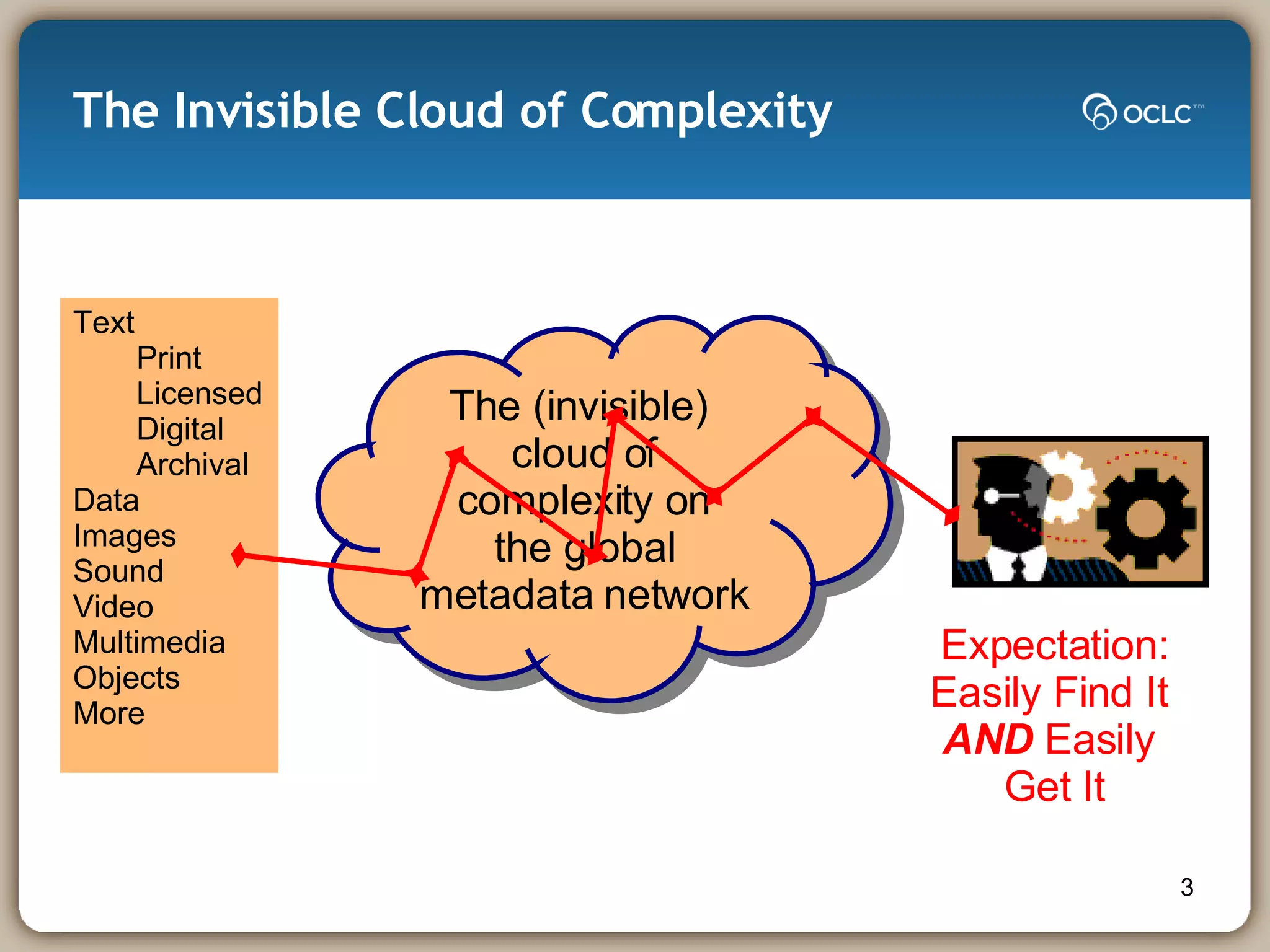
The Invisible Cloud of Complexity The (invisible)  cloud of complexity on the global metadata network Text Print Licensed Digital Archival Data Images Sound Video Multimedia Objects More Expectation: Easily Find It  AND  Easily  Get It
Content (and Metadata) Are NOT Free “ The creation of content … can be a costly proposition, typically in proportion to its worth. One of the biggest challenges facing aggregators of all types is how to support the ecosystem of collectively valuable content that information users no longer individually value.” Outsell, Inc. “Search, Aggregation and Syndication: 2007 Market Forecast and Trends Report,” p. 41.
OCLC’s critics … “ OCLC is trapped in an increasingly inappropriate business model—a model based upon the value in the creation and control of data. Increasingly, in this  interconnected world, the value is in making data openly available and building services upon it.  When people get charged for one thing, but gain value from  another, they will become increasingly uncomfortable with the old status quo.”  Wallis, Richard. “OCLC and ROI.” Panlibus Blog (Talis), December 11, 2007.  http://blogs.talis.com/panlibus/archives/2007/12/oclc_and_roi.php
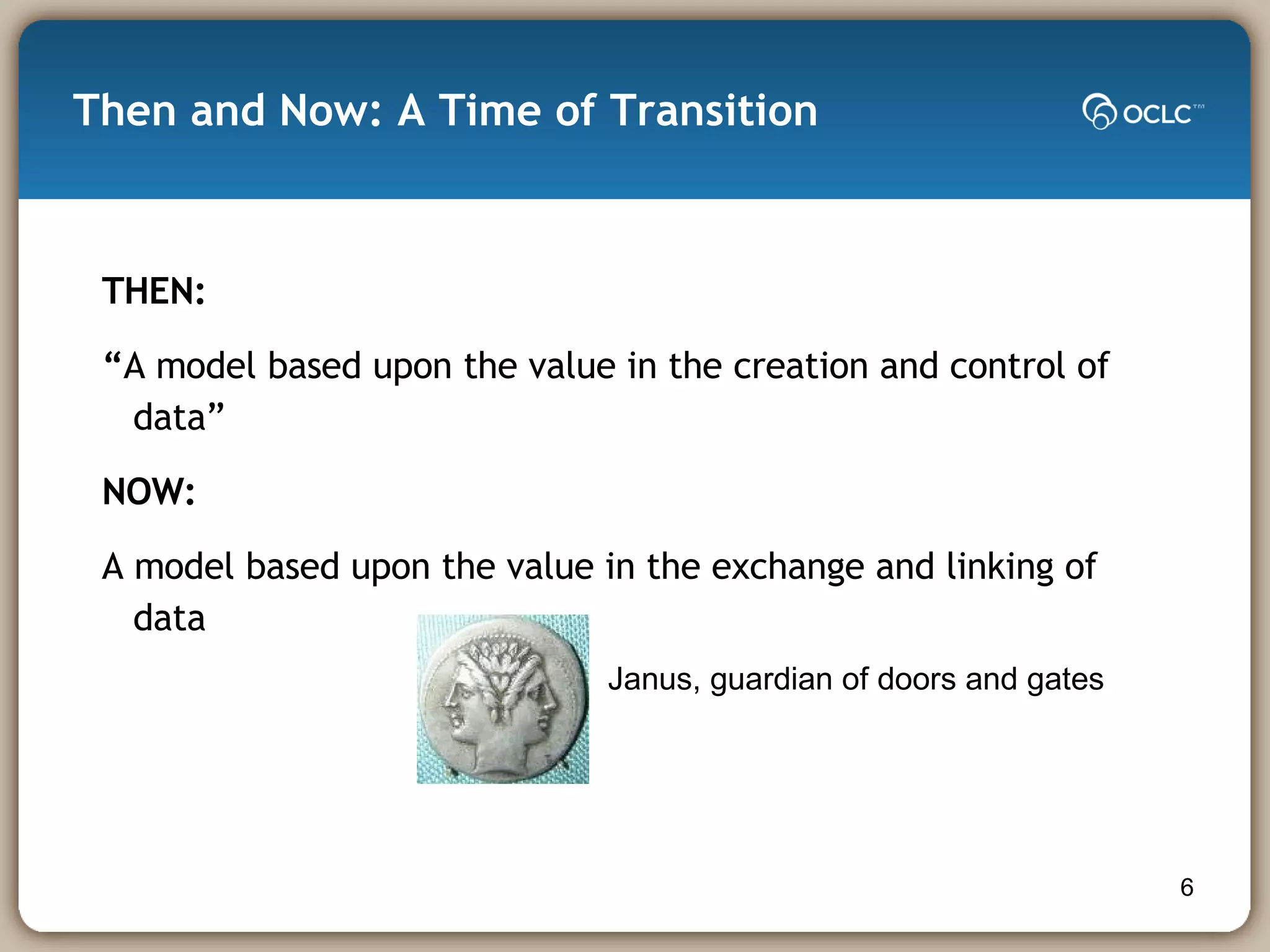
Then and Now: A Time of Transition THEN: “ A model based upon the value in the creation and control of data” NOW: A model based upon the value in the exchange and linking of data Janus, guardian of doors and gates
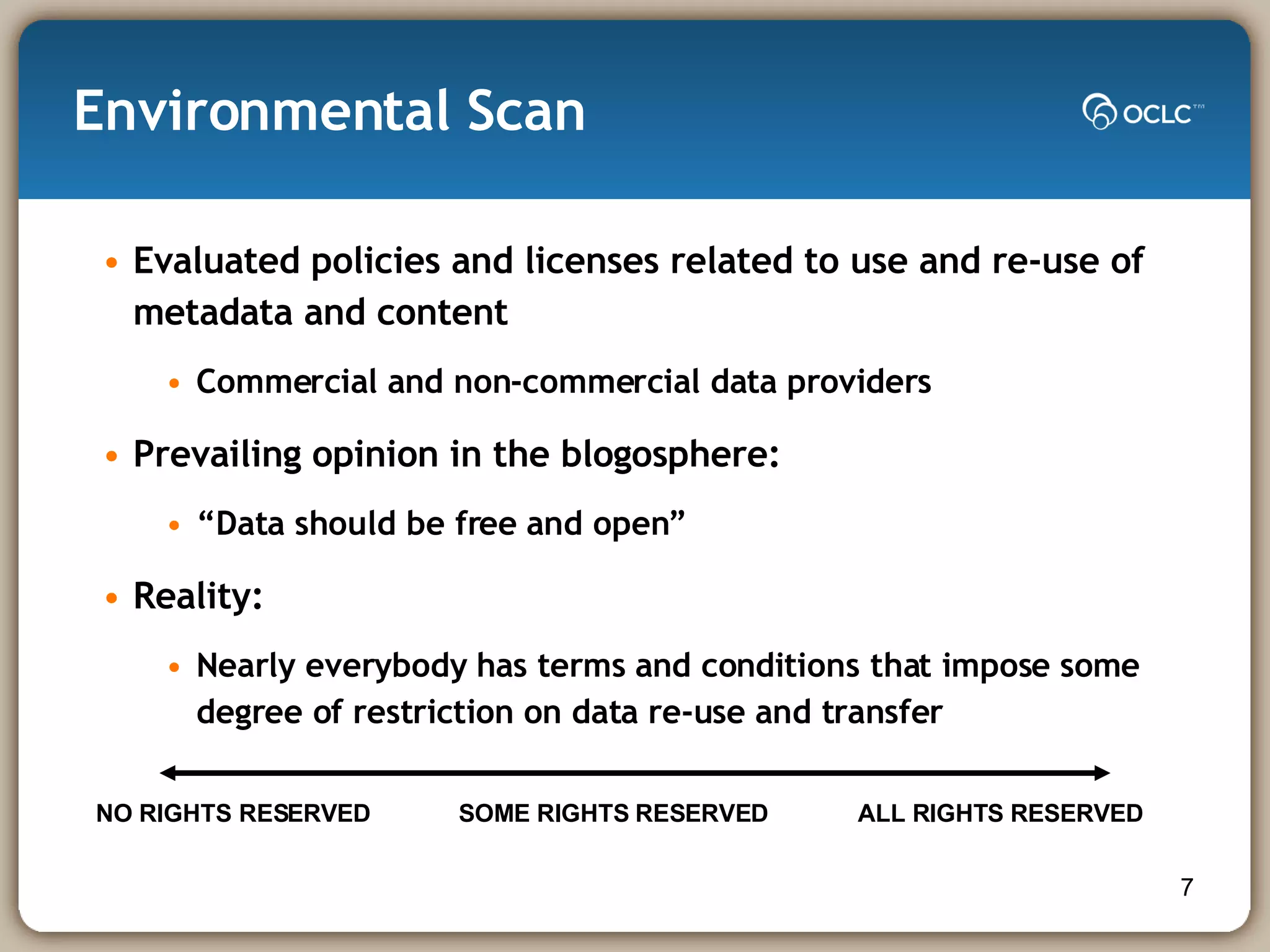
Environmental Scan Evaluated policies and licenses related to use and re-use of metadata and content Commercial and non-commercial data providers Prevailing opinion in the blogosphere: “Data should be free and open” Reality: Nearly everybody has terms and conditions that impose some degree of restriction on data re-use and transfer NO RIGHTS RESERVED  SOME RIGHTS RESERVED ALL RIGHTS RESERVED
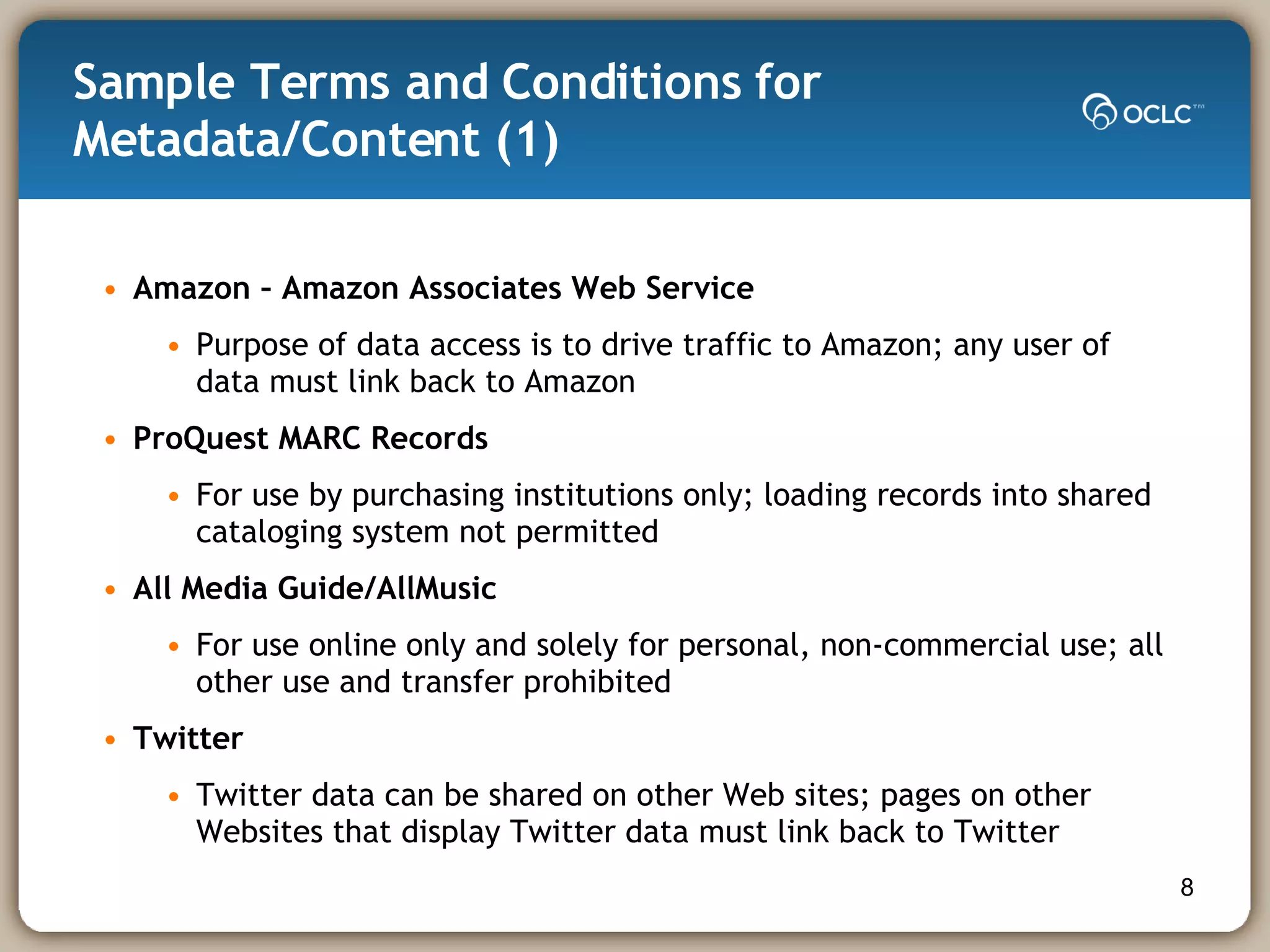
Sample Terms and Conditions for Metadata/Content (1)  Amazon – Amazon Associates Web Service Purpose of data access is to drive traffic to Amazon; any user of data must link back to Amazon ProQuest MARC Records For use by purchasing institutions only; loading records into shared cataloging system not permitted All Media Guide/AllMusic   For use online only and solely for personal, non-commercial use; all other use and transfer prohibited Twitter Twitter data can be shared on other Web sites; pages on other Websites that display Twitter data must link back to Twitter
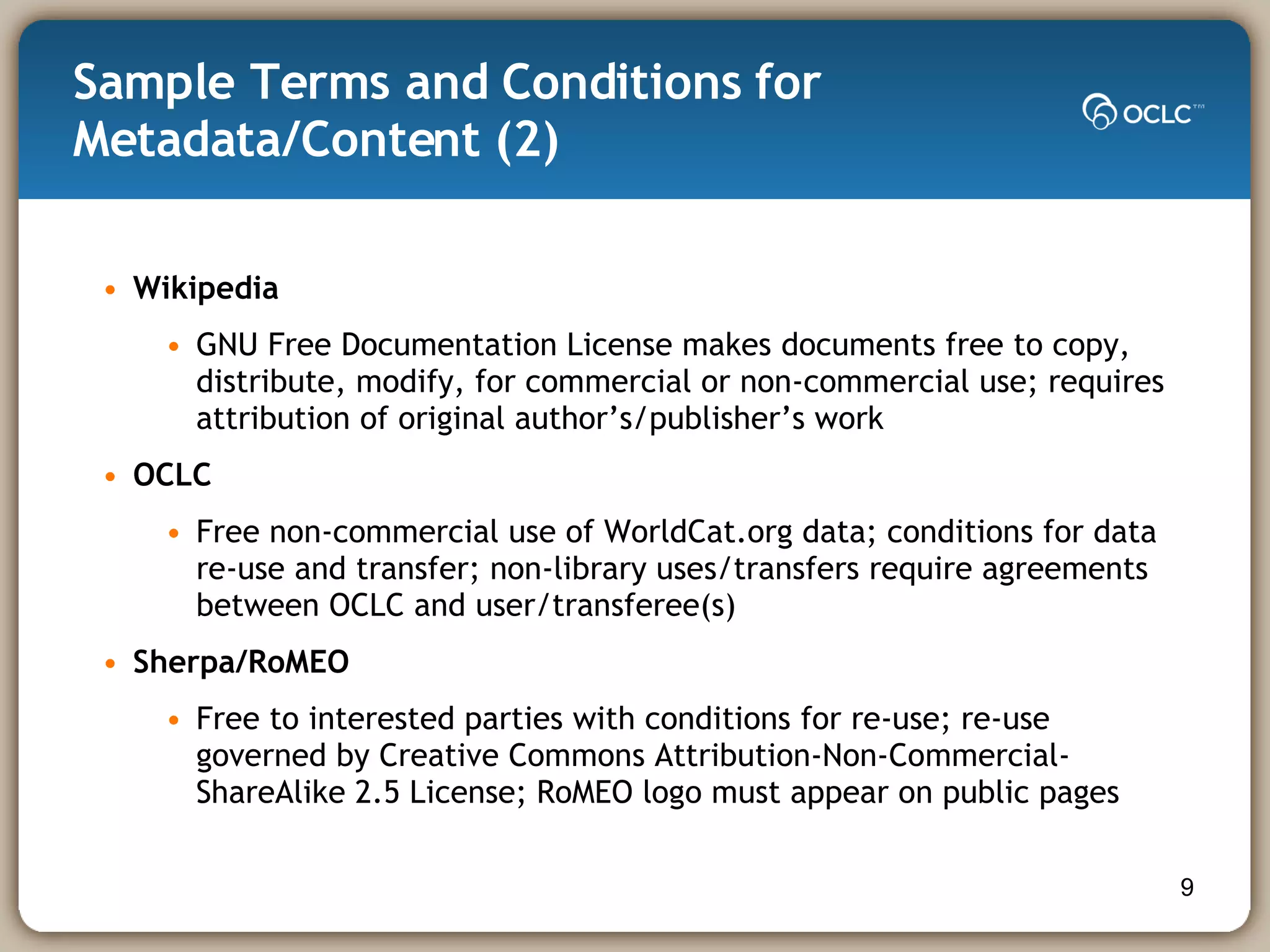
Sample Terms and Conditions for Metadata/Content (2)  Wikipedia  GNU Free Documentation License makes documents free to copy, distribute, modify, for commercial or non-commercial use; requires attribution of original author’s/publisher’s work OCLC Free non-commercial use of WorldCat.org data; conditions for data re-use and transfer; non-library uses/transfers require agreements between OCLC and user/transferee(s) Sherpa/RoMEO Free to interested parties with conditions for re-use; re-use governed by Creative Commons Attribution-Non-Commercial-ShareAlike 2.5 License; RoMEO logo must appear on public pages
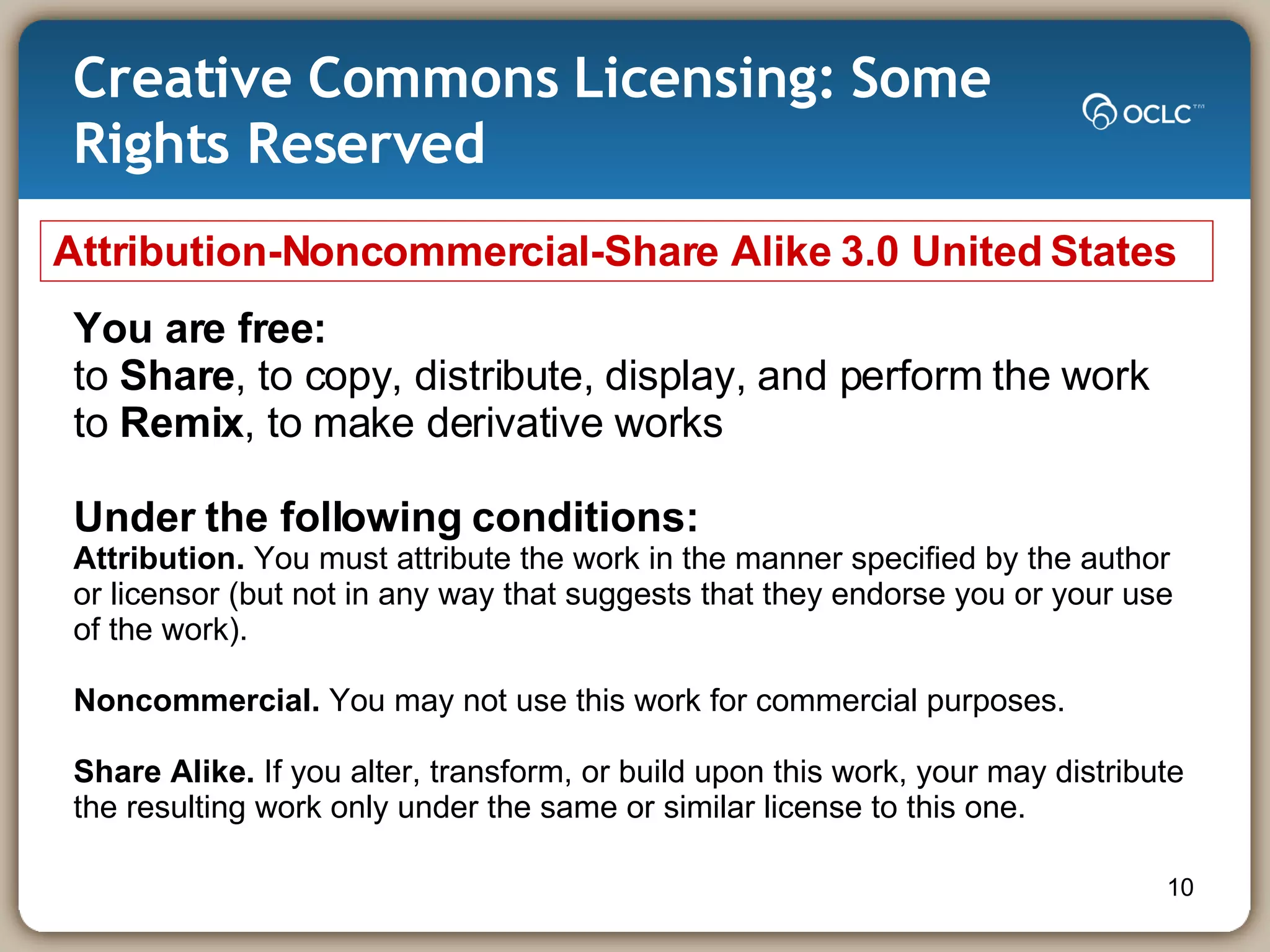
Creative Commons Licensing: Some Rights Reserved Attribution-Noncommercial-Share Alike 3.0 United States You are free: to  Share , to copy, distribute, display, and perform the work to  Remix , to make derivative works Under the following conditions: Attribution.  You must attribute the work in the manner specified by the author or licensor (but not in any way that suggests that they endorse you or your use of the work). Noncommercial.  You may not use this work for commercial purposes. Share Alike.  If you alter, transform, or build upon this work, your may distribute the resulting work only under the same or similar license to this one.
Financial Viability: Balance Between Where the Money Comes From and Where the Money Goes Public Sector – “Government goods at zero price” The fact that goods/services are furnished free of charge does NOT mean that the cost (inc. the opportunity cost) of producing them is zero Social Sector – Non-profits – 3 principal categories (US): Public charity (direct or indirect income from general public or government) Private foundation (most income from investments or endowments—used to provide grants) Private operating foundation (devotes most earnings and assets to pursuit of its public purposes, rather than providing grants) Private Sector – Profit is the reward for owners who incur the risks of going into business – profit is a cost of production
The Strange Economics of Web Start-Ups From  Ten Rules for Web Startups : “ The most likely end game if you’re successful is acquisition” ---------------------------------------- Unprecedented rise in venture capital investment "We'll monetize when the time is right. We raised enough money [$22 million] to get to that point through experimentation.“—Jack Dorsey Are Web startups “built to flip” or “built to last”? Evan Williams at Twitter Office December 2007 http://en.wikipedia.org/wiki/Evan_Williams_(blogger) http://money.cnn.com/2008/08/06/technology/true_meaning_of_twitter_lashinsky.fortune
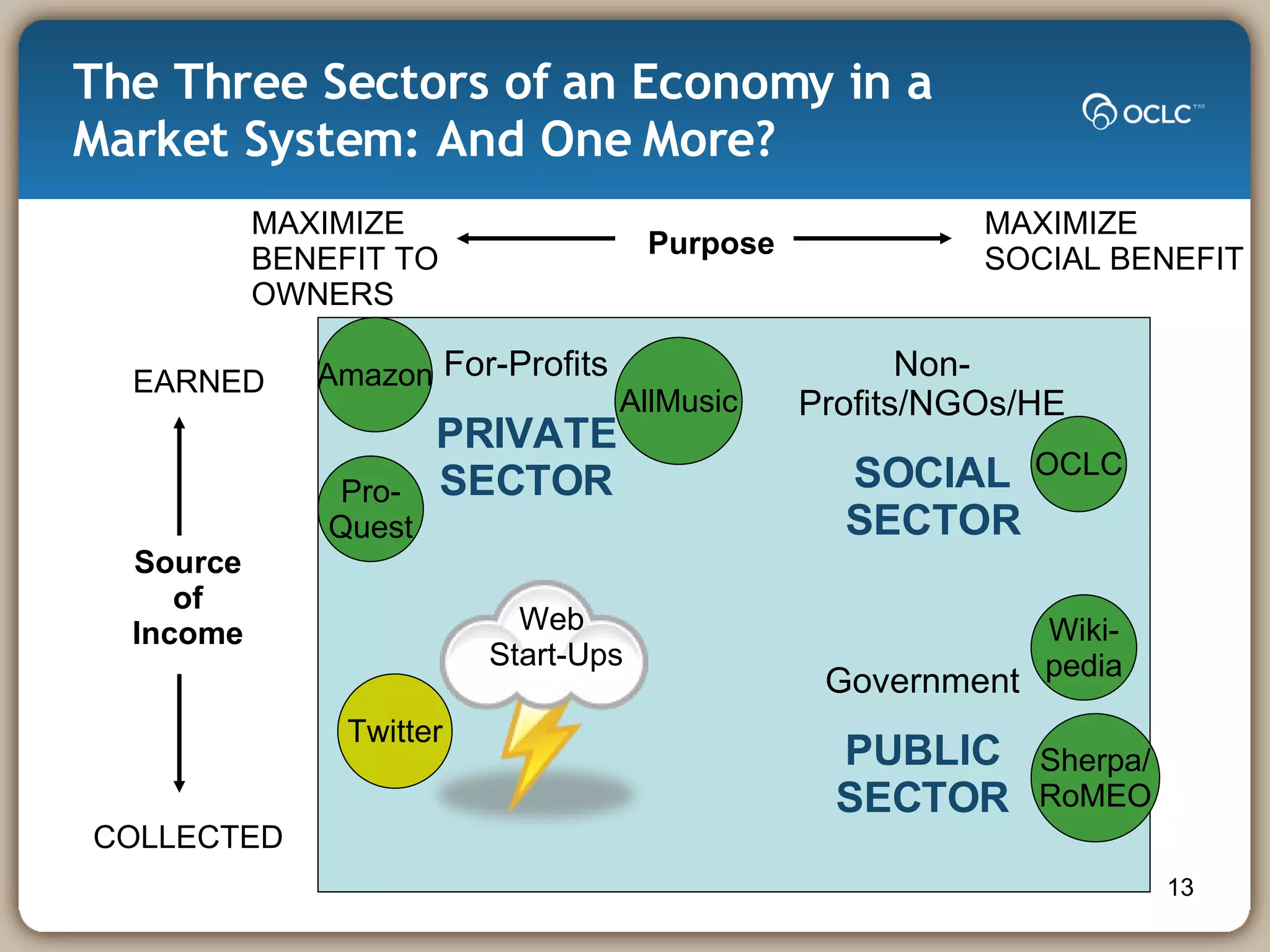
The Three Sectors of an Economy in a Market System: And One More? Source of Income COLLECTED EARNED Purpose MAXIMIZE SOCIAL BENEFIT MAXIMIZE BENEFIT TO OWNERS Government PUBLIC SECTOR Non-Profits/NGOs/HE SOCIAL SECTOR For-Profits PRIVATE SECTOR Web  Start-Ups Sherpa/ RoMEO Wiki- pedia OCLC Amazon Pro- Quest Twitter AllMusic
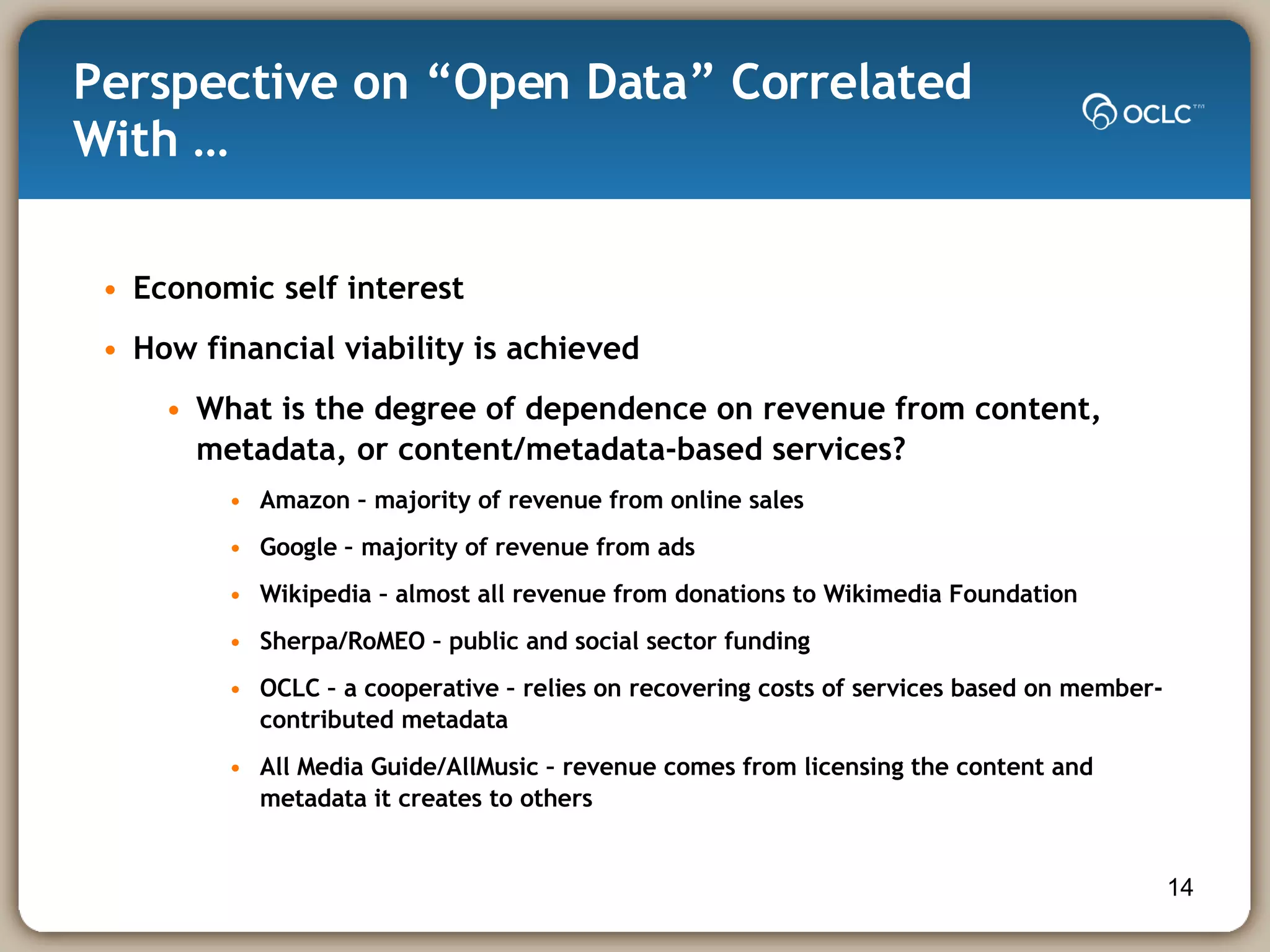
Perspective on “Open Data” Correlated With … Economic self interest How financial viability is achieved What is the degree of dependence on revenue from content, metadata, or content/metadata-based services? Amazon – majority of revenue from online sales  Google – majority of revenue from ads  Wikipedia – almost all revenue from donations to Wikimedia Foundation Sherpa/RoMEO – public and social sector funding OCLC – a cooperative – relies on recovering costs of services based on member-contributed metadata  All Media Guide/AllMusic – revenue comes from licensing the content and metadata it creates to others
A Landscape Rich in “Lessons in Contradiction” Other people’s data should be free
Summary – The Landscape for Data Sharing Information seekers expect seamless connections between metadata and content, regardless of source The information industry is being driven to a data sharing model based upon the value in the exchange and linking of data Nearly all organizations have terms and conditions for data sharing (documented or not) There is no such thing as “free” content or metadata There is no such thing as “free” content or metadata services “ Where the money comes from” directly impacts data sharing policy This is a painful transition, esp. for those organizations directly dependent on revenue from content, metadata, or content/metadata-based services The present landscape is rich in contradictions
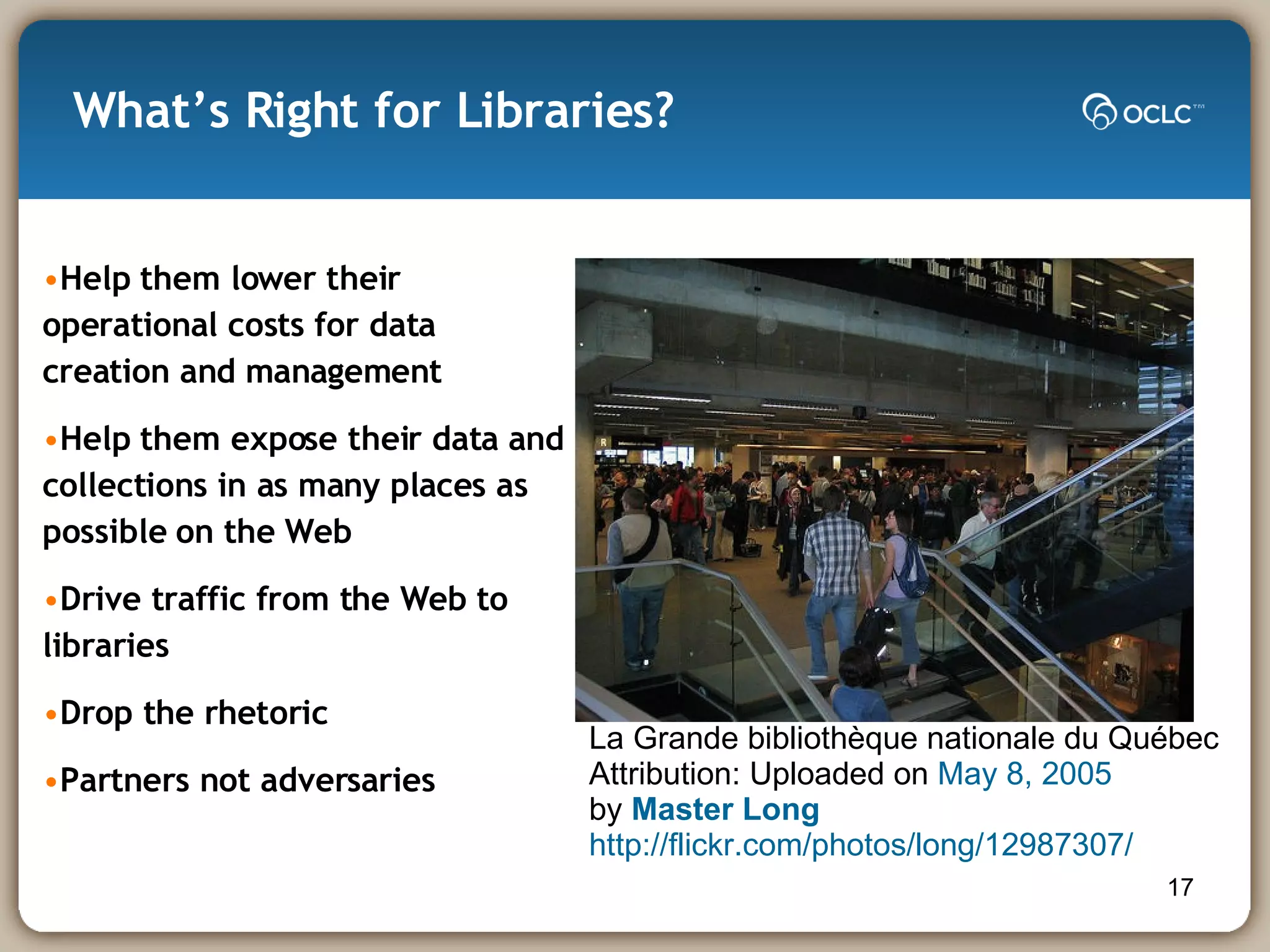
What’s Right for Libraries? Help them lower their operational costs for data creation and management Help them expose their data and collections in as many places as possible on the Web Drive traffic from the Web to libraries Drop the rhetoric Partners not adversaries La Grande bibliothèque nationale du Québec  Attribution: Uploaded on  May 8, 2005 by  Master Long   http://flickr.com/photos/long/12987307/
Thank You Merci Gracias Shukran Xie xie  Danke  Spasibo  Karen Calhoun [email_address] http://community.oclc.org/metalogue

Calhoun Data Sharing Panel IFLA Aug 2008

  • 1.
    Some Rights Reserved:The Environment for Data Sharing Karen Calhoun, Vice President, OCLC WorldCat and Metadata Services 13 August 2008 Libraries and Web 2.0 Discussion Group
  • 2.
    Context for DataSharing: A “Seamless” User Workflow from Discovery to Delivery Library user studies suggest that users expect finding and getting information they want, when and where they want it, to be easy and convenient. These users’ tolerance for barriers to easy and convenient discovery and delivery is limited. “ A colleague … sang the praises of the digital world to us. He can now, he told us, get direct access to information … His enthusiasm had screened out an enormous array of people, organizations, and institutions involved in this “direct” touch. The university, the library, publishers, editors, referees, authors, the computer and infrastructure designers, the cataloguers and library collection managers, right down to the students working their way through college by [working in the library] had no place in his story.” Brown, John Seely, and Paul Duguid. 2000. The social life of information . Boston: Harvard Business School Press.
  • 3.
    The Invisible Cloudof Complexity The (invisible) cloud of complexity on the global metadata network Text Print Licensed Digital Archival Data Images Sound Video Multimedia Objects More Expectation: Easily Find It AND Easily Get It
  • 4.
    Content (and Metadata)Are NOT Free “ The creation of content … can be a costly proposition, typically in proportion to its worth. One of the biggest challenges facing aggregators of all types is how to support the ecosystem of collectively valuable content that information users no longer individually value.” Outsell, Inc. “Search, Aggregation and Syndication: 2007 Market Forecast and Trends Report,” p. 41.
  • 5.
    OCLC’s critics …“ OCLC is trapped in an increasingly inappropriate business model—a model based upon the value in the creation and control of data. Increasingly, in this interconnected world, the value is in making data openly available and building services upon it.  When people get charged for one thing, but gain value from another, they will become increasingly uncomfortable with the old status quo.” Wallis, Richard. “OCLC and ROI.” Panlibus Blog (Talis), December 11, 2007. http://blogs.talis.com/panlibus/archives/2007/12/oclc_and_roi.php
  • 6.
    Then and Now:A Time of Transition THEN: “ A model based upon the value in the creation and control of data” NOW: A model based upon the value in the exchange and linking of data Janus, guardian of doors and gates
  • 7.
    Environmental Scan Evaluatedpolicies and licenses related to use and re-use of metadata and content Commercial and non-commercial data providers Prevailing opinion in the blogosphere: “Data should be free and open” Reality: Nearly everybody has terms and conditions that impose some degree of restriction on data re-use and transfer NO RIGHTS RESERVED SOME RIGHTS RESERVED ALL RIGHTS RESERVED
  • 8.
    Sample Terms andConditions for Metadata/Content (1) Amazon – Amazon Associates Web Service Purpose of data access is to drive traffic to Amazon; any user of data must link back to Amazon ProQuest MARC Records For use by purchasing institutions only; loading records into shared cataloging system not permitted All Media Guide/AllMusic For use online only and solely for personal, non-commercial use; all other use and transfer prohibited Twitter Twitter data can be shared on other Web sites; pages on other Websites that display Twitter data must link back to Twitter
  • 9.
    Sample Terms andConditions for Metadata/Content (2) Wikipedia GNU Free Documentation License makes documents free to copy, distribute, modify, for commercial or non-commercial use; requires attribution of original author’s/publisher’s work OCLC Free non-commercial use of WorldCat.org data; conditions for data re-use and transfer; non-library uses/transfers require agreements between OCLC and user/transferee(s) Sherpa/RoMEO Free to interested parties with conditions for re-use; re-use governed by Creative Commons Attribution-Non-Commercial-ShareAlike 2.5 License; RoMEO logo must appear on public pages
  • 10.
    Creative Commons Licensing:Some Rights Reserved Attribution-Noncommercial-Share Alike 3.0 United States You are free: to Share , to copy, distribute, display, and perform the work to Remix , to make derivative works Under the following conditions: Attribution. You must attribute the work in the manner specified by the author or licensor (but not in any way that suggests that they endorse you or your use of the work). Noncommercial. You may not use this work for commercial purposes. Share Alike. If you alter, transform, or build upon this work, your may distribute the resulting work only under the same or similar license to this one.
  • 11.
    Financial Viability: BalanceBetween Where the Money Comes From and Where the Money Goes Public Sector – “Government goods at zero price” The fact that goods/services are furnished free of charge does NOT mean that the cost (inc. the opportunity cost) of producing them is zero Social Sector – Non-profits – 3 principal categories (US): Public charity (direct or indirect income from general public or government) Private foundation (most income from investments or endowments—used to provide grants) Private operating foundation (devotes most earnings and assets to pursuit of its public purposes, rather than providing grants) Private Sector – Profit is the reward for owners who incur the risks of going into business – profit is a cost of production
  • 12.
    The Strange Economicsof Web Start-Ups From Ten Rules for Web Startups : “ The most likely end game if you’re successful is acquisition” ---------------------------------------- Unprecedented rise in venture capital investment "We'll monetize when the time is right. We raised enough money [$22 million] to get to that point through experimentation.“—Jack Dorsey Are Web startups “built to flip” or “built to last”? Evan Williams at Twitter Office December 2007 http://en.wikipedia.org/wiki/Evan_Williams_(blogger) http://money.cnn.com/2008/08/06/technology/true_meaning_of_twitter_lashinsky.fortune
  • 13.
    The Three Sectorsof an Economy in a Market System: And One More? Source of Income COLLECTED EARNED Purpose MAXIMIZE SOCIAL BENEFIT MAXIMIZE BENEFIT TO OWNERS Government PUBLIC SECTOR Non-Profits/NGOs/HE SOCIAL SECTOR For-Profits PRIVATE SECTOR Web Start-Ups Sherpa/ RoMEO Wiki- pedia OCLC Amazon Pro- Quest Twitter AllMusic
  • 14.
    Perspective on “OpenData” Correlated With … Economic self interest How financial viability is achieved What is the degree of dependence on revenue from content, metadata, or content/metadata-based services? Amazon – majority of revenue from online sales Google – majority of revenue from ads Wikipedia – almost all revenue from donations to Wikimedia Foundation Sherpa/RoMEO – public and social sector funding OCLC – a cooperative – relies on recovering costs of services based on member-contributed metadata All Media Guide/AllMusic – revenue comes from licensing the content and metadata it creates to others
  • 15.
    A Landscape Richin “Lessons in Contradiction” Other people’s data should be free
  • 16.
    Summary – TheLandscape for Data Sharing Information seekers expect seamless connections between metadata and content, regardless of source The information industry is being driven to a data sharing model based upon the value in the exchange and linking of data Nearly all organizations have terms and conditions for data sharing (documented or not) There is no such thing as “free” content or metadata There is no such thing as “free” content or metadata services “ Where the money comes from” directly impacts data sharing policy This is a painful transition, esp. for those organizations directly dependent on revenue from content, metadata, or content/metadata-based services The present landscape is rich in contradictions
  • 17.
    What’s Right forLibraries? Help them lower their operational costs for data creation and management Help them expose their data and collections in as many places as possible on the Web Drive traffic from the Web to libraries Drop the rhetoric Partners not adversaries La Grande bibliothèque nationale du Québec Attribution: Uploaded on May 8, 2005 by Master Long http://flickr.com/photos/long/12987307/
  • 18.
    Thank You MerciGracias Shukran Xie xie Danke Spasibo Karen Calhoun [email_address] http://community.oclc.org/metalogue