Intraday Equities Trend System Presented by: Sherif Youssef  April 2009
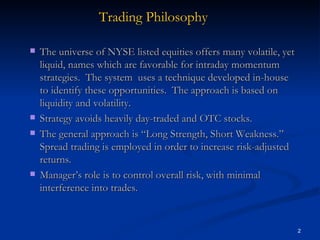
The universe of NYSE listed equities offers many volatile, yet liquid, names which are favorable for intraday momentum strategies.  The system  uses a technique developed in-house to identify these opportunities.  The approach is based on liquidity and volatility. Strategy avoids heavily day-traded and OTC stocks.  The general approach is โ€œLong Strength, Short Weakness.โ€  Spread trading is employed in order to increase risk-adjusted returns. Managerโ€™s role is to control overall risk, with minimal interference into trades. Trading Philosophy
Combines systematic trading techniques with first hand experience and judgment gained over 3 years of full time trading. Proprietary method for identifying stocks which fall into a volatility and liquidity โ€˜sweet spot,โ€™ with daily adjustments. Effective means of spotting developing momentum.  System is indifferent to holding period, taking advantage of a key weakness of discretionary traders. Sound risk control with well-defined daily, weekly, and monthly cutoffs. Sources of Market Edge
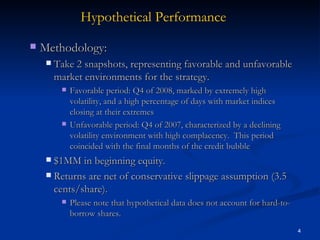
Methodology: Take 2 snapshots, representing favorable and unfavorable market environments for the strategy. Favorable period: Q4 of 2008, marked by extremely high volatility, and a high percentage of days with market indices closing at their extremes Unfavorable period: Q4 of 2007, characterized by a declining volatility environment with high complacency.  This period coincided with the final months of the credit bubble $1MM in beginning equity. Returns are net of conservative slippage assumption (3.5 cents/share). Please note that hypothetical data does not account for hard-to-borrow shares. Hypothetical Performance
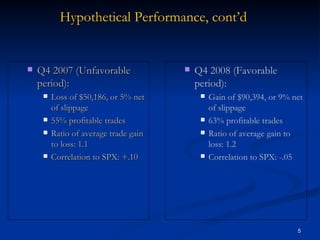
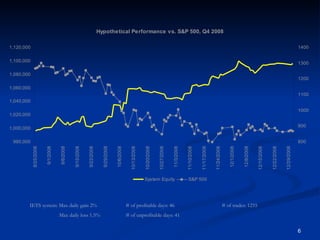
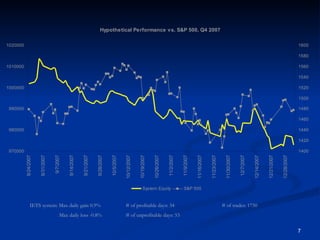
Q4 2007 (Unfavorable period): Loss of $50,186, or 5% net of slippage 55% profitable trades Ratio of average trade gain to loss: 1.1 Correlation to SPX: +.10 Hypothetical Performance, contโ€™d Q4 2008 (Favorable period): Gain of $90,394, or 9% net of slippage 63% profitable trades Ratio of average gain to loss: 1.2 Correlation to SPX: -.05
IETS system: Max daily gain 2% # of profitable days: 46 # of trades: 1255 Max daily loss 1.5% # of unprofitable days: 41
IETS system: Max daily gain 0.9% # of profitable days: 34 # of trades: 1750 Max daily loss -0.8% # of unprofitable days: 53
The Intraday Equities Trend System provides a hedge against downside market volatility, complementing  long equity portfolios, while eliminating overnight risk and allowing for full transparency to the investor. The system presents an attractive risk/reward profile, with significant upside potential and the ability to tightly define and control risk.  Long term goal to return 15-20% per year with peak-to-trough draw down no greater than ยฝ of annual return. The system will likely under perform in low volatility and/or volume market conditions, but systematic loss control will help minimize draw downs during these periods. The strategy is scalable in terms of US market liquidity, and can potentially be extended into overseas markets. Conclusions
Bio and Contact Information Sherif has 7 years work experience financial markets, both sell side and buy side.  He currently trades equities with a proprietary firm in Chicago, IL, researching and developing automated systems.  Previous experience includes corporate debt research for a major investment bank, as well as brokerage on the American Stock Exchange in New York.  He holds a B.S. in economics from Carnegie Mellon, and an M.B.A. from University of Miami. Cell: 312-802-8255 Email: sherif@marketlogicllc.com

Intraday Equities Trend System

  • 1.
    Intraday Equities TrendSystem Presented by: Sherif Youssef April 2009
  • 2.
    The universe ofNYSE listed equities offers many volatile, yet liquid, names which are favorable for intraday momentum strategies. The system uses a technique developed in-house to identify these opportunities. The approach is based on liquidity and volatility. Strategy avoids heavily day-traded and OTC stocks. The general approach is โ€œLong Strength, Short Weakness.โ€ Spread trading is employed in order to increase risk-adjusted returns. Managerโ€™s role is to control overall risk, with minimal interference into trades. Trading Philosophy
  • 3.
    Combines systematic tradingtechniques with first hand experience and judgment gained over 3 years of full time trading. Proprietary method for identifying stocks which fall into a volatility and liquidity โ€˜sweet spot,โ€™ with daily adjustments. Effective means of spotting developing momentum. System is indifferent to holding period, taking advantage of a key weakness of discretionary traders. Sound risk control with well-defined daily, weekly, and monthly cutoffs. Sources of Market Edge
  • 4.
    Methodology: Take 2snapshots, representing favorable and unfavorable market environments for the strategy. Favorable period: Q4 of 2008, marked by extremely high volatility, and a high percentage of days with market indices closing at their extremes Unfavorable period: Q4 of 2007, characterized by a declining volatility environment with high complacency. This period coincided with the final months of the credit bubble $1MM in beginning equity. Returns are net of conservative slippage assumption (3.5 cents/share). Please note that hypothetical data does not account for hard-to-borrow shares. Hypothetical Performance
  • 5.
    Q4 2007 (Unfavorableperiod): Loss of $50,186, or 5% net of slippage 55% profitable trades Ratio of average trade gain to loss: 1.1 Correlation to SPX: +.10 Hypothetical Performance, contโ€™d Q4 2008 (Favorable period): Gain of $90,394, or 9% net of slippage 63% profitable trades Ratio of average gain to loss: 1.2 Correlation to SPX: -.05
  • 6.
    IETS system: Maxdaily gain 2% # of profitable days: 46 # of trades: 1255 Max daily loss 1.5% # of unprofitable days: 41
  • 7.
    IETS system: Maxdaily gain 0.9% # of profitable days: 34 # of trades: 1750 Max daily loss -0.8% # of unprofitable days: 53
  • 8.
    The Intraday EquitiesTrend System provides a hedge against downside market volatility, complementing long equity portfolios, while eliminating overnight risk and allowing for full transparency to the investor. The system presents an attractive risk/reward profile, with significant upside potential and the ability to tightly define and control risk. Long term goal to return 15-20% per year with peak-to-trough draw down no greater than ยฝ of annual return. The system will likely under perform in low volatility and/or volume market conditions, but systematic loss control will help minimize draw downs during these periods. The strategy is scalable in terms of US market liquidity, and can potentially be extended into overseas markets. Conclusions
  • 9.
    Bio and ContactInformation Sherif has 7 years work experience financial markets, both sell side and buy side. He currently trades equities with a proprietary firm in Chicago, IL, researching and developing automated systems. Previous experience includes corporate debt research for a major investment bank, as well as brokerage on the American Stock Exchange in New York. He holds a B.S. in economics from Carnegie Mellon, and an M.B.A. from University of Miami. Cell: 312-802-8255 Email: sherif@marketlogicllc.com