IELTS
INTERNATIONAL ENGLISH LANGUAGE TESTING SYATEM

TITHI FLORENCE D’COSTA
WHAT IS IELTS?????






IELTS, or International English Language
Testing System, is an
international standardised test of English
language proficiency.
IELTS is the world's leading test of English
for higher education, immigration and
employment.
It is jointly managed by University of
Cambridge ESOL Examinations,
the British Council and IDP Education Pty
Ltd, and was established in 1989.
WHY IT IS HELPFUL??????
IELTS is accepted by most Australian, British,
Canadian, Irish, New Zealand and South
African academic institutions, over 3,000
academic institutions in the United States, and
various professional organisations. It is also a
requirement for immigration to Australia,
New Zealand and Canada
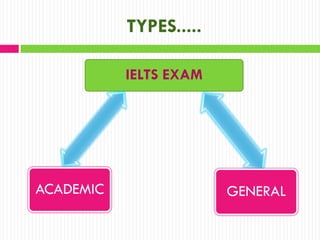
TYPES.....
IELTS EXAM

ACADEMIC

GENERAL
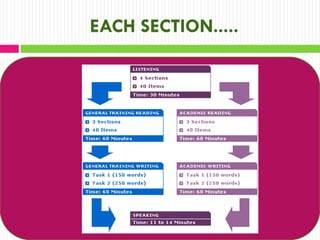
EACH SECTION.....
Reading.....








The reading test is considered by many to be the most
difficult part of IELTS.
You have to read 3 long sections, each with multiple
paragraphs, and answer 40 questions (13 to 14 per
section).
No extra time is given at the end to transfer your answers
to the answer sheet.
Answer all questions. There is no negative marking for
incorrect answers.
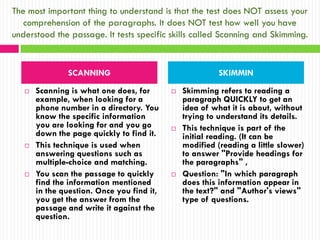
The most important thing to understand is that the test does NOT assess your
comprehension of the paragraphs. It does NOT test how well you have
understood the passage. It tests specific skills called Scanning and Skimming.

SCANNING






Scanning is what one does, for
example, when looking for a
phone number in a directory. You
know the specific information
you are looking for and you go
down the page quickly to find it.
This technique is used when
answering questions such as
multiple-choice and matching.
You scan the passage to quickly
find the information mentioned
in the question. Once you find it,
you get the answer from the
passage and write it against the
question.

SKIMMIN






Skimming refers to reading a
paragraph QUICKLY to get an
idea of what it is about, without
trying to understand its details.
This technique is part of the
initial reading. (It can be
modified (reading a little slower)
to answer "Provide headings for
the paragraphs" ,
Question: "In which paragraph
does this information appear in
the text?" and "Author's views"
type of questions.
Some important reading tips....








first read all the questions quickly to get an idea of what type of information
is required and whether scanning or skimming (or a combination of the two) is
called for. As you read the questions, use a pencil to underline important
information such as dates, places and names.
Once you are through with reading all the questions, skim over the text and
underline / mark important parts. If you see any information relating to the
questions, mark it straight away. You may even be able to answer some
questions as you read.
Answer the questions one by one with the help of the underlined parts of the
text. Having read the text once, you will find it easy to find specific
information by scanning.

As soon as you find an answer, write it against the question on the question
paper because you will not get extra time to transfer your answer to the
answer sheet.
Question pattern of reading test










Multiple choice
Short-answer questions
Sentence completion
Notes/ summary/ diagram/ flow chart/ table completion
Choosing from a "heading bank" for identified
paragraphs/ sections
of the text
Identification of writer's views / attitudes/ claims
Classification
Matching lists / phrases
Writing...
TASK - 1



TASK - 2

Time: 20-25 minutes



Usually three things asked in the
task 1 & you have to write a
paragraph about 150 words:



1. Object (eg. a cycle is shown &
various parts are labelled)
2. Process (eg. the various ways in
which solar energy is used)
3. Data; (graphs of all types eg.
line graph, bar graph, pie
charts, tables etc)

Time: 40 minutes
In task 2 you have to write an
essay near about 200 to 250
words which asks you to present
an argument for or against of the
topic. A suggested structure for
writing is:

1. Introduce the topic and state your stand,
whether you agree or disagree.
2. Give arguments in support of your
viewpoint supported by relevant
examples. You have to write three
things: General trend, Comparisons,
differences.
3. State the contrary viewpoint and give
reasons why you don't agree with it.
4. Conclude with a short concluding
paragraph.
5. If there is time left at the end, revise your
answers and correct any spelling or
grammatical mistakes.
Types of graph
PIE CHART
BAR CHART
LINE CHART
PICTURE REPRESENTATION

Nouns

Verbs

a rise
an increase
a surge
a growth
a peak

to rise
to increase
to surge
to grow
to peak
to skyrocket

a fluctuation
a variation
a period of
stability
a plateau
a fall
a decrease
a decline
a dip

Phrases

to show an upward trend
to show a downward trend
to hit the highest point
to hit the lowest point
to reach a peak
to show some fluctuation
to fluctuate wildly
to fluctuate to remain stable
to vary
to remain static
to remain unchanged
to fall
to stay constant
to decrease to reach a plateau
to decline
to level off
to dip
to flatten out
to dive
the highest
to plunge
the lowest
the second highest
the third highest
compared to
compared with
relative to

Adverbs

Adjectives

sharply
suddenly
rapidly
abruptly
dramatically
significantly
steadily
considerably
markedly
slightly
gently
gradually
wildly

sharp
sudden
rapid
abrupt
dramatic
steep
significant
steady
considerable
marked
slight
gentle
gradual

VOCABULARY OF WRITING CHARTS
Essay present an organized argument that is supported
by examples. In your IELTS essay your exam mark will
be looking for.....

Organized structure with clearly define paragraph
 Coherent sentences that link together using linking
phrases
 A clear thesis that clearly answer the essay question
 Real life examples that support the argument
 A clear introduction & conclusion
 Adherence to length requirement( minimum 250
words)

FORMET OF
ESSAY WRITING
Paragraph 1- INTRODUCTION
•
Sentence 1: background
information
•
Sentence 2: detail background
statement
•
Sentence 3: thesis
•
Sentence 4: outline the sentence

Paragraph 3 – Second supporting
paragraph
 Sentence 1: topic sentence
 Sentence 2: examples
 Sentence 3: discussion
 Sentence 4: conclusion

Paragraph 2 – First supporting
paragraph

Sentence 1: topic sentence

Sentence 2: examples

Sentence 3: discussion

Sentence 4: conclusion

Paragraph 4 – Conclusion
 Sentence 1: summery
 Sentence 2: restatement of thesis
 Sentence 3: prediction or
recommendation
ANALYSING TASK 2 ESSAYQUESTIONS
Understanding the meaning of an essay question
is essential to writing a solid essay is essential to
writing a solid essay in response. For all essay
question, you should first pinpoint these 3
attributes:
1.
Scope
2.
Keywords
3.
Instruction words
DISCUSSION OF A SAMPLE
QUESTION TASK 2
Technology is becoming increasingly prevalent in the world today. Given time, technology
will completely replace the teacher in the classroom. Do you agree or disagree with this
statement?

Scope: Scope involves the topic that can & cannot be include in your
written response. In this example essay question, the scope is
‘technology’ & ‘education’ related topics. We cannot write anything
outside of this scope. We should write our essay’s intro, body,
conclusion & examples relation with the scope.
Keywords: keywords are the words in the question which tell us how the
various ideas relate together. Here we see the phrase ‘increasingly
prevalent’. What does this tell us about the technology? We also see ‘
completely replace’. What is the connection? To write the essay we
should think first about the keywords how the connect with the topic
making examples & finally put your thought into words.
DISCUSSION OF A SAMPLE
QUESTION TASK 2
Technology is becoming increasingly prevalent in the world today. Given time, technology
will completely replace the teacher in the classroom. Do you agree or disagree with this
statement?

Instruction word:

finally we need to locate the instruction words. Where is the question
telling us to do something? Here:
Do you agree or disagree with this statement?
to answer this question properly we must answer it concisely & directly. To do this we
must use a thesis.

Thesis:






An essay’s thesis is the most important sentence in the entire essay. Because it is the
sentence that states our opinion in relation to what is being asked of us by the essay
question. Thus. In the example question above our thesis can only be one of two thing:
It is agree that technology will replace teachers in the classroom?
Or
It is not agree that technology will replace teachers in the classroom?
Prepare sample answer in our mind, point out what are you going to write in each
paragraph.
Use few fords from essay question, try to vary your vocabulary as much as you can
Try to give relevant examples.
Listening tips....







The questions are in SETS and you hear tape recording
for one set at a time.
Glance through the SET of questions for which you will
be hearing the tape.
Read the questions & find out what SPECIFIC information
is required (name, place, date, number etc)
Circle key words (Clue/trigger words)
When the tape plays listen intently when you think your
specific information will come.
In each section they will give you some time to recheck
the answer & read out the question try to read the
question on that time that will very helpful to find the
answer later when the tape start
Speaking....
The test consists of three parts.
In Part 1 the candidate answers general questions about themselves,
their homes/ families, their jobs/studies, their interests, and a range
of similar familiar topic areas. This part lasts between four and five
minutes.
In Part 2 the candidate is given a verbal prompt on a card and is
asked to talk on a particular topic. The candidate has one minute to
prepare before speaking at length, for between one and two
minutes. The examiner then asks one or two rounding-off questions.
In Part 3 the examiner and candidate engage in a discussion of more
abstract issues and concepts which are thematically linked to the
topic prompt in Part 2. The discussion lasts between four and five
minutes.
THANK YOU
All materials are taken from British council study
material, IELTS Cambridge book.

Ielts material

  • 1.
    IELTS INTERNATIONAL ENGLISH LANGUAGETESTING SYATEM TITHI FLORENCE D’COSTA
  • 2.
    WHAT IS IELTS?????    IELTS,or International English Language Testing System, is an international standardised test of English language proficiency. IELTS is the world's leading test of English for higher education, immigration and employment. It is jointly managed by University of Cambridge ESOL Examinations, the British Council and IDP Education Pty Ltd, and was established in 1989.
  • 3.
    WHY IT ISHELPFUL?????? IELTS is accepted by most Australian, British, Canadian, Irish, New Zealand and South African academic institutions, over 3,000 academic institutions in the United States, and various professional organisations. It is also a requirement for immigration to Australia, New Zealand and Canada
  • 4.
  • 5.
  • 6.
    Reading.....     The reading testis considered by many to be the most difficult part of IELTS. You have to read 3 long sections, each with multiple paragraphs, and answer 40 questions (13 to 14 per section). No extra time is given at the end to transfer your answers to the answer sheet. Answer all questions. There is no negative marking for incorrect answers.
  • 7.
    The most importantthing to understand is that the test does NOT assess your comprehension of the paragraphs. It does NOT test how well you have understood the passage. It tests specific skills called Scanning and Skimming. SCANNING    Scanning is what one does, for example, when looking for a phone number in a directory. You know the specific information you are looking for and you go down the page quickly to find it. This technique is used when answering questions such as multiple-choice and matching. You scan the passage to quickly find the information mentioned in the question. Once you find it, you get the answer from the passage and write it against the question. SKIMMIN    Skimming refers to reading a paragraph QUICKLY to get an idea of what it is about, without trying to understand its details. This technique is part of the initial reading. (It can be modified (reading a little slower) to answer "Provide headings for the paragraphs" , Question: "In which paragraph does this information appear in the text?" and "Author's views" type of questions.
  • 8.
    Some important readingtips....     first read all the questions quickly to get an idea of what type of information is required and whether scanning or skimming (or a combination of the two) is called for. As you read the questions, use a pencil to underline important information such as dates, places and names. Once you are through with reading all the questions, skim over the text and underline / mark important parts. If you see any information relating to the questions, mark it straight away. You may even be able to answer some questions as you read. Answer the questions one by one with the help of the underlined parts of the text. Having read the text once, you will find it easy to find specific information by scanning. As soon as you find an answer, write it against the question on the question paper because you will not get extra time to transfer your answer to the answer sheet.
  • 9.
    Question pattern ofreading test         Multiple choice Short-answer questions Sentence completion Notes/ summary/ diagram/ flow chart/ table completion Choosing from a "heading bank" for identified paragraphs/ sections of the text Identification of writer's views / attitudes/ claims Classification Matching lists / phrases
  • 10.
    Writing... TASK - 1   TASK- 2 Time: 20-25 minutes  Usually three things asked in the task 1 & you have to write a paragraph about 150 words:  1. Object (eg. a cycle is shown & various parts are labelled) 2. Process (eg. the various ways in which solar energy is used) 3. Data; (graphs of all types eg. line graph, bar graph, pie charts, tables etc) Time: 40 minutes In task 2 you have to write an essay near about 200 to 250 words which asks you to present an argument for or against of the topic. A suggested structure for writing is: 1. Introduce the topic and state your stand, whether you agree or disagree. 2. Give arguments in support of your viewpoint supported by relevant examples. You have to write three things: General trend, Comparisons, differences. 3. State the contrary viewpoint and give reasons why you don't agree with it. 4. Conclude with a short concluding paragraph. 5. If there is time left at the end, revise your answers and correct any spelling or grammatical mistakes.
  • 11.
    Types of graph PIECHART BAR CHART LINE CHART PICTURE REPRESENTATION 
  • 12.
    Nouns Verbs a rise an increase asurge a growth a peak to rise to increase to surge to grow to peak to skyrocket a fluctuation a variation a period of stability a plateau a fall a decrease a decline a dip Phrases to show an upward trend to show a downward trend to hit the highest point to hit the lowest point to reach a peak to show some fluctuation to fluctuate wildly to fluctuate to remain stable to vary to remain static to remain unchanged to fall to stay constant to decrease to reach a plateau to decline to level off to dip to flatten out to dive the highest to plunge the lowest the second highest the third highest compared to compared with relative to Adverbs Adjectives sharply suddenly rapidly abruptly dramatically significantly steadily considerably markedly slightly gently gradually wildly sharp sudden rapid abrupt dramatic steep significant steady considerable marked slight gentle gradual VOCABULARY OF WRITING CHARTS
  • 13.
    Essay present anorganized argument that is supported by examples. In your IELTS essay your exam mark will be looking for..... Organized structure with clearly define paragraph  Coherent sentences that link together using linking phrases  A clear thesis that clearly answer the essay question  Real life examples that support the argument  A clear introduction & conclusion  Adherence to length requirement( minimum 250 words) 
  • 14.
    FORMET OF ESSAY WRITING Paragraph1- INTRODUCTION • Sentence 1: background information • Sentence 2: detail background statement • Sentence 3: thesis • Sentence 4: outline the sentence Paragraph 3 – Second supporting paragraph  Sentence 1: topic sentence  Sentence 2: examples  Sentence 3: discussion  Sentence 4: conclusion Paragraph 2 – First supporting paragraph  Sentence 1: topic sentence  Sentence 2: examples  Sentence 3: discussion  Sentence 4: conclusion Paragraph 4 – Conclusion  Sentence 1: summery  Sentence 2: restatement of thesis  Sentence 3: prediction or recommendation
  • 15.
    ANALYSING TASK 2ESSAYQUESTIONS Understanding the meaning of an essay question is essential to writing a solid essay is essential to writing a solid essay in response. For all essay question, you should first pinpoint these 3 attributes: 1. Scope 2. Keywords 3. Instruction words
  • 16.
    DISCUSSION OF ASAMPLE QUESTION TASK 2 Technology is becoming increasingly prevalent in the world today. Given time, technology will completely replace the teacher in the classroom. Do you agree or disagree with this statement? Scope: Scope involves the topic that can & cannot be include in your written response. In this example essay question, the scope is ‘technology’ & ‘education’ related topics. We cannot write anything outside of this scope. We should write our essay’s intro, body, conclusion & examples relation with the scope. Keywords: keywords are the words in the question which tell us how the various ideas relate together. Here we see the phrase ‘increasingly prevalent’. What does this tell us about the technology? We also see ‘ completely replace’. What is the connection? To write the essay we should think first about the keywords how the connect with the topic making examples & finally put your thought into words.
  • 17.
    DISCUSSION OF ASAMPLE QUESTION TASK 2 Technology is becoming increasingly prevalent in the world today. Given time, technology will completely replace the teacher in the classroom. Do you agree or disagree with this statement? Instruction word: finally we need to locate the instruction words. Where is the question telling us to do something? Here: Do you agree or disagree with this statement? to answer this question properly we must answer it concisely & directly. To do this we must use a thesis. Thesis:    An essay’s thesis is the most important sentence in the entire essay. Because it is the sentence that states our opinion in relation to what is being asked of us by the essay question. Thus. In the example question above our thesis can only be one of two thing: It is agree that technology will replace teachers in the classroom? Or It is not agree that technology will replace teachers in the classroom? Prepare sample answer in our mind, point out what are you going to write in each paragraph. Use few fords from essay question, try to vary your vocabulary as much as you can Try to give relevant examples.
  • 18.
    Listening tips....       The questionsare in SETS and you hear tape recording for one set at a time. Glance through the SET of questions for which you will be hearing the tape. Read the questions & find out what SPECIFIC information is required (name, place, date, number etc) Circle key words (Clue/trigger words) When the tape plays listen intently when you think your specific information will come. In each section they will give you some time to recheck the answer & read out the question try to read the question on that time that will very helpful to find the answer later when the tape start
  • 19.
    Speaking.... The test consistsof three parts. In Part 1 the candidate answers general questions about themselves, their homes/ families, their jobs/studies, their interests, and a range of similar familiar topic areas. This part lasts between four and five minutes. In Part 2 the candidate is given a verbal prompt on a card and is asked to talk on a particular topic. The candidate has one minute to prepare before speaking at length, for between one and two minutes. The examiner then asks one or two rounding-off questions. In Part 3 the examiner and candidate engage in a discussion of more abstract issues and concepts which are thematically linked to the topic prompt in Part 2. The discussion lasts between four and five minutes.
  • 20.
    THANK YOU All materialsare taken from British council study material, IELTS Cambridge book.