IEEE P1581
Simplifying Connectivity Tests for Complex Memories
        and other Non-Boundary Scan Devices


             Heiko Ehrenberg, GOEPEL Electronics
              Chair of IEEE P1581 working group
                    h.ehrenberg@ieee.org
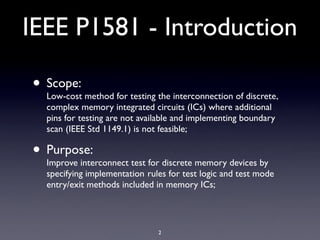
IEEE P1581 - Introduction

• Scope: method for testing the interconnection of discrete,
  Low-cost
   complex memory integrated circuits (ICs) where additional
   pins for testing are not available and implementing boundary
   scan (IEEE Std 1149.1) is not feasible;

• Purpose:
  Improve interconnect test for discrete memory devices by
   specifying implementation	

rules for test logic and test mode
   entry/exit methods included in memory ICs;


                                 2
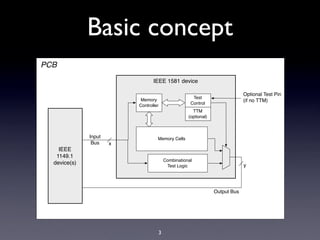
Basic concept
PCB
                                 IEEE 1581 device

                                                                            Optional Test Pin
                           Memory                   Test
                                                                            (if no TTM)
                          Controller               Control
                                                    TTM
                                                  (optional)


              Input                Memory Cells
               Bus    x
    IEEE
   1149.1
                                       Combinational
  device(s)                                                                 y
                                        Test Logic


                                                               Output Bus


                                   3
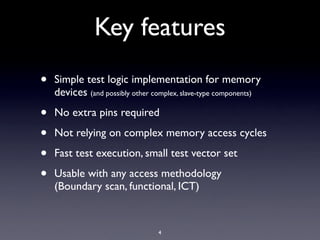
Key features
•   Simple test logic implementation for memory
    devices (and possibly other complex, slave-type components)

•   No extra pins required

•   Not relying on complex memory access cycles

•   Fast test execution, small test vector set

•   Usable with any access methodology
    (Boundary scan, functional, ICT)


                                 4
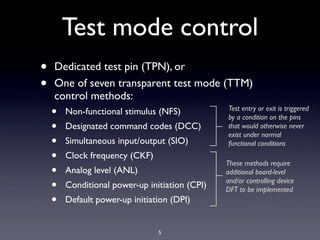
Test mode control
•   Dedicated test pin (TPN), or
•   One of seven transparent test mode (TTM)
    control methods:
    •   Non-functional stimulus (NFS)           Test entry or exit is triggered
                                                by a condition on the pins
    •   Designated command codes (DCC)          that would otherwise never
                                                exist under normal
    •   Simultaneous input/output (SIO)         functional conditions
    •   Clock frequency (CKF)
                                                These methods require
    •   Analog level (ANL)                      additional board-level

    •   Conditional power-up initiation (CPI)   and/or controlling device
                                                DFT to be implemented
    •   Default power-up initiation (DPI)


                                5
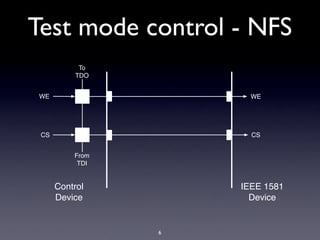
Test mode control - NFS
            To
           TDO


WE                     WE


 CS                    CS


          From
           TDI


      Control        IEEE 1581
      Device           Device


                 6
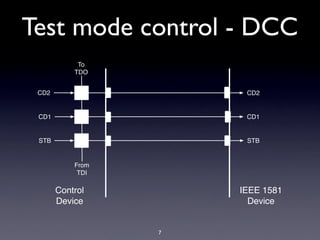
Test mode control - DCC
            To
           TDO


 CD2                   CD2


 CD1                   CD1


 STB                   STB


           From
            TDI

       Control        IEEE 1581
       Device           Device


                  7
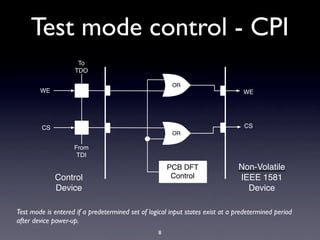
Test mode control - CPI
                     To
                    TDO

                                                        OR
        WE                                                                       WE


         CS                                                                      CS
                                                        OR

                    From
                     TDI

                                                       PCB DFT                 Non-Volatile
              Control                                   Control                IEEE 1581
              Device                                                             Device

Test mode is entered if a predetermined set of logical input states exist at a predetermined period
after device power-up.
                                                   8
Test logic

•   One of three defined test logic architectures:

    •   XOR (3-input XOR or XNOR gates)

    •   IAX (XOR, Inverters, and AND gates)

    •   XOR-2 (2-input XOR or XNOR gates)

•   Or a custom test logic that satisfies rules in IEEE
    P1581


                              9
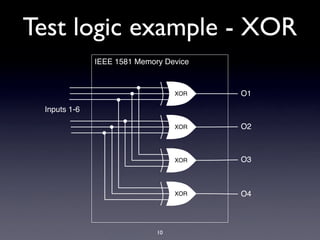
Test logic example - XOR
              IEEE 1581 Memory Device


                                  XOR   O1

 Inputs 1-6

                                  XOR   O2


                                  XOR   O3


                                  XOR   O4


                             10
Optional test functions
• Optional test functions accessible via test
  pattern partitioning
• Examples include:
  •   Reading a device identification (ID)

  •   Control line continuity test

  •   Built-in self test (BIST) access

  •   Other public or private commands


                           11
Status of IEEE P1581

• Balloting completed
• Ballot group voted to accept IEEE P1581
• IEEE needs to review and finalize
  acceptance
• Official adoption as IEEE Std 1581 expected
  for mid 2010


                    12

IEEE Std 1581 VTS 2011 slides

  • 1.
    IEEE P1581 Simplifying ConnectivityTests for Complex Memories and other Non-Boundary Scan Devices Heiko Ehrenberg, GOEPEL Electronics Chair of IEEE P1581 working group h.ehrenberg@ieee.org
  • 2.
    IEEE P1581 -Introduction • Scope: method for testing the interconnection of discrete, Low-cost complex memory integrated circuits (ICs) where additional pins for testing are not available and implementing boundary scan (IEEE Std 1149.1) is not feasible; • Purpose: Improve interconnect test for discrete memory devices by specifying implementation rules for test logic and test mode entry/exit methods included in memory ICs; 2
  • 3.
    Basic concept PCB IEEE 1581 device Optional Test Pin Memory Test (if no TTM) Controller Control TTM (optional) Input Memory Cells Bus x IEEE 1149.1 Combinational device(s) y Test Logic Output Bus 3
  • 4.
    Key features • Simple test logic implementation for memory devices (and possibly other complex, slave-type components) • No extra pins required • Not relying on complex memory access cycles • Fast test execution, small test vector set • Usable with any access methodology (Boundary scan, functional, ICT) 4
  • 5.
    Test mode control • Dedicated test pin (TPN), or • One of seven transparent test mode (TTM) control methods: • Non-functional stimulus (NFS) Test entry or exit is triggered by a condition on the pins • Designated command codes (DCC) that would otherwise never exist under normal • Simultaneous input/output (SIO) functional conditions • Clock frequency (CKF) These methods require • Analog level (ANL) additional board-level • Conditional power-up initiation (CPI) and/or controlling device DFT to be implemented • Default power-up initiation (DPI) 5
  • 6.
    Test mode control- NFS To TDO WE WE CS CS From TDI Control IEEE 1581 Device Device 6
  • 7.
    Test mode control- DCC To TDO CD2 CD2 CD1 CD1 STB STB From TDI Control IEEE 1581 Device Device 7
  • 8.
    Test mode control- CPI To TDO OR WE WE CS CS OR From TDI PCB DFT Non-Volatile Control Control IEEE 1581 Device Device Test mode is entered if a predetermined set of logical input states exist at a predetermined period after device power-up. 8
  • 9.
    Test logic • One of three defined test logic architectures: • XOR (3-input XOR or XNOR gates) • IAX (XOR, Inverters, and AND gates) • XOR-2 (2-input XOR or XNOR gates) • Or a custom test logic that satisfies rules in IEEE P1581 9
  • 10.
    Test logic example- XOR IEEE 1581 Memory Device XOR O1 Inputs 1-6 XOR O2 XOR O3 XOR O4 10
  • 11.
    Optional test functions •Optional test functions accessible via test pattern partitioning • Examples include: • Reading a device identification (ID) • Control line continuity test • Built-in self test (BIST) access • Other public or private commands 11
  • 12.
    Status of IEEEP1581 • Balloting completed • Ballot group voted to accept IEEE P1581 • IEEE needs to review and finalize acceptance • Official adoption as IEEE Std 1581 expected for mid 2010 12