Teachers’ Information and
Communication Technology (ICT)
Assessment Tools: A Review
Mbarek DHAHRI, Mohamed Koutheair Khribi
University of Tunis, Tunisia
IEEE ICALT21
OUTLINE
 Background
 Problem statement
 Methodology
 Results
 Conclusions
 Future research
2
BACKGROUND
 Teachers need to be able to make use of ICT to supervise
learners.
 Teacher training is essential as it enables teachers
developing required ICT competences.
BUT
 Teachers often run into difficulties to locate appropriate
training resources aligned to their competences.
3
PROBLEM STATEMENT
 This review represents the first milestone of an ongoing
research on teacher recommendation systems towards
recommending relevant training materials aligned to a
specific ICT competency framework.
 [Sergis and Samspon, 2016] asserted that the elicitation
of teachers’ ICT competences profile is an essential
component of an educational recommender system.
4
METHODOLOGY
5
Research
questions
Search
strategy
Selection
Criteria
RQ1: What assessment tools’ objectives are being addressed?
RQ2: What are the methods used to assess teachers’ ICT competencies?
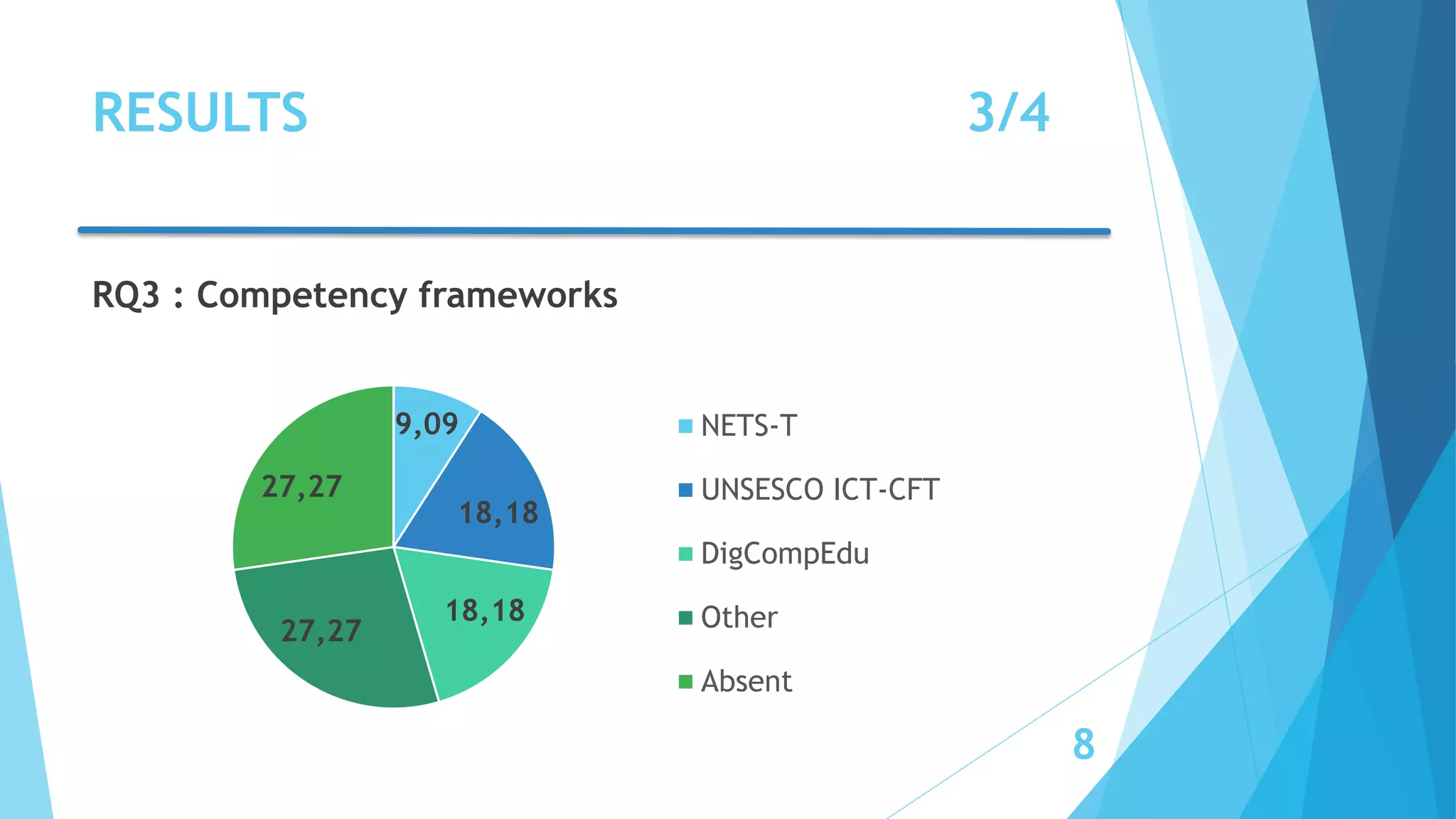
RQ3: What competency frameworks are used?
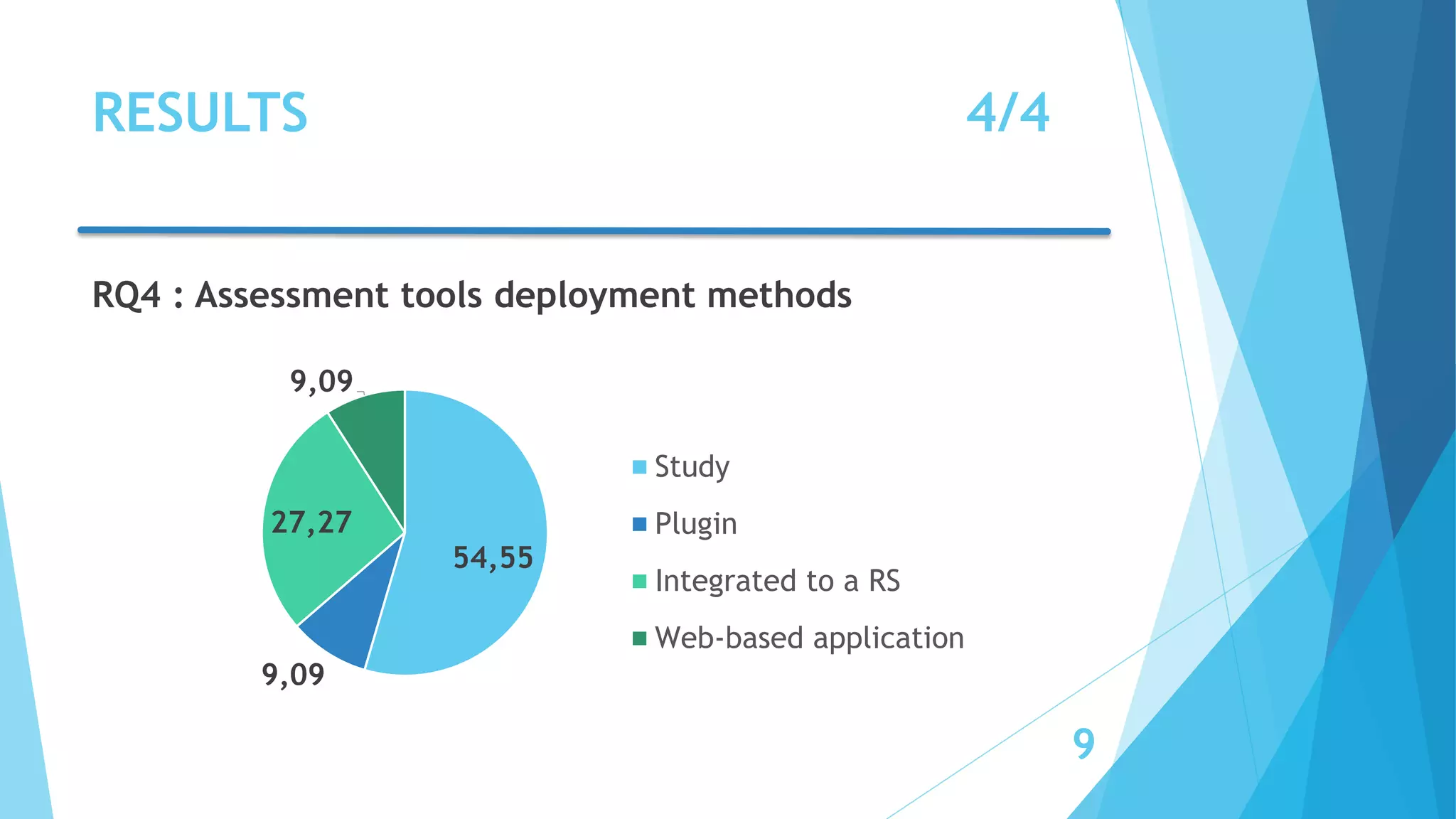
RQ4: Which deployment methods are used?
Results
RESULTS 1/4
6
0 1 2 3 4 5
ICT literacy levels
ICT Teachers’ Competence
Competence-based recommendation
ICT Teachers’ Competence level
Knowledge related to competences
Level of ICT knowledge
RQ1 : Assessment tools’ objectives
RESULTS 2/4
7
RQ2 : Assessment tools’ methods
9,09
9,09
81,82
Task-based assessment
Hybrid
Self-assessment
RESULTS 3/4
8
RQ3 : Competency frameworks
9,09
18,18
18,18
27,27
27,27
NETS-T
UNSESCO ICT-CFT
DigCompEdu
Other
Absent
RESULTS 4/4
9
RQ4 : Assessment tools deployment methods
54,55
9,09
27,27
9,09
Study
Plugin
Integrated to a RS
Web-based application
CONCLUSIONS
 11 papers selected and reviewed
 For each paper, we identified :
 the tool’s objective,
 the competency framework,
 the assessment method and
 the tool deployment method.
 It is just the first step on the way to the development of
an assessment tool of teachers’ ICT competency.
10
FUTURE WORK
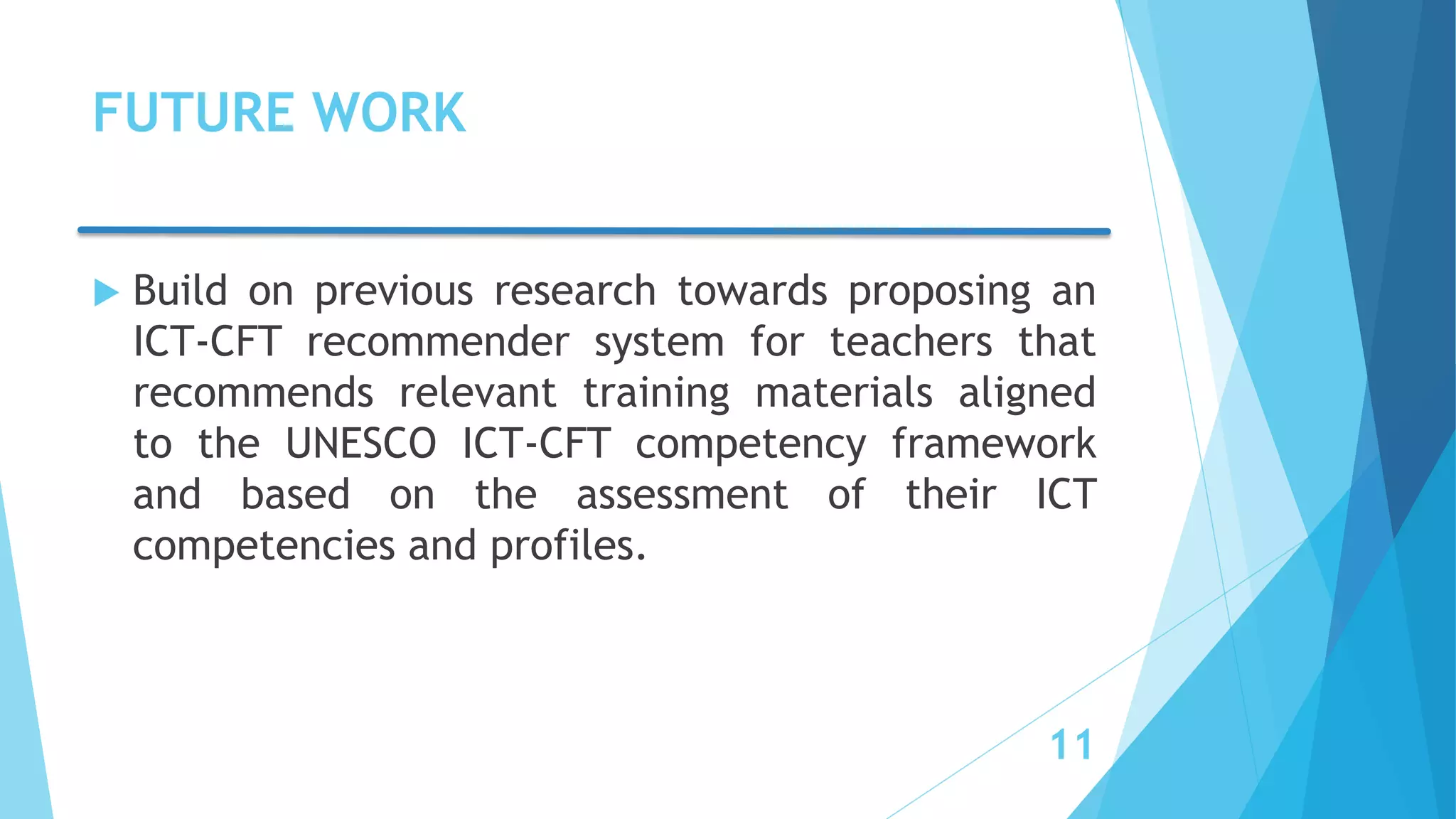
 Build on previous research towards proposing an
ICT-CFT recommender system for teachers that
recommends relevant training materials aligned
to the UNESCO ICT-CFT competency framework
and based on the assessment of their ICT
competencies and profiles.
11
Thank you !
12
Email: mbarek.dhahri@gmail.com

IEEE ICALT21

  • 1.
    Teachers’ Information and CommunicationTechnology (ICT) Assessment Tools: A Review Mbarek DHAHRI, Mohamed Koutheair Khribi University of Tunis, Tunisia IEEE ICALT21
  • 2.
    OUTLINE  Background  Problemstatement  Methodology  Results  Conclusions  Future research 2
  • 3.
    BACKGROUND  Teachers needto be able to make use of ICT to supervise learners.  Teacher training is essential as it enables teachers developing required ICT competences. BUT  Teachers often run into difficulties to locate appropriate training resources aligned to their competences. 3
  • 4.
    PROBLEM STATEMENT  Thisreview represents the first milestone of an ongoing research on teacher recommendation systems towards recommending relevant training materials aligned to a specific ICT competency framework.  [Sergis and Samspon, 2016] asserted that the elicitation of teachers’ ICT competences profile is an essential component of an educational recommender system. 4
  • 5.
    METHODOLOGY 5 Research questions Search strategy Selection Criteria RQ1: What assessmenttools’ objectives are being addressed? RQ2: What are the methods used to assess teachers’ ICT competencies? RQ3: What competency frameworks are used? RQ4: Which deployment methods are used? Results
  • 6.
    RESULTS 1/4 6 0 12 3 4 5 ICT literacy levels ICT Teachers’ Competence Competence-based recommendation ICT Teachers’ Competence level Knowledge related to competences Level of ICT knowledge RQ1 : Assessment tools’ objectives
  • 7.
    RESULTS 2/4 7 RQ2 :Assessment tools’ methods 9,09 9,09 81,82 Task-based assessment Hybrid Self-assessment
  • 8.
    RESULTS 3/4 8 RQ3 :Competency frameworks 9,09 18,18 18,18 27,27 27,27 NETS-T UNSESCO ICT-CFT DigCompEdu Other Absent
  • 9.
    RESULTS 4/4 9 RQ4 :Assessment tools deployment methods 54,55 9,09 27,27 9,09 Study Plugin Integrated to a RS Web-based application
  • 10.
    CONCLUSIONS  11 papersselected and reviewed  For each paper, we identified :  the tool’s objective,  the competency framework,  the assessment method and  the tool deployment method.  It is just the first step on the way to the development of an assessment tool of teachers’ ICT competency. 10
  • 11.
    FUTURE WORK  Buildon previous research towards proposing an ICT-CFT recommender system for teachers that recommends relevant training materials aligned to the UNESCO ICT-CFT competency framework and based on the assessment of their ICT competencies and profiles. 11
  • 12.
    Thank you ! 12 Email:mbarek.dhahri@gmail.com