Anomaly Detection
 Anomaly detection is based on the assumption that all intrusive activities are
necessarily anomalous.
 Anomaly detection studies start by forming an opinion on what the normal
attributes for the observed objects are, and then decide what kinds of
activities should be flagged as intrusions and how to make such particular
decisions.
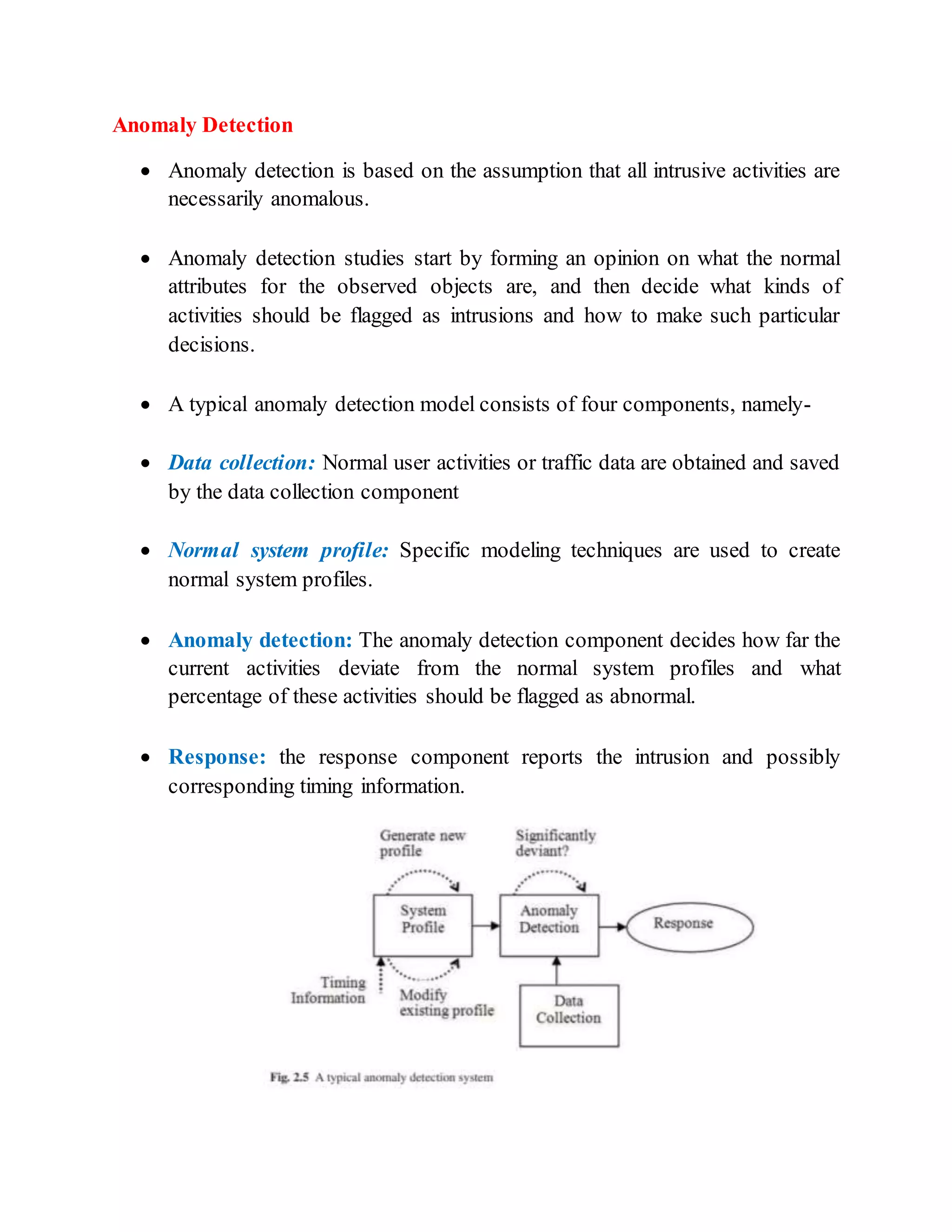
 A typical anomaly detection model consists of four components, namely-
 Data collection: Normal user activities or traffic data are obtained and saved
by the data collection component
 Normal system profile: Specific modeling techniques are used to create
normal system profiles.
 Anomaly detection: The anomaly detection component decides how far the
current activities deviate from the normal system profiles and what
percentage of these activities should be flagged as abnormal.
 Response: the response component reports the intrusion and possibly
corresponding timing information.
Advantage
1. It addresses the biggest limitation of misuse detection as it has capability to
find novel attacks
Limitations
1. The user’s normal behavior model is based on data collected over a period of
normal operations; intrusive activities missed during this period are likely to be
considered as normal behaviors.
2. Anomaly detection techniques can hardly detect stealthy attacks because this
kind of attacks are usually hidden in large number of instances of normal
behaviors.
3. The types of parameters used as inputs of normal models are usually decided by
security experts. Any mistake occurring during the process of defining these
parameters will increase the false alarm rate and decrease the effectiveness of
the anomaly detection system.
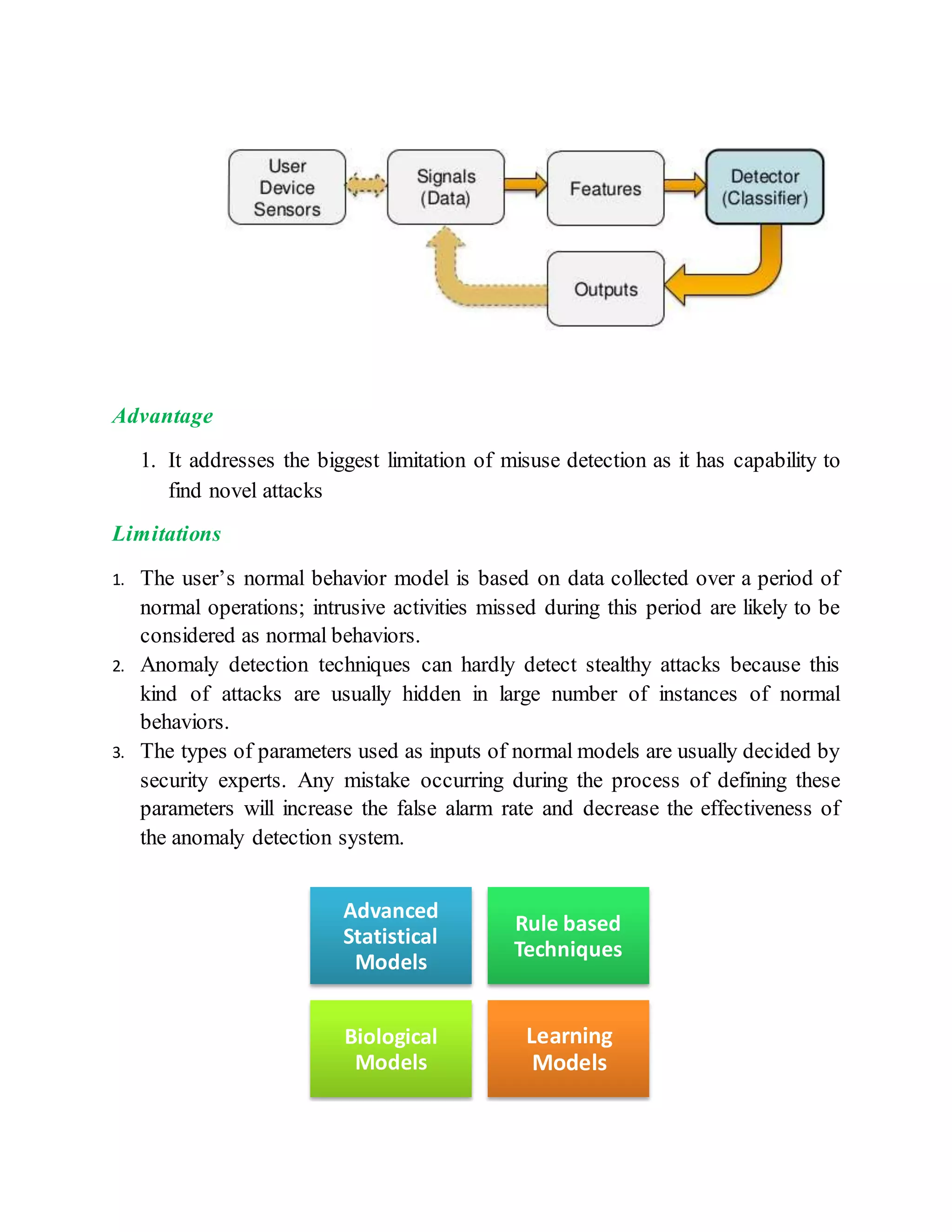
Advanced
Statistical
Models
Rule based
Techniques
Biological
Models
Learning
Models
Advanced Statistical Models
1. Proposed by Denning
2. It is a theoretical characterization of anomaly detection based on basic
statistical analysis.
3. It has a detection framework that consists of eight components:
a. Subjects
b. Objects
c. Audit records
d. Statistical metrics
e. Statistical models
f. Profiles and profile templates
g. Anomaly records
h. Activity rules
4. A subject could be a user, a process, or system itself.
5. The object is the receptor of actions and could be entities such as files,
programs and messages.
6. Audit records are m-tuples that represent a set of actions performed by
subjects on objects.
7. Once an event generator creates the audit records, the statistical model
matches it with the appropriate profile and then makes decisions regarding-
a. The profile update
b. The abnormal behavior checking
c. The report of detected anomalies
8. The activity profile includes various of variables measuring the behavior of
the system based on predefined statistical metrics.
9. The basic idea in Denning’s model appear with little modification in many
intrusion detection systems, such as Haystack, NIDES and EMERALD.
Haystack
1. Designed and implemented for the detection of intrusions in a multi-user
Air Force computer system
2. Statistical techniques are used to detect anomalous activities
3. A set of features such as the amount of I/O, CPU utilization, number of file
accesses are observed and then the normal range of values for these features
are defined.
4. Activities falling outside these ranges are reported as intrusions.
5. It uses a very simple statistical model in which each feature is assigned a
weight by the SSO
6. The main weakness of Haystack is that no test is conducted to verify if the
weight value is sensitive to intrusion patterns and furthermore no
explanation is given as to how the weight value is assigned
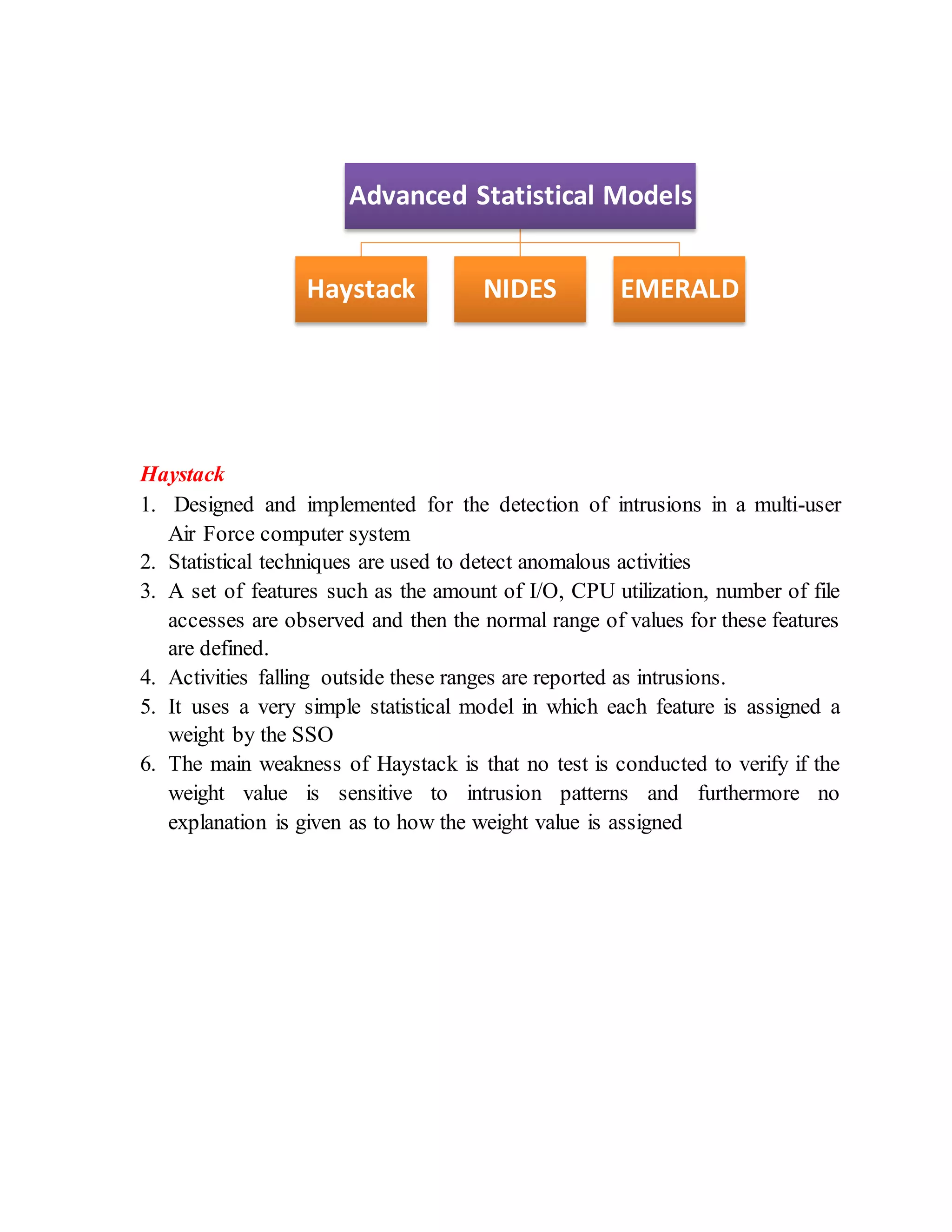
Advanced Statistical Models
Haystack NIDES EMERALD
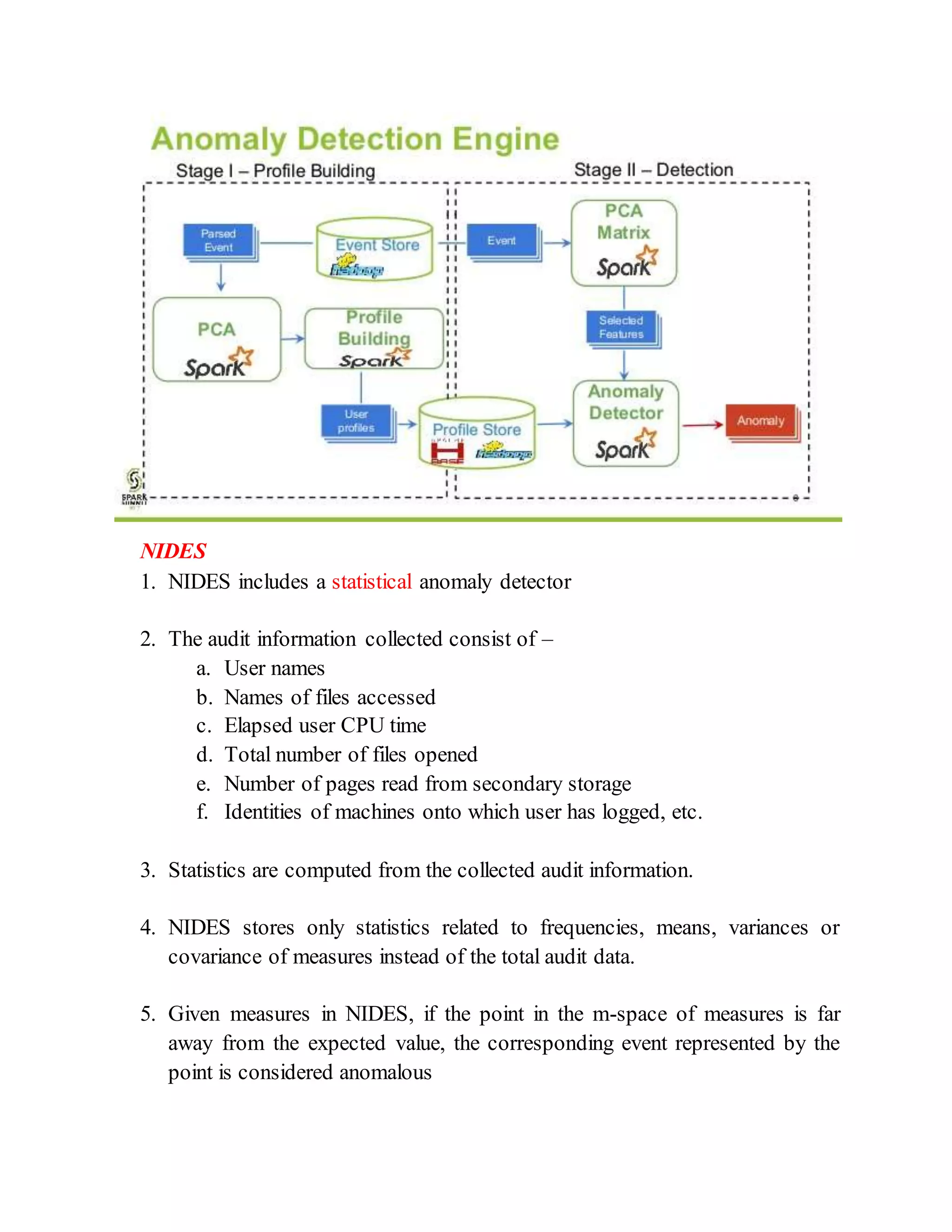
NIDES
1. NIDES includes a statistical anomaly detector
2. The audit information collected consist of –
a. User names
b. Names of files accessed
c. Elapsed user CPU time
d. Total number of files opened
e. Number of pages read from secondary storage
f. Identities of machines onto which user has logged, etc.
3. Statistics are computed from the collected audit information.
4. NIDES stores only statistics related to frequencies, means, variances or
covariance of measures instead of the total audit data.
5. Given measures in NIDES, if the point in the m-space of measures is far
away from the expected value, the corresponding event represented by the
point is considered anomalous
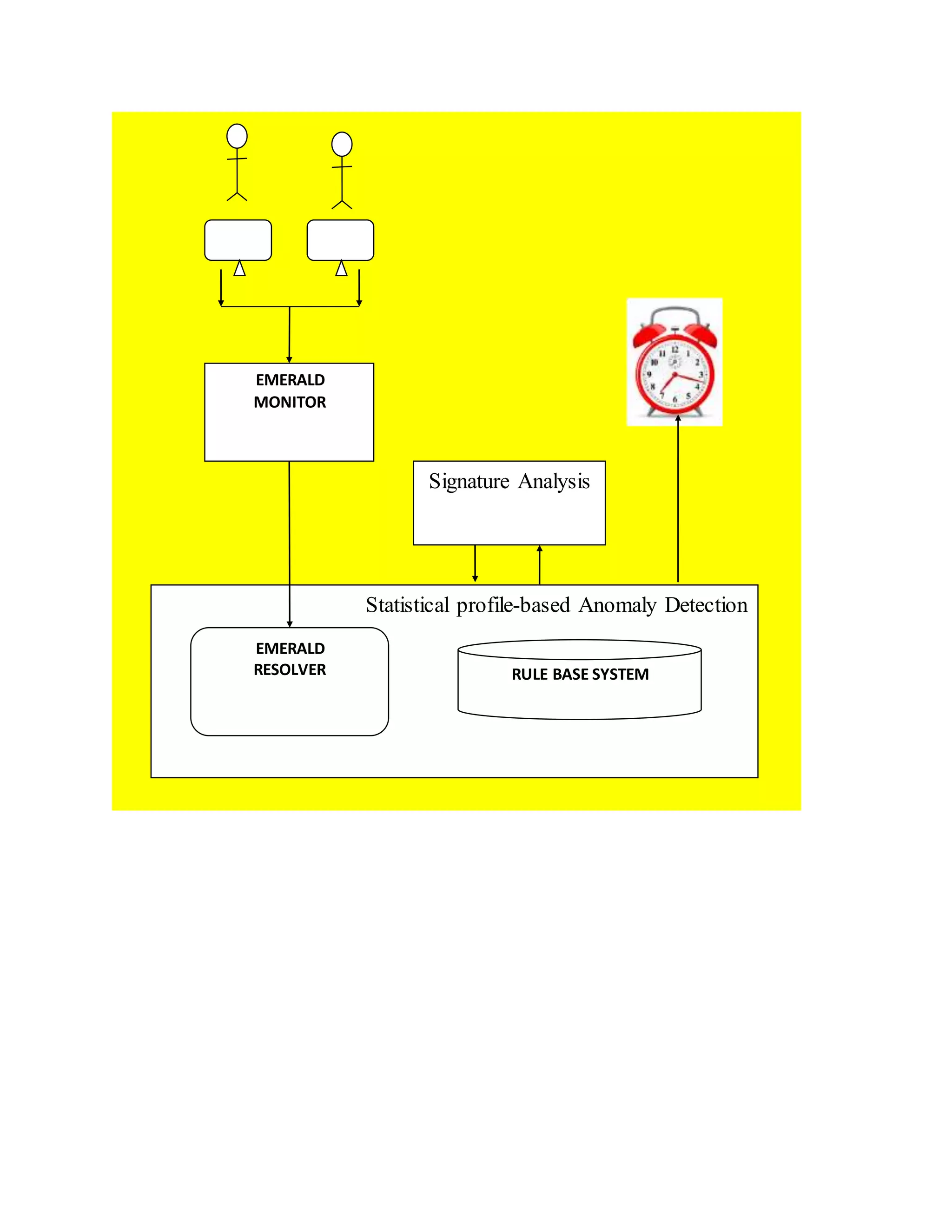
EMERALD (Event Monitoring Enabling Responses to Anomalous Live
Disturbances)
1. An environment for anomaly and misuse detection
2. It consists of a signature analysis component and a statistical profile-based
anomaly detection component
3. The anomaly detector is based on the statistical approach where the events
are labeled as intrusive if they are largely deviant from the expected
behavior
4. In EMERALD more than 30 different criteria including CPU and I/O usage,
commands used, local network activity, and system errors are used to build
these expected user profiles
5. An EMERALD monitor is either passive through reading activity logs or
network packets or active via probing for gathering a normal event.
6. The analytical results can be exchanged asynchronously between different
client monitors operated on different layers (e.g. domain layer, enterprise
layer, etc.)
7. Moreover, each monitor has an instance of the EMERALD resolver, a
countermeasure decision engine fusing the alerts from its associated analysis
engines and invoking response handlers to counter malicious activities
Statistical profile-based Anomaly Detection
Signature Analysis
EMERALD
MONITOR
EMERALD
RESOLVER RULE BASE SYSTEM
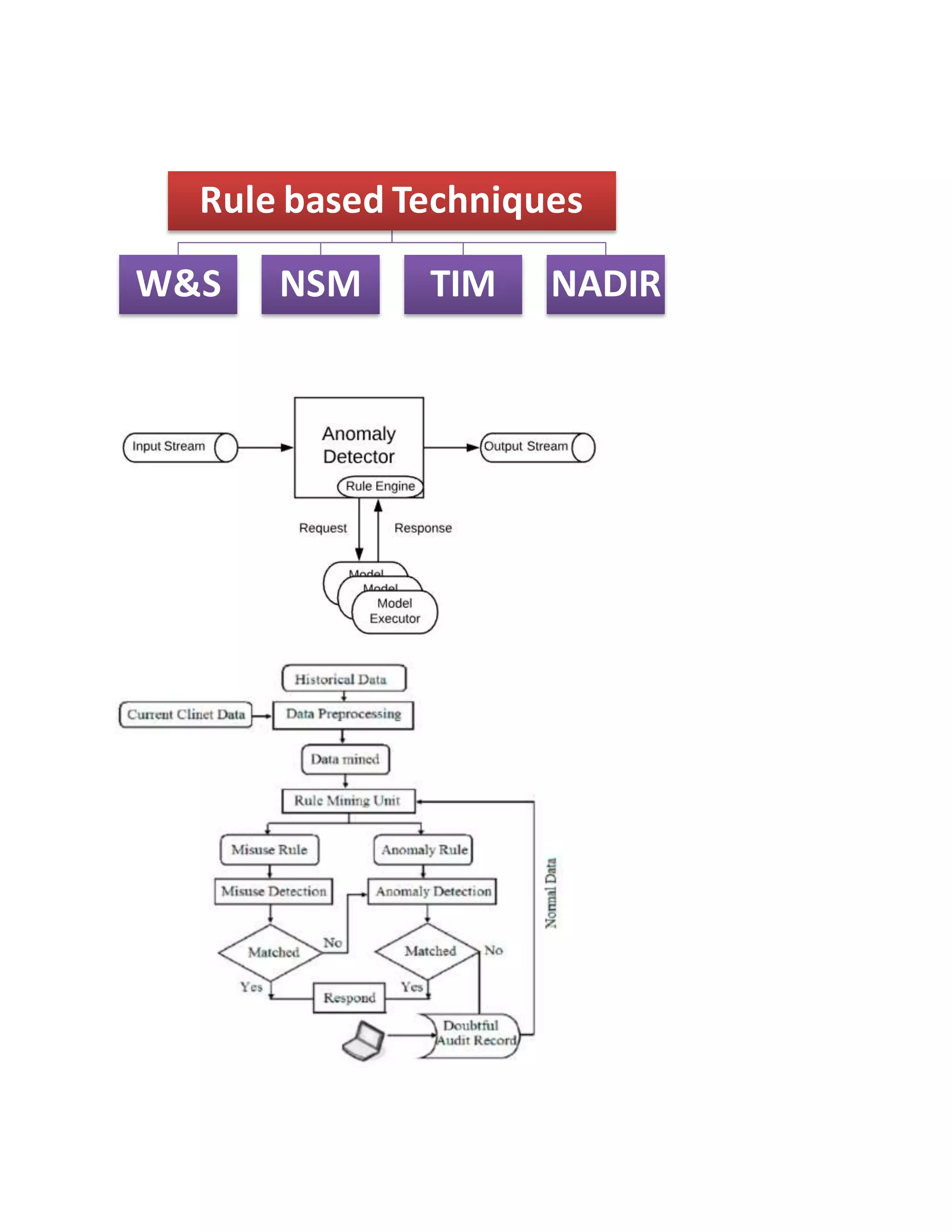
Rule based Techniques
W&S NSM TIM NADIR
Wisdom & Sense (W&S)
 Two components: wisdom and sense
 The wisdom component consists of a set of rules describing normal
behaviors of the system based on historical audit data
 About 10,000 records per user are read from the file in order to create the
rules
 The sense component is an expert system based on the previous rules,
which verifies whether the subsequent audit data violates the rule base or
not
 The system security officer is then alerted when the sense detects some
anomalous behavior
 the Figure of Merit (FOM) metric is used to compute an anomalousness
score for each thread
 The FOMs values for several events are summed and compared against a
threshold
 When the sum value is above the threshold, corresponding events are
flagged as anomalies by the system
Network Security Monitor (NSM)
 Rule-based intrusion detection system targeting anomalous network
activities
 First intrusion detection system using network traffic directly as the
primary source of data
 Network traffic profiles are created by generating connection vectors
derived from the network data
 Host vectors and connection vectors are the main input to the expert
system in NSM
 The expert system illustrates the data-path with which systems are
expected to communicate
 Intrusions are decided according to analysis results of the expert system.
 The final result reported to the SSO consists of a connection vector and
corresponding suspicion level.
 The suspicion level measures the likelihood that a particular connection
represents some intrusive behaviors.
Time-based Inductive Machine (TIM)
 Models user’s normal behavior patterns by dynamically generating
activity rules
 TIM discovers normal behavior patterns in a sequence of events instead
of a single event.
 Each rule represents a model that can predict the next event from a given
sequence of events.
 If user’s behavior matches with previous event sequences and the actual
next event is not included in the predicted event sets, the user’s behavior
is considered as intrusive.
 The major limitation of TIM is that the rules only model adjacent events.
 When many applications are executed at the same time, events occurring
in one application may be interleaved with events occurring in other
applications, in which case the rules generated by TIM may not
accurately identify user’s normal behaviors.
NADIR (Network Anomaly Detection and Intrusion Reporter)
 Collects audit information from three different kinds of service nodes,
namely network security controller, common file system and security
assurance machine
 Network security controller provides user authentication and access
control;
 Common file system stores the data, and security assurance machine
records attempts to degrade the security level of the data
 The audit information collected for each event include-
o A unique user ID associated with the subject
o The date and time of the event
o An accounting parameter, the error code
o A flag indicating whether the corresponding action is successful or
not
o The description of the event.
 Individual user profile is computed on a weekly basis from the audit
database.
 The user profiles are compared with a set of expert system rules in order
to detect possible deviations in users’ behaviors.
 The expert rules are mainly derived from the security policies and the
statistical analysis of previous audit logs.
 Each rule is assigned a level-of-interest. If the corresponding sum of
level-of-interest for a user is too big the intrusion alarm is raised.
BiologicalModels
 Inspired from biological principles
 Initially proposed by Forrest et al.
 They studied the analogy between human immune system’s capability of
distinguishing self from nonself and intrusion detection system
 When applying the self-nonself technique to intrusion detection,
behaviors of the system are viewed as a string.
 This string is divided into sub-strings of equal length k.
 Self contains some of the possible 2k strings
 The rest of the sub-strings 2k −sel f or the complement of self is called
nonself.
 Nonself contains some detector strings, which are of length and does not
exist in the collection of self.
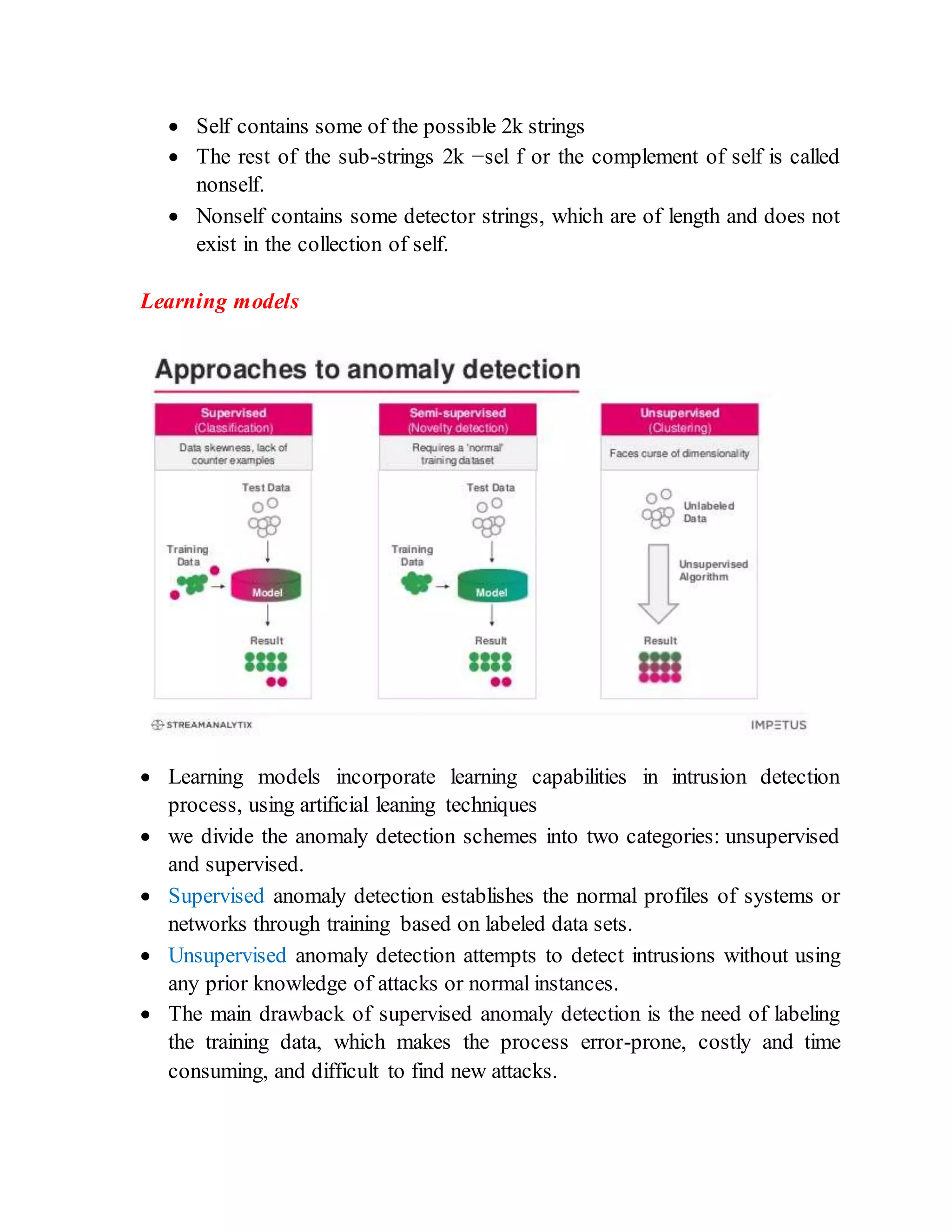
Learning models
 Learning models incorporate learning capabilities in intrusion detection
process, using artificial leaning techniques
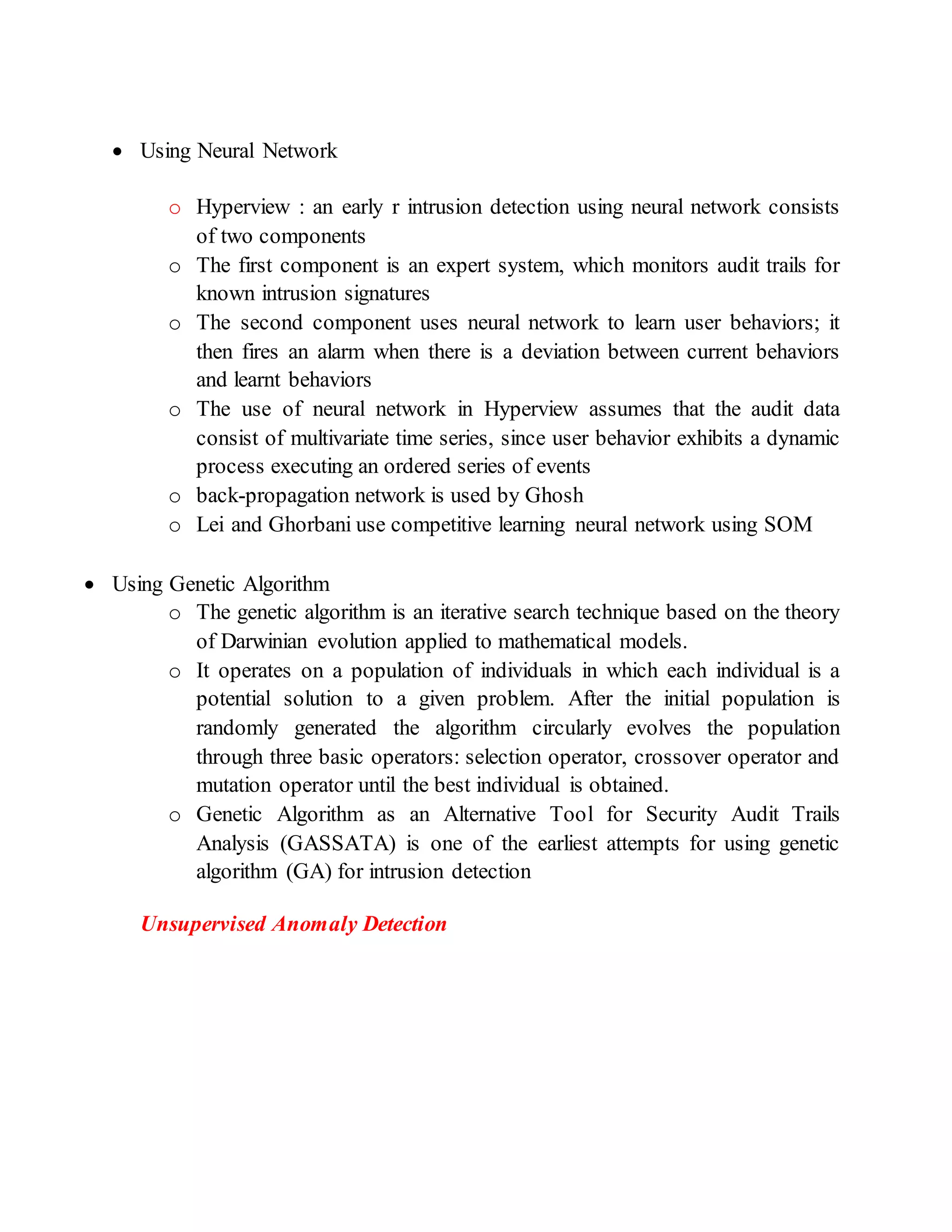
 we divide the anomaly detection schemes into two categories: unsupervised
and supervised.
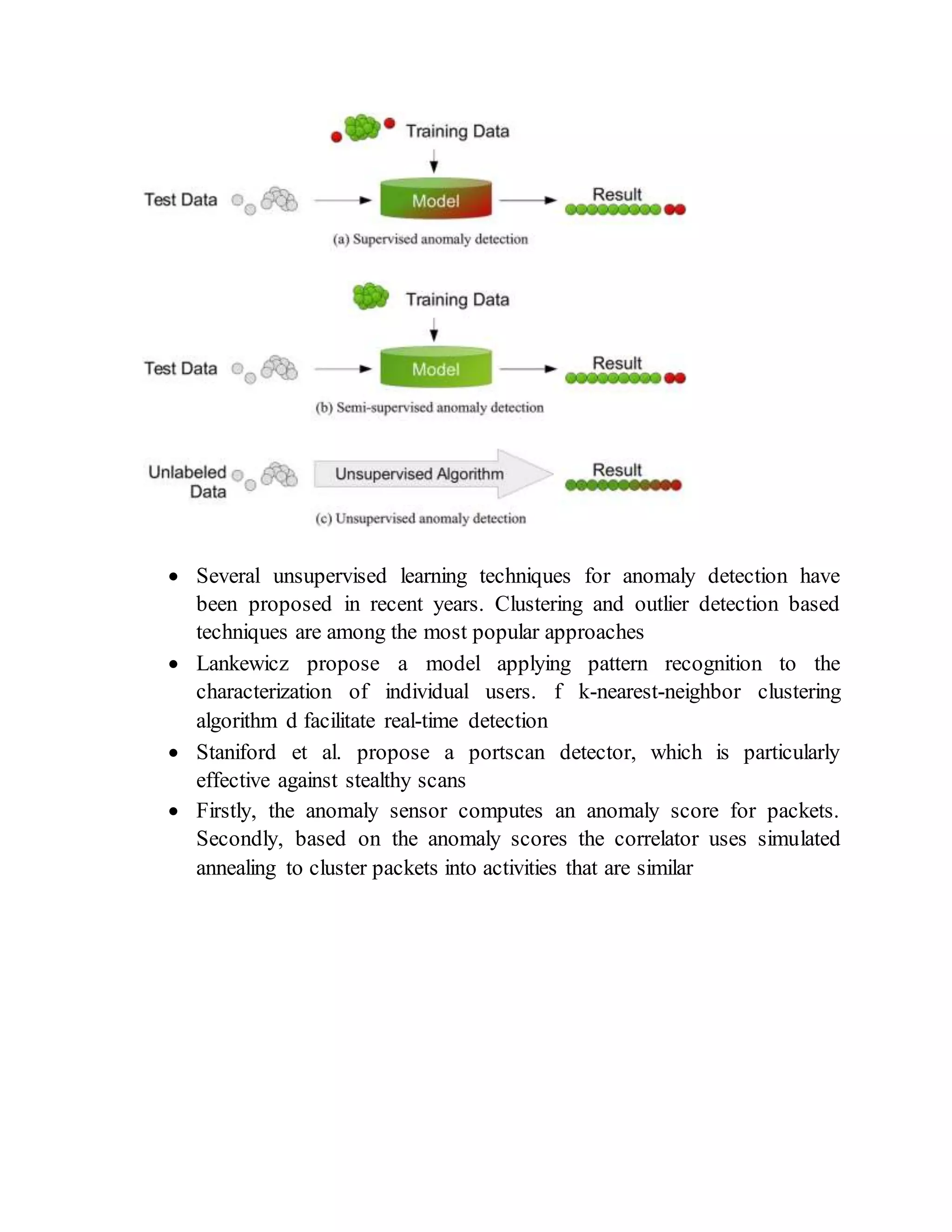
 Supervised anomaly detection establishes the normal profiles of systems or
networks through training based on labeled data sets.
 Unsupervised anomaly detection attempts to detect intrusions without using
any prior knowledge of attacks or normal instances.
 The main drawback of supervised anomaly detection is the need of labeling
the training data, which makes the process error-prone, costly and time
consuming, and difficult to find new attacks.
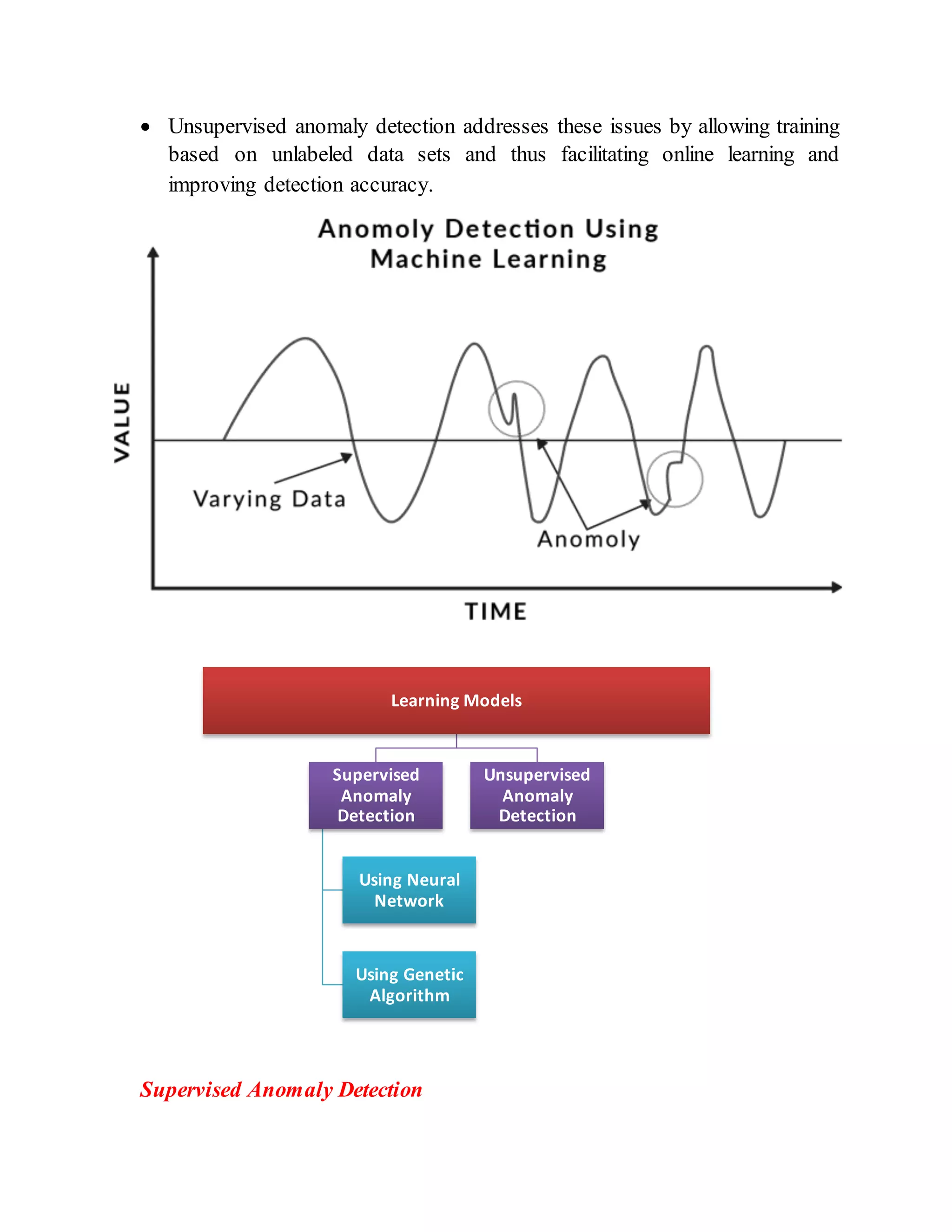
 Unsupervised anomaly detection addresses these issues by allowing training
based on unlabeled data sets and thus facilitating online learning and
improving detection accuracy.
Supervised Anomaly Detection
Learning Models
Supervised
Anomaly
Detection
Using Neural
Network
Using Genetic
Algorithm
Unsupervised
Anomaly
Detection
 Using Neural Network
o Hyperview : an early r intrusion detection using neural network consists
of two components
o The first component is an expert system, which monitors audit trails for
known intrusion signatures
o The second component uses neural network to learn user behaviors; it
then fires an alarm when there is a deviation between current behaviors
and learnt behaviors
o The use of neural network in Hyperview assumes that the audit data
consist of multivariate time series, since user behavior exhibits a dynamic
process executing an ordered series of events
o back-propagation network is used by Ghosh
o Lei and Ghorbani use competitive learning neural network using SOM
 Using Genetic Algorithm
o The genetic algorithm is an iterative search technique based on the theory
of Darwinian evolution applied to mathematical models.
o It operates on a population of individuals in which each individual is a
potential solution to a given problem. After the initial population is
randomly generated the algorithm circularly evolves the population
through three basic operators: selection operator, crossover operator and
mutation operator until the best individual is obtained.
o Genetic Algorithm as an Alternative Tool for Security Audit Trails
Analysis (GASSATA) is one of the earliest attempts for using genetic
algorithm (GA) for intrusion detection
Unsupervised Anomaly Detection
 Several unsupervised learning techniques for anomaly detection have
been proposed in recent years. Clustering and outlier detection based
techniques are among the most popular approaches
 Lankewicz propose a model applying pattern recognition to the
characterization of individual users. f k-nearest-neighbor clustering
algorithm d facilitate real-time detection
 Staniford et al. propose a portscan detector, which is particularly
effective against stealthy scans
 Firstly, the anomaly sensor computes an anomaly score for packets.
Secondly, based on the anomaly scores the correlator uses simulated
annealing to cluster packets into activities that are similar
Specification-based Detection
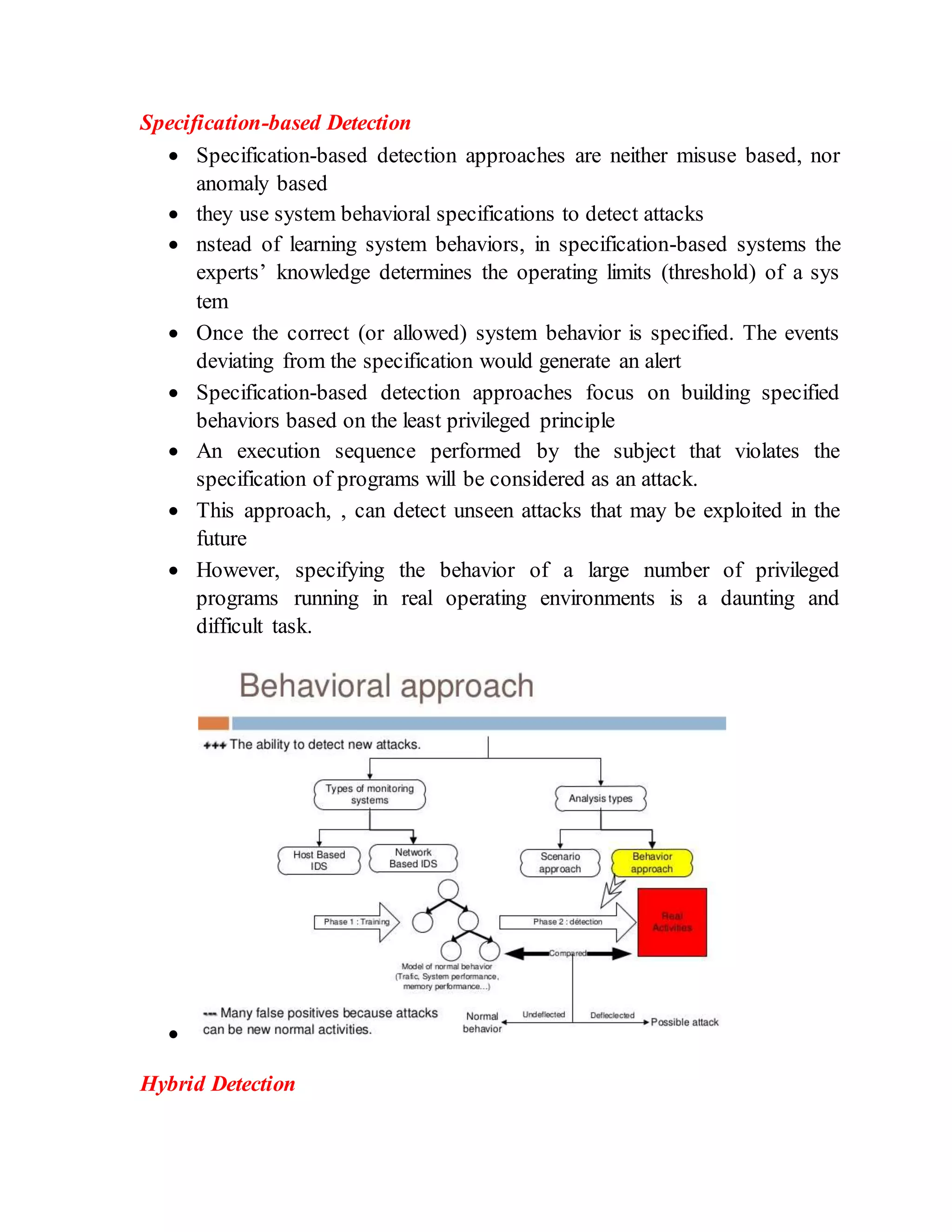
 Specification-based detection approaches are neither misuse based, nor
anomaly based
 they use system behavioral specifications to detect attacks
 nstead of learning system behaviors, in specification-based systems the
experts’ knowledge determines the operating limits (threshold) of a sys
tem
 Once the correct (or allowed) system behavior is specified. The events
deviating from the specification would generate an alert
 Specification-based detection approaches focus on building specified
behaviors based on the least privileged principle
 An execution sequence performed by the subject that violates the
specification of programs will be considered as an attack.
 This approach, , can detect unseen attacks that may be exploited in the
future
 However, specifying the behavior of a large number of privileged
programs running in real operating environments is a daunting and
difficult task.

Hybrid Detection
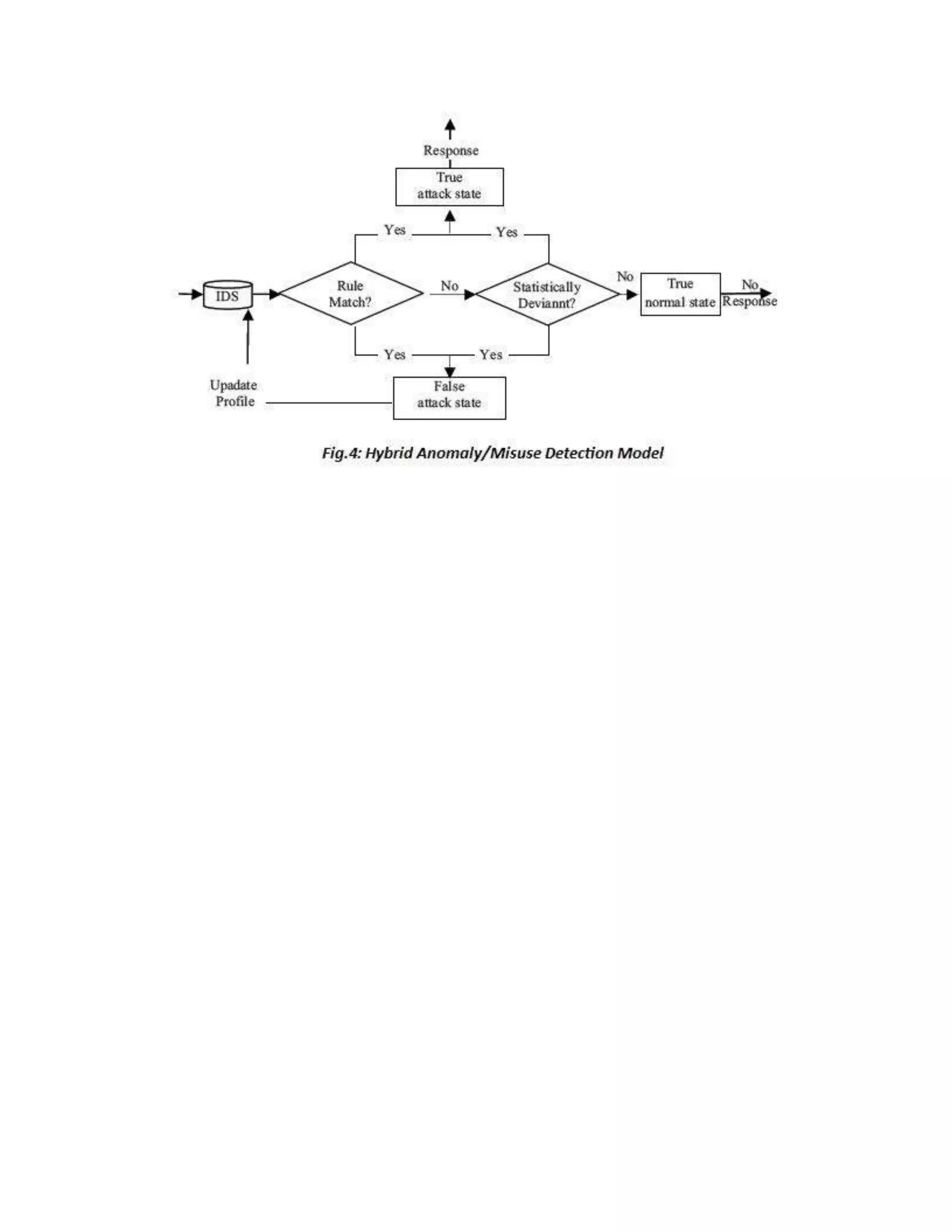
 The intrusion detection capabilities can be improved through a hybrid
approach
 A hybrid approach consisting of both signature (misuse) detection as well
as anomaly detection
 In such a hybrid system, the signature detection technique detects known
attacks and the anomaly detection technique detects novel or unknown
attacks.
 Tombini et al. applied an anomaly detection approach to create a list of
suspicious items. Then a signature detection approach is used to classify
these suspicious items into three categories, namely false alarms, attacks,
and unknown attacks.
 The approach is based on an assumption that a high detection rate can be
achieved by the anomaly detection component because missed intrusions
in the first step will not be found by the follow-up signature detection
component.
 Zhang et al. proposed a hybrid IDS combining both misuse detection and
anomaly detection components, in which a random forests algorithm was
applied
 Based on an idea of combining the advantages of low false positive rate
of signature based IDS and the ability of anomaly detection system
(ADS) for detecting new or unknown attacks,
 The well known examples are: signature based SNORT or Bro systems
Ids 014 anomaly detection

Ids 014 anomaly detection

  • 1.
    Anomaly Detection  Anomalydetection is based on the assumption that all intrusive activities are necessarily anomalous.  Anomaly detection studies start by forming an opinion on what the normal attributes for the observed objects are, and then decide what kinds of activities should be flagged as intrusions and how to make such particular decisions.  A typical anomaly detection model consists of four components, namely-  Data collection: Normal user activities or traffic data are obtained and saved by the data collection component  Normal system profile: Specific modeling techniques are used to create normal system profiles.  Anomaly detection: The anomaly detection component decides how far the current activities deviate from the normal system profiles and what percentage of these activities should be flagged as abnormal.  Response: the response component reports the intrusion and possibly corresponding timing information.
  • 2.
    Advantage 1. It addressesthe biggest limitation of misuse detection as it has capability to find novel attacks Limitations 1. The user’s normal behavior model is based on data collected over a period of normal operations; intrusive activities missed during this period are likely to be considered as normal behaviors. 2. Anomaly detection techniques can hardly detect stealthy attacks because this kind of attacks are usually hidden in large number of instances of normal behaviors. 3. The types of parameters used as inputs of normal models are usually decided by security experts. Any mistake occurring during the process of defining these parameters will increase the false alarm rate and decrease the effectiveness of the anomaly detection system. Advanced Statistical Models Rule based Techniques Biological Models Learning Models
  • 3.
    Advanced Statistical Models 1.Proposed by Denning 2. It is a theoretical characterization of anomaly detection based on basic statistical analysis. 3. It has a detection framework that consists of eight components: a. Subjects b. Objects c. Audit records d. Statistical metrics e. Statistical models f. Profiles and profile templates g. Anomaly records h. Activity rules 4. A subject could be a user, a process, or system itself. 5. The object is the receptor of actions and could be entities such as files, programs and messages. 6. Audit records are m-tuples that represent a set of actions performed by subjects on objects. 7. Once an event generator creates the audit records, the statistical model matches it with the appropriate profile and then makes decisions regarding- a. The profile update b. The abnormal behavior checking c. The report of detected anomalies 8. The activity profile includes various of variables measuring the behavior of the system based on predefined statistical metrics. 9. The basic idea in Denning’s model appear with little modification in many intrusion detection systems, such as Haystack, NIDES and EMERALD.
  • 4.
    Haystack 1. Designed andimplemented for the detection of intrusions in a multi-user Air Force computer system 2. Statistical techniques are used to detect anomalous activities 3. A set of features such as the amount of I/O, CPU utilization, number of file accesses are observed and then the normal range of values for these features are defined. 4. Activities falling outside these ranges are reported as intrusions. 5. It uses a very simple statistical model in which each feature is assigned a weight by the SSO 6. The main weakness of Haystack is that no test is conducted to verify if the weight value is sensitive to intrusion patterns and furthermore no explanation is given as to how the weight value is assigned Advanced Statistical Models Haystack NIDES EMERALD
  • 5.
    NIDES 1. NIDES includesa statistical anomaly detector 2. The audit information collected consist of – a. User names b. Names of files accessed c. Elapsed user CPU time d. Total number of files opened e. Number of pages read from secondary storage f. Identities of machines onto which user has logged, etc. 3. Statistics are computed from the collected audit information. 4. NIDES stores only statistics related to frequencies, means, variances or covariance of measures instead of the total audit data. 5. Given measures in NIDES, if the point in the m-space of measures is far away from the expected value, the corresponding event represented by the point is considered anomalous
  • 6.
    EMERALD (Event MonitoringEnabling Responses to Anomalous Live Disturbances) 1. An environment for anomaly and misuse detection 2. It consists of a signature analysis component and a statistical profile-based anomaly detection component 3. The anomaly detector is based on the statistical approach where the events are labeled as intrusive if they are largely deviant from the expected behavior 4. In EMERALD more than 30 different criteria including CPU and I/O usage, commands used, local network activity, and system errors are used to build these expected user profiles 5. An EMERALD monitor is either passive through reading activity logs or network packets or active via probing for gathering a normal event. 6. The analytical results can be exchanged asynchronously between different client monitors operated on different layers (e.g. domain layer, enterprise layer, etc.) 7. Moreover, each monitor has an instance of the EMERALD resolver, a countermeasure decision engine fusing the alerts from its associated analysis engines and invoking response handlers to counter malicious activities
  • 7.
    Statistical profile-based AnomalyDetection Signature Analysis EMERALD MONITOR EMERALD RESOLVER RULE BASE SYSTEM
  • 8.
  • 9.
    Wisdom & Sense(W&S)  Two components: wisdom and sense  The wisdom component consists of a set of rules describing normal behaviors of the system based on historical audit data  About 10,000 records per user are read from the file in order to create the rules  The sense component is an expert system based on the previous rules, which verifies whether the subsequent audit data violates the rule base or not  The system security officer is then alerted when the sense detects some anomalous behavior  the Figure of Merit (FOM) metric is used to compute an anomalousness score for each thread  The FOMs values for several events are summed and compared against a threshold  When the sum value is above the threshold, corresponding events are flagged as anomalies by the system Network Security Monitor (NSM)  Rule-based intrusion detection system targeting anomalous network activities  First intrusion detection system using network traffic directly as the primary source of data
  • 10.
     Network trafficprofiles are created by generating connection vectors derived from the network data  Host vectors and connection vectors are the main input to the expert system in NSM  The expert system illustrates the data-path with which systems are expected to communicate  Intrusions are decided according to analysis results of the expert system.  The final result reported to the SSO consists of a connection vector and corresponding suspicion level.  The suspicion level measures the likelihood that a particular connection represents some intrusive behaviors. Time-based Inductive Machine (TIM)  Models user’s normal behavior patterns by dynamically generating activity rules  TIM discovers normal behavior patterns in a sequence of events instead of a single event.  Each rule represents a model that can predict the next event from a given sequence of events.  If user’s behavior matches with previous event sequences and the actual next event is not included in the predicted event sets, the user’s behavior is considered as intrusive.  The major limitation of TIM is that the rules only model adjacent events.  When many applications are executed at the same time, events occurring in one application may be interleaved with events occurring in other applications, in which case the rules generated by TIM may not accurately identify user’s normal behaviors.
  • 11.
    NADIR (Network AnomalyDetection and Intrusion Reporter)  Collects audit information from three different kinds of service nodes, namely network security controller, common file system and security assurance machine  Network security controller provides user authentication and access control;  Common file system stores the data, and security assurance machine records attempts to degrade the security level of the data  The audit information collected for each event include- o A unique user ID associated with the subject o The date and time of the event o An accounting parameter, the error code o A flag indicating whether the corresponding action is successful or not o The description of the event.  Individual user profile is computed on a weekly basis from the audit database.  The user profiles are compared with a set of expert system rules in order to detect possible deviations in users’ behaviors.  The expert rules are mainly derived from the security policies and the statistical analysis of previous audit logs.  Each rule is assigned a level-of-interest. If the corresponding sum of level-of-interest for a user is too big the intrusion alarm is raised. BiologicalModels  Inspired from biological principles  Initially proposed by Forrest et al.  They studied the analogy between human immune system’s capability of distinguishing self from nonself and intrusion detection system  When applying the self-nonself technique to intrusion detection, behaviors of the system are viewed as a string.  This string is divided into sub-strings of equal length k.
  • 12.
     Self containssome of the possible 2k strings  The rest of the sub-strings 2k −sel f or the complement of self is called nonself.  Nonself contains some detector strings, which are of length and does not exist in the collection of self. Learning models  Learning models incorporate learning capabilities in intrusion detection process, using artificial leaning techniques  we divide the anomaly detection schemes into two categories: unsupervised and supervised.  Supervised anomaly detection establishes the normal profiles of systems or networks through training based on labeled data sets.  Unsupervised anomaly detection attempts to detect intrusions without using any prior knowledge of attacks or normal instances.  The main drawback of supervised anomaly detection is the need of labeling the training data, which makes the process error-prone, costly and time consuming, and difficult to find new attacks.
  • 13.
     Unsupervised anomalydetection addresses these issues by allowing training based on unlabeled data sets and thus facilitating online learning and improving detection accuracy. Supervised Anomaly Detection Learning Models Supervised Anomaly Detection Using Neural Network Using Genetic Algorithm Unsupervised Anomaly Detection
  • 14.
     Using NeuralNetwork o Hyperview : an early r intrusion detection using neural network consists of two components o The first component is an expert system, which monitors audit trails for known intrusion signatures o The second component uses neural network to learn user behaviors; it then fires an alarm when there is a deviation between current behaviors and learnt behaviors o The use of neural network in Hyperview assumes that the audit data consist of multivariate time series, since user behavior exhibits a dynamic process executing an ordered series of events o back-propagation network is used by Ghosh o Lei and Ghorbani use competitive learning neural network using SOM  Using Genetic Algorithm o The genetic algorithm is an iterative search technique based on the theory of Darwinian evolution applied to mathematical models. o It operates on a population of individuals in which each individual is a potential solution to a given problem. After the initial population is randomly generated the algorithm circularly evolves the population through three basic operators: selection operator, crossover operator and mutation operator until the best individual is obtained. o Genetic Algorithm as an Alternative Tool for Security Audit Trails Analysis (GASSATA) is one of the earliest attempts for using genetic algorithm (GA) for intrusion detection Unsupervised Anomaly Detection
  • 15.
     Several unsupervisedlearning techniques for anomaly detection have been proposed in recent years. Clustering and outlier detection based techniques are among the most popular approaches  Lankewicz propose a model applying pattern recognition to the characterization of individual users. f k-nearest-neighbor clustering algorithm d facilitate real-time detection  Staniford et al. propose a portscan detector, which is particularly effective against stealthy scans  Firstly, the anomaly sensor computes an anomaly score for packets. Secondly, based on the anomaly scores the correlator uses simulated annealing to cluster packets into activities that are similar
  • 16.
    Specification-based Detection  Specification-baseddetection approaches are neither misuse based, nor anomaly based  they use system behavioral specifications to detect attacks  nstead of learning system behaviors, in specification-based systems the experts’ knowledge determines the operating limits (threshold) of a sys tem  Once the correct (or allowed) system behavior is specified. The events deviating from the specification would generate an alert  Specification-based detection approaches focus on building specified behaviors based on the least privileged principle  An execution sequence performed by the subject that violates the specification of programs will be considered as an attack.  This approach, , can detect unseen attacks that may be exploited in the future  However, specifying the behavior of a large number of privileged programs running in real operating environments is a daunting and difficult task.  Hybrid Detection
  • 17.
     The intrusiondetection capabilities can be improved through a hybrid approach  A hybrid approach consisting of both signature (misuse) detection as well as anomaly detection  In such a hybrid system, the signature detection technique detects known attacks and the anomaly detection technique detects novel or unknown attacks.  Tombini et al. applied an anomaly detection approach to create a list of suspicious items. Then a signature detection approach is used to classify these suspicious items into three categories, namely false alarms, attacks, and unknown attacks.  The approach is based on an assumption that a high detection rate can be achieved by the anomaly detection component because missed intrusions in the first step will not be found by the follow-up signature detection component.  Zhang et al. proposed a hybrid IDS combining both misuse detection and anomaly detection components, in which a random forests algorithm was applied  Based on an idea of combining the advantages of low false positive rate of signature based IDS and the ability of anomaly detection system (ADS) for detecting new or unknown attacks,  The well known examples are: signature based SNORT or Bro systems