Social Identity
Introduction to my research project:
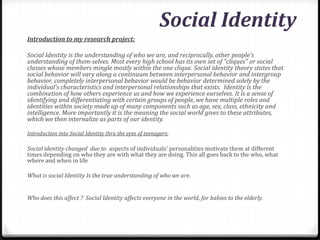
Social Identity is the understanding of who we are, and reciprocally, other people's
understanding of them-selves. Most every high school has its own set of "cliques" or social
classes whose members mingle mostly within the one clique. Social identity theory states that
social behavior will vary along a continuum between interpersonal behavior and intergroup
behavior, completely interpersonal behavior would be behavior determined solely by the
individual’s characteristics and interpersonal relationships that exists. Identity is the
combination of how others experience us and how we experience ourselves. It is a sense of
identifying and differentiating with certain groups of people, we have multiple roles and
identities within society made up of many components such as age, sex, class, ethnicity and
intelligence. More importantly it is the meaning the social world gives to these attributes,
which we then internalize as parts of our identity.
Introduction into Social Identity thru the eyes of teenagers:
Social identity changed due to aspects of individuals' personalities motivate them at different
times depending on who they are with what they are doing. This all goes back to the who, what
where and when in life
What is social Identity Is the true understanding of who we are.
Who does this affect ? Social Identity affects everyone in the world, for babies to the elderly.
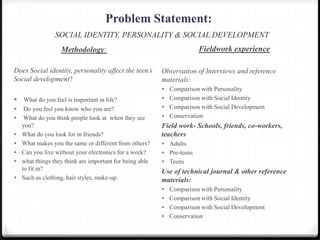
Problem Statement:
SOCIAL IDENTITY, PERSONALITY & SOCIAL DEVELOPMENT
Methodology:
Does Social identity, personality affect the teen’s
Social development?
 What do you feel is important in life?
 Do you feel you know who you are?
 What do you think people look at when they see
you?
 What do you look for in friends?
 What makes you the same or different from others?
 Can you live without your electronics for a week?
 what things they think are important for being able
to fit in?
 Such as clothing, hair styles, make-up.
Fieldwork experience
Observation of Interviews and reference
materials:
 Comparison with Personality
 Comparison with Social Identity
 Comparison with Social Development
 Conservation
Field work- Schools, friends, co-workers,
teachers
 Adults
 Pre-teens
 Teens
Use of technical journal & other reference
materials:
 Comparison with Personality
 Comparison with Social Identity
 Comparison with Social Development
 Conservation
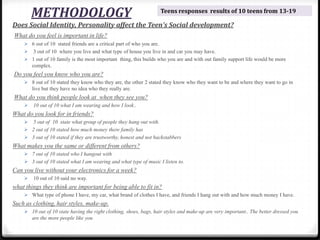
METHODOLOGY
Does Social Identity, Personality affect the Teen’s Social development?
What do you feel is important in life?
 6 out of 10 stated friends are a critical part of who you are.
 3 out of 10 where you live and what type of house you live in and car you may have.
 1 out of 10 family is the most important thing, this builds who you are and with out family support life would be more
complex.
Do you feel you know who you are?
 8 out of 10 stated they know who they are, the other 2 stated they know who they want to be and where they want to go in
live but they have no idea who they really are.
What do you think people look at when they see you?
 10 out of 10 what I am wearing and how I look..
What do you look for in friends?
 5 out of 10 state what group of people they hang out with.
 2 out of 10 stated how much money there family has
 3 out of 10 stated if they are trustworthy, honest and not backstabbers
What makes you the same or different from others?
 7 out of 10 stated who I hangout with
 3 out of 10 stated what I am wearing and what type of music I listen to.
Can you live without your electronics for a week?
 10 out of 10 said no way.
what things they think are important for being able to fit in?
 What type of phone I have, my car, what brand of clothes I have, and friends I hang out with and how much money I have.
Such as clothing, hair styles, make-up.
 10 out of 10 state having the right clothing, shoes, bags, hair styles and make-up are very important.. The better dressed you
are the more people like you
Teens responses results of 10 teens from 13-19
COMPARISON WITH PERSONALITY
 How are teens different when they are with their friends
 Teens tend to take more risks if their peers are around
 They talk, act and communicate on different level
 Are willing to do a bigger variety of things when not supervised
 How do they act without their peers
 They are respectful in words used
 They act like themselves
 Feel more safe and not pressured to act a certain way
 Are their common traits, teens have shown many common traits while with there peers and
without.
 Who has the biggest impact on their personality it is not just a single person it influences
nearly every aspect of our live.
 Peer pressure Peer pressure can try to influence behaviors (pressure to have another drink, be
more sexually active, vote for a certain person) or may try to influence thinking and values. It
can be direct with peers verbally making statements that encourage thoughts/behaviors.
 Alter ego They imagine themselves in the world of their dreams and reach their goals
with the help of this alter ego. Most of the times the interest of the person and his/ her
alter ego are the same and they try to develop it in their own manner.
Questions asked of, adults, and
teens along with parents.
COMPARISON WITH SOCIAL IDENTITY
 Dealing Teen Peer Pressure
 I found after watching teens at middle & high School for a few hours
for over about 5 days that peer pressure is a critical factor. They are
making choices.
 Importance of Individual Social Identity
 I noticed that fitting in is hard since teens don’t tend to have their own
individual social identity. They gain social class by which peers and
clichés they are involved in.
 Self Esteem I found that watching teens walking alone without any of
their peers around they looked glum. Lost or out of place, then tending to
walk with their heads down. When their peers or clichés came around
they were very different.
 Alter ego Having an alter ego at times can be beneficial, provided it does not
go overboard. It gives the person a sense of completeness.
 What is more important fitting in with the other teens and clichés seems
to be very important in determining who they truly are even it this is a
false identity.
Observation of Middle School and High School
COMPARISON WITH SOCIAL DEVELOPMENT
 Is there a trend with social development traits Because of young adolescents'
strong need for affiliation, they need opportunities to form positive and
healthy relationships with peers.
 How does social development play factor today vs. 20 yrs. Ago . Romantic
relationships tend to increase in prevalence throughout adolescence. By age
15, 53% of adolescents have had a romantic relationship that lasted at least
one month over the course of the previous 18 months. In a 2008 study
conducted found that 20% of 14−17-year-olds. A 2002 American study found
that those aged 15–44 reported that the average age of first sexual
intercourse was 17.0 for males and 17.3 for females. The typical duration of
relationships increases throughout the teenage years as well.
 How is social development taught or ignored It is widely believed that the
everyday experiences in relationships with their parents are fundamental to
children's developing social skills. With peer relationships this is learned also by the
experiences and relationships with their peers.
Reviewed websites,
doctoral documents,
CONSERVATION
 Taking a time frame of 20 years why has things changed? The parents stated two main things have changes, the amount of time the
youth like to be with their families & the amount of money they need to spend to help their children feel comfortable in social
groups.
 What are contributing factors of this change? The social networking, media and the cost of living . Parents have to work more
hours to provide for their families and they never had to work up to two jobs just to make ends meet. Electronic have evolved, cell
phones, intranet and social networking has never been a more critical factor in teens lives like the past 10 years.
 Compare family participation in children’s lives in the past 20 yrs. We as parents are always trying to get the teens interesting in
spending time with the family. Its not so much that we have changed what we do or have done from our parent's. Youth of today is
just so different and family does not come first on the list of things to do for the day. Its all out social networking.
 Are their common traits in teens today? I feel that teens are for the most part the same, as in what they desire. Not so much the
same in personality. I feel that fitting in has always been something that we all desire, not just teens of today or yesterday that is
anyone. Some people just show more interest and more drive to be the person that everyone excepts us to be.
 Averages of teens with social identity issues in the USA, what are common traits? I feel that it is all children not just teens. These can
happen at very young ages. The common traits would be just trying to belong.
 Why have things changed so much or seem like they changed so much? We feel things are always changing and nothing is meant to
be the same. There is no one answer we can give for things changing. One of the factors of change is the Social networking seems to
be bigger and much faster. You can sit and video chat with someone for hours and it not cost you anything. Facebook came out. 20
years ago the internet was released. Car phones went to being the coolest thing to having the nicest phone. Television came so far,
from having a few channels only to having hundreds of channels, video game have came so far. I feel that the media has the biggest
influence on things today.
 What is the biggest fact of change social identity, personality & social development : I feel that youth feel they need to be these
poster board people before someone will like them, the meaning of being yourself has disappeared. The pressure is very high for
clothing, money, hair style, all these things should not be the 1st thing people look at when they look at someone. The truth of being
yourself as disappeared. Now you are just a pin up person. I feel the things that make us special is we can be our self's with all these
material things how do we even know who we are anymore.
Interview with a parent of three teenagers
Developing a unique social identity is part of teen social development. This social
identity usually stays with the teen well into adult life. A teen will express ther
identity through clothes, makeup, hair style, music preferences, friends and
hobbies. In order to live a productive adult life, a teen must develop positive self-
esteem. A teen's self-esteem fluctuates from day to day as she /he struggles to
deal with the everyday changes in his or her life.

Social identity

  • 2.
    Social Identity Introduction tomy research project: Social Identity is the understanding of who we are, and reciprocally, other people's understanding of them-selves. Most every high school has its own set of "cliques" or social classes whose members mingle mostly within the one clique. Social identity theory states that social behavior will vary along a continuum between interpersonal behavior and intergroup behavior, completely interpersonal behavior would be behavior determined solely by the individual’s characteristics and interpersonal relationships that exists. Identity is the combination of how others experience us and how we experience ourselves. It is a sense of identifying and differentiating with certain groups of people, we have multiple roles and identities within society made up of many components such as age, sex, class, ethnicity and intelligence. More importantly it is the meaning the social world gives to these attributes, which we then internalize as parts of our identity. Introduction into Social Identity thru the eyes of teenagers: Social identity changed due to aspects of individuals' personalities motivate them at different times depending on who they are with what they are doing. This all goes back to the who, what where and when in life What is social Identity Is the true understanding of who we are. Who does this affect ? Social Identity affects everyone in the world, for babies to the elderly.
  • 3.
    Problem Statement: SOCIAL IDENTITY,PERSONALITY & SOCIAL DEVELOPMENT Methodology: Does Social identity, personality affect the teen’s Social development?  What do you feel is important in life?  Do you feel you know who you are?  What do you think people look at when they see you?  What do you look for in friends?  What makes you the same or different from others?  Can you live without your electronics for a week?  what things they think are important for being able to fit in?  Such as clothing, hair styles, make-up. Fieldwork experience Observation of Interviews and reference materials:  Comparison with Personality  Comparison with Social Identity  Comparison with Social Development  Conservation Field work- Schools, friends, co-workers, teachers  Adults  Pre-teens  Teens Use of technical journal & other reference materials:  Comparison with Personality  Comparison with Social Identity  Comparison with Social Development  Conservation
  • 4.
    METHODOLOGY Does Social Identity,Personality affect the Teen’s Social development? What do you feel is important in life?  6 out of 10 stated friends are a critical part of who you are.  3 out of 10 where you live and what type of house you live in and car you may have.  1 out of 10 family is the most important thing, this builds who you are and with out family support life would be more complex. Do you feel you know who you are?  8 out of 10 stated they know who they are, the other 2 stated they know who they want to be and where they want to go in live but they have no idea who they really are. What do you think people look at when they see you?  10 out of 10 what I am wearing and how I look.. What do you look for in friends?  5 out of 10 state what group of people they hang out with.  2 out of 10 stated how much money there family has  3 out of 10 stated if they are trustworthy, honest and not backstabbers What makes you the same or different from others?  7 out of 10 stated who I hangout with  3 out of 10 stated what I am wearing and what type of music I listen to. Can you live without your electronics for a week?  10 out of 10 said no way. what things they think are important for being able to fit in?  What type of phone I have, my car, what brand of clothes I have, and friends I hang out with and how much money I have. Such as clothing, hair styles, make-up.  10 out of 10 state having the right clothing, shoes, bags, hair styles and make-up are very important.. The better dressed you are the more people like you Teens responses results of 10 teens from 13-19
  • 5.
    COMPARISON WITH PERSONALITY How are teens different when they are with their friends  Teens tend to take more risks if their peers are around  They talk, act and communicate on different level  Are willing to do a bigger variety of things when not supervised  How do they act without their peers  They are respectful in words used  They act like themselves  Feel more safe and not pressured to act a certain way  Are their common traits, teens have shown many common traits while with there peers and without.  Who has the biggest impact on their personality it is not just a single person it influences nearly every aspect of our live.  Peer pressure Peer pressure can try to influence behaviors (pressure to have another drink, be more sexually active, vote for a certain person) or may try to influence thinking and values. It can be direct with peers verbally making statements that encourage thoughts/behaviors.  Alter ego They imagine themselves in the world of their dreams and reach their goals with the help of this alter ego. Most of the times the interest of the person and his/ her alter ego are the same and they try to develop it in their own manner. Questions asked of, adults, and teens along with parents.
  • 6.
    COMPARISON WITH SOCIALIDENTITY  Dealing Teen Peer Pressure  I found after watching teens at middle & high School for a few hours for over about 5 days that peer pressure is a critical factor. They are making choices.  Importance of Individual Social Identity  I noticed that fitting in is hard since teens don’t tend to have their own individual social identity. They gain social class by which peers and clichés they are involved in.  Self Esteem I found that watching teens walking alone without any of their peers around they looked glum. Lost or out of place, then tending to walk with their heads down. When their peers or clichés came around they were very different.  Alter ego Having an alter ego at times can be beneficial, provided it does not go overboard. It gives the person a sense of completeness.  What is more important fitting in with the other teens and clichés seems to be very important in determining who they truly are even it this is a false identity. Observation of Middle School and High School
  • 7.
    COMPARISON WITH SOCIALDEVELOPMENT  Is there a trend with social development traits Because of young adolescents' strong need for affiliation, they need opportunities to form positive and healthy relationships with peers.  How does social development play factor today vs. 20 yrs. Ago . Romantic relationships tend to increase in prevalence throughout adolescence. By age 15, 53% of adolescents have had a romantic relationship that lasted at least one month over the course of the previous 18 months. In a 2008 study conducted found that 20% of 14−17-year-olds. A 2002 American study found that those aged 15–44 reported that the average age of first sexual intercourse was 17.0 for males and 17.3 for females. The typical duration of relationships increases throughout the teenage years as well.  How is social development taught or ignored It is widely believed that the everyday experiences in relationships with their parents are fundamental to children's developing social skills. With peer relationships this is learned also by the experiences and relationships with their peers. Reviewed websites, doctoral documents,
  • 8.
    CONSERVATION  Taking atime frame of 20 years why has things changed? The parents stated two main things have changes, the amount of time the youth like to be with their families & the amount of money they need to spend to help their children feel comfortable in social groups.  What are contributing factors of this change? The social networking, media and the cost of living . Parents have to work more hours to provide for their families and they never had to work up to two jobs just to make ends meet. Electronic have evolved, cell phones, intranet and social networking has never been a more critical factor in teens lives like the past 10 years.  Compare family participation in children’s lives in the past 20 yrs. We as parents are always trying to get the teens interesting in spending time with the family. Its not so much that we have changed what we do or have done from our parent's. Youth of today is just so different and family does not come first on the list of things to do for the day. Its all out social networking.  Are their common traits in teens today? I feel that teens are for the most part the same, as in what they desire. Not so much the same in personality. I feel that fitting in has always been something that we all desire, not just teens of today or yesterday that is anyone. Some people just show more interest and more drive to be the person that everyone excepts us to be.  Averages of teens with social identity issues in the USA, what are common traits? I feel that it is all children not just teens. These can happen at very young ages. The common traits would be just trying to belong.  Why have things changed so much or seem like they changed so much? We feel things are always changing and nothing is meant to be the same. There is no one answer we can give for things changing. One of the factors of change is the Social networking seems to be bigger and much faster. You can sit and video chat with someone for hours and it not cost you anything. Facebook came out. 20 years ago the internet was released. Car phones went to being the coolest thing to having the nicest phone. Television came so far, from having a few channels only to having hundreds of channels, video game have came so far. I feel that the media has the biggest influence on things today.  What is the biggest fact of change social identity, personality & social development : I feel that youth feel they need to be these poster board people before someone will like them, the meaning of being yourself has disappeared. The pressure is very high for clothing, money, hair style, all these things should not be the 1st thing people look at when they look at someone. The truth of being yourself as disappeared. Now you are just a pin up person. I feel the things that make us special is we can be our self's with all these material things how do we even know who we are anymore. Interview with a parent of three teenagers
  • 9.
    Developing a uniquesocial identity is part of teen social development. This social identity usually stays with the teen well into adult life. A teen will express ther identity through clothes, makeup, hair style, music preferences, friends and hobbies. In order to live a productive adult life, a teen must develop positive self- esteem. A teen's self-esteem fluctuates from day to day as she /he struggles to deal with the everyday changes in his or her life.