Archaeological Situations Archaeological Theory From The Inside Out Gavin Lucas
Archaeological Situations Archaeological Theory From The Inside Out Gavin Lucas
Archaeological Situations Archaeological Theory From The Inside Out Gavin Lucas
Archaeological Situations Archaeological Theory From The Inside Out Gavin Lucas
Archaeological Situations Archaeological Theory From The Inside Out Gavin Lucas
1.
Archaeological Situations ArchaeologicalTheory
From The Inside Out Gavin Lucas download
https://ebookbell.com/product/archaeological-situations-
archaeological-theory-from-the-inside-out-gavin-lucas-43982592
Explore and download more ebooks at ebookbell.com
2.
Here are somerecommended products that we believe you will be
interested in. You can click the link to download.
Archaeological Situations Archaeological Theory From The Inside Out
Gavin Lucas
https://ebookbell.com/product/archaeological-situations-
archaeological-theory-from-the-inside-out-gavin-lucas-49133420
Archaeological Theory In Dialogue Situating Relationality Ontology
Posthumanism And Indigenous Paradigms Rachel Crellin Craig N Cipolla
Lindsay Martel Montgomery Oliver J T Harris Sophie V Moore
https://ebookbell.com/product/archaeological-theory-in-dialogue-
situating-relationality-ontology-posthumanism-and-indigenous-
paradigms-rachel-crellin-craig-n-cipolla-lindsay-martel-montgomery-
oliver-j-t-harris-sophie-v-moore-56348290
General Report About The Situation Of Archaeological Sites In Al
Jazira Canton Syria Coll
https://ebookbell.com/product/general-report-about-the-situation-of-
archaeological-sites-in-al-jazira-canton-syria-coll-10998388
General Report The Situation Of Archaeological Sites In Al Jazireah
Territory Syria Coll
https://ebookbell.com/product/general-report-the-situation-of-
archaeological-sites-in-al-jazireah-territory-syria-coll-10998392
3.
Place As OccupationalHistories An Investigation Of The Deflated
Surface Archaeological Record Of Pine Point And Langwell Stations
Western New South Wales Australia Justin Shiner
https://ebookbell.com/product/place-as-occupational-histories-an-
investigation-of-the-deflated-surface-archaeological-record-of-pine-
point-and-langwell-stations-western-new-south-wales-australia-justin-
shiner-49989064
Simulations Genetics And Human Prehistory Peter Forster A Colin
Renfrew
https://ebookbell.com/product/simulations-genetics-and-human-
prehistory-peter-forster-a-colin-renfrew-31291114
Archaeological Prospection Proceedings Of The 10th International
Conference Vienna May 29th June 2nd 2013 Wolfgang Neubauer
https://ebookbell.com/product/archaeological-prospection-proceedings-
of-the-10th-international-conference-vienna-may-29th-
june-2nd-2013-wolfgang-neubauer-44991410
Archaeological Theory The Basics Robert Chapman
https://ebookbell.com/product/archaeological-theory-the-basics-robert-
chapman-46496248
Archaeological Perspectives On Conflict And Warfare In Australia And
The Pacific Geoffrey Clarke
https://ebookbell.com/product/archaeological-perspectives-on-conflict-
and-warfare-in-australia-and-the-pacific-geoffrey-clarke-46782194
6.
Archaeological Situations
This bookis an introduction to theory in archaeology – but with a difference.
Archaeological Situations avoids talking about theory as if it was something you
apply but rather as something embedded in archaeological practice from the start.
Rather than see theory as something worked from the outside in, this book
explores theory from the inside out, which means it focuses on specific
archaeological practices rather than specific theories. It starts from the kinds of
situations that students find themselves in and learn about in other archaeology
courses, avoiding the gap between practice and theory from the very beginning. It
shows students the theoretical implications of almost everything they engage in as
archaeologists, from fieldwork, recording, writing up and making and assessing an
argument to exploring the very nature of archaeology and justifying its relevance.
Essentially, it adopts a structure which attempts to pre-empt one of the most
common complaints of students taking theory courses: how is this applicable?
Aimed primarily at undergraduates, this book is the ideal way to engage students
with archaeological theory.
Gavin Lucas is professor of archaeology at the University of Iceland. His main
research interests are in archaeological method and theory and the archaeology
of the modern world. He has published several books on archaeological theory,
most recently Writing the Past (2019) and Making Time (2021), both published
with Routledge.
List of Figuresvi
Listof Boxesix
Acknowledgementsxi
Read This First 1
1 Who’s Afraid of Theory? 5
2 Doing Fieldwork 22
3 Making Records 53
4 Writing Up 84
5 Building a Case 115
6 Doing Research 141
7 Defining the Discipline 165
Coda: Theorizing Without Theory 192
Index195
Contents
11.
Figures
1.1 Some contemporaryresponses to the current state of theory 6
2.1 Section drawing showing the interpretive problems of an
interface: is the top of deposit 1203 a surface or a cut – perhaps
a horizontal continuation of the cut 1211? 26
2.2 A comparison of two context sheets (left: Cambridge
Archaeology Unit; right: Ardnamurchan Transitions Project) 27
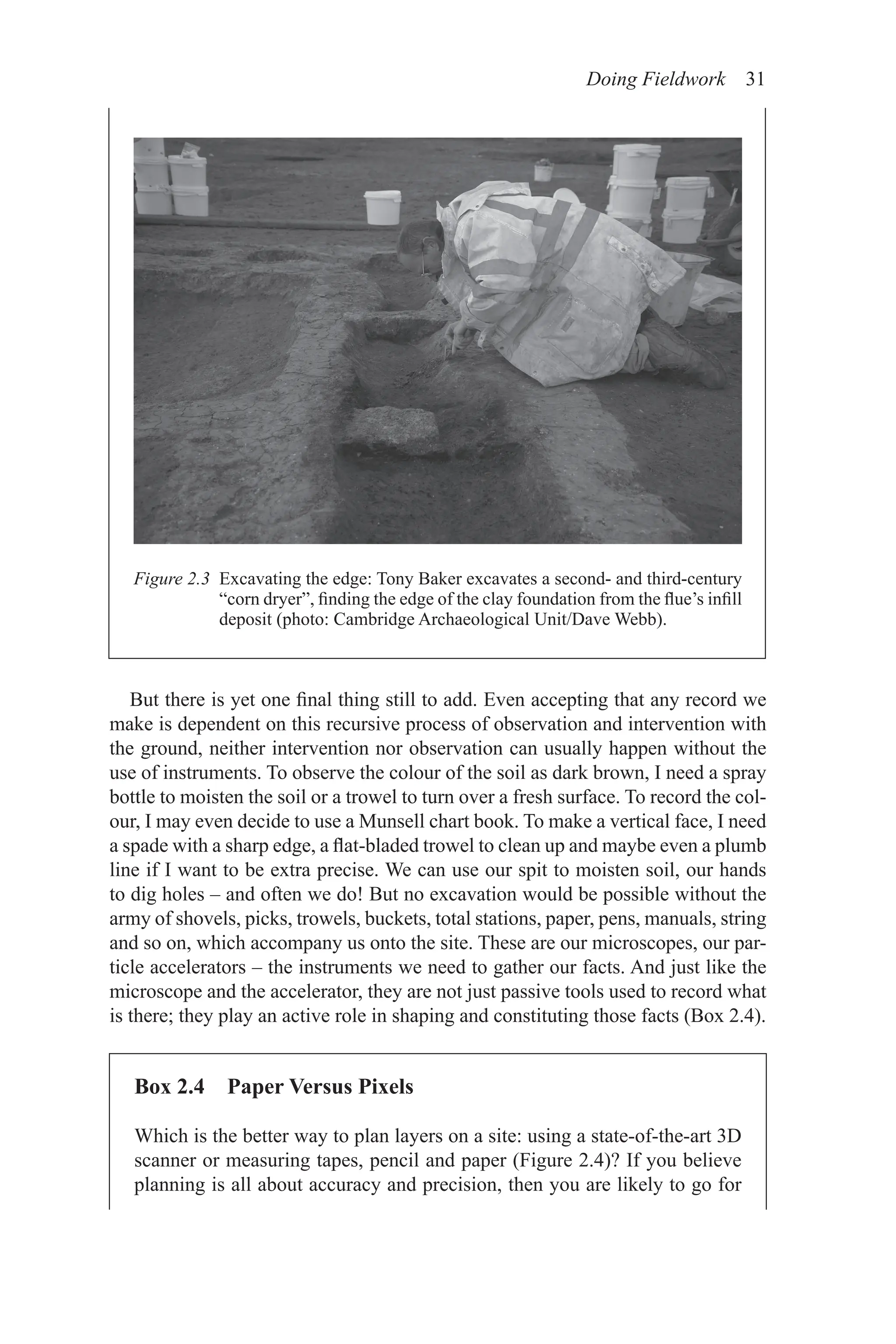
2.3 Excavating the edge: Tony Baker excavates a second- and
third-century “corn dryer”, finding the edge of the clay
foundation from the flue’s infill deposit 31
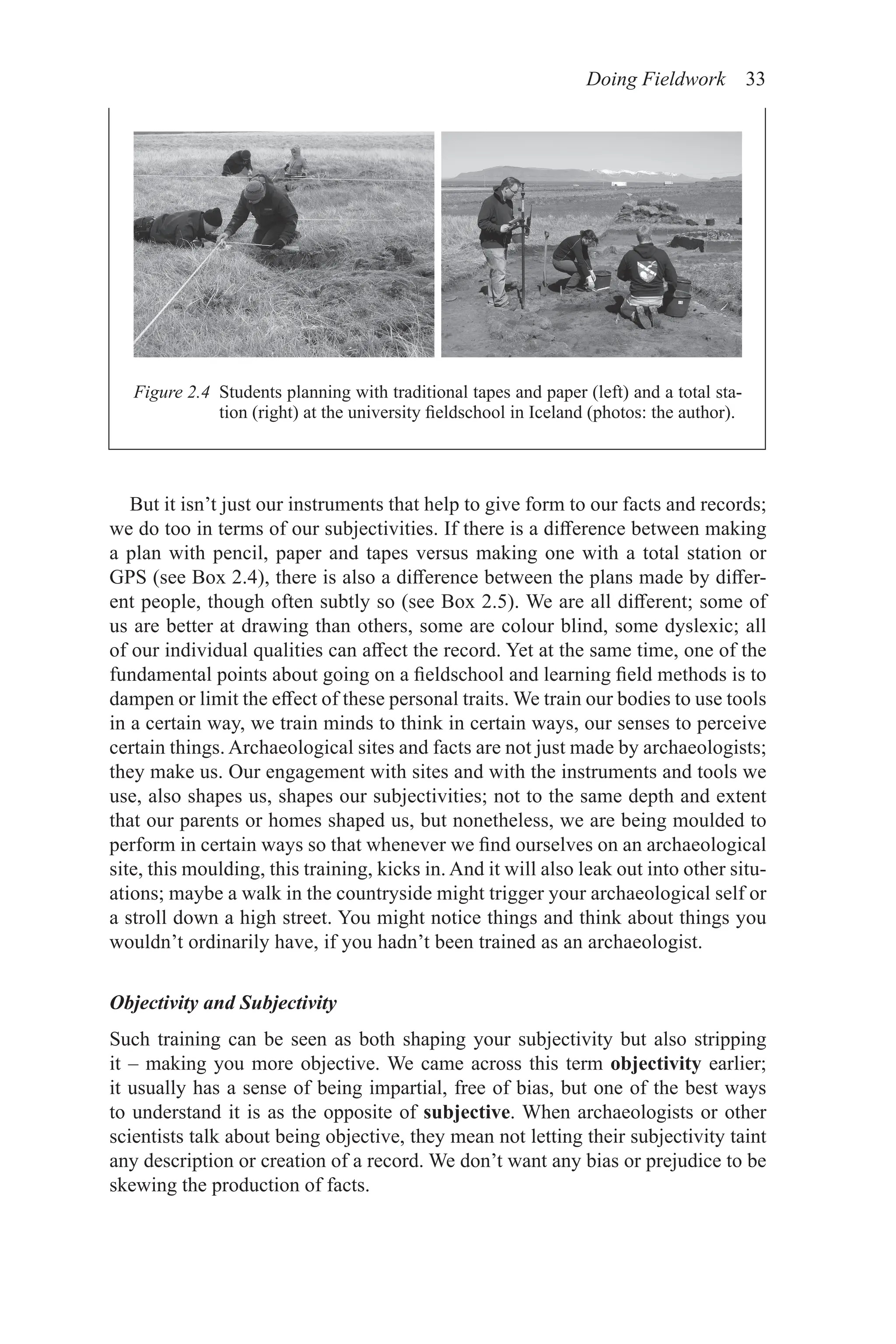
2.4 Students planning with traditional tapes and paper (left) and a
total station (right) at the university fieldschool in Iceland 33
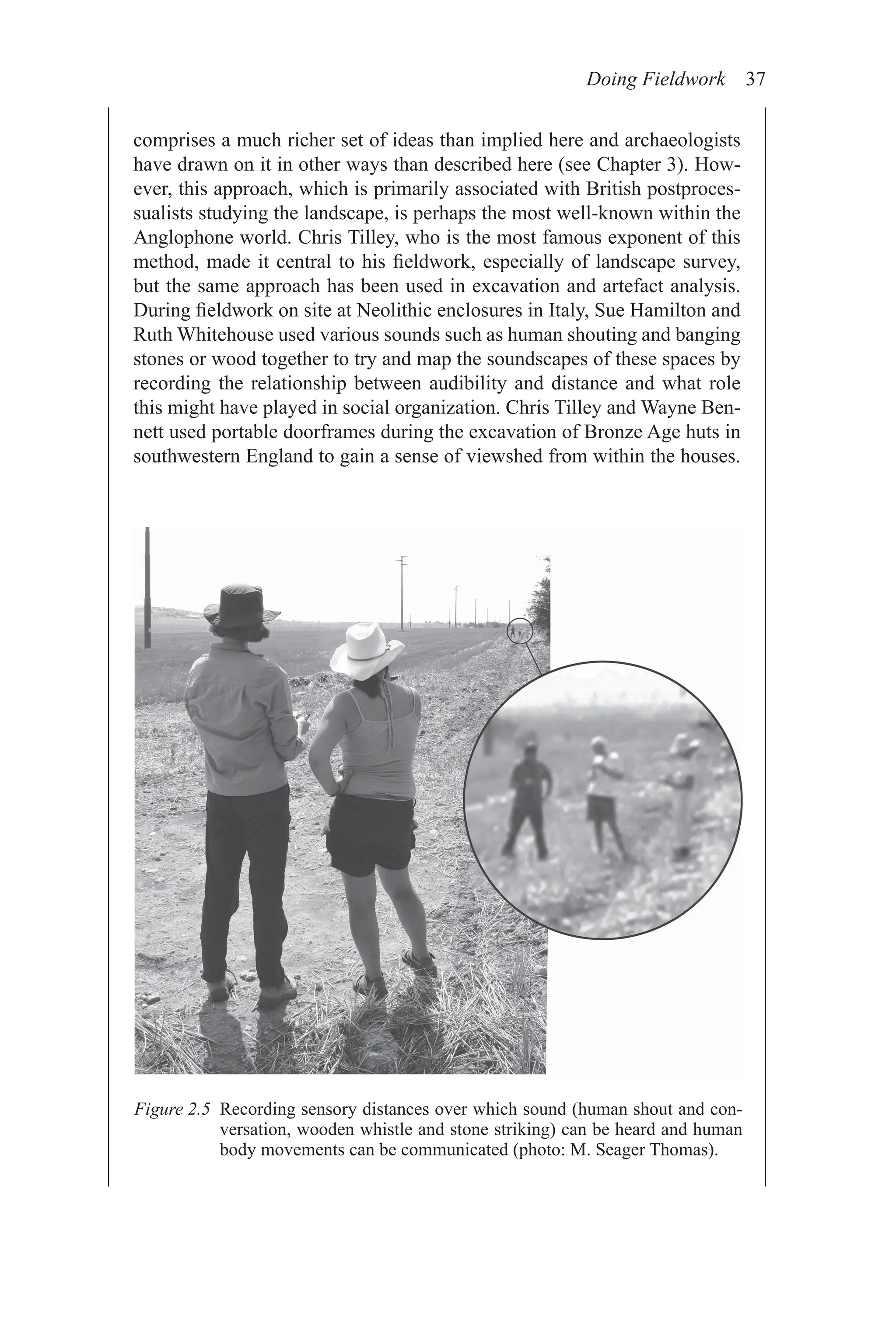
2.5 Recording sensory distances over which sound (human shout
and conversation, wooden whistle and stone striking) can be
heard and human body movements can be communicated 37
2.6 Different levels of community engagement 45
2.7 Andrew Dafnis, Homeless Heritage project, surveying Turbo
Island, Bristol, in 2010 48
3.1 The DIKW or data pyramid 55
3.2 The data trail 57
3.3 Map of excavations at Longstanton and Oakington, 5 km
northwest of Cambridge (Northstowe Phases 1 2 [2014–2019]).
The excavated areas revealed Middle to Late Iron Age, Roman
and fifth- to seventh-century CE settlements, alongside other
sites based on comprehensive trenching, geophysics and airborne
transcription program [2005–2007, 2020–2021]. What data can
you draw out from this map? 59
3.4 Extract from the CIDOC CRM pertaining to the category of
“thing”; what kind of ontology does this entail? 65
3.5 Vessel types used for liquid and semi-solid foods in the
Potomac typological system (POTS) which attempted to
connect emic and etic classifications by matching terms
from documentary sources (mostly probate inventories) with
excavated pottery forms 68
12.
Figures vii
3.6 Conceptualoppositions structuring a medieval longhouse in
Dartmoor, England. Although not explicitly presented as a
structuralist archaeology, the influence of structuralism in this
example is clear 69
3.7 Making a pot: island of Sifnos, Greece 72
3.8 The Holywell witch bottle 74
4.1 The fragmentation and synthesis of the archaeological process 90
4.2 The architecture of the Rigny excavation archive 94
4.3 In the Virtual World of Second Life, Ruth Galileo stands on top
of Okapi Island, aka the East Mound of Çatalhöyük, Turkey,
surveying her team’s construction in 2007–2008 of Neolithic
houses (based on the South archaeological area) and, on the
right, the shelter over the BACH archaeological area 97
4.4 Principal genres in archaeology and their relation to
disciplinary knowledge 100
4.5 Principal modes of address in writing with hypothetical examples 106
5.1 Two views of archaeological knowledge. Left: jigsaw model,
where the goal is to fill in the blanks by simply accumulating
more pieces (induction). Right: crossword model, where the
goal is to fill in the blanks by ensuring coherence between the
pieces and correspondence with the clues 118
5.2 Diagram showing the structure of hypothesis testing in
Lucero’s example 120
5.3 Diagram showing the structure of IBE in Bogaard’s example.
Four hypotheses (H1-H4) are tested against three strands of
evidence. Ticks indicate the presence of evidence showing only
one hypothesis (H4) withstands all three tests 123
5.4 Diagram showing the structure of arguments adapted from an
example in Chapman and Wylie (2016). A claim of provenance
is made on the basis of specific data linked by warrants; note
the criticisms (rebuttals) which largely focus on the warrants as
the weak link in the argument 126
5.5 The hermeneutic spiral 129
5.6 The evidential relations and Peircean semiotics of fingerprints 133
5.7 Three types of binary thinking based on the nature of the
relation between two concepts 137
6.1 Working out the value of a plate using George Miller’s CC indices 151
6.2 Formal analogy between prehistoric stone gorgets and
contemporary potter’s tools 155
6.3 Jemez tribal member Aaron Tosa collecting obsidian and
ceramic samples at the ancestral Jemez pueblo of Kwastiyukwa 161
7.1 A pavement on Mill Road, Cambridge, England; like an
archaeological site, it is mix of multiple past events whose
material presence persists in the present 167
13.
viii Figures
7.2 Driftmatter in Eidsbukta on the Sværholt peninsula, Finnmark,
Norway 172
7.3 A tree growing around a sign in a park in north London, 2014;
for whom does this sign matter? 174
7.4 The swinging pendulum of archaeology between the sciences
and humanities 177
7.5 Diagram showing the different degrees of integration between
multi-, inter- and trans-disciplinary research 182
7.6 Different ways to align archaeology depending on which
aspect is privileged 183
7.7 The artefact as metaphor for two ways of looking at the
archaeological record: as loss or as transformation (objects not
to the same scale) 185
8.1 A plot from Google Ngram viewer using the search term
“archaeological theory”. How well does this reflect the status
of theory in archaeology and if it does, what does it mean? 194
14.
Boxes
1.1 The Three-Paradigmsof Archaeological Theory 6
1.2 Three Views on the Relation Between Facts and
Theory in Archaeology 11
1.3 Levels of Archaeological Theory? 13
1.4 Strong and Weak Theory 15
2.1 Total Recovery? 23
2.2 The Context Sheet 27
2.3 Following the Cut 30
2.4 Paper Versus Pixels 31
2.5 Gendered Fieldwork 34
2.6 Phenomenology and Fieldwork 36
2.7 Sutton Hoo in the Summer of ’39 39
2.8 Research-Driven and Development-Led Excavation in Europe 41
2.9 What Do You Mean by Collaboration? 44
2.10 Community Archaeology as Intervention 47
3.1 What Do Maps Do? 58
3.2 AI and Machine Learning 62
3.3 Open Archaeology and Conceptual Reference Models (CRMs) 64
3.4 Making a Pot 71
3.5 Artefacts or Belongings? 75
3.6 Digital Collections and Archaeological Prosthetics 78
4.1 Honouring Ambiguity and Dealing With Doubt 87
4.2 Rigny Excavation: An Online Excavation Report 93
4.3 Virtual Reality at Çatalhöyük 96
4.4 Storytelling on the Acropolis 107
5.1 Hypothesis Testing and Mayan Household Rituals 119
5.2 A Process of Elimination: Modelling Neolithic Farming Practice
in Central Europe 122
5.3 Networks of Trade and Networks of Inference: the Case of the
Copper Ingots 125
5.4 Hermeneutics at Haddenham: Evolving Interpretations of a
Neolithic Causewayed Enclosure 128
5.5 Bodies of Evidence or Silent Witness? 131
15.
x Boxes
5.6 BinaryThinking, Dualism and Dialectics 136
6.1 Research Agendas and Grand Challenges 142
6.2 The Caring Archaeologist 144
6.3 The Unrepeatable Experiment? 152
6.4 Analogy in Archaeology 154
6.5 Creativity and Collaborative Archaeology 160
7.1 When Did the Neolithic End? 168
7.2 Archaeological Drift 171
7.3 Archaeology and the Two (or Three?) Cultures 177
7.4 Disciplinary Crossings 181
16.
Writing this bookhas been a new experience for me. All my previous books have
been written with an audience of peers in mind, but this work has been composed
for the student reader, for someone relatively new to archaeology and its rich
history. Although I have been teaching such students for two decades now, it is a
different matter writing for them. I don’t know how well I have succeeded in this
and certainly I am aware of occasions where I slipped into old habits and assumed
I was writing for my colleagues. One of my colleagues who read over a draft of
the manuscript asked me whether this was intended for the teachers of a theory
course or the students, pointing out what I feared. I suspect the final result may
still be something in between. All I can hope is that those teachers who use this
book in their courses will help their students navigate the more difficult parts.
That said, I want to acknowledge a number of people who kindly took time
to help bring this book into being by offering valuable feedback and comments.
First, to all the students who took my theory course at the University of Iceland
over the last 20 years; it has changed radically since I first started and it was
through those classes that I came to rethink what theory is. You are too numerous
to mention, but without you, this book would not exist. My thanks also go to Matt
Gibbons at Routledge who was very enthusiastic and supportive of the project;
I also want to thank several reviewers who read the book at concept stage, includ-
ing Lynn Meskell, Hannah Cobb and one other reviewer, who were so encourag-
ing of the initial idea. In writing a book of this nature, I felt a greater than usual
sense of obligation to the reader to get things right, and so I asked several people
to read over either the whole manuscript or individual chapters and sections. I was
quite overwhelmed that everyone agreed and I cannot express my gratitude for
this, as such requests are always a “big ask” and I owe all of you a huge debt.
For
reading over the whole book: Craig Cipolla, Hannah Cobb, Bjørnar Olsen
and Chris Witmore. For reading over individual chapters: Anna Beck, Matthew
Johnson,
Jeremy Huggett, Julian Thomas and Ruth Tringham. For reading spe-
cific sections: Zoë Crossland, Matt Edgeworth and Þóra Pétursdóttir; and especial
thanks to Zoë for helping me come to grips with the complexities of Peirce’s semi-
otics. To all of you, my deepest thanks. I don’t doubt the book still has its flaws,
but without your input, it would have been immeasurably poorer.
Acknowledgements
17.
xii Acknowledgements
Finally, Iwant to thank several people who kindly shared images with me and/or
allowed me to reproduce them in this book. To Matt Brudenell and Oscar Aldred/
Cambridge Archaeological Unit (Figures 2.2, 2.3 and 3.3); Hannah Cobb, Oliver
Harris and Phil Richardson (Figure 2.2); Sue Hamilton and Mike Seager Thomas
(Figure 2.5); Rachael Kiddey and John Schofield (Figure 2.7); David Austin and
Julian Thomas (Figure 3.6); Lambos Malafouris (Figure 3.7); Nigel Jeffries and
Andy Chopping/Museum of London Archaeology (Figure 3.8); Ruth Tringham
(Figure 4.3); Cambridge University Press (Figure 6.2); Matthew Liebmann
(Figure 6.3); Laurent Olivier (Figure 7.1); and Þóra Pétursdóttir (Figure 7.2).
18.
DOI: 10.4324/9781003098294-1
I studiedarchaeology as an undergraduate in the 1980s, and at the time, theory
courses were fairly new and – at my university at least – optional. Forty years
on, theory courses are now a regular part of the curriculum in many institutions
and often mandatory, as they are where I teach. This shift has probably also been
accompanied by changes in how students perceive theory. Archaeologists of my
generation seemed to adopt a “marmite mindset” to theory – you either loved it or
hated it, or rather perhaps you either embraced it as an indispensable part of doing
archaeology or were suspicious of it and sceptical that it really had any useful role
that wasn’t already served by common sense. Part of the suspicion related to the
historical background of archaeology and its separation from antiquarianism and
emergence as a scientific field in the late nineteenth century. At worst, “theory”
meant wild speculation, interpretation ungrounded in evidence while at best, it
was a bias leading you to ignore evidence that did not fit your interpretation. Part
of the scepticism is related to the abstract ideas and language that theory used,
which seemed to be very detached from specific archaeological problems and
issues. What does Heidegger really have to do with archaeology? For archaeolo-
gists of my generation, teaching theory often meant also trying to justify or defend
it, even if only tacitly so. Many of the discussions in the 1980s and 1990s were
about showing how theory was not separate from evidence, how it was not sepa-
rate from archaeological practice.
I only started teaching theory in the new millennium and for a long time,
I assumed my students inhabited the same “marmite mindset” of loving or hating
theory, of embracing it or being suspicious or sceptical about it. Perhaps some
did, but slowly it dawned on me that many of them didn’t. I would see puzzled
looks where I had expected resistance or acceptance. In other words, students
simply didn’t really have an opinion on the matter. At a British TAG session from
2017 called Why Do Undergraduates Hate Archaeological Theory, several of the
speakers noted that students don’t really hate theory – rather they are indifferent
to it. I think this sums up my experience too. In some ways though, indifference
is worse than hatred; at least with hatred, there is a sense of passion, of engage-
ment; the problem with indifference is one tends to be detached, uninterested.
The problem is one of getting the student engaged and connected to theory. But
indifference can still have different inflections; it can be ingrained, an indifference
Read This First
19.
2 Read ThisFirst
bred from disappointment. Or it can be an initial uncertainty, an indifference that
is waiting to make up its mind. My feeling is most students’ first encounter with
archaeological theory is the latter. At the same time, students will vary between
institutions (and generations), and one has to be careful extrapolating from one’s
own limited perspective; for people who are already interested in issues of politi-
cal and social equality, theory is an important way to engage with the discipline
and indifference is certainly not a quality one could ascribe to them. What about
you? What is your attitude to theory?
If we teach theory in a defensive mode, then the chances are that it will be
self-perpetuating; students will learn to love or hate it, regardless of how they
first felt about it. What I mean by a defensive mode is more than implicit assump-
tions about whether theory is important or not, it is also about how this attitude
spills over into the design of a course content and structure. Another of the recur-
rent themes in the TAG session I mentioned earlier was the importance of peda-
gogy and engaging students in theory, getting them to see its connections to other
courses on their programme and countering the detachment and disconnection
that many students experience when exposed to archaeological theory. Of course,
such pedagogics are an important part of all courses and teaching, but often they
seem especially amplified with theory courses. I love archaeological theory, yet
for a long time, it was the course I hated teaching the most. I found it really dif-
ficult to engage the students, and while part of this was down to poor pedagogy
on my part, part of it, I slowly came to realize, was the very way the course was
structured. It was set up to fail.
The problem was precisely because I loved theory. I started reading philoso-
phy around the same time I started reading archaeology; even before I took my
optional theory course as an undergraduate in the 1980s, I was already predis-
posed to like theory. There will always be some students who share this same
passion, but most who go into archaeology don’t. For me, teaching archaeological
theory as a series of schools of thought or -isms, or even as a series of concepts or
topics, was like a duck taking to water. This was the way I was taught theory, and
this is the way I taught theory for nearly 15 years. Most if not all existing archaeo-
logical theory textbooks are set up in the same way, even if there is great variety
in style and manner of exposition. But teaching theory this way is already to
begin with one hand tied behind your back; you are starting at a position already
removed from what most students who go into archaeology are interested in learn-
ing about: excavation, analysing artefacts or bones, radiocarbon dating and so on.
The best theory books – and teachers – bridge this divide, making the connections
between personhood and a prehistoric burial apparent to students so they can see
how theory relates. But why start with this disadvantage? Why not integrate the
theory into the very core of these other things, like excavation and artefact typolo-
gies from the start?
There are good arguments against this. Setting concepts and ideas in their
intellectual and historical context is important. Discussing a movement like
postprocessualism in the context of historical developments in (mostly) Anglo-
American archaeology is important for a deep appreciation of the history of our
20.
Read This First3
discipline; framing current theory like new materialisms in the context of theories
of the body, phenomenology and actor network theory is crucial for a proper grasp
of how its ideas are articulated. There is no question that for a deeper understand-
ing of theory in archaeology, these ways of presenting theory are valuable. But
for students starting out, especially those with more of an interest in osteology
than object ontology, such an approach is, I believe, unnecessarily alienating. As
teachers of archaeological theory, we are making our job harder than it needs to
be and it doesn’t matter if you present this approach to theory as a murder mystery
or through practical case studies, you are still starting from a position of distance.
For me, the immediate answer to this turned out to also reveal a deeper problem
with theory. If teaching students archaeology was about helping them to learn how
to do archaeology, surely teaching theory involved the same; it made me pose the
question, how do we do theory? It was in trying to answer this question that I real-
ized I don’t do theory; at best, you might say I do a theoretical archaeology, but
even if this characterization is not quite right either, it opened up a different way
to approach the topic. To teach theory as archaeology, not theory in archaeology.
This book is an attempt to introduce archaeological theory to undergraduates
at a basic level, that is, as a first- or second-year course, but through a very dif-
ferent approach. It merges theory with method and tries to teach theory as part
of the normal process of learning archaeology. Instead of seeing theory as some-
thing apart, as a distinct topic, it integrates theory into the archaeological process.
Hence the title which situates theory within concrete, archaeological situations.
It is almost a mantra repeated by theoretical archaeologists that theory is every-
where, it underlies everything we do; taking this to the extreme though, it might
suggest we shouldn’t even be talking about theory anymore. If this book inte-
grates theory with method, in what way is it an introduction to theory as opposed
to an introduction to archaeology? I don’t have a good answer to that question, but
I would say that if you compare this book with a methods textbook, the difference
should be obvious. At the same time, I am not sure I want there to be a distinction.
In the end, any answer to this revolves around the question of what theory is; a
question which I raise in the first chapter and return to briefly again at the end of
the book. But however you might define theory, I hope at least, you will find some
advantage to learning theory in the alternative mode offered in this textbook.
Let me end with a few final words about the contents of this book. I have tried
to draw on the work of a diverse range of archaeologists and examples, but I know
my own background shapes the topics covered within.As an English (and English-
educated) archaeologist, I am inextricably part of the Anglo-American tradition,
and this bias is difficult to shake off, especially in the field of theory. Certainly the
centre of gravity of this book is North American and European, and this will likely
be the main readership. To readers outside this sphere, I nonetheless hope you still
find things of interest as the situations addressed are universal. The book is organ-
ized into seven chapters, each chapter addressing a specific domain of archaeo-
logical practice or concern. Each chapter begins with a short, fictional vignette
which describes a situation that a student or junior scholar may find themselves
in. The point of these vignettes is to foreground the situated nature of theory and
21.
4 Read ThisFirst
to introduce it through an accessible and concrete example that the student can
relate to as a way to set the scene for what the chapter addresses. The vignette is
then returned to at the end of each chapter as a way of enfolding what has been
covered, back into the original story.
Following the convention of many textbooks, there is no in-text citation in this
book. Instead, I include a note on further reading at the end of each chapter, where
I reference any works cited in the text as well as others the reader may find useful
in connection to the topics discussed. A full list of references appends this. The
references on each topic are by no means exhaustive; this is not a monograph but
a textbook, so I have tried to select what I see as either key readings or readings
with exemplary case studies. As this is meant as a textbook and teaching aid,
I have also included a few exercises at the end of each chapter. These are small
projects I have used in my classes and which the teacher can adapt and extend in
their own way or the student can even try for themselves. As theory has tradition-
ally been seen by many students as lacking a practical (or purposeful!) dimension,
I consider such exercises an important part of this book, even if they take up little
space. In my teaching, they take up half the time we spend in class. Finally, the
reader will note that throughout the text, various words have been highlighted
in bold, especially the first time it occurs. These words can also be found in the
index at the back of the book. Sometimes, these terms are explained in the text but
not always, and in many books, they might be connected to a glossary. Instead of
providing a glossary, however, the terms in bold are an invitation to the student
to make their own glossary as they work through the book or to serve as discus-
sion points in class. In other words, this can serve as another exercise to engage
students with archaeological theory in a more active way.
22.
DOI: 10.4324/9781003098294-2
1 Who’sAfraid of Theory?
Situation 1: In the Field
This was my first year in the field with this particular team; it was a
hot day and we were doing some heavy shovelling, removing backfill
from the previous season, and so apart from having half an eye on
the soil, this was fairly mindless digging. I was already known as
an archaeologist with an interest in theory and I thought the person
I was next to had an interest in Marxism, so I decided to throw out
a question: “So what kind of theoretical perspective do you come
from in your archaeology?” There was a short pause before they
answered: “I guess I just come from a tradition of common sense
archaeology”. I am not sure he even stopped shovelling.
Why Do We Need Theory?
You know how politicians almost never answer the questions they are posed –
they deflect, ignore or best of all, tell you the question you should have asked and
then proceed to answer that. Well, it’s the same here. Why do we need theory?
There are many ways of answering this question, but the cleverest is to argue that
the question is all wrong; it is not even a choice. It is not about whether we need
theory or not, as it is already inbuilt in everything we do. Rather the question is
how we treat it; do we ignore it or bring it out into the open and cultivate it? The
coded message here being: do we stick with our prejudices and bias, or do we
expose them to scrutiny, to critique and so allow ourselves to grow, intellectu-
ally? This is an argument made nearly a century ago by American anthropologist
Clyde Kluckhohn in 1939 and has remained a constant refrain ever since. One of
the most popular theory textbooks today by Matthew Johnson makes the same
point; although Johnson offers some justifications for why we need theory, he
ends by affirming the point that all archaeologists are already theoretical whether
they know it or not; what many people call common sense is just a cloak for a
whole series of assumptions and perspectives which guide our thinking. They
23.
6 Who’s Afraidof Theory?
may be sound, but maybe not; very likely they are shaped by specific cultural and
historical contexts and one person’s common sense might be another’s nonsense.
We will encounter some examples of this later in the book, especially in relation
to what counts as archaeology.
The question then, is not “why do we need theory”, but whether we should think
about it or not, and given the implicit connotation that not thinking about theory is
akin to being prejudiced, biased, uncritical – all the things that academic scholarship
stands against, well then, who really would choose that? One conception of being
theoretical therefore – and we will explore others later in this
chapter – simply means
bringing these assumptions out into the open so they can be challenged, developed
or rejected.And yet in the last decade, there has been what you might call a backlash
against theory which suggests not everyone agrees with this argument. The backlash
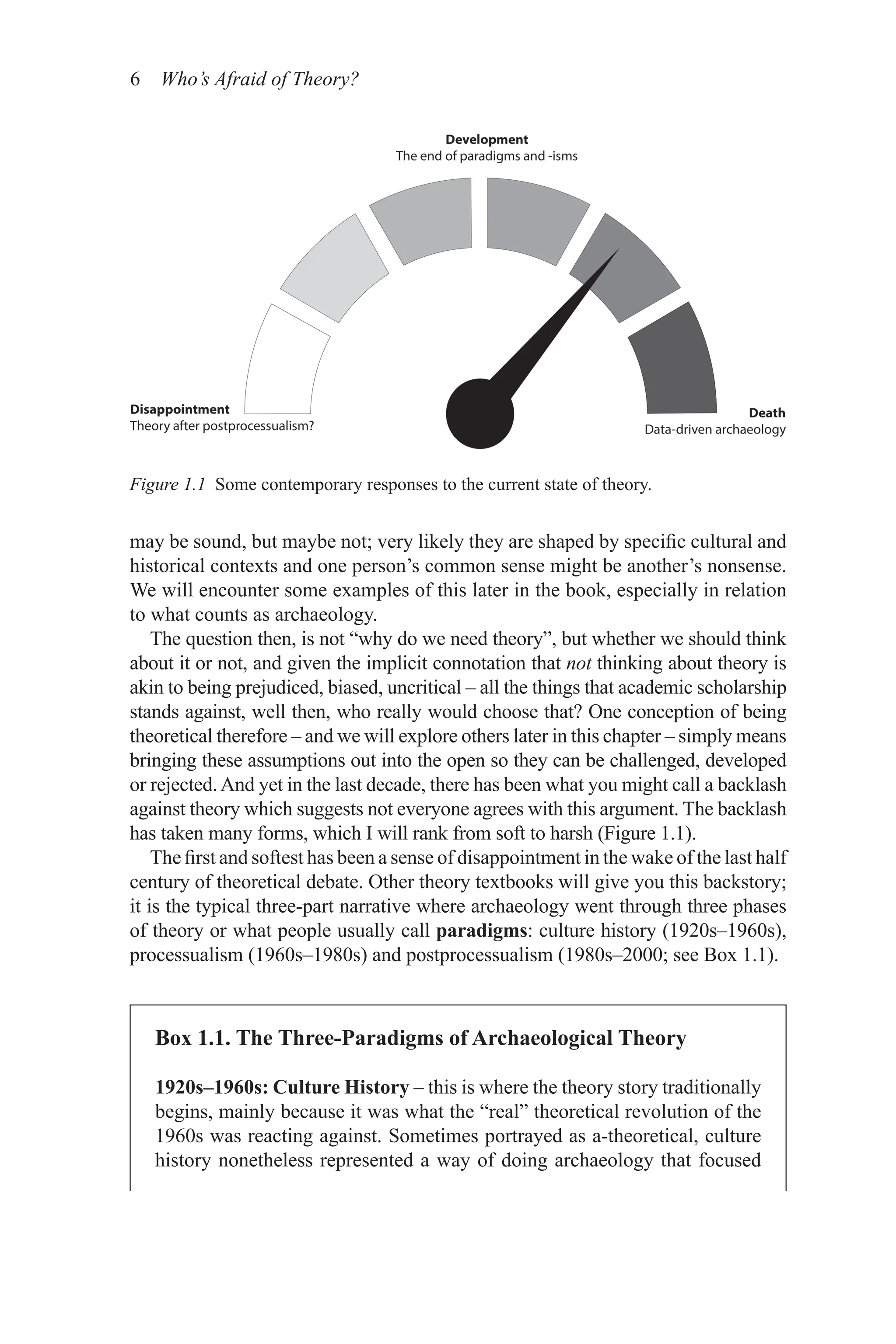
has taken many forms, which I will rank from soft to harsh (Figure 1.1).
The first and softest has been a sense of disappointment in the wake of the last half
century of theoretical debate. Other theory textbooks will give you this backstory;
it is the typical three-part narrative where archaeology went through three phases
of theory or what people usually call paradigms: culture history (1920s–1960s),
processualism (1960s–1980s) and postprocessualism (1980s–2000; see Box 1.1).
Figure 1.1 Some contemporary responses to the current state of theory.
Box 1.1. The Three-Paradigms of Archaeological Theory
1920s–1960s: Culture History – this is where the theory story traditionally
begins, mainly because it was what the “real” theoretical revolution of the
1960s was reacting against. Sometimes portrayed as a-theoretical, culture
history nonetheless represented a way of doing archaeology that focused
24.
Who’s Afraid ofTheory? 7
on mapping material traits to specific cultures in time and space and under-
standing how these cultures changed over time through interaction and dif-
fusion. Gordon Childe is often counted as the paragon of culture historical
archaeology, yet both Marxism and nineteenth-century cultural evolution
suffuse his writings. Go figure!
1960s–1980s: New Archaeology and Processualism – the 1960s was a
period of social “revolutions” in the Western world, and archaeology was
no exception. The New Archaeology was a movement that emerged around
Lewis Binford in the US which sought to make archaeology both more sci-
entific and more like anthropology. Critical of what they saw as the “stamp-
collecting” mentality of culture history, they wanted to make the past come
alive by offering images of living societies, not just catalogues of artefacts.
They also wanted archaeologists to adopt a more rigorous methodology,
one that aligned their discipline closer to the natural sciences and away
from the humanities, and so their approach to studying past societies was
framed by a search for generalizations and cross-cultural comparison.
1980s–2000: Postprocessualism – the conclusion to the story happens
on the other side of the Atlantic with a largely English counteraction to
processualism centred around Ian Hodder. Postprocessualism reacted to the
heavy “sciencification” of archaeology under processualism, and although
it shared its vision of making the past come alive, it had very different
ideas about how to do this. In seeking to resurrect an interest in historical
particulars but wedded to a more up-to-date social theory from within the
humanities, postprocessualism acted as an umbrella term for a diverse set of
interests from feminism to phenomenology.
The better narratives will qualify this story by saying each phase didn’t replace
the last, but they overlapped, and in fact aspects of culture historical and proces-
sual archaeology are still with us today. The better narratives will also remind you
that this is largely an Anglo-American story though it spilled out into other parts
of Europe and the globe. A typical clue to this Anglophone bias is if you hear
some country or archaeologist being described as still being stuck in the “culture
historical” phase; if this sounds familiar it is no surprise – it is also how North
America and Europe often describe other parts of the world in terms of economic
and social development. “Country X is now how England was in the 1800s”. But
the problem is, we are still teaching this narrative in the 2020s, two decades after
the “end” of postprocessualism. It begs the question: what -ism are we in now?
Julian Thomas has argued that theory has become a victim of its own historiog-
raphy; by narrating the development of archaeological theory as one of paradigm
shifts or revolutions, we are conditioned into expecting the next big thing. The
fact that there has been no new obvious contender to replace postprocessualism –
we have been waiting now for 20 years! – surely suggests an epic stalling of
25.
8 Who’s Afraidof Theory?
theory. Or does it? There are different ways to see this and it all depends on where
you are situated. Arguably, given the predominantly Anglo-American nature of
this three-part history of theory, it is only archaeologists bound to this tradition
who see any crisis in the first place; for many other archaeologists outside this
narrative, theoretical archaeology has never been more vibrant and creative and in
some cases, is arguing for a redefinition of what archaeology is. From within the
traditional Anglophone world of theoretical archaeology, however, it is another
matter, and perceptions of the state of theory vary.
Thus there are some who have even proclaimed the death of theory in archae-
ology. Such a proclamation was somewhat hyperbolic though; its main propo-
nents, John Bintliff and Mark Pearce, were chiefly referring to the demise of grand
theory, of the big systems or schools, not theoretical reflection per se. Instead of
theory referring to grand paradigms or systems – all those -isms and -ologies that
form the stock in trade of basic theory courses – theory instead became about
concepts and ideas. Concepts such as gender, agency or materiality gradually
started to take centre stage over Marxism and Structuralism, or processualism
and postprocessualism. Anthropologist Henrietta Moore characterized this as the
shift from grand theory to concept-metaphors while archaeologist John Robb has
described it as the difference between High Church and Low Church theory (per-
sonal communication). Many good theory courses today try and compromise and
offer both historical narratives of the big schools alongside coverage of more spe-
cific concepts and topics. But ultimately the reason why there is no next big thing
is that theory has changed its colours; it has metamorphosized into something less
grand, more dispersed; for some it has finally grown up and come of age, fulfill-
ing a promise first proposed by David Clarke in 1973 when he defined theoretical
archaeology as the loss of innocence.
Yet a more hard-line approach exists, which constitutes the third and most criti-
cal backlash against theory, and this seems common to both Anglo-American and
other European traditions. This is an approach which has been linked to the rise
of big data and the resurgence of science in archaeology linked to work in aDNA
and isotope analysis among others (see chapter 3). It is also linked to claims for
a data-driven archaeology which no longer needs theory. The more naïve posi-
tions proclaim that the data deluge means that no theory or model can possibly
account for the complexity of available data; rather we need to draw on statistical
algorithms generated by computers to look for patterns and correlations. Finally,
the old antiquarian dream has been realized: the data or facts can speak for them-
selves. Such a view is often called empiricism (see Box 1.2) although this term
also covers rather more complex and diverse positions. Some archaeologists have
challenged the naïveté of this position; facts can never speak for themselves, they
always need some kind of framework and are, anyway, always pre-coded in some
way that reflects some “theory”. There is no such thing as raw data (see Chapter 3
for further discussion of this). On the whole, discussion of big data and science
in archaeology has tended not to be so naïve. Rather than advocating any end of
theory, it suggests that the usual relationship between theory and data be reversed.
Instead of questions and problems being framed by theory, and where data are
26.
Who’s Afraid ofTheory? 9
used to test theories, data-driven science argues that the questions and problems
emerge from the data themselves, with theory being brought in afterward.
These various forms of backlash against theory in archaeology, from the soft
sense of paradigm disappointment to the harder advocation of data-driven inter-
pretation, are important not so much in their details as in their general nature. For
I would suggest they are symptomatic of an underlying uncertainty in how the dis-
cipline feels towards theory today, the ground is changing underneath our feet and
we don’t really know how or why. Philosopher Rosi Braidotti has identified this as
part of a wider trend in the humanities that she calls “theory fatigue” – though in
her case, it manifests itself more as an increasing rejection of the abstract and eso-
teric language (and language games) of high theory. In archaeology, the jargon of
theory has always had its critics, but there is a deeper set of shared consequences
of such theory fatigue: the return of anti-intellectualism and privileging of com-
mon sense over theory, all of which feed a dangerous political populism.
We started this section with the question “do we need theory?” and came to
the conclusion that we are always theoretical whether we acknowledge it or not.
This does not mean we are always engaging in theoretical reflection – no archae-
ologist does this and how could they? All it means is that everything we do has
theoretical implications. So the better question is not “why do we need theory”
but rather “why think about theory?” and the answer is: because it makes you a
better scholar, a better archaeologist. But if we look more closely at this, we see
that it makes certain assumptions about what theory is in the first place. Theory
is taken to be the assumptions, perspectives, frameworks within which you think;
these can be implicit (as in common sense) or explicit (as in, say Marxism or
Feminism). In deflecting the question of why we need theory, we have adopted a
definition of theory without really talking about what theory is. Now being critical
and reflexive is surely a good thing; whatever our opinion on what theory is, these
intellectual virtues should still stand as central tenets of academia and scholar-
ship. But connecting theory to common sense as part of a broad umbrella concept
makes certain assumptions about theory that perhaps we should question. Indeed,
reviewing the various backlashes against theory in the new millennium, it is quite
clear that definitions of theory are precisely what is at stake. So perhaps it is time
we address the elephant in the room: what is theory?
What Is Theory?
Defining theory is not something many archaeologists are comfortable doing,
though some have bravely tried. Consider the following statements about theory –
only some of which I should stress were offered as explicit definitions:
• Theory is the eat-your-vegetables part of archaeology. Everyone says it’s
good for you, but actually getting it down isn’t considered much fun (Adrian
Praetzellis 2015).
• Theory grabs the assumptions you hold dearest and shakes them until they
fall apart (Oliver Harris Craig Cipolla 2017).
27.
10 Who’s Afraidof Theory?
• Theory does not provide answers, but it suggests a wider range of interesting
questions (Kevin Greene 1995).
• Theory as revelatory, as opening up new spaces, as challenging assumptions
(Meg Conkey 2007).
• Theory is the order we put facts in (Matthew Johnson 2019).
• I have come to think of theory as a pair of glasses. When you need to see
things close-up, you grab some bifocals, when the sun is too bright, you need
to filter it out, you put on sunglasses, when you need to see far away, you put
on your distance glasses or binoculars . . . . Theories and schools of thought
are frameworks designed to support particular idea structures (Laurie Wilkie
2016).
• Scientific theories operate at multiple levels of generalization and abstra
ction . . . . High-order theories, like world views, are filters through which
reality is perceived, described, and explained (Patricia Urban Edward
Schortman 2012).
The first one on this list is just fun, but underneath of course Praetzellis has a
serious message we have already come across: theory is necessary for good intel-
lectual health. The trouble is, it is very broad and vague, and it doesn’t really say
much about theory except it is “a good thing”. The second statement by Harris
and Cipolla is rather more specific and draws on the association between being
theoretical and being critical but perhaps goes too far and merges their roles;
theory as critical thinking. One might agree that it has this function, but is that all?
Why not just call it critical thinking then? The third description is also connected
to the same idea of critical and reflexive thought, but whereas the Harris and
Cipolla focus on negative critique and pulling apart our preconceptions, Greene’s
observation fixes on positive stimulation and expanding our horizons. Again, we
can surely agree that theory can do this, but it also reduces theory to a kind of
lateral reading around one’s subject. Theory as reading philosophy, anthropology,
psychology and so on, which again is somewhat true – but is that all it is? The
fourth statement by Conkey in some ways combines the best of both the previous
ones – it is both critical in challenging assumptions but productive in clearing a
space for new ideas.
The remaining three descriptions all take a slightly different tack. Johnson’s
definition of theory as something that structures or orders our facts is about see-
ing theory as a set of assumptions, perspectives or framework for thinking. It
is this idea which also underlies the argument in the last section that theory is
everywhere – it cannot be avoided. Wilkie’s take on theory is very similar to
Johnson’s but expressed in a more concrete and familiar metaphor while the last
statement quoted here by Urban and Schortman says much the same though with
an interesting twist. They suggest that theory actually comes in different levels or
layers and while the uppermost layer is akin to a “perspective”, the lower levels
are more empirically grounded and relate to a specific set of material or phe-
nomena. I will come back to this question of levels of theory in a moment (see
Box 1.3) as it is quite an old idea in archaeology.
28.
Who’s Afraid ofTheory? 11
Box 1.2 Three Views on the Relation Between Facts
and Theory in Archaeology
Using artefact types cross-dated with coins as well as several radio-
carbon dates, a site has been dated to the first half of the tenth-
century
CE. How are facts and theory implicated in this simple example?
Depending on the archaeologist, you might hear at least three different
versions of an answer.
To be fair, most of these quotes are not offered explicitly as a definition and
elaborated upon through argument. They are more like “one-liners” and it would
be unfair to hold the authors to these definitions too tightly. At the same time, it
does emphasize how shy archaeologists – even theoretical archaeologists – have
been about defining theory. It is one of those dangerous concepts that if you tinker
with it too closely, it may blow up in your face. But there is perhaps a difference
between the first four and the last three; the first four are what you might call
prescriptive; they implicitly or explicitly suggest how theory ought to perform,
ideally. Yet it would not be hard to find examples of archaeological theory that are
not very critical or imaginative or even good for you! Yet somehow, we might still
be happy to call them theoretical. The latter three definitions on the other hand are
rather more descriptive; they purport to demonstrate what theory actually does,
not what it ought to do or we would like it to do. In this way, theory can be good
or bad, like anything else, but it is always with us.
For simplicity, let us return to Johnson’s definition of theory as the order in
which you put your facts. It is important because straightaway it highlights some-
thing that many archaeologists intuitively understand; theory stands in some rela-
tion or tension with facts. For some archaeologists, theory stands in opposition
to facts; this is an old antiquarian view of theory which linked theory to specula-
tion, interpretation in the absence of data and is often linked to a position known
as empiricism which we encountered in the last section (also see Box 1.2). For
Johnson though and probably most archaeologists, the relation is not oppositional
but mutual. Facts without theory are just dry dust, trivial statements like “there
were 234 sherds of pottery in the deposit” or “this wall has two re-builds”; the-
ory is needed to arrange these atoms into some meaningful order. Yet Johnson’s
definition as it stands is still suitably broad to allow different views on what that
mutual relation is (see Box 1.2). Under one view known as positivism, facts or
data are construed as independent and used to test theory, while under another –
conveniently labelled post-positivism – data are considered “theory-laden” while
theories were regarded as “under-determined” by the data, all of which simply
means that the separation of theory and data is more blurred and interdependent
than in the former view.
29.
12 Who’s Afraidof Theory?
Empiricism – this is the view that all knowledge is ultimately based on
experience, that what we securely know – even complex beliefs – can be
traced back to direct observations through our senses. In archaeology, this
position usually manifests itself by a strong adherence to the privileging
of facts – that is, observations made typically during fieldwork or in the
lab – and the mistrust of theory as speculation or at best a temporary “filler”
to be used in the absence of facts. It has close associations with induction
which is discussed further in Chapter 5. For an empiricist, the dating in the
aforementioned example makes use of no theory at all; it is based purely on
the collation of several pieces of observed data: artefact types which have
demonstrably been associated with coins minted in the early tenth century
from other sites and the calibration of C14 isotope ratios recorded from
samples recovered from the site. The facts all link up without any leaps of
logic or speculation.
Positivism – with positivism, the role of theory becomes much more
important, central even as it recognizes that no matter how many facts you
have, they will never self-assemble into more than trivial knowledge with-
out the aid of a theory or hypothesis. More than just a surrogate “filler” in
the absence of data, theory acts as the glue to hold facts together in a mean-
ingful way. At the same time, the facts remain independent of theory and as
such act as an essential way to test the validity of any theory. Hypothesis
testing, which formed a key method under positivism, is discussed further
in Chapter 5. For a positivist, there is therefore theory involved even in this
dating example, albeit of a subtle kind; the fact that coins have been found
with artefacts of the same type on other sites does not automatically mean
the same date can be applied here. It is always an assumption or hypoth-
esis and as such they might want to check how often this association has
occurred or know what the sample size is. They might even suggest that the
radiocarbon dates from this site act as a further test on this typological dat-
ing, helping to corroborate or strengthen it.
Post-positivism – this last view is more an umbrella term for a variety
of positions that reacted against positivism, but generally all share the posi-
tion that facts and theory are not independent but mutually implicated. This
means there is no such thing as a fact which isn’t coloured by some theory,
which is why the term theory-laden is often used to describe facts. Early
versions of post-positivism often seemed to make theory all-powerful, so
that data almost seemed to be at its complete mercy; however, it was recog-
nized that because theory is not unified but heterogeneous, data could still
resist one theory by being tied to another. In our dating example, a post-
positivist would go one further with the typological association and argue
that it doesn’t matter how many times coins are found with a certain artefact
type, there are still theoretical assumptions implicit in what counts as an
“association”. Do we count coins found with artefact types from the same
30.
Who’s Afraid ofTheory? 13
What empiricism, positivism and post-positivism all share however is a con-
ception of theory which is articulated in relation to facts or data. It is thus easy to
see why Johnson’s definition cited earlier works and why it seems to be easy for
archaeologists of very different outlook to accept it. Moreover, if theory is defined
as the order in which we arrange our facts, it can also incorporate some of the
shifts we observed in the last section around the softer backlash against theory.
Whether you use theory to refer to grand systems, schools or paradigms, or to
more specific concepts and ideas, it still works with Johnson’s definition. It is this
close pairing with data that has also informed the many attempts to create a clas-
sification of theory in archaeology, where different types of theory are defined in
terms of the distance or degree of detachment between theory and data (Box 1.3).
deposit, regardless of how long or under what conditions it took that deposit
to form? How do we define contemporaneity when it comes to objects being
associated with one another? In other words, at no point do data escape a
theoretical frame. On the other hand, the theoretical frame which structures
typological dating is very different to the theoretical framework structuring
radioactive decay, so when the results of both agree, we can argue that such
theoretical frames do not need to be seen as taking us down a rabbit hole of
circular reasoning as empiricists and positivists have claimed.
Box 1.3 Levels of Archaeological Theory?
For some archaeologists, the close relation between theory and data sug-
gests a need to discriminate different levels of theory, depending on how
close a theory is to a set of facts. Inspired by sociological discussions of
middle range theory, archaeologists suggested the need for a similar,
archaeological middle range theory which bridged the abstract realms of
high theory (e.g. evolutionism) and the facts on the ground. Lewis Binford
was the first to adopt this idea in print and tied it to his interest with forma-
tion processes, though he was subsequently criticized for conflating two
very different types of theory. In general though, middle range theory can be
seen as a type of theory that has a very close relationship to data and is thus
often empirically specific as opposed to very general theories which tend to
be far removed from specific facts. Smith calls this kind of theory “empiri-
cal theory” to distinguish it from high-level social theory while Urban and
Schortman, who we met earlier in this chapter, discriminate between high-
level, middle-level and low-level theory, the latter largely overlapping with
our notion of a fact. In Box 1.2, where I discussed the relation of theory and
facts through the dating example, the theory there might be characterized as
middle- or low-level theory.
31.
14 Who’s Afraidof Theory?
High level Abstract theories about general social and historical pro-
cesses (e.g. Marxism)
Middle level Empirically tied theories about observable patterns in
the archaeological record (e.g. mortuary rites)
Low level Facts or empirical observations, usually patterned or recurring
(e.g. typology)
Other archaeologists have viewed this issue of the relation between theory
and data in terms of the archaeological process; instead of being a purely
conceptual issue which separate grand theory from middle range or low the-
ory, the differences can be mapped onto the different stages of archaeologi-
cal research. So the lowest levels of theory, those closest to the data, are also
those that belong to processes of data generation and extraction – how sites
are formed, how sites are excavated, while the higher levels of theory are
those closest to data interpretation. Both David Clarke and Michael Schiffer
offered versions of this kind of approach to different types of theory.
On the whole, this concern with levels of theory has largely been con-
ducted within North America and more particularly within processual
archaeology. There are several reasons for this but one major one probably
relates to the way archaeology fits into a broader conceptualization of dis-
ciplinary knowledge. Traditionally in North America, archaeology is part
of a fourfield division of a broader subject called anthropology; archaeol-
ogy thus comprises one of four key fields along with linguistics, biological
anthropology and cultural anthropology. There is a sense of a disciplinary
hierarchy, where at the bottom, each field has its own empirical domain but
at the top, they are all joined by a common body of social theory. Such a
scheme has resulted in an anxiety peculiar to Anglo-American archaeol-
ogy, that of being somehow always beholden to other disciplines who build
theory, while archaeology remains a borrower.
The idea of archaeology belonging to a wider academic endeavour concerned
with humanity is not unique to North America – indeed the English archaeol-
ogist Pitt Rivers also proposed a fourfield structure in the late nineteenth cen-
tury. But in Europe and other parts of the world, this relation is conceived of in
a much looser and more fragmented fashion, and as a result, the idea of social
theory as something that floats above more parochial, disciplinary theories is
less obvious. Indeed for many archaeologists, these levels are somewhat dis-
ingenuous as they ultimately perpetuate the separation of theory and data by
mapping it onto a disciplinary hierarchy which separates the empirical side
of research from its interpretation, one where archaeology – as archaeology –
is primarily about fieldwork and data collection, while anthropology –
as an umbrella field, not ethnographic fieldwork – is the domain of social
theory (see Chapters 6 and 7 for further discussion of these issues).
32.
Who’s Afraid ofTheory? 15
Box 1.4 Strong and Weak Theory
The idea of strong and weak theory was first suggested by literary scholar
Eve Sedgwick who linked strong theory to what she called paranoid read-
ing – that in reading a text, we are always trying to find concealed or hid-
den meanings and treat the text with suspicion. In short, we always want
to dominate the text by showing how much cleverer we are than the text
itself. In contrast, she argued for reparative reading, one which was open
to the text and its creative and emancipatory potential. Sedgwick’s ideas
which focused on texts were developed by anthropologist Kathleen Stewart
in relation to our general sensory experiences of the world and the way we
interact or respond to the things we encounter. From there, the idea was
taken up by Þóra Pétursdóttir and Bjørnar Olsen in the context of archaeol-
ogy, where they argue for the importance of allowing things to confront
our expectations and that we should resist the desire to impose order that is
normally part of the archaeological impetus to explain what we encounter.
All of this foregoing discussion suggests that Johnson’s definition of theory
seems to capture fairly well what archaeological theory is. And yet there remains
something troubling about it.
Rethinking Theory
Defining theory in relation to facts or data carries certain assumptions about the
nature of knowledge, about the nature of archaeological thought and practice.
Even accepting that theory and data are mutually dependent, even constitutive of
each other, there remains an important sense in which they are still different things.
Johnson’s definition of theory as the order in which we put our facts implicitly
carries certain connotations of theory as active and facts as passive. Facts on their
own are not enough, they need theory to make them meaningful, sensible. In the
last section, we saw how some archaeologists were arguing that facts or data need
to be given a more active, leading role; a data-driven archaeology is one which
does not eschew theory but reverses the domination of theory over data. A simi-
lar argument has been made by archaeologists from what many would call, a
more deeply theoretical position. Þóra Þétursdóttir and Bjørnar Olsen have argued
for what they call weak theory (Box 1.4); weak theory is theory which does not
impose itself on the material, on things, but which gives things the space to open
themselves out and reveal aspects that might normally be closed off. Strong theory
on the other hand is theory which imposes order and constraint on archaeological
remains and more importantly, all significance is supplied by theory, not things.
33.
16 Who’s Afraidof Theory?
Structurally, the arguments from weak theory and data-driven archaeology are
very similar; both argue for a reversal of dominance or at least symmetry between
theory and data or things. But in other ways, the positions are very different.
Data-driven archaeology frames theory within the context of abstract knowledge
production; it is what you might call a purely conceptual view of theory and in
this sense, it shares the same assumptions as Johnson’s definition of theory. Both
theory and data are concepts, ideas which are inextricably caught up in systems
A key idea driving Pétursdóttir and Olsen’s approach was the reaction
against a view which saw theory as some kind of grazing omnivore, that
whatever it encountered, it chewed it up and converted it into something
for its own purposes. The very quality of theory that Johnson highlights –
its ability to bring order to facts – is for Pétursdóttir and Olsen, a sign of
tyranny. Seeing theory as something that floats above the world (especially
in the “levels of theory” typical of North American processualism; see
Box 1.3), as something that we have to bring down to earth and apply or
“operationalize” is precisely what is wrong with this view of theory. It is
wrong because such a view of theory ends up making the archaeological
remains conform to shapes and forms of its own making. The danger is, one
application of say, postcolonial theory will start to look like another, even if
one has been applied on a site in Australia and another in South Africa. Of
course, the empirical details will vary, but the interpretation – the relevance
of the two case studies – may be hard to tell apart. And if that happens, what
have we really learnt? The danger is that theory starts to reproduce, make
multiple copies of itself in different places, while specificities of the place
become superficial and interchangeable.
To some extent, this is not a new critique; it was a key point in postproces-
sual attacks on the grand narrative in the 1990s. Any study of capitalism
in the seventeenth or eighteenth centuries should always stress the local
articulations of this concept rather than see the local as simply a manifesta-
tion of a global process. But what is new is the rebounding implications this
has for our view of theory. What Pétursdóttir and Olsen have argued is that
to avoid this “grand narrative” affect, we need to cut theory adrift from its
privileged position of being the one that brings order to an archaeological
situation. Theory will certainly affect the things it comes into contact with,
but the reverse is equally true. Those things will affect theory – or ought to,
if theory remains open to them. In Pétursdóttir and Olsen’s succinct phase,
it matters to theory what it matters for. In this way, weak theory is one
which embraces this quality of openness, while strong theory is the oppo-
site; it resists the agency of the things it encounters and tries to enfold them
into its own image.
34.
Who’s Afraid ofTheory? 17
of meaning. Weak theory on the other hand frames theory differently, not against
facts or data but things, objects, real stuff. Part of weak theory’s argument is that
there is more to things than meaning and by reducing theory to a conceptual field
is to ignore the fact that archaeology deals with things. In defining theory as the
order you put facts in, one is also defining theory as a meaning-making process.
But meaning does not capture everything that soils, potsherds and flint axes pre-
sent to us as archaeologists. Weak theory is all about acknowledging this. In a
sense, weak theory is not a conceptual view of theory but an embodied or per-
formative one.
Suddenly, a crack now opens in this definition of theory as something which
would seem to be inevitably paired with facts or data. Indeed, many scholars
who have been studying how scientists work, abandoned long ago such a con-
ceptual framework in favour of a more practice-based or performative approach.
The problem with this standard view of theory is that it frequently seems to entail
another opposition: not just between theory and data but also between theory and
practice. Theory as something abstract and cerebral, removed from the concrete
and embodied work of archaeology. Maybe the uncertainty and backlash around
theory that came with the new millennium is actually about this. If so, it is not
enough to simply argue that theory has shifted from being about grand systems,
schools and -isms to more localized concepts and topics. No, there is something
even more radical afoot. Theory is no longer about conceptual schemes of any
sort, big or small, no longer about the imposition of order, meaning or sense to an
array of otherwise mute facts through the application of ideas. Indeed, arguably
this was always a very (Anglo-)American view of what theory is, something you
apply to your data. In many ways, this alternative view of theory takes us back to
the first four statements about theory I quoted earlier, where theory is more like an
attitude; Meg Conkey in particular elaborated upon this at length from a feminist
position where she long ago contested the notion of theory as something to be
applied in favour of something which opens up or discloses a terrain for thinking
about the stuff we encounter as archaeologists.
Yet the traditional notion of theory as something applied to facts still has a
strong hold and for obvious reasons. There is definitely a sense of the pragmatic
here, of theory as something useful, something which helps you along. Such a
view of theory informs the very structure of how students write their dissertations,
how researchers frame their project: you outline your theory/theoretical frame-
work, you present the methodology which operationalizes that framework and
provides the bridge between theory and data, and then you bring in the data and
apply the theory and methods to it in order to obtain your results. It is a deeply
entrenched structure and of course it works. At the same time, it locks theory into
a very confined role and helps to perpetuate the view of theory as a purely concep-
tual operation, of theory in relation to facts. But if theory is or can be something
different, well then, this is a game-changer. Arguments for weak theory such as
those discussed previously suggest that theory is or can be something different.
Indeed, it is precisely this recognition that has motivated this book and why in it
35.
18 Who’s Afraidof Theory?
you won’t be presented with a historical narrative of paradigms in archaeology
or with a toolkit of theories and concepts set within their intellectual context. You
will still encounter such theories and concepts in the pages that follow, but they
will be embedded in a series of archaeological situations, the kind of typical and
everyday situation that you will find yourself in when doing archaeology. In this
sense, I have retained something of the pragmatism of the old view of theory,
but instead of putting it as an add-on to theory as a conceptual operation, I have
tried to make it central. In this sense, theory is no longer a tool used to assist
archaeology but is part of the very fabric of archaeology itself. It is pragmatic in
a performative sense, not a utilitarian one. Perhaps this is something most theo-
retical archaeologists have claimed theory is all along, but I would argue that the
language of theory, especially the way theory has been traditionally defined in
relation to facts and data, has in fact mitigated against this claim.
In the vignette which opened this chapter, two archaeologists were shovelling
side by side; we had a “theoretical archaeologist” and a “common sense archae-
ologist”. What do you think of these two characters having read this chapter? On
the one hand, “common sense” has come in for some criticism in these pages. It is
not that it is necessarily bad – we all start here after all – it is just never enough.
For the theoretical archaeologist, the biggest problem with common sense is that it
assumes a universal rationality and thus will be blind to its own biases –
cultural,
sexual or whatever. For the common sense archaeologist, however, the theoretical
archaeologist appears to be deliberately introducing their own bias to the situation.
How can a self-proclaimed Marxist not be biased? They would respond in turn by
arguing that avoidance of bias is not the issue, but rather it is about putting any bias
out front so it can be subject to and part of the discussion. And yet if the theoretical
archaeologist seems to have come out looking better, this was short-lived. As the
chapter progressed, our theoretical archaeologist who seemed to be disappointed
by their fellow-digger’s lack of theoretical position betrays an equally problematic
position. An assumption that theory is something you bring to your work, like the
tools they are using to dig with. They implicitly viewed theory as something to apply,
something to render brute data meaningful. In this perception, theory itself becomes
the active ingredient in archaeology without which no real interpretation is pos-
sible, a view which runs the risk of turning all archaeology into a game of mirrors.
Ultimately, I hope you feel that neither of these characters are quite right; both are,
to an extent, caricatures, yet ones that the discipline still works with.
Classroom Exercises
1. Go through a paper or even the abstract for a paper and identify what theoreti-
cal assumptions it makes or position it adopts.
2. Define what you think theory is, especially in the context of archaeology;
write down 3–5 words or phrases and then discuss the results in the class. You
can even try repeating this exercise at the end of the course to see how your
answers have changed.
36.
Who’s Afraid ofTheory? 19
Further Reading
Why Do We Need Theory?
Most other textbooks on archaeological theory will give you a more detailed sur-
vey of the development of theory, usually framed through the “three-paradigm
model” of culture history, processualism and postprocessualism (e.g. see Johnson
2019). For a more complex history of archaeology, the standard volume by Trig-
ger can also be consulted (Trigger 2006). However, for a wider perspective on
the history of theory outside the Anglo-American sphere, various volumes can
be consulted including Hodder (1991), Ucko (1995) and Gramsch and Sommer
(2011). For a prescient critique of the Anglo-American dominance of theory, see
Olsen (1991).
For contemporary theory, this is a fast-moving river, so my suggestions
here may need to be updated by your teacher. The “death of paradigmatic the-
ory” was first proclaimed by Bintliff and Pearce (2011), but earlier, Baines
and Brophy (2006) had questioned such schools, and Henrietta Moore (2004)
has characterized a similar shift in anthropology. Advocates of big data and a
new scientism include Kristiansen (2014) while Johnson (2011) offers a useful
reminder of the dangers of a naïve empiricism (though for an alternative view
on empiricism, see Witmore 2015). On “theory fatigue”, see Braidotti (2019).
More general papers reflecting on the current state of theory include Thomas
(2015a, 2015b), Barrett (2016), Pétursdóttir and Olsen (2018) and Lucas and
Witmore (2022).
What Is Theory?
Johnson (2014; also 2006) provides one answer for what theory is for as well as
offering his own definition. The quotes used in this chapter come mostly from
textbooks including Praetzellis (2015), Harris and Cipolla (2017), Green (1995),
Wilkie (2016), Urban and Schortman (2012) and of course Johnson (2019). The
exception is Conkey (2007), which is a journal article. The discussion of different
types or levels of theory in Box 1.3 draws from Binford (1977), Smith (2011),
and Urban and Schortman (2012); but also see Clarke (1973) and Schiffer (1988).
For a revealing example of how levels of theory are connected to disciplinary
hierarchies (and anxieties) in North American archaeology, see Lyman (2007);
for reflections on archaeology as part of a fourfield anthropology outside of North
America, see Hicks (2013) and Hodder (2005).
Rethinking Theory
For a critical discussion on levels of theory, see Lucas (2015). For strong and
weak theory, see Sedgwick (1997), Stewart (2008), Pétursdóttir and Olsen (2018)
and Lucas and Witmore (2022). For a classic postprocessual critique of “grand
narrative”, see Johnson (1999).
37.
20 Who’s Afraidof Theory?
References
Baines, A. K. Brophy. 2006. Archaeology Without -Isms. Archaeological Dialogues
13(1): 69–91.
Barrett, J. 2016. Archaeology After Interpretation. Returning Humanity to Archaeological
Theory. Archaeological Dialogues 23(2): 133–7.
Binford, L. 1977. Introduction. In L. Binford (ed.), For Theory Building in Archaeology.
New York: Academic Press, pp. 1–10.
Bintliff, J.L. M. Pearce (eds.). 2011. The Death of Archaeological Theory? Oxford:
Oxbow.
Braidotti, R. 2019. Posthuman Knowledge. Cambridge: Polity.
Clarke, D.L. 1973. Archaeology: The Loss of Innocence. Antiquity 47: 6–18.
Conkey, M.W. 2007. Questioning Theory: Is There a Gender of Theory in Archaeology?
Journal of Archaeological Method and Theory 14(3): 285–310.
Gramsch, A. U. Sommer (eds.). 2011. A History of Central European Archaeology. The-
ory, Methods, and Politics. Budapest: Archaeolingua.
Greene, K. 1995. Archaeology. An Introduction. London: Routledge.
Harris, O. C. Cipolla. 2017. Archaeological Theory in the New Millennium. London:
Routledge.
Hicks, D. 2013. Four-Field Anthropology. Charter Myths and Time Warps from St. Louis
to Oxford. Current Anthropology 54(6): 753–63.
Hodder, I. (ed.). 1991. Archaeological Theory in Europe: The Last Three Decades. Lon-
don: Routledge.
Hodder, I. 2005. An Archaeology of the Four-Field Approach in Anthropology in the
United States. In D.A. Segal S.J. Yanagisako (eds.), Unwrapping the Sacred Bundle:
Reflections on the Disciplining of Anthropology. Durham, NC: Duke University Press,
pp. 126–40.
Johnson, M. 1999. Rethinking Historical Archaeology. In P.P. Funari, M. Hall S. Jones
(eds.), Historical Archaeology. Back from the Edge. London: Routledge, pp. 23–36.
Johnson, M. 2006. On the Nature of Theoretical Archaeology and Archaeological Theory.
Archaeological Dialogues 13(2): 117–32.
Johnson, M. 2011. On the Nature of Empiricism in Archaeology. Journal of the Royal
Anthropological Institute 17: 764–87.
Johnson, M. 2014. What Is Theory For? In A. Gardiner, M. Lake U. Sommer (eds.),
Oxford Handbook of Archaeological Theory. Oxford: Handbooks Online.
Johnson, M. 2019. Archaeological Theory. An Introduction. Chichester: Wiley-Blackwell.
Kristiansen, K. 2014. Towards a New Paradigm? The Third Science Revolution and Its
Possible Consequences in Archaeology. Current Swedish Archaeology 22: 11–34.
Lucas, G. 2015. The Mobility of Theory. Current Swedish Archaeology 23: 13–82.
Lucas, G. C. Witmore. 2022. Paradigm Lost: What Is a Commitment to Theory in Con-
temporary Archaeology? Norwegian Archaeological Review. https://doi.org/10.1080/00
293652.2021.1986127.
Lyman, R.L. 2007. Archaeology’s Quest for a Seat at the High Table of Anthropology.
Journal of Anthropological Archaeology 26: 133–49.
Moore, H. 2004. Global Anxieties, Concept-Metaphors and Pre-Theoretical Commitments
in Anthropology. Anthropological Theory 4(1): 71–88.
Olsen, B. 1991. Metropolises and Satellites in Archaeology: On Power and Asymmetry in
Global Archaeological Discourse. In R.W. Preucel (ed.), Processual and Postprocessual
38.
Who’s Afraid ofTheory? 21
Archaeologies: Multiple Ways of Knowing the Past. Carbondale: Southern Illinois
University, pp. 211–24.
Pétursdóttir, Þ. B. Olsen. 2018. Theory Adrift: The Matter of Archaeological Thinking.
Journal of Social Archaeology 18(1): 97–117.
Praetzellis, A. 2015. Archaeological Theory in a Nutshell. Walnut Creek: Left Coast Press.
Schiffer, M.B. 1988. The Structure of Archaeological Theory. American Antiquity 53:
461–85.
Sedgwick, E.K. 1997. Paranoid Reading and Reparative Reading: Or, You’re So Paranoid,
You Probably Think This Introduction Is About You. In E. Sedgwick (ed.), Novel Gaz-
ing: Queer Readings in Fiction. Durham: Duke University Press, pp. 1–40.
Smith, M.E. 2011. Empirical Urban Theory for Archaeologists. Journal of Archaeological
Method and Theory 18(3): 167–92.
Stewart, K. 2008. Weak Theory in an Unfinished World. Journal of Folklore Research
45(1): 71–82.
Thomas, J. 2015a. The Future of Archaeological Theory. Antiquity 89(348): 1287–96.
Thomas, J. 2015b. Why Are Archaeologists Discussing ‘the Death of Archaeological
Theory’? In C. Hillerdal J. Siapkas (eds.), Debating Archaeological Empiricism. The
Ambiguity of Material Evidence. London: Routledge.
Trigger, B. 2006. A History of Archaeological Thought. Cambridge: Cambridge University
Press.
Ucko, P. (ed.). 1995. Theory in Archaeology. A World Perspective. London: Routledge.
Urban, P. E. Schortman. 2012. Archaeological Theory in Practice. London: Routledge.
Wilkie, L. 2016. Strung Out on Archaeology. An Introduction to Archaeological Research.
London: Routledge.
Witmore, C. 2015. Archaeology and the Second Empiricism. In C. Hillerdal J. Siapkis
(eds.), Debating Archaeological Empiricism. London: Routledge, pp. 45–75.
39.
DOI: 10.4324/9781003098294-3
2 DoingFieldwork
Situation 2: In the Trench
The first week of the fieldschool, students are down on their knees,
trowelling away, the supervisor is wandering around the site doing who
knows what. Imagine if all the thoughts of these people were flashed
above them in little cloud-bubbles like those cartoons: when is the lunch
break? . . . . I have no idea what I am doing . . . they are cute . . . why
didn’t the supervisor put me over there? . . . this soil looks different to
before . . . .Then suddenly all these bubbles pop as a voice breaks the
silence, calling for the supervisor. A gleaming object has caught the
eye of a student. “Is this anything?” the student asks, handing it to the
supervisor. The supervisor examines the object, a rounded white peb-
ble. After a brief moment of reflection, the answer comes back: “Prob-
ably not.It is a natural pebble, and although sometimes pebbles like this
may have been intentionally brought to site – what we call manuports –
this is probably not the case here”. The supervisor hands it back to the
student, who is still a bit unsure. “So . . . shall I keep it or throw it?”
Fieldwork and Facts
What Counts as Archaeology?
Keep it or not? That is the question faced by any archaeologist when excavating
and encountering things in the ground. For novices, such questions may be more
frequent, but no matter how experienced you are, this dilemma will always crop
up now and again. The fear is, of course, you may be discarding something mean-
ingful or keeping something pointless. But either way, think about what happens
in that moment of decision. If you keep it, the object gets registered and given
a number, it goes through the same process as all the other finds and becomes
a small fact about the site, a little bit of data. If you throw it on the spoil, it has
40.
Doing Fieldwork 23
Box2.1 Total Recovery?
Excavators, as a rule, record only those things which appear important
to them at the time, but fresh problems in archaeology and anthro-
pology are constantly arising, and it can hardly fail to have escaped
the notice of anthropologists, especially those who, like myself, have
been concerned with the morphology of art, that, on turning back to
old accounts in search of evidence, the points which would have been
most valuable have been passed over from being thought uninteresting
at the time. Every detail should, therefore, be recorded in the manner
most conducive to facility of reference, and it ought at all times to be
become nothing and sinks into oblivion. There you are, at the birth of a fact – you
are the midwife and perhaps you never even realized it.
Such decisions actually pervade our work all the time and underline the selective
nature of fieldwork; we are always dividing the stuff we encounter into two groups:
stuff that matters and stuff that doesn’t. Because it isn’t just about what object you keep
or discard; it is also about whether that pile of rocks on the surface is a ruin or a natural
pile; should I take a GPS reading or not? Whether that linear anomaly on a geophysi-
cal plot is an archaeological feature or an artefact of the software. Although a lot of
the examples in this chapter will focus on excavation, almost everything discussed
applies to other types of fieldwork. Indeed, perhaps this is what defines fieldwork in
general: the act of transforming a farmer’s field, a mountain valley or the seabed into
an archaeological site. Crucially, we will adopt in this chapter, a notion of the field
as anywhere this process of transformation takes place – which in recent times has
included an increasing diversity of places, from an archaeologist’s van to outer space!
The stuff that matters become our facts and data; the stuff that doesn’t is ignored
and eventually forgotten. Not everything that matters is always kept; the soil we
are trowelling may get saved or sampled, but most of it ends up on, indeed cre-
ates, the spoil heap. But still we record things about it like its colour, its texture,
composition and so on. But even here, we make selections; we cannot record
everything about it. Is that even possible? We write down its colour, but not how
it tastes; we measure its thickness, but rarely do we weigh it. The selections are
endless, and in most cases we don’t even think about them. As a student, this is
part of what you learn, usually by following guidelines and rules about how to
record stuff in the ground. These selections are not entirely arbitrary of course;
in part, they have been honed over years and years of experience, but they are
also informed by certain assumptions about what we think is important based on
the research questions and general disciplinary background knowledge which lies
behind all projects. Most of the time, what goes into the meaningful group, worthy
of keeping or recording and what doesn’t, is not subject to any deep reflection but
taken for granted. But you only have to look at the history of archaeology to see
that these divisions have not always been the same as they are today (Box 2.1).
41.
24 Doing Fieldwork
thechief object of an excavator to reduce his own personal equation
to a minimum.
(Pitt Rivers 1887)
Archaeologists who systematically record the position of a coke bottle
or tin foil from a cigarette wrapper and then carefully bag and curate
it as part of the archaeology of the site just make themselves (and other
archaeologists) look silly.
(Drewitt 1999)
The late nineteenth century was a period when archaeologists were increas-
ingly exhorting each other on the importance of mundane things and to recover
as much as possible, especially in areas where art historical approaches often
framedrecoveryprotocols,thatis,savingonlymuseum-worthyobjects.Itiseasy
to portray the development of scientific archaeology as one where this shift in
mindsetmarksadecisivebreakbetweenantiquarianismandtruearchaeology.Yet
the goalposts for recovery have constantly been shifting and often depend upon
the kind of site you happen to be working on. Pitt Rivers, who worked mostly
on prehistoric sites in England at the end of the nineteenth century, argued for
total recovery while Flinders Petrie, who worked in Egypt at the same time,
faced with tons of pottery as opposed to the handfuls that Pitt Rivers was used to
encountering, argued for a selective retention policy. Yet even Pitt Rivers’meth-
ods were somewhat contradictory to his philosophy; he seems to have rewarded
his workmen for the recovery of “nicer” finds and didn’t always collect all bones
but only the more diagnostic parts (skulls and long bones). And it goes without
saying he will not have used sieves or flotation to recover smaller items.
Indeed, this last point reveals how recovery protocols are affected by broader
frameworks of research; the rise in recovery of environmental samples from
the 1950s is closely linked to an emerging interest in the ecological dimen-
sion of human cultures and societies. The same can be said about the interest
in later modern periods, such as the archaeology of nineteenth and twentieth
centuries remains which were – and still are in some places – neglected as out-
side the domain of archaeology. At the same time, no excavation can recover
everything; has there ever been a site without a spoil heap? Most of the soil
and stones are not kept. But recovery it is not just about materials; it also about
the relations between materials: the location of finds, the stratigraphic position
and shape of deposits, all the kinds of things we, of course, cannot keep simply
because the very act of excavation destroys them. In this case, total recovery
takes on a new meaning, one which places great burden on the written or visual
record to “preserve” these aspects of a site more sensitive to our excavation.
This is why excavation is sometimes called “preservation by record”. Yet such
claims, even when put in quotes, raise all kinds of questions about the extent
to which a record can act as a copy of the site – what is often called the archive
objective. This is a topic we will cover in more detail in Chapter 3.
42.
Doing Fieldwork 25
Whatall this comes down to is quite simple really. We can argue and theorize
all we like about what archaeology is, but every day, on every site, the bound-
ary between what counts as archaeology and what doesn’t is being made in the
hundreds and thousands of small decisions about what to keep, what to record.
Archaeological facts are not out there waiting to be discovered; they are made
in these everyday events. But let’s be clear here. When we say made, we don’t
mean made up; soils, stones, walls, pits and potsherds are all real things and they
too play a role in these decisions. But when we describe something as “a natural
pebble”, that is not the same thing as the cold, smooth, rounded object you hold
in your hand. Facts are always abstractions, representations of real things which
begs the question: what is the relationship between the physical object and the
fact?
Well, one thing we already know from the previous discussion is that facts are
selective, they involve processes of sorting between what is deemed relevant and
what isn’t. Nobody can collect or record everything; we always make decisions
based either on prior assumptions usually defined by the discipline or on-the-spot
calls. When creating a fact about a layer, we regard colour as an important attrib-
ute but not usually how it tastes. When deciding if something is worth keeping as
a find, we make judgements about whether it was made or at least used by humans
and may therefore have cultural significance. But even if we accept that facts are
selective, that they only give us partial representations of the things they refer to,
that still leaves the question of how we understand the nature of that representa-
tion. Surely facts are, by definition, true? However selective or partial they may
be, they still purport to be truthful statements about things. This layer was dark
brown, it was not blue or pink; it was 12 cm thick, not 200 cm thick. Surely then,
in making facts, one of the most important things we need to do is be truthful or
faithful to the thing which we are representing? Archaeologists often refer to this
fidelity as objectivity – but this is a difficult term, so let us put it to one side for
now and explore this problem through a more familiar set of terms: description
and interpretation.
Interpretation and Description
Archaeologists are a cautious bunch on the whole. Fieldwork is, like any good
science, guided by protocols and rules which attempt to obtain truthfulness in
the construction of facts. One of the most important traditions in fieldwork has
been the importance of separating description from interpretation. A descrip-
tion is often depicted as factual, while an interpretation goes beyond the facts to
speculate or infer something not immediately evident. I remember a conversa-
tion with a colleague once where he showed me two drawings; one was a plan
of a site, to scale, using standard conventions drawn in the field. The other was
a simplified drawing showing the same site but in a different style, one that tried
to show what the features represented. He held up the first and said this was fact,
the other interpretation. It is one thing to describe a layer as dark brown and
12 cm thick, quite another to identify it as a floor. Its colour and thickness we
can see and measure, it is right in front of us. The notion that it might be a floor
43.
26 Doing Fieldwork
issurely more speculative; it refers to how that deposit was used in the past, a
thing we cannot ever observe. So in calling this layer a floor, we have to accept
that this is an interpretation because we are making inferences beyond what is
observable.
To some extent, this seems like an intuitively correct way to separate descrip-
tion from interpretation; a description shows us what was there, while an inter-
pretation goes beyond that, it makes inferences (Box 2.2). But how separate are
they really? Let’s go back to that deposit we are calling a floor and consider its
interface with the deposit above it. The interface is that line on a section or profile
drawing that marks the separation of two layers (Figure 2.1). Is that interface the
surface of the deposit or could it actually be a horizontal levelling cut? Maybe the
original upper surface of that deposit has been scraped away prior to the upper
layer being laid down. How do we decide which of these two it is? Of course we
use various clues to help, but this just underlines the point that this is an interpre-
tive decision. Such examples can be multiplied; you only have to think about
how difficult it can be sometimes to define the edges of a deposit at all; where
does it stop and start? Often deposits blend or merge into one another and sites
don’t always conform to the neat, discrete layering shown in textbooks. Very often
when you draw a section or profile of a trench or feature, you are faced with deci-
sions about where to draw lines demarcating layers; even though we may use
conventions to indicate where divisions are more (or less) distinct, such decisions
can still be open to negotiation.
Figure 2.1
Section drawing showing the interpretive problems of an interface: is the top
of deposit 1203 a surface or a cut – perhaps a horizontal continuation of the
cut 1211?
44.
Doing Fieldwork 27
Allof this suggests that the distinction between description and interpretation
is not as rigid as we might have thought; deciding whether the upper face of a
deposit is an intact surface or has been truncated/cut away will start to affect our
descriptions; not only do we have to decide if the deposit is complete or not, it
will also affect whether we have one or two unit sheets to fill out: a single deposit
with a surface or a deposit with a truncated surface on the one hand and a cut on
the other. And if we open the door to this, then maybe we need to open it further.
Box 2.2 The Context Sheet
One of the common targets of criticism in field recording was the way
description was separated from interpretation on pro forma record sheets
for excavation units, known as context sheets in the UK. Moreover, descrip-
tion tended to take up the larger part of space on such sheets with the inter-
pretation relegated to a small box at the bottom. The philosophy implicit
in such traditional sheets is that subjective input should be both kept to a
minimum and clearly separated from objective description. In the 1990s
and early 2000s, many archaeologists argued against such divisions and
tried to develop sheets which embodied a more reflexive and self-aware
process of documentation where the relationship between description and
interpretation is more fluid and recursive. Compare the two context sheets
in Figure 2.2 and look at how they differ in respect to these issues.
Figure 2.2
A comparison of two context sheets (left: Cambridge Archaeology Unit;
right: Ardnamurchan Transitions Project).
45.
28 Doing Fieldwork
Youmight think whether we call a deposit a floor or a midden won’t change the
description of it. It is still dark brown and 12 cm thick. Yes, but maybe we will
start to pay closer attention to other aspects of the deposit we hadn’t given much
thought to before. If we see it as a floor, we might expect it to be more compact
than other adjacent deposits, maybe we would go back and check our description,
compare it and possibly modify it in light of this. On the other hand, if it clearly
is not compact but rather soft and loose, maybe our interpretation of it as a floor
needs to be questioned or explained why it is not more compact.
What this example suggests is that the relation between description and inter-
pretation is recursive, that is, each informs how we construct the other. This does
not mean they are completely circular though and can be collapsed. There does
remain some autonomy between the two. Overall descriptions tend to follow more
explicit protocols; we might have a checklist of attributes to go through, whereas
an interpretation is more open and flexible. At one level, descriptions are always
interpretive in the sense that they are selective and guided by some set of assump-
tions; protocols we use to describe a layer are based on theories of soil science and
deposit formation which guide us in choosing what things to record and how. But
the crucial thing here is that these general theoretical frameworks are independ-
ent from the specific interpretations you might make of features on a particular
site. In this sense, the difference between description and interpretation still has
some validity, though maybe the terms are not the most appropriate. In most cases
what we mean by interpretation is some inference as to the past use or forma-
tion process of a deposit or feature. In the cases discussed here, whether we are
dealing with the interpretation of an interface as a surface or cut, or of a deposit
as a floor, the inference is how the deposit was formed or functioned in the past.
These formational or functional attributions are different to the physical attributes
of description because they are inferential. It is fair to say, both description and
inference are interpretive, but in different ways which does not invalidate the dis-
tinction between them.
However, there is another dimension here we still need to consider. It is not
just that description and inference are recursive, each helping to constitute the
other. This recursiveness also extends out to how we interact and even excavate
a deposit. If, for example, we decide that this deposit is a floor and not a mid-
den, then it might also affect the way we excavate it. We might want to separate
finds from the surface as finds contemporary with the use of the room with which
the floor is associated and finds from the lower part of the deposit as mixed/
re-deposited material brought in as part of the floor construction. In doing this
though, it also reveals to us something even more important about the construc-
tion of facts in the field; it isn’t just a purely mental or conceptual exercise. It is a
deeply embodied and performative one. Everyone knows fieldwork is an intensely
physical activity; you are outside, using your hands, arms and legs, and at the end
of the day, your muscles can ache, especially at the beginning of the field season.
This physical aspect of our discipline is not just one of the perks (or put-offs) of
doing archaeology; it is also deeply implicated in the production of facts and pro-
duction of archaeological knowledge. More importantly, as we shall see, it also
46.
Doing Fieldwork 29
shiftsthe balance of agency in terms of how facts are made: as joint endeavours
constructed not only by the archaeologist but also by their tools and, of course,
the ground itself.
Fieldwork as Lived Practice
Observation and Intervention
In the previous discussion about description and interpretation, I presented these
ideas as if they were purely cognitive acts; I look at the layer and see it is dark
brown, I notice the layer sits within four lines of stones I take to be walls and
infer my layer must be a floor. It is as if we can make all these decisions at a dis-
tance, simply by gazing at the ground. It reminds me of that stereotypical image
about how archaeologists used to excavate 150 years ago: sitting in an armchair
under a parasol while directing the labourers, occasionally getting up to inspect
the area, making notes. Doubtless this stereotype has some truth to it, which we
will see later on in this chapter. But in terms of the previous discussion, such
detachment seriously misrepresents the process of how facts are made. Quite pos-
sibly I can record the colour of a deposit at a distance, but if it is a hot day, it may
help to moisten the layer to enhance its colour or at the very least, remove the
top, dry crust to get a fresher exposure. In most cases, making facts requires not
just detached observation but physical intervention. Certainly, there will be times
when you do need to stand back; one of the reasons the supervisor seems to spend
a lot of time wandering around the site doing nothing is that she is thinking about
what is going on: how this layer relates to that, what that section of wall is doing
there, why are these two features at different levels? But to answer these ques-
tions, usually also then requires some action: clear away that spoil, clean up that
edge, remove this layer so we can better see what is going on . . . . Observation and
intervention – like description and inference – are inextricably bound together.
But this relation is more complex than simply a recursive process of reflect-
ing and acting. Into this mix, we also have to include recording. We often think
of recording as something we do when the process of intervention has reached
completion; when we have finally resolved the edges of a deposit, then we are
ready to record it; when the section or profile has been cleaned and the stratifica-
tion makes sense, we can start to draw it. But in some ways, recording actually
precedes the intervention; one of the reasons we clean the top of a deposit to
ascertain its edges is so we can draw it, measure it and so on. One of the reasons
your supervisor tells you to keep the trench edges straight and vertical is that they
want it to materially prefigure the drawing you might later make. We are sculpting
and shaping the site to look like the record we will subsequently make of it. Why?
Because the whole point of a record is to be a faithful copy or representation of
the physical thing it records. If a drawing of a deposit looks like the deposit, then
it is partly because we have moulded the deposit to look like the drawing, even
before we have made it. This is the reason why sometimes, plans of different sites
or parts of sites can look eerily familiar, why descriptions of soils can become
47.
30 Doing Fieldwork
Box2.3 Following the Cut
The phrase “follow the cut” refers to the injunction given to archaeolo-
gists when excavating features like pits, postholes or ditches (Figure 2.3).
These cut-down features filled with sediment require the excavator to find
the edges between the “fill” and the surrounding (often “natural”) soil. How
should we characterize this action? Are we simply revealing what is there?
And if so, how does the skill of an excavator seem to make such a difference
in enabling this cut to emerge? Matt Edgeworth offers a very lucid discus-
sion of this and argues that we are neither simply uncovering what is “really
there” nor are we making it up.
The problem here is that, on the one hand, we traditionally see this cut
as something which pre-exists the archaeologist, while on the other, the
feature only becomes visible through the act of excavation. The problem
exists because we have already assumed a separation of the cut (in the past)
and archaeologist (in the present) at the start, whereas Edgeworth argues
that the cut is never a static object. It was made in the past, presumably by
humans like us but with very different tools; but it didn’t then just freeze.
It continued existing, interacting with the soil and other living organisms
around it, its shape subtly being modified as the sides weathered and this
process of “what the cut is” simply carries on when the archaeologist
comes along and starts to excavate. The “cut” therefore is an extended co-
production of many different agencies and materials from compact subsoil
and long-dead humans and antler shovels to wind and rain to archaeologists
and their trowels. At any one point in time, it is always an emergent thing,
an object which is a conjunction of past and present forces and materials.
Viewed in this way, the original problem and separation of a “pre-existing
cut” and an “excavating archaeologist” no longer has any meaning or rel-
evance. When the archaeologist is following the cut, it is as much about
how the cut guides the archaeologist’s hands as it is about the dexterity of
those hands.
very repetitive, especially when recording and archiving systems become highly
standardized across projects.
Once again though, we must be careful not to over-state this. You cannot
sculpt a site into any shape you like; as archaeologists, you are trying to learn
to “read” the soil, to spot when there are changes or differences. The ground
itself has its own properties, its own characteristics which will resist as well
as conform to your actions. The point here is that recording on site is never a
passive process of simply transferring what is there, on to paper or tablet; the
record is always an active co-production between the archaeologists and the site
(see Box 2.3).
48.
Doing Fieldwork 31
Box2.4 Paper Versus Pixels
Which is the better way to plan layers on a site: using a state-of-the-art 3D
scanner or measuring tapes, pencil and paper (Figure 2.4)? If you believe
planning is all about accuracy and precision, then you are likely to go for
But there is yet one final thing still to add. Even accepting that any record we
make is dependent on this recursive process of observation and intervention with
the ground, neither intervention nor observation can usually happen without the
use of instruments. To observe the colour of the soil as dark brown, I need a spray
bottle to moisten the soil or a trowel to turn over a fresh surface. To record the col-
our, I may even decide to use a Munsell chart book. To make a vertical face, I need
a spade with a sharp edge, a flat-bladed trowel to clean up and maybe even a plumb
line if I want to be extra precise. We can use our spit to moisten soil, our hands
to dig holes – and often we do! But no excavation would be possible without the
army of shovels, picks, trowels, buckets, total stations, paper, pens, manuals, string
and so on, which accompany us onto the site. These are our microscopes, our par-
ticle accelerators – the instruments we need to gather our facts. And just like the
microscope and the accelerator, they are not just passive tools used to record what
is there; they play an active role in shaping and constituting those facts (Box 2.4).
Figure 2.3
Excavating the edge: Tony Baker excavates a second- and third-century
“corn dryer”, finding the edge of the clay foundation from the flue’s infill
deposit (photo: Cambridge Archaeological Unit/Dave Webb).
49.
32 Doing Fieldwork
themodern technology. There is no doubt it will measure the edges and
even topography of the layer or feature to a level of accuracy in a way that
traditional tapes and levels could never compete with. Indeed, if you can
scan in 3D, it far surpasses 2D drawings which have to rely on hachures or
combine elevations and plans to capture a site in three dimensions. It will
also be quicker. So surely the answer is obvious. But is it? Let’s look at
some of the counter arguments.
Colleen Morgan and Holly Wright have argued that important cogni-
tive work is lost in the shift from hand drawing to digital recording. Given
what we discussed earlier in the chapter about the problems with separat-
ing description from interpretation, planning a layer or feature is not only
about accurately rendering the shape or size of a deposit, it is equally about
understanding why it takes this form and how it relates to other layers on
site. It is argued that drawing engages the archaeologist in an understanding
of the site in ways that are lost with digital recording because it is a much
more interactive and recursive process, especially so when more than one
person is involved in making the drawing. In a follow-up study, they found
moreover that this was especially acute with novice archaeologists and stu-
dents because the impact of the technology is much greater on the inex-
perienced whose mental map of what it is they are recording is generally
much more undeveloped. Indeed, when comparing people’s descriptions of
objects before and after drawing, it was commonly the case that the drawing
greatly enhanced attention to details and aspects not noticed before.
Related to this is also a question of speed. It certainly can be beneficial
to record a site faster, especially in the competitive world of commercial
archaeology. But taking your time brings its own benefits; embracing the
slower pace of low-tech tapes and pencils means you have time to think and
once again engage with the site in a way that fast, automated technologies
make harder. This is the impetus behind calls for a slow archaeology by
archaeologists like William Caraher who has questioned our inbuilt assump-
tions that advances in field technology are always better. Indeed, there is a
wider issue here which relates to the way highly refined methodologies –
whether of fieldwork or scientific analysis – streamline the archaeologi-
cal operation too much. Marko Marila has argued that this methodological
streamlining which is especially associated with archaeological science
encourages a “fast archaeology”, which may produce speedy results but
at the expense of narrowing the breadth of our knowledge. When excava-
tion, for example, is too formalized and bound to protocols, how will we
innovate?
At the end of day though, as Morgan and Wright conclude, it isn’t a ques-
tion of either/or but rather acknowledging that different technologies each
have their own strengths and weaknesses but more importantly, construct
knowledge in different ways, that the medium matters.
50.
Doing Fieldwork 33
Butit isn’t just our instruments that help to give form to our facts and records;
we do too in terms of our subjectivities. If there is a difference between making
a plan with pencil, paper and tapes versus making one with a total station or
GPS (see Box 2.4), there is also a difference between the plans made by differ-
ent people, though often subtly so (see Box 2.5). We are all different; some of
us are better at drawing than others, some are colour blind, some dyslexic; all
of our individual qualities can affect the record. Yet at the same time, one of the
fundamental points about going on a fieldschool and learning field methods is to
dampen or limit the effect of these personal traits. We train our bodies to use tools
in a certain way, we train minds to think in certain ways, our senses to perceive
certain things. Archaeological sites and facts are not just made by archaeologists;
they make us. Our engagement with sites and with the instruments and tools we
use, also shapes us, shapes our subjectivities; not to the same depth and extent
that our parents or homes shaped us, but nonetheless, we are being moulded to
perform in certain ways so that whenever we find ourselves on an archaeological
site, this moulding, this training, kicks in. And it will also leak out into other situ-
ations; maybe a walk in the countryside might trigger your archaeological self or
a stroll down a high street. You might notice things and think about things you
wouldn’t ordinarily have, if you hadn’t been trained as an archaeologist.
Objectivity and Subjectivity
Such training can be seen as both shaping your subjectivity but also stripping
it – making you more objective. We came across this term objectivity earlier;
it usually has a sense of being impartial, free of bias, but one of the best ways
to understand it is as the opposite of subjective. When archaeologists or other
scientists talk about being objective, they mean not letting their subjectivity taint
any description or creation of a record. We don’t want any bias or prejudice to be
skewing the production of facts.
Figure 2.4
Students planning with traditional tapes and paper (left) and a total sta-
tion (right) at the university fieldschool in Iceland (photos: the author).
51.
34 Doing Fieldwork
Butwhat does removing subjectivity really mean? How can anyone get rid
of their subjectivity? Isn’t that what it means to be human? Does being objec-
tive mean becoming dehumanized? This is one way of looking at it, although
in a moment we will see this is not quite right either. Let’s think of it this way.
Which do you think produces a more accurate plan: a total station using lasers,
prisms and a computer chip, or a pair of archaeologists with tapes and pegs? The
answer – as we saw in Box 2.4 – is of course the first and the reasons are manifold:
it is a lot harder for humans to take account of sloping ground, humans are more
prone to make errors transcribing numbers from tapes to paper or round numbers
up and down, the wind and weather may also impact performance and so on. In
short, compared to a machine, humans frequently don’t measure up when it comes
to certain operations. Using a total station is not just more accurate, it’s more
Box 2.5 Gendered Fieldwork
We all know how gender is implicated in behaviour in everyday life, how
cultural norms around the traditional binary of male and female gender
roles leads to certain expectations, no matter how critical or reflexive we
try to be. Archaeological fieldwork is no more exempt from these patterns
than any other sphere of life as Joan Gero once demonstrated in a paper
on gendered fieldwork. In particular, she found some quite startling differ-
ences in the way her male and female students dug and recorded. When the
students were excavating around finds to leave them on pedestals of soil for
later plotting, she noticed that the pedestals of male students tended to be
larger than those of the female students who only left enough soil to support
the find. Gero saw this as indicative of an (unconscious) masculine practice
of drawing attention to their own finds as the eye is automatically drawn to
these finds “framed” by larger pillars of soil. When it came to drawing, she
also observed that the female students were much more open to ambiguity
in what they were recording, using dotted lines in the plans and acknowl-
edging uncertainty. In contrast, the male students were much more likely
to use solid lines and produce a record that left little space for uncertainty.
Such subtle, gendered differences in how male and female students
engaged with the site is connected to broader philosophies of knowledge
production where authority and certainty is valued over ambiguity, an issue
Gero went on to write about in another paper (see Box 4.1). Indeed, the
larger point here is not whether male and female archaeologists differ in
how they excavate or record but rather whether a masculinist “logic” of
how to do science has dominated archaeological practice throughout most
of the history of our discipline. This is not about essentializing male and
female ways of thinking but acknowledging that cultural norms of gendered
behaviour impact science as much as any other cultural practice.
52.
Doing Fieldwork 35
objectivebecause the degree of human-induced error has been reduced; all we
have to do is to point and press a button. It is quite literally, dehumanized record-
ing. Still, there are other sources of inaccuracy with the older method using paper
and tapes; the tapes may stretch and bend, gridded paper may shrink or expand.
Nobody is arguing that instruments don’t also have their problems, but the issue
is rather which has the least. So let’s wind this back one stage. Which is better
for measuring the dimensions of a deposit: a measuring tape or the human body?
I can certainly pace out the length of a layer or use my arms or hands as guides,
but a measuring tape is certainly more useful, however much it may stretch or
break; human paces and body parts are of variable length, whereas a tape measure
is standardized. Once again, a tape measure is a more objective means of evaluat-
ing the dimensions of a feature than any human body on its own. Objectivity as it
is being used here therefore means a situation where an act of recording has been
delegated to an object.
So one way of characterizing what we mean when we talk about objectivity is
really about minimizing subjectivity; we can never remove human involvement
and subjectivity all together, but we can minimize the dependence on human eyes
and hands to dehumanize the recording process as much as possible by delegat-
ing as much of this task to non-human instruments and tools as possible. This is
what our recording tools do, whether they are cheap fibre glass tapes or expensive
robotic total stations, cameras or soil pH meters. This is also what Munsell colour
books and pro forma context sheets also do; by creating standardized protocols,
they essentially turn the human mind and body into a supplement of these recording
protocols. Ultimately, all the training you receive in learning how to do fieldwork
and how to record could be seen as about learning to subordinate your agency to a
variety of instruments and tools so that as objective a record as possible is made.
Yet describing this process of creating objectivity through delegation to non-
human instruments as dehumanizing is misleading. One of the major theoretical
developments in the last few decades has been an acknowledgement that objects
like tools are what makes us human in the first place. In using cameras and total
stations to record a site, we are not dehumanizing the process but actually repro-
ducing what it is to be human, more specifically, to be an archaeologist as a special
kind of human. Rather than see Munsell books and GPS as ways of minimizing
subjectivity, we could argue that in fact they are ways of enhancing subjectivity or
more precisely, archaeological subjectivity. This in fact has been a key argument
of many archaeologists who talked about the role of material culture in the past,
especially its role in human development and evolution. Whenever humans use
other things, it often extends their abilities or powers in super-human ways; it is
in this sense that some have claimed we have always been cyborgs. When humans
domesticated horses, they increased their speed of movement umpteen fold; when
they developed projectiles, they created a new ability to kill or maim other life at a
distance. Tool use, whether of a palaeolithic hunter or an archaeologist in a trench,
gives people capacities to act in new and sometimes very powerful ways. Just
as a bow and arrow enhance the subjectivity of a human-as-hunter, so a trowel
enhances the subjectivity of a human-as-archaeologist.
53.
36 Doing Fieldwork
Box2.6 Phenomenology and Fieldwork
Our bodies are our most important tools for recording; even when we use
cameras, digital surveying equipment and tablets or pencils and paper, we
use our eyes and hands to operate these things, just as we use our whole
bodies when fieldwalking or excavating. The problem is, most conventional
recording technologies tend to privilege just one sense: vision. Colour, size,
composition and spatial position all largely rely on our sense of sight, and
moreover, on one that has been channelled in very specific ways. Why are
sites typically presented as aerial, birds-eye views in our plans and maps?
We almost never see them or experience them like this and nor did people
in the past.
Many archaeologists, drawing on a philosophical movement called phe-
nomenology, argued for broadening the experiential repertoire of how we
engage with and record sites. Phenomenology in the philosophical tradition
Arguably in discussing our instruments on site as tools for minimizing
subjectivity, for dehumanizing the recording process, we have it the wrong
way around. Rather we should claim such objects develop our subjectivity or
humanity rather than strip it away – but develop it in very specific ways. Maybe
all we really mean by objectivity is enhanced scientific subjectivity, and as
such, objectivity is not opposed to subjectivity but simply a specialized facet
of it. And we should stress that it is just one facet; archaeological subjectiv-
ity has in fact multiple facets, even in the field. Certainly when it comes to
recording a deposit, we might value the use of measuring tools to obtain an
accurate representation of its shape and dimensions; we might value the use of
pro forma sheets to create some consistency between our descriptions. But on
other occasions, we might actually wish to eschew such technology or develop
alternative tools; sometimes, our bodies and senses are the best tools for the
job (Box 2.6). Consider, for example, the case of human footprints in Peche
Merle Cave, southern France, dating to more than 10,000 years ago; since their
discovery in 1949, they had been subject to repeated archaeological investiga-
tion using morpho-metric techniques (i.e. counting, measuring and classifica-
tion), but usually these only resulted in broad identification of the number of
people and their age. Yet when archaeologists recently invited three indigenous
trackers from the Ju/‘hoan San people in Namibia to study the prints, whole
mini-narratives emerged around the prints which often extended the number
of people but importantly told them about how they were walking – a woman
slipping, a middle-aged man walking slower than his companions and so on.
Suddenly, the whole scene comes much more alive. Ultimately, the strength of
our understanding comes from combining different approaches and being open
to different ways of experiencing the archaeology.
54.
Doing Fieldwork 37
comprisesa much richer set of ideas than implied here and archaeologists
have drawn on it in other ways than described here (see Chapter 3). How-
ever, this approach, which is primarily associated with British postproces-
sualists studying the landscape, is perhaps the most well-known within the
Anglophone world. Chris Tilley, who is the most famous exponent of this
method, made it central to his fieldwork, especially of landscape survey,
but the same approach has been used in excavation and artefact analysis.
During fieldwork on site at Neolithic enclosures in Italy, Sue Hamilton and
Ruth Whitehouse used various sounds such as human shouting and banging
stones or wood together to try and map the soundscapes of these spaces by
recording the relationship between audibility and distance and what role
this might have played in social organization. Chris Tilley and Wayne Ben-
nett used portable doorframes during the excavation of Bronze Age huts in
southwestern England to gain a sense of viewshed from within the houses.
Figure 2.5
Recording sensory distances over which sound (human shout and con-
versation, wooden whistle and stone striking) can be heard and human
body movements can be communicated (photo: M. Seager Thomas).
which the externalcoating extends. The genera may be thus
distinguished:
1. Mytilus. Umbones terminating in a point. Fig. 158.
2. Dreissina. The same, with a septiform plate. Fig. 159.
3. Modiola. Anterior margin rounded beyond the
umbones. Fig. 160.
4. Pinna. Open at the posterior extremity. Fig. 162.
5. Lithodomus. Cylindrical, living in holes. Fig. 161.
MYTILUS. Auct. Fam. Mytilacea. Lam.—Descr. Equivalve,
cuneiform, oblique, smooth, with umbones terminal, pointed,
and posterior side broad, rounded; hinge linear, with a long,
partly internal ligament; muscular impressions two in each
valve, that on the posterior side large, irregular; that on the
anterior small; palleal impression irregular.—Obs. The Linnean
genus Mytilus included the Modiolæ, which differ from the
Mytili in the rounded anterior side; and the Pinnæ, which are
large shells, gaping at the posterior extremity. M. achatinus,
fig. 158.
NÆARA. Gray. A genus composed of Anatina longirostrum, Lam.
and other similar species.
NAIA. Sw. A sub-genus of Castalia, Lam. thus described: Oval,
cardinal teeth beneath the bosses, and deeply sulcated, C.
corrugata. Lam. En. Méth. 248. f. 8, picta. Sw. En. Méth. 248.
f. 6. Sw. p. 379.
NANINIA. Gray. A genus composed of the planorbicular species of
Helix, with large umbilici, and outer lip thin, included in the
sub-genus Helicella, Fer. Ex. H. citrina, fig. 280.
57.
NASSA. Lam. Agenus of small shells united to Buccinum by some
authors, but separated by others on account of the little
tooth-like projection terminating the columella. N. arcularia,
fig. 423.
NATICA. Brug. Fam. Neritacea, Lam. Hemicyclostomata, Bl.—
Descr. Globose, thick, generally smooth; spire short, pointed,
with few volutions; aperture semilunar, entire; outer lip thin;
columellar lip oblique, nearly straight, callous; umbilicus with
a spiral callosity, terminating behind the columella, and
sometimes filling up the cavity; operculum shelly in some
species, horny in others; epidermis thin, light,
semitransparent.—Obs. The straight, callous, smooth edge of
the columella and the callosity serve to distinguish this genus
from Nerita, Neritina, Neritopsis and Helix. Fig. 327, 328.
NATICARIA. Sw. A sub-genus of Natica, thus described: Oval;
convex above; umbilicus small, open, placed very near the
top of the aperture; inner lip reflected; small. N.
melanostoma, Mart. 189. f. 1926, 1927. cancellata, Sw. Ib.
189. f. 1939. bifasciata, Griff. Cuv. 1. f. 2. Sw. p. 346.
NATICELLA. Guild. A sub-genus of Natica, thus described:
Operculum horny; shell globose, but generally depressed;
umbilicus nearly filled up by a vitreous deposition of the inner
lip; spire obtuse. N. aurantia. Mart. 189. f. 1934, 1935. Sw.
p. 345.
NAVICELLA. Lam. (A little ship.) Fam. Neritacea, Lam.
Hemicyclostomata, Bl.—Descr. Transversely oval, symmetrical,
smooth; aperture entire, oval; dorsal surface convex; outer lip
thin; inner lip flat, straight edged; spread over the front
surface of the body whorl, and sometimes hiding the apex;
apex incurved; operculum testaceous, flat, sub-quadrate, with
a lateral articulation.—Obs. This well known genus, of which
there are several species, is named Cimber by Montfort. The
58.
shells are broughtfrom India, the Isle of France and the
Moluccas. Fig. 323, N. elliptica.
NAUTELLIPSITES. Parkinson. A generic name proposed to include
such species of Nautilus as have been compressed, so as to
assume an oval instead of a round form. The genus
Ellipsolites of De Montfort consists of species of Ammonites
similarly deformed.
NAUTILACEA. Bl. The fifth family of Polythalamacea, Bl. the shells
of which are described as more or less discoidal, compressed,
symmetrically convolute; the last whorl much longer than the
others; which are entirely hidden beneath it and advancing
beyond the last but one, so as constantly to form a large oval
aperture, which is always, however, modified by the last
whorl. The septa are united in the greater number of
instances and pierced by one or more (?) siphons. This family
contains the genera Orbulites, Nautilus, Polystomella and
Lenticulina.
NAUTILACEA. Lam. The sixth family of Polythalamous
Cephalopoda, Lam. containing the genera Discorbites,
Siderolites, Polystomella, Vorticialis, Nummulites, Nautilus. To
these may be added Simplegas and Endosiphonites. Fig. 472
to 476.
NAUTILUS. Auct. (A little boat.) Fam. Nautilacea, Lam. and Bl.—
Descr. Convolute, discoid, chambered, symmetrical; spire
partly or entirely concealed by the last whorl; aperture
modified by the last whorl, wide, sinuated on the dorsal
margin; interior surface pearly; septa dividing the chambers
simple; siphon discontinuous.—Obs. The shell named Nautilus
by Pliny is the Argonauta of modern authors, a thin shell, not
chambered. The Nautili are known from the Ammonites by
the septa being simple, not sinuated as in the latter genus,
and in general the volutions of the spire are not visible. Three
59.
or four speciesare known inhabitants of the Pacific Ocean
and Australian Ocean. The fossil species are found in the
tertiary, and also in the secondary strata, as low down as the
Mountain limestone. N. pompilius, Frontispiece.
NAYADES. Lam. A family of the order Conchifera Dimyaria, Lam.
described as containing fresh-water bivalve shells, with or
without teeth on the hinge. They are all pearly within, and
have a thick, rather smooth epidermis without. This family
contains a great variety of shells, which have been separated
into an immense number of genera, but which G. B. Sowerby,
sen. gives very good reasons for uniting under one generic
name. The most generally received distinctions are as follows:
1. Castalia. Two cardinal, one lateral, ribbed teeth. This
genus is removed from the family of Trigonacea. Fig.
140.
2. Unio. Teeth various. Fig. 142, 145, 149, 148, 147, 151,
141.
3. Hyria. Trigonal, alated. Fig. 143, 150.
4. Anodon. No teeth. Fig. 152.
5. Iridina. Hinge crenated. Fig. 150.
NECTOPODA. Bl. The first family Nucleobranchiata, Bl. containing
the genera Carinaria and Firola; the latter is not a shell.
NEMATOPODA. Bl. The first class of the sub-type Malentozoa, Bl.
containing all the mollusca with multivalve shells, except
Chiton, and divided into the families Lepadicea and Balanidea,
corresponding with Lamarck's sessile and pedunculated
Cirripedes, and with the Linnæan genus Lepas.
60.
NEMATURA. Benson. Fam.Turbinacea, Lam.—Descr. Thin, nearly
oval, somewhat compressed from back to front; spire acute,
consisting of few rounded whorls; last whorl large, but
contracted near the aperture; aperture small, oblique,
rounded anteriorly; peritreme continuous, thin; operculum
spiral, horny, with few volutions.—Obs. The distinguishing
character of this genus is the contraction of the last whorl
near the aperture, in which respect it is nearly resembled by
the shell called Cyclostoma lucidum. Two recent and one fossil
species, all very minute, are described by Sowerby in
Loudon's Magazine of Natural History, New Series. Fig. 305.
NERINEA. Defr. Fam. Canalifera, Lam.—Descr. Turrited, oblong,
sub-canaliculated, consisting of numerous whorls; aperture
with a strong fold on the columella, one on the outer lip, and
one on the inner lip at the edge of the body whorl.—Obs. This
genus is only found in a fossil state usually in the Oolitic beds,
it is not resembled by any other; the strong, prominent folds
on the three upper angles of the subquadrate aperture
present a singular appearance in a section. One species has
been named N. Hieroglyphus. We give N. Goodhallii, fig. 374.
NERITA. Auct. Fam. Neritacea, Lam. Hemicyclostomata, Bl.—Descr.
Smooth or ribbed, semiglobose; spire short, sometimes flat,
consisting of few volutions; aperture large, semilunar; outer
lip thick, entire; inner lip thickened, dentated at the edge,
spread over the body whorl, forming a flattened disc;
operculum shelly, spiral, with an appendage by which it is
locked under the sharp edge of the columella.—Obs. These
marine shells are known from Neritina by the thickness of the
shell and the want of the thick, horny, dark coloured
epidermis; from Natica by the flat area produced by the
spreading of the thickened columellar lip. N. Peloronta, fig.
330. N. polita, fig. 329.
61.
NERITACEA. Lam. Afamily of the first order of Trachelipoda, Lam.
containing the following genera:
1. Navicella. Apex terminal, not spiral; inner lip septiform.
Fig. 323.
2. Nerita. Columellar lip septiform, edge with distinct
teeth; shell thick. Fig. 330.
3. Neritina. Shell thin; columellar lip septiform, edge
denticulated; generally a thick, dark coloured
epidermis. Fig. 324 to 326.
4. Natica. Having an umbilicus behind the columellar lip,
with a spiral callosity. Fig. 327, 328.
5. Neritopsis. Edge of the columellar lip with a deep
notch. Fig. 331.
6. Pileolus. Patelliform; apex central; columellar lip
septiform, leaving the aperture small. Fig. 332.
7. Janthina. Columellar lip linear; aperture angulated. Fig.
333.
NERITINA. Lam. Fam. Neritacea, Lam.—Descr. Thin, semiglobose,
obliquely oval, smooth, flattish in front; spire short,
sometimes depressed, consisting of few rapidly increasing
whorls; aperture semicircular; outer lip thin, sharp; columellar
lip broad, flat, its inner edge straight, denticulated; operculum
testaceous, semicircular, sub-spiral, with an articulating
process on the inner edge.—Obs. This genus of fresh-water
shells differs from Nerita in the minuteness of the
denticulation of the columella, as well as in the characters
mentioned in our observations upon the latter genus. N.
spinosa, (Clithon, Montf.) fig. 325. N. virginea, fig. 324. N.
perversa, Lam. (Velates, Montf.) fig. 326. All the species
62.
known up tothe present time, with the exception of three,
are represented in the author's Conchological Illustrations,
parts 86, 87, 90, 91, 94 to 100. The catalogue accompanying
these representations enumerates 59 species.
NERITOPSIS. Gray. Fam. Neritacea, Lam.—Descr. Sub-globose,
thick, cancellated; spire short, composed of few rapidly
increasing whorls; aperture transverse, sub-orbicular; outer
lip thickened within; columellar lip thick, rather flat, with a
large rounded notch in the centre of its inner edge.—Obs.
This genus most nearly resembles Nerita, from which it differs
in the peculiar notch of the columella. N. granosa, fig. 331.
NICANIA. Leach. Astarte, Sowerby. The same as Crassina of
Lamarck.
NITIDELLA. Sw. A genus of Columbellinæ, Sw. thus described:
Bucciniform, small, ovate, smooth, glassy; aperture effuse;
outer lip slightly thickened, faintly inflexed, and generally
striated internally; inner lip somewhat flattened above; base
of the pillar with one or two slight internal folds, or a single
angular projection. Columbella nitida, Lam. (fig. 17, c. p.
151.) Sw. p. 313.
NOBIA. Leach. Order, Sessile Cirripedes, Lam. This genus
resembles Pyrgoma, Auct. consisting of a conical paries,
supported upon a funnel-shaped cavity in the madrepore, but
differs in its operculum, which consists of two valves, whereas
that of Pyrgoma has four. N. grandis, fig. 29.
NODOSARIA. Lam. and Orthocera have been united by Sowerby
under the name of the first. Fam. Orthocerata, Lam. and Bl.—
Descr. Straight, chambered, elongated; chambers more or less
ventricose; septa perforated by a central siphon.—Obs. This
genus consists only of fossils found in sub-appenine tertiary
beds. It is placed by De Blainville in one of his divisions of the
genus Orthoceras, which is characterized as species not
63.
striated, and withchambers very much inflated. N. æqualis,
fig. 465.
NODOSE. Having tubercles or knobs.
NOGROBS. Montf. A fossil appearing from the figure and
description to resemble Belemnites.
NONION. Montf. A genus of microscopic Foraminifera.
NONIONINA. D'Orb. A genus of microscopic Foraminifera.
NOTREMA. Rafinesque. A shell described as composed of three
integral valves, concerning which De Blainville puts the query,
ne seroit-ce pas plutôt une Balanide mal observée?
NOVACULINA. Benson. (Novacula, a razor.) Fam. Solenacea, Lam.
—Descr. Equivalve, inequilateral, transversely elongated;
external ligament communicating with the interior of the shell
by an oblique channel; beaks prominent; hinge line nearly
straight, with one narrow curved cardinal tooth in one valve,
entering between two similar teeth in the other; siphonal scar
long; extremities of the shell gaping; epidermis thin, light
brown, folding over the edges and connecting the dorsal
margins. Hab. Jumna, Gooti, and Ganges. Fig. 63.
NUCLEOBRANCHIATA. Bl. The fifth order of the second section of
Paracephalophora Monoica, Bl. the shells of which are
described as symmetrical, more or less curved, or
longitudinally rolled up and very thin. This order contains,
Fam. 1. Nectopoda, containing Carinaria; Fam. 2. Pteropoda,
containing Atlanta, Spiratella and Argonauta.
NUCLEUS. (A kernel.) Anything forming a centre around which
matter is gathered. The nucleus of shells is the first formed
part; the first deposit of shelly matter to which the successive
layers are added; the apex of the spiral cone, of which most
64.
shells are composed.(See Cone.) The nucleus is formed within
the egg in oviparous, and within the old shell in viviparous
mollusca. It is frequently more transparent and light than the
remainder of the shell, and sometimes falls off; when this
occurs the shell is said to be decollated.
NUCULA. Lam. (A small nut.) Fam. Arcacea, Bl. and Lam.—Descr.
Equivalve, inequilateral, transverse, covered with an
epidermis; hinge linear, with a series of sharp, angulated
teeth, arranged in a line on each side of the umbones, and a
central ligamentary pit; muscular impressions two, simple;
palleal impressions not sinuated.—Obs. The row of teeth on
each side of the umbones, and the ligamentary pit in the
centre of the hinge prevent the pretty little shells of this
genus from being confounded with any other. Thirty-four
figures are enumerated in the catalogue by Sowerby, sen.
which accompanies the Conchological Illustrations of the
author. The new species, to the amount of 24, have been
figured in parts 14 to 16, of the above mentioned work.
Recent Nuculæ are found from the frozen to the torrid zones,
and the fossil species occur in nearly all the beds from the
Pliocene to the Carboniferous system.
NUMMULACEA. Bl. The third family of Cellulacea, Bl. described as
containing shells or calcareous bodies, which are
characterized as discoidal, lenticular; without the slightest
traces of whorls to be seen externally. The whorls are
numerous, internal, and divided into a great number of cells,
which are separated from each other by imperforate septa.
This family contains the genera Nummulites, Siderolites,
Vorticialis, Helicites, Orbiculina, Placentula.
NUMMULTTES. Lam. (Nummus, money.) Fam. Nautilacea, Lam.—
Descr. Orbicular, convolute, shewing no trace of spire
externally; interior divided into cells spirally arranged.—Obs.
The singular fossils composing this genus receive their name
65.
from their externalresemblance to a battered coin. Fig. 472.
N. lenticulina.
NUX. Humph. Cyclas, Lam.
NYMPHACEA. Lam. A family belonging to the order Conchifera
Dimyaria, Lam. Ligament external, placed on a prominent
fulcrum. This family contains the following genera:
1. Sanguinolaria. Rostrated, gaping; two cardinal teeth in
each valve, including Soletellina and Lobaria. Fig. 98,
99.
2. Psammobia. Quadrate; valves closed, including
Psammotæa. Fig. 100.
3. Corbis. Thick, fimbriated; a cardinal tooth in the centre
of a pit. Fig. 101.
4. Grateloupia. A series of small teeth filling a triangular
area. Fig. 102.
5. Egeria. One single and one double cardinal tooth. Fig.
103.
6. Lucina. Rounded; anterior muscular impression tongue-
shaped. Fig. 104.
7. Tellina. An anterior fold in the ventral margin; lateral
teeth. Fig. 105, 106.
8. Tellinides. No anterior fold; no lateral teeth. Fig. 107.
9. Donax. Margin denticulated; shell wedge-shaped. Fig.
108.
10. Capsa. Margin not denticulated, no lateral teeth. Fig.
109.
66.
OBELISCUS. Humph. Trochus,Lam.
OBLIQUE. (obliquus. lat.) In a slanting direction. The whorls of
spiral univalves generally take an oblique direction in
reference to the imaginary axis of the shell. A bivalve is said
to be oblique when it slants off from the umbones. An
example of this is seen in Avicula, fig. 163.
OBSOLETE. (obsoletus, lat.) Worn out, out of use. This term is
used to express an indistinctness of character, which
sometimes results from the action of sea-water upon
unprotected parts of the shell, and sometimes from the
deposits of enamel formed in age, and covering the early
striæ, ribs, teeth, c. thereby rendering them less acute.
OBTUSE. (obtusus, blunt.) The application of this term is not
peculiar to conchology. It is most frequently used to express
the character of the spire. Ex. The apex of Megaspira, fig.
294.
OCEANUS. Montf. (Corne d'ammon vivant, Fr.) Nautilus
umbilicatus, Auct.
OCTHOSIA. Ranz. Clitia, Leach.
OCTOCERA. Bl. The first family of the order Cryptodibranchiata, Bl.
containing the genus Octopus. A species of which being found
in the Argonauta, or Paper Sailor, has given rise to the long
continued controversy as to whether it is really the
constructor of the shell, or whether it is a mere pirate, and
having destroyed the true animal of the Argonaut, has
possessed itself of the habitation. This question is now set at
rest. See Argonauta.
OCTOGONAL. (octogonum.) Having eight angles. For an example,
see Dentalium, fig. 2.
67.
OCTOMERIS. Sow. (οκτω,octo, eight; μερος, meros, part.) Fam.
Balanidea, Bl. Order, Sessile Cirripedes, Lam.—Descr. Eight
principal valves circularly arranged, forming a compressed
cone, attached by a jagged base; aperture enclosed by an
operculum, consisting of four valves in pairs.—Obs. The only
genus of Sessile Cirripedes agreeing with this in the number
of principal valves is Catophragmus, Sow. which is, however,
sufficiently distinguished by the several rows of smaller valves
by which the principals are surrounded at the base. O.
angulosus, fig. 24.
ODONTIS. Sow. Monodonta, Lam.
ODOSTOMIA. Flem. Descr. Shell conical; aperture ovate;
peristome incomplete, retrally, and furnished with a tooth on
the pillar. A genus composed of several small species of land
shells. Turbo plicatus, Spiralis, Unidentatus, c. Mont.
OLIVA. Auct. (An olive.) Fam. Convoluta, Lam. Angyostomata. Bl.
—Descr. Oblong, cylindrical, thick, smooth, shining; spire very
short, with sutures distinct, aperture elongated, notched at
both extremities; outer lip generally thick; columella thick,
obliquely striated, terminated by a tumid, oblique, striated
varix; a raised band passing round the lower part of the body
whorl.—Obs. The shells composing this well known genus
present a great variety of rich markings and brilliant colours.
They are marine and tropical. Fossil species are found
sparingly in the London Clay and Calcaire-grossièr. The
Ancillariæ are distinguished from this genus by the sutures of
the whorls being covered by enamel. O. maura, fig. 457.
OLIVELLA. Sw. A genus of Olivinæ, Sw. thus described:
Oliviform; spire (typically) rather produced; the tip acute;
inner lip not thickened; outer lip straight; base of the pillar
curved inwards, and marked by two strong plaits; upper plaits
obsolete or wanting; aperture effused at the base only;
68.
biplicata, Tank. Cat.2332. purpurata. Zool. Ill. ii. 58. f. 1.
mutabilis. Say. eburnea. Zool. Ill. ii. 58, f. 2. conoidalis. Lam.
No. 57. oryza. Lam. No. 62.
OLYGYRA. Say. Mentioned by Ranz as properly belonging to
Helicina. H. neritella, Auct.
OMALAXIS. Desh. Subsequently Bifrontia. Desh. Fig. 354.
ONISCIA. Sow. (G. B.) Fam. Purpurifera, Lam. Entomostomata, Bl.
—Descr. Oblong, sub-ovate, slightly turbinated, cancellated;
spire short; aperture elongated; terminating anteriorly in a
very short, recurved canal; outer lip thickened, denticulated
within; inner lip spread over a portion of the body whorl,
granulated.—Obs. The granulated inner lip is the principal
character by which this genus is distinguished from
Cassidaria. In Oniscia the canal is not so produced. O.
oniscus, fig. 409.
ONUSTUS. Humph. A genus proposed by Humphrey and adopted
by Swainson who describes it thus: Shell trochiform; the
surface irregular, and often covered with extraneous bodies,
cemented and incorporated with the calcareous substance of
the shell; the under part of the body whorl flattened or
concave, umbilicate. O. Solaris. Mart. 173. f. 1700, 1701.
Indicus. Ib. 172. f. 1697. 1698. It is probable, from the above
description, that Mr. Swainson intended to include Trochus
agglutinans of authors. (Genus Phorus, Montf.) Fig. 360.
OPERCULAR. Of, or belonging to, the operculum. A term applied to
the valves which compose the operculum of multivalve shells,
as distinguished from the parietal valves, or those which are
arranged circularly and form the body of the shell.
OPERCULINA. D'Orb. A genus of microscopic Foraminifera.
69.
OPERCULUM. (A coveror lid.) The plate or plates with which many
molluscous animals enclose the aperture of their shells, when
retired within them. The operculum is sometimes horny, as in
Trochus; testaceous or shelly, as in Turbo. It is spiral when
from a central or sub-central nucleus, the successive layers
take a revolving direction, as in Trochus. It is concentric or
annular when the outside edge of each layer entirely
surrounds the preceding one. It is unguiculated, when the
laminæ are placed side by side, as in Purpura. The opercula
of multivalve shells are composed of two or four pieces, which
are called the opercular valves. The shelly or membranaceous
plate with which some of the animals enclose the aperture of
their shells, during the wintry part of the year, for the purpose
of protecting them while in a torpid state, and which they get
rid of by dissolving the edges, when preparing to emerge
from their temporary retirement, must not be considered as
the operculum, as it does not belong to or form part of either
the animal or its shell, but is produced for the occasion by a
secretion of the animal, being deposited in a soft state and
subsequently hardening. It is called the epiphragm, and may
easily be distinguished from the true operculum by the
texture, and by the circumstance of their being soldered to
the edge of the aperture. The operculum, on the contrary, is
moveable, and is always composed of a series of successive
layers, corresponding with the growth of the shell.
OPIS. Defr. A genus described by De Blainville as consisting of
species of Trigonia which have the umbones sub-spiral, with a
large, striated tooth on the hinge. Opis cardissoides, Trigonia,
Lam. Opis similis, Sow. Min. Con. pl. 232. f. 2.
ORAL. (Os, oris, mouth.) Applied to that part of a shell which
corresponds with the mouth of the animal, but very seldom
used in this sense.
70.
ORBICULA. Lam. (Orbis,an orb.) Fam. Brachiopoda, Lam.
Palliobranchiata, Bl.—Descr. Inequivalve, irregular, sub-
orbicular, compressed, attached by a fibrous substance
passing through a fissure near the centre of the lower valve;
upper valve patelliform, with the umbo central; muscular
impressions four in each valve, semilunar. South America and
West Indies.—Obs. Discina, Lam. is an Orbicula. Crania is
known from this genus by having no fissure in the lower
valve, but being attached by its substance. Hipponyx has only
two muscular impressions in each valve. O. lævis, fig. 201.
ORBICULAR. (Orbiculus, a little orb.) Of a round or circular form.
ORBICULINA. Lam. A genus of microscopic Foraminifera.
ORBIS. Lea. A minute fossil, described as orbicular, with flat
quadrate whorls and aperture square, in other respects
resembling Solarium. O. Rotella, fig. 355, 356.
ORBITINA. Risso. A genus said to be established upon the nuclei
of two land shells.
ORBULITES. Lam. A genus separated from Ammonites on account
of the last volution covering the spire. This is generally
considered as characterizing the Nautili, and distinguishing
them from the Ammonites; but there are so many gradations
that it seems impossible to maintain the distinction in this
respect. Fig. 479, O. crassus, fig. 480, O. discus.
OREAS. Montf. Part of Cristellaria, Lam. A genus of microscopic
Foraminifera.
ORTHIS. Dalman. (ορθος, orthos, straight.) Fam. Brachiopoda,
Lam. One of the generic divisions of Brachiopoda by Dalman,
thus described: Hinge rectilinear, with umbones distant; the
larger valve with a transverse, basal, smooth area, with a
triangular pit. O. basalis, fig. 207.
71.
ORTHOCERA. Lam. SeeNodosaria.
ORTHOCERATA. Lam. A family of Polythalamous Cephalopoda,
Lam. containing the following genera:—
1. Conularia. Conical, externally striated; no siphon. Fig.
469.
2. Amplexus. Cylindrical; margins of the septa reflected.
Fig. 463.
3. Orthoceratites. Straight, gradually conical; septa
simple; siphon central. Fig. 464.
4. Nodosaria. Divided externally into lobes. Fig. 465.
5. Belemnites. Straight, conical; septa simple; siphon
lateral; apex solid; internal cast, or nucleus,
pyramidal, separable. Fig. 466 to 468.
6. Conilites. Like Belemnites, but external shell thin at the
apex. Fig. 470.
ORTHOCERATA. Bl. The first family of Polythalamacea, Bl.
containing the genera Belemnites, Conularia, Conilites,
Orthoceras and Baculites. De Blainville remarks that the
genera included in this family are all fossils, and known very
imperfectly, in consequence of the greater part of the
specimens being only casts.
ORTHOCERATITES. Auct. Fam. Orthocerata, Lam. and Bl.—Descr.
Straight, conical, divided into numerous chambers by simple
septa perforated by a central siphon. O. annulata, fig. 464.
OSTEODESMA. Desh. Periploma, Schum.
OSTRACEA. (Ostracées, Lam.) A family belonging to the second
section of the order Conchifera Monomyaria, the shells of
72.
which are describedas irregular, foliaceous, sometimes
papyraceous, with the ligament wholly or partly interior. The
principal difference between the Ostracea and the Pectinides
consists in the absence of the auricles and the foliated
structure of the shells, for, although the Spondylus has ex-
foliations or spines upon the external surface, the shell itself
is compact and firm. This family contains the genera
Gryphæa, Ostrea, Vulsella, Placuna, Anomia, which may be
thus distinguished:—
1. Pedum. Flat, turned up at the sides, an hiatus for the
passage of a byssus. A triangular disc on the hinge.
Fig. 179.
2. Ostrea. Foliaceous, irregular, hinge on a small
triangular disc. Including Dendostrea, Ostræa,
Exogyra, Gryphæa. Fig. 180 to 183.
3. Placuna. Two diverging ribs near the umbones. Fig.
184.
4. Placunanomia. The same, but attached by fibres passing
through a hole in one valve. Fig. 189 to 191.
5. Anomia. No costæ, attached by a bony substance
passing through a hole in one valve. Fig. 186 to 188.
6. Vulsella. Tongue-shaped, a ligamentary pit on the
hinge. Fig. 185.
7. Mulleria. Doubtful. Fig. 192.
OSTRACEA. Bl. The first family of the order Lamellibranchiata, Bl.
containing the genera Anomia, Placuna, Harpax, Ostrea
(including Dendostrea, Sw.) Gryphæa. To these may be added
Placunanomia, Brod. and Mulleria.
73.
OSTREA. Auct. (οστρεον,ostreon, a bone.) Fam. Ostracea, Lam.
and Bl.—Descr. Irregular, inequivalve, generally inequilateral,
foliaceous, attached by part of the lower valve; hinge
sometimes slightly crenated; destitute of teeth; with the
ligament spread upon the lower part of a central, triangular
area, which is divided into three parts; upper valve much
flatter than the lower; muscular impressions one in each
valve, large, sub-central, sub-orbicular, with one very minute.
—Obs. The Linnæan Genus Ostrea includes the Pectens and
many other genera so different from each other that, without
any desire to increase the number of genera, it was found
necessary by subsequent authors to separate them. The
common Oyster is the type of this genus as at present
constituted, and is well known to be abundant in various parts
of the world. Those which depart furthest from this type are
the Gryphæa, Lam. with a prominent, incurved umbo in the
lower valve. The Dendostrea, Sw. with margins characterized
by strongly angulated folds, throws out arms from the lower
valve, by which they are attached to stems of sea-weed, c.
Fig. 180, O. edulis. Fig. 181, O. folium. (Dendostrea, Sw.) Fig.
182, Gryphæa incurva. Fig. 183, Exogyra conica.
OTIDES. Bl. The first order of Scutibranchiata, Bl. containing the
genera Haliotis and Ancylus.
OTION. Leach. (ωτιον, a little ear.) Order. Pedunculated
Cirripedes, Lam.—Descr. Body sub-quadrate, supported on a
fleshy pedicle with a gaping aperture and two posterior
auricular tubes; valves five, separate, two semilunar, placed at
the sides of the aperture, two terminal, very small, one
dorsal, minute.—Obs. Otion differs from Cineras in having two
cylindrical posterior tubes, and in the extreme minuteness of
three out of five of the valves. Found on spars floating in the
sea, c. O. Cuvierii, (Lepas aurita, Linn.) Fig. 43, O. Cuvieri.
OTIS. Humph. Auricula, Lam.
74.
OVATE. (Ovatus.) Egg-shapedor oval.
OVEOLITHES. Montf. A microscopic shell resembling Bulla.
OVIPAROUS MOLLUSCA. Those which produce their young in
eggs. Used in distinction from the Viviparous Mollusca, whose
young are perfectly formed before they leave the body of the
parent.
OUTER LIP. See Labrum.
OVULUM. Brug. (Ovum, an egg, dim.) Fam. Convoluta, Lam.
Angyostomata, Bl.—Descr. Ovate or fusiform, smooth,
convolute, spire covered; aperture narrow, with a canal at
each extremity; outer lip crenulated, inflected; inner lip
smooth, callous towards the spiral extremity; dorsal area
wide, sometimes indistinctly marked.—Obs. The Ovula were
placed by Linnæus in his genus Bulla, from which they are
very remote. They differ from Cypræa in having the inner lip
smooth. We have given representations of their different
forms as follows: O. Ovum, fig. 442. O. verrucosum,
(Calpurnus Montf.) fig. 441. O. Volva, the weaver's shuttle
(Radius, Montf.) fig. 442. O. gibbosum, (Ultimus, Montf.) fig.
443.
OXYSTOMATA. Bl. The fifth family of Asiphonibranchiata, Bl. This
family appears to have been formed for the express purpose
of providing a place in the system for the genus Janthina,
which seems to bear so little analogy with other genera of
Mollusca, that conchological writers have been puzzled to
know where to place it.
PACHYLABRA. Sw. Pachystoma, Guild. A sub-genus of Ampullaria,
the outer lip of which is thickened within. Ex. Ampullaria
globosa.
75.
PACHYMYA. Sow. (παχυς,pachus, thick, and Mya.) Fam.
Cardiacea? Lam.—Descr. Obliquely elongated, equivalve, thick,
sub-bilobed, with beaks near the anterior extremity; ligament
partly immersed attached to prominent fulcra.—Obs. This
singular fossil is shaped like Modiola, but the shell being
extremely thick, and the ligament attached to a prominent
fulcrum, it is difficult to know where to place it. Fig. 130,
Pachymya Gigas.
PACHYSTOMA. Guild. (παχυς, pachus, thick; στομα, stoma,
mouth.) A genus composed of such species of Ampullaria,
Auct. as have the edge of the aperture thickened and grooved
within so as to form a sort of ledge upon which the operculum
rests. Ampullaria globosa and corrugata are examples of this
variation. The name Pachylabra is given to such species by
Swainson, who objects to the above name on account of its
having been previously used to a genus of fishes. Fig. 539.
PACHYTOMA. Sw. A sub-genus of Helicina, thus described,
Aperture entire; the inner lip very thick; the spiral whorls
hardly convex; P. occidentalis. Zool. J. iii. 15. f. 6-10. viridis,
Zool. Journ. i. pl. 6. f. 7. Sw. p. 337.
PACLITES. Montf. A genus composed of species of Belemnites,
Auct. described towards the extremity, with a pore, at the
apex, and a straight lengthened aperture. Ex. B. ungulatus,
Bl.
PADOLLUS. Montf. A genus composed of species of Haliotis, with a
strongly marked spiral groove. Ex. H. tricostalis, Lam. Fig.
339.
PAGODELLA. Sw. A sub-genus of Trochus, thus described:
Trochiform; generally thin, and always not pearlaceous;
aperture and pillar perfectly united and entire; operculum
76.
horny. P. major.Mart. 163. f. 1541, 1542. tectum-persicum.
Ib. f. 1543, 1544. Sw. p. 351.
PALLEAL IMPRESSION. (Pallium, a mantle.) The mark or groove
formed in a bivalve shell by the muscular attachment of the
mantle, which, being always found near the margin of the
shell, is sometimes termed the marginal impression. In
bivalves with two muscular impressions it passes from one to
the other. If in passing, it takes a bend inwards posteriorly, it
is said to be sinuated, and that part is called by Mr. Gray, the
Siphonal scar.
PALLIOBRANCHIATA. Bl. The first order of the class
Acephalophora. Bl. The animals of this order are described as
more or less compressed, included between the two valves of
a bivalve shell, one inferior, the other superior, joining at the
back and opening in front. The Palliobranchiata in the system
of De Blainville correspond with the Brachiopoda in the
system of Lamarck, and the shells may be known by their
being symmetrical. This order contains in the first section of
symmetrical bivalves, Lingula, Terebratula, Thecidium,
Strophomena, Plagiostoma, Dianchora and Podopsis: in the
second section, Orbicula and Crania.
PALMATED. Flattened like a palm, as the fronds or fringes of some
Murices.
PALMINA. Gray. Differing from Otion in having but one auricle.
PALUDINA. Lam. Fam. Peristomata, Lam. Cricostomata, Bl—Descr.
Varying in form from oval to globose, in some instances
oblong, covered with a greenish horny epidermis; spire acute,
composed of rounded whorls; aperture ovate; peritreme
entire, slightly modified by the last whorl; operculum horny,
concentric. Europe, North America, East Indies, China, c.—
Obs. The construction of the operculum distinguishes this
77.
Welcome to ourwebsite – the perfect destination for book lovers and
knowledge seekers. We believe that every book holds a new world,
offering opportunities for learning, discovery, and personal growth.
That’s why we are dedicated to bringing you a diverse collection of
books, ranging from classic literature and specialized publications to
self-development guides and children's books.
More than just a book-buying platform, we strive to be a bridge
connecting you with timeless cultural and intellectual values. With an
elegant, user-friendly interface and a smart search system, you can
quickly find the books that best suit your interests. Additionally,
our special promotions and home delivery services help you save time
and fully enjoy the joy of reading.
Join us on a journey of knowledge exploration, passion nurturing, and
personal growth every day!
ebookbell.com


![Figures
1.1 Some contemporary responses to the current state of theory 6
2.1 Section drawing showing the interpretive problems of an
interface: is the top of deposit 1203 a surface or a cut – perhaps
a horizontal continuation of the cut 1211? 26
2.2 A comparison of two context sheets (left: Cambridge
Archaeology Unit; right: Ardnamurchan Transitions Project) 27
2.3 Excavating the edge: Tony Baker excavates a second- and
third-century “corn dryer”, finding the edge of the clay
foundation from the flue’s infill deposit 31
2.4 Students planning with traditional tapes and paper (left) and a
total station (right) at the university fieldschool in Iceland 33
2.5 Recording sensory distances over which sound (human shout
and conversation, wooden whistle and stone striking) can be
heard and human body movements can be communicated 37
2.6 Different levels of community engagement 45
2.7 Andrew Dafnis, Homeless Heritage project, surveying Turbo
Island, Bristol, in 2010 48
3.1 The DIKW or data pyramid 55
3.2 The data trail 57
3.3 Map of excavations at Longstanton and Oakington, 5 km
northwest of Cambridge (Northstowe Phases 1 2 [2014–2019]).
The excavated areas revealed Middle to Late Iron Age, Roman
and fifth- to seventh-century CE settlements, alongside other
sites based on comprehensive trenching, geophysics and airborne
transcription program [2005–2007, 2020–2021]. What data can
you draw out from this map? 59
3.4 Extract from the CIDOC CRM pertaining to the category of
“thing”; what kind of ontology does this entail? 65
3.5 Vessel types used for liquid and semi-solid foods in the
Potomac typological system (POTS) which attempted to
connect emic and etic classifications by matching terms
from documentary sources (mostly probate inventories) with
excavated pottery forms 68](https://image.slidesharecdn.com/21991296-250602085718-9117d71c/75/Archaeological-Situations-Archaeological-Theory-From-The-Inside-Out-Gavin-Lucas-11-2048.jpg)