Licensed for individual use only 1
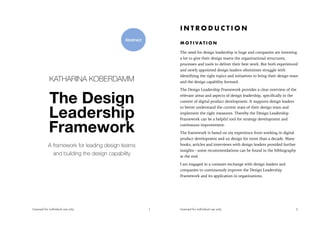
KATHARINA KOBERDAMM
The Design
Leadership
Framework
A framework for leading design teams
and building the design capability
Abstract
I N T R O D U C T I O N
M O T I VA T I O N
The need for design leadership is huge and companies are investing
a lot to give their design teams the organizational structures,
processes and tools to deliver their best work. But both experienced
and newly appointed design leaders oftentimes struggle with
identifying the right topics and initiatives to bring their design team
and the design capability forward.
The Design Leadership Framework provides a clear overview of the
relevant areas and aspects of design leadership, specifically in the
context of digital product development. It supports design leaders
to better understand the current state of their design team and
implement the right measures. Thereby the Design Leadership
Framework can be a helpful tool for strategy development and
continuous improvement.
The framework is based on my experience from working in digital
product development and ux design for more than a decade. Many
books, articles and interviews with design leaders provided further
insights - some recommendations can be found in the bibliography
at the end.
I am engaged in a constant exchange with design leaders and
companies to continuously improve the Design Leadership
Framework and its application in organizations.
Licensed for individual use only 2
F R A M E W O R K O V E R V I E W
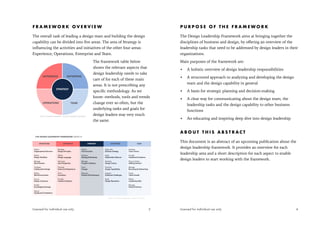
The overall task of leading a design team and building the design
capability can be divided into five areas. The area of Strategy is
influencing the activities and initiatives of the other four areas:
Experience, Operations, Enterprise and Team.
The framework table below
shows the relevant aspects that
design leadership needs to take
care of for each of these main
areas. It is not prescribing any
specific methodology. As we
know: methods, tools and trends
change ever so often, but the
underlying tasks and goals for
design leaders stay very much
the same.
Licensed for individual use only 3
P U R P O S E O F T H E F R A M E W O R K
The Design Leadership Framework aims at bringing together the
disciplines of business and design, by offering an overview of the
leadership tasks that need to be addressed by design leaders in their
organizations.
Main purposes of the framework are:
• A holistic overview of design leadership responsibilities
• A structured approach to analyzing and developing the design
team and the design capability in general
• A basis for strategic planning and decision-making
• A clear way for communicating about the design team, the
leadership tasks and the design capability to other business
functions
• An educating and inspiring deep dive into design leadership
A B O U T T H I S A B S T R A C T
This document is an abstract of an upcoming publication about the
design leadership framework. It provides an overview for each
leadership area and a short description for each aspect to enable
design leaders to start working with the framework.
Licensed for individual use only 4
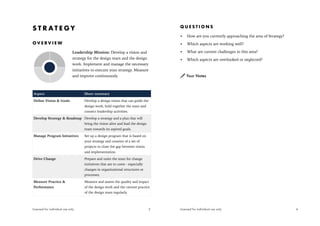
S T R A T E G Y
O V E R V I E W
Leadership Mission: Develop a vision and
strategy for the design team and the design
work. Implement and manage the necessary
initiatives to execute your strategy. Measure
and improve continuously.
Aspect Short summary
Define Vision & Goals Develop a design vision that can guide the
design work, hold together the team and
connect leadership activities.
Develop Strategy & Roadmap Develop a strategy and a plan that will
bring the vision alive and lead the design
team towards its aspired goals.
Manage Program Initiatives Set up a design program that is based on
your strategy and consists of a set of
projects to close the gap between vision
and implementation.
Drive Change Prepare and unite the team for change
initiatives that are to come - especially
changes in organizational structures or
processes.
Measure Practice &
Performance
Measure and assess the quality and impact
of the design work and the current practice
of the design team regularly.
Licensed for individual use only 5
Q U E S T I O N S
• How are you currently approaching the area of Strategy?
• Which aspects are working well?
• What are current challenges in this area?
• Which aspects are overlooked or neglected?
! Your Notes
Licensed for individual use only 6
E X P E R I E N C E
O V E R V I E W
Leadership Mission: Influence and support
the innovation of products, services and
experiences with a human-centered angle
and a design-led approach. Envision and
define what great design means for the
enterprise and what it looks like. Provide
creative leadership and input for relevant
design decisions.
Aspect Short summary
Develop Design Principles Define design principles that describe on a
general level, what are the guiding values
and guidelines for design in your team and
enterprise.
Define Design Language Define the design language that describes
the general foundations and re-usable
components and patterns to use when
creating design solutions.
Advocate User Perspective Be the advocate for human understanding
and empathy within product development
and the enterprise.
Promote End-to-End
Experience
Support a holistic and strategic approach
on improving the experience of products
and services along the customer journey.
Licensed for individual use only 7
Q U E S T I O N S
• How are you currently approaching the area of Experience?
• Which aspects are working well?
• What are current challenges in this area?
• Which aspects are overlooked or neglected?
! Your Notes
Drive Innovation Drive the innovation of products, services
and customer experiences forward with a
human-centered perspective and a design-
led approach.
Provide Creative Guidance Provide creative leadership and direction
by overseeing and guiding the outcomes of
design work across multiple teams,
products and initiatives.
Aspect Short summary
Licensed for individual use only 8
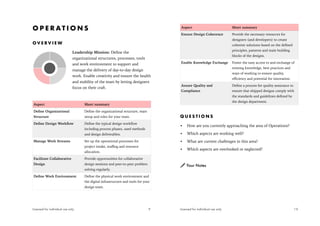
O P E R A T I O N S
O V E R V I E W
Leadership Mission: Define the
organizational structures, processes, tools
and work environment to support and
manage the delivery of day-to-day design
work. Enable creativity and ensure the health
and stability of the team by letting designers
focus on their craft.
Aspect Short summary
Define Organizational
Structure
Define the organizational structure, team
setup and roles for your team.
Define Design Workflow Define the typical design workflow
including process phases, used methods
and design deliverables.
Manage Work Streams Set up the operational processes for
project intake, staffing and resource
allocation.
Facilitate Collaborative
Design
Provide opportunities for collaborative
design sessions and peer-to-peer problem
solving regularly.
Define Work Environment Define the physical work environment and
the digital infrastructure and tools for your
design team.
Licensed for individual use only 9
Q U E S T I O N S
• How are you currently approaching the area of Operations?
• Which aspects are working well?
• What are current challenges in this area?
• Which aspects are overlooked or neglected?
! Your Notes
Ensure Design Coherence Provide the necessary resources for
designers (and developers) to create
coherent solutions based on the defined
principles, patterns and main building
blocks of the designs.
Enable Knowledge Exchange Foster the easy access to and exchange of
existing knowledge, best practices and
ways of working to ensure quality,
efficiency and potential for innovation.
Assure Quality and
Compliance
Define a process for quality assurance to
ensure that shipped designs comply with
the standards and guidelines defined by
the design department.
Aspect Short summary
Licensed for individual use only 10
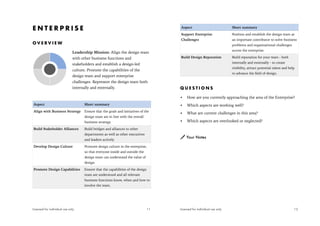
E N T E R P R I S E
O V E R V I E W
Leadership Mission: Align the design team
with other business functions and
stakeholders and establish a design-led
culture. Promote the capabilities of the
design team and support enterprise
challenges. Represent the design team both
internally and externally.
Aspect Short summary
Align with Business Strategy Ensure that the goals and initiatives of the
design team are in line with the overall
business strategy.
Build Stakeholder Alliances Build bridges and alliances to other
departments as well as other executives
and leaders actively.
Develop Design Culture Promote design culture in the enterprise,
so that everyone inside and outside the
design team can understand the value of
design.
Promote Design Capabilities Ensure that the capabilities of the design
team are understood and all relevant
business functions know, when and how to
involve the team.
Licensed for individual use only 11
Q U E S T I O N S
• How are you currently approaching the area of the Enterprise?
• Which aspects are working well?
• What are current challenges in this area?
• Which aspects are overlooked or neglected?
! Your Notes
Support Enterprise
Challenges
Position and establish the design team as
an important contributor to solve business
problems and organizational challenges
across the enterprise.
Build Design Reputation Build reputation for your team - both
internally and externally - to create
visibility, attract potential talent and help
to advance the field of design.
Aspect Short summary
Licensed for individual use only 12
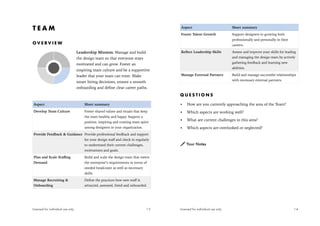
T E A M
O V E R V I E W
Leadership Mission: Manage and build
the design team so that everyone stays
motivated and can grow. Foster an
inspiring team culture and be a supportive
leader that your team can trust. Make
smart hiring decisions, ensure a smooth
onboarding and define clear career paths.
Aspect Short summary
Develop Team Culture Foster shared values and rituals that keep
the team healthy and happy. Support a
positive, inspiring and trusting team spirit
among designers in your organization.
Provide Feedback & Guidance Provide professional feedback and support
for your design staff and check in regularly
to understand their current challenges,
motivations and goals.
Plan and Scale Staffing
Demand
Build and scale the design team that meets
the enterprise’s requirements in terms of
needed headcount as well as necessary
skills.
Manage Recruiting &
Onboarding
Define the practices how new staff is
attracted, assessed, hired and onboarded.
Licensed for individual use only 13
Q U E S T I O N S
• How are you currently approaching the area of the Team?
• Which aspects are working well?
• What are current challenges in this area?
• Which aspects are overlooked or neglected?
! Your Notes
Foster Talent Growth Support designers in growing both
professionally and personally in their
careers.
Reflect Leadership Skills Assess and improve your skills for leading
and managing the design team by actively
gathering feedback and learning new
abilities.
Manage External Partners Build and manage successful relationships
with necessary external partners.
Aspect Short summary
Licensed for individual use only 14
A B O U T T H E A U T H O R
Katharina Koberdamm is a design consultant and lecturer living in
Berlin. Her main topics are experience design, customer-centered
innovation and design leadership.
She holds a degree in economics and has worked more than a
decade in UX and design in both agencies and in-house teams. She
teaches Human Computer Interaction and Innovation Design
Management at the University of Applied Sciences Europe and
other universities.
Her mission is to bridge the gap between business and design to
support a common understanding between these disciplines.
Katharina believes in human-centricity and values as the main
driver of the work we do.
Website: https://designleadershipframework.de
I M P O R T A N T N O T I C E
This is a beta version, which means the content is still work in
progress. Please use it as your personal copy for education.
January 2021,
Katharina Koberdamm
Licensed for individual use only 15
B I B L I O G R A P H Y
This is a selection of the resources that I find valuable. They are a
good start to deep dive into the relevant topics of design leadership.
B O O K S
• Baars, J.-E. (2020) Leading design: how to build a successful business by
design.
• Banfield, R. (2015) Design leadership: how top design leaders build and
grow successful organizations. First edition. O’Reilly Media.
• Coleman, D. (2018) Building brand experiences: a practical guide to
retaining brand relevance. 1st Edition. New York, NY: Kogan Page Ltd.
• Dobiéy, D., Köplin, T. and Mach, W. (2004) Programm-Management:
Projekte übergreifend koordinieren und in die Unternehmensstrategie
einbinden. 1. Aufl. Weinheim: Wiley.
• Gothelf, J. and Seiden, J. (2016) Lean UX: designing great products with
agile teams. Second edition. Sebastopol, CA: O’Reilly Media.
• Greever, T. (2020) Articulating Design Decisions, 2nd Edition. O’Reilly
Media.
• Guenther, M. (2013) Intersection: how enterprise design bridges the gap
between business, technology and people. Elsevier.
• Hands, D. (2018) Design management: the essential handbook. London,
United Kingdom; New York: Kogan Page.
• Iba, T. (2014) Presentation Patterns: a pattern language for creative
presentations. Lulu.com
• Malouf, D. et al. (2018) DesignOps Handbook. Available at: https://
www.designbetter.co/designops-handbook/
Licensed for individual use only 16
• Merholz, P
. and Skinner, K. (2016) Org design for design orgs: building
and managing in-house design teams. O’Reilly Media.
• Osterwalder, A., Pigneur, Y. and Clark, T. (2010) Business model
generation: a handbook for visionaries, game changers, and challengers.
Wiley.
• Palmer, H. (2000) Das Enneagramm: sich selbst und andere verstehen
lernen. Vollst. Taschenbuchausg. München: Droemer Knaur
• Schichtel, A. (2016) Change Management für Dummies. 2., überarbeitete
und aktualisierte Auflage. Weinheim: Wiley
• Tavşan, N. and Erdem, C. (2018) Customer experience management: how
to design, integrate, measure and lead. Tasora Books.
• Walter, A. and Woolery, E. (2018) Design Leadership Handbook. Invision
DesignBetter eBooks. Available at: https://www.designbetter.co/design-
leadership-handbook
L I N K S
• Cao, J. (2017) ‘Scaling UX: A 4-Step Framework for Design Leaders’.
Available at: https://www.uxpin.com/studio/blog/scaling-ux-4-step-
framework-design-leaders/.
• Kaiser, G., Posniak, M. and Bent, S. (2020) Reimagining Design Systems at
Spotify. Available at: https://spotify.design/article/reimagining-design-
systems-at-spotify.
• Karacizmeli, A., Belyaev, D. and Baguley, S. Build better design systems -
An open-source checklist to help you plan, build and grow your design
system. Available at: https://designsystemchecklist.com.
• Hanley, M. (2016) UX Leadership Roles: Multiple Paths. Available at:
https://www.uxmatters.com/mt/archives/2016/09/ux-leadership-roles-
multiple-paths.php.
Licensed for individual use only 17
• Hayley, H. (2019) The Future of Design Systems. Awwwards Conference
San Francisco. Available at: https://www.youtube.com/watch?
v=mq984Mc9UVA.
• Maeda, J. (2017) John Maeda on the three types of design, the four
quarters of life, and diversity. High Resolution. Available at: https://
www.youtube.com/watch?v=LU3y-5Peh9A.
• McCann, C. and Wedin, J. (2018) ‘Design Assessment Framework’,
Letterpress. Available at: https://www.letterpress.se/newblog/design-
assessment-framework
• Schleifer, A. and Allen, T. (2019) ‘Evolving by Design - Two newly
appointed creative leaders on the next chapter at Airbnb’, Airbnb Design.
Available at: https://airbnb.design/evolving-by-design/.
• Vetrov, Y. (2013) ‘Applied UX Strategy Part 1-6’, UX Matters. Available at:
https://www.uxmatters.com/authors/archives/2012/07/yury_vetrov.php.
D I S C L A I M E R
This material was prepared for you with great care. The materials are for
educational purposes only, a guarantee of any kind about the accuracy or
completeness of the content of this material cannot be made.
This material is licensed for individual, educational use only. Circulation or
reproduction of this document – including single pages or images - needs to
be permitted by the author.
© All rights reserved (2021)
Licensed for individual use only 18

Design Leadership Framework-Abstract.pdf

  • 1.
    Licensed for individualuse only 1 KATHARINA KOBERDAMM The Design Leadership Framework A framework for leading design teams and building the design capability Abstract I N T R O D U C T I O N M O T I VA T I O N The need for design leadership is huge and companies are investing a lot to give their design teams the organizational structures, processes and tools to deliver their best work. But both experienced and newly appointed design leaders oftentimes struggle with identifying the right topics and initiatives to bring their design team and the design capability forward. The Design Leadership Framework provides a clear overview of the relevant areas and aspects of design leadership, specifically in the context of digital product development. It supports design leaders to better understand the current state of their design team and implement the right measures. Thereby the Design Leadership Framework can be a helpful tool for strategy development and continuous improvement. The framework is based on my experience from working in digital product development and ux design for more than a decade. Many books, articles and interviews with design leaders provided further insights - some recommendations can be found in the bibliography at the end. I am engaged in a constant exchange with design leaders and companies to continuously improve the Design Leadership Framework and its application in organizations. Licensed for individual use only 2
  • 2.
    F R AM E W O R K O V E R V I E W The overall task of leading a design team and building the design capability can be divided into five areas. The area of Strategy is influencing the activities and initiatives of the other four areas: Experience, Operations, Enterprise and Team. The framework table below shows the relevant aspects that design leadership needs to take care of for each of these main areas. It is not prescribing any specific methodology. As we know: methods, tools and trends change ever so often, but the underlying tasks and goals for design leaders stay very much the same. Licensed for individual use only 3 P U R P O S E O F T H E F R A M E W O R K The Design Leadership Framework aims at bringing together the disciplines of business and design, by offering an overview of the leadership tasks that need to be addressed by design leaders in their organizations. Main purposes of the framework are: • A holistic overview of design leadership responsibilities • A structured approach to analyzing and developing the design team and the design capability in general • A basis for strategic planning and decision-making • A clear way for communicating about the design team, the leadership tasks and the design capability to other business functions • An educating and inspiring deep dive into design leadership A B O U T T H I S A B S T R A C T This document is an abstract of an upcoming publication about the design leadership framework. It provides an overview for each leadership area and a short description for each aspect to enable design leaders to start working with the framework. Licensed for individual use only 4
  • 3.
    S T RA T E G Y O V E R V I E W Leadership Mission: Develop a vision and strategy for the design team and the design work. Implement and manage the necessary initiatives to execute your strategy. Measure and improve continuously. Aspect Short summary Define Vision & Goals Develop a design vision that can guide the design work, hold together the team and connect leadership activities. Develop Strategy & Roadmap Develop a strategy and a plan that will bring the vision alive and lead the design team towards its aspired goals. Manage Program Initiatives Set up a design program that is based on your strategy and consists of a set of projects to close the gap between vision and implementation. Drive Change Prepare and unite the team for change initiatives that are to come - especially changes in organizational structures or processes. Measure Practice & Performance Measure and assess the quality and impact of the design work and the current practice of the design team regularly. Licensed for individual use only 5 Q U E S T I O N S • How are you currently approaching the area of Strategy? • Which aspects are working well? • What are current challenges in this area? • Which aspects are overlooked or neglected? ! Your Notes Licensed for individual use only 6
  • 4.
    E X PE R I E N C E O V E R V I E W Leadership Mission: Influence and support the innovation of products, services and experiences with a human-centered angle and a design-led approach. Envision and define what great design means for the enterprise and what it looks like. Provide creative leadership and input for relevant design decisions. Aspect Short summary Develop Design Principles Define design principles that describe on a general level, what are the guiding values and guidelines for design in your team and enterprise. Define Design Language Define the design language that describes the general foundations and re-usable components and patterns to use when creating design solutions. Advocate User Perspective Be the advocate for human understanding and empathy within product development and the enterprise. Promote End-to-End Experience Support a holistic and strategic approach on improving the experience of products and services along the customer journey. Licensed for individual use only 7 Q U E S T I O N S • How are you currently approaching the area of Experience? • Which aspects are working well? • What are current challenges in this area? • Which aspects are overlooked or neglected? ! Your Notes Drive Innovation Drive the innovation of products, services and customer experiences forward with a human-centered perspective and a design- led approach. Provide Creative Guidance Provide creative leadership and direction by overseeing and guiding the outcomes of design work across multiple teams, products and initiatives. Aspect Short summary Licensed for individual use only 8
  • 5.
    O P ER A T I O N S O V E R V I E W Leadership Mission: Define the organizational structures, processes, tools and work environment to support and manage the delivery of day-to-day design work. Enable creativity and ensure the health and stability of the team by letting designers focus on their craft. Aspect Short summary Define Organizational Structure Define the organizational structure, team setup and roles for your team. Define Design Workflow Define the typical design workflow including process phases, used methods and design deliverables. Manage Work Streams Set up the operational processes for project intake, staffing and resource allocation. Facilitate Collaborative Design Provide opportunities for collaborative design sessions and peer-to-peer problem solving regularly. Define Work Environment Define the physical work environment and the digital infrastructure and tools for your design team. Licensed for individual use only 9 Q U E S T I O N S • How are you currently approaching the area of Operations? • Which aspects are working well? • What are current challenges in this area? • Which aspects are overlooked or neglected? ! Your Notes Ensure Design Coherence Provide the necessary resources for designers (and developers) to create coherent solutions based on the defined principles, patterns and main building blocks of the designs. Enable Knowledge Exchange Foster the easy access to and exchange of existing knowledge, best practices and ways of working to ensure quality, efficiency and potential for innovation. Assure Quality and Compliance Define a process for quality assurance to ensure that shipped designs comply with the standards and guidelines defined by the design department. Aspect Short summary Licensed for individual use only 10
  • 6.
    E N TE R P R I S E O V E R V I E W Leadership Mission: Align the design team with other business functions and stakeholders and establish a design-led culture. Promote the capabilities of the design team and support enterprise challenges. Represent the design team both internally and externally. Aspect Short summary Align with Business Strategy Ensure that the goals and initiatives of the design team are in line with the overall business strategy. Build Stakeholder Alliances Build bridges and alliances to other departments as well as other executives and leaders actively. Develop Design Culture Promote design culture in the enterprise, so that everyone inside and outside the design team can understand the value of design. Promote Design Capabilities Ensure that the capabilities of the design team are understood and all relevant business functions know, when and how to involve the team. Licensed for individual use only 11 Q U E S T I O N S • How are you currently approaching the area of the Enterprise? • Which aspects are working well? • What are current challenges in this area? • Which aspects are overlooked or neglected? ! Your Notes Support Enterprise Challenges Position and establish the design team as an important contributor to solve business problems and organizational challenges across the enterprise. Build Design Reputation Build reputation for your team - both internally and externally - to create visibility, attract potential talent and help to advance the field of design. Aspect Short summary Licensed for individual use only 12
  • 7.
    T E AM O V E R V I E W Leadership Mission: Manage and build the design team so that everyone stays motivated and can grow. Foster an inspiring team culture and be a supportive leader that your team can trust. Make smart hiring decisions, ensure a smooth onboarding and define clear career paths. Aspect Short summary Develop Team Culture Foster shared values and rituals that keep the team healthy and happy. Support a positive, inspiring and trusting team spirit among designers in your organization. Provide Feedback & Guidance Provide professional feedback and support for your design staff and check in regularly to understand their current challenges, motivations and goals. Plan and Scale Staffing Demand Build and scale the design team that meets the enterprise’s requirements in terms of needed headcount as well as necessary skills. Manage Recruiting & Onboarding Define the practices how new staff is attracted, assessed, hired and onboarded. Licensed for individual use only 13 Q U E S T I O N S • How are you currently approaching the area of the Team? • Which aspects are working well? • What are current challenges in this area? • Which aspects are overlooked or neglected? ! Your Notes Foster Talent Growth Support designers in growing both professionally and personally in their careers. Reflect Leadership Skills Assess and improve your skills for leading and managing the design team by actively gathering feedback and learning new abilities. Manage External Partners Build and manage successful relationships with necessary external partners. Aspect Short summary Licensed for individual use only 14
  • 8.
    A B OU T T H E A U T H O R Katharina Koberdamm is a design consultant and lecturer living in Berlin. Her main topics are experience design, customer-centered innovation and design leadership. She holds a degree in economics and has worked more than a decade in UX and design in both agencies and in-house teams. She teaches Human Computer Interaction and Innovation Design Management at the University of Applied Sciences Europe and other universities. Her mission is to bridge the gap between business and design to support a common understanding between these disciplines. Katharina believes in human-centricity and values as the main driver of the work we do. Website: https://designleadershipframework.de I M P O R T A N T N O T I C E This is a beta version, which means the content is still work in progress. Please use it as your personal copy for education. January 2021, Katharina Koberdamm Licensed for individual use only 15 B I B L I O G R A P H Y This is a selection of the resources that I find valuable. They are a good start to deep dive into the relevant topics of design leadership. B O O K S • Baars, J.-E. (2020) Leading design: how to build a successful business by design. • Banfield, R. (2015) Design leadership: how top design leaders build and grow successful organizations. First edition. O’Reilly Media. • Coleman, D. (2018) Building brand experiences: a practical guide to retaining brand relevance. 1st Edition. New York, NY: Kogan Page Ltd. • Dobiéy, D., Köplin, T. and Mach, W. (2004) Programm-Management: Projekte übergreifend koordinieren und in die Unternehmensstrategie einbinden. 1. Aufl. Weinheim: Wiley. • Gothelf, J. and Seiden, J. (2016) Lean UX: designing great products with agile teams. Second edition. Sebastopol, CA: O’Reilly Media. • Greever, T. (2020) Articulating Design Decisions, 2nd Edition. O’Reilly Media. • Guenther, M. (2013) Intersection: how enterprise design bridges the gap between business, technology and people. Elsevier. • Hands, D. (2018) Design management: the essential handbook. London, United Kingdom; New York: Kogan Page. • Iba, T. (2014) Presentation Patterns: a pattern language for creative presentations. Lulu.com • Malouf, D. et al. (2018) DesignOps Handbook. Available at: https:// www.designbetter.co/designops-handbook/ Licensed for individual use only 16
  • 9.
    • Merholz, P .and Skinner, K. (2016) Org design for design orgs: building and managing in-house design teams. O’Reilly Media. • Osterwalder, A., Pigneur, Y. and Clark, T. (2010) Business model generation: a handbook for visionaries, game changers, and challengers. Wiley. • Palmer, H. (2000) Das Enneagramm: sich selbst und andere verstehen lernen. Vollst. Taschenbuchausg. München: Droemer Knaur • Schichtel, A. (2016) Change Management für Dummies. 2., überarbeitete und aktualisierte Auflage. Weinheim: Wiley • Tavşan, N. and Erdem, C. (2018) Customer experience management: how to design, integrate, measure and lead. Tasora Books. • Walter, A. and Woolery, E. (2018) Design Leadership Handbook. Invision DesignBetter eBooks. Available at: https://www.designbetter.co/design- leadership-handbook L I N K S • Cao, J. (2017) ‘Scaling UX: A 4-Step Framework for Design Leaders’. Available at: https://www.uxpin.com/studio/blog/scaling-ux-4-step- framework-design-leaders/. • Kaiser, G., Posniak, M. and Bent, S. (2020) Reimagining Design Systems at Spotify. Available at: https://spotify.design/article/reimagining-design- systems-at-spotify. • Karacizmeli, A., Belyaev, D. and Baguley, S. Build better design systems - An open-source checklist to help you plan, build and grow your design system. Available at: https://designsystemchecklist.com. • Hanley, M. (2016) UX Leadership Roles: Multiple Paths. Available at: https://www.uxmatters.com/mt/archives/2016/09/ux-leadership-roles- multiple-paths.php. Licensed for individual use only 17 • Hayley, H. (2019) The Future of Design Systems. Awwwards Conference San Francisco. Available at: https://www.youtube.com/watch? v=mq984Mc9UVA. • Maeda, J. (2017) John Maeda on the three types of design, the four quarters of life, and diversity. High Resolution. Available at: https:// www.youtube.com/watch?v=LU3y-5Peh9A. • McCann, C. and Wedin, J. (2018) ‘Design Assessment Framework’, Letterpress. Available at: https://www.letterpress.se/newblog/design- assessment-framework • Schleifer, A. and Allen, T. (2019) ‘Evolving by Design - Two newly appointed creative leaders on the next chapter at Airbnb’, Airbnb Design. Available at: https://airbnb.design/evolving-by-design/. • Vetrov, Y. (2013) ‘Applied UX Strategy Part 1-6’, UX Matters. Available at: https://www.uxmatters.com/authors/archives/2012/07/yury_vetrov.php. D I S C L A I M E R This material was prepared for you with great care. The materials are for educational purposes only, a guarantee of any kind about the accuracy or completeness of the content of this material cannot be made. This material is licensed for individual, educational use only. Circulation or reproduction of this document – including single pages or images - needs to be permitted by the author. © All rights reserved (2021) Licensed for individual use only 18