Download as PDF, PPTX



















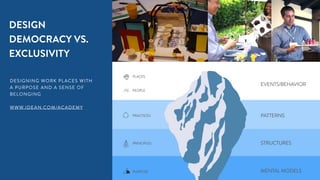
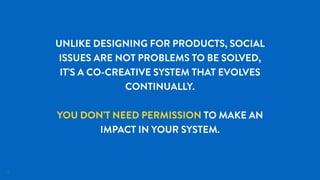


This document discusses designing for social good. It provides examples of social goods like clean air and literacy. Designing for social good is a choice that requires considering stakeholders beyond just customers, including communities, environments, and future generations. An effective process involves co-initiating with diverse partners, co-sensing issues and opportunities, co-presencing to understand perspectives, co-creating prototypes, and co-evolving solutions. Quotes emphasize the need to consider humanity, compassion and justice in technology and design visions. The document contrasts different approaches like immersion versus observation and open versus closed dialogue. It concludes that social issues are not problems to be solved but rather continuous co-creative systems that require impact without permission within communities


