P R E S E N T A T I O N T O T H E C U R R I C U L U M A D V I S O R T E A M
J U L Y 2 9 T H , 2 0 1 6
P A U L L E S L I E
Idea Management
for Teaching and Learning
29 July 2016Dr. Paul Leslie - WSU Office of the PVC Learning Transformations 1
2
The Problem
Ideas
Capture
from group
work
Share from
personal
work
Manipulate
and reflect
Reconfigure
and
transform
Carry
forward and
integrate
29 July 2016Dr. Paul Leslie - WSU Office of the PVC Learning Transformations
3
The Problem
Ideas
Capture
from group
work
Share from
personal
work
Manipulate
and reflect
Reconfigure
and
transform
Carry
forward and
integrate
Where are they?
29 July 2016Dr. Paul Leslie - WSU Office of the PVC Learning Transformations
4
The Context
Individual
effort
• Preparing for
class
• Making notes
Community
effort
• Group work
• Social
construction
Idea creation
• Medium is the
message
• Narratives of
learning
• Making thinking
visible
Idea
Management
• Preserve for
reflection
• Articulation
• learning
29 July 2016Dr. Paul Leslie - WSU Office of the PVC Learning Transformations
5
The Context
Repeat
29 July 2016Dr. Paul Leslie - WSU Office of the PVC Learning Transformations
6
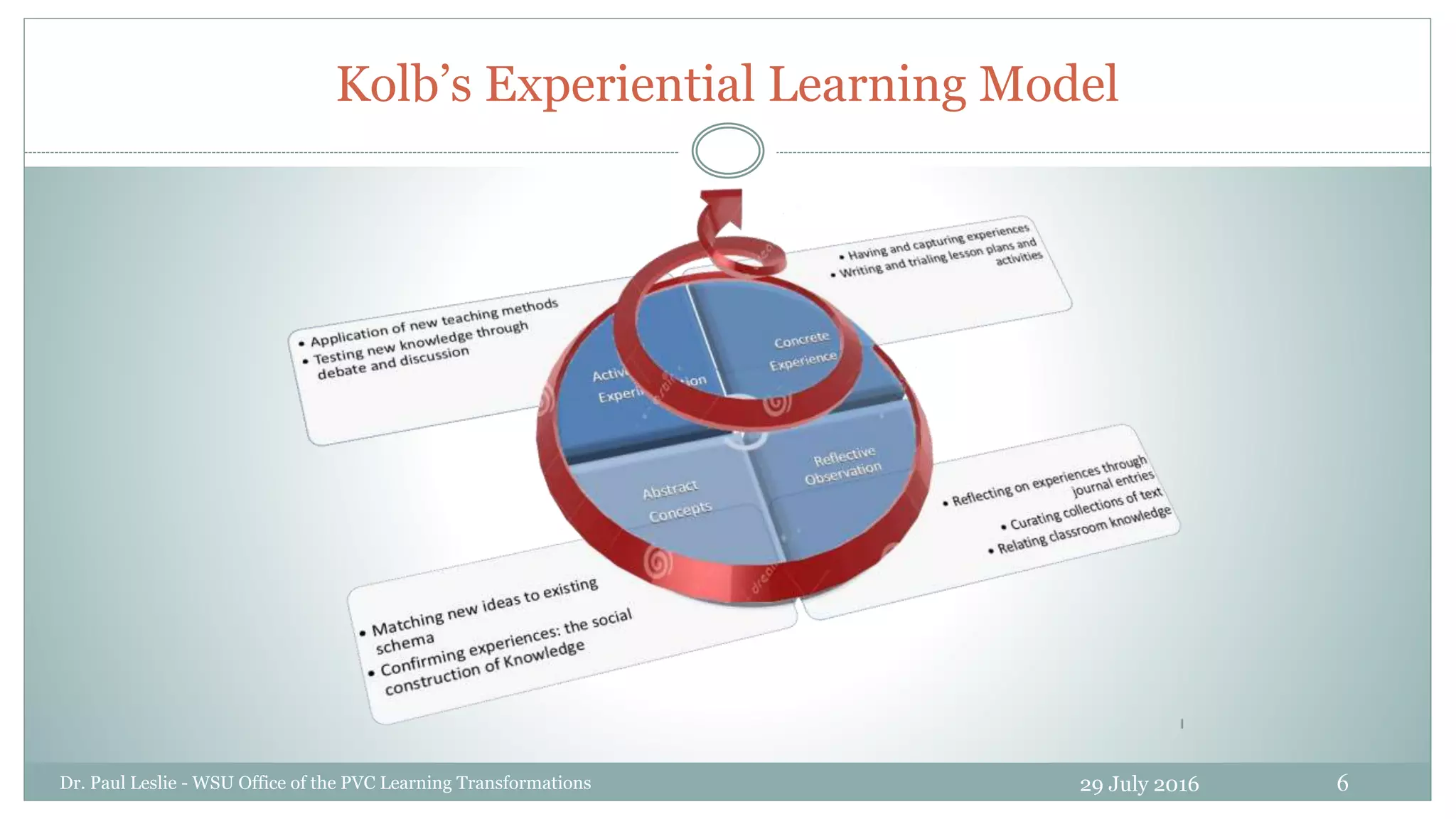
Kolb’s Experiential Learning Model
29 July 2016Dr. Paul Leslie - WSU Office of the PVC Learning Transformations
7
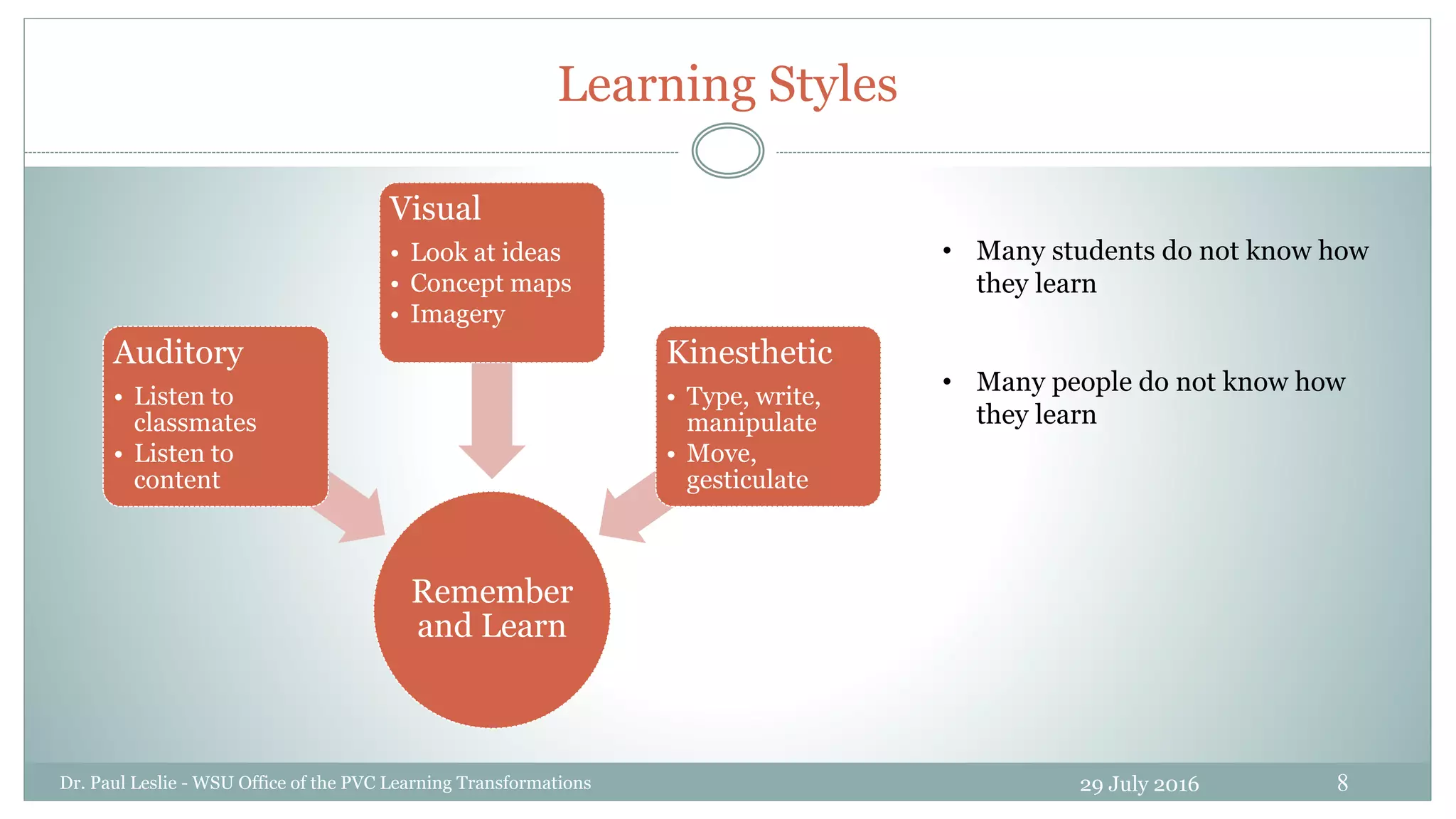
Learning Styles
Remember
and Learn
Auditory
• Listen to
classmates
• Listen to
content
Visual
• Look at ideas
• Concept maps
• Imagery
Kinesthetic
• Type, write,
manipulate
• Move,
gesticulate
29 July 2016Dr. Paul Leslie - WSU Office of the PVC Learning Transformations
8
Learning Styles
Remember
and Learn
Auditory
• Listen to
classmates
• Listen to
content
Visual
• Look at ideas
• Concept maps
• Imagery
Kinesthetic
• Type, write,
manipulate
• Move,
gesticulate
• Many students do not know how
they learn
• Many people do not know how
they learn
29 July 2016Dr. Paul Leslie - WSU Office of the PVC Learning Transformations
9
Narratives of learning: Introduction
29 July 2016Dr. Paul Leslie - WSU Office of the PVC Learning Transformations
Capturing Processes with Products -unintentional
10
Narratives of learning: Introduction
29 July 2016Dr. Paul Leslie - WSU Office of the PVC Learning Transformations
Capturing Processes with Products - intentional
11
Curation
• For showcase and assessment purposes,
documents and ideas can be pulled from
the personal workspace
• As noted earlier, when students show
their best work, where do they keep the
other work?
29 July 2016Dr. Paul Leslie - WSU Office of the PVC Learning Transformations
12
Narratives of learning: Introduction
 As Freire (1998) notes, we must create for our students and
colleagues “the possibilities for the production and construction of
knowledge” (p. 30).
Freire, P. (1998). Pedagogy of freedom. Lanham, Maryland: Rowman
& Littlefield.
29 July 2016Dr. Paul Leslie - WSU Office of the PVC Learning Transformations
13
Not Cool
29 July 2016Dr. Paul Leslie - WSU Office of the PVC Learning Transformations
14
Cloud Storage
29 July 2016Dr. Paul Leslie - WSU Office of the PVC Learning Transformations
15
So…
 Format
 Personal ideas
 Community ideas
 Competency Portfolio
 Assessment
29 July 2016Dr. Paul Leslie - WSU Office of the PVC Learning Transformations
16
So…
 Personal Portfolio
 Google Drive
 use their own cloud storage tools for the actual storage of their data in its various formats. There are a variety of different tools
available.
 Google is recommended because it offers
 an integrated range of tools
 longevity for the account
 easier access to other account holders
 ample storage space
 YouTube
 provides a video platform.
 Twitter
 can hold links, articles,
 Share ideas
 LinkedIn
 Profile, employment related groups and discussions
 Great source of professional communities
 Can be linked in showcase, used for communication, updated and shared

29 July 2016Dr. Paul Leslie - WSU Office of the PVC Learning Transformations
17
So…
 Community Portfolio
 Google docs
 Synchronous editing
 Exports to Word, Excel, PPT.
 Supports forms
 Documents and videos from these platforms and from social media including
Twitter, LinkedIn, etc. can be easily embedded.
 vUWS
 Discussion boards, wikis,
29 July 2016Dr. Paul Leslie - WSU Office of the PVC Learning Transformations
18
So…
 Competency Portfolio
 Blogger
 Can hold embedded documents, RSS feeds from Twitter, LinkedIn profile etc.
 Can be used for reflective writing and exported.
 Can be closed, shared, partially or fully public.
29 July 2016Dr. Paul Leslie - WSU Office of the PVC Learning Transformations
19
So…
 Assessment
 Contents:
 The contents can be assessed as individual items.
 Classroom activities
 Work sheets
 Quizzes and results
 Presentations
 The collection itself can be assessed for such aspects as:
 Completeness / inclusion of
 Instructor and / or peer feedback
 Individual homework items
 Reflections on activities
 Presentation of contents
 Ease of access to contents
 Curation
 Are the contents representative of some element of the unit e.g. real world examples of unit content found in
media / imagery
29 July 2016Dr. Paul Leslie - WSU Office of the PVC Learning Transformations

Idea management by Dr. Paul Leslie - 2016

  • 1.
    P R ES E N T A T I O N T O T H E C U R R I C U L U M A D V I S O R T E A M J U L Y 2 9 T H , 2 0 1 6 P A U L L E S L I E Idea Management for Teaching and Learning 29 July 2016Dr. Paul Leslie - WSU Office of the PVC Learning Transformations 1
  • 2.
    2 The Problem Ideas Capture from group work Sharefrom personal work Manipulate and reflect Reconfigure and transform Carry forward and integrate 29 July 2016Dr. Paul Leslie - WSU Office of the PVC Learning Transformations
  • 3.
    3 The Problem Ideas Capture from group work Sharefrom personal work Manipulate and reflect Reconfigure and transform Carry forward and integrate Where are they? 29 July 2016Dr. Paul Leslie - WSU Office of the PVC Learning Transformations
  • 4.
    4 The Context Individual effort • Preparingfor class • Making notes Community effort • Group work • Social construction Idea creation • Medium is the message • Narratives of learning • Making thinking visible Idea Management • Preserve for reflection • Articulation • learning 29 July 2016Dr. Paul Leslie - WSU Office of the PVC Learning Transformations
  • 5.
    5 The Context Repeat 29 July2016Dr. Paul Leslie - WSU Office of the PVC Learning Transformations
  • 6.
    6 Kolb’s Experiential LearningModel 29 July 2016Dr. Paul Leslie - WSU Office of the PVC Learning Transformations
  • 7.
    7 Learning Styles Remember and Learn Auditory •Listen to classmates • Listen to content Visual • Look at ideas • Concept maps • Imagery Kinesthetic • Type, write, manipulate • Move, gesticulate 29 July 2016Dr. Paul Leslie - WSU Office of the PVC Learning Transformations
  • 8.
    8 Learning Styles Remember and Learn Auditory •Listen to classmates • Listen to content Visual • Look at ideas • Concept maps • Imagery Kinesthetic • Type, write, manipulate • Move, gesticulate • Many students do not know how they learn • Many people do not know how they learn 29 July 2016Dr. Paul Leslie - WSU Office of the PVC Learning Transformations
  • 9.
    9 Narratives of learning:Introduction 29 July 2016Dr. Paul Leslie - WSU Office of the PVC Learning Transformations Capturing Processes with Products -unintentional
  • 10.
    10 Narratives of learning:Introduction 29 July 2016Dr. Paul Leslie - WSU Office of the PVC Learning Transformations Capturing Processes with Products - intentional
  • 11.
    11 Curation • For showcaseand assessment purposes, documents and ideas can be pulled from the personal workspace • As noted earlier, when students show their best work, where do they keep the other work? 29 July 2016Dr. Paul Leslie - WSU Office of the PVC Learning Transformations
  • 12.
    12 Narratives of learning:Introduction  As Freire (1998) notes, we must create for our students and colleagues “the possibilities for the production and construction of knowledge” (p. 30). Freire, P. (1998). Pedagogy of freedom. Lanham, Maryland: Rowman & Littlefield. 29 July 2016Dr. Paul Leslie - WSU Office of the PVC Learning Transformations
  • 13.
    13 Not Cool 29 July2016Dr. Paul Leslie - WSU Office of the PVC Learning Transformations
  • 14.
    14 Cloud Storage 29 July2016Dr. Paul Leslie - WSU Office of the PVC Learning Transformations
  • 15.
    15 So…  Format  Personalideas  Community ideas  Competency Portfolio  Assessment 29 July 2016Dr. Paul Leslie - WSU Office of the PVC Learning Transformations
  • 16.
    16 So…  Personal Portfolio Google Drive  use their own cloud storage tools for the actual storage of their data in its various formats. There are a variety of different tools available.  Google is recommended because it offers  an integrated range of tools  longevity for the account  easier access to other account holders  ample storage space  YouTube  provides a video platform.  Twitter  can hold links, articles,  Share ideas  LinkedIn  Profile, employment related groups and discussions  Great source of professional communities  Can be linked in showcase, used for communication, updated and shared  29 July 2016Dr. Paul Leslie - WSU Office of the PVC Learning Transformations
  • 17.
    17 So…  Community Portfolio Google docs  Synchronous editing  Exports to Word, Excel, PPT.  Supports forms  Documents and videos from these platforms and from social media including Twitter, LinkedIn, etc. can be easily embedded.  vUWS  Discussion boards, wikis, 29 July 2016Dr. Paul Leslie - WSU Office of the PVC Learning Transformations
  • 18.
    18 So…  Competency Portfolio Blogger  Can hold embedded documents, RSS feeds from Twitter, LinkedIn profile etc.  Can be used for reflective writing and exported.  Can be closed, shared, partially or fully public. 29 July 2016Dr. Paul Leslie - WSU Office of the PVC Learning Transformations
  • 19.
    19 So…  Assessment  Contents: The contents can be assessed as individual items.  Classroom activities  Work sheets  Quizzes and results  Presentations  The collection itself can be assessed for such aspects as:  Completeness / inclusion of  Instructor and / or peer feedback  Individual homework items  Reflections on activities  Presentation of contents  Ease of access to contents  Curation  Are the contents representative of some element of the unit e.g. real world examples of unit content found in media / imagery 29 July 2016Dr. Paul Leslie - WSU Office of the PVC Learning Transformations

Editor's Notes

  • #10 This diagram attempts to highlight the many processes that a practitioner goes through and one possible result of trying to capture their work in a portfolio
  • #11 This diagram attempts to highlight the many processes that a practitioner goes through and one possible result of trying to capture their work in a portfolio
  • #13 Freire provides very motivating thoughts about the role of educators in our society. In the Pedagogy of Freedom, he offers some challenges to the educator that may put them at risk. By making our thoughts visible, we can aspire to challenge others to read our thoughts and give us feedback. There is a freedom that comes from the putting your thoughts out ;there’ and then getting great feedback that makes us think. Freire was talking about a more literal freedom from oppression through economics and politics, but we can aspire to freedom of thought in any place.