by Nick Mark MD
OVERVIEW OF VENTILATOR MODES onepageric
u.com
@nickmma
rk
Link to the
most current
version →
ONE
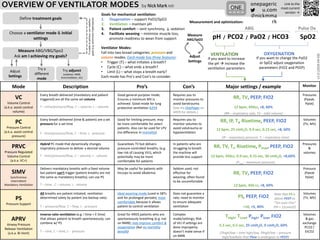
Mode Description Pro’s Con’s Major settings / example Monitor
VC
Volume Control
(a.k.a. assist control
volume)
Every breath delivered (mandatory and patient
triggered) are all the same set volume
Good general-purpose mode;
Ensures a minimum MV is
achieved. Good mode for lung
protective ventilation (LPV)
Requires you to
monitor pressures to
avoid barotrauma.
(See my OnePager on
ARDS for details.)
RR, TV, PEEP, FIO2
Pressures
(Ppeak,
Pplat)
T – time/pressure/flow, C – volume, L – volume 12 bpm, 450cc, +8, 60%
PC
Pressure Control
(a.k.a. assist control
pressure)
Every breath delivered (time & patient) are a set
pressure for a set time
Good for limiting pressure; may
be more comfortable for select
patients. Also can be used for LPV
(no difference in mortality)
Requires you to
monitor volumes to
avoid volutrauma or
hypoventilation
RR, IP, TI, Risetime, PEEP, FIO2 Volumes
(TV, MV)
12 bpm, 25 cmH2O, 0.9 sec, 0.15 sec, +8, 60%
T - time/pressure/flow, C – time, L - pressure
PRVC
Pressure Regulated
Volume Control
(a.k.a. VC+)
Hybrid PC mode that dynamically changes
inspiratory pressure to deliver a desired volume
Guarantees TV but delivers
pressure-controlled breaths; (e.g.
low risk of causing VILI), which
potentially may be more
comfortable for patients
In patients who are
struggling to breath
the machine will
provide less support
RR, TV, TI, Risetime, Pmax, PEEP, FIO2
Pressures
&
volumes
T - time/pressure/flow, C – volume, L - volume 12 bpm, 450cc, 0.9 sec, 0.15 sec, 30 cmH2O, +8,60%
SIMV
Synchronous
Intermittent
Mandatory Ventilation
Delivers mandatory breaths with a fixed volume
but patient can’t trigger (patient breaths are not
the same as mandatory breaths); can use PS
May be useful for patients with
hiccups to avoid alkalemia
Seldom used; not
effective for
weaning; often found
to be uncomfortable
RR, TV, PEEP, FIO2
Pressure
(Ppeak
Pplat)
T – time , C – volume, L - volume 12 bpm, 450 cc, +8, 60%
PS
Pressure Support
All breaths are patient initiated; ventilation
determined solely by patient (no backup rate).
Ideal weaning mode (used in SBTs
and for prolonged periods); most
comfortable because it allows
patient to control ventilation
Does not guarantee a
rate; need to monitor
to ensure adequate
ventilation
PS, PEEP, FiO2
Volumes
(TV, MV)
T – pressure/flow, C – flow, L - pressure +10, +5, 40%
APRV
Airway Pressure
Release Ventilation
(a.k.a. Bi-Vent)
Inverse ratio ventilation (e.g. I time > E time)
that allows patient to breath spontaneously; can
combine w/ PS
Great for ARDS patients who are
spontaneously breathing (e.g. not
on NMB); may improve comfort &
oxygenation (but no mortality
benefit)
Complex
mode/settings; Risk
of VILI if settings are
done improperly;
doesn’t make sense if
on NMB
THigh, TLow, Phigh, Plow, FIO2 Volumes
& gas
exchange
PCO2 /
EtCO2
5.5 sec, 0.5 sec, 25 cmH2O, 0 cmH2O, 60%
T – time, C – time, L - pressure
pH / PCO2 / PaO2 / HCO3 SpO2
VENTILATION OXYGENATION
If you want to increase
the pH  increase the
ventilation parameters
If you want to change the PaO2
or SpO2 adjust oxygenation
parameters (FiO2 and PEEP)
Goals for mechanical ventilation:
1. Oxygenation – support PaO2/SpO2
2. Ventilation – maintain pH
3. Patient comfort – vent synchrony, ↓ sedation
4. Facilitate weaning – minimize muscle loss,
promote readiness to wean from support
Measure
ABG/SpO2
Adjust
Settings
ABG Pulse Ox
Define treatment goals
Choose a ventilator mode & initial
settings
Measure ABG/VBG/Spo2
Ask am I achieving my goals?
Adjust
Settings
Try a
different
mode
If
unable
to
achieve,
can
redefine
goals
(e.g.
permissive
hypercapnia)
Ventilator Modes:
Fall into two broad categories: pressure and
volume modes. Each mode has three features:
• Trigger (T) – what initiates a breath?
• Cycle (C) – what ends a breath?
• Limit (L) – what stops a breath early?
Each mode has Pro’s and Con’s to consider.
Note that PS is
above PEEP so
“Ten over Five”
PIP = 15cmH2O
Try adjunct
(sedation, NMB,
bronchodilator, etc)
(Thigh/low – time high/low, Phigh/low – pressure
high/lowNote that Plow is analogous to PEEP)
Measurement and optimization:
(RR – respiratory rate, TV – tidal volume)
(IP – inspiratory pressure, TI – inspiratory time)
(Pmax – maximum pressure)
v1.0
(2020-04-03)

ICU_One_Pager_ventilator

  • 1.
    by Nick MarkMD OVERVIEW OF VENTILATOR MODES onepageric u.com @nickmma rk Link to the most current version → ONE Mode Description Pro’s Con’s Major settings / example Monitor VC Volume Control (a.k.a. assist control volume) Every breath delivered (mandatory and patient triggered) are all the same set volume Good general-purpose mode; Ensures a minimum MV is achieved. Good mode for lung protective ventilation (LPV) Requires you to monitor pressures to avoid barotrauma. (See my OnePager on ARDS for details.) RR, TV, PEEP, FIO2 Pressures (Ppeak, Pplat) T – time/pressure/flow, C – volume, L – volume 12 bpm, 450cc, +8, 60% PC Pressure Control (a.k.a. assist control pressure) Every breath delivered (time & patient) are a set pressure for a set time Good for limiting pressure; may be more comfortable for select patients. Also can be used for LPV (no difference in mortality) Requires you to monitor volumes to avoid volutrauma or hypoventilation RR, IP, TI, Risetime, PEEP, FIO2 Volumes (TV, MV) 12 bpm, 25 cmH2O, 0.9 sec, 0.15 sec, +8, 60% T - time/pressure/flow, C – time, L - pressure PRVC Pressure Regulated Volume Control (a.k.a. VC+) Hybrid PC mode that dynamically changes inspiratory pressure to deliver a desired volume Guarantees TV but delivers pressure-controlled breaths; (e.g. low risk of causing VILI), which potentially may be more comfortable for patients In patients who are struggling to breath the machine will provide less support RR, TV, TI, Risetime, Pmax, PEEP, FIO2 Pressures & volumes T - time/pressure/flow, C – volume, L - volume 12 bpm, 450cc, 0.9 sec, 0.15 sec, 30 cmH2O, +8,60% SIMV Synchronous Intermittent Mandatory Ventilation Delivers mandatory breaths with a fixed volume but patient can’t trigger (patient breaths are not the same as mandatory breaths); can use PS May be useful for patients with hiccups to avoid alkalemia Seldom used; not effective for weaning; often found to be uncomfortable RR, TV, PEEP, FIO2 Pressure (Ppeak Pplat) T – time , C – volume, L - volume 12 bpm, 450 cc, +8, 60% PS Pressure Support All breaths are patient initiated; ventilation determined solely by patient (no backup rate). Ideal weaning mode (used in SBTs and for prolonged periods); most comfortable because it allows patient to control ventilation Does not guarantee a rate; need to monitor to ensure adequate ventilation PS, PEEP, FiO2 Volumes (TV, MV) T – pressure/flow, C – flow, L - pressure +10, +5, 40% APRV Airway Pressure Release Ventilation (a.k.a. Bi-Vent) Inverse ratio ventilation (e.g. I time > E time) that allows patient to breath spontaneously; can combine w/ PS Great for ARDS patients who are spontaneously breathing (e.g. not on NMB); may improve comfort & oxygenation (but no mortality benefit) Complex mode/settings; Risk of VILI if settings are done improperly; doesn’t make sense if on NMB THigh, TLow, Phigh, Plow, FIO2 Volumes & gas exchange PCO2 / EtCO2 5.5 sec, 0.5 sec, 25 cmH2O, 0 cmH2O, 60% T – time, C – time, L - pressure pH / PCO2 / PaO2 / HCO3 SpO2 VENTILATION OXYGENATION If you want to increase the pH  increase the ventilation parameters If you want to change the PaO2 or SpO2 adjust oxygenation parameters (FiO2 and PEEP) Goals for mechanical ventilation: 1. Oxygenation – support PaO2/SpO2 2. Ventilation – maintain pH 3. Patient comfort – vent synchrony, ↓ sedation 4. Facilitate weaning – minimize muscle loss, promote readiness to wean from support Measure ABG/SpO2 Adjust Settings ABG Pulse Ox Define treatment goals Choose a ventilator mode & initial settings Measure ABG/VBG/Spo2 Ask am I achieving my goals? Adjust Settings Try a different mode If unable to achieve, can redefine goals (e.g. permissive hypercapnia) Ventilator Modes: Fall into two broad categories: pressure and volume modes. Each mode has three features: • Trigger (T) – what initiates a breath? • Cycle (C) – what ends a breath? • Limit (L) – what stops a breath early? Each mode has Pro’s and Con’s to consider. Note that PS is above PEEP so “Ten over Five” PIP = 15cmH2O Try adjunct (sedation, NMB, bronchodilator, etc) (Thigh/low – time high/low, Phigh/low – pressure high/lowNote that Plow is analogous to PEEP) Measurement and optimization: (RR – respiratory rate, TV – tidal volume) (IP – inspiratory pressure, TI – inspiratory time) (Pmax – maximum pressure) v1.0 (2020-04-03)