USD 25 • EUR 20 • JPY 2,300

        Ericsson                                                             Issue no. 1 2012


GANDHI
REVISITED
SAM PITRODA WANTS INDIA TO BUILD
ITS OWN TECHNOLOGICAL ECOSYSTEM

What makes a grid smart
DON’T BE FOOLED BY
THE GREEN LIGHTS

Television
in the eye of its beholders
A MAGNA CARTA


Opinion
FOR DIGITAL CONTENT


YOU’RE NOT AS CLEVER
AS YOU THINK
17   PAGES THEME – HOW CONNECTED LEARNING IS TURNING EDUCATION UPSIDE DOWN
Together, Telcordia and Ericsson can help you realize
value through unparalleled efficiency and customer
experience with the industry’s foremost capability in
operations and business support systems. Because
perfect moments begin with an outstanding experience.

ericsson.com/telcordia
contents


                       Ericsson


           ERICSSON BUSINESS REVIEW                [9] Editorial: It’s old school, really
           is Ericsson’s global business
           magazine, focusing on thought
                                                   Connected learning has the potential to take education back to original values. Socrates would
           leadership and providing a              most likely have approved.
           long-term perspective on business
           strategies in telecommunications.       [10] Cover story: Building a better India
           The magazine is distributed to          Sam Pitroda, the man behind India’s communications revolution, believes that India must
           readers in more than 130 countries.
                                                   build its own technological ecosystems based on holistic, sustainable, Gandhian values that
           ADDRESS                                 originate from rural realities.
           Telefonaktiebolaget LM Ericsson,
           SE-164 83, Stockholm, Sweden
           Phone: +46 8 719 00 00
                                                   [20] THEME: The tools of education – soon at a museum near you
                                                   Ericsson ConsumerLab’s Future School project is providing important insights into the
           ADDRESS CHANGES                         education of tomorrow.
           Strömberg Distribution AB,
           E-mail: business.review@strd.se
                                                   [27] THEME: We define innovation too narrowly
           PUBLISHER                               Ken Banks, creator of the nonprofit mobile service FrontlineSMS, says development issues
           Patrik Regårdh                          such as education require us to start with the problem, not the technology.
           EDITORIAL COUNCIL
           Patrik Regårdh, Ulrika Bergström,       [29] THEME: Can technology eliminate teachers?
           Susanna Bävertoft, Erik Kruse,          Professor Sugata Mitra’s approach is to create a self−organizing learning environment.
           Dag Helmfrid

           EDITOR-IN-CHIEF                         [30] THEME: Don’t rely too much on technology
           Mats Thorén                             Professor Richard Fletcher believes nothing will ever replace human storytelling as the most
           mats.thoren@jgcommunication.se          effective and popular means of educating people.
           DEPUTY EDITOR
           Nathan Hegedus                          [33] THEME: Reinventing corporate learning
                                                   Ericsson shares its own experiences of creating a new kind of corporate learning.
           ART DIRECTOR
           Jan Sturestig
                                                   [38] Smart−grid communications: enabling next−generation energy networks
           EDITORIAL OFFICE                        This involves more than just a simple bolt−on to the existing power grid.
           JG Communication,
           www.jgcommunication.se
                                                   [42] Content discontents: cultural protection in an internet world
           COVER PHOTO                             The regulation of audiovisual services is becoming more complex as some states begin to
           Chris Maluszynski                       recognize “the cultural exception.”
           CHIEF SUBEDITOR
           Birgitte van den Muyzenberg             [45] How to get paid twice for everything you do, part 3:
           SUBEDITORS
                                                   Innovation management
           Michael Costello, Teslin Seale,         Successful innovation management is primarily about recognizing and understanding
           Paul Eade, Robert Naylor,               effective routines and facilitating their emergence across the organization.
           Lindsay Holmwood, Ian Nicholson

           GRAPHS                                  [51] An action plan to embrace the digitization of creativity in
           Claes Göran Andersson                   the digital single market
           PRINTER                                 The European Commission needs to address some of the fundamental barriers preventing
           VTT Grafiska, Vimmerby 2012             member states from reaping and sharing productivity and creativity gains.
           VOLUME                                  [55] Don’t be fooled by the green lights – become service−aware
           17, Issue 1, 2012                       Ensuring service quality isn’t as straightforward as it may appear. Customer experiences
           ISSN                                    now depend on the performance of multiple systems within the operator’s architecture.
           1653-9486

           COPYRIGHT
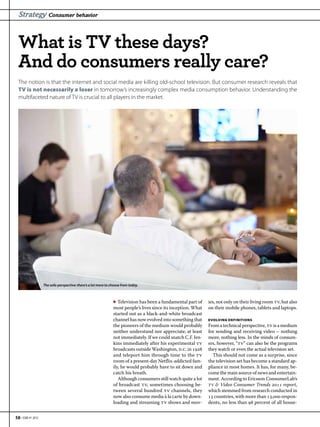
                                                   [58] What is TV these days? And do consumers really care?
           Telefonaktiebolaget LM Ericsson         Understanding the multifaceted nature of TV is crucial to all players in the market.

                                                   [62] OPINION: You’re not as clever as you think
                           ERICSSON BUSINESS
                           REVIEW was awarded      Innovation is hard and most of us, if we are honest, are not very good at it. The worry is that
                           Best Business-to-
                           Business publication    in the internet age, things might be getting worse, not better.
                           2010 by The Swedish
                           Association of Custom
                           Publishers (SACP)       [64] EXECUTIVE SUMMARIES

4 • EBR #1 2012
Jann Lipka
                                                                                                                                PHOTO


[20–35] THEME The old school – ready for the museum gallery
▶ BL ACKBOARD,    CHALK AND SL ATES are already becoming         we are already in a situation where education does not always
museum pieces. Soon, textbooks might follow. Technology          need schools; it can take place anywhere, anytime.
is playing a key role in a radical transformation of education     This issue’s theme examines the roles of the teacher, of tra−
– and a fierce debate is ongoing about whether this is a good    ditional learning institutions of the teacher, and of corporate
thing or not. Is new technology being used wisely? Is it be−     learning – all from the perspective of what new opportunities
ing used to cut costs, or to improve quality? The fact is that   technology might bring.


                                                                                                                                            EBR #1 2012 • 5
The big picture                 Enigma


             THE ENIGMA OF MACHINE INTELLIGENCE
               LO-TECH HI-TECH COMMUNICATION During World War II, German communications were encrypted
              on the Enigma cipher machine, which has now gained cult status. While original models fetch very high
              prices at auctions, there is also a healthy market for replicas and online simulators. The one pictured here is a
              three-rotor model made around 1937, and is still in working order. When sold by Rau Antiques in 2010, the
              asking price was USD 112,500.
                 As the moving rotors and wheels in the Enigma produced ever-changing alphabetic substitutions, the
              secret codes were supposed to be unbreakable, even by someone in possession of the machine.
                 Breaking the codes or ciphers did present a formidable challenge. In fact, they had to be broken
              afresh over and over again. The results of these efforts laid the groundwork for modern computing and
              artificial intelligence.
                 The British mathematician and cryptanalyst Alan Turing was recruited to work at Bletchley Park, Britain’s
              code-breaking center, devising techniques for breaking German ciphers.
                 It is now widely accepted that Turing was the father of theoretical and practical computing, although he
              died in 1954 – just as developments in the field of computing were getting underway.
                 After the war, he talked about the prospect of a machine “learning” and even “building a brain.”
              He wrote algorithms for chess-playing programs and regarded these as examples of what computers might
              eventually be able to do. In his 1946 report on the new opportunities that computers represented, he
              made his first reference to machine “intelligence” in connection with chess. ●


  6 • EBR #1 2012
EBR #1 2012 • 7
details


JUST ONE                          “At this point, the iPhone is like a drug, and the carriers are hooked.
QUESTION
                                  The question isn’t whether it’s worth it. It’s whether they can get
                                  by without it.”
                                            CRAIG MOFFETT, ANALYST AT SANFORD C. BERNSTEIN, TO CNET.


… to Samson Isa, Head


                                  Control of personal
of Value Added Services
for Globacom Nigeria.
         ▶ Have African
 ?       telecom companies
become more innovative
than their counterparts in
                                  environments
more developed markets?
                                  ▶ WristQue is a proto-          Part of the Massachusetts        three simple
         In terms of technolo-
  !      gy, Africa remains       type wristband contain-         Institute of Technology’s        buttons: two
dependent on more devel-          ing a processor; sensors        MediaLab responsive en-          to control tem-
oped countries. However,          for temperature, humidi-        vironments research, the         perature, and a
there has been some real          ty and light; and an ultra-     project is intended to cre-      third offering the
innovation in value-added         wideband radio used for         ate a practical way for          ability to interact with
services like M-PESA
                                  communicating with              people to communicate            multiple electronic devic-
(mobile money transfer) in
Kenya and specifically in          home automation sys-            with smart sensors in-           es (computers, projec-
interactive voice response        tems as well as pinpoint-       stalled in a building. The       tors, TVs) using gestures.
(IVR), which gets informa-        ing the wearer’s location.      wristband includes just          New Scientist. ●
tion to customers in the
languages they understand
and encourages rural
telephony/penetration.
    And we have seen
                                    NOW READ THIS!
development in applica-
tions. We’ve seen collabo-
                                                       M
                                                       MOBILE INTERFACE THEORY: EMBODIED SPACE AND LOCATIVE MEDIA BY JASON FARMAN,
ration between original
equipment manufacturers,                               ROUTLEDGE, .
                                                       R            The mass adoption of mobile devices – from smartphones to tablets
operators and local devel-                             to whatever comes next – is changing users’ very sense of self, as virtual space and
                                                       t
opers to work on apps that                             material space continually enhance, cooperate and disrupt each other.
                                                       m
locals in Nigeria and West                             ▶ BODIES, SPACE AND CULTURE. The author, an assistant professor at the University of Mary-
Africa can use, such as tra-                           land in the US, argues that we are using mobile media in a transformative way. The pervasive com-
ditional African games or                              puting model behind mobile devices allows people to connect across a range of locations, and this
localized “Western” prod-                               has changed the ways we “produce lived, embodied spaces.” In the book, Farman explores a range
ucts for the African market.                            of mobile practices, including storytelling projects, mobile maps and GPS technologies, as well as
    However, in general,             location-aware social networks, among many others.
African operators remain
caught in a trap of short                               FIWI ACCESS NETWORKS BY MARTIN MAIER AND NAVID GHAZISAIDI, CAMBRIDGE UNIVERSITY PRESS, .
life cycles, rising costs and                           Could the development of bimodal fiber−wireless− (FiWi) access networks be the
low average revenues per
user because of prevailing                              endgame of broadband−access evolution? Here is an overview of the network that
low disposable income                                   may change everything.
and, sadly, low investment                             ▶ INTEGRATION CHALLENGE. Many researchers think that future broadband-access networks
in R&D. The telecom indus-                             w be bimodal, merging the strengths of both optical and wireless technologies. In one scenario, an
                                                       will
try in Africa also lacks                               o
                                                       optical-fiber network could provide a broadband connection to antenna base stations, which then
strong organizations, such                             w
                                                       wirelessly transmit signals to customers. The authors of this book – one of, if not the first on FiWi –
as telecom unions, and this                            e
                                                       explore the main technologies involved, describing both state-of-the-art fiber-access networks and
weakness can often make              the latest developments in wireless-access networks, including Gigabit WiMAX and LTE, and also examine recent ad-
operators parochial and              vances such as network coding.
less likely to take a long-
term view of how to devel-                              THINKING, FAST AND SLOW BY DANIEL KAHNEMAN, FARRAR, STRAUS AND GIROUX, . One of the
op both their networks and                              leading psychologists of our age and a Nobel Prize winner in economics continues to
their services.                                         challenge the rational model of judgment and decision−making, which carries
    It is going to be very dif-
                                                        special relevance with regard to corporate strategies.
ficult to break this cycle of
                                                       ▶ FAST VERSUS SLOW. Kahneman argues that we have two modes of thought: one is fast and
high costs and low profits.
                                                       emotional while the other is slower and more logical. The ways these two modes work together,
There needs to be a para-
                                                       and against each other, determine much of our decision-making, including the impact of loss aver-
digm shift that includes
                                                       sion and overconfidence on corporate strategies. The influential computer scientist Jaron Lanier
foreign investment, which
                                     says about the book: “Before computer networking got cheap and ubiquitous, the sheer inefficiency of communica-
will help transfer skills to
African operators and spur           tion dampened the effects of the quirks of human psychology on macro-scale events. No more.”
more R&D.

8 • EBR #1 2012
editorial


                                                                                                EDITORINCHIEF


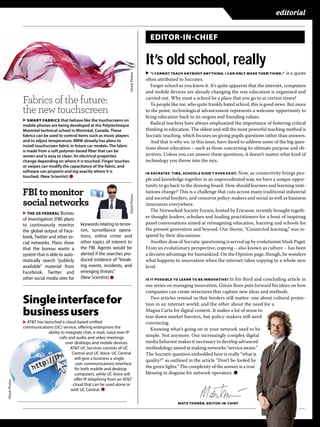
                                                                                              It’s old school, really
                                                                                              ▶ “I CANNOT TEACH ANYBODY ANYTHING. I CAN ONLY MAKE THEM THINK,” is a quote


                                                                              iStock Photos
                                                                                              often attributed to Socrates.
                                                                                                 Forget school as you know it. It’s quite apparent that the internet, computers
                                                                                              and mobile devices are already changing the way education is organized and
                Fabrics of the future:                                                        carried out. Why must a school be a place that you go to at certain times?
                                                                                                 To people like me, who quite frankly hated school, this is good news. But more
                the new touchscreen                                                           to the point, technological advancement represents a welcome opportunity to
                                                                                              bring education back to its origins and founding values.
                ▶ SMART FABRICS that behave like the touchscreens on
                mobile phones are being developed at the Polytechnique
                                                                                                 Radical teachers have always emphasized the importance of fostering critical
                Montréal technical school in Montréal, Canada. These                          thinking in education. The oldest and still the most powerful teaching method is
                fabrics can be used to control items such as music players                    Socratic teaching, which focuses on giving pupils questions rather than answers.
                and to adjust temperature. BMW already has plans to                              And that is why we, in this issue, have dared to address some of the big ques-
                install touchscreen fabric in future car models. The fabric
                                                                                              tions about education – such as those concerning its ultimate purpose and ob-
                is made from a soft polymer-based fiber that can be
                woven and is easy to clean. Its electrical properties                         jectives. Unless you can answer these questions, it doesn’t matter what kind of
                change depending on where it is touched. Finger touches                       technology you throw into the mix.
                or swipes can modify the capacitance of the fabric, and
                software can pinpoint and log exactly where it is                             IN SOCRATES’ TIME, SCHOOLS DIDN’T EVEN EXIST. Now, as connectivity brings peo-
                touched. (New Scientist) ●
                                                                                              ple and knowledge together in an unprecedented way, we have a unique oppor-
                                                                                              tunity to go back to the drawing board. How should learners and learning insti-
                FBI to monitor                                                                tutions change? This is a challenge that cuts across many traditional industrial
                                                                              iStock Photos


                                                                                              and societal borders, and concerns policy-makers and social as well as business
                social networks                                                               innovators everywhere.
                                                                                                 The Networked Society Forum, hosted by Ericsson, recently brought togeth-
                ▶ THE US FEDERAL Bureau
                of Investigation (FBI) plans                                                  er thought leaders, scholars and leading practitioners for a bout of inspiring
                to continuously monitor         keywords relating to terror-                  panel conversations aimed at reimagining education, learning and schools for
                the global output of Face-      ism, surveillance opera-                      the present generation and beyond. Our theme, “Connected learning,” was in-
                book, Twitter and other so-     tions, online crime and                       spired by their discussions.
                cial networks. Plans show       other topics of interest to                      Another dose of Socratic questioning is served up by evolutionist Mark Pagel.
                that the bureau wants a         the FBI. Agents would be                      From an evolutionary perspective, copying – also known as culture – has been
                system that is able to auto-    alerted if the searches pro-                  a decisive advantage for humankind. On the Opinion page, though, he wonders
                matically search “publicly      duced evidence of “break-                     what happens to innovation when the internet takes copying to a whole new
                available” material from        ing events, incidents, and                    level.
                Facebook, Twitter and           emerging threats.”
                other social media sites for    (New Scientist) ●                             IS IT POSSIBLE TO LEARN TO BE INNOVATIVE? In his third and concluding article in
                                                                                              our series on managing innovation, Göran Roos puts forward his ideas on how
                                                                                              companies can create structures that capture new ideas and methods.

                Single interface for                                                             Two articles remind us that borders still matter: one about cultural protec-
                                                                                              tion in an internet world; and the other about the need for a
                business users                                                                Magna Carta for digital content. It makes a lot of sense to
                                                                                              tear down market barriers, but policy-makers still need
                ▶ AT&T has launched a cloud-based unified                                     convincing.
                communications (UC) service, offering enterprises the                            Knowing what’s going on in your network used to be
                             ability to integrate chat, e-mail, voice over IP
                                    calls and audio and video meetings                        simple. Not anymore. Our increasingly complex digital
                                        over desktops and mobile devices.                     media behavior makes it necessary to develop advanced
                                           AT&T UC Services consists of UC                    methodology aimed at making networks “service aware.”
                                            Central and UC Voice. UC Central                  The Socratic question embedded here is really “what is
                                             will give a business a single                    quality?” as outlined in the article “Don’t be fooled by
                                             user communications interface
                                             for both mobile and desktop                      the green lights.” The complexity of the answer is a true
                                             computers, while UC Voice will                   blessing in disguise for network operators. ●
                                             offer IP telephony from an AT&T
iStock Photos


                                            cloud that can be used alone or
                                           with UC Central. ●


                                                                                                              MATS THORÉN, EDITORIN CHIEF
cover story         Sam Pitroda


       Basic facts              NAME Satyanarayan (Sam) Gangaram Pitroda TITLE Adviser to the Prime Minister on Public
       Information Infrastructure and Innovations EMPLOYER Government of India AGE 69 HEADQUARTERS New Delhi and Chicago


 10 • EBR #1 2012
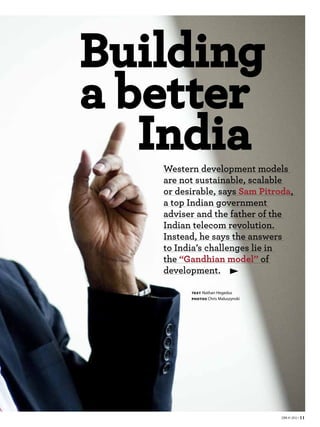
Building
a better
   India
   Western development models
   are not sustainable, scalable
   or desirable, says Sam Pitroda,
   a top Indian government
   adviser and the father of the
   Indian telecom revolution.
   Instead, he says the answers
   to India’s challenges lie in
   the “Gandhian model” of
   development.

         TEXT   Nathan Hegedus
         PHOTOS    Chris Maluszynski


                                       EBR #1 2012 • 11
Pitroda on… Indian versus Chinese development

Culturally, the two countries are very different. India is going to
focus on democratizing information. India is going to focus on
young talent. The Indian innovation model is very different.

        AM PITRODA is the man who brought             life cycles of Sam Pitroda” as if he were one of         in the family had died.

S       telephones to rural India, essentially
        connecting India to itself.
   Today, at the age of , this son of a carpen-
                                                      the groundbraking digital switches that he
                                                      once developed as a young immigrant in
                                                      Chicago.
                                                                                                                   “So we knew that he was ‘part of the fami-
                                                                                                               ly.’ He taught us… Make sure you do the right
                                                                                                               things. So a sense of sacrifice, love for every-
ter remains tirelessly true to a vision deeply                                                                 body, truth, simplicity: all these things are em-
rooted in his familys devotion to Gandhi. As          PHASE ONE: STARTING OUT                                  bedded in me, in my lifestyle.”
influential as ever in India civic life, Pitroda      One of eight children, Pitroda was born and                  But there is another side to Pitroda: the
preaches that India must drive its own open-          raised in Titilagarh in the state of Orissa, a deep-     American side.
source tech revolution, one based on sustain-         ly poor town with no running water or electric-              In , inspired by the romanticism in us
able and rural-based values. In its latest form,      ity and certainly no telephones. His father, an          President John F. Kennedy’s speech about put-
he describes it as thedemocratization of in-          immigrant from the faraway state of Gujarat,             ting a man on the moon, Pitroda – newly grad-
formation through connectivity.                       was a small-time lumber dealer with a drive for          uated with an MSc in Physics and Electronics
   “We are a nation of over a billion people and      his children to become something more.                   – boarded a boat, the start of a long journey
we cannot afford to follow a short-term mod-             “In those days, he used to sell nails to the          away from India and to the us.
el meant for a population of less than  mil-       British,” Pitroda says. “But he couldn’t speak               It was in the us that Pitroda made his first
lion people,” Pitroda said at a recent confer-        English. So he felt inferior to them. He said,           phone call, home to India, and it was in the us
ence on Gandhi and connectivity.                      when his children grew up, that he wanted                that he got a degree in electrical engineering.
   But Pitroda is not simply a visionary tech-        them to speak English.”                                  He found a niche in telecom in Chicago, work-
nocrat grounded in Gandhian philosophy. He               And then there was Mahatma Gandhi – a                 ing with digital switching for the US telecom
is also a gifted electrical engineer with more        fellow Gujarati and a central figure for both            company gte. Later, after his father told him
than  patents to his name. Even now, talk-          India and the Pitroda family.                            he was too young to get into the habit of work-
ing to Ericsson Business Review, he sits up              “When I was growing up, Gandhi was al-                ing for other people, he started his own com-
straight and says with a says with a spreading        ways in our midst,” Pitroda says. “I still remem-        pany with two partners.
smile that he can most certainly “still do the        ber when I was a little kid, six years old, I                Around this time, Pitroda was also editing
bits and bytes.”                                      was playing outside my house, and my father              an issue of an ieee magazine that focused on
   So it is no surprise that when he considers        came in and said Gandhi had died. I didn’t               telecom development in the third world.
his career, he uses the language not of a poli-       quite understand it. Then everybody in the                   “I said, ‘Don’t focus on telecom density,
tician but of an engineer and speaks of “the          household had to take a bath, as if someone              focus on accessibility,’” he says now.


   Sam Pitroda: walking the telecom talk
   ▶ SAM PITRODA SAYS “ percent” of his fo-        bile money. He is no longer the ceo of                  which made him a millionaire. During the
   cus is on India and innovation, but it is im-      c-sam, but the business has thrived as the              same period, he also patented an idea for a
   portant to remember that this is a man who         concept of mobile payments – and the tech-              personal electronic diary. In the s, this
   can back up his tech talk. He holds more than      nology surrounding it – have finally caught             patent was incorporated into the popular
    telecom and technology-based patents,           up with his vision.                                     Casio Digital Diary, a precursor to the per-
   and his visionary mobile-wallet technology            “It was too far ahead of its time,” he says of his   sonal digital assistants of the late s and
   may soon be in millions of smartphones.            initial idea. “Now is the time to build (on) it.”       the smartphones of today. In the past five
      In , Pitroda had recently returned to                                                               years alone, that patent has been referenced
   the US after living in India for most of the       CSAM’S FIRST MOBILE wallet was launched in             by the likes of ibm, Microsoft and Nokia.
   previous decade. He noticed his wife writ-         Japan in  and has since been used in the               But Pitroda’s most fun idea was probably
   ing personal check after personal check to         us, China, India and Mexico, among other                Compucards. Developed in , this is a
   pay their household expenses. Then he con-         places. And the company keeps gaining new,              deck of cards with binary numbers (, , ,
   sidered all the other daily financial tasks that   ever bigger customers. In August, , Isis            , …) for the computer generation. Any-
   could even then be carried out online, and         – the joint venture formed by at&t Mobil-               one who reads the instructions closely can
   he came up with the idea of a digital wallet,      ity, T-Mobile usa and Verizon Wireless –                use the cards to play family games such as
   complete with “id cards,” “money,” “receipts”      adopted c-sam’s platform to provide its                 poker and rummy. The joker is a hairy soft-
   and branded “credit cards.”                        mobile-wallet service.                                  ware bug complete with legs and antennae.
      Pitroda patented his mobile-wallet idea in         Yet the mobile wallet is just one of Pitro-          But the most interesting card is probably the
   , founded a company (c-sam) to devel-          da’s many innovative ideas. In the s, he            king, who appears to resemble none other
   op it in , and later wrote a book on mo-       created the  dss digital switching system,           than Sam Pitroda. ●

12 • EBR #1 2012
Sam Pitroda   cover story
Pitroda is an accomplished painter who first
started drawing in meetings: “When people
talk, they spend useless time talking. And
their message takes just two minutes of a
30-minute conversation. So I learned early
that the best thing you can do is to doodle.
Meetings and all… That’s how I started.”


                                                                EBR #1 2012 • 13
cover story            Sam Pitroda


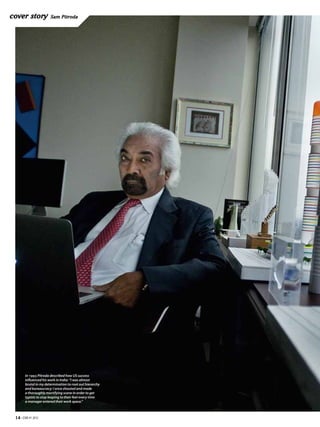
       In 1993 Pitroda described how US success
       influenced his work in India: “I was almost
       brutal in my determination to root out hierarchy
       and bureaucracy: I once shouted and made
       a thoroughly mortifying scene in order to get
       typists to stop leaping to their feet every time
       a manager entered their work space.”


 14 • EBR #1 2012
Pitroda on… the future of telecom

                                              You can’t say telecom like we did in the eighties.
                                              It is more pervasive. You have to talk about
                                              the role of telecom in research. You have to
                                              talk about the role of telecom in medicine. You
                                              have to talk about the role of telecom in education
                                              and the role of telecom in government.


                                                 Nobody paid attention to his articles, he          Over the following years, in a series of
                                              says. But if they had, it would have been          jobs culminating in a minister-level tech-
                                              no surprise when, after he sold his digital        nology mission, Pitroda created the infra-
                                              switch business to Rockwell International          structure that placed now-famous yellow
                                              in  and made millions, Pitroda turned          phone boxes in almost every Indian vil-
                                              back to India to put his words into action.        lage. It is this achievement that garnered
                                                 In a Harvard Business Review article in         him the unofficial title of the father of In-
                                              , Pitroda said that he had dreamed all         dian telecom. It also put him at the center
                                              his life of wealth and success, but that af-       of debates about whether or not technol-
Background check                              ter he sold his business, he was suddenly          ogy was a luxury, about the balance be-
                                              confronted with the fact that he had               tween the state and the free market, and
▶ 2010–present: Government of India,          walked out on India. The selfishness of his        about whether it was possible to move In-
  Adviser to the Prime Minister on Public     success set him off in pursuit of another          dia forward without the help of big mul-
  Information Infrastructure and              American dream, he said: the exploration           tinational corporations.
  Innovations                                 of a new frontier. The frontier? Using tel-           Pitroda believed fervently that technol-
▶ 1998–present – C-SAM, founder, former       ecommunications as a bridge between the            ogy was as crucial a developmental tool
  CEO and current Chairman, Chicago, US
                                              first world and the third.                         as education or clean water. And he used
▶ 2005–2009: Government of India,
  National Knowledge Commission,                                                                 his faith in connectivity to push for core
  Chairman, New Delhi, India                  PHASE TWO: GROWTH                                  Gandhian tenets such as indigenous
▶ 1993–2005: started a series of business     On his first trip to Delhi in the early s,     development and an emphasis on rural
  ventures, including World-Tel Limited (an   Pitroda tried to call his wife in Chicago. It      development.
  International Telecommunication Union       took four hours. So with a mixture of what            For this, he was branded an Indian na-
  project), and served on several United
  Nations commissions                         he calls “arrogance and ignorance,” he             tionalist and an enemy of foreign firms.
▶ 1987–1991: Government of India,             decided then and there to “fix” telecom               “Look, we took Intel’s processor,” he
  Adviser to the Prime Minister of India,     in India.                                          says. “That was collaboration. We took
  with the rank of Minister on national          “I saw that it and telecom could change         software from other companies. We took
  technology missions, New Delhi, India       the face of India,” he says. “I just saw it. In-   Motorola’s switch. The idea was ‘Don’t
▶ 1987–1991: Government of India,             dian culture is a rural culture. India was         give me lock, stock and barrel products.
  founder and Head of Indian Telecom
  Commission, New Delhi, India                disconnected. If I could just connect eve-         Give me components.’
▶ 1984–1987: Centre for Development of        rybody … Maybe it was because I was                   “It was not homegrown just for the sake
  Telematics, founder, New Delhi, India       poor. Because I lived in a village. If I had       of homegrown. If we had not used the
▶ 1979–1983: Rockwell International, Vice     been from Mumbai, it would have been               homegrown technology, we would not have
  President of Advanced Technology and        very different.”                                   the it business we have in India today.”
  Engineering, Chicago                           What follows is Indian political legend,           Pitroda and his team soon had phone
▶ 1974–1979: Wescom Switching, founder,
                                              as the man The Economist later called “the         booths rolling out to one village a week,
  Chicago, US
▶ late 1960s–early 1970s: General
                                              Indian with the long hair and the manner           then to a village a day, then to three villag-
  Telephone & Electronics, various            of an American superbrat” fought to get            es a day. There are more than , of
  engineering positions, Chicago, US          an unthinkably long one-hour meeting               these pay phones today. But then Rajiv
▶ 1966: MSc in Electrical Engineering,        with Prime Minister Indira Gandhi. After           Gandhi lost an election in , and while
  Illinois Institute of Technology, US        eight months, he got the meeting and,              Pitroda stayed at his post, things got
▶ 1964: MSc in Physics and Electronics, The   most importantly, he also met Rajiv Gan-           tougher. He was accused of corruption,
  Maharaja Sayajirao University of Baroda,
  Gujarat, India
                                              dhi, Indira’s son, who would become                and there were threats that drove his fam-
                                              prime minister in  and Pitroda’s great-        ily back to the us. He had a heart attack
                                              est ally.                                          and a quadruple bypass. Then in ,
                                                                                                                                    EBR #1 2012 • 15
Pitroda on… the impact of moving to the US as a young man

  It really opened up possibilities. I could talk about this for hours…
  For example, the most fascinating thing for me was the door
  knob, because in India, we had only this latch.
       Then I saw a revolving door and I thought, “What a good idea!”
  Then I saw a post-office box in the US and said, “What a design!” I had
  never thought that way. There had been nothing in my village. Nothing.


  while campaigning to return to power, Rajiv        people out of poverty and to find jobs for         only a dream because the “information
  Gandhi was killed by a suicide bomber.             the hundreds of millions of Indians under          element” had been missing. But now, final-
     “It was the biggest shock of my life,” Pitro-   the age of .                                     ly, India had built the tools to realize
  da says. “I just didn’t know what to do. Went         “Who am I to do it? I don’t know,” he says.     Gandhi’s dream.
  to the house, thought about what to do next,       “Do I have the authority? I don’t think so.
  and realized that this phase had to end in         But I try to get it done. That’s the advantage     PHASE FOUR: THE NEXT STEP
  life. I had to go back.”                           (of my position). A lot of times, people ask:      Even after a fight with cancer and a second
     Plus, after years of working for a token sal-   ‘Why don’t you become a minister?’ No, I           heart attack, Pitroda is busier than ever, his
  ary of usd  per year, Pitroda was out of mon-     don’t want to be a minister. That precludes        life reduced to a transcendent simplicity of
  ey. Yet he refused to do business in India.        my entire flexibility to operate.”                 work – now in Chicago, now in Delhi, now
     “I didn’t want to work in India in telecom,”       He still believes in centralization as a pre-   at a conference in Oslo, Norway.
  he said in an interview with India’s Skoch         condition to decentralization and in build-           The new plans keep coming too. Now he
  Consultancy Services. “I didn’t want a spec-       ing a scalable India-centered ecosystem.           wants to build an indigenous hardware
  trum license… didn’t want people to say:           And he still gets exasperated at being tagged      industry that would match India’s strength
  ‘Oh, that’s why you did all this stuff. So that    as an anti-colonial leftist.                       in software. Otherwise, hardware imports
  when the right time comes you cash in.’ I             “We need to centralize the thinking in          could someday be more costly than petro-
  didn’t want them to say: ‘He had this mas-         setting up infrastructure,” he says. “That is      leum, he says. Now, since Indian companies
  ter plan.’”                                        very different from saying, ‘Centralize eve-       have missed the g opportunity, he says,
     He went back to Chicago sick, broke and         rything.’ But the kind of infrastructure we        they need to get a jump start on “g”
  on a tourist visa.                                 are trying to build… no private enterprise         Gigabit Passive Optical Network (gpon)
                                                     would ever build it. It’s not viable. You have     technology.
  PHASE THREE: MATURITY                              to do it from the top because it is a nation-         “I am Gandhian in many ways,” he says. “I
  During the rest of the s, Pitroda looked       al infrastructure.”                                don’t have personal needs. I don’t go shop-
  after his business interests and made some            Yet he insists there remain great business      ping. I don’t have my own bank account. My
  more money. He put his kids through col-           opportunities in the Indian market.                wife takes care of that. If she buys me new
  lege and stayed close to his dying mother,            “Where is the money in telecom in India?        shoes, I wear the shoes. If she buys me a new
  who had moved to Chicago.                          Applications. Local applications, local lan-       shirt, I wear the shirt. I don’t give much
    But India and public service never               guage, local content. There is a huge oppor-       thought to these things. They don’t matter.”
  stopped calling to him and, in , he was        tunity in applications, applications, appli-          For Pitroda, being Gandhian goes far be-
  named head of the National Knowledge               cations.”                                          yond studying or emulating Gandhi him-
  Commission. From that point on, Pitroda               He has big numbers to match his big             self. He doesn’t like to talk about Gandhi as
  has been a whirlwind, advising and work-           plans. The government is working to con-           a person. It is more about asking the bigger
  ing on everything from fighting hunger to          nect , key nodes – libraries, universi-        questions, such as “How do I run my life?”
  reforming the railways, to reorganizing            ties and research facilities – with high-             This brings him back to his childhood in
  state telecom operator Bharat Sanchar              speed fiber. There are plans to connect            Orissa, back to the focus that has brought
  Nigam Ltd (bsnl).                                  , local governments with fiber. In           him so far and back to the long-term vision
    Today his official title is Adviser to the       January he announced a usd  billion gov-         he has for a prosperous and sustainable In-
  Prime Minister on Public Information In-           ernment investment in creating an “infor-          dia. It will not be easy to achieve this vision,
  frastructure and Innovations, though he is         mation highway,” including usd  billion for       he says. But it must be done. And who bet-
  most often referred to in the Indian press         a national fiber-optic network.                    ter to construct this future than the son of
  as a “technocrat.” His position allows Pitro-         At the  World Economic Forum,               a carpenter, a man who builds things?
  da to operate freely across the political and      Pitroda talked about how Mahatma                      “Technology is just a tool. At the end of
  economic spectrum, as he relentlessly push-        Gandhi’s dream of the development of the           the day, I am the son of a carpenter. I look
  es his agenda to lift hundreds of millions of      villages and decentralization had remained         at tools.” ●


16 • EBR #1 2012
Sam Pitroda   cover story
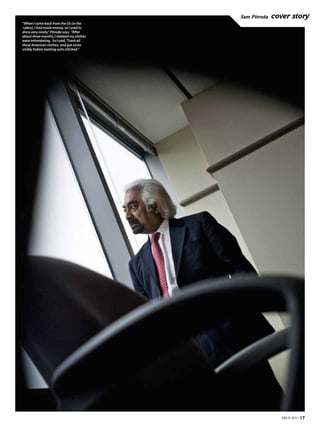
“When I came back from the US (in the
1980s), I had made money, so I used to
dress very nicely,” Pitroda says. “After
about three months, I realized my clothes
were intimidating. So I said, ‘Trash all
these American clothes,’ and got some
visibly Indian-looking suits stitched.”


                                                             EBR #1 2012 • 17
technology report


                       VOICE RECOGNITION: A STEP TOW
    Istockphotoi


                   Voice interfaces will soon be everywhere: in                              strides in voice recognition,        network connections. Many
                   cars, home appliances, medical equipment,                                 largely due to two factors: the      media outlets ran practical tests
                                                                                             capability to collect huge           comparing Siri with Google
                   production lines, and on websites. They are                               amounts of voice data, and then      Voice with mixed results, and
                   already helping us to make phone calls. But                               the ability to process it quickly.   both systems still required
                   these services have yet to find business                                      Google is running several ar-     some of the stilted formal com-
                   models that actually make money.                                          tificial intelligence programs –      mands so typical of early voice
                                                                 TEXT   Nathan Hegedus       others include language trans-       systems to get the right results.
                                                                                             lation and the image searches           Until recently, Google was
                   ▶ “Call Mom.” “Am I busy Tues-       little sense on their own. It must   necessary for highly function-       the leader in the mobile field,
                   day afternoon?” “I want pizza.”      also use sophisticated logic to      ing augmented reality – that         introducing Google Search by
                      People have waited a long         find the appropriate answer and       depend on the kind of massive        Voice for Android in February
                   time for their machines to be        be able to intelligently ask for     computing power of which the         . However, Jared Cohen
                   able to understand simple            clarification if wrong.               company is in a special position     from Google says the industry is
                   speech. And now it appears               The most relevant field for       to take advantage.                   still years, if not decades, away
                   that machines are beginning to       developing voice recognition is         For voice recognition, Google     from seamless voice recogni-
                   find their voice, so to speak,        computational linguistics,           has collected voice samples –        tion on the mobile phone. But
                   with voice control poised to         which marries linguistics with       the data – from Android’s            that doesn’t mean the systems
                   become the latest paradigm-          data-driven processing. Reflect-      speech-recognition system,           will get much better very fast in
                   shifting innovation in computer      ing this dual focus, models may      Google Voice’s e-mail transcrip-     the next decade.
                   interaction, after the mouse         be “knowledge-based” with            tion service and the now de-
                   and touchscreens.                    written linguistic rules or “data-   funct information service            Where does this
                      The hottest buzz surrounds        driven.” These two approaches        Goog, among other sources.        conversation go from here?
                   Siri, the voice-recognition sys-     have often been in conflict,             In both the Apple and             The real power of voice recog-
                   tem included in iOS, the latest     though the gap between them          Google voice-recognition             nition may not be in our mobile
                   version of Apple’s mobile oper-      has closed in recent decades. It     systems, most of the comput-         phones, but in applications in
                   ating system, as well as similar     turns out there are too many         ing is done not on the user’s        everything from our TVs to our
                   efforts from Google in Android-       possible sounds in human             phone but on the Apple or            cars, especially if systems like
                   powered phones.                      speech for a computer to un-         Google servers. With Apple’s Siri    Siri become able to interact
                                                        derstand using only linguistic       system, the voice command is         with third-party apps with
                   Just hard work                       rules – the data is needed, too.     recorded, compressed and sent        artificial intelligence capabilities
                   Scientists have worked on voice          Computational linguistics is     back to Apple’s servers, which       of their own.
                   recognition and natural-language     used in a wide array of products     process the request and return          Norman Winarsky, the
                   processing for more than five         besides voice recognition,           a text answer for the phone to       cofounder of Siri, said in Tech-
                   decades, with voice-recognition      including text-to-speech             “read” to the user.                  nology Review in October
                   technology included in some          synthesizers, automated voice-          For all this, current voice-      : “It’s clear that it would be
                   computers since the early s.     response systems, web search         recognition systems are far          technically possible to integrate
                   So it is not hard to do, but it is   engines, text editors and lan-       from perfect.                        any web service into Siri; you
                   extremely hard to do right.          guage instruction materials.            Both Siri and the Google sys-     can put a Siri front end in front
                      A good system must recognize                                           tem often fail to register slang     of anything.”
                   the context of a question, includ-   Talking about big data               and regional accents, and they          And almost to prove him
                   ing follow-up questions that refer   In recent years, both Google         depend on both external serv-        true, within weeks of its Apple
                   to an original question but make     and Apple have made great            ers and sometimes unreliable         debut, Siri had been hacked to


18 • EBR #1 2012
technology report

                                                                                                                          Technology at
                                                                                                                          your fingertips
                                                                                                                          ▶ For more on technology,

ARD THINKING PHONES                                                                                                       Ericsson Business Review
                                                                                                                          has a partner journal
                                                                                                                          designed to encourage dis-
                                                                                                                          cussion on a wide range of
                                                                                                                          R&D topics and innovative
                                                                                                                          solutions. Written by em-
                                                                                                                          ployees since 1924, Ericsson
                                            What’s the killer app?                                                        Review is now available as
                                                                                                                          an app for Android tablets
                                            Your voice.                                                                   in the Android Market, and
                                                                                                                          for iPad through the App
                                            ▶ In , Steve Jobs stood before the crowd at MacWorld and                  Store. To download the app,
                                                                                                                          go to the Ericsson Review
                                            introduced the iPhone for the first time. And what did he think
                                                                                                                          page, ericsson.com/review,
                                            was its most revolutionary function? The touch screen? The in-                and select the link for your
                                            tegration with iTunes?                                                        device.
                                               “What’s the killer app?” he asked. “The killer app is making
                                            calls! It’s amazing how hard it is to make calls on most phones.”
                                               And he was right, maybe more than he knew at the time.
  allow people to start certain cars        Voice is the gold standard for communication (video too, but
  with voice commands.                      only when it includes voice). Humans love to talk. They always
     Google already offers voice             have, and they always will.
  commands for searching on                    Sure, many voice minutes are going “over the top.” But people
  Google TV, and earlier this year it       are still going to talk, in both old and new channels, and they
  introduced Android@Home, a                will likely always value voice higher than data apps. Plus, at least
                                            for now, many, if not most, consumers seem to value the inter-                Smartphone
  framework for controlling light                                                                                         signaling storm
  switches, alarm clocks and other          operability and reliability that comes with their phone number
  home appliances through An-               and carrier billing.                                                          a growing
  droid-powered devices using voice
                                                                                                                          problem
                                            But that is just the beginning, and the most conservative                     ▶ NTT DOCOMO and
  as well as other means of input.                                                                                        Verizon Wireless have
     Apart from Google and Apple,           guess at the future of voice. With Siri in the new iPhone, we                 suffered several network
  the most promising develop-               have seen voice recognition hit the mainstream. And even if                   outages caused by the
  ments have come from Microsoft            most iPhone owners are not chatting with their phones just yet,               signaling behavior of
                                            many are at least thinking about voice commands. Think of the                 modern smartphones.
  and Nuance, with its Dragon                                                                                             According to Nikkei News,
  products. Microsoft’s Kinect con-         possibilities as we expand the realm of voice communication
                                                                                                                          this has caused DOCOMO
  troller for the Xbox now features         from human-to-human to human-to-machine (and vice versa).                     to demand that Google
  a voice-activated system that lets           Soon every context that can support voice will support                     rein in the signaling and
                                            voice. You’ve got voice in cars, voice on medical equipment                   data loads imposed by
  users speak directly to the Kinect
                                            and voice on production lines. With the advent of HTML, you                  Android. In particular, the
  console to search for music,                                                                                            problem is the way devices
  games, movies and TV shows.               could soon have one-click voice services on every website out                 are transmitting control
  Plus, the automaker Ford has in-          there, which opens up a so-far unexplored range of communi-                   signals to the network
  stalled a Microsoft Sync voice-           cation possibilities.                                                         and pinging the servers
                                               All these voice services will need developing and organizing,              automatically to support
  recognition system in even its                                                                                          constantly updating apps.
  cheapest models.                          and the answers may not always fit the wishes of the telecom
                                            industry. Plus, someone needs to find a business model that ac-
  What is Siri?                             tually makes money, as “freemium” is far from a sure thing.                   Shopping sites
  Siri has a distinguished pedigree.                                                                                      slow to load
  It started in  as CALO (Cog-                                                                                        ▶ It takes an average of
                                                                                                                          10 seconds to load a retail
  nitive Assistant that Learns and        In  Siri was acquired by              No machine has ever defini-            website, according to a
  Organizes), a project funded by       Apple, which removed the inde-           tively passed the Turing test, and       study by Strangeloop Net-
  the Defense Advanced Research         pendent Siri app from the market         neither Siri nor its Android coun-       works. The 2,000 retail sites
  Projects Agency (DARPA), an           and introduced it exclusively in         terparts are close, though their         tested were from Amazon’s
                                                                                                                          Alexa list of top sites. The
  agency of the US Department of        the iPhone S, which was un-             increased “natural language”             speed-testing tool used
  Defense. According to its web-        veiled the day before Apple              functionality seemingly brings           in the test added delays
  site, DARPA’s mission is to “pre-     founder and CEO Steve Jobs died.         them closer than any other mass-         called latency to round-trip
  vent technological surprise to the                                             market product.                          communications to better
  US, but also to create technologi-    Will phones think like us?               The most successful example of           simulate how consumers
                                                                                                                          several steps removed
  cal surprise for its enemies.” The    Many people consider the defini-          artificial intelligence has been the      from a website see it. The
  agency has played a central role      tive test of artificial intelligence to   IBM supercomputer Watson,                study shows that web-
  in the development of computer        be the “Turing test,” proposed in        which beat two human contest-            pages are becoming more
  networking, including creating         by English computer scien-          ants on the TV quiz show Jeop-           complex at the same time
                                                                                                                          as economization measu-
  the predecessor to the internet.      tist Alan Turing.                        ardy! in the US in . ●               res and browser speed are
                                                                                                                          improving.

                                                                                                                                          EBR #1 2012 • 19
20 • EBR #1 2012
Beyond educational technology «« Connected learning «« THEME


         Connected learning – theme in short
         ▶ As education reinvents itself, new opportunities for growth abound.
         ▶ Technology makes it possible to bridge educational gaps on all levels of society,
         and globally. ▶ The market for education is set to grow, primarily by diversification.

         CONCLUSION ▶ Broadband, computers and mobile devices are key enablers in
         the creation of a whole new market for education. ▶ Network operators can choose
         from a range of different roles in the new value chains, even becoming schools
         themselves – or they can remain bitpipe providers.


         The
         tools of
         education
         – soon at a museum near you
          Technology represents a provocation to
          schools’ traditional ways of working. But
          investigating its role in tech-savvy schools
          clearly shows that, by building on two
          fundamental human needs – communication
          and curiosity – technology can be used to
          broaden students’ horizons.

PHOTOS   Jann Lipka
                                                                                                        ▶
                                                                                                  EBR #1 2012 • 21
THEME »» Connected learning »» Beyond educational technology

▶
                            The school of the future will require hybrid forms of
                            connectivity, including wireless, fixed and mobile broad-
                            band, to meet the need for flexible but reliable high-speed
                            internet access.


                            B
                                     Y COMBINING the results of expert inter-     mobile phones as flexible multipurpose tools –
     ▶ Jon Eddy Abdullah:            views, literature searches, and ethno-       mostly for recording information and communicat-
     “The real question              graphic case studies carried out in five     ing, but also for listening to music while working.
                            schools (for students aged four to ) in Stock-         During interviews with teachers, we were told
     is: what’s next? In    holm, Chicago, and Hong Kong, Ericsson Con-           that the touchscreens on mobile phones were too
     this industry we       sumerLab’s Future School project is providing im-     small to write on. However, we later observed stu-
     have spent years       portant insights into tomorrow’s education.           dents using digital pens to “write” on their tablet
                               Schools have always been a reflection of the so-   and laptop screens. Older students may favor key-
     trying to get mobile
                            cieties in which they operate. In agrarian socie-     boards, but younger ones often use pen and
     handsets into the      ties, which tended to be small, homogeneous and       screen instead of pen and paper.
     hands of people.       socially cohesive, the model was one village, one        Whether the school of the future uses laptops,
     We’re almost there     school, one teacher. Later, the birth of the indus-   tablets, mobile phones or something in between,
                            trial society led to the emergence of the factory-    the future will demand individualized, mobile,
     with 100 percent       model school, with clocks, scheduled lessons,         easy-to-use devices. Having said that, it is inter-
     coverage in many       standardized tests and national curriculums. To-      esting to see that several schools are also making
     countries. Some        day, with the rise of the Networked Society,          great use of interactive whiteboards. Like an
     people might think     schools are changing yet again, this time in re-      analog whiteboard, an interactive whiteboard is
                            sponse to the process of modernization and in-        a fixed device, but it can support – like a moth-
     it’s game over for     dividualization – a trend that network theorist       er screen – interaction with each student’s com-
     telecoms – but it’s    Andreas Wittel at Nottingham Trent University         puter. Some experts view these devices only as a
     not. We can help       in the UK calls network sociality. This develop-      stepping-stone on the road to a classroom that
                            ment is based on an individualization that is         has no fixed devices at all, while others recognize
     other industries to
                            deeply embedded in new technology – an infor-         the potential of interactive whiteboards for sup-
     use this technology    mation-focused, ephemeral but intense way of          porting both individual and collaborative work.
     for good.”             living, characterized by an assimilation of work
                            and play.                                             WORKSPACE
                               What will schools be like in the Networked So-     In the new ict environment, where mobile de-
                            ciety? To understand the ongoing paradigm shift       vices are more common, a classroom filled with
                            in education, the Future School project identified    rows of individual desks no longer fulfills any pur-
                            the following six key areas of change...              pose. Students carry their mobile work tools
                                                                                  around throughout the day. Several of the schools
                            WORK TOOLS                                            studied in the project have broken down walls to
     ▶ Bill Clinton:        Today, : programs, in which every student and       make large rooms with plenty of lightweight,
     “The great genius of   every teacher has a computer, have become the         movable desks and chairs that can be rearranged
                            model for progressive schools that focus on inte-     to suit the needs of each class or group of stu-
     the network is that
                            grating ICT into education. Often, students have      dents. Students can work in “islands of learning”
     it is a continuously   their own laptops to use both at school and at        in large rooms, creating flexible classrooms that
     evolving exper-        home. However, in schools that are underfund-         enhance collaboration.
     iment. And as long     ed or are located in economically disadvantaged         Breaking down walls is one way for schools
                            neighborhoods, : programs can also consist of       with old architectural structures to redefine their
     as our goal is to      mobile carts with laptops that students loan for      classrooms. Schools that are renovating or build-
     do things smarter,     a specific class or throughout the day.               ing new premises are better able to adapt their
     cheaper and better,       The : model is not restricted to laptops.        architecture to include new technology and new
     we don’t have to be    Schools now increasingly favor tablets, especial-     pedagogical methods. Two of the five schools in
                            ly for use by younger students who find the app-      the study are currently renovating by building
     afraid of not having   based devices easier to handle.                       rooms of various sizes with movable furniture.
     all the answers.          Even though the mobile phone has been pro-           Work space includes not only physical but also
     We don’t have to       claimed the epitome of modern society, the            virtual space, extending the classroom through
                            Future School project has not discovered much         the use of e-mail, Facebook, Skype, Google Docs
     be afraid of trying
                            support for mobile phones in education, at least      document-sharing software, OneNote planning
     something that         not in formal educational activities. However, in-    and note-taking software, Prezi presentation soft-
     doesn’t work.”         formally, students and teachers frequently use        ware, and many other open or closed forms of


22 • EBR #1 2012
Beyond educational technology «« Connected learning «« THEME


                                                                                                               ▶ Hans Vestberg:

                                                                                                               “The ICT industry
software that allow students to do schoolwork         meeting the school’s needs. The answer was               has now reached
without being restricted to the physical class-       found in students’ informal internet use. In our         a point where
room. With connectivity, schools start to inter-      observations of students between classes, we saw         it’s possible to
act and learn from each another. Classes in dif-      their informal use of devices and the internet.
ferent countries are using Skype to communicate       The total number of devices connected to the             bring education
with each other and take virtual tours of each oth-   school’s wireless system was not equal to the            and learning
er’s schools. Teachers are using blogs and social     number of devices owned by the school – not by           opportunities to all,
media to exchange ideas and lecture materials,        a long shot. Most students had smartphones,
driving forth new pedagogical ideals.                 which they had connected to the school’s Wi-Fi
                                                                                                               no matter where
   Virtual schools can and will be a great comple-    network. Some also carried personal tablets.             they are. It’s time
ment to physical schools, especially in areas           The school of the future will require hybrid           to act to close the
where students and teachers must travel long dis-     forms of connectivity, including wireless, fixed         education gap.”
tances to school, or when individual disabilities     and mobile broadband, to meet the need for flex-
make participation in physical schools difficult.     ible but reliable high-speed internet access. And
However, the physical school with eye-to-eye          that connectivity will be required not only in
communication is still the norm. But in a socie-      schools, but also when students are on the way
ty with omnipresent connectivity, the focus           to and from school, in locations such as the li-
                                                                                                                 Using
should not be on whether to work online or of-        brary and even at home, in districts where they            video to
fline, but rather on using the best work tool and     would otherwise be unlikely to have internet
space for the specific task and situation at hand.    access at home.                                            reinvent
                                                                                                                 education
INFRASTRUCTURE REQUIREMENTS                           WAYS OF WORKING
                                                                                                                 ▶ The Khan Academy,
The schools of the future will rely heavily on con-   New technology represents a challenge to schools’
                                                                                                                 based in Mountain View,
nectivity. As computers are used more frequent-       traditional ways of working. As the work tools             California, started out in
ly, additional control mechanisms, backups and        used in schools change, the ways of working are            2006 by teaching math
filters will be necessary. Teachers will use ict to   also changing.                                             online for free through
manage, observe, coach, protect and evaluate stu-        With increased connectivity, information is             simple conversational-
dents. Without stable, high-speed connectivity,       available anywhere, anytime. This raises ques-             style YouTube videos. The
many of these tasks will fail. The schools studied    tions about the future of textbooks. Although              company was able to ex-
in the Future School project are building heavily     textbooks (both analog and digital) are still being        pand after receiving sig-
                                                                                                                 nificant donations, and
on wireless systems, but also using fixed broad-      used in the schools studied in the Future School
                                                                                                                 now it has grown with
band for components such as printers and serv-        project, extensive amounts of schoolwork and               the addition of features
ers to reduce the load on the Wi-Fi network. One      lecturing are taking place without them. Text-             such as exercises that test
school in Chicago has also begun looking at mo-       books only represent one collected interpreta-             students’ understanding
bile broadband as a complement to Wi-Fi.              tion and presentation of a subject. If students are        of the videos and track
   Even in the tech-savvy schools studied in the      not satisfied with the explanation – or lack of ex-        their progress with met-
project, connectivity is lost from time to time,      planation – provided in a particular textbook,             rics. The focus is primarily
forcing teachers to improvise and always have an      they use Google to search for another perspec-             on math, but topics rang-
analog backup plan. All the schools in the study      tive on the topic.                                         ing from algebra, calculus
                                                                                                                 and economics to history
reported problems with “dead spaces” and lagging         All the schools in the study are moving away
                                                                                                                 and preparation for
Wi-Fi connectivity when large groups of students      from the idea that all students should do one spe-         standardized assessment
moved from one end of the school to another.          cific thing at one particular time in one place.           tests are included.
   A sometimes unreliable Wi-Fi network is not        Project-based learning seems to be the way of the             Teachers or coaches
the only problem being encountered by these           future. Like many adults working in projects, stu-         can monitor student pro-
schools. In several of the schools studied, we have   dents are learning how to divide and take respon-          gress in groups, and stu-
also seen that school administrators do not have      sibility for different parts of their projects. In one     dents can earn badges to
a clear understanding of students’ media habits.      Chicago school, the students appointed project             keep their interest up. The
                                                                                                                 idea is that teachers inter-
For example, in one school, administrators were       managers and gave them the mandate to fire team
                                                                                                                 vene only when a student
trying to figure out why their modern Wi-Fi sys-      members who did not do their jobs. Promoting               gets stuck; ideally, they
tem was not up to scratch. Their calculations were    leadership skills through project-based learning           are only needed as cor-
accurate – they knew how many connected de-           is meant to prepare students for future work at            rective influences.
vices the school owned – yet the network wasn’t       the management level.
                                                                                                                                            ▶
                                                                                                                                      EBR #1 2012 • 23
THEME »» Connected learning »» Beyond educational technology

▶
                                              Looking at these schools, it is evident that an ICT revo-
                                              lution in a school is never the end; it is the beginning of
                                              a continuous evolution.


                                                      Working in projects redefines the concept            Through the use of ict, parents are also gain-
                                              of a class of students. When most work and                ing greater opportunities for involvement in their
                                              socializing takes place in project groups instead         children’s education. Technology is making
                                              of classes, the class exists only for administrative      schools more transparent, offering new ways for
                                              purposes.                                                 parents to keep track of their children’s perfor-
                                                 In projects, students need to work both indi-          mance at school and to establish direct contact
                                              vidually and in groups. Despite extensive fears           with teachers and school administrators. Teach-
                                              that the : model risked isolating students, the         ers do not always welcome this development, since
                                              schools and experts in the study now say that mo-         it places greater demands on their shoulders.
                                              bile digital tools actually promote both individ-
                                              ual and collaborative work. As Stephen Heppell,           SKILLS, KNOWLEDGE  AND GAMES
                                              Professor of New Media Environments at the                Schools are facing new challenges in their mis-
                                              Centre for Excellence in Media Practice at                sion to prepare students for their working lives.
                                              Bournemouth University in the uk, put it when             With the rise of the Networked Society, we are
                                              we interviewed him: “With the : model, we see           seeing changes in the skills demanded from young
                                              that kids are doing it together. Who would have           people. Basic skills such as reading, writing and
                                              thought that personal computers could be a great          arithmetic will always be important. But integrat-
                                              collaboration tool?”                                      ed technology is creating the need for new, st-
     ▶ Sir Harold Kroto:                                                                                century skills, such as information and ict liter-
                                              NEW ROLES FOR TEACHERS                                    acy; communication; collaboration; and critical
     “The internet is the                     Teachers will clearly continue to play a central          and analytical thinking.
     most remarkable                          role in students’ learning process. However, with            A school that has access to almost unlimited
     innovation since                         new tools and changed ways of working, a new              information must teach students how to search
     the invention of                         role for teachers is emerging. Teachers will have         for relevant, trustworthy material and how to an-
                                              to accept being more of a “guide by the side” in-         alyze and understand information in different
     the printing press.                      stead of a “sage on the stage.”                           contexts. The focus in education is shifting from
     We need to use                              This does not mean that students are left to           rote memorization and worksheets to collabora-
     this technology to                       learn entirely by themselves. On the contrary, the        tion and content creation.
                                              teacher is more important than ever – not as an              Laptops and other devices provide students
     unlock the creative
                                              all-knowing deity, but rather as an instructor or         with access to global information, collaborative
     potential of every                       coach whose wisdom goes beyond mere textbook              tools, and creative applications that enable them
     kid on the planet                        facts, expanding into the realm of everyday life          to create their own content. Projectors and inter-
     and to inject the                        and including the use of Facebook and Skype.              active whiteboards are used for collaboration and
                                              Several teachers we met had set up teacher pro-           presentations. What’s important is not only
     ideas of every                           files on Facebook as an additional way to com-            knowing all the right answers, but also under-
     brilliant teacher                        municate with their students – meeting the stu-           standing how to formulate and present the best
     into every school.”                      dents where they were, using their preferred tools.       questions.


         South Koreans launch mobile school                                                            T Smart Learning allows
                                                                                                    parents to check on and
                                                                                                                                    books, and allows users
                                                                                                                                    to buy each chapter
         ▶ South Korean operator         education companies and      and learning style. It also   assist with their children’s    separately.
         SK Telecom’s T Smart            groups, including the Ko-    provides constant motiva-     learning progress. It is also      SK Telecom will pro-
         Learning is a tablet-based      rean Federation of Teach-    tion for the student          expected to contribute to       mote the South Korean
         education platform for in-      ers’ Association.            through diverse measures      reducing household              government’s policy initi-
         teractive learning. An on-         Designed to support       including text messages.      spending on education.          ative on smart learning by
         line support community          classroom coursework,        The platform includes         Its online content store,       actively cooperating in
         enables students to share       T Smart Learning suggests    support tools such as a       called Library, offers a        the development of digi-
         study tips via a knowl-         a customized study sched-    dictionary, vocabulary        wide variety of electronic      tal textbooks, new after-
         edge-sharing system.            ule, tips and learning ma-   boxes, review notes, smart    study materials at prices       school programs and a
            For this project, SK Tele-   terials that reflect each    notes, and educational        30 to 40 percent lower          smart learning system for
         com is partnering with 12       student’s academic level     games.                        than those of printed           students with disabilities.


24 • EBR #1 2012
Beyond educational technology «« Connected learning «« THEME


   New technology has also brought gaming into        evolving as they adopt the : model to further
schools. In Chicago, the children in the study        improve learning and provide students and teach-
played Nintendo Wii interactive video games dur-      ers with access to the most cutting-edge ict tools.
ing recess. In Stockholm, they played Word feud,         We also witnessed a revolutionary develop-
an interactive crossword game. Recreational and       ment in one school. A school in Chicago was on
educational gaming are also becoming tools for        academic probation a few years ago, and under-                      ▶ Jan Eliasson:
learning. An example is the first lego League,        went a complete reorganization – a total change
an international robotics competition for stu-        in its pedagogical approach that included the ad-                   “Education
dents aged nine to . Each year, the organizers      dition of new technology. As one of the schools’                    needs input from
of the competition announce a new challenge that      teachers says: “What we were doing wasn’t
focuses on a real-world topic related to science      working so much, because we were declared
                                                                                                                          everyone involved.
and technology. Part of the current challenge con-    a failing school.” Today, the school is off proba-                  ICT has the
sists of a robot game, which is set up like a giant   tion, and the students’ test scores have signifi-                   business models,
board game and revolves around designing and          cantly increased.                                                   education has the
programming lego robots to complete tasks.               Some of the schools in this project have  or
Students collaborate and work out solutions to         years of experience of working with ict, and
                                                                                                                          experience, and
the various problems they are given and then          as such they have already undergone their revo-                     government has the
meet for regional tournaments to share their          lution. But they are still working hard on trying                   policy. It’s a triple
knowledge, compare ideas, and display their ro-       new devices, new software and new ways of work-                     win.”
bots. The gaming part of the competition includes     ing. Looking at these schools, it is evident that an
lectures, and extensive physical and intellectual     ict revolution in a school is never the end; it is
work. Science, global issues and strategic think-     the beginning of a continuous evolution. Today
ing are natural focus areas during the challenge.     the majority of schools worldwide are still facing
                                                      the revolution that connectivity and integrated
REVOLUTIONARY SCHOOLS                                 ict is ushering in. The shaping of a new educa-
Findings from fieldwork for the Future School         tional infrastructure has only just begun.
                                                                                                                          ▶ Jeffrey Sachs:
project show that when ict is successfully inte-
grated into schools, it can help engage and em-       About the project                                                   “At Columbia
power students, thus adding value to their edu-       Future School is a project co-financed by Ericsson                  University, every
cation. Building on two fundamental human             ConsumerLab, an organization that provides con-
needs – communication and curiosity – ict can         sumer insight to influence strategy, marketing and
                                                                                                                          week we turn on
be used to broaden students’ horizons, enhance        product management within the Ericsson Group,                       the screen and 20
their motivation to learn, and prepare them for       and Riksbankens Jubileumsfond, an independent                       campuses are on
their working lives in a society characterized by     Swedish foundation designed to promote and sup-                     live, simultaneous
individualism, mobility, and the blurring of          port scientific research. The ethnographic field
boundaries between what is private and public,        work in Chicago and Hong Kong was done in co-
                                                                                                                          video conference.
as well as between work and play.                     operation with Conifer Research. ●                                  We now have
   However, to successfully integrate ict into ed-                                                                        a worldwide
ucation, it is important to understand the peda-                                                                          classroom.”
gogical changes that must accompany the new
technology. These changes will in turn encour-
age the development of new technology. Fancy            AUTHOR
gadgets that have no real impact on schools’ ways                                   ▶ MARCUS PERSSON is a
of working will soon lose their novelty and begin                                   Consumer Researcher at Ericsson
                                                                                    ConsumerLab. Since 2010 he has
to collect dust.                                                                    held a postdoctoral position as in-
   By adopting new technology, educators hope                                       house sociologist at the lab, con-
                                                                                                                          ▶ Chris Hughes:
to bring about beneficial educational and admin-                                    ducting research on consumers’
istrative changes and to better prepare students      use of, and relationships with, technology in various con-          “The textbook is
                                                      texts. He holds a PhD in Sociology from Örebro University,
for their professional lives. Most of the schools                                                                         dead. It’s no longer
                                                      Sweden. In 2007 he published an award-winning disserta-
in the study have a legacy of using ict in educa-     tion called Between Humans and Things: an Interactionistic
tion, including advanced computer labs and            Analysis of Collecting, at Lund University in Sweden..
                                                                                                                          the basic building
shared laptop carts. Their use of technology is       (marcus.persson@ericsson.com)                                       block of education.”
                                                                                                                                                   ▶
                                                                                                                                             EBR #1 2012 • 25
26 • EBR #1 2012
The experts’ opinions «« Connected learning «« THEME


Lessons
on learning
How can technology help bring learning to everyone?
Ericsson Business Review posed the question to three
prominent experts in the field of education – each
with his own vision of the classroom of the future.
                                         TEXT   Nicholas Smith


                         Ken Banks: “We define
                         innovation too narrowly”
Creator of FrontlineSMS, a mobile messaging application aimed at the grassroots
nonprofit community, Ken Banks argues that development issues such as educa-
tion require us to start with the problem, not the technology. In developing
countries, most high-tech solutions just don’t work.

What role can mobile technology play in devel-       ful connection with the rest of the world, and al-
opment?                                              low them to engage, make themselves heard and
   Too many people today are disconnected from       to be empowered by information.
the world and the opportunities it offers. Many        Mobile phones are, of course, the main drivers
developing countries still lack landlines, and in    here. This is the first time in history that billions
many cases where the infrastructure does exist,      of people have had a real-time, immediate
it is often poorly maintained. Mobile networks       digital communication channel that is cheap,
open up the possibility of reaching communities      portable and easy to use. And for development
that would otherwise miss out on any meaning-        projects looking to widen public access to
                                                                                                                       ▶
                                                                                                                 EBR #1 2012 • 27
THEME »» Connected learning »» The experts’ opinion

▶
                                               education, to give just one example, mobile      money or delays in network rollout in rural re-
                                          phones can enable them to reach out to people         gions with small populations certainly need to be
                                          who would previously have been beyond reach.          addressed. But on the other hand, it is unfair to
                                          But it is not development organizations or even       expect businesses to act like charities, and I be-
                                          governments that have made this happen; the pri-      lieve that the development sector is very lucky
                                          vate sector is ultimately responsible for much of     that the mobile industry exists and can make
                                          the rollout of mobile phone networks in the de-       money from what it is doing.
                                          veloping world, and many operators are making            Operators are doing a better job than anybody
                                          healthy sums of money by doing so.                    else of meeting the insatiable demand for mobile
                                                                                                technology, and the development sector has many
                                          You have been involved in many fruitful mobile-       more opportunities to make a positive difference
                                          centered development initiatives. What sepa-          as a result. In fact, there is probably space for
         MIT                              rates the successful projects from the unsuccess-     operators to get even more involved in develop-
                                          ful ones?                                             ment issues.
         pushing                             The single most important thing is starting
         the                              with the problem and not the technology. It is        What kind of relations do operators and non-
                                          quite common for people to grab the latest smart-     profit organizations have at present?
         boundaries                       phone or iPad or whatever happens to be hot at           A lot of nonprofits never get an answer when
         of online                        the moment and try to figure out how it could be
                                          used in a development context. This approach
                                                                                                they try and contact operators. The reason is that
                                                                                                there is a “thousand flowers blooming” scenario
         learning                         can work, but most of the time it is destined to      right now, where the number of development pro-
         ▶ Students at the Massa-         fail. If you go in with technology as your main ob-   jects just keeps on rising. If representatives of
         chusetts Institute of Tech-      jective, you will end up shoehorning it into con-     each of these projects knock on an operator’s door
         nology (MIT) pay thou-           texts where it will not always work. The solution     asking for free minutes or text messages, it quick-
         sands of dollars for cours-      to a development question could be pencils or         ly becomes unmanageable. Operators do not have
         es, but now anyone, any-         paper – it does not necessarily need to have an-      the time to speak to everybody, and in many cas-
         where can take MIT               ything to do with ict.                                es the project scale is too small. The development
         courses online free of
                                             I think that the correct sequence should instead   sector requires a coordinated effort, where eve-
         charge – and earn official
         certificates.                    be problem-people-technology. By “people” I mean      rybody gets together to determine the aggregate
            Ten years ago, MIT be-        the individuals at the grassroots who usually un-     value of what they need, and then makes a com-
         gan leading the way in           derstand the problem better than anybody else.        mon case to the operators.
         online learning by post-         Many outside projects bulldoze their way in and
         ing course materials from        try to modernize everything from scratch without      Is this united front realistic?
         almost all of its classes. Its   stopping to ask for advice. The schools, churches        The nonprofit world is as competitive as the
         free OpenCourseWare in-          and cooperatives that have been there for a long      business world. Everybody is chasing the same
         cludes nearly 2,000 cours-
                                          time and better understand the culture and geog-      funds, and each project tries everything possible
         es and has been used by
         more than 100 million            raphy are often not spoken to or listened to.         in an attempt to look better than the others. There
         people. The new MITx in-                                                               is a fear that if everybody gets together then eve-
         teractive online learning        Does the Western world have too much faith in         rybody ends up looking the same. I hope it does
         platform will go further,        the power of ict to drive development?                materialize, however. Development organizations
         giving students access to          The problem is that the West views innovation       really should stop assuming that they only need to
         online laboratories, self-       in a fairly narrow sense. The focus is almost ex-     turn up on an operator’s doorstep and they will au-
         assessments and student-         clusively on high-tech solutions, but most of this    tomatically be given everything they need for free.
         to-student discussions.
                                          technology simply does not work in the places
            For an affordable fee,
         students will be able to
                                          that need most developmental help, whether that       Until developing countries are in a position to
         receive a document stat-         means education, health care or something else.       develop their own solutions, is mobile technol-
         ing that they have dem-          Technologies like tablets or g networks that the     ogy not just another form of aid from the West?
         onstrated an understand-         West sees as innovative and exciting are just not        Sometimes it is, yes. But if we take Africa as
         ing of a given topic. Al-        applicable to rural areas in developing countries.    an example, there is more local innovation to-
         though they are not MIT          So we need a big mindset shift, where we stop         day than ever before – just look at the iHub in-
         degrees, these documents         seeing innovation exclusively in our own terms        cubator in Nairobi or the new technology cen-
         will be legitimate creden-
                                          and realize that local solutions to some problems     ters springing up in Ghana and South Africa.
         tials bearing the name of
         a new nonprofit body to
                                          may actually work best. Perhaps we should be          The numbers are still low, but three or four years
         be created within MIT.           scaling these solutions rather than thinking about    ago there was practically nothing at all. There is
            The MITx learning plat-       how we can scale our own.                             a general realization that the best place to devel-
         form will eventually host        You referred earlier to the crucial role played by    op technology solutions for Africa is in Africa,
         a virtual community of           private enterprise in bringing mobility to the de-    and a clear sign of this change in mindset is the
         learners around the world        veloping world. How do you see this role evolv-       number of people who are now choosing to
         and will be accompanied          ing in the future?                                    pursue entrepreneurial opportunities at home
         by an MIT-wide research
                                            “Operators often get quite a hard time from de-     rather than leaving for the West. Although de-
         initiative on online teach-
         ing and learning, includ-
                                          velopment organizations, although I think that        velopment continues to be dominated by the
         ing grading by computer.         some of this criticism is unjustified. On the one     West bringing in technologies to the developing
                                          hand, issues such as the high cost of mobile ser-     world, in five years’ time it might just be the
                                          vices in areas where people do not have enough        other way around. ●


28 • EBR #1 2012
The experts’ opinions «« Connected learning «« THEME


                       Sugata Mitra:
                       “Can technology eliminate
                       teachers? – Well, almost”
Everybody agrees that ICT has a place in education. Questions remain, however,
about just how far this involvement should go. The views of Sugata Mitra, Professor
of Educational Technology at Newcastle University in the UK, lie at the extreme end
of the scale.
Creator of the Hole in the Wall experiment in          difficult one. For example, I was recently at a
, which showed that children in a New Del-         school in England where the nine-year-olds were
hi slum could learn to use computers without adult     showing no interest in learning about the solar
supervision, Mitra has suggested that IT equip-        system. This is a subject that normally holds the
ment could soon assume many – if not most – of         attention of most children, so the lessons were
the responsibilities currently held by teachers.       clearly not taking the right approach. So my ques-
   Why should Mitra’s vision matter to operators?      tion for the class was, “When and how did the
The answer is that if broadband really is more im-     world begin, and when and how will it end?”
portant than blackboards, and netbooks really             The children got to work on the computers.
can take the place of textbooks, the classroom         After  minutes they came back with the Big
won’t be able to do without them.                      Bang theory and the fact that the Earth was com-
                                                       posed from solidified gases. They told me that
One of your most provocative views is that teach-      the universe was formed  billion years ago and
ers should be replaced by computers wherever           that the Earth is about  billion years old. Most
possible. Can you explain your reasoning?              importantly, they found the question fascinating.
   The idea actually comes from the science fic-       They found all kinds of mumbo jumbo on the in-
tion writer Arthur C. Clarke. I received an e-mail     ternet, but had taken a collective decision to be-
from him back in  when I was in the middle         lieve the explanation that the sun will expand and
of the first Hole in the Wall project in India and     eventually swallow up the Earth, and that this will
he was extremely interested in what I was doing.       happen four billion years from now. In other
I met Clarke at his home in Colombo, Sri Lanka,        words, they had opted for the scientifically ac-
and he said that although nothing can complete-        cepted theory.
ly replace a good teacher, large parts of what they       So I am not proposing to eliminate teachers
do could be better handled by computers. He was        completely. My classroom of the future will have
right then and I think he is even more right to-       the children learning in groups by using comput-
day. Aptitude is increasingly measured only in         ers to solve challenging questions for most of the
terms of the ability to regurgitate existing knowl-    school day, but the teachers are needed to ask
edge and pass question-and-answer tests. But           those questions and then, depending on how the
why teach this knowledge if you can get it instant-    children progress, ask the next question and then
ly on Google?                                          the question after that and so on. Schooling be-
                                                       comes a sequence of answers to the big questions,
So what should the classroom of the future look        and if these questions are engineered properly,
like?                                                  the curriculum will naturally follow. I am not anti-
   My approach is based on something called a          curriculum in the least. A teacher I know in Hong
self-organizing learning environment. This is a        Kong asked his students how an iPad knows
place where children can work in groups, access        where it is. After  minutes with the computers,
the internet and use software, follow up on a class    the children ran into trigonometry, and asked the
activity or project, or go wherever their interests    teacher to explain what it was. They then listened
lead them. There are always five times as many         intently – because they had a reason to do so. He
children as computers, so a class of  children       told me it was the first time in his career that any-
gets five computers – one of the things I learned      body had asked him to teach them trigonometry.
from the Hole in the Wall experiment was that          The computer had opened the door to teaching
the children using those computers tended to           by creating a situation where he could say, “So
work in groups of three to five. Children work-        you really want to know? OK, I’ll explain it to you.”
ing by themselves do not, as a rule, get the results
that groups can manage. I arrange the furniture        The sheer volume of “mumbo jumbo,” to use
so that each computer has a cluster of five chairs     your term, seems to weaken the value of the in-
around it and then ask the children to form            ternet as a learning resource.
groups of their choice.                                  Collectively speaking, the children always make
   Having set that up, I ask a question – a really     the right decision and never opt for the
                                                                                                                        ▶
                                                                                                                  EBR #1 2012 • 29
THEME »» Connected learning »» The experts’ opinion


                                  mumbo jumbo. Groups of children inter-           questions with computers can be enormously
                            acting with each other seem to have a self-            powerful in helping this process.
                            correcting mechanism. At another school in Eng-
                            land, I asked the children a particularly contro-      Today’s children are, of course, tomorrow’s pro-
                            versial question: “What was the British Raj, and       fessionals. If your way of educating becomes
                            was it good or bad?” They sat down at the com-         widespread, what do you think that means for
                            puters and straight away I could see that four girls   the future business environment?
                            were headed in completely the wrong direction.            More and more people have grown up with
                            One of them came up to me and said: “The Brit-         computers and lead increasingly digital lives, and
                            ish Raj is an Indian restaurant in South Shields –     companies need to adjust to this new reality. For
                            and we’re looking at the menu to find out if it’s      example, they need to accept that employees will
                            good or bad.” At that point I could see all my the-    use Facebook in the office and that trying to ban
                            ories collapsing in front of my eyes. But then a       it is not the right response. Nothing can be
                            boy from another group made his way across the         banned. People will do what they want to do.
                            room to the girl and explained that the question          In the long run, I think that the business im-
                            was about history, not Indian restaurants. As soon     pact of my approach will be even more profound.
                            as he had done so, the group of four girls followed    I have been using this system in schools for sev-
                            him over to the other corner and worked togeth-        eral years, and this has given me the opportuni-
                            er with his group instead.                             ty of seeing so many children, when confronted
                              The children had corrected themselves, and           with different learning challenges as they grow
                            that is one of the things that gives me full confi-    older, asking their teacher if they can get into
                            dence in the role of computers and the internet        groups of four or five. Together they feel that they
                            in the classroom. In fact, that same group went        can achieve anything. Their self-confidence lev-
                            on to give an absolutely brilliant answer to my        els just go through the roof. So their behavior im-
                            original question. At first they said that the Brit-   proves, their interpersonal relationships get bet-
                            ish Raj was both good and bad. The British did a       ter, and in the long run they become an employ-
                            lot of terrible things in India, but they also built   er’s dream.
                            the railways and created the machinery of gov-
                            ernment.                                               Do you see the wider implementation of your
                              I replied that I was not satisfied with that an-     approach as a job for markets or governments?
                            swer, and asked them to go back to the comput-            I used to think that governments should make
                            ers and take a definite stance. In the end they        it happen, and my job was simply to explain it to
                            made a decision. “It was bad,” one little boy said.    them properly. However, I am beginning to re-
                            “The British may have done some good in India,         vise my opinion. This kind of change will proba-
                            but nobody asked them to.” These are supposed          bly only happen from the grassroots upwards. My
                            to be stupid children in disadvantaged schools,        experience has been that one school tries it and
                            but those are just stories made up by adults try-      sees the benefits, and then another one contacts
                            ing to cover their own inadequacies. Every child       me, and then the next. There seems to be every
                            can think for themselves and combining the right       chance that it will happen by itself. ●


                                                     Richard Fletcher: “Don’t rely
                                                     too much on technology”
                            A specialist in physical sensors and augmented reality, Professor Richard Fletcher of
                            MIT Media Lab believes that ICT-enabled learning is about much more than
                            computers and mobile phones.
                            Fletcher’s research group works on ways to in-         Is there a right way and a wrong way to combine
                            corporate digital education into the physical          ict and education?
                            world by using toys, robots and models to inter-          Using a computer to learn has historically been
                            pret and apply the rich data now available for         a very isolating experience. I think it is tremen-
                            learning and training.                                 dously sad to go to a computer lab and see  stu-
                               Techno-utopians take note: despite his posi-        dents, each sitting by themselves with head-
                            tion at the cutting edge of ict-enabled learning,      phones on, completely isolated from the world
                            Fletcher cautions against relying exclusively on       around them. This has been a problem in some
                            technology to teach.                                   way ever since the emergence of the pc in the


30 • EBR #1 2012
The experts’ opinions «« Connected learning «« THEME


s. ict has the potential to give so much more.     and augment it. This can take different forms –
   One of the main priorities for the Media Lab
is finding new ways to bring technology out into
                                                       perhaps we add sensors to the object itself, or per-
                                                       haps we project some digital information into
                                                                                                              Forum for
the physical world and make our interactions with      physical space that helps and guides the user to
                                                                                                              a smarter
it more natural. If we can do this, we can help to     achieve whatever they are proposing to do.             society
transform ict-based education into a social, rath-                                                            ▶ NEST – The Networked
er than an isolating, experience. The fact that we     What could ict-based learning mean for cur-            Society Forum, held in No-
now have the ability to use various types of sen-      rent education models?                                 vember 2011, included an
sors to make computers aware of their surround-           We are on the verge of a generational shift in      intense debate on how ICT
ings is therefore very significant from an educa-      education models, and right now it is probably too     can help bring learning to
tional point of view.                                  early to know for sure exactly which approach will     everyone, everywhere.
   The Media Lab has a long-running collabora-         prevail. But some distinct trends are definitely       With almost 80 leading fig-
                                                                                                              ures from business, politics
tion with lego to create something called lego         emerging. Firstly, many of the world’s most prom-
                                                                                                              and academia gathered in
Mindstorms. These are kits containing hardware         inent universities have embraced online learning       Hong Kong, the conversa-
and software that enable children to create, pro-      – along with the idea that it should be free.          tions both inspired and
gram and customize small robots. Most impor-              On the other hand, watching an hour-long            challenged – and led to
tantly, each kit comes with a set of modular sen-      lecture on a subject like calculus is not necessar-    several new initiatives.
sors that can respond to touch, distance, light or     ily for everyone. And we all know from YouTube             Opening the forum, Eric-
sound. This has proven to be a great way to get        how easy it has become for people to make and          sson President and CEO
started in programming, regardless of age or ex-       publish videos. So the other major trend that we       Hans Vestberg said that ICT
                                                                                                              can play a key role in reshap-
isting technical skills, and it has been enabled by    are seeing is a shift from university- to student-
                                                                                                              ing education to the benefit
these new types of sensing technology. It is a way     produced content – or, in other words, students        of everyone. “If we can
of educating by bringing computation out from          teaching each other. For example, students at mit      rethink education, we get a
behind screens and into the physical world, and        are being commissioned to create videos designed       smarter society,” he said.
it becomes a more natural learning experience.         to teach a specific point, rather than the complete        The discussions at NEST
For me, that is the right way to combine educa-        theories or textbook chapters that a faculty class     were structured around
tion and ict.                                          might cover. The mit experiment has so far been        three themes: the role of
                                                       very successful because there is such a variety of     technology access in re-
                                                                                                              shaping education; the re-
What are the key ingredients for a successful          videos available, meaning that there is something
                                                                                                              defined educational mod-
ict-enabled learning project?                          that will appeal to just about everyone. It may be-    els needed in a Networked
   I believe that the most important thing of all is   come more natural to learn about certain subjects      Society in which everything
that the system can adapt to the learner. Every-       from people your own age, rather than from an          that can benefit from a
one is different and we all learn in different ways.   older professor from a different generation.           connection is connected;
My research group has done a lot of work with                                                                 and how education can
autistic children, who have very specific needs        Some educational thinkers believe ict has the          support social mobility.
and conditions for learning, and we have focused       potential to take on many of the responsibilities          With some participants
                                                                                                              going so far as to question
on finding solutions that can adapt to the partic-     currently held by teachers. Do you agree?
                                                                                                              the need for teachers at all,
ular set of skills that these children have. This is      I do not believe that anything will ever replace    the event usefully illustrat-
an approach that I think is relevant to everybody,     human storytelling as the most effective and pop-      ed some of the fracture
autistic or not. When the industry talks about ac-     ular means of educating people. This will contin-      lines – explored in depth in
cessibility to ict-based learning, there is a ten-     ue to be true regardless of how great our technol-     this issue – between the
dency to structure the discussion around connec-       ogies become.                                          techno-utopian thinkers
tivity. That is a very important question, but ac-        Over the past few years I have come to under-       who see ICT as radically re-
cessibility is equally relevant. We have to think      stand just how powerful the human element re-          defining and digitalizing
                                                                                                              our whole approach to ed-
about things like interfaces, user style and natu-     ally is. I have been doing a lot of work related to
                                                                                                              ucation, and those more
ral language that enable a system and a learner to     health care in rural communities in the develop-       cautious observers who in-
have a conversation on the individual’s level.         ing world, and of course education is a very im-       sist human teachers are ir-
                                                       portant part of these efforts. In many cases it is     replaceable.
Augmented reality represents one of your main          necessary to convince people that they need to             Vestberg announced an
research interests. How should this technology         make some dramatic lifestyle changes in order to       agreement between Erics-
be used in education?                                  reach a particular health benefit, and in that con-    son and the Earth Institute
   As the name suggests, augmented reality is          text the best form of education is based on story-     to develop metrics that
there to augment, rather than replace. And I have      telling. One project in particular has been very       describe the relationship
                                                                                                              between education and ICT
a way of testing whether an augmented reality          successful simply by providing a way to make
                                                                                                              – just as Ericsson previously
system is good or not. What happens when you           a film, burn it onto a dvd and then properly           measured connectivity’s
turn off the electricity? If the system remains        distribute it. People can watch other people tell-     impact on GDP and jobs.
workable, beautiful and useful for educational         ing or acting out stories using natural language,          “After this weekend,”
purposes, then you have succeeded. If it becomes       and this has been remarkably effective in making       Vestberg said, “I think we
instantly useless, you have not. So pull the plug      a difference.                                          have come closer to ex-
and see what you have left.                               We should make technology as human as pos-          perts in academia, the pub-
   My philosophy is not to rely completely on dig-     sible rather than asking it to replace humans, and     lic sector and our industry
                                                                                                              colleagues to understand
ital technology for learning, but to take a physi-     perhaps the true measure of success will be
                                                                                                              the challenges and oppor-
cal object like an abacus or a set of wooden blocks    whether we even notice the technology at all. ●        tunities before us.”
that has been used to teach for hundreds of years
                                                                                                                                           ▶
                                                                                                                                     EBR #1 2012 • 31
32 • EBR #1 2012
How to gain a competitive edge «« Connected learning «« THEME


Reinventing
corporate
learning
Talent and competence management has emerged as a strategic issue for today’s businesses. A key
part of this can be defined as corporate learning. Companies currently have an opportunity to reinvent
corporate learning to ensure they adapt more rapidly to a fast-changing business environment. Here,
some Ericsson insights are shared on how to approach this new reality.


            ITH THE CONVERGENCE of the telecom, in-       As the workforce demographics change, a new

W           ternet and media industries, a new
            multiplex technology and business
landscape is emerging. Social trends are harder
                                                        generation of talent is entering the workplace.
                                                        Often highly educated, and with technology in
                                                        their dna, these “millennials” are shunning the
                                                                                                            ▶ Anna Simioni, Executive
                                                                                                            Vice President, Head of Corpo-
                                                                                                            rate Learning at UniCredit:
to foresee, and the life cycles of solutions and ser-   nine-to-five lifestyle and bringing with them new
vices are more difficult to predict. These uncer-       expectations, norms and values into the work-       “Technology has
tainties make it necessary for organizations to be-     place.                                              enabled us to make
come more responsive and agile in terms of the
way they build competence for the future.               WHAT FACTORS SHAPE THE WAY WE LEARN?
                                                                                                            the shift away
   In a dynamic environment corporations can            We all know how important corporate culture         from dependent
gain a competitive advantage, by implementing           could be for success, and part of such culture is   learning – where
a new approach to corporate learning.                   about the way we acquire new knowledge and          it’s the teacher
   Such an approach consists of a number of com-        skills. So can we see some key trends that affect
bined efforts, explained later in this article. The     us in shaping a learning culture? Here are our
                                                                                                            who gives you the
first one is to push learning beyond the tradition-     four main trends:                                   knowhow. Today we
al classroom and e-learning, and work with the          3 The sheer volume of information now availa-       are able to offer a
larger question of how people acquire compe-              ble online is increasing rapidly. With such in-   more community-
tence, and how you can make the less formal part          credible resources at hand, the challenge of
of learning a success.                                    finding the best source of knowledge at the       based approach to
   Secondly, in a fast-changing reality, it becomes       right time is becoming a key issue                learning, ultimately
critical to cut the middlemen between the source        3 The globalization of organizations puts even      drawing together
of knowledge and the learners, wherever possi-            higher expectations on the borderless utiliza-
ble. Connected to that, online and mobile tech-           tion of knowledge & skills
                                                                                                            multiple sources
nologies become critical to explore. Therefore,         3 Communication technologies and digital tools      of knowledge that
the it department needs to be a key partner to            offering radical new ways to collaborate and      combine to make
the learning and development function.                    learn are available, and new technologies pro-    a fundamental
   At last, modern corporate learning needs to be         vide endless opportunities
designed to stimulate employees to make better
                                                                                                            difference for the
                                                        3 The way we process and memorize the infor-
use of online learning and opportunity sharing.           mation we need to perform is changing.            business.”
                                                                                                                                        ▶
                                                                                                                                  EBR #1 2012 • 33
THEME »» Connected learning »» How to gain a competitive edge

▶
                                   All of this is good, but how do we move beyond simply
                                   taking an old teaching and learning model and making
                                   it available online?


                                        We have a shorter attention span, and we           resources and study material. The delivery cost
                                     are making selective decisions faster than we         for each participant to attend a lecture was in the
                                     did before.                                           range of a cinema ticket, and the spontaneous re-
                                                                                           action from employees was remarkable.
                                   Based on those trends, corporate learning must             Interestingly, the employees who responded
                                   respond by fulfilling five criteria:                    with the most enthusiasm were not only strate-
                                   3 Online on-demand – whenever possible,                 gy and product managers but also staff working
                                     knowledge should be available “at my finger-          in areas such as software development, r&d pro-
                                     tips”                                                 ject management and service delivery – typical-
                                   3 Personalized – information should be tailored         ly, groups of employees who would otherwise be
                                     to individuals’ specific needs                        unlikely to have the chance to attend lectures at
                                   3 Contextual – learning should be embedded              an Ivy League university.
                                     into business processes                                  All of this is good, but how do we move beyond
                                   3 Collaborative – employees should be able to           simply taking an old teaching and learning mod-
                                     use the power and cooperative creativity of all       el and making it available online?
                                     their colleagues worldwide, inside as well as            We believe teachers and classrooms will con-
                                     outside the company walls                             tinue to exist in the new world of learning. How-
                                   3 Trusted source – there needs to be confidence         ever, new educational paradigms will make great-
                                     in the reliability and quality of the information     er use of technology, and classrooms will be used
                                     being used.                                           only when they bring additional value to educa-
                                                                                           tion. For learning professionals, this will place
                                   Besides being well grounded in corporate strate-        new demands on the design of learning solutions.
                                   gic priorities, a company’s learning architecture
                                   must be agile and able to offer exactly what indi-      LESSONS LEARNED
                                   vidual employees need. It should be designed not        Bottom line: a modern approach to corporate
                                   only to support people’s aspirations and career         learning should support a company’s ability to
     ▶ Krish Shankar, Executive
                                   dreams, but also to meet their immediate needs          better understand the market and its customers,
     Director HR, Bharti Airtel:
                                   in a highly demanding and dynamic workplace.            introduce new products and services faster, open
     “People are                                                                           up more opportunities with customers, boost em-
     changing the                  THE NEW REALITY                                         ployee productivity and engagement and increase
                                   There is no doubt that technology is the main           customer satisfaction.
     way they learn,               theme that will impact corporate learning the              At Ericsson, we are experiencing our own
     and prefer short              most for the years to come. Technology provides         transformation in this field. Here are some of the
     bursts of training            companies with access to incredible experts, com-       lessons we have learned during our journey.
     supplemented by               munities, written or recorded resources, speak-
                                   ers, lecturers and teachers that would otherwise        . Extend the learning proposition beyond the
     a lot of interesting          be out of reach. Technology can also be used to         classroom and e-learning
     hands-on projects.            facilitate the individual learning process itself. If      We are all aware that for each of us individu-
     Our success                   harnessed properly, the digital revolution has the      als, learning happens in a variety of ways. In some
                                   potential to lift the level of competence develop-      cases, it’s about receiving a challenging task, per-
     depends on how                ment, scale up and enrich the learning experience.      forming beside a more experienced person or re-
     rapidly we up-                   Ericsson was one of the first companies to ex-       ceiving continuous coaching and feedback. In
     skill our people on           plore the possibility of providing all its employ-      other situations, it’s about collaborating and shar-
     new capabilities.             ees with access to recorded Harvard lectures on-        ing with colleagues and others.
                                   line. We chose the lectures based on a number of           It is important to ensure that various function-
     We have to be                 carefully selected key strategic themes. We want-       al stakeholders understand that there are many
     very creative and             ed to provide a source of inspirational strategic       ways to build employee competence – not only
     focused in how                thinking, penetrating insights and practical ad-        by designing e-learning and instructor-led train-
     we do this, and               vice – not only for a selected few, but for every-      ing. And it is important to make sure that em-
                                   one. By making only a minor investment in tech-         ployees realize that competence development is
     change our existing           nology, we were able to deliver these lectures along    much more than just the traditional experience
     models.”                      with access to transcripts, additional related          of classroom programs.


34 • EBR #1 2012
How to gain a competitive edge «« Connected learning «« THEME


   In addition to this, traditional metrics and        was to ensure that the learning initiative was re-
funding models for companies’ learning programs        tained as an integral part of product management.
can create a resistance to change. Companies that      Under guidance of our l&d function, they put to-
measured delivery of education by counting the         gether teams consisting of r&d experts, sales and
number of days spent in the classroom or course        marketing professionals, solution architects, ser-
fees from instructor-led training could be hold-       vice delivery personnel and regional managers.
ing back their progress toward a more effective        A comprehensive knowledge gap analysis was in-
approach. In this regard, our insight is that a mod-   itiated looking at various target groups. One of
ern corporate learning function must overcome          the largest gaps identified was among the engi-
its reliance on restrictive kpis and funding mod-      neers responsible for lte implementation and
els like these. There is now an increasing focus       rollout.
on metrics that are instead related to actual             We decided to launch a dedicated online learn-
knowledge, skills, behaviors and business impact.      ing space for lte within our Ericsson Academy
                                                       web portal, providing more than  options for
. Rethink the assignment of responsibilities for      learning ranging from two-minute tutorials to
competence development                                 hands-on lab experiences. All employees were in-
   To build a successful learning culture that gen-    vited to choose the lte-related courses that best
uinely drives business value, it is critical to be     met their personal requirements.
clear about roles and ownership. If the speed of
business is high, then we need a model that ena-       The findings were very encouraging:
bles us to respond to change quickly.                  3 Within a year, 25 percent of Ericsson’s total      ▶ Bernardo Quinn,
   As part of this process, we are moving away           workforce had visited the lte learning portal,     HR Director at Telefónica:
from a centralized model of corporate learning.          and 14,000 employees had completed one or
The responsibility for identifying and building          more of the learning modules                       “With our
competence should instead be assigned closer to        3 Competence increased by 30 percent.                corporate
the owner of the challenge addressed. But at the                                                            university, the aim
same time as we try to cut middlemen, corporate          Our analysis following the launch of the learn-
                                                                                                            is to be as good
learning efforts need to be synchronized and co-       ing space clearly showed that online learning
ordinated well. Working closely together with          modules resulted in the largest increases in com-    as any business
teams of learning professionals in the regional        petence; specifically:                               school academically
and local organizations, we are systematically         3 Service engineers who took 10 or more learn-       – but, critically,
identifying learning strategies to support achieve-      ing modules increased their competence by 114
ment of business goals. By gaining a clear picture       percent, while those who completed up to four
                                                                                                            far more relevant
of our local needs on a global scale we can focus        modules boosted their competence by less than      for Telefónica.
our efforts on enabling capabilities that contrib-       half that amount                                   We ensure the
ute most to the business, resulting in the best        3 The greater the number of learning modules         whole learning
competence for our customers.                            taken, the greater the resulting improvement.
   So how do you organize competence develop-                                                               experience is
ment in an efficiently distributed way, but coor-      . Team up with it                                   focused on business
dinated under the same global framework?               Learning & Development is one of the hr disci-       needs and mission-
   The first step is to establish functional owner-    plines that can benefit most from the opportuni-
                                                                                                            critical issues.
ship with responsibility for the various compe-        ties presented in the new digital workplace.
tence categories. This means that some owners          A modern corporate learning architecture must        We also endeavor
focus on professional competence, others on            explore how technology can provide better ac-        to maximize
technical competence or general skills. For each       cess to knowledge, foster a learning culture and     the networking,
category, having good teamwork between func-           offer a more personalized experience. Advanced
tions is a must.                                       companies are looking at areas such as web por-
                                                                                                            team-building
   In , Ericsson’s product management group        tal technologies, collaboration and social media     and general cross-
for lte asked the company’s Learning & Devel-          platforms, mobile learning applications, content     cultural exchange
opment (L&D) team to ensure competence read-           server architecture, gaming platforms for learn-     of the university
iness among the employees who would contrib-           ing, remote lab environments, virtual classroom
ute to the success of lte. Our team’s first response   alternatives, and more.                              participants.”
                                                                                                                                         ▶
                                                                                                                                   EBR #1 2012 • 35
THEME »» Connected learning »» How to gain a competitive edge

▶
                               Ultimately employees need to take charge of their own
                               competence development and in doing so support the
                               shift from training to an everyday learning culture.


                                       it departments should take a key role in          not clear how sharing contributes productively
                               corporate learning programs. Our l&d team is              to an individual’s working day, it can easily be-
                               working closely with our it department on dif-            come a low priority. The architecture of the on-
                               ferent levels, influencing the functionality on our       line communities used for learning programs is
                               collaboration sites, enabling efficient distribution      important, but companies also need to reinforce
                               of videos, and exploring mobile devices as a plat-        the message by leaders and experts walking the
                               form for learning.                                        talk, and making it part of job duties, recognition
                                  As a result, we have been able to establish an         systems and performance follow-up.
                               Ericsson Academy portal, where more than                   A challenge we are facing ourselves is the need
     ▶ Terry Jones,            percent of the company’s global workforce pop-            for access to experts in various fields. We discov-
     Head of Learning at BT:   ulation now enters every month.                           ered that by recording an expert’s knowledge on
                                                                                         a specific topic, tagging it and making it availa-
     “With a company           . Leveraging on the desire to learn                      ble to others we could dramatically reduce the
     the size of BT, there     In a world of instant connectivity and broadband,         time to productivity for new employees. As a re-
     are numerous              we have the opportunity to encourage a “self-             sult, these experts actually had more time to ded-
     challenges and            served” online learning behavior. But just as on-         icate to their day jobs and spent less time re-
                               line learning is easy to access, it is also easy to put   sponding to employee questions.
     aspirations               off – employees may tend to postpone acquiring               Giving individuals access to experts through
     when it comes to          new competence in favor of other, more pressing           virtual classrooms also improves the scalability
     implementing a            work. The discipline required to set aside time           of expert knowledge and reduces the need to
                               for online learning doesn’t develop by itself.            spend time and money on travel.
     first-class learning
                                  The use of online learning resources can be               Excellence in sharing doesn’t stop there. The
     program globally.         stimulated in many ways, some of which fall into          idea of erasing borders between geographies and
     Transformation,           the category of portal and learning design. For           organizational functions shouldn’t be limited to
     business                  example, in our experience, the length of time re-        a company’s walls. Applying the same principles
                               quired to complete an online tutorial is extreme-         as an extended enterprise will bring added value
     improvement,              ly important. Our studies show that people tend           to a company’s relations with customers, suppli-
     leadership and            to complete  percent of a module if its dura-           ers, partners and universities.
     management skills         tion is  minutes or less, but they complete only           We firmly believe that a strong learning
     are all critical           percent of a -minute module.                         organization can harness all that technology,
                                  Social context is important for stimulating par-       globalization, collaboration and shifting socio-
     to drive the              ticipants’ eagerness to learn. Designing learning         economic trends have to offer. To remain suc-
     business forward.         using gaming theories with various scoring and            cessful, businesses must match the accelerating
     But, equally, our         points systems is one example. Peer recognition           pace of change within the industry. And corpo-
                               and formal certification are other concepts to            rate learning should be at the core of helping to
     engineer force must
                               consider. Feedback and results from learning ac-          drive that change. ●
     be fully equipped         tivities must be easily available to managers so
     with the knowledge        that they can act as a source of encouragement
     to meet the               for employees and be used as input for perfor-
                               mance discussions between managers and staff.              AUTHOR
     varying demands              Creating an environment that supports and                                             ▶ PETTER ANDERSSON is Vice
     of a customer on          recognizes the use of online digital learning, and                                       President Learning & Develop-
     a single visit. This      integrating it with other hr and business process-                                       ment and Head of Ericsson Acade-
                               es makes learning a very attractive proposition.                                         my. With a background in busi-
     means equipping                                                                                                    ness consulting and strategy,
                               Ultimately employees need to take charge of their
     them with the             own competence development, and in doing so,
                                                                                                                        he assumed his current role in
                                                                                         2006. In 2009 he established Ericsson Academy, in collabo-
     right technology          support the shift from training to an everyday            ration with key stakeholders at Ericsson. The Ericsson
     to deliver                learning culture.                                         Academy portal provides training in a broad range of areas
                                                                                         of competence, and two years after its launch, it is visited
     social learning                                                                     by more than 25 percent of the global Ericsson workforce
                               . Foster excellence in sharing                           every month. Andersson holds an MSc in business and
     opportunities and         In theory, most people will readily share knowl-          economics from Uppsala University, Sweden.
     real-time support.        edge, insights and expertise. But in reality, if it is    (petter.andersson@ericsson.com)


36 • EBR #1 2012
A brave new world «« Reinventing money «« THEME


Många uthyrningsalternativ hos Hertz


          www.hertz.mobi


                                 F a better journey
                                  or


                                                                           ▶
                                                                     EBR #1 2012 • 37
Strategy Green business


  Smart−grid communications:
  enabling next−generation
  energy networks
  What makes a grid smart? Intelligence is not just a simple bolt-on to the existing power grid. Understanding how the
  combined grid, communication and IT systems will interact requires research and sophisticated modeling. The answers
  will be key to meeting challenges and realizing a range of new opportunities for utilities.

                                         ▶ Electricity utilities around the world are           This concept of a smart grid goes beyond
                                         updating and redesigning their power net-           the deployment of smart meters, also called
                                         works. This is largely in response to growth        Advanced Metering Infrastructure (ami). On
                                         in user demand, regulatory changes, and the         the smart-meter front, the main focus has
                                         restructuring of generation capacity to in-         been on the introduction of “time of use” tar-
                                         clude distributed supply from renewable             iffs and in-home displays, with the expecta-
                                         sources such as wind and solar energy.              tion that users will modify their behavior and
                                            Consequently, there is a compelling need         consume energy at times of lower demand.
                                         to incorporate far more pervasive commu-            While the smart-grid concept incorporates
                                         nications systems. The resulting “smart grid”       smart meters, it is more far-reaching in that
                                         is a synthesis of energy, it and communica-         it directly helps utilities manage their pow-
                                         tions infrastructure.                               er networks better.
                                            Some power engineers argue with justifi-            The challenge for engineers when imple-
                                         cation that communications has been part            menting a smart grid is to understand the
                                         of utility networks for decades. Supervisory        dynamics of monitoring and managing
                                         Control and Data Acquisition (scada) net-           the power network and to map this
                                         works have been monitoring power-trans-             into communications-traffic requirements
                                         mission lines and equipment in substations          (throughput, latency and so on), to ensure
                                         since the s. Utilities have been control-       that the communications infrastructure can
                                         ling user demand through control of off-peak        be scaled and deployed to meet realistic fu-
                                         hot-water systems and pool pumps since at           ture requirements.
                                         least the s, and possibly even earlier.            As a provider of smart-grid communica-
                                            However, these are modest communica-             tions networks, Ericsson has a keen interest
                                         tions components incorporated into a pow-           in a gaining detailed understanding of this
                                         er network architecture that has changed lit-       subject and is collaborating in several re-
                                         tle since the basic model was introduced by         search programs to model these require-
                                         Edison and Tesla in the s. And the great        ments and validate the models against real
                                         bulk of utility-distribution infrastructure (lo-    power networks.
                                         cated in streets and on poles) is still almost         This modeling is expected to cover the fol-
                                         entirely offline, so utilities often have no way    lowing range of scenarios or use cases.
                                         of detecting faults; they simply have to wait
                                         for their customers to call and complain.           GRID MONITORING AND CONTROL
                                            Today energy utilities are testing, piloting     scada networks have been used to monitor
                                         or rolling out the building blocks of their smart   and control the transmission and substation
                                         grids. The key enabler is the communications        sections of power networks for many years.
                                         infrastructure that overlays and intertwines        A smart grid is aimed at extending the mon-
                                         with the power-distribution infrastructure. It      itoring into the distribution network. Exam-
                                         works in conjunction with field devices and         ples of devices to be monitored include
                                         IT systems to monitor and manage power-             transformers, fault detectors, pole-top
                                         distribution infrastructure, making automat-        switches, sectionalizers and reclosers.
                                         ic adjustments as real-world events such as         Communications-traffic requirements are
                                         storms, fires and runaway trucks damage the         expected to be modest, but status reporting
                                         integrity of the physical grid.                     will be frequent.
                                            The benefits for consumers and business             When monitoring identifies grid failures,
                                         users include a more robust supply of energy        the root cause of the failure will have to
                                         with reduced carbon emissions, and tools to         be quickly identified, and appropriate
                                         help users reduce their own carbon footprint.       devices commanded to fix or minimize the


38 • EBR #1 2012
Green business Strategy


 Smarter power grids:
 The key enabler is the
 communications infrastructure.


consequences of the problem. This is often        ry and condition, rather than fixed schedules.
referred to as Fault Detection, Isolation and     This avoids the cost of premature servicing,
Recovery (fdir). Traffic-volume require-          and prolongs asset life by making sure servic-
ments are expected to be small, but com-          ing happens when necessary.
mands and responses must be dealt with
quickly and with high priority.                   ADVANCED METERING INFRASTRUCTURE
   The volume and nature of communica-            One can assume that smart meters, once in-
tions for fdir will be determined by the          troduced, will be read frequently, even sev-
extent to which detection and recovery are        eral times a day.
dealt with centrally, or through local distrib-      Traffic volumes are expected to be small
uted mechanisms, or a combination of cen-         and infrequent for each smart meter, but will
tral and distributed control mechanisms.          be substantial in aggregate across the thou-
   The introduction of grid monitoring and        sands of meters to be read. While each “read”
control is expected to greatly reduce the fre-    may have a low priority, the records are of
quency and impact of faults in the distribu-      high importance to the utility because they
tion networks, leading to improved reliabil-      are the basis on which it charges customers.
ity for the utility.                                 “Demand Management” for household de-
   Pervasive communications will also reduce      vices, when implemented by distribution-
the cost of introducing new regimes for using     service operators, is likely to be done through
and maintaining grid equipment. “Dynamic          the meter. This may be regular (such as turn-
Rating” allows switching and dispatch deci-       ing hot-water systems on or off at different
sions to be based on the actual condition of      times of the day), or ad hoc (for example, dis-
equipment, taking into account the operat-        abling particular devices such as pool pumps
ing environment and operating history, rath-      or air-conditioners) in emergencies or for
er than the factory specifications. “Condition-   supply shortages. Traffic volumes are expect-
Based Maintenance” allows grid equipment          ed to be small and infrequent but substan-
to be serviced according to actual load histo-    tial in total.


                                                                                                                    EBR #1 2012 • 39
Strategy Green business


                                                                           “Service Connection/Disconnection”       incentive tariffs are in place.
                                                                   (disabling or enabling energy supply to prem-      “Distributed Energy Resources” will be an
                                                                   ises) offers significant benefits. Perhaps the   increasingly important aspect of the smart
                                                                   most obvious is the ability to deal with a       grid. It will mean the introduction of new
                                                                   change in ownership or tenancy of a prop-        devices and processes for monitoring and
                                                                   erty without a truck roll. There are also ben-   managing the grid. Current understanding
                                                                   efits when dealing with disaster recovery,       suggests that these changes – while challeng-
                                                                   such as the gradual ramping up of supply on      ing for the power grid – will mean only mod-
                                                                   the distribution grid after a major failure.     est communications requirements. But the
                                                                   Traffic volumes are very low, but of relative-   area is new and much remains to be learned.
                                                                   ly high priority.
                                                                      Perhaps the most challenging scenario for     ELECTRIC VEHICLES
    AUTHOR                                                         smart-meter communications is the remote         The introduction of electric vehicles will
                               ▶ JOHN GORMAN                       “over-the -air” (ota) updating of the meter      require a major rethink of the grid, and not
                               is Head of Value Creation           firmware. In a worst-case scenario, this could   just because of the expected massive increase
                               and Consulting for Engage-          apply to all the meters in a region, and might   in night-time demand. No other element on
                               ment Practice in Region             have to be done relatively quickly (say, over    the grid is simultaneously a load, embedded
                               Western and Central Europe,
                               responsible for operational,        a day).                                          storage, distributed generator and roams
  technology and strategy consulting engagements                      While some calculations suggest this could    from place to place throughout the day.
  for telecom, IT and utility clients. Prior to joining Eric-      be a very challenging task, with thousands          The mobility of electric vehicles introduc-
  sson in 2009, he worked as Operations Director for               of meters having to receive megabytes of         es a need to handle the authentication of
  an internet service provider, and he has 20 years’ ex-
                                                                   data, these tend to ignore techniques that       devices, before energy is transferred to or
  perience of managing large teams for operators such
  as BT, Esat Telecom and Eircom. He holds an MSc in               allow efficient use of the communications        from the vehicle. This is a novel concept for
  Telecommunications Business from University                      infrastructure, such as the use of multicast.    a grid designed for supplying energy to sta-
  College London, UK, awarded as part of the BT                                                                     tionary, not mobile units.
  Masters’ Program.                                                DISTRIBUTED ENERGY RESOURCES                        It is difficult today to be confident of the
  (john.a.gorman@ericsson.com)
                                                                   While large renewable energy sources, such       communications requirements for a smart
                                                                   as wind farms, and solar, geothermal and         grid with a large population of electric vehi-
    AUTHOR
                                                                   wave/tidal generators, are increasing in num-    cles because the business models are still be-
                              ▶ YOCHAI GLICK is a utili-           ber, they do not of themselves change the to-    ing tested. However, early work suggests that
                              ties industry expert focusing
                              on international standards,
                                                                   pography of the power grid, other than by        the changes in it systems and energy infra-
                              communication and data               requiring new transmission capacity to allow     structure will overshadow the communica-
                              protocols. He has worked on          connection. However, the irregular nature        tions requirements.
                              numerous projects for Eric-          of their supply may lead to the introduction        Ericsson is taking part in several smart-
  sson in the following organizations: SP AusNet, Pow-
                                                                   of new elements within the grid, such as dis-    grid pilots incorporating the charging of
  erlink, Energy Australia, ENERGEX, Integral Energy,
  Origin Energy, AGL, Alinta, United Energy, Multinet,             tributed storage (for example, flow batter-      electric vehicles, and the associated authen-
  Jemena, Acea Italy, City West Water, South East Water,           ies). And these elements will themselves have    tication and billing of the driver. Such trials
  United Water, SA Water, Yarra Valley Water, Weston               to be monitored and managed.                     will no doubt lead to greater insight into the
  Milling, and many others. He holds a BSc in Engineer-               Co-generation or tri-generation, where        issues around electric-vehicle charging.
  ing and Computer Science.
  (yochai.glick@ericsson.com)
                                                                   business owners generate electricity, typical-
                                                                   ly from natural gas, introduces another new      INTERACTING WITH FIELD STAFF
                                                                   source of supply – one that is somewhat pre-     Then there is the need to interact with field
    AUTHOR
                                                                   dictable and somewhat distributed through-       staff as they go about changing, maintaining
                                  ▶ RÉGIS HOURDOUILLIE             out the grid (although probably centralized      and repairing the grid. In addition to “Field
                                  is Principal Consultant in the
                                  Global Utility Team and is an
                                                                   in certain areas such as business districts).    Force Automation,” which supports the
                                  expert on smart grids. He           More challenging is the introduction of       optimized scheduling and dispatch of crews,
                                  has more than 20 years of        autonomous distributed generation through-       the ability to communicate real-time grid sta-
                                  experience in telecommuni-       out the grid (small-scale solar/photovoltaic     tus and outage information to field staff will
  cations and energy, ranging from R&D and technical
                                                                   plants, natural-gas turbines or fuel cells),     significantly improve fault-resolution times.
  project management to strategy consulting and
  global profit and loss management. Before joining                which requires the distribution network to       This is an unusual smart-grid scenario in that
  Ericsson in 2011, he worked for Alcatel-Lucent, EDF,             be redesigned as a bidirectional grid, along     it requires mobile telecommunications.
  Booz & Company, and Alstom Grid. He holds an MSc                 with the increased use of embedded storage          There will also be a need to introduce
  from Télécom ParisTech technical college in France,              to smooth out supply. Smart meters will          communications gateways so that those in
  an MSc from Cornell University in Ithaca, in the US,
  and an MBA from École des Hautes Études Commer-
                                                                   typically be used to record the energy           the field can easily communicate with cor-
  ciales de Paris (HEC) business school in France.                 generated, and then must be read for cross-      porate/office-based staff, and in some cases
  (regis.hourdouillie@ericsson.com)                                charging and billing settlements where           with other field teams (such as emergency


40 • EBR #1 2012
Green business Strategy


services workers) who may be using quite
different wireless technologies.
   During normal operations, communica-
tions requirements are expected to be rela-
tively modest, though traffic could be more
substantial when crews are on location for a
major event.

CONCLUSION
Smart-grid communications have a wide
variety of requirements, from regular low-         Smart meters need smart communications.
priority traffic to mission-critical emer-
gency traffic.
   Utilities have considerable experience with
the communications requirements for the
real-time monitoring and management of             Are public networks up to the task?
the high-voltage transmission section of the       ▶ There has been an ongoing animated debate about whether, for smart-grid communica-
grid, moderate experience with the medium-         tions or smart-meter reading, the utility should or shouldn’t use existing public mobile-
voltage section, and the least experience with     telephone networks, or build a private dedicated communications network owned and
the low-voltage distribution network.              operated by the utility.
   Understanding how the grid, communica-             Around the world, the small-scale reading of commercial and industrial electricity meters
tions and IT systems will interact requires        over existing mobile-phone networks is common, often using basic connectivity such as
sophisticated modeling, testing the modell-        GPRS (the data service supported by 2G networks). However, this is a long way from the scale,
ing results through validation against real        capacity and reliability required for residential-meter reading, and even further from the de-
smart grids as they are deployed, and “learn-      manding requirements of a communications infrastructure supporting a full-scale smart grid
ing by doing” through participation in pilot       – with millions of meters, and many thousands of sensors, reclosers and the like.
networks.                                             In the various scenarios discussed here, many uses of the communications infrastructure
   It is already clear that utilities have to      have stringent latency, availability, security and capacity requirements, which are different
design for the future. A communications            from the traffic profile of mobile-broadband services. We cannot simply assume that the util-
network designed merely to handle meter-           ity’s communications needs can be met by a mobile operator’s network. Rather, it is up to
reading cannot cope with the complexities          the operator to demonstrate to the utility that the mobile network has been designed and
of a smart grid with distributed generation        will be operated to meet the utility network’s needs.
and electric vehicles.                                The ability to handle the utility’s traffic requirements is not the only issue. Most utilities
   The introduction of a smart grid is not a       need to deal with natural disasters, and they may need to monitor and manage their power
simple bolt-on to the existing power grid. A       grid during floods or fires that last many days and destroy parts of the grid. The communi-
smart grid enables different and efficient         cations infrastructure will be needed for tasks ranging from communications with field main-
processes that can increase the reliability of     tenance crews to the eventual, cautious restoration of power. Mobile networks, however, are
the grid, optimize demand, and reduce the          seldom designed with power backup that lasts more than a few hours.
carbon emissions and costs (both operation-           Such technical issues can be dealt with through cooperation, and a willingness to consid-
al and capital expenditure).                       er all the various forms of network sharing – from mobile virtual network operator (MVNO)
   Achieving these important benefits will re-     contracts, to facility-sharing (towers, power, racks, backhaul) and perhaps co-investment.
quire investment in communications infra-             The toughest issues, however, are those that arise from the different regulatory constraints
structure, smarter grid-power equipment,           in various countries.
and new skills and it systems. However, it’s       ▶ In many countries, the regulated income of a utility is calculated as a return on capital in-
not just an issue of access to funds. In many         vested (ROCI) in the power grid. Consequently, a utility will prefer to invest in a private
countries, the nature of energy-network reg-          network rather than incurring increased operating costs.
ulation and legislation is designed to con-        ▶ In many countries, utilities may be barred from bidding for spectrum, which encourages
strain investment, with the intention of keep-        them to consider deals with telcos, or alternatives such as proprietary mesh-radio on un-
ing costs down, and reining in price rises for        licensed spectrum or old-fashioned, slow power line communication (PLC).
energy users.                                         The right decision for a utility is based on the complex interplay of regulatory, commer-
   To allow utilities to introduce future-proof    cial and technical issues pertinent to that utility and its stakeholders. Ericsson uses special-
communications for their smart grids, many         ized consultants to advise utilities and telcos on the appropriate strategy.
jurisdictions may need to change their leg-           Should-or-shouldn’t debates are irrelevant when, for most utilities, the issue is actually
islation on access to capital to fund this in-     about choosing the right combination of public and private communications to meet their
frastructure, so that utilities really can build   strategic goals within regulatory constraints.
for the low-carbon future we all need. ●


                                                                                                                                            EBR #1 2012 • 41
Regulation Controlling content


  Content discontents: cultural
  protection in an internet world
  How can the state maintain control of cultural policy in an environment where content-delivery platforms are evolving
  so rapidly? An examination of different regulatory approaches shows the complexity and the paradox of having
  policies designed to protect the audiovisual sector, while is regarded as just another aspect of electronic commerce.

                                         ▶ It is normal to analyze regulation in an in-            position: “France has special interest because
                                         ternational context by considering the pow-               it has adopted the most active and most vo-
                                         er exercised over such regulation by states               cal policy of cultural protectionism.” It is sig-
                                         and companies. However, the regulation of                 nificant to note that the French government
                                         audiovisual services is more complex owing                was influenced by civil society expressing
                                         to the recognition by some states of “the cul-            concerns for French culture (or, at least, the
                                         tural exception.” In many countries, particu-             French way of life), and by French firms that
                                         larly member states of the European Union                 deliver audiovisual services reflecting a sim-
                                         (eu), Australia and Canada, there is state sup-           ilar view.
                                         port for the audiovisual-services sector. In the             In , author and research scholar So-
                                         eu, for example, broadcasting is an exception             phie Meunier argued that the French gov-
                                         in the European school of the politics of reg-            ernment’s decision not to trade in audiovis-
                                         ulation owing to the absence of competition-              ual services was taken in the context of an-
                                         based management of the sector, and the ex-               other decision on agricultural goods and ser-
                                         istence of cultural-diversity policies.                   vices and the preservation of a “rural way of
                                                                                                   life.” In , she also pointed out in the jour-
                                         THE CULTURAL EXCEPTION                                    nal Comparative European Politics that the
                                         The original call for a “cultural exception”              Court of Justice of the European Union re-
                                         for trade in cultural services was made by                quires a majority ruling on any matter relat-
                                         France during the pre-World Trade Organ-                  ing to agricultural trade, but unanimity when
                                         ization (wto) negotiations on the General                 it comes to cultural trade.
                                         Agreement on Tariffs and Trade (gatt). In
                                         an article by Jacques Delacroix and Julien                REGULATION OF BROADCASTING
                                         Bornon published in the Independent Re-                   The regulatory process has been described
                                         view in , the authors describe the French            by Kenneth Abbott and Duncan Snidal, for


                                           Figure 1: Regulatory process applied to broadcasting


                                                                                      Agenda-setting


                                                                                 Negotiation of standards


                                                                                      Implementation


                                                                                         Monitoring


                                                                                        Enforcement


                                                               Source: Adapted from Abbott and Snidal


42 • EBR #1 2012
Controlling content   Regulation


whom it comprises five separate tasks. Fig-
ure  illustrates their approach. While their       Table 1 – Regulatory typology
original description of the regulatory pro-
cess was linear, it has been adapted and de-             Regulatory issue
veloped by adding the regulatory-process                 Number of licenses
feedback (on the left) and the stakeholder               Reach
feedback (on the right).                                 Foreign control
   A feedback process takes place between                Cross-media control
enforcement and monitoring (for effective                Domestic content requirements
enforcement to take place in one area, mon-              Censorship
itoring of other areas might be required).
There is also a feedback path running be-
tween the enforcement, monitoring, imple-         from the regulation of other networked in-
mentation and agenda-setting tasks involved       dustries in that broadcasting can be an ex-
in establishing new or amended regulation.        pression of culture, and specifically national
In the case of audiovisual services, the cur-     or regional culture. One or more of three
rent agenda-setting phase is affected by the      forms of cultural regulatory intervention
availability of technologies that facilitate      drive each of the regulatory issues in Table .
market entry by new players.                         Cultural protection is the use of barriers
   Broadcasting is regulated in a limited         in trade in services to protect the integrity
number of ways. In respect of content, there      of domestic culture on a national basis. As
is scope to define the genres of program-         the Organisation for Economic Co-
ming. For example, there might be an obli-        Operation and Development (oecd) notes,
gation imposed to deliver certain quotas of       it is widely practiced.
drama and children’s programming. There              Pluralism in broadcasting is the delivery
might also be obligations to meet in respect      of a “fair, balanced and unbiased represen-
of the timing and availability of types of pro-   tation of a wide range of political opinions
gramming. This might mean showing pro-            and views.” Lesley Hitchens analyzes issues
grams with certain censorship classifications     of pluralism in broadcasting through her
after a particular time of day (the “water-        comparative study of the uk, the us
shed”), or an obligation to air religious pro-    and Australia.
gramming. There may also be restrictions in          Censorship is designed to limit access to
the form of domestic-content rules.               material that the state deems “unsuitable”
   In addition to content rules, the owner-       for consumption by particular groups.
ship of broadcasting licenses may be restrict-       In the regulatory typology of Table , only
ed in terms of both the licensee’s nationali-     foreign control and domestic-content re-
ty and their ownership of other media inter-      quirements are based on cultural protection.
ests. The number of market participants may       That is, the typology provides a basis for
be limited by regulation, even when the orig-     analysis of three forms of regulatory inter-
inal technical limitation (typically that of      vention, as set out in Table .
spectrum scarcity) has disappeared. In ad-
dition, there may be measures restricting the
entry of new firms, or the exit of incumbents.
With allocated spectrum influencing broad-
casters’ operations, there may also be regu-       Table 2 – Using the typology to analyze regulatory intervention
lations concerning the reach and availabili-
ty of services.                                      Regulatory issue                           Pluralism    Cultural      Censorship
   The limited range of processes associated                                                                 protection
with the regulation of broadcasting means            Number of licenses
that a simple typology can be used to de-            Reach
scribe regulatory changes, . Each of the reg-      Foreign control
ulatory issues that would lead to a change in        Cross-media control
the structure of the relevant market is set out      Domestic content requirements
in Table .                                          Censorship
   The regulation of broadcasting is different


                                                                                                                               EBR #1 2012 • 43
Regulation Controlling content


                                                                                   Filling the regulatory vacuum, content aggregators are
                                                                                   providing private regulation.


       References                                                                       REGULATING BROADCASTING                       Microsoft’s technical essays represented the
  
       Jacques Delacroix and Julien Bornon. . “Can Protectionism Ever Be       The European school of politics of regulation      exercise of global commercial power (rath-
       Respectable? A Skeptic’s Case for the Cultural Exception, with Special      generally treats the politics of broadcasting      er than market power) by Microsoft.
       Reference to French Movies.”The Independent Review ():-.            regulation as an exception. This is logical in
  
       Sophie Meunier.  “The French exception.”Foreign Affairs ():.      that the fundamental assumption of this            POWER OF STATES AND FIRMS
  
       Sophie Meunier. . “Trade Policy and Political Legitimacy in the Eu-     school is that competition is the driver of reg-   One of the key issues in cultural protection
       ropean Union.” Comparative European Politics ():.                       ulation using the regulatory capitalism mod-       is the ability of content providers to deter-
  
       Kenneth Abbott and Duncan Snidal. . “The Governance Triangle:           el. In broadcasting regulation, social policy    mine which content can be viewed and
       Regulatory Standards Institutions and the Shadow of the State.” In The      rather than economic policy (and with it, the      where. Instead of national regulators inter-
       Politics of Global Regulation, eds. Walter Mattli and Ngaire Woods.         promotion of competition) is the driver.           vening to regulate the areas set out in the ty-
       Princeton: Princeton University Press.                                                                                         pology outlined in Table , content aggrega-
  
       Rob Nicholls. . “Axes of integration in the delivery of audiovisual     ONLINE DELIVERY OF AUDIOVISUAL SERVICES            tors are using geolocation technology as the
       services.”Telecommunications Journal of Australia ().                    The regulatory paradigms governing radio           basis for restricting the delivery of services.
  
       Rob Nicholls. . “Regulatory reform in broadcasting: cultural excep-     and television broadcasting in the th cen-       Hulu is available in the us, but not in Asia,
       tion or race to the bottom.” In (Re)Regulation in the Wake of Neoliber-     tury have since been challenged. The deliv-        and the bbc limits the use of iPlayer in Eu-
       alism, ed. David Levi-Faur. Utrecht: European Consortium of Political Re-   ery of audiovisual content by download or          rope. In the rapidly evolving digital environ-
       search Standing Group on Regulatory Governance.                             streaming – either through an over-the-top         ment it is firms, rather than states, that are
  
       OECD. . “Communications Outlook .” Paris: Organisation for          (ott) or managed iptv service – is an at-          imposing a form of private regulation. Many
       Economic Co-operation and Development.                                      tractive alternative to consumers. If regula-      of the classification issues are dealt with by
  
       Lesley Hitchens. . Broadcasting Pluralism and Diversity: A Compar-      tion is to be applied to these types of servic-    self-censorship (to maximize the potential
       ative Study of Policy and Regulation. Portland: Hart Publishing.            es, a different approach is required. The eu       market), and local ownership restrictions
  
       David Levi-Faur. . “Regulatory Capitalism: The Dynamics of Change       codified the Audiovisual Media Services Di-        make no sense in an internet-enabled world.
       beyond Telecoms and Electricity.” Governance ():-.                 rective in  as an appropriate response.
  
       See Levi-Faur above. Also see Fabrizio Gilardi. . Delegation in the     However, many other jurisdictions (for ex-         CONCLUSIONS
       Regulatory State: Independent Regulatory Agencies in Western Europe.        ample, Canada and Australia) are currently         In a period of rapid technological change, cul-
       Cheltenham: Edward Elgar; Jacint Jordana, David Levi-Faur and Xavier        coming to terms with the challenges provid-        tural protection is not easy to implement. The
       Ferdinandez Marin. . “The Limits of Europeanization: Regulatory         ed by convergence, particularly the issues as-     significance of the position of the us as a cul-
       Reforms in the Spanish and Portuguese Telecommunications and Elec-          sociated with encouraging domestic content         tural exporter with a trade policy that char-
       tricity Sectors.” Governance ():-; and David Levi-Faur. .      delivered through the internet.                    acterizes cultural services in e-commerce
       “The Political Economy of Legal Globalization: Juridification, Adversar-                                                       terms compounds these issues. Filling the
       ial Legalism, and Responsive Regulation. A comment.”International Or-       AUDIOVISUAL SERVICES AS E COMMERCE                regulatory vacuum, content aggregators are
       ganization ():-.                                                  The us changed its position on trade in au-        providing private regulation. However, this
  
       USTR. . Communication from the United States on Audiovisual and         diovisual services between  and .          is not caused by a change in the power of
       Related Services. Council for Trade in Services Edition. Washington: WTO.   The thrust of the us Trade Representative’s        states. The ability of states to regulate has not
  
       Rob Nicholls and Carolyn Lidgerwood. . “Ministerial Determination       (ustr) argument was that audiovisual ser-          changed. However, the capacity or willing-
       gives pause for thought to high speed internet providers.” Telemedia        vices were being delivered by a variety of         ness to keep up with the challenges provid-
       ():-.                                                                 means, and that the “old-world” services that      ed by convergence has changed the way in
  
       Microsoft. . “World Trade and E-Commerce.”                              use analog delivery mechanisms were entire-        which cultural protection is implemented. ●
                                                                                   ly different from the “new-world” services de-
                                                                                   livered by digital transmission mechanisms.
                                                                                                                                        AUTHOR
                                                                                      In , Australia provided separate reg-
                                                                                                                                                                 ▶ ROB NICHOLLS
                                                                                   ulation of audiovisual services, according to
                                                                                                                                                                    is Principal Advisor, Consul-
                                                                                   the delivery platform. Services delivered                                        tancy, based in the Sydney
                                                                                   through the internet were deemed outside                                         office of Webb Henderson,
                                                                                   of the regulatory environment for broadcast-                                     an international legal and
                                                                                   ing services. This reflects the intent of one                                  regulatory advisory firm. He
                                                                                                                                      holds a BSc (Hons) from the University of Birming-
                                                                                   of the Microsoft “technical essays,” which ar-     ham in the UK, and an MA and PhD from the Univer-
                                                                                   gued that regulation of internet content           sity of New South Wales (UNSW), Sydney, Australia,
                                                                                   should be limited. Indeed, perhaps the lob-      where his doctorate thesis examined broadcasting
                                                                                   bying that led to separate regulatory treat-       regulation. He provides regulatory and business
                                                                                                                                      strategy advice within the fields of telecommunica-
                                                                                   ment is comparable with the current debate
                                                                                                                                      tions and broadcasting. He specializes in spectrum
                                                                                   on global approaches to net neutrality. In the     management and the interaction between lawful
                                                                                   case of the determination of internet servic-      interception and human rights.
                                                                                   es as being outside of broadcast repulation,       (rob.nicholls@webbhenderson.com)


44 • EBR #1 2012
How to get paid twice for
everything you do, part 3:
Innovation management
Individuals with good ideas tend to be creative, but not innovative. Innovation is a group process that needs to
be managed like any other business process. To become a high-achieving performer in the field, you need
a best-practice innovation management system in place.


▶ In the previous article in this series (Issue     ly redefine an existing problem. Creativity
no. , ), we looked at innovation activ-        requires interaction with people who have
ities that drive value creation and value           knowledge expertise in domains other than
appropriation. Here, in this follow-up arti-        one’s own. This generates cross-fertilization
cle, we address issues that surround the            and the ability to combine ideas from differ-
management of these types of integrated             ent fields. Creativity also involves rational
innovation activities.                              analysis based on having a good feel for the
   Successful innovation management is pri-         target audience. And all of this takes time.
marily about recognizing and understand-
ing effective routines and facilitating their       INNOVATION IS ABOUT GENERATING VALUE
emergence across the organization. Unfor-           Innovation is ultimately about the conversion
tunately, such routines are not easy to estab-      of knowledge into money. High-performing
lish since they represent lessons learned over      organisations in value-creating innovation
time, through a process of trial and error,         have several things in common. They have
and hence tend to be very company-specific.         clear value-creating innovation strategies,
Each company has to develop its own par-            and their employees know what these inno-
ticular routines. The good news, though, is         vation strategies mean for them in their jobs.
that we can identify some general rules about       They incorporate demanding customers and/
how to manage innovations well                      or true consumer insights into the value-
                                                    creating innovation process already at the
DON’T CONFUSE CREATIVITY WITH INNOVATION            idea stage. They know what they are good at
Creativity is a process undertaken by the           and they identify, maintain and leverage core
individual, and nearly everyone is capable of       competencies. They also know what they are
coming up with good ideas. But individuals          not good at, and ensure that activities requir-
do not innovate. Innovation is a group pro-         ing skills outside the organisation’s core com-
cess for a simple reason: individuals may have      petence are avoided or outsourced.
part of the solution to a problem, but they            Other characteristics shared by high per-
rarely have the whole answer. To be creative,       formers in value-creating innovation are that
they require domain knowledge expertise,            they put best-practice innovation manage-
which takes an average of  years to devel-        ment systems in place, and they ensure that
op, whatever the domain. If this knowledge          value-creating innovation activities and out-
is lacking, most ideas will either be reinven-      comes are constantly evaluated and measured.
tions of others that already exist, or impossi-        Research shows that there is a strong cau-
ble to implement. In addition, many of today’s      sality link between innovation management
product-service systems, for example, are so        and performance in value-creating innova-
complex that no single individual can have          tion. An example of findings in this domain
knowledge of all their critical components.         is shown (in simplified form) in Figure .
Innovation is therefore a group process.
   Creativity also requires imagination, and        BESTPRACTICE INNOVATION MANAGEMENT SYSTEMS
the ability to fantasize – to allow the mind        Best-practice value-creating innovation
to wander, free from the constraints of log-        management systems are used to keep track
ical patterns. Other characteristics of crea-       of all projects for the current budget year,
tivity include the ability to see the things that   both planned and ongoing, including evalu-
others miss, or to ask the questions that oth-      ations and suggestions for corrective actions.
ers do not. It is also the ability to complete-     Projects are also evaluated annually,


                                                                                                               EBR #1 2012 • 45
Management Understanding innovation

                                               Value-creating innovation is a business
                                               process like any other and needs to be
                                               managed accordingly.


                                                    and their financial outcomes are docu-                holders that require peer-to-peer interac-
                                               mented.                                                    tion, and articulating corporate interests
                                                 Best-practice value-creating innovation                  when involving key stakeholders in
                                               management systems have the following or-                  projects. The top-down element further
                                               ganizational features:                                     initiates key projects to ensure that the
                                               3 a top-down element that determines and                   strategy decided is delivered upon.
                                                 approves the value-creating innovation                 3 a value-creating innovation management
                                                 strategy for the next product-service sys-               group, which is the permanent staff func-
                                                 tem life cycles, as drafted by the value-cre-            tion that oversees and runs the value-cre-
                                                 ating innovation management group. The                   ating innovation management system.
                                                 top-down element also decides on and ap-                 This group is responsible for organizing
                                                 proves the strategy document, outlining                  and leading the work and preparing the
                                                 the different projects as provided by the                strategy and the plans, as well as prepar-
                                                 value-creating innovation prioritization                 ing and documenting the value-creating
                                                 meeting and documented by the value-                     innovation prioritization meeting. It com-
                                                 creating innovation management group.                    prises senior people with relevant back-
                                                 The top-down element is responsible for                  grounds. It is important to note that the
                                                 decisions on strategic investments, as well              management group’s responsibility is to
                                                 as for initiating and responding to stake-               oversee and coordinate, though it does not
                                                 holder relationships that follow as a con-               have the authority to make any project- or
                                                 sequence of the value-creating innovation                strategy-related decisions.
                                                 strategy that is chosen. This occurs in                3 a series of value-creating innovation pri-
                                                 alignment with the corporate strategy and                oritization meetings. Together with the
                                                 includes initiating cooperation agree-                   value-creating innovation strategy, these
                                                 ments, negotiating joint efforts with stake-             meetings are the key component of the val-


    Figure 1: Impact of innovation management on value-creating innovation performance

                                                                           Innovation                                  Collaborative
                                                                           leadership                                   capabilities
                                                                                                Explains 37%
                   Stimulus factors                                         Explains            of the variance
                     of innovation                                         36% of the
                                                                            variance
                     management

                                            Explains 17% of                 Innovation
                       Explains              the variance                  capabilities
                      70% of the                                                                                 Explains 26%
                       variance                                                                                 of the variance
                                                                            Explains
                                                                           23% of the
                                                                            variance
                    Technological
                                      Explains
                     capacity for                    Innovation                                                           Market
                                      69% of the                         Sales increase
                      innovation                    performance                                                         performance
                                      variance
                    management
                                                                            Explains            Explains 18%
                                                                           18% of the           of the variance
                                                                            variance


                                                                           Financial
                                                                          performance


                                                                                 (Extracted, adapted and simplified, based on Prajogo et al.1, and on Moser2, respectively)


46 • EBR #1 2012
Understanding innovation Management


ue-creating innovation management sys-            3 a bottom-up element, which is responsi-
tem, ensuring transparency and adherence            ble for generating ideas, evaluating these
to the innovation strategy. The frequency           against the innovation strategy, and
of prioritization meetings depends on the           executing the projects and evaluating the
industry in which the company operates              results. The bottom-up element includes
and the strategy that it pursues. One of the        representatives of both the providers of
meetings is dedicated to developing the             the value-creating innovation and its us-
upcoming year’s budget and plans, while             ers, and is frequently linked into a semi-
the others address re-prioritization as a           open value-creating innovation network.
consequence of emerging issues. At the
former meeting, both the bottom-up ele-              Best-practice value-creating innovation
ment (defined below) and the top-down             management systems should also have pro-
element are represented, together with the        cesses that outline how these elements work
management group. The prioritization-             and interact, as outlined in Figure .
meeting attendees discuss priorities                 The rise of open innovation changes noth-
against the background of the innovation          ing in the above system, which is inherently
strategy. Based on this discussion, the           an open-innovation system, though it does
chairman of the prioritization meeting de-        place even higher demands on the value-cre-
cides which projects and programs should          ating innovation strategy.
be launched within the existing budget.              Value-creating innovation is a business
The prioritization meeting delivers its out-      process like any other and needs to be man-
put to the management group for process-          aged accordingly. This entails the articulation
ing into the plans. The management group          of a clear value-creating innovation strategy
then forwards this to the top-down ele-           against the backdrop of which the manage-
ment for a formal decision and sign-off.          ment system operates. This manage-


Figure 2: The value-creating innovation management system operating against the backdrop
of the innovation strategy


                                                                  Strategy
                                                                             CEO

                                      Decision

                                                                 Corporate head of innovation


                                     Innovation
                                      meeting                          Innovation office
                                                                                                             External
                                                                                                            proposals


                                                                      Innovation groups


                                                         Suggestions from all parts of the organization      External
                                                                             and                            proposals
                                                         membership from all parts of the organization


                                                                                                                             (Roos3)


                                                                                                                        EBR #1 2012 • 47
Management Understanding innovation


                               Business-model innovation timing differs according
                               to whether the company is in proactive or reactive
                               mode.


                                     ment system ensures that all major              their own opinion after the change); benefi-
                               value-creating innovation activities are exe-         cial to the supplier and has a positive impact
                               cuted using the integrated approach of val-           on other stakeholders. One of the best known
                               ue-creating innovation – utilizing value-             living labs is the Aalto Design Factory.
                               creating innovation that is based on technol-            The stage is a delimited and controlled do-
                               ogy, design, art, hermeneutics and efficiency         main in which the customer or consumer in-
                               improvement.                                          teracts with the product-service-system of-
                                                                                     fering and experiences the value (for exam-
                               PRACTICAL TOOLS FOR ASSISTING IN THE                  ple, authenticity, beauty, delight) that the art-
                               VALUECREATING INNOVATION PROCESS                     ists have added through using their individ-
                               One of theese tools, the living lab, is an em-        ual understanding to question reality and ex-
                               bodied research methodology for sensing,              press insights in the form of a holistic but
                               prototyping, validating and refining complex          abstract attribute of the offering. One such
                               solutions in multiple and evolving real-life          stage could be “fashionable-people’s” expres-
                               contexts. In essence it applies a methodolog-         sions of opinions on the esthetics of mobile
                               ical approach to design within a semi-open            phones in online fashion media, such as
                               innovation framework. Such frameworks                 blogs and magazines (for more on this, see
                               build on the principal of crowd sourcing,             Juhlin et al.)
                               meaning that tasks traditionally performed               Getting inside the consumer’s mind is
                               by individuals are outsourced to a group or           about being able to, through the use of the
                               community through an open call. In this               senses or information, create a predictable
                               case, the crowd is defined and delimited by           feeling in the consumer. For example they
                               the originator of the problem, to enhance             can feel hunger if the smell of newly baked
                               fast prototyping co-creation thinking when            bread is released into a shop, fear or excite-
                               it comes to products, services and solutions          ment can be generated through the use of
                               that are either systemic in nature or part of         music and visual techniques in movies, and
                               a greater systemic/holistic setting. The aim          relaxation can be encouraged through the
                               is to achieve behavioral change in the user           tactile experience of bedding materials.
                               which is: desirable from the user’s point of             Classical productivity tools include all the
                               view (in other words, they are better off in          well known efficiency improving tech-


                                Figure 3: Strategies for managing dual business models

                                                                 A                            B

                                                     Serious         Separation strategy          Phased integration
                                                                                                  strategy

                                   Nature of conflicts
                                   between the established
                                   business and the innovation   D                            C

                                                                     Phased separation            Integration
                                                     Minor           strategy                     strategy


                                                                 Low strategic relatedness High strategic relatedness
                                                                    (different markets)         (similar markets)

                                                                     Similarity between the established business and
                                                                                      the innovation
                                                                                                                         (Markides et al)6


48 • EBR #1 2012
Understanding innovation Management


niques like lean manufacturing, Six Sigma, and            developing a new one through innovation
so on.                                                    or imitation of the entrant’s business model.
  The company needs to master the tools                   This has been seen in several industries
that are appropriate for the various knowl-               (for example, the establishment of low-
edge domains that are to be deployed for                  cost carriers by incumbent airlines), with
value-creating innovation purposes.                       varying success. Charitou et al.)5 identify
                                                          four strategies for managing dual business
INNOVATION IS ABOUT APPROPRIATING VALUE                   models. These are outlined in Figure 3.
Successful innovation involves the appropri-              Using a separation strategy entails keep-
ation of the highest possible share of the val-        ing the two business models separate and
ue created. High performers in innovation              minimizing any interaction between them.
have several things in common. They have a             As the opportunity for achieving synergies
clear strategy for when and how to increase            between the two business models decreases
the relevance of the product-service system            and the conflict between them increases, the
offering and when and how to innovate as-              appropriateness of the separation strategy
pects of the existing business model. At the           increases.
idea stage, they have already incorporated                Markides et al. found that companies
insights into the structure and dynamics of            which adopt the separation strategy will do
the business ecosystem, as well as the devel-          better if they:
opments in the knowledge domains that un-              3 give operational and financial autonomy
derpin their value-appropriation innovation               to their units, but still maintain a close
process. High performers also constantly                  watch over each unit’s strategy and en-
evaluate and measure the value appropria-                 courage cooperation between the unit and
tion achieved.                                            the parent through common incentive and
                                                          reward systems
BUSINESSMODEL INNOVATION MANAGEMENT                   3 allow the units to develop their own cul-
Business-model innovation timing differs                  tures and budgetary systems
according to whether the company is in pro-            3 allow each unit to have its own ceo, who
active or reactive mode. In proactive mode,               is transferred from inside the organization
there appear to be three main situations in               (rather than being hired from outside the
which business-model innovation is poten-                 company).
tially required:                                          The use of a phased integration strategy
3 when scaling up new product-service systems          entails initial separation between the two
3 when entering a market that includes                 business models for a period of time, fol-
   entrenched competitors and requires a               lowed by a slow merger between them with
   “breaking the rules” approach                       a focus on minimizing any disruptions from
3 when facing a near-death experience in               the conflicts that initially exist between the
   which the continued use of the existing             two. As both the opportunity for achieving
   business model would likely lead to the             synergies between the two business models
   company’s demise.                                   and the conflict between them increases, so
   In reactive mode, a company must respond            does the appropriateness of the phased
to an entrant that is using a new business mod-        integration strategy.
el. The appropriate response could be to:                 When a phased separation strategy is
3 abandon the existing business model and              used, the first step is to establish the new
   develop a new one through innovation or             business model inside the company’s exist-
   imitation of the entrant’s business model.          ing organizational infrastructure, to leverage
   Both of these approaches are highly risky           the firm’s existing resources and resource-
   and very difficult to achieve, so they are          deployment system. This results in a faster
   rarely used. The longer the incumbent has           learning curve. When the learning is deemed
   been in the industry and the longer the life        sufficient, the new business model is sepa-
   cycle of the product-service system in the          rated into an independent organizational
   industry, the less likely it is that these strat-   unit. As both the opportunity for achieving
   egies will succeed.                                 synergies between the two business models
3 maintain the existing business model while           and the conflict between them decreases, the


                                                                                                                         EBR #1 2012 • 49
Management Understanding innovation


                                                                                        appropriateness of the phased separa-           an effective resource-deployment system
                                                                                  tion strategy increases.                            ᕣ make sure that knowledge relating to as
                                                                                     The integration strategy entails embrac-           many of the science, technology, engineer-
                                                                                  ing the new business model through the                ing, design, art, hermeneutics and effi-
                                                                                  company’s existing organizational infra-              ciency domains as are relevant exists with-
                                                                                  structure. As the opportunity for achieving           in the company, and deploy this combined
                                                                                  synergies between the two business models             domain knowledge in an integrated way
                                                                                  increases and the conflict between them de-           with the aim of maximizing the value that
                                                                                  creases, the appropriateness of the integra-          can be created and embodied in a prod-
                                                                                  tion strategy increases.                              uct-service system
                                                                                     Markides et al. found that companies            ᕤ see to it that domain knowledge relating
                                                                                  which adopt the integration strategy will do          to effectiveness and business models ex-
                                                                                  better if they:                                       ists within the company, and deploy this
                                                                                  3 treat the new business model as an oppor-           combined domain knowledge in an inte-
                                                                                     tunity to grow the business (rather than           grated way with the aim of maximizing the
                                                                                     see it as a threat)                                value that can be appropriated from the
                                                                                  3 leverage the strengths of the traditional           newly innovated product-service system
                                                                                     business to find ways to differentiate           ᕥ design the innovation process to enable
                                                                                     themselves (rather than imitating the              the necessary dynamic interaction and
                                                                                     strategies of their attackers)                     feedback loops between steps 3 and 4
       References
                                                                                  3 approach the task in a proactive, strategic       ᕦ develop an appropriate set of systems,
  
       Daniel I. Prajogo and Pervaiz K. Ahmed. . “Relationships between          manner rather than as a hasty knee-jerk            structures and processes to manage the
       innovation stimulus, innovation capacity, and innovation performance.”        reaction to a problem                              complete integrated-innovation approach
       R&D Management (): -.                                             3 take extreme care not to suffocate the new          in a scalable, efficient and effective way
  
       Roger Moser. . Strategic Purchasing and Supply Management: A              business through the firm’s existing policies.   ᕧ make sure that all this fits in with the com-
       Strategy-Based Selection of Suppliers. Dissertation. European Business        Incremental business-model improve-                pany culture and strategy typology
       School Oestrich-Winkel. Deutscher Universitäts-Verlag.                     ments should be a continuous process                ᕨ continuously measure and evaluate pro-
  
       Roos, G., Innovation Management – A Success Factor for Competitive-        (Mitchell et al.), whereas discontinuous busi-       gress made toward the objective. ●
       ness, VTT Intelligence Forum ; Tuottavuus ja T&K-strategia mur-        ness-model innovation should not be a con-
       roksessa; Miten vastata haasteeseen?, VTT SYMPOSIUM , VTT ,         tinuous process due to its disruptive effect
                                                                                                                                       AUTHOR
       pp -                                                                   and high associated risk (Markides). Suc-
  
       Juhlin, O. and Zhang, Y., , Unpacking social interaction that make     ceeding through business model innovation                                     ▶ GÖRAN ROOS is
                                                                                                                                                                Chairman of VTT Technical
       us adore: on the aesthetics of mobile phones as fashion items, in Pro-     is normally better than competing on the                                      Research Centre of Finland,
       ceedings of the th International Conference on Human Computer In-        same business model as competition since                                      Honorary Professor at
       teraction with Mobile Devices and Services (MobileHCI ‘), ACM, New       successful new business models offer more                                     Warwick Business School in
       York, NY, USA, pp. -                                                 value to customers, and as a consequence,                                     Coventry, UK, Visiting
  
       Charitou, C. D. and Markides, C. C., , Responses to Disruptive Stra-   sets the standards for the next generation of       Professor of Intangible Asset Management and
                                                                                                                                      Performance Measurement at the Centre for
       tegic Innovation, MIT Sloan Management Review, Vol. , Nº , pp. -      entrepreneurs. Furthermore, they normally           Business Performance at Cranfield University, UK,
                                                                                create new, incremental demand, they fail           part-time Professor in Strategic Design in the Faculty
  
       Constantinos Markides and Constantinos D. Charitou. . “Compet-         neither the narrative nor the numbers test,         of Design at Swinburne University of Technology in
       ing with dual business models: A contingency approach.” Academy of         and they are difficult to replicate (Magretta).   Melbourne, Australia, and Senior Advisor, Asia Pacific,
                                                                                                                                      at Aalto Executive Education Academy. Presently the
       Management Executive (): -.
  
                                                                                                                                      Managing Director for Intellectual Capital Services
       Markides et al. .                                                      CONCLUDING REMARKS                                  Ltd in London, he has founded or co-founded several
  
       Markides et al. .                                                      Achieving the objective of being paid twice         companies, worked as a consultant in 50 countries
  
       Donald Mitchell and Carol Coles. . “The ultimate competitive ad-       for everything you do – or, in more practi-         and held management positions in several corpora-
       vantage of continuing business model innovation.” Journal of Business      cal terms, having the profit of your activities     tions. He presently sits on several corporate advisory
                                                                                                                                      boards.
       Strategy (): -.                                                     exceed the gross revenues from your prima-          (goran@roos.org.uk)
  
       Constantinos Markides. . “Disruptive innovation: in need of better     ry revenue stream – requires the ability to
       theory.” Journal of Product Innovation Management : -.               simultaneously manage value-creating inno-
  
       Joan Magretta. . “Why business models matter.” Harvard Business        vation and value-appropriating innovation.
       Review (May): -.                                                       To succeed in this, the following sequence
  
       Magretta. .                                                            of steps is suggested:
                                                                                  ᕡ confirm that the company has access to
  A complete list of references can be found
  in the PDF-version of this article at                                              the right resources
  ericsson.com/thecompany/our_publications                                        ᕢ ensure that these resources are deployed in


50 • EBR #1 2012
Market barriers   Regulation


                 Magna
                 carta

An action plan to embrace
the digitization of creativity
in the digital single market
The best ideas never age. It may be almost  years since the feudal barons of England created the Magna
Carta, but the unequivocal opposition of this remarkable document to the arbitrary exercise of power
remains highly relevant to every European. In fact, it has never been more necessary.


T
        HE SINGLE MARKET became a reality in      gress, and significant limitations remain.
         and is generally accepted to be        Even in the year , many barriers still
        one of the European Union’s (eu)          block the free flow of lawful cultural and
greatest achievements. Its main goal is to        entertainment-oriented digital services
promote economic liberties by limiting sov-       across member states’ national borders. The
ereign member states’ ability to restrict the     European Commission’s (ec) Digital
free flow of trade in goods and services and      Agenda for Europe, which consists of 
the free movement of capital and labor. How-      action points, has been devised to bring the
ever, the Single Market is still a work in pro-   Single Market into the digital era by


                                                                                                                       EBR #1 2012 • 51
Regulation Market barriers


                                                     The digital Magna Carta needs to be implemented
                                                     across Europe as a matter of urgency.


                                                     removing some of these barriers. Digitiza-        being a zero-sum game with only two pos-
                                                     tion is of course not an end in itself, but a     sible outcomes: the elimination of control,
                                                     means of contributing to Europe’s econom-         through piracy – sometimes depicted as un-
                                                     ic recovery (adding at least  percent to the     limited and growing consumer demand for
                                                     eu’s gdp) by driving competitiveness and          entitlements; or the perfection of control,
                                                     innovation. It would also generate many con-      through further strengthening of copyright
                                                     sumer benefits, ranging from more choices         protection and enforcement to maintain the
                                                     to better quality and lower prices.              analog Single Market status quo. It is time
                                                        The issue of achieving a vibrant Digital       to demystify the false zero-sum doctrine and
                                                     Single Market (dsm) goes beyond the self-         resolve the market supply failure as the ad-
                                                     interest of the established players within me-    equate path for the dsm.
  Piracy is the result of a market supply failure.   dia, entertainment and ict wishing to pro-
                                                     tect the status quo. It is about improving the    PRODUCTIVITY AND CREATIVITY ARE LINKED
                                                     supply-side incentives to invest and innovate     If the goal is to achieve sustainable, smarter
                                                     in new cultural and entertainment-based           and more inclusive economic growth, a
                                                     creativity, services and high-speedbroad-         continuous expansion of the digital pan-
                                                     band infrastructure.                              European trade in goods and services – for
                                                        The aim of a dsm is equally about shaping      instance, e-commerce – is essential. It there-
                                                     better demand-side conditions, whether            fore does not make sense to exempt the cre-
                                                     the demand is for productivity, culture or        ative, cultural and entertainment-oriented
                                                     entertainment-oriented services. While            markets from the dsm. Exemptions on the
                                                     Europe is rightly proud of its rich cultural      basis of national copyright laws and protec-
                                                     heritage, there is an obvious and urgent need     tion of conventional media practice and li-
                                                     to boost productivity growth. Productivity       censing have a counterproductive effect on
                                                     will play an even greater role in the future,     the dsm.
                                                     especially given the current European eco-           Why should digital productivity be vigor-
                                                     nomic climate. Smart use of ict technology        ously pursued but digital creativity exempt-
                                                     is fundamental to productivity, which is ul-      ed from contributing to sustained, smarter
                                                     timately not all about raising consumption        and inclusive economic growth? The simple
                                                     but rather a social and political imperative,     answer is of course that it should not. Nor
                                                     because declining productivity would result       does it make sense to continue to pursue a
                                                     in declining living standards.                    false zero-sum doctrine.
                                                        A vital link between digital productivity         A revision of the current fragmented and
                                                     and digital creativity is the presence – and      digitally restrictive copyright approach in the
                                                     the mass adoption, not just mere rollout – of     eu offers a unique opportunity for the ec to
                                                     ubiquitous high-speed broadband. High-            lead by example. This is an opportunity the
                                                     speed broadband on its own is not enough;         dsm cannot afford to miss. Through the Dig-
                                                     demand-side drivers need to be in place.          ital Agenda, the ec can update the current
                                                     These include economies of scope (expand-         state of play in the European digital creative
                                                     ing digitization of trade in goods and servic-    market by tearing down key structural bar-
                                                     es) and scale (the size of the Single Market);    riers to making lawful digital content wide-
                                                     lower transaction costs; personalization of       ly available within the eu in an appealing,
                                                     services according to individual preferences;     timely and user-friendly way.
                                                     and the establishment of trusted relationships       The ec needs to address some of the fun-
                                                     between creators, innovators and end users.       damental barriers that hinder the possibili-
                                                        Another vital but missing link between         ty to reap and share the digital productivity
                                                     digital productivity and digital creativity is    and creativity gains that we so greatly need
                                                     the availability of consumer-friendly legal al-   in the eu. It is time to tear down these bar-
                                                     ternatives to piracy.                             riers and solve the failure of the market to
                                                        To make matters worse, the creative tran-      supply lawful digital content. This failure is
                                                     sition to a digital economy has been mispor-      caused largely by three structural barriers:
                                                     trayed in the media and in policy circles as      3 Limited availability of lawful digital con-

52 • EBR #1 2012
Market barriers                   Regulation

  tent through “windowing” (selling and re-       ᕤ   Ensuring technology-neutral fair-use/                          References
                                                                                                                 
  selling products over time using various            copyright exception provisions that can                        European Policy Centre , Digital Single Market, http://
  channels, for example the film industry us-         enable the proliferation of pan-European                       www.epc.eu/dsm/
                                                                                                                 
  ing cinemas, home video, rentals, cable,            private “cloud” content such as tv, film,                      McKinsey Global Institute, “Beyond austerity: A path to eco-
  video on demand, and free-to-air broad-             music, e-books and services, thereby en-                       nomic growth and renewal in Europe, October ”
                                                                                                                 
  cast) and territoriality                            suring that contract law and technical                         Ericsson Business Review issue No. , “Fighting piracy –
3 Technology-specific copyright and licens-          standards cannot be allowed to override                        the smart way”, http://www.guardian.co.uk/media//
  ing conditions limiting or delaying inno-          statutory exceptions, such as fair-use re-                     nov//economist-profits-digital-subscribers, and http://
  vation of new services                              gimes or private copy exemptions, in ways                      www.tennessean.com/section/OPINION/
                                                                                                                 
3 Unreasonable transaction costs making               that would limit the ability of lawfully ac-                   International Federation of the Phonographic Industry (IFPI):
  digital content unnecessarily more expen-           quired content to shift format, place or                       Digital Music Report .
  sive.                                              device within the private sphere.                          
                                                                                                                     Josh Lerner: “The Impact of Copyright Policy Changes on Ven-
                                                      As in the case of the original document,                       ture Capital Investment in Cloud Computing Companies”
                                                                                                                 
THE DIGITAL MAGNA CARTA                           the Digital Magna Carta should establish a                         European Broadcasting Union (EBU): Modernizing Copyright,
Tearing down these structural barriers            digital equivalence liberty principle that                         , http://www.ebu.ch
                                                                                                                 
should be the goal and purpose of a Digital       should decisively challenge and limit arbi-                        Economic Impact of Copyright for Cable Operators in Europe,
Magna Carta. As in the original document          trary use of the monopoly powers of eco-                           , http://www.cableeurope.eu
                                                                                                                 
from , the Digital Magna Carta should         nomic rights holders. Fragmented and dig-                          EU Study: Legal Analysis of a Single Market for the Informa-
introduce a pan-European “digital equiva-         itally restrictive copyright laws and conven-                      tion Society. Draft Report October 
lence” liberty principle that decisively chal-    tions are today exploited by economic rights
lenges and limits the arbitrary use of mo-        holders – as opposed to creators – to extract
nopoly powers by economic rights holders          monopoly rents from consumers. To coun-
over digital content. It should also form the     ter this, the Digital Magna Carta should
basis of guiding enforceable eu-wide policy       assure fair, reasonable and non-discrimina-
directions. These policy directions must en-      tory terms and conditions for lawful digital
sure that creative and entertainment-based        exploitation of creative works and facilitate
digital services and related transactions can     the proliferation of lawful digital creative
take place without legislative restrictions by    services across the eu.
other member states (such as national cop-           It took time for the significance of the orig-
yright law), any commercial conduct (such         inal Magna Carta to be fully appreciated. The
as windowing or other technology-specific         Digital Magna Carta, on the other hand,
licensing terms) over any electronic distri-      needs to be recognized and implemented
bution channel and without the artificial im-     across Europe as a matter of urgency. Such
position of any additional inequitable re-        a document would carry symbolic as well as
quirements or restrictions discriminating         practical value. It would stand as a visible
the digital choice.                               commitment to completing the integration
   The European Digital Magna Carta should        of European markets. It would symbolize the
include, but not necessarily be limited to, the   development of digital equivalence liberty
following actions:                                principles not only in the eu but eventually
ᕡ Ensuring the principle of technology-           also elsewhere. Above all, it would draw a
   neutral licensing by mandating an “any-        line between the past – the adherence to the
   where, anytime and any device” exploita-       zero-sum doctrine often associated with bi-
   tion right which is not specific to distri-    ased questioning of digital creative transi-
   bution, technology or device. This right       tion – and the future, with the commitment
   should be combined with remuneration           to solving the digital market supply failure.
   based on actual and identifiable private-         Which policy-maker would not be proud
   sphere consumption, rather than poten-         to be associated with such a charter? ●
   tial consumption and reach.
ᕢ Ensuring the principle of technology-
   neutral exhaustion, or the first-sale prin-
   ciple for creative works extending to           AUTHOR
   digital/electronic formats, thereby pro-                                 ▶ RENE SUMMER
   hibiting and abolishing any statutory                                     is Director of Government
   windowing provisions. Also, abolishing                                    and Industry Relations at
   discrimination against legal premium                                      Region South East Asia &
   video-on-demand services released in                                      Oceania, Ericsson. His exper-
   competition with cinema-release win-           tise is in media, content, copyright and convergence.
   dows – for example, mandating a digital-       He is also General Manager of Government Affairs
   ly available first-release window option.      for Ericsson in Australia and New Zealand, responsi-
ᕣ Ensuring a simplified and efficient cross-      ble for spectrum, telecom and media/content regu-
   border licensing and collective rights-        lation. Summer is a member of the Board of Direc-
   management regime for creative works           tors of the Internet Industry Association in Australia.
   such as tv, film and music.                    (rene.summer@ericsson.com)


                                                                                                                                                                EBR #1 2012 • 53
Xxxxxxx Xxxxxxx


        70% of African girls don’t
        get a secondary education.
        When a girl is educated, she
        can earn 25% more income,
        90% of which she’ll invest in
        her family and community.


          The global education initiative provides

          The global education initiative provides
                                  Quality teaching and
                                                                                  A global advocacy
            Access to secondary                                                   platform supporting the
                                                learning resources
            schooling for girls through                                           importance of universal
                                                through broadband                 A global advocacy
            scholarships.                       Quality teaching and              secondary education,
            Access to secondary                 connectivity.                     platform supporting the
                                                learning resources                especially for girls.
            schooling for girls through                                           importance of universal
                                                through broadband
            scholarships.                                                         secondary education,
                                                connectivity.
                                                                                  especially for girls.
         This public-private partnership has
         now connected the first schools and
         awarded the first scholarships but
         This public-private partnership has
         there are still many more to go before
         now connected the first schools and
         the Millennium Development Goals
         awarded the first scholarships but
         are achieved.
         there are still many more to go before
         the Millennium Development Goals
         are achieved.

         ICT partners interested in joining this initiative are welcome to contact:
         connecttolearn@ericsson.com To learn more: www.connecttolearn.org
54 • EBR #1ICT
           2012   partners interested in joining this initiative are welcome to contact:
Get to know your network               Management


Don’t be fooled by the green lights
– become service−aware
Rows of green lights on network-performance systems only tell you that the network is working – they provide no
insight into the service quality being delivered. Operators must become much more aware of what’s going on in
their networks. This is a challenge since services that didn’t exist just a few years ago are now dominating traffic.


S
         E RVI C E Q UALIT Y isn’t the same as   TOP TOOLS AND PRACTICES
         network-performance management.         State-of-the-art measurement tools, which
         It’s easy to confuse them given that,   work in multi-vendor environments, can be
historically in telecom, network uptime has      used to describe the characteristics of data
been equated with service quality. Today the     traffic through traffic profiling and advanced
stakes are higher than ever as soaring mo-       algorithms.
bile data usage puts pressure on the net-           At Ericsson, we employ a methodology
works. Customers won’t accept poor service       based on analyzing live traffic that enables
quality because they now rely on high-class      us to look in detail at the subscriber’s per-
mobile-broadband services to run both their      ceived quality of service. This is important
personal and professional lives. If they are     because it describes how the user feels, rath-
disappointed, they simply vote with their feet   er than how the network is actually behav-
and take their custom elsewhere. However,        ing. We reconstruct application-level trans-
in many cases, operators simply aren’t suffi-    actions from raw data packets, so we can
ciently aware of what’s going on in their net-   measure the service quality as it is experi-
works. They need to adopt service- and ap-       enced by end users.
plication-aware approaches, as well as ap-          We can also investigate how the sub-
propriate tools and methodologies to ensure      scriber actually perceives the mobile-
high-class service delivery.                     broadband service by analyzing the control
   Ensuring mobile-broadband service qual-       and user planes using a method called deep
ity isn’t just about preventing bad experienc-   packet inspection (dpi) which can be used
es from occurring; it’s about providing cus-     to examine and filter traffic according to       Different activities put
tomer satisfaction. To do that, network op-      its type. The benefit of this approach is that
erators need to understand the requirements      system performance is measured on the
                                                                                                  different demands on the
of subscriber applications and ensure that       control plane, according to system service
                                                                                                  network
the various elements in their networks work      key performance indicators (s-kpis). We
seamlessly with them.                            can also measure application-dependent                        Activity duration (s)
   That requires a shift in operator strategy.   user-plane performance, which helps us to                     Packet size uplink (bytes)
                                                                                                               Packet size downlink (bytes)
Analyst firm Yankee Group has identified         understand whether the raw performance
that, in order to catalyze adoption of new       results are of a satisfactory quality for the                                        1203
services and increase customer loyalty, the      given user application. This is done by          (s)                                         (bytes)
operator needs to move on from a network-        analyzing pattern-based application recog-
                                                                                                            319
based operational-service-management             nition, kpis for application performance
strategy to a more customer-focused,             and real webpage or video-download
application-aware service-management             performance.
model. This is the only way service provid-         With these tools we can correlate the sub-
ers can differentiate themselves from in-        scriber experience data from multiple mea-
creasingly aggressive competition and re-        surement points, such as dpi in the user
duce churn.                                      plane, and the control-plane-interface traf-
   Service quality has two key roles to play:    fic, node events, node counters and network
                                                                                                                  320
it helps operators to retain customers; and      topology. The benefit of this is that action-
encourages them to spend more money. It          able results are produced for better fault lo-
isn’t a complete solution in itself, however.    calization. With this information, we are able
Service providers also need the appropriate      to accurately locate the bottleneck or prob-
tools and methodologies to ensure that cus-      lem wherever it may be – in the user expe-                                      95
tomers receive the level of service they have    rience, the radio network, the core network,
paid for. And it’s equally important that they   the internet or the server – and then fix the          Social networking     Web browsing
don’t over-deliver to the extent that opera-     problem if it is located anywhere within the                                          Source: Ericsson
tional costs escalate out of control.            operator’s network.


                                                                                                                                          EBR #1 2012 • 55
Management Get to know your network


    Unlocking revenue                              Application classification is critical because
    potential                                      the demand placed on the network by different
    ▶ Ericsson recently modeled the poten-         applications varies.
    tial additional revenue that a service
    provider in a mature market could gen-
    erate from improved service quality and
    greater end-user satisfaction. The ef-              HIT TING QUALIT Y GOALS ON A MOVING             plete contrast to traditional web browsing,
    fect model showed that operator                PITCH                                                which typically involves shorter sessions
    revenue per subscriber could in-               The issue of service quality would be far sim-       and a heavy bias toward consumption on
    crease by 6.9 percent if service qual-         pler to address if the situation in terms of         the downlink, as Figure  illustrates.
    ity was optimized. For some operators,         user behavior, services provided and tech-              Activities such as social networking,
    that could unlock additional revenues          nologies used remained static. But that is           downloading large files or watching video
    of USD , each month, depend-             unthinkable in any technology-related                streams place different demands on the net-
    ing on their average revenue per user          industry, and the pace of change has inten-          work and, with video messaging potentially
    (ARPU).                                        sified in recent years. Service providers need       coming to the mass market, the landscape
                                                   to adapt their strategies to the cost of provid-     will continue to shift. Performance for each
                                                   ing quality in this rapidly shifting landscape.      of these application areas requires separate
                                                   This is one of their greatest challenges.            investigation, and our application identifi-
                                                      Services that didn’t exist just a few years ago   cation technology – combined with DPI ca-
                                                   are now dominating network traffic, and op-          pabilities – enables service providers to un-
                                                   erators have had to scale accordingly. Approx-       derstand the perceived subscriber quality for
                                                   imately  percent of the world’s data trans-        each application. That enables optimization
                                                   actions are related to social-networking ser-        of network performance for each and every
                                                   vices and to Facebook in particular. Facebook        application. As an example, there’s no point
                                                   has seemingly come from nowhere to have a            in optimizing video for a user who isn’t in-
    Addressing setup issues                        direct impact on service-provider revenue.           terested in video applications.
                                                      Application classification is critical be-           The launch of the smartphone opened up
    ▶ Ericsson recently conducted a                cause the demand placed on the network by            the market for mobile data applications. The
    service- quality investigation and             different applications varies. For example,          wide distribution of smartphones in G net-
    benchmarking process using ETSI-               certain types of traffic may be composed of          works has changed end users’ behavior and
    based S-KPIs and Ericsson’s world              long packets, or may be particularly sensi-          radically altered the balance between sig-
    benchmark database for a service-pro-          tive to issues such as jitter or packet loss.        naling load and traffic load in the networks.
    vider client. The investigation analyzed       Classification enables the network to under-         Smartphones have introduced heavier usage
    signaling sequences and payload traf-          stand the varying traffic characteristics of         of the network from a signaling-load per-
    fic and uncovered that the client suf-         diverse applications.                                spective because they enable the use of so-
    fered from a poor network setup                   An algorithm for analyzing traffic patterns       cial networking, chat applications and the
    success rate for mobile data servic-           applied to a client’s network revealed that          fast dormancy feature.
    es. If the network isn’t set up correctly,     web surfing, and browsing of public social              Advanced event analysis has shown that
    the user receives poor or no service.          networks were by far the most dominant               one of the issues caused by smartphones, as
       Vendor-independent tools were               types of traffic, accounting for more than           a result of the types of traffic they enable, is
    used to identify the performance and           three-quarters of the service provider’s to-         that fast dormancy results in constant con-
    organizational issues that existed in the      tal traffic. That clearly has severe implica-        nections and disconnections. Those signal-
    client’s multi-vendor environment. A           tions for a service provider’s approach to ser-      ing communications put additional load on
    key finding was that the operations            vice quality, given that such applications are       the node processors. Our further analysis
    functions of the service provider and          typically not monetized.                             found that, in a worst-case scenario,  per-
    the vendor were aware of the network              The client had not previously been aware          cent of radio-access establishments were af-
    setup issues but, because they didn’t          that a large percentage of its network re-           fected by this behavior. As a direct conse-
    know how to solve them, had in es-             sources were being consumed by a specif-             quence, the client had to expand the access
    sence ignored them. The issue had a            ic social-networking application. That ap-           network in order to guarantee the desired
    high impact on subscriber churn, so            plication had characteristics that were un-          service quality. That entailed substantial
    management set it as a high priority. In       known in the dimensioning and network                costs – an investment that, in the eyes of the
    fact, management decided to address            design of the service provider’s network.            customer, only allowed the service provider
    both the network-access issue and the          Simply put, trying to deliver service quali-         to maintain the existing quality levels. The
    service-quality reporting process.             ty with a network not designed for the most          impact of the smartphone, therefore, must
       Using advanced bottleneck localiza-         popular service being delivered presents a           always be considered when planning and de-
    tion capabilities in traffic analysis helped   challenge. The shorter messages, longer              signing future network expansions.
    to identify the root cause of the perfor-      sessions and equal downlink and uplink us-
    mance problem, and once that had               age that social media generate present new           MULTI - DATA SOURCE METHODOLOGY

    been achieved, the resolution was              challenges in handling and dimensioning              Greater understanding of the impact of
    straightforward to implement.                  mobile data traffic and have a consequent            smartphones can be achieved by applying a
                                                   impact on service quality. That’s in com-            multi-data-source methodology, which helps


56 • EBR #1 2012
Get to know your network        Management


to reveal the reasons behind performance            AUTHOR
limitation. That means drawing data from                                    ▶ MARCIN CZECHOWSKI is
                                                                                                               Solving a case of
several sources within a network architec-                                      Service Product Manager at     unawareness
ture – from the edge to the core. We can iden-                                  Product Area Business Line
tify smartphone users from their control                                        Consulting and System Inte-    ▶ Based on Ericsson’s S-KPIs and MMS
                                                                                gration. His work is focused   failure-breakdown analysis, an operator
plane, investigate smartphone-generated                                         on asset development for
traffic, record each transaction and recon-       technology consulting. He has more than 15 years of
                                                                                                               found that less than 10 percent of
struct entire communication histories from        experience in telecommunication, and his previous            MMSs sent were successful. The im-
the packet sequence. As it captures traffic       roles include Senior Core Network Consultant. His            pact on the customer was obvious:
using advanced filtering algorithms devel-        broad-ranging project experience includes work as a          a user would have to try to send such a
                                                  Project Manager focusing on the development of
oped in cooperation with Ericsson Traffic                                                                      message  times before succeeding.
                                                  methods and tools for services. He holds an MSc in
Lab, the methodology is scalable in terms of      Electrical Engineering from KTH Royal Institute of           In addition to a substantial revenue loss,
the processable data rates it can deliver.        Technology in Stockholm, Sweden.                             the area affected was in a very popular
   The ability to scale up is critical because,   (marcin.czechowski@ericsson.com)                             tourist spot with a large number of
according to business forecasts, data traffic                                                                  roaming visitors. Alarmingly, the cli-
is expected to increase by a factor of  be-       AUTHOR                                                     ent was unaware of the MMS perfor-
tween  and . This means that a sig-                                                                    mance issues because the information
                                                                            ▶ BORIS BABIC is a Senior
nificant change in the demand can occur on                                   Solution Architect, Packet        focused on the network’s functionality
a week-by-week basis. Against that back-                                     Core Networks at Ericsson         and not on the end user’s experience.
drop, maintaining service quality requires                                   Croatia. His work at Ericsson       Ericsson performed an MMS investi-
                                                                             has ranged from network           gation measuring the performance
continuous planning and optimization ef-
                                                                             design, audits and optimiza-
forts – areas in which we have a significant                                                                   based on DPI and transaction recon-
                                                  tions to driving technology consulting programs.
track record building on the capabilities of      Prior to joining Ericsson, he worked on packet core          struction. This enabled the sequence of
our global service engineer community.            network solutions at Siemens. He holds an MSc in             every MMS sent to be made visible. The
   Ensuring service quality isn’t as straight-    Radio Communications from the University of Za-              investigation was performed on three
                                                  greb in Croatia.                                             levels: TCP, HTTP and the MMS layer. It
forward as it may appear because customer         (boris.babic@ericsson.com)
experiences now depend on the performance                                                                      found that the HTTP and MMS layer
of multiple systems within the operator’s ar-                                                                  were causing the issues, with major fail-
chitecture. In the past, these have been run        AUTHOR                                                     ures in the latter as well as the MMS
as separate entities from an organizational                                 ▶ PÉTER MICHALETZKY                servers.
                                                                                is a Solution Architect at
and technological point of view. From now
                                                                                Ericsson Hungary, working
on, it will be necessary to refine this ap-                                     with technology consulting.
proach and to make adjustments to the ex-                                       His focus is on transforming
isting organizational structures in this com-                                   business ideas related to
plex environment – although massive reor-         subscriber quality of experience into solutions, in-         Increased operational
ganization may not always be necessary. In-
                                                  cluding software and hardware systems, by driving            efficiency
                                                  the development team and contributing to the con-
stead, significant positive service-quality       sulting community. He holds an MSc in Electrical En-         ▶ Service quality is not only about in-
results can be achieved if service providers      gineering from Budapest University of Technology             creasing customer revenues; it can also
alter their network performance indicators,       and Economics in Hungary and an MBA from the
                                                  same institute.                                              lower operational and capital expendi-
and focus on quality of service rather than                                                                    tures. Ericsson estimates that by opti-
                                                  (peter.michaletzky@ericsson.com)
performance.                                                                                                   mizing resource utilization, a mature
   A multi-faceted approach is required that                                                                   service provider can achieve a
encompasses how operators set up the ex-                                                                       4 percent gain in infrastructure ef-
perience for their customers. This is espe-                                                                    ficiency, releasing a value of as much
cially important for over-the-top services,                                                                    as USD , per month depending
because operators face a communications                                                                        on the ARPU and number of users. By
challenge when explaining to customers how                                                                     optimizing and maximizing coverage,
the best-effort delivery of such services im-                                                                  the operator’s cost per packet can drop
pacts on service quality. Service providers                                                                    by . percent. By improving network
need to explain to consumers what best-                                                                        design, coverage gains of 8.6 percent
effort delivery of services means and man-                                                                     can be achieved, delivering greater us-
age their expectations accordingly. If they                                                                    able capacity without adding extra net-
don’t, they will be leaving money on the ta-                                                                   work base stations, unlocking a value
ble and failing to deliver a high level of cus-                                                                of about USD ,.
tomer satisfaction. ●


                                                                                                                                              EBR #1 2012 • 57
Strategy Consumer behavior


  What is TV these days?
  And do consumers really care?
  The notion is that the internet and social media are killing old-school television. But consumer research reveals that
  TV is not necessarily a loser in tomorrow’s increasingly complex media consumption behavior. Understanding the
  multifaceted nature of TV is crucial to all players in the market.


                   The sofa-perspective: there’s a lot more to choose from today.


                                                                ▶ Television has been a fundamental part of     ies, not only on their living room tv, but also
                                                                most people’s lives since its inception. What   on their mobile phones, tablets and laptops.
                                                                started out as a black-and-white broadcast
                                                                channel has now evolved into something that     EVOLVING DEFINITIONS
                                                                the pioneers of the medium would probably       From a technical perspective, tv is a medium
                                                                neither understand nor appreciate, at least     for sending and receiving video – nothing
                                                                not immediately. If we could snatch C.F. Jen-   more, nothing less. In the minds of consum-
                                                                kins immediately after his experimental tv      ers, however, “tv” can also be the programs
                                                                broadcasts outside Washington, d.c. in      they watch or even the actual television set.
                                                                and teleport him through time to the tv           This should not come as a surprise, since
                                                                room of a present-day Netflix-addicted fam-     the television set has become a standard ap-
                                                                ily, he would probably have to sit down and     pliance in most homes. It has, for many, be-
                                                                catch his breath.                               come the main source of news and entertain-
                                                                   Although consumers still watch quite a lot   ment. According to Ericsson ConsumerLab’s
                                                                of broadcast tv, sometimes choosing be-         tv & Video Consumer Trends  report,
                                                                tween several hundred tv channels, they         which stemmed from research conducted in
                                                                now also consume media à la carte by down-       countries, with more than , respon-
                                                                loading and streaming tv shows and mov-         dents, no less than  percent of all house-


58 • EBR #1 2012
Consumer behavior Strategy


holds have at least one television set, and as    content on all of their personal devices.
many as  percent have at least one flat-           Consumers are beginning to, at least par-
screen tv.                                        tially, abandon their traditional tv service
   But the definition of tv is not fixed – nei-   providers and instead use on-demand, over-
ther technically nor in the eyes of consum-       the-top (ott) services, thereby avoiding –
ers. What used to be a uniform, one-size-         for example – expensive movie channel
fits-all, medium is now an mixture of many        packages. By mixing and matching different
different things.                                 services and suppliers, they create their own
   From a technical perspective, the old an-      individual tv/video solutions, getting the
alog terrestrial broadcast tv still exists in     best of both worlds: a mixture of live and on-
some markets, but it has been complement-         demand content.
ed – or even replaced – by other technolo-
gies: Digital Video Broadcasting – Terrestri-     SUPER SIMPLICITY  THE PARADOX OF CHOICE
al/Cable/Satellite/Mobile (dvb-t/dvb-c/           The drawback of these homebrewed solu-
dvb-s), iptv, internet streaming and down-        tions is that they add complexity for tv
loading, to mention just a few.                   viewers. If each service has a unique inter-
   tv, by definition, naturally still includes    face, or even its own remote control and
traditional broadcast tv, but consumers also      mode of access, it will become prohibitive-
regard the catch-up tv available through          ly difficult for less advanced consumers to
set-top boxes or tv network internet pages        both set up and manage. The user experi-
as tv. Furthermore, tv also includes              ence revolution brought about by the mo-
on-demand tv shows watched on mobile              bile internet and apps has greatly increased
phones, tablets and laptops – the definition      our expectations of new services.
of tv is simply much broader than it was             The ConsumerLab study revealed that it
before.                                           has become a basic requirement for the in-
                                                  terface to be super-simple and intuitive. “Us-
FROM TECHNOLOGY TO EXPERIENCE                     ability and super-simple interfaces” was
When asking consumers about their tv con-         ranked as one of the top three most impor-
sumption, their answers revolve around con-       tant factors contributing to the overall tv/
tent. Consumers don’t think in terms of spe-      video experience, and this criterion clearly
cific technology or distribution channels. In     influences consumers’ habits and consump-
fact, functionality demands are secondary to      tion of content.
demands on the overall experience. For con-          An important aspect of usability is the ef-
sumers, functionality is merely a means to        fort it takes to do something. Forcing con-
an end.                                           sumers to use several services/interfaces to
   Consumers have started to expect to be         access the tv/video content they want com-
able to watch what they want, when and            plicates things. Many video-on-demand
where they want. They want full access to all     (vod) services do not offer both old and new
content, including:                               content, so consumers must use several ser-
3 all tv provider services on all screens         vices to access all of the content they want.
3 all video-on-demand on all screens              This makes their vod usage both time-
3 all downloaded content on all screens           consuming and complicated.
3 all online tv on all screens.                      Consumer demand for super-simple con-
   Naturally this does not mean all consum-       tent discovery and consumption will, in the
ers will watch all content on all screens all     long run, favor major tv and video-content
the time, but they want the ability to do so.     players that can offer services and a wide
   The large variety of tv/video content and      range of content in an easy-to-use manner
services available online is becoming integrat-   to all devices.
ed into the traditional living room setting.         The ability to also consume tv and video
Consumers are connecting add-ons and set-         content off-line will be another success fac-
top boxes to all of their screens so that they    tor, since in the short- to medium-term per-
are able to experience tv the way they want.      spective, internet access will not be available
   One out of four respondents in the Con-        everywhere. Airplanes, trains, cars – as well
sumerLab study expressed a strong interest        as remote and foreign locations – will remain
in being able to access all of their tv/video     disconnected for many consumers.


                                                                                                                       EBR #1 2012 • 59
Strategy Consumer behavior

                                                   FROM BROADCAST TO CONTENT ON DEMAND          ple – sports together, is further proof of this.
                                               For a long time, physical media – such as        Content and social aspects are very much
                                               videocassettes, dvds and now Blu-ray Discs       linked together and combining them adds
                                               – have made it possible for consumers to         extra value. More than  percent say they
                                               break free from the program schedule and         use social media services – for example Face-
                                               view recorded broadcast material as well as      book and Twitter – on a weekly basis while
                                               purchased or rented video content. This          watching tv, and a quarter of the sample in
                                               means that on-demand consumption is not          the ConsumerLab study say that they are
                                               really as new as we sometimes seem to think.     more likely to pay for tv/video content when
                                                  A large part of consumers’ tv/video hab-      watching it together with others, rather than
                                               its are now based on different types of time-    watching alone.
                                               shifted and on-demand content. No less than         Enabling online social interaction around
                                               half of all consumers watched streamed or        tv/video could therefore drive consumption
                                               downloaded tv/video content more than            and increase willingness to pay for it. Sever-
                                               once per week in . That is an increase       al social tv services are already available that
                                               by  percent compared to .                  enable consumers to discuss the things they
                                                  As on-demand content contributes to an        watch – not only during, but also before and
                                               ever-increasing percentage of daily tv/vid-      afterward.
                                               eo consumption, it is becoming a basic hab-         This kind of behavior will impact the way
                                               it. This will affect the way consumers pay for   consumers explore and discover content, be-
                                               such content, and also how much they are         cause we have a tendency to trust advice
                                               willing to pay. As on-demand viewing be-         from friends more than advice from people
                                               comes a basic feature, it is more likely to be   we don’t know.
                                               considered something that should be includ-         A possible future scenario would involve
                                               ed in basic tv fees. This will, however, pose    content discovery through social forums. In-
                                               challenges to existing players and their busi-   stead of discovering content through an elec-
                                               ness models. Service providers that can cost-    tronic program guide or a classic content
                                               effectively extend their broadcast offering to   store interface, consumers could use their
                                               allow super-simple access to a wide range of     social connections to help them decide what
                                               on-demand content and offer a multitude of       to watch – for example, using Facebook.
                                               payment models and schemes will be much
                                               more likely to succeed in this new world.        INTEGRATING SOCIAL SERVICES WITH TV
                                                  There are still some types of content that    When considering expanding traditional tv
                                               consumers are willing to pay extra for. Fresh    by adding new services and features, we have
                                               and new content – such as movies will            to be careful not to interrupt or disturb the
                                               continue to elicit a higher willingness to       tv experience. The first attempts to inte-
                                               pay. Theatrical releases direct to tv were       grate social services into the tv resulted in
                                               ranked fourth in terms of tv/video functions     conflicts between the private nature of many
                                               and features consumers are most prepared         of the conversations and the social/shared
                                               to pay for.                                      nature of the tv screen.
                                                  Although subscription video-on-demand            A possible way of resolving this conflict
                                               (svod) services clearly appeal to many tv/       would be to introduce a second screen – for
                                               video consumers, it is also clear that many      example, a tablet or a mobile phone. By al-
                                               others are not prepared to pay extra for on-     lowing consumers to decide whether the
                                               demand content – at least not on a regular,      conversation should be private or social by
                                               subscription basis. That means that to cre-      switching between a big-screen tv and a
                                               ate mass-market appeal, it will be essential     smaller, separate screen, the problem is eas-
                                               to combine svod services with pay-per-view       ily managed.
                                               content and sponsored free content that in-         Even though the main tv screen is by far
                                               cludes advertisements.                           the most-used screen, computers, smart-
                                                  Top of the list of things worth paying for,   phones and tablets are also becoming im-
                                               according to participants in the Consumer-       portant media consumption devices. In fact,
                                               Lab study, is quality. Clearly, high-quality     tablet owners consume much more tv/vid-
                                               content is still worth paying extra for.         eo content on their tablets than smartphone
                                                                                                users – especially outside the home. Accord-
                                               FROM SOFA TO VIRTUAL SOCIALIZING                 ing to the ConsumerLab study, almost
                                               We are social creatures by nature and like to     percent of all tablet video consumption
                                               share and discuss the things we see and ex-      takes place outside the home.
                                               perience. This remains the case for most of
                                               the tv/video content we consume. The way         MOVING FROM ONE TO MANY SCREENS
                                               we furnish our living rooms, with comfort-       Restricting consumers’ access to content
                                               able armchairs and sofas arranged around a       through different devices restricts their to-
  Traditional TV is not necessarily a loser.   tv, and invite people to watch – for exam-       tal tv/video experience. When purchasing


60 • EBR #1 2012
Consumer behavior Strategy


or subscribing to content, consumers pay for      consumer mindset. “Windowing,” as in de-
the movie or tv show itself – not for access-     laying the release of certain content for some
ing it in a certain way. ott content distrib-     consumers or offering content only through
utors are flourishing because they allow con-     certain exclusive channels, is frustrating to
sumers seamless access to all of their songs,     consumers – not least because it makes it
movies and tv series across all of their          much harder for affected consumers to
internet-enabled devices.                         participate in online discussions about that
   Apps, internet access, online shopping,        content.
chatting and video telephony are transform-          Some argue that consumers don’t turn to
ing the traditional tv screen into a multipur-    piracy just out of cheapness or bad will, but
pose device. The shift from being a passive,      instead as a reaction to the windowing issue
one-way channel to also allowing interaction      and a lack of competitive legal alternatives.
is enabling not only new services and features,   Comparing the level of piracy in the us, with
but also new business opportunities. tv, one      its many reasonably priced legal offerings,
of the largest windows for consumer adver-        to that of Spain and other countries seems
tising, is now becoming interactive.              to add weight to that theory. Consumers will
   Advertising on an interactive, multipur-       no doubt use, and pay for, products and ser-
pose screen will generate higher click-           vices that provide them with the best value
through rates, as the advertising and point of    for their investment – whether this is mea-
purchase are combined. More personalized          sured in money, time or effort, or the bene-
advertising will increase click-through rates     fits are improved status, entertainment or
even further, and also increase consumer ac-      content. Improving the quality of legal solu-
ceptance of advertising.                          tions is the best way forward.
   The risk is that consumers might revolt
against this increased interactivity, because     CONCLUSIONS
of their previously passive tv consumption        The tv industry is clearly migrating toward
experience – but again, the introduction of a     the internet:
second screen could be what is needed to off-     3 user-friendly and cost-effective technical
set that risk. If the interactivity is managed       solutions give consumers access to inter-
through a connected tablet or even a smart-          net content across devices, including the
phone, the big-screen experience can remain          main tv, pcs, mobile devices and tablets
more or less intact.                              3 high-quality content is becoming more
                                                     easily available online
POWER OF THE REMOTE CONTROL                       3 consumers are increasingly consuming tv
This brings us to another challenge – the re-        and video online.                                AUTHOR
mote control. It was more or less designed           So far, this migration has followed a steady                               ▶ ANDERS ERLANDS-
for one purpose: basic control of media on        path that is evolutionary, rather than revolu-                                   SON is a Senior Advisor
the screen – or, more colloquially, channel       tionary. But it will nevertheless have a pro-                                    at Ericsson Consumer-
surfing. As the tv experience becomes in-         found impact on the industry. Consumer in-                                       Lab engaged in analyz-
                                                                                                                                   ing consumer behavior,
teractive and flexible, the remote needs to       terest and willingness to pay for live content                                   attitudes and trends
keep up. A flexible and multipurpose tv           will likely remain high, but some traditional     that help Ericsson develop strategies that gener-
screen requires a flexible and multipurpose       tv network services, like pay-tv movie chan-      ate revenue and improve the customer experi-
interface by which to control it – it needs a     nels, will face an uncertain destiny, due to      ence. He joined Ericsson in 1991 and has worked
                                                                                                    extensively with consumer insights in areas such
new remote. A lot of consumers are frustrat-      competition from the new internet players.        as social media, privacy and integrity, rich com-
ed with existing remotes, longing for some-       The tv industry already enjoys a fairly strong    munication and TV/media. He holds an MSc in
thing that offers tailor-made navigation. The     position online. Many tv networks offer on-       Industrial Engineering and Management from
solution is, however, close at hand: the          line access to their own tv content for catch-    Linköping Institute of Technology, Sweden.
touchscreen devices that many consumers           up purposes. Above all, amongst the “old”         (anders.erlandsson@ericsson.com)
already have in their hands.                      tv industry players, the major rights holders
   Several tv service providers across the        are most likely to benefit from the globaliza-
globe already offer downloadable apps for         tion trend.                                         AUTHOR
both tablets and smartphones, enabling their         The current media rights model based on                                       ▶ NIKLAS RÖNNBLOM
customers to interact and remotely control        exclusive, “windowed” availability will fail to                                  is an Advisor at Ericsson
various aspects of the tv experience. As these    deliver enough consumer value. By embrac-                                        ConsumerLab, working
solutions become more powerful and com-           ing new opportunities, as well as consumers’                                     with consumer behav-
                                                                                                                                   ior and trends. His areas
plete, consumers might soon be able to toss       needs and expectations, rather than obstruct-                                    of research include
away the old remote control altogether, and       ing them, television will remain a core video     smartphones, app culture, fixed and mobile
welcome a truly interactive tv experience.        service also in the future. ●                     broadband, the connected home and, recently,
                                                                                                    TV and video consumption. Understanding how
GLOBALIZATION OF MEDIA
                                                                                                    all kinds of technology fit into the everyday life
                                                                                                    of consumers is the ultimate aim of this work. He
The internet is truly accelerating the pace of                                                      holds an MSc from KTH Royal Institute of Tech-
globalization. Anything that works against                                                          nology in Stockholm, Sweden.
the globalization trend is not in line with the                                                     (niklas.ronnblom@ericsson.com)


                                                                                                                                              EBR #1 2012 • 61
౧ Send your contribution to the editor-in-chief at mats.thoren@jgcommunication.se


                                                                                  MARK PAGEL


                                                 OPINION
                            You’re not as clever as you think
                         We can blame evolution for making us glorified karaoke singers in most aspects of our lives.
                            So what happens to innovation when mass communication, the internet and
                                       social networking make copying others pay off even more?


                 INNOVATION IS HARD AND MOST OF US, if we are honest with                 unbridgeable gap in the evolutionary potential between humans and
          ourselves, are not very good at it. Still, one of our conceits is to call our   all other animals. Only we have the capacity to observe others,
          species Homo sapiens or “wise man”, so why do we struggle so much               understand their actions and then choose to copy the best of their
          with innovation? The difficulty we have might be a consequence of a             ideas, objects and behaviors.
          new form of evolution our species introduced to the world around                   Now this all makes us sound rather intelligent, but there is a twist:
          200,000 years ago. Whereas all evolution before we arrived depended             our capacity for culture – for learning socially from others – introduces
          upon genes, our species created a second great form of evolution to             a conflict between being innovative or creative ourselves and merely
          act alongside them.                                                             copying others. If I am living in a society, and I can observe the people
             The competitor to genes that we introduced was the world of ideas            and the innovations they’re coming up with, I can simply take my pick
          and, without us knowing it, there is reason to believe that this new            of their best ideas rather than attempting to create something myself.
          world of ideas turned around and sculpted us – and in ways we might                For instance, if I am trying to make a better spear or hand ax, I could
          never have imagined. For one, it made us less creative than we might            make lots of different shapes and sizes, until I figure out by trial and
          think – and the worry is that things might be getting worse, not better.        error which one works well. On the other hand, if I notice that some-
             It might sound odd, but introducing ideas was a true form of evolu-          body else has made a very good spear, I can simply copy it.
          tion because among human beings, ideas can arise, be transferred
          from mind to mind and evolve. And they can do so independently of               BUT WHY WOULDN’T I WANT TO INNOVATE ON MY OWN?
          the far slower process of genetic evolution. At first, ideas produced           Well, innovation is difficult. It takes time. It requires energy, and it could
          simple things like hand axes, spears or fishhooks as one person copied          even be dangerous; eating the wrong berry or mushroom could kill
          another’s ideas. But like genes, ideas could be accumulated, one on             you. And so, if we can survey others, if we can sift through a range of
          top of the other, and so they eventually produced objects of great              alternatives, and choose the best one going at any particular moment,
          sophistication and complexity.                                                  we don’t have to pay the cost of innovation: we don’t have to invest
             We call the accumulation of ideas cumulative cultural adaptation,            the time and energy it takes to come up with the idea ourselves. In
          and it has utterly transformed the world in what amounts to just the            fact, the time and energy I save by copying someone’s idea for a spear
          last 0.01 percent of the 3.8-billion-year history of life on Earth. Today,      means I might even kill that mammoth or moose before they do.
          we owe to it everything around us in our bustling everyday lives. Our              Our awareness of the value of ideas is illustrated even today: in our
          toasters and mobile phones, our trains and airplanes, hammers and               reluctance to share them, whether they are old family recipes, knowl-
          saws, bicycles, computers and space shuttles didn’t just appear out of          edge of fishing lures, or scientific or business innovations; but also in
          nowhere when a light bulb went on in someone’s mind. They were all              the existence of our many patents and copyrights; in the prevalence
          built on innovations that came before them. Even something as simple            of espionage and theft; and even in the insatiable appetites of busi-
          as a pencil is a combination of a great range of technologies and ideas.        nesses for acquiring each other. It is often easier to buy or steal
             The power to transform the world by accumulating ideas, knowl-               someone’s technology than to create it yourself.
          edge and skills is our “capacity for culture”. This is what created an             This gives us a whole new perspective on what it means to be


62 • EBR #1 2012
human. An unexpected and, you could say, unintended byproduct of                 ▶ MARK PAGEL is a Fellow of the Royal Society and Professor of Evolutionary
our capacity for social learning, is that natural selection will have favored    Biology; Head of the Evolution Laboratory at the University of Reading in
the tendency – for most of us at least – to be copiers rather than inno-         the UK; author of the Oxford Encyclopedia of Evolution; and coauthor of The
                                                                                 Comparative Method in Evolutionary Biology. His book Wired for Culture:
vators. In any given group, a small number of innovators is sufficient
                                                                                 Origins of the Human Social Mind was published in February.
because the rest of us can simply copy, plagiarize or steal their works.         (m.pagel@reading.ac.uk)
Successful inventors and entrepreneurs are rare, and efforts to find
them in television reality shows or to produce them in the classroom
seldom yield results. Social learning tells us why.                              Indeed, in my book Wired for Culture: Origins of the Human Social Mind,
   Still, it is tempting to dismiss this argument as clever evolutionary         I show how this granted a prominent role to language in our species.
mumbo jumbo. After all, we are intelligent, aren’t we? Maybe compared               Today, mass communication, the internet, and social networking might
with other animals… But think of things that have made a difference              inadvertently intensify this situation by pandering to our tendency to
in the history of life: the first hand ax, the first spear, the first bow and    copy. These technologies connect hundreds of millions or even billions
arrow, the first fishhook. And now ask yourself, how many comparable             of us, and this means that an innovation by someone somewhere in one
ideas have you had – ideas that have changed humanity?                           corner of the Earth can instantly travel to another corner of the Earth, in
   You might object to setting the bar so high. So let’s lower it a little and   a way that it would not have done just 10 years ago.
ask: how many of us have had an idea that influenced others – something
they felt like copying? I think even then, very few of us can say we’ve          ENCOURAGED TO BE LESS INNOVATIVE
invented much that has really made a difference to someone else.                 It’s not that the internet is a bad thing, it’s just that in the cold calculus
                                                                                 of evolution by natural selection, and at no time in history more than
THE BENEFITS OF COPYING OTHERS                                                   now, copiers can benefit from the innovators. Our modern world might
Even in our everyday lives, most of us don’t know the answers to the key         be encouraging us to be more docile, more bovine, less innovative and
questions we face. Should you buy that house? What mortgage product              more susceptible to fads and blind alleys, at a time when we need to be
should you opt for? Which car should you buy? Who should you marry?              increasingly innovative if we’re going to be able to survive given the vast
What sort of job should you take?                                                numbers of people on this Earth. Indeed, the banking crisis of 2007–2008
   If we really were the highly intelligent species we like to think we are,     came about at least in part because thousands of bankers used imagi-
we might know the answers to these questions. But if you are like most           native financial products built by a very small number of people, whose
people, you probably look around and tend to do what everybody else              risks they didn’t understand.
is doing. Indeed, one reason the service industries exist is that we aren’t          We have been domesticated by our cultures. In fact, most of us today
very good at working things out for ourselves.                                   can get by just fine without ever really having to invent, create or even
   Our evolutionary history of living in ever-larger social groups has only      understand much of anything. For many of us, life is little more than
served to reinforce the benefits of copying others, because there is almost      being a glorified karaoke singer, and the surprising cause of this
no limit to how many times a small number of good ideas can be copied.           predicament is our capacity for social learning. ●


                                                                                                                                                          EBR #1 2012 • 63
executive summaries

                                                would ever build it. It’s not vi-    can be used to broaden students’
          Building a better India,              able. You have to do it from the     horizons, enhance their motiva-      Can technology eliminate
          by Nathan Hegedus page 10             top because it is a national in-     tion to learn, and prepare them      teachers? Well, almost.
          ▶ Sam Pitroda is the man who          frastructure.”                       for their working lives in a soci-   by Nicholas Smith page 29
          brought telephones to rural              Yet he insists there remain       ety characterized by individual-     ▶ Sugata Mitra, a professor of
          India, essentially connecting         great business opportunities in      ism, mobility, and the blurring      Educational Technology at
          the country to itself. He made        the Indian market.                   of boundaries between what is        Newcastle University in the uk,
          millions of dollars in the us,           “Where is the money in tel-       private and public, as well as       created the Hole in the Wall
          and has held some of the high-        ecom in India?” he says. “Ap-        between work and play.               experiment in , which
          est political positions in India.     plications. Local applications,                                           showed that slum children
             He is a dreamer and policy         local language, local content.”                                           could learn to use computers
          maker, who rose from rural                                                 We define innovation too              without adult supervision.
          poverty to great power and                                                 narrowly                               His approach is based on
          influence, and who has now            The tools of education               by Nicholas Smith page 27            something called a self-organ-
          transformed himself into a            – soon at a museum near you          ▶ Founder of kiwanja.net and         izing learning environment.
          tireless visionary.                   by Marcus Persson page 20            creator of Frontlinesms, Ken         This is a place where children
             Pitroda believes that India        ▶ By combining the results of        Banks argues that development        can work in groups, access the
          must build its own technologi-        expert interviews, literature        issues, such as education, re-       internet and use software, fol-
          cal ecosystems based on holis-        searches, and ethnographic           quire that we start with the prob-   low up on a class activity or
          tic, sustainable and rural-based      case studies carried out in five     lem, not the technology. In de-      project, or go wherever their
          Gandhian values.                      schools (for students aged four      veloping countries, most high-       interests lead them.
             One of eight children, Pitroda     to ) in Stockholm, Chicago,        tech solutions just don’t work.        “I am not proposing to elim-
          was born and raised in Titila-        and Hong Kong, Ericsson Con-            For example, it is quite com-     inate teachers completely,”
          garh in the Indian state of           sumerLab’s Future School pro-        mon for people to grab the lat-      Mitra says. “My classroom of
          Orissa, a deeply poor town with       ject is providing important          est smartphone, iPad or what-        the future will have the children
          no running water or electricity,      insights into the school of the      ever happens to be hot at the        learning in groups by using
          and certainly no telephones. His      future.                              moment, and try to figure out        computers to solve challenging
          father, an immigrant from the            The schools of the future will    how it could be used in a devel-     questions for most of the
          faraway state of Gujarat, was a       rely heavily on connectivity. As     opment context. The correct          school day, but the teachers are
          small-time lumber dealer with         computers are used more fre-         sequence should instead be           needed to ask those questions
          a drive for his children to           quently, additional control          problem-people-technology.           and then, depending on how
          become something more.                mechanisms, backups and fil-            The problem is that the West      the children progress, ask the
             His success in the us set him      ters will be necessary. Teachers     views innovation in a fairly nar-    next question and then the
          off in exploration of a new fron-     will use ict to manage, ob-          row sense. The focus is almost       question after that and so on.
          tier: using telecommunications        serve, coach, protect and            exclusively on high-tech solu-          “I used to think that govern-
          as a bridge between the first         evaluate students. Without           tions, but most of this technol-     ments should make it happen,
          world and the third.                  stable, high-speed connectivity,     ogy simply does not work in the      and my job was simply to ex-
             In a series of jobs culminating    many of these tasks will fail.       places that need the most de-        plain it to them properly. How-
          in a minister-level technology           With increased connectivity,      velopmental help.                    ever, I am beginning to revise
          mission, Pitroda created the          information is available any-           “In the West, social media is     my opinion. This kind of
          infrastructure that placed now-       where, anytime. This raises          something we use for fun, but        change will probably only
          famous yellow phone boxes in          questions about the future of        there are huge opportunities to      happen from the grassroots
          almost every Indian village.          textbooks. Although textbooks        use it for more meaningful           upwards.”
             In , he was named head         (both analog and digital) are        things in developing countries,
          of the National Knowledge             still being used in the schools      particularly when there are not
          Commission. From that point           studied in the Future School         many other options,” Banks           Don’t rely too much on
          on, Pitroda has been advising         project, extensive amounts of        says.                                technology
          and working on everything from        schoolwork and lecturing are            “There is a general realiza-      by Nicholas Smith page 30
          fighting hunger and reforming         taking place without them.           tion that the best place to de-      ▶ Richard Fletcher of mit
          the railways, to reorganizing            All of the schools in the study   velop technology solutions for       Media Lab works on ways to
          state telecom operator bsnl.          are moving away from the idea        Africa is in Africa, and a clear     incorporate digital education
             He still believes in centraliza-   that all students should do one      sign of this change in mindset       into the physical world by using
          tion as a precondition to decen-      specific thing at one particular     is the number of people who          toys, robots and models to in-
          tralization and in building a         time in one place.                   are now choosing to pursue           terpret and apply the rich data
          scalable India-centered eco-             Findings from fieldwork for       entrepreneurial opportunities        now available for learning and
          system.                               the Future School project show       at home rather than leaving for      training.
             “We need to centralize the         that when ict is successfully        the West.”                             lego Mindstorms are kits
          thinking in setting up infra-         integrated into schools, it can                                           containing hardware and soft-
          structure,” he says. “That is very    help engage and empower stu-                                              ware that enable children to
          different from saying, ‘Central-      dents, thus adding value to their                                         create, program and customize
          ize everything.’ But the kind of      education. Building on two fun-                                           small robots. This has proven
          infrastructure we are trying to       damental human needs – com-                                               to be a great way to get started
          build… no private enterprise          munication and curiosity – ict                                            in programming, regardless of


64 • EBR #1 2012
executive summaries

age or existing technical skills,    cess and memorize information.           of modeling results through          tory capitalism model. In
and has been enabled by these        Based on these trends, corpo-            validation against real smart        broadcasting regulation, social
new types of sensing technol-        rate learning must respond by            grids as they are deployed.          policy rather than economic
ogy. Rather than just simulating     fulfilling the criteria of being            The introduction of a smart       policy is the driver.
things in a virtual space, chil-     online, on-demand, personal-             grid is not a simple bolt-on to         In a period of rapid techno-
dren can try out all kinds of        ized, contextual, collaborative          the existing power grid. A           logical change, cultural protec-
things for real, whether they        and from a trusted source.               smart grid enables different         tion is not easy to implement.
want to do a science experi-            Ericsson is moving away               and efficient processes that can     The significance of the us as a
ment or just build a toy.            from a centralized model of              increase the reliability of the      cultural exporter with a trade
  Fletcher’s philosophy is not       corporate learning; the respon-          grid, optimize demand, and           policy that characterizes cul-
to rely completely on digital        sibility of identifying and build-       reduce the carbon emissions          tural services in e-commerce
technology for learning, but to      ing competence should instead            and costs (both operational and      terms compounds these issues.
take a physical object and aug-      be assigned closer to the owner          capital expenditure).                Filling the regulatory vacuum,
ment it. This can take different     of the challenge addressed.                 Achieving these important         content aggregators are provid-
forms – perhaps adding sen-             Social context is important           benefits will require investment     ing private regulation. The abil-
sors to the object itself, or some   in stimulating participants’             in communications infrastruc-        ity of states to regulate has not
digital information into the         eagerness to learn. Designing            ture, smarter grid-power             changed. However, the capac-
physical space that guides the       learning using gaming theories           equipment, and new skills and        ity or willingness to keep up
user to achieve whatever they        with various scoring and points          it systems. However, it’s not        with the challenges created by
are proposing to do.                 systems is one example. Peer             just an issue of access to funds.    convergence has changed the
  “I do not believe that any-        recognition and formal certifi-          In many countries, the nature        way in which cultural protec-
thing will ever replace human        cation are other concepts to             of energy-network regulation         tion is implemented.
storytelling as the most effec-      consider.                                and legislation is designed to
tive and popular means of               The bottom line is to create          constrain investment with the
educating people,” he says.          an environment that supports             intention of keeping costs           How to get paid twice for
“The goal must be to offer new       and recognizes the use of on-            down, and reining in price           everything you do, part 3:
tools that help make the best        line digital learning, and inte-         hikes for energy users.              Innovation management
teachers or the best storytellers    grate it with other hr and busi-                                              by Göran Roos page 45
even better.”                        ness processes. Most people                                                   ▶ Successful innovation man-
                                     will readily share knowledge,            Content discontents: cultural        agement is primarily about
                                     insight and expertise. Giving            protection in an internet world      recognizing and understanding
Reinventing corporate learning       individuals access to experts            by Rob Nicholls page 42              effective routines, and facilitat-
by Petter Andersson page 33          through virtual classrooms also          ▶ Regulation of audiovisual          ing their emergence across an
▶ Ericsson’s approach to cor-        improves the scalability of ex-          services is more complex owing       organization. Creativity is a
porate learning consists of a        pert knowledge, and reduces              to the recognition by some           process undertaken by the indi-
number of combined efforts.          the need to spend time and               states of “the cultural excep-       vidual, and nearly everyone is
The first one is to push learning    money on travel.                         tion.” Broadcasting is regulated     capable of coming up with good
beyond the traditional class-                                                 in a limited number of ways. In      ideas. But individuals do not
room and e-learning, and work                                                 terms of content, there is scope     innovate. Innovation is a group
with the larger question of how      Smart-grid communications:               to define the genres of program-     process for a simple reason:
people acquire competence,           enabling next-generation                 ming. For example, there might       individuals may have part of the
and how to make less formal          energy networks                          be an obligation imposed to          solution to a problem, but they
learning a success.                  by John Gorman, Yochai Glick and Regis   deliver certain quotas of drama      rarely have the whole answer.
                                     Hourdouillie page 38
   A second way is to cut out                                                 and children’s programming.             Innovation is ultimately
the middlemen between the            ▶ Smart-grid communications                 The regulation of broadcast-      about the conversion of knowl-
source of knowledge and the          have a wide variety of require-          ing is different from the regula-    edge into money.
learners, wherever possible.         ments, from regular low-prior-           tion of other networked indus-          Having the profit of your
This is where online and mo-         ity traffic to mission-critical          tries, in that broadcasting can      activities exceed the gross rev-
bile technologies become criti-      emergency traffic.                       be an expression of culture, and     enues from your primary rev-
cal. The it department needs            Utilities have considerable           specifically national or region-     enue stream requires the abil-
to be a key partner in the learn-    experience with the communi-             al culture. Cultural protection      ity to simultaneously manage
ing and development func-            cations requirements for the             is the use of barriers in trade of   value-creating innovation and
tion. Lastly, corporate learning     real-time monitoring and man-            services to protect the integrity    value-appropriating innova-
needs to be designed to stimu-       agement of the high-voltage              of domestic culture on a na-         tion. To succeed in this, the
late employees to make better        transmission section of the grid,        tional basis.                        following sequence of steps is
use of online learning and shar-     moderate experience with the                The European school of            suggested:
ing opportunities.                   medium-voltage section, and              regulation generally treats the      ᕡ Confirm that the company
   The main trends that shape        least experience with the low-           politics of broadcasting regula-        has access to the right
learning are the sheer volume        voltage distribution network.            tion as an exception. This is           resources.
of information now available            Understanding how the grid,           logical in that the fundamental      ᕢ Ensure that they are de-
online, globalization of organi-     communications and it systems            assumption of this school is            ployed effectively.
zations, communication tech-         will interact requires sophisti-         that competition is the driver       ᕣ Make sure that knowledge
nologies, and the way we pro-        cated modeling, and the testing          of regulation using the regula-         in the relevant science, tech-    »»»
                                                                                                                                                EBR #1 2012 • 65
executive summaries

            nology, engineering, design,      greatly need in the eu. It is time               A multi-faceted approach is      live content will likely remain
            art, hermeneutics and effi-       to tear down these barriers and               required that encompasses how       high, but some traditional tv
            ciency domains exists with-       solve the failure of the market               operators set up the experience     network services, like pay-tv
            in the company, and deploy        to supply lawful digital content.             for their customers. This is es-    movie channels, will face an
            this combined domain                 Ensuring technology-neu-                   pecially important for over-the-    uncertain destiny because of
            knowledge in an integrated        tral, fair-use/copyright excep-               top services, because operators     competition from the new in-
            way with the aim of maxi-         tion provisions that can enable               face a communications chal-         ternet players. The tv industry
            mizing the value that can be      the proliferation of pan-                     lenge when explaining to cus-       already enjoys a fairly strong
            created and embodied in a         European private “cloud” con-                 tomers how the best-effort de-      position online. Many tv net-
            product-service system.           tent, such as tv, film, music,                livery of such services impacts     works offer online access to
          ᕤ Domain knowledge relating         e-books and services, means                   service quality. Service provid-    their own tv content for catch-
            to effectiveness and business     that contract law and technical               ers need to explain to consum-      up purposes. Among the “old”
            models should exist within        standards cannot be allowed to                ers what a best-effort delivery     tv industry players, the major
            the company. Deploy this          override statutory exceptions,                of services means and manage        rights holders are most likely to
            combined domain knowl-            such as fair-use regimes or pri-              their expectations accordingly.     benefit from the globalization
            edge in an integrated way         vate copy exemptions, in ways                                                     trend.
            with the aim of maximizing        that would limit the ability of
            the value that can be appro-      lawfully acquired content to                  What is TV these days? And do
            priated from the newly in-        shift format, place or device                 consumers really care?              OPINION: You’re not
            novated product-service           within the private sphere.                    by Anders Erlandsson and            as clever as you think
                                                                                            Niklas Rönnblom page 58
            system.                                                                                                             by Mark Pagel page 62
          ᕥ Design the innovation pro-                                                      ▶ When asking consumers             ▶ Innovation is hard and most
            cess to enable the necessary      Don’t be fooled by the green                  about their tv consumption          of us, if we are honest with
            dynamic interaction and           lights – become service-aware                 habits, their answers revolve       ourselves, are not very good at
            feedback loops between            by Marcin Czechowski, Boris Babic and Péter   around content. Consumers           it. Whereas all evolution before
                                              Michaletzky page 55
            steps 3 and 4.                                                                  don’t think in terms of specific    we arrived depended upon
          ᕦ Develop an appropriate set        ▶ Service quality has two key                 technology or distribution          genes, our species created a
            of systems, structures and        roles to play: it helps operators             channels, according to a        second great form of evolution
            processes to manage the           retain customers, and encour-                 ConsumerLab study.                  to act alongside them – the
            complete integrated-inno-         ages them to spend more                          Consumer demand for su-          world of ideas. It made us less
            vation approach.                  money. It isn’t a complete solu-              per-simple content discovery        creative than we might think
          ᕧ Make sure that all of this fits   tion in itself, however. Service              and consumption will, in the        – and the worry is that things
            in with the company culture       providers also need the appro-                long run, favor major tv and        might be getting worse, not
            and strategy.                     priate tools and methodologies                video-content players that can      better.
          ᕨ Continuously measure and          to ensure that customers re-                  offer services and a wide range         An unintended by-product
            evaluate progress.                ceive the level of service for                of content in an easy-to-use        of our capacity for social learn-
                                              which they have paid.                         manner to all devices. The          ing is that natural selection will
                                                 Services that didn’t exist just            added ability to consume tv         have favored the tendency – for
          An action plan to embrace           a few years ago are now domi-                 and video content offline will      most of us at least – to be
          digitization of creativity in the   nating network traffic, and                   be another success factor.          copiers rather than innovators.
          digital single market               operators have had to scale ac-                  A large part of consumers’       Today, mass communication,
          by Rene Summer page 51              cordingly. Today, most of the                 tv/video habits are now based       the internet, and social net-
          ▶ The Single Market became a        world’s data transactions are                 on different types of time-shift-   working might inadvertently
          reality in  and is generally    related to social-networking                  ed and on-demand content. No        intensify this situation by pan-
          accepted to be one of the Euro-     services. This places different               less than half of all consumers     dering to our tendency to copy.
          pean Union’s (eu) greatest          demands on the network.                       watched streamed or down-               It’s not that the internet is a
          achievements. However, the             A greater understanding of                 loaded tv/video content more        bad thing. It’s just that in the
          Single Market is still a work in    the impact of smartphones can                 than once per week in .         cold calculus of evolution by
          progress, and significant limi-     be achieved by applying a                        More than  percent say they    natural selection – and at no
          tations remain.                     multi-datasource methodology,                 use social media services on a      time in history more than now
            The issue of achieving a vi-      which helps to reveal the rea-                weekly basis while watching tv,     – copiers can benefit from the
          brant Digital Single Market         sons behind performance limi-                 and a quarter of the sample in      innovators.
          (dsm) goes beyond the self-         tation. That means drawing                    the ConsumerLab study say that          Most of us can get by just
          interest of the established play-   data from several sources                     they are more likely to pay for     fine without ever really having
          ers within media, entertain-        within a network’s architecture               tv/video content when watch-        to invent, create or even under-
          ment and ict wishing to pro-        – from the edge to the core.                  ing it with others, rather than     stand much of anything. For
          tect the status quo.                   Ensuring service quality isn’t             watching it alone.                  many of us, life is little more
            The European Commission           as straightforward as it may                     So far, the migration of the     than being a glorified karaoke
          needs to address some of the        appear, because customer ex-                  tv industry toward the inter-       singer, and the surprising cause
          fundamental barriers that hin-      periences now depend on the                   net has followed a steady path      of this predicament is our
          der the opportunity to reap and     performance of multiple sys-                  that is evolutionary, rather than   capacity for social learning.
          share the digital productivity      tems within the operator’s                    revolutionary. Consumer inter-
          and creativity gains that we so     architecture.                                 est and willingness to pay for


66 • EBR #1 2012
executive summaries


NO ONE FLIES TO MORE
CITIES IN SCANDINAVIA
COPENHAGEN STOCKHOLM OSLO HELSINKI
GOTHENBURG BERGEN STAVANGER AARHUS
ALTA MOLDE ANDENES VARDØ STOKMARKNES
HELSINGBORG ÄNGELHOLM UMEÅ BERLEVÅG
TURKU BODØ MOSJØEN BRØNNØYSUND LULEÅ
VADSØ FØRDE OULU HAMMERFEST SANDEFJORD
HARSTAD NARVIK HASVIK KALMAR KIRKENES
RØST KIRUNA RØRVIK KRISTIANSAND MO I RANA
SKIEN KRISTIANSUND ÅLESUND LEKNES
HONNINGSVÅG SANDANE BÅTSFJORD LAKSELV
VAASA TRONDHEIM KUOPIO AALBORG MEHAMN
SKELLEFTEÅ RONNEBY LONGYEARBYEN TROMSØ
MALMÖ ØRSTA-VOLDA NAMSOS SOGNDAL
SANDNESSJØEN HAUGESUND ÖSTERSUND
SVOLVÆR TAMPERE SUNDSVALL SØRKJOSEN


To Scandinavia with SAS
Direct flights from Europe, Asia and the USA
Most flights within Scandinavia
Only primary airports
                                                              »»»
flysas.com
THE NETWORKED SOCIETY
IS TAKING SHAPE
                                  fe      es.
When one person connects, their life changes.
                                    d c ng
With everything connected, our world changes.


Find out more at: ericsson.com/networkedsociety
     o                            wor     cie

ICT And Future Education

  • 1.
    USD 25 •EUR 20 • JPY 2,300 Ericsson Issue no. 1 2012 GANDHI REVISITED SAM PITRODA WANTS INDIA TO BUILD ITS OWN TECHNOLOGICAL ECOSYSTEM What makes a grid smart DON’T BE FOOLED BY THE GREEN LIGHTS Television in the eye of its beholders A MAGNA CARTA Opinion FOR DIGITAL CONTENT YOU’RE NOT AS CLEVER AS YOU THINK 17 PAGES THEME – HOW CONNECTED LEARNING IS TURNING EDUCATION UPSIDE DOWN
  • 2.
    Together, Telcordia andEricsson can help you realize value through unparalleled efficiency and customer experience with the industry’s foremost capability in operations and business support systems. Because perfect moments begin with an outstanding experience. ericsson.com/telcordia
  • 4.
    contents Ericsson ERICSSON BUSINESS REVIEW [9] Editorial: It’s old school, really is Ericsson’s global business magazine, focusing on thought Connected learning has the potential to take education back to original values. Socrates would leadership and providing a most likely have approved. long-term perspective on business strategies in telecommunications. [10] Cover story: Building a better India The magazine is distributed to Sam Pitroda, the man behind India’s communications revolution, believes that India must readers in more than 130 countries. build its own technological ecosystems based on holistic, sustainable, Gandhian values that ADDRESS originate from rural realities. Telefonaktiebolaget LM Ericsson, SE-164 83, Stockholm, Sweden Phone: +46 8 719 00 00 [20] THEME: The tools of education – soon at a museum near you Ericsson ConsumerLab’s Future School project is providing important insights into the ADDRESS CHANGES education of tomorrow. Strömberg Distribution AB, E-mail: business.review@strd.se [27] THEME: We define innovation too narrowly PUBLISHER Ken Banks, creator of the nonprofit mobile service FrontlineSMS, says development issues Patrik Regårdh such as education require us to start with the problem, not the technology. EDITORIAL COUNCIL Patrik Regårdh, Ulrika Bergström, [29] THEME: Can technology eliminate teachers? Susanna Bävertoft, Erik Kruse, Professor Sugata Mitra’s approach is to create a self−organizing learning environment. Dag Helmfrid EDITOR-IN-CHIEF [30] THEME: Don’t rely too much on technology Mats Thorén Professor Richard Fletcher believes nothing will ever replace human storytelling as the most mats.thoren@jgcommunication.se effective and popular means of educating people. DEPUTY EDITOR Nathan Hegedus [33] THEME: Reinventing corporate learning Ericsson shares its own experiences of creating a new kind of corporate learning. ART DIRECTOR Jan Sturestig [38] Smart−grid communications: enabling next−generation energy networks EDITORIAL OFFICE This involves more than just a simple bolt−on to the existing power grid. JG Communication, www.jgcommunication.se [42] Content discontents: cultural protection in an internet world COVER PHOTO The regulation of audiovisual services is becoming more complex as some states begin to Chris Maluszynski recognize “the cultural exception.” CHIEF SUBEDITOR Birgitte van den Muyzenberg [45] How to get paid twice for everything you do, part 3: SUBEDITORS Innovation management Michael Costello, Teslin Seale, Successful innovation management is primarily about recognizing and understanding Paul Eade, Robert Naylor, effective routines and facilitating their emergence across the organization. Lindsay Holmwood, Ian Nicholson GRAPHS [51] An action plan to embrace the digitization of creativity in Claes Göran Andersson the digital single market PRINTER The European Commission needs to address some of the fundamental barriers preventing VTT Grafiska, Vimmerby 2012 member states from reaping and sharing productivity and creativity gains. VOLUME [55] Don’t be fooled by the green lights – become service−aware 17, Issue 1, 2012 Ensuring service quality isn’t as straightforward as it may appear. Customer experiences ISSN now depend on the performance of multiple systems within the operator’s architecture. 1653-9486 COPYRIGHT [58] What is TV these days? And do consumers really care? Telefonaktiebolaget LM Ericsson Understanding the multifaceted nature of TV is crucial to all players in the market. [62] OPINION: You’re not as clever as you think ERICSSON BUSINESS REVIEW was awarded Innovation is hard and most of us, if we are honest, are not very good at it. The worry is that Best Business-to- Business publication in the internet age, things might be getting worse, not better. 2010 by The Swedish Association of Custom Publishers (SACP) [64] EXECUTIVE SUMMARIES 4 • EBR #1 2012
  • 5.
    Jann Lipka PHOTO [20–35] THEME The old school – ready for the museum gallery ▶ BL ACKBOARD, CHALK AND SL ATES are already becoming we are already in a situation where education does not always museum pieces. Soon, textbooks might follow. Technology need schools; it can take place anywhere, anytime. is playing a key role in a radical transformation of education This issue’s theme examines the roles of the teacher, of tra− – and a fierce debate is ongoing about whether this is a good ditional learning institutions of the teacher, and of corporate thing or not. Is new technology being used wisely? Is it be− learning – all from the perspective of what new opportunities ing used to cut costs, or to improve quality? The fact is that technology might bring. EBR #1 2012 • 5
  • 6.
    The big picture Enigma THE ENIGMA OF MACHINE INTELLIGENCE LO-TECH HI-TECH COMMUNICATION During World War II, German communications were encrypted on the Enigma cipher machine, which has now gained cult status. While original models fetch very high prices at auctions, there is also a healthy market for replicas and online simulators. The one pictured here is a three-rotor model made around 1937, and is still in working order. When sold by Rau Antiques in 2010, the asking price was USD 112,500. As the moving rotors and wheels in the Enigma produced ever-changing alphabetic substitutions, the secret codes were supposed to be unbreakable, even by someone in possession of the machine. Breaking the codes or ciphers did present a formidable challenge. In fact, they had to be broken afresh over and over again. The results of these efforts laid the groundwork for modern computing and artificial intelligence. The British mathematician and cryptanalyst Alan Turing was recruited to work at Bletchley Park, Britain’s code-breaking center, devising techniques for breaking German ciphers. It is now widely accepted that Turing was the father of theoretical and practical computing, although he died in 1954 – just as developments in the field of computing were getting underway. After the war, he talked about the prospect of a machine “learning” and even “building a brain.” He wrote algorithms for chess-playing programs and regarded these as examples of what computers might eventually be able to do. In his 1946 report on the new opportunities that computers represented, he made his first reference to machine “intelligence” in connection with chess. ● 6 • EBR #1 2012
  • 7.
  • 8.
    details JUST ONE “At this point, the iPhone is like a drug, and the carriers are hooked. QUESTION The question isn’t whether it’s worth it. It’s whether they can get by without it.” CRAIG MOFFETT, ANALYST AT SANFORD C. BERNSTEIN, TO CNET. … to Samson Isa, Head Control of personal of Value Added Services for Globacom Nigeria. ▶ Have African ? telecom companies become more innovative than their counterparts in environments more developed markets? ▶ WristQue is a proto- Part of the Massachusetts three simple In terms of technolo- ! gy, Africa remains type wristband contain- Institute of Technology’s buttons: two dependent on more devel- ing a processor; sensors MediaLab responsive en- to control tem- oped countries. However, for temperature, humidi- vironments research, the perature, and a there has been some real ty and light; and an ultra- project is intended to cre- third offering the innovation in value-added wideband radio used for ate a practical way for ability to interact with services like M-PESA communicating with people to communicate multiple electronic devic- (mobile money transfer) in Kenya and specifically in home automation sys- with smart sensors in- es (computers, projec- interactive voice response tems as well as pinpoint- stalled in a building. The tors, TVs) using gestures. (IVR), which gets informa- ing the wearer’s location. wristband includes just New Scientist. ● tion to customers in the languages they understand and encourages rural telephony/penetration. And we have seen NOW READ THIS! development in applica- tions. We’ve seen collabo- M MOBILE INTERFACE THEORY: EMBODIED SPACE AND LOCATIVE MEDIA BY JASON FARMAN, ration between original equipment manufacturers, ROUTLEDGE, . R The mass adoption of mobile devices – from smartphones to tablets operators and local devel- to whatever comes next – is changing users’ very sense of self, as virtual space and t opers to work on apps that material space continually enhance, cooperate and disrupt each other. m locals in Nigeria and West ▶ BODIES, SPACE AND CULTURE. The author, an assistant professor at the University of Mary- Africa can use, such as tra- land in the US, argues that we are using mobile media in a transformative way. The pervasive com- ditional African games or puting model behind mobile devices allows people to connect across a range of locations, and this localized “Western” prod- has changed the ways we “produce lived, embodied spaces.” In the book, Farman explores a range ucts for the African market. of mobile practices, including storytelling projects, mobile maps and GPS technologies, as well as However, in general, location-aware social networks, among many others. African operators remain caught in a trap of short FIWI ACCESS NETWORKS BY MARTIN MAIER AND NAVID GHAZISAIDI, CAMBRIDGE UNIVERSITY PRESS, . life cycles, rising costs and Could the development of bimodal fiber−wireless− (FiWi) access networks be the low average revenues per user because of prevailing endgame of broadband−access evolution? Here is an overview of the network that low disposable income may change everything. and, sadly, low investment ▶ INTEGRATION CHALLENGE. Many researchers think that future broadband-access networks in R&D. The telecom indus- w be bimodal, merging the strengths of both optical and wireless technologies. In one scenario, an will try in Africa also lacks o optical-fiber network could provide a broadband connection to antenna base stations, which then strong organizations, such w wirelessly transmit signals to customers. The authors of this book – one of, if not the first on FiWi – as telecom unions, and this e explore the main technologies involved, describing both state-of-the-art fiber-access networks and weakness can often make the latest developments in wireless-access networks, including Gigabit WiMAX and LTE, and also examine recent ad- operators parochial and vances such as network coding. less likely to take a long- term view of how to devel- THINKING, FAST AND SLOW BY DANIEL KAHNEMAN, FARRAR, STRAUS AND GIROUX, . One of the op both their networks and leading psychologists of our age and a Nobel Prize winner in economics continues to their services. challenge the rational model of judgment and decision−making, which carries It is going to be very dif- special relevance with regard to corporate strategies. ficult to break this cycle of ▶ FAST VERSUS SLOW. Kahneman argues that we have two modes of thought: one is fast and high costs and low profits. emotional while the other is slower and more logical. The ways these two modes work together, There needs to be a para- and against each other, determine much of our decision-making, including the impact of loss aver- digm shift that includes sion and overconfidence on corporate strategies. The influential computer scientist Jaron Lanier foreign investment, which says about the book: “Before computer networking got cheap and ubiquitous, the sheer inefficiency of communica- will help transfer skills to African operators and spur tion dampened the effects of the quirks of human psychology on macro-scale events. No more.” more R&D. 8 • EBR #1 2012
  • 9.
    editorial EDITORINCHIEF It’s old school, really ▶ “I CANNOT TEACH ANYBODY ANYTHING. I CAN ONLY MAKE THEM THINK,” is a quote iStock Photos often attributed to Socrates. Forget school as you know it. It’s quite apparent that the internet, computers and mobile devices are already changing the way education is organized and Fabrics of the future: carried out. Why must a school be a place that you go to at certain times? To people like me, who quite frankly hated school, this is good news. But more the new touchscreen to the point, technological advancement represents a welcome opportunity to bring education back to its origins and founding values. ▶ SMART FABRICS that behave like the touchscreens on mobile phones are being developed at the Polytechnique Radical teachers have always emphasized the importance of fostering critical Montréal technical school in Montréal, Canada. These thinking in education. The oldest and still the most powerful teaching method is fabrics can be used to control items such as music players Socratic teaching, which focuses on giving pupils questions rather than answers. and to adjust temperature. BMW already has plans to And that is why we, in this issue, have dared to address some of the big ques- install touchscreen fabric in future car models. The fabric tions about education – such as those concerning its ultimate purpose and ob- is made from a soft polymer-based fiber that can be woven and is easy to clean. Its electrical properties jectives. Unless you can answer these questions, it doesn’t matter what kind of change depending on where it is touched. Finger touches technology you throw into the mix. or swipes can modify the capacitance of the fabric, and software can pinpoint and log exactly where it is IN SOCRATES’ TIME, SCHOOLS DIDN’T EVEN EXIST. Now, as connectivity brings peo- touched. (New Scientist) ● ple and knowledge together in an unprecedented way, we have a unique oppor- tunity to go back to the drawing board. How should learners and learning insti- FBI to monitor tutions change? This is a challenge that cuts across many traditional industrial iStock Photos and societal borders, and concerns policy-makers and social as well as business social networks innovators everywhere. The Networked Society Forum, hosted by Ericsson, recently brought togeth- ▶ THE US FEDERAL Bureau of Investigation (FBI) plans er thought leaders, scholars and leading practitioners for a bout of inspiring to continuously monitor keywords relating to terror- panel conversations aimed at reimagining education, learning and schools for the global output of Face- ism, surveillance opera- the present generation and beyond. Our theme, “Connected learning,” was in- book, Twitter and other so- tions, online crime and spired by their discussions. cial networks. Plans show other topics of interest to Another dose of Socratic questioning is served up by evolutionist Mark Pagel. that the bureau wants a the FBI. Agents would be From an evolutionary perspective, copying – also known as culture – has been system that is able to auto- alerted if the searches pro- a decisive advantage for humankind. On the Opinion page, though, he wonders matically search “publicly duced evidence of “break- what happens to innovation when the internet takes copying to a whole new available” material from ing events, incidents, and level. Facebook, Twitter and emerging threats.” other social media sites for (New Scientist) ● IS IT POSSIBLE TO LEARN TO BE INNOVATIVE? In his third and concluding article in our series on managing innovation, Göran Roos puts forward his ideas on how companies can create structures that capture new ideas and methods. Single interface for Two articles remind us that borders still matter: one about cultural protec- tion in an internet world; and the other about the need for a business users Magna Carta for digital content. It makes a lot of sense to tear down market barriers, but policy-makers still need ▶ AT&T has launched a cloud-based unified convincing. communications (UC) service, offering enterprises the Knowing what’s going on in your network used to be ability to integrate chat, e-mail, voice over IP calls and audio and video meetings simple. Not anymore. Our increasingly complex digital over desktops and mobile devices. media behavior makes it necessary to develop advanced AT&T UC Services consists of UC methodology aimed at making networks “service aware.” Central and UC Voice. UC Central The Socratic question embedded here is really “what is will give a business a single quality?” as outlined in the article “Don’t be fooled by user communications interface for both mobile and desktop the green lights.” The complexity of the answer is a true computers, while UC Voice will blessing in disguise for network operators. ● offer IP telephony from an AT&T iStock Photos cloud that can be used alone or with UC Central. ● MATS THORÉN, EDITORIN CHIEF
  • 10.
    cover story Sam Pitroda Basic facts NAME Satyanarayan (Sam) Gangaram Pitroda TITLE Adviser to the Prime Minister on Public Information Infrastructure and Innovations EMPLOYER Government of India AGE 69 HEADQUARTERS New Delhi and Chicago 10 • EBR #1 2012
  • 11.
    Building a better India Western development models are not sustainable, scalable or desirable, says Sam Pitroda, a top Indian government adviser and the father of the Indian telecom revolution. Instead, he says the answers to India’s challenges lie in the “Gandhian model” of development. TEXT Nathan Hegedus PHOTOS Chris Maluszynski EBR #1 2012 • 11
  • 12.
    Pitroda on… Indianversus Chinese development Culturally, the two countries are very different. India is going to focus on democratizing information. India is going to focus on young talent. The Indian innovation model is very different. AM PITRODA is the man who brought life cycles of Sam Pitroda” as if he were one of in the family had died. S telephones to rural India, essentially connecting India to itself. Today, at the age of , this son of a carpen- the groundbraking digital switches that he once developed as a young immigrant in Chicago. “So we knew that he was ‘part of the fami- ly.’ He taught us… Make sure you do the right things. So a sense of sacrifice, love for every- ter remains tirelessly true to a vision deeply body, truth, simplicity: all these things are em- rooted in his familys devotion to Gandhi. As PHASE ONE: STARTING OUT bedded in me, in my lifestyle.” influential as ever in India civic life, Pitroda One of eight children, Pitroda was born and But there is another side to Pitroda: the preaches that India must drive its own open- raised in Titilagarh in the state of Orissa, a deep- American side. source tech revolution, one based on sustain- ly poor town with no running water or electric- In , inspired by the romanticism in us able and rural-based values. In its latest form, ity and certainly no telephones. His father, an President John F. Kennedy’s speech about put- he describes it as thedemocratization of in- immigrant from the faraway state of Gujarat, ting a man on the moon, Pitroda – newly grad- formation through connectivity. was a small-time lumber dealer with a drive for uated with an MSc in Physics and Electronics “We are a nation of over a billion people and his children to become something more. – boarded a boat, the start of a long journey we cannot afford to follow a short-term mod- “In those days, he used to sell nails to the away from India and to the us. el meant for a population of less than  mil- British,” Pitroda says. “But he couldn’t speak It was in the us that Pitroda made his first lion people,” Pitroda said at a recent confer- English. So he felt inferior to them. He said, phone call, home to India, and it was in the us ence on Gandhi and connectivity. when his children grew up, that he wanted that he got a degree in electrical engineering. But Pitroda is not simply a visionary tech- them to speak English.” He found a niche in telecom in Chicago, work- nocrat grounded in Gandhian philosophy. He And then there was Mahatma Gandhi – a ing with digital switching for the US telecom is also a gifted electrical engineer with more fellow Gujarati and a central figure for both company gte. Later, after his father told him than  patents to his name. Even now, talk- India and the Pitroda family. he was too young to get into the habit of work- ing to Ericsson Business Review, he sits up “When I was growing up, Gandhi was al- ing for other people, he started his own com- straight and says with a says with a spreading ways in our midst,” Pitroda says. “I still remem- pany with two partners. smile that he can most certainly “still do the ber when I was a little kid, six years old, I Around this time, Pitroda was also editing bits and bytes.” was playing outside my house, and my father an issue of an ieee magazine that focused on So it is no surprise that when he considers came in and said Gandhi had died. I didn’t telecom development in the third world. his career, he uses the language not of a poli- quite understand it. Then everybody in the “I said, ‘Don’t focus on telecom density, tician but of an engineer and speaks of “the household had to take a bath, as if someone focus on accessibility,’” he says now. Sam Pitroda: walking the telecom talk ▶ SAM PITRODA SAYS “ percent” of his fo- bile money. He is no longer the ceo of which made him a millionaire. During the cus is on India and innovation, but it is im- c-sam, but the business has thrived as the same period, he also patented an idea for a portant to remember that this is a man who concept of mobile payments – and the tech- personal electronic diary. In the s, this can back up his tech talk. He holds more than nology surrounding it – have finally caught patent was incorporated into the popular  telecom and technology-based patents, up with his vision. Casio Digital Diary, a precursor to the per- and his visionary mobile-wallet technology “It was too far ahead of its time,” he says of his sonal digital assistants of the late s and may soon be in millions of smartphones. initial idea. “Now is the time to build (on) it.” the smartphones of today. In the past five In , Pitroda had recently returned to years alone, that patent has been referenced the US after living in India for most of the CSAM’S FIRST MOBILE wallet was launched in by the likes of ibm, Microsoft and Nokia. previous decade. He noticed his wife writ- Japan in  and has since been used in the But Pitroda’s most fun idea was probably ing personal check after personal check to us, China, India and Mexico, among other Compucards. Developed in , this is a pay their household expenses. Then he con- places. And the company keeps gaining new, deck of cards with binary numbers (, , , sidered all the other daily financial tasks that ever bigger customers. In August, , Isis , …) for the computer generation. Any- could even then be carried out online, and – the joint venture formed by at&t Mobil- one who reads the instructions closely can he came up with the idea of a digital wallet, ity, T-Mobile usa and Verizon Wireless – use the cards to play family games such as complete with “id cards,” “money,” “receipts” adopted c-sam’s platform to provide its poker and rummy. The joker is a hairy soft- and branded “credit cards.” mobile-wallet service. ware bug complete with legs and antennae. Pitroda patented his mobile-wallet idea in Yet the mobile wallet is just one of Pitro- But the most interesting card is probably the , founded a company (c-sam) to devel- da’s many innovative ideas. In the s, he king, who appears to resemble none other op it in , and later wrote a book on mo- created the  dss digital switching system, than Sam Pitroda. ● 12 • EBR #1 2012
  • 13.
    Sam Pitroda cover story Pitroda is an accomplished painter who first started drawing in meetings: “When people talk, they spend useless time talking. And their message takes just two minutes of a 30-minute conversation. So I learned early that the best thing you can do is to doodle. Meetings and all… That’s how I started.” EBR #1 2012 • 13
  • 14.
    cover story Sam Pitroda In 1993 Pitroda described how US success influenced his work in India: “I was almost brutal in my determination to root out hierarchy and bureaucracy: I once shouted and made a thoroughly mortifying scene in order to get typists to stop leaping to their feet every time a manager entered their work space.” 14 • EBR #1 2012
  • 15.
    Pitroda on… thefuture of telecom You can’t say telecom like we did in the eighties. It is more pervasive. You have to talk about the role of telecom in research. You have to talk about the role of telecom in medicine. You have to talk about the role of telecom in education and the role of telecom in government. Nobody paid attention to his articles, he Over the following years, in a series of says. But if they had, it would have been jobs culminating in a minister-level tech- no surprise when, after he sold his digital nology mission, Pitroda created the infra- switch business to Rockwell International structure that placed now-famous yellow in  and made millions, Pitroda turned phone boxes in almost every Indian vil- back to India to put his words into action. lage. It is this achievement that garnered In a Harvard Business Review article in him the unofficial title of the father of In- , Pitroda said that he had dreamed all dian telecom. It also put him at the center his life of wealth and success, but that af- of debates about whether or not technol- Background check ter he sold his business, he was suddenly ogy was a luxury, about the balance be- confronted with the fact that he had tween the state and the free market, and ▶ 2010–present: Government of India, walked out on India. The selfishness of his about whether it was possible to move In- Adviser to the Prime Minister on Public success set him off in pursuit of another dia forward without the help of big mul- Information Infrastructure and American dream, he said: the exploration tinational corporations. Innovations of a new frontier. The frontier? Using tel- Pitroda believed fervently that technol- ▶ 1998–present – C-SAM, founder, former ecommunications as a bridge between the ogy was as crucial a developmental tool CEO and current Chairman, Chicago, US first world and the third. as education or clean water. And he used ▶ 2005–2009: Government of India, National Knowledge Commission, his faith in connectivity to push for core Chairman, New Delhi, India PHASE TWO: GROWTH Gandhian tenets such as indigenous ▶ 1993–2005: started a series of business On his first trip to Delhi in the early s, development and an emphasis on rural ventures, including World-Tel Limited (an Pitroda tried to call his wife in Chicago. It development. International Telecommunication Union took four hours. So with a mixture of what For this, he was branded an Indian na- project), and served on several United Nations commissions he calls “arrogance and ignorance,” he tionalist and an enemy of foreign firms. ▶ 1987–1991: Government of India, decided then and there to “fix” telecom “Look, we took Intel’s processor,” he Adviser to the Prime Minister of India, in India. says. “That was collaboration. We took with the rank of Minister on national “I saw that it and telecom could change software from other companies. We took technology missions, New Delhi, India the face of India,” he says. “I just saw it. In- Motorola’s switch. The idea was ‘Don’t ▶ 1987–1991: Government of India, dian culture is a rural culture. India was give me lock, stock and barrel products. founder and Head of Indian Telecom Commission, New Delhi, India disconnected. If I could just connect eve- Give me components.’ ▶ 1984–1987: Centre for Development of rybody … Maybe it was because I was “It was not homegrown just for the sake Telematics, founder, New Delhi, India poor. Because I lived in a village. If I had of homegrown. If we had not used the ▶ 1979–1983: Rockwell International, Vice been from Mumbai, it would have been homegrown technology, we would not have President of Advanced Technology and very different.” the it business we have in India today.” Engineering, Chicago What follows is Indian political legend, Pitroda and his team soon had phone ▶ 1974–1979: Wescom Switching, founder, as the man The Economist later called “the booths rolling out to one village a week, Chicago, US ▶ late 1960s–early 1970s: General Indian with the long hair and the manner then to a village a day, then to three villag- Telephone & Electronics, various of an American superbrat” fought to get es a day. There are more than , of engineering positions, Chicago, US an unthinkably long one-hour meeting these pay phones today. But then Rajiv ▶ 1966: MSc in Electrical Engineering, with Prime Minister Indira Gandhi. After Gandhi lost an election in , and while Illinois Institute of Technology, US eight months, he got the meeting and, Pitroda stayed at his post, things got ▶ 1964: MSc in Physics and Electronics, The most importantly, he also met Rajiv Gan- tougher. He was accused of corruption, Maharaja Sayajirao University of Baroda, Gujarat, India dhi, Indira’s son, who would become and there were threats that drove his fam- prime minister in  and Pitroda’s great- ily back to the us. He had a heart attack est ally. and a quadruple bypass. Then in , EBR #1 2012 • 15
  • 16.
    Pitroda on… theimpact of moving to the US as a young man It really opened up possibilities. I could talk about this for hours… For example, the most fascinating thing for me was the door knob, because in India, we had only this latch. Then I saw a revolving door and I thought, “What a good idea!” Then I saw a post-office box in the US and said, “What a design!” I had never thought that way. There had been nothing in my village. Nothing. while campaigning to return to power, Rajiv people out of poverty and to find jobs for only a dream because the “information Gandhi was killed by a suicide bomber. the hundreds of millions of Indians under element” had been missing. But now, final- “It was the biggest shock of my life,” Pitro- the age of . ly, India had built the tools to realize da says. “I just didn’t know what to do. Went “Who am I to do it? I don’t know,” he says. Gandhi’s dream. to the house, thought about what to do next, “Do I have the authority? I don’t think so. and realized that this phase had to end in But I try to get it done. That’s the advantage PHASE FOUR: THE NEXT STEP life. I had to go back.” (of my position). A lot of times, people ask: Even after a fight with cancer and a second Plus, after years of working for a token sal- ‘Why don’t you become a minister?’ No, I heart attack, Pitroda is busier than ever, his ary of usd  per year, Pitroda was out of mon- don’t want to be a minister. That precludes life reduced to a transcendent simplicity of ey. Yet he refused to do business in India. my entire flexibility to operate.” work – now in Chicago, now in Delhi, now “I didn’t want to work in India in telecom,” He still believes in centralization as a pre- at a conference in Oslo, Norway. he said in an interview with India’s Skoch condition to decentralization and in build- The new plans keep coming too. Now he Consultancy Services. “I didn’t want a spec- ing a scalable India-centered ecosystem. wants to build an indigenous hardware trum license… didn’t want people to say: And he still gets exasperated at being tagged industry that would match India’s strength ‘Oh, that’s why you did all this stuff. So that as an anti-colonial leftist. in software. Otherwise, hardware imports when the right time comes you cash in.’ I “We need to centralize the thinking in could someday be more costly than petro- didn’t want them to say: ‘He had this mas- setting up infrastructure,” he says. “That is leum, he says. Now, since Indian companies ter plan.’” very different from saying, ‘Centralize eve- have missed the g opportunity, he says, He went back to Chicago sick, broke and rything.’ But the kind of infrastructure we they need to get a jump start on “g” on a tourist visa. are trying to build… no private enterprise Gigabit Passive Optical Network (gpon) would ever build it. It’s not viable. You have technology. PHASE THREE: MATURITY to do it from the top because it is a nation- “I am Gandhian in many ways,” he says. “I During the rest of the s, Pitroda looked al infrastructure.” don’t have personal needs. I don’t go shop- after his business interests and made some Yet he insists there remain great business ping. I don’t have my own bank account. My more money. He put his kids through col- opportunities in the Indian market. wife takes care of that. If she buys me new lege and stayed close to his dying mother, “Where is the money in telecom in India? shoes, I wear the shoes. If she buys me a new who had moved to Chicago. Applications. Local applications, local lan- shirt, I wear the shirt. I don’t give much But India and public service never guage, local content. There is a huge oppor- thought to these things. They don’t matter.” stopped calling to him and, in , he was tunity in applications, applications, appli- For Pitroda, being Gandhian goes far be- named head of the National Knowledge cations.” yond studying or emulating Gandhi him- Commission. From that point on, Pitroda He has big numbers to match his big self. He doesn’t like to talk about Gandhi as has been a whirlwind, advising and work- plans. The government is working to con- a person. It is more about asking the bigger ing on everything from fighting hunger to nect , key nodes – libraries, universi- questions, such as “How do I run my life?” reforming the railways, to reorganizing ties and research facilities – with high- This brings him back to his childhood in state telecom operator Bharat Sanchar speed fiber. There are plans to connect Orissa, back to the focus that has brought Nigam Ltd (bsnl). , local governments with fiber. In him so far and back to the long-term vision Today his official title is Adviser to the January he announced a usd  billion gov- he has for a prosperous and sustainable In- Prime Minister on Public Information In- ernment investment in creating an “infor- dia. It will not be easy to achieve this vision, frastructure and Innovations, though he is mation highway,” including usd  billion for he says. But it must be done. And who bet- most often referred to in the Indian press a national fiber-optic network. ter to construct this future than the son of as a “technocrat.” His position allows Pitro- At the  World Economic Forum, a carpenter, a man who builds things? da to operate freely across the political and Pitroda talked about how Mahatma “Technology is just a tool. At the end of economic spectrum, as he relentlessly push- Gandhi’s dream of the development of the the day, I am the son of a carpenter. I look es his agenda to lift hundreds of millions of villages and decentralization had remained at tools.” ● 16 • EBR #1 2012
  • 17.
    Sam Pitroda cover story “When I came back from the US (in the 1980s), I had made money, so I used to dress very nicely,” Pitroda says. “After about three months, I realized my clothes were intimidating. So I said, ‘Trash all these American clothes,’ and got some visibly Indian-looking suits stitched.” EBR #1 2012 • 17
  • 18.
    technology report VOICE RECOGNITION: A STEP TOW Istockphotoi Voice interfaces will soon be everywhere: in strides in voice recognition, network connections. Many cars, home appliances, medical equipment, largely due to two factors: the media outlets ran practical tests capability to collect huge comparing Siri with Google production lines, and on websites. They are amounts of voice data, and then Voice with mixed results, and already helping us to make phone calls. But the ability to process it quickly. both systems still required these services have yet to find business Google is running several ar- some of the stilted formal com- models that actually make money. tificial intelligence programs – mands so typical of early voice TEXT Nathan Hegedus others include language trans- systems to get the right results. lation and the image searches Until recently, Google was ▶ “Call Mom.” “Am I busy Tues- little sense on their own. It must necessary for highly function- the leader in the mobile field, day afternoon?” “I want pizza.” also use sophisticated logic to ing augmented reality – that introducing Google Search by People have waited a long find the appropriate answer and depend on the kind of massive Voice for Android in February time for their machines to be be able to intelligently ask for computing power of which the . However, Jared Cohen able to understand simple clarification if wrong. company is in a special position from Google says the industry is speech. And now it appears The most relevant field for to take advantage. still years, if not decades, away that machines are beginning to developing voice recognition is For voice recognition, Google from seamless voice recogni- find their voice, so to speak, computational linguistics, has collected voice samples – tion on the mobile phone. But with voice control poised to which marries linguistics with the data – from Android’s that doesn’t mean the systems become the latest paradigm- data-driven processing. Reflect- speech-recognition system, will get much better very fast in shifting innovation in computer ing this dual focus, models may Google Voice’s e-mail transcrip- the next decade. interaction, after the mouse be “knowledge-based” with tion service and the now de- and touchscreens. written linguistic rules or “data- funct information service Where does this The hottest buzz surrounds driven.” These two approaches Goog, among other sources. conversation go from here? Siri, the voice-recognition sys- have often been in conflict, In both the Apple and The real power of voice recog- tem included in iOS, the latest though the gap between them Google voice-recognition nition may not be in our mobile version of Apple’s mobile oper- has closed in recent decades. It systems, most of the comput- phones, but in applications in ating system, as well as similar turns out there are too many ing is done not on the user’s everything from our TVs to our efforts from Google in Android- possible sounds in human phone but on the Apple or cars, especially if systems like powered phones. speech for a computer to un- Google servers. With Apple’s Siri Siri become able to interact derstand using only linguistic system, the voice command is with third-party apps with Just hard work rules – the data is needed, too. recorded, compressed and sent artificial intelligence capabilities Scientists have worked on voice Computational linguistics is back to Apple’s servers, which of their own. recognition and natural-language used in a wide array of products process the request and return Norman Winarsky, the processing for more than five besides voice recognition, a text answer for the phone to cofounder of Siri, said in Tech- decades, with voice-recognition including text-to-speech “read” to the user. nology Review in October technology included in some synthesizers, automated voice- For all this, current voice- : “It’s clear that it would be computers since the early s. response systems, web search recognition systems are far technically possible to integrate So it is not hard to do, but it is engines, text editors and lan- from perfect. any web service into Siri; you extremely hard to do right. guage instruction materials. Both Siri and the Google sys- can put a Siri front end in front A good system must recognize tem often fail to register slang of anything.” the context of a question, includ- Talking about big data and regional accents, and they And almost to prove him ing follow-up questions that refer In recent years, both Google depend on both external serv- true, within weeks of its Apple to an original question but make and Apple have made great ers and sometimes unreliable debut, Siri had been hacked to 18 • EBR #1 2012
  • 19.
    technology report Technology at your fingertips ▶ For more on technology, ARD THINKING PHONES Ericsson Business Review has a partner journal designed to encourage dis- cussion on a wide range of R&D topics and innovative solutions. Written by em- ployees since 1924, Ericsson What’s the killer app? Review is now available as an app for Android tablets Your voice. in the Android Market, and for iPad through the App ▶ In , Steve Jobs stood before the crowd at MacWorld and Store. To download the app, go to the Ericsson Review introduced the iPhone for the first time. And what did he think page, ericsson.com/review, was its most revolutionary function? The touch screen? The in- and select the link for your tegration with iTunes? device. “What’s the killer app?” he asked. “The killer app is making calls! It’s amazing how hard it is to make calls on most phones.” And he was right, maybe more than he knew at the time. allow people to start certain cars Voice is the gold standard for communication (video too, but with voice commands. only when it includes voice). Humans love to talk. They always Google already offers voice have, and they always will. commands for searching on Sure, many voice minutes are going “over the top.” But people Google TV, and earlier this year it are still going to talk, in both old and new channels, and they introduced Android@Home, a will likely always value voice higher than data apps. Plus, at least for now, many, if not most, consumers seem to value the inter- Smartphone framework for controlling light signaling storm switches, alarm clocks and other operability and reliability that comes with their phone number home appliances through An- and carrier billing. a growing droid-powered devices using voice problem But that is just the beginning, and the most conservative ▶ NTT DOCOMO and as well as other means of input. Verizon Wireless have Apart from Google and Apple, guess at the future of voice. With Siri in the new iPhone, we suffered several network the most promising develop- have seen voice recognition hit the mainstream. And even if outages caused by the ments have come from Microsoft most iPhone owners are not chatting with their phones just yet, signaling behavior of many are at least thinking about voice commands. Think of the modern smartphones. and Nuance, with its Dragon According to Nikkei News, products. Microsoft’s Kinect con- possibilities as we expand the realm of voice communication this has caused DOCOMO troller for the Xbox now features from human-to-human to human-to-machine (and vice versa). to demand that Google a voice-activated system that lets Soon every context that can support voice will support rein in the signaling and voice. You’ve got voice in cars, voice on medical equipment data loads imposed by users speak directly to the Kinect and voice on production lines. With the advent of HTML, you Android. In particular, the console to search for music, problem is the way devices games, movies and TV shows. could soon have one-click voice services on every website out are transmitting control Plus, the automaker Ford has in- there, which opens up a so-far unexplored range of communi- signals to the network stalled a Microsoft Sync voice- cation possibilities. and pinging the servers All these voice services will need developing and organizing, automatically to support recognition system in even its constantly updating apps. cheapest models. and the answers may not always fit the wishes of the telecom industry. Plus, someone needs to find a business model that ac- What is Siri? tually makes money, as “freemium” is far from a sure thing. Shopping sites Siri has a distinguished pedigree. slow to load It started in  as CALO (Cog- ▶ It takes an average of 10 seconds to load a retail nitive Assistant that Learns and In  Siri was acquired by No machine has ever defini- website, according to a Organizes), a project funded by Apple, which removed the inde- tively passed the Turing test, and study by Strangeloop Net- the Defense Advanced Research pendent Siri app from the market neither Siri nor its Android coun- works. The 2,000 retail sites Projects Agency (DARPA), an and introduced it exclusively in terparts are close, though their tested were from Amazon’s Alexa list of top sites. The agency of the US Department of the iPhone S, which was un- increased “natural language” speed-testing tool used Defense. According to its web- veiled the day before Apple functionality seemingly brings in the test added delays site, DARPA’s mission is to “pre- founder and CEO Steve Jobs died. them closer than any other mass- called latency to round-trip vent technological surprise to the market product. communications to better US, but also to create technologi- Will phones think like us? The most successful example of simulate how consumers several steps removed cal surprise for its enemies.” The Many people consider the defini- artificial intelligence has been the from a website see it. The agency has played a central role tive test of artificial intelligence to IBM supercomputer Watson, study shows that web- in the development of computer be the “Turing test,” proposed in which beat two human contest- pages are becoming more networking, including creating  by English computer scien- ants on the TV quiz show Jeop- complex at the same time as economization measu- the predecessor to the internet. tist Alan Turing. ardy! in the US in . ● res and browser speed are improving. EBR #1 2012 • 19
  • 20.
    20 • EBR#1 2012
  • 21.
    Beyond educational technology«« Connected learning «« THEME Connected learning – theme in short ▶ As education reinvents itself, new opportunities for growth abound. ▶ Technology makes it possible to bridge educational gaps on all levels of society, and globally. ▶ The market for education is set to grow, primarily by diversification. CONCLUSION ▶ Broadband, computers and mobile devices are key enablers in the creation of a whole new market for education. ▶ Network operators can choose from a range of different roles in the new value chains, even becoming schools themselves – or they can remain bitpipe providers. The tools of education – soon at a museum near you Technology represents a provocation to schools’ traditional ways of working. But investigating its role in tech-savvy schools clearly shows that, by building on two fundamental human needs – communication and curiosity – technology can be used to broaden students’ horizons. PHOTOS Jann Lipka ▶ EBR #1 2012 • 21
  • 22.
    THEME »» Connectedlearning »» Beyond educational technology ▶ The school of the future will require hybrid forms of connectivity, including wireless, fixed and mobile broad- band, to meet the need for flexible but reliable high-speed internet access. B Y COMBINING the results of expert inter- mobile phones as flexible multipurpose tools – ▶ Jon Eddy Abdullah: views, literature searches, and ethno- mostly for recording information and communicat- “The real question graphic case studies carried out in five ing, but also for listening to music while working. schools (for students aged four to ) in Stock- During interviews with teachers, we were told is: what’s next? In holm, Chicago, and Hong Kong, Ericsson Con- that the touchscreens on mobile phones were too this industry we sumerLab’s Future School project is providing im- small to write on. However, we later observed stu- have spent years portant insights into tomorrow’s education. dents using digital pens to “write” on their tablet Schools have always been a reflection of the so- and laptop screens. Older students may favor key- trying to get mobile cieties in which they operate. In agrarian socie- boards, but younger ones often use pen and handsets into the ties, which tended to be small, homogeneous and screen instead of pen and paper. hands of people. socially cohesive, the model was one village, one Whether the school of the future uses laptops, We’re almost there school, one teacher. Later, the birth of the indus- tablets, mobile phones or something in between, trial society led to the emergence of the factory- the future will demand individualized, mobile, with 100 percent model school, with clocks, scheduled lessons, easy-to-use devices. Having said that, it is inter- coverage in many standardized tests and national curriculums. To- esting to see that several schools are also making countries. Some day, with the rise of the Networked Society, great use of interactive whiteboards. Like an people might think schools are changing yet again, this time in re- analog whiteboard, an interactive whiteboard is sponse to the process of modernization and in- a fixed device, but it can support – like a moth- it’s game over for dividualization – a trend that network theorist er screen – interaction with each student’s com- telecoms – but it’s Andreas Wittel at Nottingham Trent University puter. Some experts view these devices only as a not. We can help in the UK calls network sociality. This develop- stepping-stone on the road to a classroom that ment is based on an individualization that is has no fixed devices at all, while others recognize other industries to deeply embedded in new technology – an infor- the potential of interactive whiteboards for sup- use this technology mation-focused, ephemeral but intense way of porting both individual and collaborative work. for good.” living, characterized by an assimilation of work and play. WORKSPACE What will schools be like in the Networked So- In the new ict environment, where mobile de- ciety? To understand the ongoing paradigm shift vices are more common, a classroom filled with in education, the Future School project identified rows of individual desks no longer fulfills any pur- the following six key areas of change... pose. Students carry their mobile work tools around throughout the day. Several of the schools WORK TOOLS studied in the project have broken down walls to ▶ Bill Clinton: Today, : programs, in which every student and make large rooms with plenty of lightweight, “The great genius of every teacher has a computer, have become the movable desks and chairs that can be rearranged model for progressive schools that focus on inte- to suit the needs of each class or group of stu- the network is that grating ICT into education. Often, students have dents. Students can work in “islands of learning” it is a continuously their own laptops to use both at school and at in large rooms, creating flexible classrooms that evolving exper- home. However, in schools that are underfund- enhance collaboration. iment. And as long ed or are located in economically disadvantaged Breaking down walls is one way for schools neighborhoods, : programs can also consist of with old architectural structures to redefine their as our goal is to mobile carts with laptops that students loan for classrooms. Schools that are renovating or build- do things smarter, a specific class or throughout the day. ing new premises are better able to adapt their cheaper and better, The : model is not restricted to laptops. architecture to include new technology and new we don’t have to be Schools now increasingly favor tablets, especial- pedagogical methods. Two of the five schools in ly for use by younger students who find the app- the study are currently renovating by building afraid of not having based devices easier to handle. rooms of various sizes with movable furniture. all the answers. Even though the mobile phone has been pro- Work space includes not only physical but also We don’t have to claimed the epitome of modern society, the virtual space, extending the classroom through Future School project has not discovered much the use of e-mail, Facebook, Skype, Google Docs be afraid of trying support for mobile phones in education, at least document-sharing software, OneNote planning something that not in formal educational activities. However, in- and note-taking software, Prezi presentation soft- doesn’t work.” formally, students and teachers frequently use ware, and many other open or closed forms of 22 • EBR #1 2012
  • 23.
    Beyond educational technology«« Connected learning «« THEME ▶ Hans Vestberg: “The ICT industry software that allow students to do schoolwork meeting the school’s needs. The answer was has now reached without being restricted to the physical class- found in students’ informal internet use. In our a point where room. With connectivity, schools start to inter- observations of students between classes, we saw it’s possible to act and learn from each another. Classes in dif- their informal use of devices and the internet. ferent countries are using Skype to communicate The total number of devices connected to the bring education with each other and take virtual tours of each oth- school’s wireless system was not equal to the and learning er’s schools. Teachers are using blogs and social number of devices owned by the school – not by opportunities to all, media to exchange ideas and lecture materials, a long shot. Most students had smartphones, driving forth new pedagogical ideals. which they had connected to the school’s Wi-Fi no matter where Virtual schools can and will be a great comple- network. Some also carried personal tablets. they are. It’s time ment to physical schools, especially in areas The school of the future will require hybrid to act to close the where students and teachers must travel long dis- forms of connectivity, including wireless, fixed education gap.” tances to school, or when individual disabilities and mobile broadband, to meet the need for flex- make participation in physical schools difficult. ible but reliable high-speed internet access. And However, the physical school with eye-to-eye that connectivity will be required not only in communication is still the norm. But in a socie- schools, but also when students are on the way ty with omnipresent connectivity, the focus to and from school, in locations such as the li- Using should not be on whether to work online or of- brary and even at home, in districts where they video to fline, but rather on using the best work tool and would otherwise be unlikely to have internet space for the specific task and situation at hand. access at home. reinvent education INFRASTRUCTURE REQUIREMENTS WAYS OF WORKING ▶ The Khan Academy, The schools of the future will rely heavily on con- New technology represents a challenge to schools’ based in Mountain View, nectivity. As computers are used more frequent- traditional ways of working. As the work tools California, started out in ly, additional control mechanisms, backups and used in schools change, the ways of working are 2006 by teaching math filters will be necessary. Teachers will use ict to also changing. online for free through manage, observe, coach, protect and evaluate stu- With increased connectivity, information is simple conversational- dents. Without stable, high-speed connectivity, available anywhere, anytime. This raises ques- style YouTube videos. The many of these tasks will fail. The schools studied tions about the future of textbooks. Although company was able to ex- in the Future School project are building heavily textbooks (both analog and digital) are still being pand after receiving sig- nificant donations, and on wireless systems, but also using fixed broad- used in the schools studied in the Future School now it has grown with band for components such as printers and serv- project, extensive amounts of schoolwork and the addition of features ers to reduce the load on the Wi-Fi network. One lecturing are taking place without them. Text- such as exercises that test school in Chicago has also begun looking at mo- books only represent one collected interpreta- students’ understanding bile broadband as a complement to Wi-Fi. tion and presentation of a subject. If students are of the videos and track Even in the tech-savvy schools studied in the not satisfied with the explanation – or lack of ex- their progress with met- project, connectivity is lost from time to time, planation – provided in a particular textbook, rics. The focus is primarily forcing teachers to improvise and always have an they use Google to search for another perspec- on math, but topics rang- analog backup plan. All the schools in the study tive on the topic. ing from algebra, calculus and economics to history reported problems with “dead spaces” and lagging All the schools in the study are moving away and preparation for Wi-Fi connectivity when large groups of students from the idea that all students should do one spe- standardized assessment moved from one end of the school to another. cific thing at one particular time in one place. tests are included. A sometimes unreliable Wi-Fi network is not Project-based learning seems to be the way of the Teachers or coaches the only problem being encountered by these future. Like many adults working in projects, stu- can monitor student pro- schools. In several of the schools studied, we have dents are learning how to divide and take respon- gress in groups, and stu- also seen that school administrators do not have sibility for different parts of their projects. In one dents can earn badges to a clear understanding of students’ media habits. Chicago school, the students appointed project keep their interest up. The idea is that teachers inter- For example, in one school, administrators were managers and gave them the mandate to fire team vene only when a student trying to figure out why their modern Wi-Fi sys- members who did not do their jobs. Promoting gets stuck; ideally, they tem was not up to scratch. Their calculations were leadership skills through project-based learning are only needed as cor- accurate – they knew how many connected de- is meant to prepare students for future work at rective influences. vices the school owned – yet the network wasn’t the management level. ▶ EBR #1 2012 • 23
  • 24.
    THEME »» Connectedlearning »» Beyond educational technology ▶ Looking at these schools, it is evident that an ICT revo- lution in a school is never the end; it is the beginning of a continuous evolution. Working in projects redefines the concept Through the use of ict, parents are also gain- of a class of students. When most work and ing greater opportunities for involvement in their socializing takes place in project groups instead children’s education. Technology is making of classes, the class exists only for administrative schools more transparent, offering new ways for purposes. parents to keep track of their children’s perfor- In projects, students need to work both indi- mance at school and to establish direct contact vidually and in groups. Despite extensive fears with teachers and school administrators. Teach- that the : model risked isolating students, the ers do not always welcome this development, since schools and experts in the study now say that mo- it places greater demands on their shoulders. bile digital tools actually promote both individ- ual and collaborative work. As Stephen Heppell, SKILLS, KNOWLEDGE  AND GAMES Professor of New Media Environments at the Schools are facing new challenges in their mis- Centre for Excellence in Media Practice at sion to prepare students for their working lives. Bournemouth University in the uk, put it when With the rise of the Networked Society, we are we interviewed him: “With the : model, we see seeing changes in the skills demanded from young that kids are doing it together. Who would have people. Basic skills such as reading, writing and thought that personal computers could be a great arithmetic will always be important. But integrat- collaboration tool?” ed technology is creating the need for new, st- ▶ Sir Harold Kroto: century skills, such as information and ict liter- NEW ROLES FOR TEACHERS acy; communication; collaboration; and critical “The internet is the Teachers will clearly continue to play a central and analytical thinking. most remarkable role in students’ learning process. However, with A school that has access to almost unlimited innovation since new tools and changed ways of working, a new information must teach students how to search the invention of role for teachers is emerging. Teachers will have for relevant, trustworthy material and how to an- to accept being more of a “guide by the side” in- alyze and understand information in different the printing press. stead of a “sage on the stage.” contexts. The focus in education is shifting from We need to use This does not mean that students are left to rote memorization and worksheets to collabora- this technology to learn entirely by themselves. On the contrary, the tion and content creation. teacher is more important than ever – not as an Laptops and other devices provide students unlock the creative all-knowing deity, but rather as an instructor or with access to global information, collaborative potential of every coach whose wisdom goes beyond mere textbook tools, and creative applications that enable them kid on the planet facts, expanding into the realm of everyday life to create their own content. Projectors and inter- and to inject the and including the use of Facebook and Skype. active whiteboards are used for collaboration and Several teachers we met had set up teacher pro- presentations. What’s important is not only ideas of every files on Facebook as an additional way to com- knowing all the right answers, but also under- brilliant teacher municate with their students – meeting the stu- standing how to formulate and present the best into every school.” dents where they were, using their preferred tools. questions. South Koreans launch mobile school T Smart Learning allows parents to check on and books, and allows users to buy each chapter ▶ South Korean operator education companies and and learning style. It also assist with their children’s separately. SK Telecom’s T Smart groups, including the Ko- provides constant motiva- learning progress. It is also SK Telecom will pro- Learning is a tablet-based rean Federation of Teach- tion for the student expected to contribute to mote the South Korean education platform for in- ers’ Association. through diverse measures reducing household government’s policy initi- teractive learning. An on- Designed to support including text messages. spending on education. ative on smart learning by line support community classroom coursework, The platform includes Its online content store, actively cooperating in enables students to share T Smart Learning suggests support tools such as a called Library, offers a the development of digi- study tips via a knowl- a customized study sched- dictionary, vocabulary wide variety of electronic tal textbooks, new after- edge-sharing system. ule, tips and learning ma- boxes, review notes, smart study materials at prices school programs and a For this project, SK Tele- terials that reflect each notes, and educational 30 to 40 percent lower smart learning system for com is partnering with 12 student’s academic level games. than those of printed students with disabilities. 24 • EBR #1 2012
  • 25.
    Beyond educational technology«« Connected learning «« THEME New technology has also brought gaming into evolving as they adopt the : model to further schools. In Chicago, the children in the study improve learning and provide students and teach- played Nintendo Wii interactive video games dur- ers with access to the most cutting-edge ict tools. ing recess. In Stockholm, they played Word feud, We also witnessed a revolutionary develop- an interactive crossword game. Recreational and ment in one school. A school in Chicago was on educational gaming are also becoming tools for academic probation a few years ago, and under- ▶ Jan Eliasson: learning. An example is the first lego League, went a complete reorganization – a total change an international robotics competition for stu- in its pedagogical approach that included the ad- “Education dents aged nine to . Each year, the organizers dition of new technology. As one of the schools’ needs input from of the competition announce a new challenge that teachers says: “What we were doing wasn’t focuses on a real-world topic related to science working so much, because we were declared everyone involved. and technology. Part of the current challenge con- a failing school.” Today, the school is off proba- ICT has the sists of a robot game, which is set up like a giant tion, and the students’ test scores have signifi- business models, board game and revolves around designing and cantly increased. education has the programming lego robots to complete tasks. Some of the schools in this project have  or Students collaborate and work out solutions to  years of experience of working with ict, and experience, and the various problems they are given and then as such they have already undergone their revo- government has the meet for regional tournaments to share their lution. But they are still working hard on trying policy. It’s a triple knowledge, compare ideas, and display their ro- new devices, new software and new ways of work- win.” bots. The gaming part of the competition includes ing. Looking at these schools, it is evident that an lectures, and extensive physical and intellectual ict revolution in a school is never the end; it is work. Science, global issues and strategic think- the beginning of a continuous evolution. Today ing are natural focus areas during the challenge. the majority of schools worldwide are still facing the revolution that connectivity and integrated REVOLUTIONARY SCHOOLS ict is ushering in. The shaping of a new educa- Findings from fieldwork for the Future School tional infrastructure has only just begun. ▶ Jeffrey Sachs: project show that when ict is successfully inte- grated into schools, it can help engage and em- About the project “At Columbia power students, thus adding value to their edu- Future School is a project co-financed by Ericsson University, every cation. Building on two fundamental human ConsumerLab, an organization that provides con- needs – communication and curiosity – ict can sumer insight to influence strategy, marketing and week we turn on be used to broaden students’ horizons, enhance product management within the Ericsson Group, the screen and 20 their motivation to learn, and prepare them for and Riksbankens Jubileumsfond, an independent campuses are on their working lives in a society characterized by Swedish foundation designed to promote and sup- live, simultaneous individualism, mobility, and the blurring of port scientific research. The ethnographic field boundaries between what is private and public, work in Chicago and Hong Kong was done in co- video conference. as well as between work and play. operation with Conifer Research. ● We now have However, to successfully integrate ict into ed- a worldwide ucation, it is important to understand the peda- classroom.” gogical changes that must accompany the new technology. These changes will in turn encour- age the development of new technology. Fancy AUTHOR gadgets that have no real impact on schools’ ways ▶ MARCUS PERSSON is a of working will soon lose their novelty and begin Consumer Researcher at Ericsson ConsumerLab. Since 2010 he has to collect dust. held a postdoctoral position as in- By adopting new technology, educators hope house sociologist at the lab, con- ▶ Chris Hughes: to bring about beneficial educational and admin- ducting research on consumers’ istrative changes and to better prepare students use of, and relationships with, technology in various con- “The textbook is texts. He holds a PhD in Sociology from Örebro University, for their professional lives. Most of the schools dead. It’s no longer Sweden. In 2007 he published an award-winning disserta- in the study have a legacy of using ict in educa- tion called Between Humans and Things: an Interactionistic tion, including advanced computer labs and Analysis of Collecting, at Lund University in Sweden.. the basic building shared laptop carts. Their use of technology is (marcus.persson@ericsson.com) block of education.” ▶ EBR #1 2012 • 25
  • 26.
    26 • EBR#1 2012
  • 27.
    The experts’ opinions«« Connected learning «« THEME Lessons on learning How can technology help bring learning to everyone? Ericsson Business Review posed the question to three prominent experts in the field of education – each with his own vision of the classroom of the future. TEXT Nicholas Smith Ken Banks: “We define innovation too narrowly” Creator of FrontlineSMS, a mobile messaging application aimed at the grassroots nonprofit community, Ken Banks argues that development issues such as educa- tion require us to start with the problem, not the technology. In developing countries, most high-tech solutions just don’t work. What role can mobile technology play in devel- ful connection with the rest of the world, and al- opment? low them to engage, make themselves heard and Too many people today are disconnected from to be empowered by information. the world and the opportunities it offers. Many Mobile phones are, of course, the main drivers developing countries still lack landlines, and in here. This is the first time in history that billions many cases where the infrastructure does exist, of people have had a real-time, immediate it is often poorly maintained. Mobile networks digital communication channel that is cheap, open up the possibility of reaching communities portable and easy to use. And for development that would otherwise miss out on any meaning- projects looking to widen public access to ▶ EBR #1 2012 • 27
  • 28.
    THEME »» Connectedlearning »» The experts’ opinion ▶ education, to give just one example, mobile money or delays in network rollout in rural re- phones can enable them to reach out to people gions with small populations certainly need to be who would previously have been beyond reach. addressed. But on the other hand, it is unfair to But it is not development organizations or even expect businesses to act like charities, and I be- governments that have made this happen; the pri- lieve that the development sector is very lucky vate sector is ultimately responsible for much of that the mobile industry exists and can make the rollout of mobile phone networks in the de- money from what it is doing. veloping world, and many operators are making Operators are doing a better job than anybody healthy sums of money by doing so. else of meeting the insatiable demand for mobile technology, and the development sector has many You have been involved in many fruitful mobile- more opportunities to make a positive difference centered development initiatives. What sepa- as a result. In fact, there is probably space for MIT rates the successful projects from the unsuccess- operators to get even more involved in develop- ful ones? ment issues. pushing The single most important thing is starting the with the problem and not the technology. It is What kind of relations do operators and non- quite common for people to grab the latest smart- profit organizations have at present? boundaries phone or iPad or whatever happens to be hot at A lot of nonprofits never get an answer when of online the moment and try to figure out how it could be used in a development context. This approach they try and contact operators. The reason is that there is a “thousand flowers blooming” scenario learning can work, but most of the time it is destined to right now, where the number of development pro- ▶ Students at the Massa- fail. If you go in with technology as your main ob- jects just keeps on rising. If representatives of chusetts Institute of Tech- jective, you will end up shoehorning it into con- each of these projects knock on an operator’s door nology (MIT) pay thou- texts where it will not always work. The solution asking for free minutes or text messages, it quick- sands of dollars for cours- to a development question could be pencils or ly becomes unmanageable. Operators do not have es, but now anyone, any- paper – it does not necessarily need to have an- the time to speak to everybody, and in many cas- where can take MIT ything to do with ict. es the project scale is too small. The development courses online free of I think that the correct sequence should instead sector requires a coordinated effort, where eve- charge – and earn official certificates. be problem-people-technology. By “people” I mean rybody gets together to determine the aggregate Ten years ago, MIT be- the individuals at the grassroots who usually un- value of what they need, and then makes a com- gan leading the way in derstand the problem better than anybody else. mon case to the operators. online learning by post- Many outside projects bulldoze their way in and ing course materials from try to modernize everything from scratch without Is this united front realistic? almost all of its classes. Its stopping to ask for advice. The schools, churches The nonprofit world is as competitive as the free OpenCourseWare in- and cooperatives that have been there for a long business world. Everybody is chasing the same cludes nearly 2,000 cours- time and better understand the culture and geog- funds, and each project tries everything possible es and has been used by more than 100 million raphy are often not spoken to or listened to. in an attempt to look better than the others. There people. The new MITx in- is a fear that if everybody gets together then eve- teractive online learning Does the Western world have too much faith in rybody ends up looking the same. I hope it does platform will go further, the power of ict to drive development? materialize, however. Development organizations giving students access to The problem is that the West views innovation really should stop assuming that they only need to online laboratories, self- in a fairly narrow sense. The focus is almost ex- turn up on an operator’s doorstep and they will au- assessments and student- clusively on high-tech solutions, but most of this tomatically be given everything they need for free. to-student discussions. technology simply does not work in the places For an affordable fee, students will be able to that need most developmental help, whether that Until developing countries are in a position to receive a document stat- means education, health care or something else. develop their own solutions, is mobile technol- ing that they have dem- Technologies like tablets or g networks that the ogy not just another form of aid from the West? onstrated an understand- West sees as innovative and exciting are just not Sometimes it is, yes. But if we take Africa as ing of a given topic. Al- applicable to rural areas in developing countries. an example, there is more local innovation to- though they are not MIT So we need a big mindset shift, where we stop day than ever before – just look at the iHub in- degrees, these documents seeing innovation exclusively in our own terms cubator in Nairobi or the new technology cen- will be legitimate creden- and realize that local solutions to some problems ters springing up in Ghana and South Africa. tials bearing the name of a new nonprofit body to may actually work best. Perhaps we should be The numbers are still low, but three or four years be created within MIT. scaling these solutions rather than thinking about ago there was practically nothing at all. There is The MITx learning plat- how we can scale our own. a general realization that the best place to devel- form will eventually host You referred earlier to the crucial role played by op technology solutions for Africa is in Africa, a virtual community of private enterprise in bringing mobility to the de- and a clear sign of this change in mindset is the learners around the world veloping world. How do you see this role evolv- number of people who are now choosing to and will be accompanied ing in the future? pursue entrepreneurial opportunities at home by an MIT-wide research “Operators often get quite a hard time from de- rather than leaving for the West. Although de- initiative on online teach- ing and learning, includ- velopment organizations, although I think that velopment continues to be dominated by the ing grading by computer. some of this criticism is unjustified. On the one West bringing in technologies to the developing hand, issues such as the high cost of mobile ser- world, in five years’ time it might just be the vices in areas where people do not have enough other way around. ● 28 • EBR #1 2012
  • 29.
    The experts’ opinions«« Connected learning «« THEME Sugata Mitra: “Can technology eliminate teachers? – Well, almost” Everybody agrees that ICT has a place in education. Questions remain, however, about just how far this involvement should go. The views of Sugata Mitra, Professor of Educational Technology at Newcastle University in the UK, lie at the extreme end of the scale. Creator of the Hole in the Wall experiment in difficult one. For example, I was recently at a , which showed that children in a New Del- school in England where the nine-year-olds were hi slum could learn to use computers without adult showing no interest in learning about the solar supervision, Mitra has suggested that IT equip- system. This is a subject that normally holds the ment could soon assume many – if not most – of attention of most children, so the lessons were the responsibilities currently held by teachers. clearly not taking the right approach. So my ques- Why should Mitra’s vision matter to operators? tion for the class was, “When and how did the The answer is that if broadband really is more im- world begin, and when and how will it end?” portant than blackboards, and netbooks really The children got to work on the computers. can take the place of textbooks, the classroom After  minutes they came back with the Big won’t be able to do without them. Bang theory and the fact that the Earth was com- posed from solidified gases. They told me that One of your most provocative views is that teach- the universe was formed  billion years ago and ers should be replaced by computers wherever that the Earth is about  billion years old. Most possible. Can you explain your reasoning? importantly, they found the question fascinating. The idea actually comes from the science fic- They found all kinds of mumbo jumbo on the in- tion writer Arthur C. Clarke. I received an e-mail ternet, but had taken a collective decision to be- from him back in  when I was in the middle lieve the explanation that the sun will expand and of the first Hole in the Wall project in India and eventually swallow up the Earth, and that this will he was extremely interested in what I was doing. happen four billion years from now. In other I met Clarke at his home in Colombo, Sri Lanka, words, they had opted for the scientifically ac- and he said that although nothing can complete- cepted theory. ly replace a good teacher, large parts of what they So I am not proposing to eliminate teachers do could be better handled by computers. He was completely. My classroom of the future will have right then and I think he is even more right to- the children learning in groups by using comput- day. Aptitude is increasingly measured only in ers to solve challenging questions for most of the terms of the ability to regurgitate existing knowl- school day, but the teachers are needed to ask edge and pass question-and-answer tests. But those questions and then, depending on how the why teach this knowledge if you can get it instant- children progress, ask the next question and then ly on Google? the question after that and so on. Schooling be- comes a sequence of answers to the big questions, So what should the classroom of the future look and if these questions are engineered properly, like? the curriculum will naturally follow. I am not anti- My approach is based on something called a curriculum in the least. A teacher I know in Hong self-organizing learning environment. This is a Kong asked his students how an iPad knows place where children can work in groups, access where it is. After  minutes with the computers, the internet and use software, follow up on a class the children ran into trigonometry, and asked the activity or project, or go wherever their interests teacher to explain what it was. They then listened lead them. There are always five times as many intently – because they had a reason to do so. He children as computers, so a class of  children told me it was the first time in his career that any- gets five computers – one of the things I learned body had asked him to teach them trigonometry. from the Hole in the Wall experiment was that The computer had opened the door to teaching the children using those computers tended to by creating a situation where he could say, “So work in groups of three to five. Children work- you really want to know? OK, I’ll explain it to you.” ing by themselves do not, as a rule, get the results that groups can manage. I arrange the furniture The sheer volume of “mumbo jumbo,” to use so that each computer has a cluster of five chairs your term, seems to weaken the value of the in- around it and then ask the children to form ternet as a learning resource. groups of their choice. Collectively speaking, the children always make Having set that up, I ask a question – a really the right decision and never opt for the ▶ EBR #1 2012 • 29
  • 30.
    THEME »» Connectedlearning »» The experts’ opinion mumbo jumbo. Groups of children inter- questions with computers can be enormously acting with each other seem to have a self- powerful in helping this process. correcting mechanism. At another school in Eng- land, I asked the children a particularly contro- Today’s children are, of course, tomorrow’s pro- versial question: “What was the British Raj, and fessionals. If your way of educating becomes was it good or bad?” They sat down at the com- widespread, what do you think that means for puters and straight away I could see that four girls the future business environment? were headed in completely the wrong direction. More and more people have grown up with One of them came up to me and said: “The Brit- computers and lead increasingly digital lives, and ish Raj is an Indian restaurant in South Shields – companies need to adjust to this new reality. For and we’re looking at the menu to find out if it’s example, they need to accept that employees will good or bad.” At that point I could see all my the- use Facebook in the office and that trying to ban ories collapsing in front of my eyes. But then a it is not the right response. Nothing can be boy from another group made his way across the banned. People will do what they want to do. room to the girl and explained that the question In the long run, I think that the business im- was about history, not Indian restaurants. As soon pact of my approach will be even more profound. as he had done so, the group of four girls followed I have been using this system in schools for sev- him over to the other corner and worked togeth- eral years, and this has given me the opportuni- er with his group instead. ty of seeing so many children, when confronted The children had corrected themselves, and with different learning challenges as they grow that is one of the things that gives me full confi- older, asking their teacher if they can get into dence in the role of computers and the internet groups of four or five. Together they feel that they in the classroom. In fact, that same group went can achieve anything. Their self-confidence lev- on to give an absolutely brilliant answer to my els just go through the roof. So their behavior im- original question. At first they said that the Brit- proves, their interpersonal relationships get bet- ish Raj was both good and bad. The British did a ter, and in the long run they become an employ- lot of terrible things in India, but they also built er’s dream. the railways and created the machinery of gov- ernment. Do you see the wider implementation of your I replied that I was not satisfied with that an- approach as a job for markets or governments? swer, and asked them to go back to the comput- I used to think that governments should make ers and take a definite stance. In the end they it happen, and my job was simply to explain it to made a decision. “It was bad,” one little boy said. them properly. However, I am beginning to re- “The British may have done some good in India, vise my opinion. This kind of change will proba- but nobody asked them to.” These are supposed bly only happen from the grassroots upwards. My to be stupid children in disadvantaged schools, experience has been that one school tries it and but those are just stories made up by adults try- sees the benefits, and then another one contacts ing to cover their own inadequacies. Every child me, and then the next. There seems to be every can think for themselves and combining the right chance that it will happen by itself. ● Richard Fletcher: “Don’t rely too much on technology” A specialist in physical sensors and augmented reality, Professor Richard Fletcher of MIT Media Lab believes that ICT-enabled learning is about much more than computers and mobile phones. Fletcher’s research group works on ways to in- Is there a right way and a wrong way to combine corporate digital education into the physical ict and education? world by using toys, robots and models to inter- Using a computer to learn has historically been pret and apply the rich data now available for a very isolating experience. I think it is tremen- learning and training. dously sad to go to a computer lab and see  stu- Techno-utopians take note: despite his posi- dents, each sitting by themselves with head- tion at the cutting edge of ict-enabled learning, phones on, completely isolated from the world Fletcher cautions against relying exclusively on around them. This has been a problem in some technology to teach. way ever since the emergence of the pc in the 30 • EBR #1 2012
  • 31.
    The experts’ opinions«« Connected learning «« THEME s. ict has the potential to give so much more. and augment it. This can take different forms – One of the main priorities for the Media Lab is finding new ways to bring technology out into perhaps we add sensors to the object itself, or per- haps we project some digital information into Forum for the physical world and make our interactions with physical space that helps and guides the user to a smarter it more natural. If we can do this, we can help to achieve whatever they are proposing to do. society transform ict-based education into a social, rath- ▶ NEST – The Networked er than an isolating, experience. The fact that we What could ict-based learning mean for cur- Society Forum, held in No- now have the ability to use various types of sen- rent education models? vember 2011, included an sors to make computers aware of their surround- We are on the verge of a generational shift in intense debate on how ICT ings is therefore very significant from an educa- education models, and right now it is probably too can help bring learning to tional point of view. early to know for sure exactly which approach will everyone, everywhere. The Media Lab has a long-running collabora- prevail. But some distinct trends are definitely With almost 80 leading fig- ures from business, politics tion with lego to create something called lego emerging. Firstly, many of the world’s most prom- and academia gathered in Mindstorms. These are kits containing hardware inent universities have embraced online learning Hong Kong, the conversa- and software that enable children to create, pro- – along with the idea that it should be free. tions both inspired and gram and customize small robots. Most impor- On the other hand, watching an hour-long challenged – and led to tantly, each kit comes with a set of modular sen- lecture on a subject like calculus is not necessar- several new initiatives. sors that can respond to touch, distance, light or ily for everyone. And we all know from YouTube Opening the forum, Eric- sound. This has proven to be a great way to get how easy it has become for people to make and sson President and CEO started in programming, regardless of age or ex- publish videos. So the other major trend that we Hans Vestberg said that ICT can play a key role in reshap- isting technical skills, and it has been enabled by are seeing is a shift from university- to student- ing education to the benefit these new types of sensing technology. It is a way produced content – or, in other words, students of everyone. “If we can of educating by bringing computation out from teaching each other. For example, students at mit rethink education, we get a behind screens and into the physical world, and are being commissioned to create videos designed smarter society,” he said. it becomes a more natural learning experience. to teach a specific point, rather than the complete The discussions at NEST For me, that is the right way to combine educa- theories or textbook chapters that a faculty class were structured around tion and ict. might cover. The mit experiment has so far been three themes: the role of very successful because there is such a variety of technology access in re- shaping education; the re- What are the key ingredients for a successful videos available, meaning that there is something defined educational mod- ict-enabled learning project? that will appeal to just about everyone. It may be- els needed in a Networked I believe that the most important thing of all is come more natural to learn about certain subjects Society in which everything that the system can adapt to the learner. Every- from people your own age, rather than from an that can benefit from a one is different and we all learn in different ways. older professor from a different generation. connection is connected; My research group has done a lot of work with and how education can autistic children, who have very specific needs Some educational thinkers believe ict has the support social mobility. and conditions for learning, and we have focused potential to take on many of the responsibilities With some participants going so far as to question on finding solutions that can adapt to the partic- currently held by teachers. Do you agree? the need for teachers at all, ular set of skills that these children have. This is I do not believe that anything will ever replace the event usefully illustrat- an approach that I think is relevant to everybody, human storytelling as the most effective and pop- ed some of the fracture autistic or not. When the industry talks about ac- ular means of educating people. This will contin- lines – explored in depth in cessibility to ict-based learning, there is a ten- ue to be true regardless of how great our technol- this issue – between the dency to structure the discussion around connec- ogies become. techno-utopian thinkers tivity. That is a very important question, but ac- Over the past few years I have come to under- who see ICT as radically re- cessibility is equally relevant. We have to think stand just how powerful the human element re- defining and digitalizing our whole approach to ed- about things like interfaces, user style and natu- ally is. I have been doing a lot of work related to ucation, and those more ral language that enable a system and a learner to health care in rural communities in the develop- cautious observers who in- have a conversation on the individual’s level. ing world, and of course education is a very im- sist human teachers are ir- portant part of these efforts. In many cases it is replaceable. Augmented reality represents one of your main necessary to convince people that they need to Vestberg announced an research interests. How should this technology make some dramatic lifestyle changes in order to agreement between Erics- be used in education? reach a particular health benefit, and in that con- son and the Earth Institute As the name suggests, augmented reality is text the best form of education is based on story- to develop metrics that there to augment, rather than replace. And I have telling. One project in particular has been very describe the relationship between education and ICT a way of testing whether an augmented reality successful simply by providing a way to make – just as Ericsson previously system is good or not. What happens when you a film, burn it onto a dvd and then properly measured connectivity’s turn off the electricity? If the system remains distribute it. People can watch other people tell- impact on GDP and jobs. workable, beautiful and useful for educational ing or acting out stories using natural language, “After this weekend,” purposes, then you have succeeded. If it becomes and this has been remarkably effective in making Vestberg said, “I think we instantly useless, you have not. So pull the plug a difference. have come closer to ex- and see what you have left. We should make technology as human as pos- perts in academia, the pub- My philosophy is not to rely completely on dig- sible rather than asking it to replace humans, and lic sector and our industry colleagues to understand ital technology for learning, but to take a physi- perhaps the true measure of success will be the challenges and oppor- cal object like an abacus or a set of wooden blocks whether we even notice the technology at all. ● tunities before us.” that has been used to teach for hundreds of years ▶ EBR #1 2012 • 31
  • 32.
    32 • EBR#1 2012
  • 33.
    How to gaina competitive edge «« Connected learning «« THEME Reinventing corporate learning Talent and competence management has emerged as a strategic issue for today’s businesses. A key part of this can be defined as corporate learning. Companies currently have an opportunity to reinvent corporate learning to ensure they adapt more rapidly to a fast-changing business environment. Here, some Ericsson insights are shared on how to approach this new reality. ITH THE CONVERGENCE of the telecom, in- As the workforce demographics change, a new W ternet and media industries, a new multiplex technology and business landscape is emerging. Social trends are harder generation of talent is entering the workplace. Often highly educated, and with technology in their dna, these “millennials” are shunning the ▶ Anna Simioni, Executive Vice President, Head of Corpo- rate Learning at UniCredit: to foresee, and the life cycles of solutions and ser- nine-to-five lifestyle and bringing with them new vices are more difficult to predict. These uncer- expectations, norms and values into the work- “Technology has tainties make it necessary for organizations to be- place. enabled us to make come more responsive and agile in terms of the way they build competence for the future. WHAT FACTORS SHAPE THE WAY WE LEARN? the shift away In a dynamic environment corporations can We all know how important corporate culture from dependent gain a competitive advantage, by implementing could be for success, and part of such culture is learning – where a new approach to corporate learning. about the way we acquire new knowledge and it’s the teacher Such an approach consists of a number of com- skills. So can we see some key trends that affect bined efforts, explained later in this article. The us in shaping a learning culture? Here are our who gives you the first one is to push learning beyond the tradition- four main trends: knowhow. Today we al classroom and e-learning, and work with the 3 The sheer volume of information now availa- are able to offer a larger question of how people acquire compe- ble online is increasing rapidly. With such in- more community- tence, and how you can make the less formal part credible resources at hand, the challenge of of learning a success. finding the best source of knowledge at the based approach to Secondly, in a fast-changing reality, it becomes right time is becoming a key issue learning, ultimately critical to cut the middlemen between the source 3 The globalization of organizations puts even drawing together of knowledge and the learners, wherever possi- higher expectations on the borderless utiliza- ble. Connected to that, online and mobile tech- tion of knowledge & skills multiple sources nologies become critical to explore. Therefore, 3 Communication technologies and digital tools of knowledge that the it department needs to be a key partner to offering radical new ways to collaborate and combine to make the learning and development function. learn are available, and new technologies pro- a fundamental At last, modern corporate learning needs to be vide endless opportunities designed to stimulate employees to make better difference for the 3 The way we process and memorize the infor- use of online learning and opportunity sharing. mation we need to perform is changing. business.” ▶ EBR #1 2012 • 33
  • 34.
    THEME »» Connectedlearning »» How to gain a competitive edge ▶ All of this is good, but how do we move beyond simply taking an old teaching and learning model and making it available online? We have a shorter attention span, and we resources and study material. The delivery cost are making selective decisions faster than we for each participant to attend a lecture was in the did before. range of a cinema ticket, and the spontaneous re- action from employees was remarkable. Based on those trends, corporate learning must Interestingly, the employees who responded respond by fulfilling five criteria: with the most enthusiasm were not only strate- 3 Online on-demand – whenever possible, gy and product managers but also staff working knowledge should be available “at my finger- in areas such as software development, r&d pro- tips” ject management and service delivery – typical- 3 Personalized – information should be tailored ly, groups of employees who would otherwise be to individuals’ specific needs unlikely to have the chance to attend lectures at 3 Contextual – learning should be embedded an Ivy League university. into business processes All of this is good, but how do we move beyond 3 Collaborative – employees should be able to simply taking an old teaching and learning mod- use the power and cooperative creativity of all el and making it available online? their colleagues worldwide, inside as well as We believe teachers and classrooms will con- outside the company walls tinue to exist in the new world of learning. How- 3 Trusted source – there needs to be confidence ever, new educational paradigms will make great- in the reliability and quality of the information er use of technology, and classrooms will be used being used. only when they bring additional value to educa- tion. For learning professionals, this will place Besides being well grounded in corporate strate- new demands on the design of learning solutions. gic priorities, a company’s learning architecture must be agile and able to offer exactly what indi- LESSONS LEARNED vidual employees need. It should be designed not Bottom line: a modern approach to corporate only to support people’s aspirations and career learning should support a company’s ability to ▶ Krish Shankar, Executive dreams, but also to meet their immediate needs better understand the market and its customers, Director HR, Bharti Airtel: in a highly demanding and dynamic workplace. introduce new products and services faster, open “People are up more opportunities with customers, boost em- changing the THE NEW REALITY ployee productivity and engagement and increase There is no doubt that technology is the main customer satisfaction. way they learn, theme that will impact corporate learning the At Ericsson, we are experiencing our own and prefer short most for the years to come. Technology provides transformation in this field. Here are some of the bursts of training companies with access to incredible experts, com- lessons we have learned during our journey. supplemented by munities, written or recorded resources, speak- ers, lecturers and teachers that would otherwise . Extend the learning proposition beyond the a lot of interesting be out of reach. Technology can also be used to classroom and e-learning hands-on projects. facilitate the individual learning process itself. If We are all aware that for each of us individu- Our success harnessed properly, the digital revolution has the als, learning happens in a variety of ways. In some potential to lift the level of competence develop- cases, it’s about receiving a challenging task, per- depends on how ment, scale up and enrich the learning experience. forming beside a more experienced person or re- rapidly we up- Ericsson was one of the first companies to ex- ceiving continuous coaching and feedback. In skill our people on plore the possibility of providing all its employ- other situations, it’s about collaborating and shar- new capabilities. ees with access to recorded Harvard lectures on- ing with colleagues and others. line. We chose the lectures based on a number of It is important to ensure that various function- We have to be carefully selected key strategic themes. We want- al stakeholders understand that there are many very creative and ed to provide a source of inspirational strategic ways to build employee competence – not only focused in how thinking, penetrating insights and practical ad- by designing e-learning and instructor-led train- we do this, and vice – not only for a selected few, but for every- ing. And it is important to make sure that em- one. By making only a minor investment in tech- ployees realize that competence development is change our existing nology, we were able to deliver these lectures along much more than just the traditional experience models.” with access to transcripts, additional related of classroom programs. 34 • EBR #1 2012
  • 35.
    How to gaina competitive edge «« Connected learning «« THEME In addition to this, traditional metrics and was to ensure that the learning initiative was re- funding models for companies’ learning programs tained as an integral part of product management. can create a resistance to change. Companies that Under guidance of our l&d function, they put to- measured delivery of education by counting the gether teams consisting of r&d experts, sales and number of days spent in the classroom or course marketing professionals, solution architects, ser- fees from instructor-led training could be hold- vice delivery personnel and regional managers. ing back their progress toward a more effective A comprehensive knowledge gap analysis was in- approach. In this regard, our insight is that a mod- itiated looking at various target groups. One of ern corporate learning function must overcome the largest gaps identified was among the engi- its reliance on restrictive kpis and funding mod- neers responsible for lte implementation and els like these. There is now an increasing focus rollout. on metrics that are instead related to actual We decided to launch a dedicated online learn- knowledge, skills, behaviors and business impact. ing space for lte within our Ericsson Academy web portal, providing more than  options for . Rethink the assignment of responsibilities for learning ranging from two-minute tutorials to competence development hands-on lab experiences. All employees were in- To build a successful learning culture that gen- vited to choose the lte-related courses that best uinely drives business value, it is critical to be met their personal requirements. clear about roles and ownership. If the speed of business is high, then we need a model that ena- The findings were very encouraging: bles us to respond to change quickly. 3 Within a year, 25 percent of Ericsson’s total ▶ Bernardo Quinn, As part of this process, we are moving away workforce had visited the lte learning portal, HR Director at Telefónica: from a centralized model of corporate learning. and 14,000 employees had completed one or The responsibility for identifying and building more of the learning modules “With our competence should instead be assigned closer to 3 Competence increased by 30 percent. corporate the owner of the challenge addressed. But at the university, the aim same time as we try to cut middlemen, corporate Our analysis following the launch of the learn- is to be as good learning efforts need to be synchronized and co- ing space clearly showed that online learning ordinated well. Working closely together with modules resulted in the largest increases in com- as any business teams of learning professionals in the regional petence; specifically: school academically and local organizations, we are systematically 3 Service engineers who took 10 or more learn- – but, critically, identifying learning strategies to support achieve- ing modules increased their competence by 114 ment of business goals. By gaining a clear picture percent, while those who completed up to four far more relevant of our local needs on a global scale we can focus modules boosted their competence by less than for Telefónica. our efforts on enabling capabilities that contrib- half that amount We ensure the ute most to the business, resulting in the best 3 The greater the number of learning modules whole learning competence for our customers. taken, the greater the resulting improvement. So how do you organize competence develop- experience is ment in an efficiently distributed way, but coor- . Team up with it focused on business dinated under the same global framework? Learning & Development is one of the hr disci- needs and mission- The first step is to establish functional owner- plines that can benefit most from the opportuni- critical issues. ship with responsibility for the various compe- ties presented in the new digital workplace. tence categories. This means that some owners A modern corporate learning architecture must We also endeavor focus on professional competence, others on explore how technology can provide better ac- to maximize technical competence or general skills. For each cess to knowledge, foster a learning culture and the networking, category, having good teamwork between func- offer a more personalized experience. Advanced tions is a must. companies are looking at areas such as web por- team-building In , Ericsson’s product management group tal technologies, collaboration and social media and general cross- for lte asked the company’s Learning & Devel- platforms, mobile learning applications, content cultural exchange opment (L&D) team to ensure competence read- server architecture, gaming platforms for learn- of the university iness among the employees who would contrib- ing, remote lab environments, virtual classroom ute to the success of lte. Our team’s first response alternatives, and more. participants.” ▶ EBR #1 2012 • 35
  • 36.
    THEME »» Connectedlearning »» How to gain a competitive edge ▶ Ultimately employees need to take charge of their own competence development and in doing so support the shift from training to an everyday learning culture. it departments should take a key role in not clear how sharing contributes productively corporate learning programs. Our l&d team is to an individual’s working day, it can easily be- working closely with our it department on dif- come a low priority. The architecture of the on- ferent levels, influencing the functionality on our line communities used for learning programs is collaboration sites, enabling efficient distribution important, but companies also need to reinforce of videos, and exploring mobile devices as a plat- the message by leaders and experts walking the form for learning. talk, and making it part of job duties, recognition As a result, we have been able to establish an systems and performance follow-up. Ericsson Academy portal, where more than  A challenge we are facing ourselves is the need ▶ Terry Jones, percent of the company’s global workforce pop- for access to experts in various fields. We discov- Head of Learning at BT: ulation now enters every month. ered that by recording an expert’s knowledge on a specific topic, tagging it and making it availa- “With a company . Leveraging on the desire to learn ble to others we could dramatically reduce the the size of BT, there In a world of instant connectivity and broadband, time to productivity for new employees. As a re- are numerous we have the opportunity to encourage a “self- sult, these experts actually had more time to ded- challenges and served” online learning behavior. But just as on- icate to their day jobs and spent less time re- line learning is easy to access, it is also easy to put sponding to employee questions. aspirations off – employees may tend to postpone acquiring Giving individuals access to experts through when it comes to new competence in favor of other, more pressing virtual classrooms also improves the scalability implementing a work. The discipline required to set aside time of expert knowledge and reduces the need to for online learning doesn’t develop by itself. spend time and money on travel. first-class learning The use of online learning resources can be Excellence in sharing doesn’t stop there. The program globally. stimulated in many ways, some of which fall into idea of erasing borders between geographies and Transformation, the category of portal and learning design. For organizational functions shouldn’t be limited to business example, in our experience, the length of time re- a company’s walls. Applying the same principles quired to complete an online tutorial is extreme- as an extended enterprise will bring added value improvement, ly important. Our studies show that people tend to a company’s relations with customers, suppli- leadership and to complete  percent of a module if its dura- ers, partners and universities. management skills tion is  minutes or less, but they complete only We firmly believe that a strong learning are all critical  percent of a -minute module. organization can harness all that technology, Social context is important for stimulating par- globalization, collaboration and shifting socio- to drive the ticipants’ eagerness to learn. Designing learning economic trends have to offer. To remain suc- business forward. using gaming theories with various scoring and cessful, businesses must match the accelerating But, equally, our points systems is one example. Peer recognition pace of change within the industry. And corpo- and formal certification are other concepts to rate learning should be at the core of helping to engineer force must consider. Feedback and results from learning ac- drive that change. ● be fully equipped tivities must be easily available to managers so with the knowledge that they can act as a source of encouragement to meet the for employees and be used as input for perfor- mance discussions between managers and staff. AUTHOR varying demands Creating an environment that supports and ▶ PETTER ANDERSSON is Vice of a customer on recognizes the use of online digital learning, and President Learning & Develop- a single visit. This integrating it with other hr and business process- ment and Head of Ericsson Acade- es makes learning a very attractive proposition. my. With a background in busi- means equipping ness consulting and strategy, Ultimately employees need to take charge of their them with the own competence development, and in doing so, he assumed his current role in 2006. In 2009 he established Ericsson Academy, in collabo- right technology support the shift from training to an everyday ration with key stakeholders at Ericsson. The Ericsson to deliver learning culture. Academy portal provides training in a broad range of areas of competence, and two years after its launch, it is visited social learning by more than 25 percent of the global Ericsson workforce . Foster excellence in sharing every month. Andersson holds an MSc in business and opportunities and In theory, most people will readily share knowl- economics from Uppsala University, Sweden. real-time support. edge, insights and expertise. But in reality, if it is (petter.andersson@ericsson.com) 36 • EBR #1 2012
  • 37.
    A brave newworld «« Reinventing money «« THEME Många uthyrningsalternativ hos Hertz www.hertz.mobi F a better journey or ▶ EBR #1 2012 • 37
  • 38.
    Strategy Green business Smart−grid communications: enabling next−generation energy networks What makes a grid smart? Intelligence is not just a simple bolt-on to the existing power grid. Understanding how the combined grid, communication and IT systems will interact requires research and sophisticated modeling. The answers will be key to meeting challenges and realizing a range of new opportunities for utilities. ▶ Electricity utilities around the world are This concept of a smart grid goes beyond updating and redesigning their power net- the deployment of smart meters, also called works. This is largely in response to growth Advanced Metering Infrastructure (ami). On in user demand, regulatory changes, and the the smart-meter front, the main focus has restructuring of generation capacity to in- been on the introduction of “time of use” tar- clude distributed supply from renewable iffs and in-home displays, with the expecta- sources such as wind and solar energy. tion that users will modify their behavior and Consequently, there is a compelling need consume energy at times of lower demand. to incorporate far more pervasive commu- While the smart-grid concept incorporates nications systems. The resulting “smart grid” smart meters, it is more far-reaching in that is a synthesis of energy, it and communica- it directly helps utilities manage their pow- tions infrastructure. er networks better. Some power engineers argue with justifi- The challenge for engineers when imple- cation that communications has been part menting a smart grid is to understand the of utility networks for decades. Supervisory dynamics of monitoring and managing Control and Data Acquisition (scada) net- the power network and to map this works have been monitoring power-trans- into communications-traffic requirements mission lines and equipment in substations (throughput, latency and so on), to ensure since the s. Utilities have been control- that the communications infrastructure can ling user demand through control of off-peak be scaled and deployed to meet realistic fu- hot-water systems and pool pumps since at ture requirements. least the s, and possibly even earlier. As a provider of smart-grid communica- However, these are modest communica- tions networks, Ericsson has a keen interest tions components incorporated into a pow- in a gaining detailed understanding of this er network architecture that has changed lit- subject and is collaborating in several re- tle since the basic model was introduced by search programs to model these require- Edison and Tesla in the s. And the great ments and validate the models against real bulk of utility-distribution infrastructure (lo- power networks. cated in streets and on poles) is still almost This modeling is expected to cover the fol- entirely offline, so utilities often have no way lowing range of scenarios or use cases. of detecting faults; they simply have to wait for their customers to call and complain. GRID MONITORING AND CONTROL Today energy utilities are testing, piloting scada networks have been used to monitor or rolling out the building blocks of their smart and control the transmission and substation grids. The key enabler is the communications sections of power networks for many years. infrastructure that overlays and intertwines A smart grid is aimed at extending the mon- with the power-distribution infrastructure. It itoring into the distribution network. Exam- works in conjunction with field devices and ples of devices to be monitored include IT systems to monitor and manage power- transformers, fault detectors, pole-top distribution infrastructure, making automat- switches, sectionalizers and reclosers. ic adjustments as real-world events such as Communications-traffic requirements are storms, fires and runaway trucks damage the expected to be modest, but status reporting integrity of the physical grid. will be frequent. The benefits for consumers and business When monitoring identifies grid failures, users include a more robust supply of energy the root cause of the failure will have to with reduced carbon emissions, and tools to be quickly identified, and appropriate help users reduce their own carbon footprint. devices commanded to fix or minimize the 38 • EBR #1 2012
  • 39.
    Green business Strategy Smarter power grids: The key enabler is the communications infrastructure. consequences of the problem. This is often ry and condition, rather than fixed schedules. referred to as Fault Detection, Isolation and This avoids the cost of premature servicing, Recovery (fdir). Traffic-volume require- and prolongs asset life by making sure servic- ments are expected to be small, but com- ing happens when necessary. mands and responses must be dealt with quickly and with high priority. ADVANCED METERING INFRASTRUCTURE The volume and nature of communica- One can assume that smart meters, once in- tions for fdir will be determined by the troduced, will be read frequently, even sev- extent to which detection and recovery are eral times a day. dealt with centrally, or through local distrib- Traffic volumes are expected to be small uted mechanisms, or a combination of cen- and infrequent for each smart meter, but will tral and distributed control mechanisms. be substantial in aggregate across the thou- The introduction of grid monitoring and sands of meters to be read. While each “read” control is expected to greatly reduce the fre- may have a low priority, the records are of quency and impact of faults in the distribu- high importance to the utility because they tion networks, leading to improved reliabil- are the basis on which it charges customers. ity for the utility. “Demand Management” for household de- Pervasive communications will also reduce vices, when implemented by distribution- the cost of introducing new regimes for using service operators, is likely to be done through and maintaining grid equipment. “Dynamic the meter. This may be regular (such as turn- Rating” allows switching and dispatch deci- ing hot-water systems on or off at different sions to be based on the actual condition of times of the day), or ad hoc (for example, dis- equipment, taking into account the operat- abling particular devices such as pool pumps ing environment and operating history, rath- or air-conditioners) in emergencies or for er than the factory specifications. “Condition- supply shortages. Traffic volumes are expect- Based Maintenance” allows grid equipment ed to be small and infrequent but substan- to be serviced according to actual load histo- tial in total. EBR #1 2012 • 39
  • 40.
    Strategy Green business “Service Connection/Disconnection” incentive tariffs are in place. (disabling or enabling energy supply to prem- “Distributed Energy Resources” will be an ises) offers significant benefits. Perhaps the increasingly important aspect of the smart most obvious is the ability to deal with a grid. It will mean the introduction of new change in ownership or tenancy of a prop- devices and processes for monitoring and erty without a truck roll. There are also ben- managing the grid. Current understanding efits when dealing with disaster recovery, suggests that these changes – while challeng- such as the gradual ramping up of supply on ing for the power grid – will mean only mod- the distribution grid after a major failure. est communications requirements. But the Traffic volumes are very low, but of relative- area is new and much remains to be learned. ly high priority. Perhaps the most challenging scenario for ELECTRIC VEHICLES AUTHOR smart-meter communications is the remote The introduction of electric vehicles will ▶ JOHN GORMAN “over-the -air” (ota) updating of the meter require a major rethink of the grid, and not is Head of Value Creation firmware. In a worst-case scenario, this could just because of the expected massive increase and Consulting for Engage- apply to all the meters in a region, and might in night-time demand. No other element on ment Practice in Region have to be done relatively quickly (say, over the grid is simultaneously a load, embedded Western and Central Europe, responsible for operational, a day). storage, distributed generator and roams technology and strategy consulting engagements While some calculations suggest this could from place to place throughout the day. for telecom, IT and utility clients. Prior to joining Eric- be a very challenging task, with thousands The mobility of electric vehicles introduc- sson in 2009, he worked as Operations Director for of meters having to receive megabytes of es a need to handle the authentication of an internet service provider, and he has 20 years’ ex- data, these tend to ignore techniques that devices, before energy is transferred to or perience of managing large teams for operators such as BT, Esat Telecom and Eircom. He holds an MSc in allow efficient use of the communications from the vehicle. This is a novel concept for Telecommunications Business from University infrastructure, such as the use of multicast. a grid designed for supplying energy to sta- College London, UK, awarded as part of the BT tionary, not mobile units. Masters’ Program. DISTRIBUTED ENERGY RESOURCES It is difficult today to be confident of the (john.a.gorman@ericsson.com) While large renewable energy sources, such communications requirements for a smart as wind farms, and solar, geothermal and grid with a large population of electric vehi- AUTHOR wave/tidal generators, are increasing in num- cles because the business models are still be- ▶ YOCHAI GLICK is a utili- ber, they do not of themselves change the to- ing tested. However, early work suggests that ties industry expert focusing on international standards, pography of the power grid, other than by the changes in it systems and energy infra- communication and data requiring new transmission capacity to allow structure will overshadow the communica- protocols. He has worked on connection. However, the irregular nature tions requirements. numerous projects for Eric- of their supply may lead to the introduction Ericsson is taking part in several smart- sson in the following organizations: SP AusNet, Pow- of new elements within the grid, such as dis- grid pilots incorporating the charging of erlink, Energy Australia, ENERGEX, Integral Energy, Origin Energy, AGL, Alinta, United Energy, Multinet, tributed storage (for example, flow batter- electric vehicles, and the associated authen- Jemena, Acea Italy, City West Water, South East Water, ies). And these elements will themselves have tication and billing of the driver. Such trials United Water, SA Water, Yarra Valley Water, Weston to be monitored and managed. will no doubt lead to greater insight into the Milling, and many others. He holds a BSc in Engineer- Co-generation or tri-generation, where issues around electric-vehicle charging. ing and Computer Science. (yochai.glick@ericsson.com) business owners generate electricity, typical- ly from natural gas, introduces another new INTERACTING WITH FIELD STAFF source of supply – one that is somewhat pre- Then there is the need to interact with field AUTHOR dictable and somewhat distributed through- staff as they go about changing, maintaining ▶ RÉGIS HOURDOUILLIE out the grid (although probably centralized and repairing the grid. In addition to “Field is Principal Consultant in the Global Utility Team and is an in certain areas such as business districts). Force Automation,” which supports the expert on smart grids. He More challenging is the introduction of optimized scheduling and dispatch of crews, has more than 20 years of autonomous distributed generation through- the ability to communicate real-time grid sta- experience in telecommuni- out the grid (small-scale solar/photovoltaic tus and outage information to field staff will cations and energy, ranging from R&D and technical plants, natural-gas turbines or fuel cells), significantly improve fault-resolution times. project management to strategy consulting and global profit and loss management. Before joining which requires the distribution network to This is an unusual smart-grid scenario in that Ericsson in 2011, he worked for Alcatel-Lucent, EDF, be redesigned as a bidirectional grid, along it requires mobile telecommunications. Booz & Company, and Alstom Grid. He holds an MSc with the increased use of embedded storage There will also be a need to introduce from Télécom ParisTech technical college in France, to smooth out supply. Smart meters will communications gateways so that those in an MSc from Cornell University in Ithaca, in the US, and an MBA from École des Hautes Études Commer- typically be used to record the energy the field can easily communicate with cor- ciales de Paris (HEC) business school in France. generated, and then must be read for cross- porate/office-based staff, and in some cases (regis.hourdouillie@ericsson.com) charging and billing settlements where with other field teams (such as emergency 40 • EBR #1 2012
  • 41.
    Green business Strategy servicesworkers) who may be using quite different wireless technologies. During normal operations, communica- tions requirements are expected to be rela- tively modest, though traffic could be more substantial when crews are on location for a major event. CONCLUSION Smart-grid communications have a wide variety of requirements, from regular low- Smart meters need smart communications. priority traffic to mission-critical emer- gency traffic. Utilities have considerable experience with the communications requirements for the real-time monitoring and management of Are public networks up to the task? the high-voltage transmission section of the ▶ There has been an ongoing animated debate about whether, for smart-grid communica- grid, moderate experience with the medium- tions or smart-meter reading, the utility should or shouldn’t use existing public mobile- voltage section, and the least experience with telephone networks, or build a private dedicated communications network owned and the low-voltage distribution network. operated by the utility. Understanding how the grid, communica- Around the world, the small-scale reading of commercial and industrial electricity meters tions and IT systems will interact requires over existing mobile-phone networks is common, often using basic connectivity such as sophisticated modeling, testing the modell- GPRS (the data service supported by 2G networks). However, this is a long way from the scale, ing results through validation against real capacity and reliability required for residential-meter reading, and even further from the de- smart grids as they are deployed, and “learn- manding requirements of a communications infrastructure supporting a full-scale smart grid ing by doing” through participation in pilot – with millions of meters, and many thousands of sensors, reclosers and the like. networks. In the various scenarios discussed here, many uses of the communications infrastructure It is already clear that utilities have to have stringent latency, availability, security and capacity requirements, which are different design for the future. A communications from the traffic profile of mobile-broadband services. We cannot simply assume that the util- network designed merely to handle meter- ity’s communications needs can be met by a mobile operator’s network. Rather, it is up to reading cannot cope with the complexities the operator to demonstrate to the utility that the mobile network has been designed and of a smart grid with distributed generation will be operated to meet the utility network’s needs. and electric vehicles. The ability to handle the utility’s traffic requirements is not the only issue. Most utilities The introduction of a smart grid is not a need to deal with natural disasters, and they may need to monitor and manage their power simple bolt-on to the existing power grid. A grid during floods or fires that last many days and destroy parts of the grid. The communi- smart grid enables different and efficient cations infrastructure will be needed for tasks ranging from communications with field main- processes that can increase the reliability of tenance crews to the eventual, cautious restoration of power. Mobile networks, however, are the grid, optimize demand, and reduce the seldom designed with power backup that lasts more than a few hours. carbon emissions and costs (both operation- Such technical issues can be dealt with through cooperation, and a willingness to consid- al and capital expenditure). er all the various forms of network sharing – from mobile virtual network operator (MVNO) Achieving these important benefits will re- contracts, to facility-sharing (towers, power, racks, backhaul) and perhaps co-investment. quire investment in communications infra- The toughest issues, however, are those that arise from the different regulatory constraints structure, smarter grid-power equipment, in various countries. and new skills and it systems. However, it’s ▶ In many countries, the regulated income of a utility is calculated as a return on capital in- not just an issue of access to funds. In many vested (ROCI) in the power grid. Consequently, a utility will prefer to invest in a private countries, the nature of energy-network reg- network rather than incurring increased operating costs. ulation and legislation is designed to con- ▶ In many countries, utilities may be barred from bidding for spectrum, which encourages strain investment, with the intention of keep- them to consider deals with telcos, or alternatives such as proprietary mesh-radio on un- ing costs down, and reining in price rises for licensed spectrum or old-fashioned, slow power line communication (PLC). energy users. The right decision for a utility is based on the complex interplay of regulatory, commer- To allow utilities to introduce future-proof cial and technical issues pertinent to that utility and its stakeholders. Ericsson uses special- communications for their smart grids, many ized consultants to advise utilities and telcos on the appropriate strategy. jurisdictions may need to change their leg- Should-or-shouldn’t debates are irrelevant when, for most utilities, the issue is actually islation on access to capital to fund this in- about choosing the right combination of public and private communications to meet their frastructure, so that utilities really can build strategic goals within regulatory constraints. for the low-carbon future we all need. ● EBR #1 2012 • 41
  • 42.
    Regulation Controlling content Content discontents: cultural protection in an internet world How can the state maintain control of cultural policy in an environment where content-delivery platforms are evolving so rapidly? An examination of different regulatory approaches shows the complexity and the paradox of having policies designed to protect the audiovisual sector, while is regarded as just another aspect of electronic commerce. ▶ It is normal to analyze regulation in an in- position: “France has special interest because ternational context by considering the pow- it has adopted the most active and most vo- er exercised over such regulation by states cal policy of cultural protectionism.” It is sig- and companies. However, the regulation of nificant to note that the French government audiovisual services is more complex owing was influenced by civil society expressing to the recognition by some states of “the cul- concerns for French culture (or, at least, the tural exception.” In many countries, particu- French way of life), and by French firms that larly member states of the European Union deliver audiovisual services reflecting a sim- (eu), Australia and Canada, there is state sup- ilar view. port for the audiovisual-services sector. In the In , author and research scholar So- eu, for example, broadcasting is an exception phie Meunier argued that the French gov- in the European school of the politics of reg- ernment’s decision not to trade in audiovis- ulation owing to the absence of competition- ual services was taken in the context of an- based management of the sector, and the ex- other decision on agricultural goods and ser- istence of cultural-diversity policies. vices and the preservation of a “rural way of life.” In , she also pointed out in the jour- THE CULTURAL EXCEPTION nal Comparative European Politics that the The original call for a “cultural exception” Court of Justice of the European Union re- for trade in cultural services was made by quires a majority ruling on any matter relat- France during the pre-World Trade Organ- ing to agricultural trade, but unanimity when ization (wto) negotiations on the General it comes to cultural trade. Agreement on Tariffs and Trade (gatt). In an article by Jacques Delacroix and Julien REGULATION OF BROADCASTING Bornon published in the Independent Re- The regulatory process has been described view in , the authors describe the French by Kenneth Abbott and Duncan Snidal, for Figure 1: Regulatory process applied to broadcasting Agenda-setting Negotiation of standards Implementation Monitoring Enforcement Source: Adapted from Abbott and Snidal 42 • EBR #1 2012
  • 43.
    Controlling content Regulation whom it comprises five separate tasks. Fig- ure  illustrates their approach. While their Table 1 – Regulatory typology original description of the regulatory pro- cess was linear, it has been adapted and de- Regulatory issue veloped by adding the regulatory-process Number of licenses feedback (on the left) and the stakeholder Reach feedback (on the right). Foreign control A feedback process takes place between Cross-media control enforcement and monitoring (for effective Domestic content requirements enforcement to take place in one area, mon- Censorship itoring of other areas might be required). There is also a feedback path running be- tween the enforcement, monitoring, imple- from the regulation of other networked in- mentation and agenda-setting tasks involved dustries in that broadcasting can be an ex- in establishing new or amended regulation. pression of culture, and specifically national In the case of audiovisual services, the cur- or regional culture. One or more of three rent agenda-setting phase is affected by the forms of cultural regulatory intervention availability of technologies that facilitate drive each of the regulatory issues in Table . market entry by new players. Cultural protection is the use of barriers Broadcasting is regulated in a limited in trade in services to protect the integrity number of ways. In respect of content, there of domestic culture on a national basis. As is scope to define the genres of program- the Organisation for Economic Co- ming. For example, there might be an obli- Operation and Development (oecd) notes, gation imposed to deliver certain quotas of it is widely practiced. drama and children’s programming. There Pluralism in broadcasting is the delivery might also be obligations to meet in respect of a “fair, balanced and unbiased represen- of the timing and availability of types of pro- tation of a wide range of political opinions gramming. This might mean showing pro- and views.” Lesley Hitchens analyzes issues grams with certain censorship classifications of pluralism in broadcasting through her after a particular time of day (the “water-  comparative study of the uk, the us shed”), or an obligation to air religious pro- and Australia. gramming. There may also be restrictions in Censorship is designed to limit access to the form of domestic-content rules. material that the state deems “unsuitable” In addition to content rules, the owner- for consumption by particular groups. ship of broadcasting licenses may be restrict- In the regulatory typology of Table , only ed in terms of both the licensee’s nationali- foreign control and domestic-content re- ty and their ownership of other media inter- quirements are based on cultural protection. ests. The number of market participants may That is, the typology provides a basis for be limited by regulation, even when the orig- analysis of three forms of regulatory inter- inal technical limitation (typically that of vention, as set out in Table . spectrum scarcity) has disappeared. In ad- dition, there may be measures restricting the entry of new firms, or the exit of incumbents. With allocated spectrum influencing broad- casters’ operations, there may also be regu- Table 2 – Using the typology to analyze regulatory intervention lations concerning the reach and availabili- ty of services. Regulatory issue Pluralism Cultural Censorship The limited range of processes associated protection with the regulation of broadcasting means Number of licenses that a simple typology can be used to de- Reach scribe regulatory changes, . Each of the reg- Foreign control ulatory issues that would lead to a change in Cross-media control the structure of the relevant market is set out Domestic content requirements in Table . Censorship The regulation of broadcasting is different EBR #1 2012 • 43
  • 44.
    Regulation Controlling content Filling the regulatory vacuum, content aggregators are providing private regulation. References REGULATING BROADCASTING Microsoft’s technical essays represented the  Jacques Delacroix and Julien Bornon. . “Can Protectionism Ever Be The European school of politics of regulation exercise of global commercial power (rath- Respectable? A Skeptic’s Case for the Cultural Exception, with Special generally treats the politics of broadcasting er than market power) by Microsoft. Reference to French Movies.”The Independent Review ():-. regulation as an exception. This is logical in  Sophie Meunier.  “The French exception.”Foreign Affairs ():. that the fundamental assumption of this POWER OF STATES AND FIRMS  Sophie Meunier. . “Trade Policy and Political Legitimacy in the Eu- school is that competition is the driver of reg- One of the key issues in cultural protection ropean Union.” Comparative European Politics ():. ulation using the regulatory capitalism mod- is the ability of content providers to deter-  Kenneth Abbott and Duncan Snidal. . “The Governance Triangle: el. In broadcasting regulation, social policy mine which content can be viewed and Regulatory Standards Institutions and the Shadow of the State.” In The rather than economic policy (and with it, the where. Instead of national regulators inter- Politics of Global Regulation, eds. Walter Mattli and Ngaire Woods. promotion of competition) is the driver. vening to regulate the areas set out in the ty- Princeton: Princeton University Press. pology outlined in Table , content aggrega-  Rob Nicholls. . “Axes of integration in the delivery of audiovisual ONLINE DELIVERY OF AUDIOVISUAL SERVICES tors are using geolocation technology as the services.”Telecommunications Journal of Australia (). The regulatory paradigms governing radio basis for restricting the delivery of services.  Rob Nicholls. . “Regulatory reform in broadcasting: cultural excep- and television broadcasting in the th cen- Hulu is available in the us, but not in Asia, tion or race to the bottom.” In (Re)Regulation in the Wake of Neoliber- tury have since been challenged. The deliv- and the bbc limits the use of iPlayer in Eu- alism, ed. David Levi-Faur. Utrecht: European Consortium of Political Re- ery of audiovisual content by download or rope. In the rapidly evolving digital environ- search Standing Group on Regulatory Governance. streaming – either through an over-the-top ment it is firms, rather than states, that are  OECD. . “Communications Outlook .” Paris: Organisation for (ott) or managed iptv service – is an at- imposing a form of private regulation. Many Economic Co-operation and Development. tractive alternative to consumers. If regula- of the classification issues are dealt with by  Lesley Hitchens. . Broadcasting Pluralism and Diversity: A Compar- tion is to be applied to these types of servic- self-censorship (to maximize the potential ative Study of Policy and Regulation. Portland: Hart Publishing. es, a different approach is required. The eu market), and local ownership restrictions  David Levi-Faur. . “Regulatory Capitalism: The Dynamics of Change codified the Audiovisual Media Services Di- make no sense in an internet-enabled world. beyond Telecoms and Electricity.” Governance ():-. rective in  as an appropriate response.  See Levi-Faur above. Also see Fabrizio Gilardi. . Delegation in the However, many other jurisdictions (for ex- CONCLUSIONS Regulatory State: Independent Regulatory Agencies in Western Europe. ample, Canada and Australia) are currently In a period of rapid technological change, cul- Cheltenham: Edward Elgar; Jacint Jordana, David Levi-Faur and Xavier coming to terms with the challenges provid- tural protection is not easy to implement. The Ferdinandez Marin. . “The Limits of Europeanization: Regulatory ed by convergence, particularly the issues as- significance of the position of the us as a cul- Reforms in the Spanish and Portuguese Telecommunications and Elec- sociated with encouraging domestic content tural exporter with a trade policy that char- tricity Sectors.” Governance ():-; and David Levi-Faur. . delivered through the internet. acterizes cultural services in e-commerce “The Political Economy of Legal Globalization: Juridification, Adversar- terms compounds these issues. Filling the ial Legalism, and Responsive Regulation. A comment.”International Or- AUDIOVISUAL SERVICES AS E COMMERCE regulatory vacuum, content aggregators are ganization ():-. The us changed its position on trade in au- providing private regulation. However, this  USTR. . Communication from the United States on Audiovisual and diovisual services between  and . is not caused by a change in the power of Related Services. Council for Trade in Services Edition. Washington: WTO. The thrust of the us Trade Representative’s states. The ability of states to regulate has not  Rob Nicholls and Carolyn Lidgerwood. . “Ministerial Determination (ustr) argument was that audiovisual ser- changed. However, the capacity or willing- gives pause for thought to high speed internet providers.” Telemedia vices were being delivered by a variety of ness to keep up with the challenges provid- ():-. means, and that the “old-world” services that ed by convergence has changed the way in  Microsoft. . “World Trade and E-Commerce.” use analog delivery mechanisms were entire- which cultural protection is implemented. ● ly different from the “new-world” services de- livered by digital transmission mechanisms. AUTHOR In , Australia provided separate reg- ▶ ROB NICHOLLS ulation of audiovisual services, according to is Principal Advisor, Consul- the delivery platform. Services delivered tancy, based in the Sydney through the internet were deemed outside office of Webb Henderson, of the regulatory environment for broadcast- an international legal and ing services. This reflects the intent of one regulatory advisory firm. He holds a BSc (Hons) from the University of Birming- of the Microsoft “technical essays,” which ar- ham in the UK, and an MA and PhD from the Univer- gued that regulation of internet content sity of New South Wales (UNSW), Sydney, Australia, should be limited. Indeed, perhaps the lob- where his doctorate thesis examined broadcasting bying that led to separate regulatory treat- regulation. He provides regulatory and business strategy advice within the fields of telecommunica- ment is comparable with the current debate tions and broadcasting. He specializes in spectrum on global approaches to net neutrality. In the management and the interaction between lawful case of the determination of internet servic- interception and human rights. es as being outside of broadcast repulation, (rob.nicholls@webbhenderson.com) 44 • EBR #1 2012
  • 45.
    How to getpaid twice for everything you do, part 3: Innovation management Individuals with good ideas tend to be creative, but not innovative. Innovation is a group process that needs to be managed like any other business process. To become a high-achieving performer in the field, you need a best-practice innovation management system in place. ▶ In the previous article in this series (Issue ly redefine an existing problem. Creativity no. , ), we looked at innovation activ- requires interaction with people who have ities that drive value creation and value knowledge expertise in domains other than appropriation. Here, in this follow-up arti- one’s own. This generates cross-fertilization cle, we address issues that surround the and the ability to combine ideas from differ- management of these types of integrated ent fields. Creativity also involves rational innovation activities. analysis based on having a good feel for the Successful innovation management is pri- target audience. And all of this takes time. marily about recognizing and understand- ing effective routines and facilitating their INNOVATION IS ABOUT GENERATING VALUE emergence across the organization. Unfor- Innovation is ultimately about the conversion tunately, such routines are not easy to estab- of knowledge into money. High-performing lish since they represent lessons learned over organisations in value-creating innovation time, through a process of trial and error, have several things in common. They have and hence tend to be very company-specific. clear value-creating innovation strategies, Each company has to develop its own par- and their employees know what these inno- ticular routines. The good news, though, is vation strategies mean for them in their jobs. that we can identify some general rules about They incorporate demanding customers and/ how to manage innovations well or true consumer insights into the value- creating innovation process already at the DON’T CONFUSE CREATIVITY WITH INNOVATION idea stage. They know what they are good at Creativity is a process undertaken by the and they identify, maintain and leverage core individual, and nearly everyone is capable of competencies. They also know what they are coming up with good ideas. But individuals not good at, and ensure that activities requir- do not innovate. Innovation is a group pro- ing skills outside the organisation’s core com- cess for a simple reason: individuals may have petence are avoided or outsourced. part of the solution to a problem, but they Other characteristics shared by high per- rarely have the whole answer. To be creative, formers in value-creating innovation are that they require domain knowledge expertise, they put best-practice innovation manage- which takes an average of  years to devel- ment systems in place, and they ensure that op, whatever the domain. If this knowledge value-creating innovation activities and out- is lacking, most ideas will either be reinven- comes are constantly evaluated and measured. tions of others that already exist, or impossi- Research shows that there is a strong cau- ble to implement. In addition, many of today’s sality link between innovation management product-service systems, for example, are so and performance in value-creating innova- complex that no single individual can have tion. An example of findings in this domain knowledge of all their critical components. is shown (in simplified form) in Figure . Innovation is therefore a group process. Creativity also requires imagination, and BESTPRACTICE INNOVATION MANAGEMENT SYSTEMS the ability to fantasize – to allow the mind Best-practice value-creating innovation to wander, free from the constraints of log- management systems are used to keep track ical patterns. Other characteristics of crea- of all projects for the current budget year, tivity include the ability to see the things that both planned and ongoing, including evalu- others miss, or to ask the questions that oth- ations and suggestions for corrective actions. ers do not. It is also the ability to complete- Projects are also evaluated annually, EBR #1 2012 • 45
  • 46.
    Management Understanding innovation Value-creating innovation is a business process like any other and needs to be managed accordingly. and their financial outcomes are docu- holders that require peer-to-peer interac- mented. tion, and articulating corporate interests Best-practice value-creating innovation when involving key stakeholders in management systems have the following or- projects. The top-down element further ganizational features: initiates key projects to ensure that the 3 a top-down element that determines and strategy decided is delivered upon. approves the value-creating innovation 3 a value-creating innovation management strategy for the next product-service sys- group, which is the permanent staff func- tem life cycles, as drafted by the value-cre- tion that oversees and runs the value-cre- ating innovation management group. The ating innovation management system. top-down element also decides on and ap- This group is responsible for organizing proves the strategy document, outlining and leading the work and preparing the the different projects as provided by the strategy and the plans, as well as prepar- value-creating innovation prioritization ing and documenting the value-creating meeting and documented by the value- innovation prioritization meeting. It com- creating innovation management group. prises senior people with relevant back- The top-down element is responsible for grounds. It is important to note that the decisions on strategic investments, as well management group’s responsibility is to as for initiating and responding to stake- oversee and coordinate, though it does not holder relationships that follow as a con- have the authority to make any project- or sequence of the value-creating innovation strategy-related decisions. strategy that is chosen. This occurs in 3 a series of value-creating innovation pri- alignment with the corporate strategy and oritization meetings. Together with the includes initiating cooperation agree- value-creating innovation strategy, these ments, negotiating joint efforts with stake- meetings are the key component of the val- Figure 1: Impact of innovation management on value-creating innovation performance Innovation Collaborative leadership capabilities Explains 37% Stimulus factors Explains of the variance of innovation 36% of the variance management Explains 17% of Innovation Explains the variance capabilities 70% of the Explains 26% variance of the variance Explains 23% of the variance Technological Explains capacity for Innovation Market 69% of the Sales increase innovation performance performance variance management Explains Explains 18% 18% of the of the variance variance Financial performance (Extracted, adapted and simplified, based on Prajogo et al.1, and on Moser2, respectively) 46 • EBR #1 2012
  • 47.
    Understanding innovation Management ue-creatinginnovation management sys- 3 a bottom-up element, which is responsi- tem, ensuring transparency and adherence ble for generating ideas, evaluating these to the innovation strategy. The frequency against the innovation strategy, and of prioritization meetings depends on the executing the projects and evaluating the industry in which the company operates results. The bottom-up element includes and the strategy that it pursues. One of the representatives of both the providers of meetings is dedicated to developing the the value-creating innovation and its us- upcoming year’s budget and plans, while ers, and is frequently linked into a semi- the others address re-prioritization as a open value-creating innovation network. consequence of emerging issues. At the former meeting, both the bottom-up ele- Best-practice value-creating innovation ment (defined below) and the top-down management systems should also have pro- element are represented, together with the cesses that outline how these elements work management group. The prioritization- and interact, as outlined in Figure . meeting attendees discuss priorities The rise of open innovation changes noth- against the background of the innovation ing in the above system, which is inherently strategy. Based on this discussion, the an open-innovation system, though it does chairman of the prioritization meeting de- place even higher demands on the value-cre- cides which projects and programs should ating innovation strategy. be launched within the existing budget. Value-creating innovation is a business The prioritization meeting delivers its out- process like any other and needs to be man- put to the management group for process- aged accordingly. This entails the articulation ing into the plans. The management group of a clear value-creating innovation strategy then forwards this to the top-down ele- against the backdrop of which the manage- ment for a formal decision and sign-off. ment system operates. This manage- Figure 2: The value-creating innovation management system operating against the backdrop of the innovation strategy Strategy CEO Decision Corporate head of innovation Innovation meeting Innovation office External proposals Innovation groups Suggestions from all parts of the organization External and proposals membership from all parts of the organization (Roos3) EBR #1 2012 • 47
  • 48.
    Management Understanding innovation Business-model innovation timing differs according to whether the company is in proactive or reactive mode. ment system ensures that all major their own opinion after the change); benefi- value-creating innovation activities are exe- cial to the supplier and has a positive impact cuted using the integrated approach of val- on other stakeholders. One of the best known ue-creating innovation – utilizing value- living labs is the Aalto Design Factory. creating innovation that is based on technol- The stage is a delimited and controlled do- ogy, design, art, hermeneutics and efficiency main in which the customer or consumer in- improvement. teracts with the product-service-system of- fering and experiences the value (for exam- PRACTICAL TOOLS FOR ASSISTING IN THE ple, authenticity, beauty, delight) that the art- VALUECREATING INNOVATION PROCESS ists have added through using their individ- One of theese tools, the living lab, is an em- ual understanding to question reality and ex- bodied research methodology for sensing, press insights in the form of a holistic but prototyping, validating and refining complex abstract attribute of the offering. One such solutions in multiple and evolving real-life stage could be “fashionable-people’s” expres- contexts. In essence it applies a methodolog- sions of opinions on the esthetics of mobile ical approach to design within a semi-open phones in online fashion media, such as innovation framework. Such frameworks blogs and magazines (for more on this, see build on the principal of crowd sourcing, Juhlin et al.) meaning that tasks traditionally performed Getting inside the consumer’s mind is by individuals are outsourced to a group or about being able to, through the use of the community through an open call. In this senses or information, create a predictable case, the crowd is defined and delimited by feeling in the consumer. For example they the originator of the problem, to enhance can feel hunger if the smell of newly baked fast prototyping co-creation thinking when bread is released into a shop, fear or excite- it comes to products, services and solutions ment can be generated through the use of that are either systemic in nature or part of music and visual techniques in movies, and a greater systemic/holistic setting. The aim relaxation can be encouraged through the is to achieve behavioral change in the user tactile experience of bedding materials. which is: desirable from the user’s point of Classical productivity tools include all the view (in other words, they are better off in well known efficiency improving tech- Figure 3: Strategies for managing dual business models A B Serious Separation strategy Phased integration strategy Nature of conflicts between the established business and the innovation D C Phased separation Integration Minor strategy strategy Low strategic relatedness High strategic relatedness (different markets) (similar markets) Similarity between the established business and the innovation (Markides et al)6 48 • EBR #1 2012
  • 49.
    Understanding innovation Management niqueslike lean manufacturing, Six Sigma, and developing a new one through innovation so on. or imitation of the entrant’s business model. The company needs to master the tools This has been seen in several industries that are appropriate for the various knowl- (for example, the establishment of low- edge domains that are to be deployed for cost carriers by incumbent airlines), with value-creating innovation purposes. varying success. Charitou et al.)5 identify four strategies for managing dual business INNOVATION IS ABOUT APPROPRIATING VALUE models. These are outlined in Figure 3. Successful innovation involves the appropri- Using a separation strategy entails keep- ation of the highest possible share of the val- ing the two business models separate and ue created. High performers in innovation minimizing any interaction between them. have several things in common. They have a As the opportunity for achieving synergies clear strategy for when and how to increase between the two business models decreases the relevance of the product-service system and the conflict between them increases, the offering and when and how to innovate as- appropriateness of the separation strategy pects of the existing business model. At the increases. idea stage, they have already incorporated Markides et al. found that companies insights into the structure and dynamics of which adopt the separation strategy will do the business ecosystem, as well as the devel- better if they: opments in the knowledge domains that un- 3 give operational and financial autonomy derpin their value-appropriation innovation to their units, but still maintain a close process. High performers also constantly watch over each unit’s strategy and en- evaluate and measure the value appropria- courage cooperation between the unit and tion achieved. the parent through common incentive and reward systems BUSINESSMODEL INNOVATION MANAGEMENT 3 allow the units to develop their own cul- Business-model innovation timing differs tures and budgetary systems according to whether the company is in pro- 3 allow each unit to have its own ceo, who active or reactive mode. In proactive mode, is transferred from inside the organization there appear to be three main situations in (rather than being hired from outside the which business-model innovation is poten- company). tially required: The use of a phased integration strategy 3 when scaling up new product-service systems entails initial separation between the two 3 when entering a market that includes business models for a period of time, fol- entrenched competitors and requires a lowed by a slow merger between them with “breaking the rules” approach a focus on minimizing any disruptions from 3 when facing a near-death experience in the conflicts that initially exist between the which the continued use of the existing two. As both the opportunity for achieving business model would likely lead to the synergies between the two business models company’s demise. and the conflict between them increases, so In reactive mode, a company must respond does the appropriateness of the phased to an entrant that is using a new business mod- integration strategy. el. The appropriate response could be to: When a phased separation strategy is 3 abandon the existing business model and used, the first step is to establish the new develop a new one through innovation or business model inside the company’s exist- imitation of the entrant’s business model. ing organizational infrastructure, to leverage Both of these approaches are highly risky the firm’s existing resources and resource- and very difficult to achieve, so they are deployment system. This results in a faster rarely used. The longer the incumbent has learning curve. When the learning is deemed been in the industry and the longer the life sufficient, the new business model is sepa- cycle of the product-service system in the rated into an independent organizational industry, the less likely it is that these strat- unit. As both the opportunity for achieving egies will succeed. synergies between the two business models 3 maintain the existing business model while and the conflict between them decreases, the EBR #1 2012 • 49
  • 50.
    Management Understanding innovation appropriateness of the phased separa- an effective resource-deployment system tion strategy increases. ᕣ make sure that knowledge relating to as The integration strategy entails embrac- many of the science, technology, engineer- ing the new business model through the ing, design, art, hermeneutics and effi- company’s existing organizational infra- ciency domains as are relevant exists with- structure. As the opportunity for achieving in the company, and deploy this combined synergies between the two business models domain knowledge in an integrated way increases and the conflict between them de- with the aim of maximizing the value that creases, the appropriateness of the integra- can be created and embodied in a prod- tion strategy increases. uct-service system Markides et al. found that companies ᕤ see to it that domain knowledge relating which adopt the integration strategy will do to effectiveness and business models ex- better if they: ists within the company, and deploy this 3 treat the new business model as an oppor- combined domain knowledge in an inte- tunity to grow the business (rather than grated way with the aim of maximizing the see it as a threat) value that can be appropriated from the 3 leverage the strengths of the traditional newly innovated product-service system business to find ways to differentiate ᕥ design the innovation process to enable themselves (rather than imitating the the necessary dynamic interaction and strategies of their attackers) feedback loops between steps 3 and 4 References 3 approach the task in a proactive, strategic ᕦ develop an appropriate set of systems,  Daniel I. Prajogo and Pervaiz K. Ahmed. . “Relationships between manner rather than as a hasty knee-jerk structures and processes to manage the innovation stimulus, innovation capacity, and innovation performance.” reaction to a problem complete integrated-innovation approach R&D Management (): -. 3 take extreme care not to suffocate the new in a scalable, efficient and effective way  Roger Moser. . Strategic Purchasing and Supply Management: A business through the firm’s existing policies. ᕧ make sure that all this fits in with the com- Strategy-Based Selection of Suppliers. Dissertation. European Business Incremental business-model improve- pany culture and strategy typology School Oestrich-Winkel. Deutscher Universitäts-Verlag. ments should be a continuous process ᕨ continuously measure and evaluate pro-  Roos, G., Innovation Management – A Success Factor for Competitive- (Mitchell et al.), whereas discontinuous busi- gress made toward the objective. ● ness, VTT Intelligence Forum ; Tuottavuus ja T&K-strategia mur- ness-model innovation should not be a con- roksessa; Miten vastata haasteeseen?, VTT SYMPOSIUM , VTT , tinuous process due to its disruptive effect AUTHOR pp - and high associated risk (Markides). Suc-  Juhlin, O. and Zhang, Y., , Unpacking social interaction that make ceeding through business model innovation ▶ GÖRAN ROOS is Chairman of VTT Technical us adore: on the aesthetics of mobile phones as fashion items, in Pro- is normally better than competing on the Research Centre of Finland, ceedings of the th International Conference on Human Computer In- same business model as competition since Honorary Professor at teraction with Mobile Devices and Services (MobileHCI ‘), ACM, New successful new business models offer more Warwick Business School in York, NY, USA, pp. - value to customers, and as a consequence, Coventry, UK, Visiting  Charitou, C. D. and Markides, C. C., , Responses to Disruptive Stra- sets the standards for the next generation of Professor of Intangible Asset Management and Performance Measurement at the Centre for tegic Innovation, MIT Sloan Management Review, Vol. , Nº , pp. - entrepreneurs. Furthermore, they normally Business Performance at Cranfield University, UK,  create new, incremental demand, they fail part-time Professor in Strategic Design in the Faculty  Constantinos Markides and Constantinos D. Charitou. . “Compet- neither the narrative nor the numbers test, of Design at Swinburne University of Technology in ing with dual business models: A contingency approach.” Academy of and they are difficult to replicate (Magretta). Melbourne, Australia, and Senior Advisor, Asia Pacific, at Aalto Executive Education Academy. Presently the Management Executive (): -.  Managing Director for Intellectual Capital Services Markides et al. . CONCLUDING REMARKS Ltd in London, he has founded or co-founded several  Markides et al. . Achieving the objective of being paid twice companies, worked as a consultant in 50 countries  Donald Mitchell and Carol Coles. . “The ultimate competitive ad- for everything you do – or, in more practi- and held management positions in several corpora- vantage of continuing business model innovation.” Journal of Business cal terms, having the profit of your activities tions. He presently sits on several corporate advisory boards. Strategy (): -. exceed the gross revenues from your prima- (goran@roos.org.uk)  Constantinos Markides. . “Disruptive innovation: in need of better ry revenue stream – requires the ability to theory.” Journal of Product Innovation Management : -. simultaneously manage value-creating inno-  Joan Magretta. . “Why business models matter.” Harvard Business vation and value-appropriating innovation. Review (May): -. To succeed in this, the following sequence  Magretta. . of steps is suggested: ᕡ confirm that the company has access to A complete list of references can be found in the PDF-version of this article at the right resources ericsson.com/thecompany/our_publications ᕢ ensure that these resources are deployed in 50 • EBR #1 2012
  • 51.
    Market barriers Regulation Magna carta An action plan to embrace the digitization of creativity in the digital single market The best ideas never age. It may be almost  years since the feudal barons of England created the Magna Carta, but the unequivocal opposition of this remarkable document to the arbitrary exercise of power remains highly relevant to every European. In fact, it has never been more necessary. T HE SINGLE MARKET became a reality in gress, and significant limitations remain.  and is generally accepted to be Even in the year , many barriers still one of the European Union’s (eu) block the free flow of lawful cultural and greatest achievements. Its main goal is to entertainment-oriented digital services promote economic liberties by limiting sov- across member states’ national borders. The ereign member states’ ability to restrict the European Commission’s (ec) Digital free flow of trade in goods and services and Agenda for Europe, which consists of  the free movement of capital and labor. How- action points, has been devised to bring the ever, the Single Market is still a work in pro- Single Market into the digital era by EBR #1 2012 • 51
  • 52.
    Regulation Market barriers The digital Magna Carta needs to be implemented across Europe as a matter of urgency. removing some of these barriers. Digitiza- being a zero-sum game with only two pos- tion is of course not an end in itself, but a sible outcomes: the elimination of control, means of contributing to Europe’s econom- through piracy – sometimes depicted as un- ic recovery (adding at least  percent to the limited and growing consumer demand for eu’s gdp) by driving competitiveness and entitlements; or the perfection of control, innovation. It would also generate many con- through further strengthening of copyright sumer benefits, ranging from more choices protection and enforcement to maintain the to better quality and lower prices. analog Single Market status quo. It is time The issue of achieving a vibrant Digital to demystify the false zero-sum doctrine and Single Market (dsm) goes beyond the self- resolve the market supply failure as the ad- interest of the established players within me- equate path for the dsm. Piracy is the result of a market supply failure. dia, entertainment and ict wishing to pro- tect the status quo. It is about improving the PRODUCTIVITY AND CREATIVITY ARE LINKED supply-side incentives to invest and innovate If the goal is to achieve sustainable, smarter in new cultural and entertainment-based and more inclusive economic growth, a creativity, services and high-speedbroad- continuous expansion of the digital pan- band infrastructure. European trade in goods and services – for The aim of a dsm is equally about shaping instance, e-commerce – is essential. It there- better demand-side conditions, whether fore does not make sense to exempt the cre- the demand is for productivity, culture or ative, cultural and entertainment-oriented entertainment-oriented services. While markets from the dsm. Exemptions on the Europe is rightly proud of its rich cultural basis of national copyright laws and protec- heritage, there is an obvious and urgent need tion of conventional media practice and li- to boost productivity growth. Productivity censing have a counterproductive effect on will play an even greater role in the future, the dsm. especially given the current European eco- Why should digital productivity be vigor- nomic climate. Smart use of ict technology ously pursued but digital creativity exempt- is fundamental to productivity, which is ul- ed from contributing to sustained, smarter timately not all about raising consumption and inclusive economic growth? The simple but rather a social and political imperative, answer is of course that it should not. Nor because declining productivity would result does it make sense to continue to pursue a in declining living standards. false zero-sum doctrine. A vital link between digital productivity A revision of the current fragmented and and digital creativity is the presence – and digitally restrictive copyright approach in the the mass adoption, not just mere rollout – of eu offers a unique opportunity for the ec to ubiquitous high-speed broadband. High- lead by example. This is an opportunity the speed broadband on its own is not enough; dsm cannot afford to miss. Through the Dig- demand-side drivers need to be in place. ital Agenda, the ec can update the current These include economies of scope (expand- state of play in the European digital creative ing digitization of trade in goods and servic- market by tearing down key structural bar- es) and scale (the size of the Single Market); riers to making lawful digital content wide- lower transaction costs; personalization of ly available within the eu in an appealing, services according to individual preferences; timely and user-friendly way. and the establishment of trusted relationships The ec needs to address some of the fun- between creators, innovators and end users. damental barriers that hinder the possibili- Another vital but missing link between ty to reap and share the digital productivity digital productivity and digital creativity is and creativity gains that we so greatly need the availability of consumer-friendly legal al- in the eu. It is time to tear down these bar- ternatives to piracy. riers and solve the failure of the market to To make matters worse, the creative tran- supply lawful digital content. This failure is sition to a digital economy has been mispor- caused largely by three structural barriers: trayed in the media and in policy circles as 3 Limited availability of lawful digital con- 52 • EBR #1 2012
  • 53.
    Market barriers Regulation tent through “windowing” (selling and re- ᕤ Ensuring technology-neutral fair-use/ References  selling products over time using various copyright exception provisions that can European Policy Centre , Digital Single Market, http:// channels, for example the film industry us- enable the proliferation of pan-European www.epc.eu/dsm/  ing cinemas, home video, rentals, cable, private “cloud” content such as tv, film, McKinsey Global Institute, “Beyond austerity: A path to eco- video on demand, and free-to-air broad- music, e-books and services, thereby en- nomic growth and renewal in Europe, October ”  cast) and territoriality suring that contract law and technical Ericsson Business Review issue No. , “Fighting piracy – 3 Technology-specific copyright and licens- standards cannot be allowed to override the smart way”, http://www.guardian.co.uk/media// ing conditions limiting or delaying inno- statutory exceptions, such as fair-use re- nov//economist-profits-digital-subscribers, and http:// vation of new services gimes or private copy exemptions, in ways www.tennessean.com/section/OPINION/  3 Unreasonable transaction costs making that would limit the ability of lawfully ac- International Federation of the Phonographic Industry (IFPI): digital content unnecessarily more expen- quired content to shift format, place or Digital Music Report . sive. device within the private sphere.  Josh Lerner: “The Impact of Copyright Policy Changes on Ven- As in the case of the original document, ture Capital Investment in Cloud Computing Companies”  THE DIGITAL MAGNA CARTA the Digital Magna Carta should establish a European Broadcasting Union (EBU): Modernizing Copyright, Tearing down these structural barriers digital equivalence liberty principle that , http://www.ebu.ch  should be the goal and purpose of a Digital should decisively challenge and limit arbi- Economic Impact of Copyright for Cable Operators in Europe, Magna Carta. As in the original document trary use of the monopoly powers of eco- , http://www.cableeurope.eu  from , the Digital Magna Carta should nomic rights holders. Fragmented and dig- EU Study: Legal Analysis of a Single Market for the Informa- introduce a pan-European “digital equiva- itally restrictive copyright laws and conven- tion Society. Draft Report October  lence” liberty principle that decisively chal- tions are today exploited by economic rights lenges and limits the arbitrary use of mo- holders – as opposed to creators – to extract nopoly powers by economic rights holders monopoly rents from consumers. To coun- over digital content. It should also form the ter this, the Digital Magna Carta should basis of guiding enforceable eu-wide policy assure fair, reasonable and non-discrimina- directions. These policy directions must en- tory terms and conditions for lawful digital sure that creative and entertainment-based exploitation of creative works and facilitate digital services and related transactions can the proliferation of lawful digital creative take place without legislative restrictions by services across the eu. other member states (such as national cop- It took time for the significance of the orig- yright law), any commercial conduct (such inal Magna Carta to be fully appreciated. The as windowing or other technology-specific Digital Magna Carta, on the other hand, licensing terms) over any electronic distri- needs to be recognized and implemented bution channel and without the artificial im- across Europe as a matter of urgency. Such position of any additional inequitable re- a document would carry symbolic as well as quirements or restrictions discriminating practical value. It would stand as a visible the digital choice. commitment to completing the integration The European Digital Magna Carta should of European markets. It would symbolize the include, but not necessarily be limited to, the development of digital equivalence liberty following actions: principles not only in the eu but eventually ᕡ Ensuring the principle of technology- also elsewhere. Above all, it would draw a neutral licensing by mandating an “any- line between the past – the adherence to the where, anytime and any device” exploita- zero-sum doctrine often associated with bi- tion right which is not specific to distri- ased questioning of digital creative transi- bution, technology or device. This right tion – and the future, with the commitment should be combined with remuneration to solving the digital market supply failure. based on actual and identifiable private- Which policy-maker would not be proud sphere consumption, rather than poten- to be associated with such a charter? ● tial consumption and reach. ᕢ Ensuring the principle of technology- neutral exhaustion, or the first-sale prin- ciple for creative works extending to AUTHOR digital/electronic formats, thereby pro- ▶ RENE SUMMER hibiting and abolishing any statutory is Director of Government windowing provisions. Also, abolishing and Industry Relations at discrimination against legal premium Region South East Asia & video-on-demand services released in Oceania, Ericsson. His exper- competition with cinema-release win- tise is in media, content, copyright and convergence. dows – for example, mandating a digital- He is also General Manager of Government Affairs ly available first-release window option. for Ericsson in Australia and New Zealand, responsi- ᕣ Ensuring a simplified and efficient cross- ble for spectrum, telecom and media/content regu- border licensing and collective rights- lation. Summer is a member of the Board of Direc- management regime for creative works tors of the Internet Industry Association in Australia. such as tv, film and music. (rene.summer@ericsson.com) EBR #1 2012 • 53
  • 54.
    Xxxxxxx Xxxxxxx 70% of African girls don’t get a secondary education. When a girl is educated, she can earn 25% more income, 90% of which she’ll invest in her family and community. The global education initiative provides The global education initiative provides Quality teaching and A global advocacy Access to secondary platform supporting the learning resources schooling for girls through importance of universal through broadband A global advocacy scholarships. Quality teaching and secondary education, Access to secondary connectivity. platform supporting the learning resources especially for girls. schooling for girls through importance of universal through broadband scholarships. secondary education, connectivity. especially for girls. This public-private partnership has now connected the first schools and awarded the first scholarships but This public-private partnership has there are still many more to go before now connected the first schools and the Millennium Development Goals awarded the first scholarships but are achieved. there are still many more to go before the Millennium Development Goals are achieved. ICT partners interested in joining this initiative are welcome to contact: connecttolearn@ericsson.com To learn more: www.connecttolearn.org 54 • EBR #1ICT 2012 partners interested in joining this initiative are welcome to contact:
  • 55.
    Get to knowyour network Management Don’t be fooled by the green lights – become service−aware Rows of green lights on network-performance systems only tell you that the network is working – they provide no insight into the service quality being delivered. Operators must become much more aware of what’s going on in their networks. This is a challenge since services that didn’t exist just a few years ago are now dominating traffic. S E RVI C E Q UALIT Y isn’t the same as TOP TOOLS AND PRACTICES network-performance management. State-of-the-art measurement tools, which It’s easy to confuse them given that, work in multi-vendor environments, can be historically in telecom, network uptime has used to describe the characteristics of data been equated with service quality. Today the traffic through traffic profiling and advanced stakes are higher than ever as soaring mo- algorithms. bile data usage puts pressure on the net- At Ericsson, we employ a methodology works. Customers won’t accept poor service based on analyzing live traffic that enables quality because they now rely on high-class us to look in detail at the subscriber’s per- mobile-broadband services to run both their ceived quality of service. This is important personal and professional lives. If they are because it describes how the user feels, rath- disappointed, they simply vote with their feet er than how the network is actually behav- and take their custom elsewhere. However, ing. We reconstruct application-level trans- in many cases, operators simply aren’t suffi- actions from raw data packets, so we can ciently aware of what’s going on in their net- measure the service quality as it is experi- works. They need to adopt service- and ap- enced by end users. plication-aware approaches, as well as ap- We can also investigate how the sub- propriate tools and methodologies to ensure scriber actually perceives the mobile- high-class service delivery. broadband service by analyzing the control Ensuring mobile-broadband service qual- and user planes using a method called deep ity isn’t just about preventing bad experienc- packet inspection (dpi) which can be used es from occurring; it’s about providing cus- to examine and filter traffic according to Different activities put tomer satisfaction. To do that, network op- its type. The benefit of this approach is that erators need to understand the requirements system performance is measured on the different demands on the of subscriber applications and ensure that control plane, according to system service network the various elements in their networks work key performance indicators (s-kpis). We seamlessly with them. can also measure application-dependent Activity duration (s) That requires a shift in operator strategy. user-plane performance, which helps us to Packet size uplink (bytes) Packet size downlink (bytes) Analyst firm Yankee Group has identified understand whether the raw performance that, in order to catalyze adoption of new results are of a satisfactory quality for the 1203 services and increase customer loyalty, the given user application. This is done by (s) (bytes) operator needs to move on from a network- analyzing pattern-based application recog- 319 based operational-service-management nition, kpis for application performance strategy to a more customer-focused, and real webpage or video-download application-aware service-management performance. model. This is the only way service provid- With these tools we can correlate the sub- ers can differentiate themselves from in- scriber experience data from multiple mea- creasingly aggressive competition and re- surement points, such as dpi in the user duce churn. plane, and the control-plane-interface traf- Service quality has two key roles to play: fic, node events, node counters and network 320 it helps operators to retain customers; and topology. The benefit of this is that action- encourages them to spend more money. It able results are produced for better fault lo- isn’t a complete solution in itself, however. calization. With this information, we are able Service providers also need the appropriate to accurately locate the bottleneck or prob- tools and methodologies to ensure that cus- lem wherever it may be – in the user expe- 95 tomers receive the level of service they have rience, the radio network, the core network, paid for. And it’s equally important that they the internet or the server – and then fix the Social networking Web browsing don’t over-deliver to the extent that opera- problem if it is located anywhere within the Source: Ericsson tional costs escalate out of control. operator’s network. EBR #1 2012 • 55
  • 56.
    Management Get toknow your network Unlocking revenue Application classification is critical because potential the demand placed on the network by different ▶ Ericsson recently modeled the poten- applications varies. tial additional revenue that a service provider in a mature market could gen- erate from improved service quality and greater end-user satisfaction. The ef- HIT TING QUALIT Y GOALS ON A MOVING plete contrast to traditional web browsing, fect model showed that operator PITCH which typically involves shorter sessions revenue per subscriber could in- The issue of service quality would be far sim- and a heavy bias toward consumption on crease by 6.9 percent if service qual- pler to address if the situation in terms of the downlink, as Figure  illustrates. ity was optimized. For some operators, user behavior, services provided and tech- Activities such as social networking, that could unlock additional revenues nologies used remained static. But that is downloading large files or watching video of USD , each month, depend- unthinkable in any technology-related streams place different demands on the net- ing on their average revenue per user industry, and the pace of change has inten- work and, with video messaging potentially (ARPU). sified in recent years. Service providers need coming to the mass market, the landscape to adapt their strategies to the cost of provid- will continue to shift. Performance for each ing quality in this rapidly shifting landscape. of these application areas requires separate This is one of their greatest challenges. investigation, and our application identifi- Services that didn’t exist just a few years ago cation technology – combined with DPI ca- are now dominating network traffic, and op- pabilities – enables service providers to un- erators have had to scale accordingly. Approx- derstand the perceived subscriber quality for imately  percent of the world’s data trans- each application. That enables optimization actions are related to social-networking ser- of network performance for each and every vices and to Facebook in particular. Facebook application. As an example, there’s no point has seemingly come from nowhere to have a in optimizing video for a user who isn’t in- Addressing setup issues direct impact on service-provider revenue. terested in video applications. Application classification is critical be- The launch of the smartphone opened up ▶ Ericsson recently conducted a cause the demand placed on the network by the market for mobile data applications. The service- quality investigation and different applications varies. For example, wide distribution of smartphones in G net- benchmarking process using ETSI- certain types of traffic may be composed of works has changed end users’ behavior and based S-KPIs and Ericsson’s world long packets, or may be particularly sensi- radically altered the balance between sig- benchmark database for a service-pro- tive to issues such as jitter or packet loss. naling load and traffic load in the networks. vider client. The investigation analyzed Classification enables the network to under- Smartphones have introduced heavier usage signaling sequences and payload traf- stand the varying traffic characteristics of of the network from a signaling-load per- fic and uncovered that the client suf- diverse applications. spective because they enable the use of so- fered from a poor network setup An algorithm for analyzing traffic patterns cial networking, chat applications and the success rate for mobile data servic- applied to a client’s network revealed that fast dormancy feature. es. If the network isn’t set up correctly, web surfing, and browsing of public social Advanced event analysis has shown that the user receives poor or no service. networks were by far the most dominant one of the issues caused by smartphones, as Vendor-independent tools were types of traffic, accounting for more than a result of the types of traffic they enable, is used to identify the performance and three-quarters of the service provider’s to- that fast dormancy results in constant con- organizational issues that existed in the tal traffic. That clearly has severe implica- nections and disconnections. Those signal- client’s multi-vendor environment. A tions for a service provider’s approach to ser- ing communications put additional load on key finding was that the operations vice quality, given that such applications are the node processors. Our further analysis functions of the service provider and typically not monetized. found that, in a worst-case scenario,  per- the vendor were aware of the network The client had not previously been aware cent of radio-access establishments were af- setup issues but, because they didn’t that a large percentage of its network re- fected by this behavior. As a direct conse- know how to solve them, had in es- sources were being consumed by a specif- quence, the client had to expand the access sence ignored them. The issue had a ic social-networking application. That ap- network in order to guarantee the desired high impact on subscriber churn, so plication had characteristics that were un- service quality. That entailed substantial management set it as a high priority. In known in the dimensioning and network costs – an investment that, in the eyes of the fact, management decided to address design of the service provider’s network. customer, only allowed the service provider both the network-access issue and the Simply put, trying to deliver service quali- to maintain the existing quality levels. The service-quality reporting process. ty with a network not designed for the most impact of the smartphone, therefore, must Using advanced bottleneck localiza- popular service being delivered presents a always be considered when planning and de- tion capabilities in traffic analysis helped challenge. The shorter messages, longer signing future network expansions. to identify the root cause of the perfor- sessions and equal downlink and uplink us- mance problem, and once that had age that social media generate present new MULTI - DATA SOURCE METHODOLOGY been achieved, the resolution was challenges in handling and dimensioning Greater understanding of the impact of straightforward to implement. mobile data traffic and have a consequent smartphones can be achieved by applying a impact on service quality. That’s in com- multi-data-source methodology, which helps 56 • EBR #1 2012
  • 57.
    Get to knowyour network Management to reveal the reasons behind performance AUTHOR limitation. That means drawing data from ▶ MARCIN CZECHOWSKI is Solving a case of several sources within a network architec- Service Product Manager at unawareness ture – from the edge to the core. We can iden- Product Area Business Line tify smartphone users from their control Consulting and System Inte- ▶ Based on Ericsson’s S-KPIs and MMS gration. His work is focused failure-breakdown analysis, an operator plane, investigate smartphone-generated on asset development for traffic, record each transaction and recon- technology consulting. He has more than 15 years of found that less than 10 percent of struct entire communication histories from experience in telecommunication, and his previous MMSs sent were successful. The im- the packet sequence. As it captures traffic roles include Senior Core Network Consultant. His pact on the customer was obvious: using advanced filtering algorithms devel- broad-ranging project experience includes work as a a user would have to try to send such a Project Manager focusing on the development of oped in cooperation with Ericsson Traffic message  times before succeeding. methods and tools for services. He holds an MSc in Lab, the methodology is scalable in terms of Electrical Engineering from KTH Royal Institute of In addition to a substantial revenue loss, the processable data rates it can deliver. Technology in Stockholm, Sweden. the area affected was in a very popular The ability to scale up is critical because, (marcin.czechowski@ericsson.com) tourist spot with a large number of according to business forecasts, data traffic roaming visitors. Alarmingly, the cli- is expected to increase by a factor of  be- AUTHOR ent was unaware of the MMS perfor- tween  and . This means that a sig- mance issues because the information ▶ BORIS BABIC is a Senior nificant change in the demand can occur on Solution Architect, Packet focused on the network’s functionality a week-by-week basis. Against that back- Core Networks at Ericsson and not on the end user’s experience. drop, maintaining service quality requires Croatia. His work at Ericsson Ericsson performed an MMS investi- has ranged from network gation measuring the performance continuous planning and optimization ef- design, audits and optimiza- forts – areas in which we have a significant based on DPI and transaction recon- tions to driving technology consulting programs. track record building on the capabilities of Prior to joining Ericsson, he worked on packet core struction. This enabled the sequence of our global service engineer community. network solutions at Siemens. He holds an MSc in every MMS sent to be made visible. The Ensuring service quality isn’t as straight- Radio Communications from the University of Za- investigation was performed on three greb in Croatia. levels: TCP, HTTP and the MMS layer. It forward as it may appear because customer (boris.babic@ericsson.com) experiences now depend on the performance found that the HTTP and MMS layer of multiple systems within the operator’s ar- were causing the issues, with major fail- chitecture. In the past, these have been run AUTHOR ures in the latter as well as the MMS as separate entities from an organizational ▶ PÉTER MICHALETZKY servers. is a Solution Architect at and technological point of view. From now Ericsson Hungary, working on, it will be necessary to refine this ap- with technology consulting. proach and to make adjustments to the ex- His focus is on transforming isting organizational structures in this com- business ideas related to plex environment – although massive reor- subscriber quality of experience into solutions, in- Increased operational ganization may not always be necessary. In- cluding software and hardware systems, by driving efficiency the development team and contributing to the con- stead, significant positive service-quality sulting community. He holds an MSc in Electrical En- ▶ Service quality is not only about in- results can be achieved if service providers gineering from Budapest University of Technology creasing customer revenues; it can also alter their network performance indicators, and Economics in Hungary and an MBA from the same institute. lower operational and capital expendi- and focus on quality of service rather than tures. Ericsson estimates that by opti- (peter.michaletzky@ericsson.com) performance. mizing resource utilization, a mature A multi-faceted approach is required that service provider can achieve a encompasses how operators set up the ex- 4 percent gain in infrastructure ef- perience for their customers. This is espe- ficiency, releasing a value of as much cially important for over-the-top services, as USD , per month depending because operators face a communications on the ARPU and number of users. By challenge when explaining to customers how optimizing and maximizing coverage, the best-effort delivery of such services im- the operator’s cost per packet can drop pacts on service quality. Service providers by . percent. By improving network need to explain to consumers what best- design, coverage gains of 8.6 percent effort delivery of services means and man- can be achieved, delivering greater us- age their expectations accordingly. If they able capacity without adding extra net- don’t, they will be leaving money on the ta- work base stations, unlocking a value ble and failing to deliver a high level of cus- of about USD ,. tomer satisfaction. ● EBR #1 2012 • 57
  • 58.
    Strategy Consumer behavior What is TV these days? And do consumers really care? The notion is that the internet and social media are killing old-school television. But consumer research reveals that TV is not necessarily a loser in tomorrow’s increasingly complex media consumption behavior. Understanding the multifaceted nature of TV is crucial to all players in the market. The sofa-perspective: there’s a lot more to choose from today. ▶ Television has been a fundamental part of ies, not only on their living room tv, but also most people’s lives since its inception. What on their mobile phones, tablets and laptops. started out as a black-and-white broadcast channel has now evolved into something that EVOLVING DEFINITIONS the pioneers of the medium would probably From a technical perspective, tv is a medium neither understand nor appreciate, at least for sending and receiving video – nothing not immediately. If we could snatch C.F. Jen- more, nothing less. In the minds of consum- kins immediately after his experimental tv ers, however, “tv” can also be the programs broadcasts outside Washington, d.c. in  they watch or even the actual television set. and teleport him through time to the tv This should not come as a surprise, since room of a present-day Netflix-addicted fam- the television set has become a standard ap- ily, he would probably have to sit down and pliance in most homes. It has, for many, be- catch his breath. come the main source of news and entertain- Although consumers still watch quite a lot ment. According to Ericsson ConsumerLab’s of broadcast tv, sometimes choosing be- tv & Video Consumer Trends  report, tween several hundred tv channels, they which stemmed from research conducted in now also consume media à la carte by down-  countries, with more than , respon- loading and streaming tv shows and mov- dents, no less than  percent of all house- 58 • EBR #1 2012
  • 59.
    Consumer behavior Strategy holdshave at least one television set, and as content on all of their personal devices. many as  percent have at least one flat- Consumers are beginning to, at least par- screen tv. tially, abandon their traditional tv service But the definition of tv is not fixed – nei- providers and instead use on-demand, over- ther technically nor in the eyes of consum- the-top (ott) services, thereby avoiding – ers. What used to be a uniform, one-size- for example – expensive movie channel fits-all, medium is now an mixture of many packages. By mixing and matching different different things. services and suppliers, they create their own From a technical perspective, the old an- individual tv/video solutions, getting the alog terrestrial broadcast tv still exists in best of both worlds: a mixture of live and on- some markets, but it has been complement- demand content. ed – or even replaced – by other technolo- gies: Digital Video Broadcasting – Terrestri- SUPER SIMPLICITY  THE PARADOX OF CHOICE al/Cable/Satellite/Mobile (dvb-t/dvb-c/ The drawback of these homebrewed solu- dvb-s), iptv, internet streaming and down- tions is that they add complexity for tv loading, to mention just a few. viewers. If each service has a unique inter- tv, by definition, naturally still includes face, or even its own remote control and traditional broadcast tv, but consumers also mode of access, it will become prohibitive- regard the catch-up tv available through ly difficult for less advanced consumers to set-top boxes or tv network internet pages both set up and manage. The user experi- as tv. Furthermore, tv also includes ence revolution brought about by the mo- on-demand tv shows watched on mobile bile internet and apps has greatly increased phones, tablets and laptops – the definition our expectations of new services. of tv is simply much broader than it was The ConsumerLab study revealed that it before. has become a basic requirement for the in- terface to be super-simple and intuitive. “Us- FROM TECHNOLOGY TO EXPERIENCE ability and super-simple interfaces” was When asking consumers about their tv con- ranked as one of the top three most impor- sumption, their answers revolve around con- tant factors contributing to the overall tv/ tent. Consumers don’t think in terms of spe- video experience, and this criterion clearly cific technology or distribution channels. In influences consumers’ habits and consump- fact, functionality demands are secondary to tion of content. demands on the overall experience. For con- An important aspect of usability is the ef- sumers, functionality is merely a means to fort it takes to do something. Forcing con- an end. sumers to use several services/interfaces to Consumers have started to expect to be access the tv/video content they want com- able to watch what they want, when and plicates things. Many video-on-demand where they want. They want full access to all (vod) services do not offer both old and new content, including: content, so consumers must use several ser- 3 all tv provider services on all screens vices to access all of the content they want. 3 all video-on-demand on all screens This makes their vod usage both time- 3 all downloaded content on all screens consuming and complicated. 3 all online tv on all screens. Consumer demand for super-simple con- Naturally this does not mean all consum- tent discovery and consumption will, in the ers will watch all content on all screens all long run, favor major tv and video-content the time, but they want the ability to do so. players that can offer services and a wide The large variety of tv/video content and range of content in an easy-to-use manner services available online is becoming integrat- to all devices. ed into the traditional living room setting. The ability to also consume tv and video Consumers are connecting add-ons and set- content off-line will be another success fac- top boxes to all of their screens so that they tor, since in the short- to medium-term per- are able to experience tv the way they want. spective, internet access will not be available One out of four respondents in the Con- everywhere. Airplanes, trains, cars – as well sumerLab study expressed a strong interest as remote and foreign locations – will remain in being able to access all of their tv/video disconnected for many consumers. EBR #1 2012 • 59
  • 60.
    Strategy Consumer behavior FROM BROADCAST TO CONTENT ON DEMAND ple – sports together, is further proof of this. For a long time, physical media – such as Content and social aspects are very much videocassettes, dvds and now Blu-ray Discs linked together and combining them adds – have made it possible for consumers to extra value. More than  percent say they break free from the program schedule and use social media services – for example Face- view recorded broadcast material as well as book and Twitter – on a weekly basis while purchased or rented video content. This watching tv, and a quarter of the sample in means that on-demand consumption is not the ConsumerLab study say that they are really as new as we sometimes seem to think. more likely to pay for tv/video content when A large part of consumers’ tv/video hab- watching it together with others, rather than its are now based on different types of time- watching alone. shifted and on-demand content. No less than Enabling online social interaction around half of all consumers watched streamed or tv/video could therefore drive consumption downloaded tv/video content more than and increase willingness to pay for it. Sever- once per week in . That is an increase al social tv services are already available that by  percent compared to . enable consumers to discuss the things they As on-demand content contributes to an watch – not only during, but also before and ever-increasing percentage of daily tv/vid- afterward. eo consumption, it is becoming a basic hab- This kind of behavior will impact the way it. This will affect the way consumers pay for consumers explore and discover content, be- such content, and also how much they are cause we have a tendency to trust advice willing to pay. As on-demand viewing be- from friends more than advice from people comes a basic feature, it is more likely to be we don’t know. considered something that should be includ- A possible future scenario would involve ed in basic tv fees. This will, however, pose content discovery through social forums. In- challenges to existing players and their busi- stead of discovering content through an elec- ness models. Service providers that can cost- tronic program guide or a classic content effectively extend their broadcast offering to store interface, consumers could use their allow super-simple access to a wide range of social connections to help them decide what on-demand content and offer a multitude of to watch – for example, using Facebook. payment models and schemes will be much more likely to succeed in this new world. INTEGRATING SOCIAL SERVICES WITH TV There are still some types of content that When considering expanding traditional tv consumers are willing to pay extra for. Fresh by adding new services and features, we have and new content – such as movies will to be careful not to interrupt or disturb the continue to elicit a higher willingness to tv experience. The first attempts to inte- pay. Theatrical releases direct to tv were grate social services into the tv resulted in ranked fourth in terms of tv/video functions conflicts between the private nature of many and features consumers are most prepared of the conversations and the social/shared to pay for. nature of the tv screen. Although subscription video-on-demand A possible way of resolving this conflict (svod) services clearly appeal to many tv/ would be to introduce a second screen – for video consumers, it is also clear that many example, a tablet or a mobile phone. By al- others are not prepared to pay extra for on- lowing consumers to decide whether the demand content – at least not on a regular, conversation should be private or social by subscription basis. That means that to cre- switching between a big-screen tv and a ate mass-market appeal, it will be essential smaller, separate screen, the problem is eas- to combine svod services with pay-per-view ily managed. content and sponsored free content that in- Even though the main tv screen is by far cludes advertisements. the most-used screen, computers, smart- Top of the list of things worth paying for, phones and tablets are also becoming im- according to participants in the Consumer- portant media consumption devices. In fact, Lab study, is quality. Clearly, high-quality tablet owners consume much more tv/vid- content is still worth paying extra for. eo content on their tablets than smartphone users – especially outside the home. Accord- FROM SOFA TO VIRTUAL SOCIALIZING ing to the ConsumerLab study, almost We are social creatures by nature and like to  percent of all tablet video consumption share and discuss the things we see and ex- takes place outside the home. perience. This remains the case for most of the tv/video content we consume. The way MOVING FROM ONE TO MANY SCREENS we furnish our living rooms, with comfort- Restricting consumers’ access to content able armchairs and sofas arranged around a through different devices restricts their to- Traditional TV is not necessarily a loser. tv, and invite people to watch – for exam- tal tv/video experience. When purchasing 60 • EBR #1 2012
  • 61.
    Consumer behavior Strategy orsubscribing to content, consumers pay for consumer mindset. “Windowing,” as in de- the movie or tv show itself – not for access- laying the release of certain content for some ing it in a certain way. ott content distrib- consumers or offering content only through utors are flourishing because they allow con- certain exclusive channels, is frustrating to sumers seamless access to all of their songs, consumers – not least because it makes it movies and tv series across all of their much harder for affected consumers to internet-enabled devices. participate in online discussions about that Apps, internet access, online shopping, content. chatting and video telephony are transform- Some argue that consumers don’t turn to ing the traditional tv screen into a multipur- piracy just out of cheapness or bad will, but pose device. The shift from being a passive, instead as a reaction to the windowing issue one-way channel to also allowing interaction and a lack of competitive legal alternatives. is enabling not only new services and features, Comparing the level of piracy in the us, with but also new business opportunities. tv, one its many reasonably priced legal offerings, of the largest windows for consumer adver- to that of Spain and other countries seems tising, is now becoming interactive. to add weight to that theory. Consumers will Advertising on an interactive, multipur- no doubt use, and pay for, products and ser- pose screen will generate higher click- vices that provide them with the best value through rates, as the advertising and point of for their investment – whether this is mea- purchase are combined. More personalized sured in money, time or effort, or the bene- advertising will increase click-through rates fits are improved status, entertainment or even further, and also increase consumer ac- content. Improving the quality of legal solu- ceptance of advertising. tions is the best way forward. The risk is that consumers might revolt against this increased interactivity, because CONCLUSIONS of their previously passive tv consumption The tv industry is clearly migrating toward experience – but again, the introduction of a the internet: second screen could be what is needed to off- 3 user-friendly and cost-effective technical set that risk. If the interactivity is managed solutions give consumers access to inter- through a connected tablet or even a smart- net content across devices, including the phone, the big-screen experience can remain main tv, pcs, mobile devices and tablets more or less intact. 3 high-quality content is becoming more easily available online POWER OF THE REMOTE CONTROL 3 consumers are increasingly consuming tv This brings us to another challenge – the re- and video online. AUTHOR mote control. It was more or less designed So far, this migration has followed a steady ▶ ANDERS ERLANDS- for one purpose: basic control of media on path that is evolutionary, rather than revolu- SON is a Senior Advisor the screen – or, more colloquially, channel tionary. But it will nevertheless have a pro- at Ericsson Consumer- surfing. As the tv experience becomes in- found impact on the industry. Consumer in- Lab engaged in analyz- ing consumer behavior, teractive and flexible, the remote needs to terest and willingness to pay for live content attitudes and trends keep up. A flexible and multipurpose tv will likely remain high, but some traditional that help Ericsson develop strategies that gener- screen requires a flexible and multipurpose tv network services, like pay-tv movie chan- ate revenue and improve the customer experi- interface by which to control it – it needs a nels, will face an uncertain destiny, due to ence. He joined Ericsson in 1991 and has worked extensively with consumer insights in areas such new remote. A lot of consumers are frustrat- competition from the new internet players. as social media, privacy and integrity, rich com- ed with existing remotes, longing for some- The tv industry already enjoys a fairly strong munication and TV/media. He holds an MSc in thing that offers tailor-made navigation. The position online. Many tv networks offer on- Industrial Engineering and Management from solution is, however, close at hand: the line access to their own tv content for catch- Linköping Institute of Technology, Sweden. touchscreen devices that many consumers up purposes. Above all, amongst the “old” (anders.erlandsson@ericsson.com) already have in their hands. tv industry players, the major rights holders Several tv service providers across the are most likely to benefit from the globaliza- globe already offer downloadable apps for tion trend. AUTHOR both tablets and smartphones, enabling their The current media rights model based on ▶ NIKLAS RÖNNBLOM customers to interact and remotely control exclusive, “windowed” availability will fail to is an Advisor at Ericsson various aspects of the tv experience. As these deliver enough consumer value. By embrac- ConsumerLab, working solutions become more powerful and com- ing new opportunities, as well as consumers’ with consumer behav- ior and trends. His areas plete, consumers might soon be able to toss needs and expectations, rather than obstruct- of research include away the old remote control altogether, and ing them, television will remain a core video smartphones, app culture, fixed and mobile welcome a truly interactive tv experience. service also in the future. ● broadband, the connected home and, recently, TV and video consumption. Understanding how GLOBALIZATION OF MEDIA all kinds of technology fit into the everyday life of consumers is the ultimate aim of this work. He The internet is truly accelerating the pace of holds an MSc from KTH Royal Institute of Tech- globalization. Anything that works against nology in Stockholm, Sweden. the globalization trend is not in line with the (niklas.ronnblom@ericsson.com) EBR #1 2012 • 61
  • 62.
    ౧ Send yourcontribution to the editor-in-chief at mats.thoren@jgcommunication.se MARK PAGEL OPINION You’re not as clever as you think We can blame evolution for making us glorified karaoke singers in most aspects of our lives. So what happens to innovation when mass communication, the internet and social networking make copying others pay off even more? INNOVATION IS HARD AND MOST OF US, if we are honest with unbridgeable gap in the evolutionary potential between humans and ourselves, are not very good at it. Still, one of our conceits is to call our all other animals. Only we have the capacity to observe others, species Homo sapiens or “wise man”, so why do we struggle so much understand their actions and then choose to copy the best of their with innovation? The difficulty we have might be a consequence of a ideas, objects and behaviors. new form of evolution our species introduced to the world around Now this all makes us sound rather intelligent, but there is a twist: 200,000 years ago. Whereas all evolution before we arrived depended our capacity for culture – for learning socially from others – introduces upon genes, our species created a second great form of evolution to a conflict between being innovative or creative ourselves and merely act alongside them. copying others. If I am living in a society, and I can observe the people The competitor to genes that we introduced was the world of ideas and the innovations they’re coming up with, I can simply take my pick and, without us knowing it, there is reason to believe that this new of their best ideas rather than attempting to create something myself. world of ideas turned around and sculpted us – and in ways we might For instance, if I am trying to make a better spear or hand ax, I could never have imagined. For one, it made us less creative than we might make lots of different shapes and sizes, until I figure out by trial and think – and the worry is that things might be getting worse, not better. error which one works well. On the other hand, if I notice that some- It might sound odd, but introducing ideas was a true form of evolu- body else has made a very good spear, I can simply copy it. tion because among human beings, ideas can arise, be transferred from mind to mind and evolve. And they can do so independently of BUT WHY WOULDN’T I WANT TO INNOVATE ON MY OWN? the far slower process of genetic evolution. At first, ideas produced Well, innovation is difficult. It takes time. It requires energy, and it could simple things like hand axes, spears or fishhooks as one person copied even be dangerous; eating the wrong berry or mushroom could kill another’s ideas. But like genes, ideas could be accumulated, one on you. And so, if we can survey others, if we can sift through a range of top of the other, and so they eventually produced objects of great alternatives, and choose the best one going at any particular moment, sophistication and complexity. we don’t have to pay the cost of innovation: we don’t have to invest We call the accumulation of ideas cumulative cultural adaptation, the time and energy it takes to come up with the idea ourselves. In and it has utterly transformed the world in what amounts to just the fact, the time and energy I save by copying someone’s idea for a spear last 0.01 percent of the 3.8-billion-year history of life on Earth. Today, means I might even kill that mammoth or moose before they do. we owe to it everything around us in our bustling everyday lives. Our Our awareness of the value of ideas is illustrated even today: in our toasters and mobile phones, our trains and airplanes, hammers and reluctance to share them, whether they are old family recipes, knowl- saws, bicycles, computers and space shuttles didn’t just appear out of edge of fishing lures, or scientific or business innovations; but also in nowhere when a light bulb went on in someone’s mind. They were all the existence of our many patents and copyrights; in the prevalence built on innovations that came before them. Even something as simple of espionage and theft; and even in the insatiable appetites of busi- as a pencil is a combination of a great range of technologies and ideas. nesses for acquiring each other. It is often easier to buy or steal The power to transform the world by accumulating ideas, knowl- someone’s technology than to create it yourself. edge and skills is our “capacity for culture”. This is what created an This gives us a whole new perspective on what it means to be 62 • EBR #1 2012
  • 63.
    human. An unexpectedand, you could say, unintended byproduct of ▶ MARK PAGEL is a Fellow of the Royal Society and Professor of Evolutionary our capacity for social learning, is that natural selection will have favored Biology; Head of the Evolution Laboratory at the University of Reading in the tendency – for most of us at least – to be copiers rather than inno- the UK; author of the Oxford Encyclopedia of Evolution; and coauthor of The Comparative Method in Evolutionary Biology. His book Wired for Culture: vators. In any given group, a small number of innovators is sufficient Origins of the Human Social Mind was published in February. because the rest of us can simply copy, plagiarize or steal their works. (m.pagel@reading.ac.uk) Successful inventors and entrepreneurs are rare, and efforts to find them in television reality shows or to produce them in the classroom seldom yield results. Social learning tells us why. Indeed, in my book Wired for Culture: Origins of the Human Social Mind, Still, it is tempting to dismiss this argument as clever evolutionary I show how this granted a prominent role to language in our species. mumbo jumbo. After all, we are intelligent, aren’t we? Maybe compared Today, mass communication, the internet, and social networking might with other animals… But think of things that have made a difference inadvertently intensify this situation by pandering to our tendency to in the history of life: the first hand ax, the first spear, the first bow and copy. These technologies connect hundreds of millions or even billions arrow, the first fishhook. And now ask yourself, how many comparable of us, and this means that an innovation by someone somewhere in one ideas have you had – ideas that have changed humanity? corner of the Earth can instantly travel to another corner of the Earth, in You might object to setting the bar so high. So let’s lower it a little and a way that it would not have done just 10 years ago. ask: how many of us have had an idea that influenced others – something they felt like copying? I think even then, very few of us can say we’ve ENCOURAGED TO BE LESS INNOVATIVE invented much that has really made a difference to someone else. It’s not that the internet is a bad thing, it’s just that in the cold calculus of evolution by natural selection, and at no time in history more than THE BENEFITS OF COPYING OTHERS now, copiers can benefit from the innovators. Our modern world might Even in our everyday lives, most of us don’t know the answers to the key be encouraging us to be more docile, more bovine, less innovative and questions we face. Should you buy that house? What mortgage product more susceptible to fads and blind alleys, at a time when we need to be should you opt for? Which car should you buy? Who should you marry? increasingly innovative if we’re going to be able to survive given the vast What sort of job should you take? numbers of people on this Earth. Indeed, the banking crisis of 2007–2008 If we really were the highly intelligent species we like to think we are, came about at least in part because thousands of bankers used imagi- we might know the answers to these questions. But if you are like most native financial products built by a very small number of people, whose people, you probably look around and tend to do what everybody else risks they didn’t understand. is doing. Indeed, one reason the service industries exist is that we aren’t We have been domesticated by our cultures. In fact, most of us today very good at working things out for ourselves. can get by just fine without ever really having to invent, create or even Our evolutionary history of living in ever-larger social groups has only understand much of anything. For many of us, life is little more than served to reinforce the benefits of copying others, because there is almost being a glorified karaoke singer, and the surprising cause of this no limit to how many times a small number of good ideas can be copied. predicament is our capacity for social learning. ● EBR #1 2012 • 63
  • 64.
    executive summaries would ever build it. It’s not vi- can be used to broaden students’ Building a better India, able. You have to do it from the horizons, enhance their motiva- Can technology eliminate by Nathan Hegedus page 10 top because it is a national in- tion to learn, and prepare them teachers? Well, almost. ▶ Sam Pitroda is the man who frastructure.” for their working lives in a soci- by Nicholas Smith page 29 brought telephones to rural Yet he insists there remain ety characterized by individual- ▶ Sugata Mitra, a professor of India, essentially connecting great business opportunities in ism, mobility, and the blurring Educational Technology at the country to itself. He made the Indian market. of boundaries between what is Newcastle University in the uk, millions of dollars in the us, “Where is the money in tel- private and public, as well as created the Hole in the Wall and has held some of the high- ecom in India?” he says. “Ap- between work and play. experiment in , which est political positions in India. plications. Local applications, showed that slum children He is a dreamer and policy local language, local content.” could learn to use computers maker, who rose from rural We define innovation too without adult supervision. poverty to great power and narrowly His approach is based on influence, and who has now The tools of education by Nicholas Smith page 27 something called a self-organ- transformed himself into a – soon at a museum near you ▶ Founder of kiwanja.net and izing learning environment. tireless visionary. by Marcus Persson page 20 creator of Frontlinesms, Ken This is a place where children Pitroda believes that India ▶ By combining the results of Banks argues that development can work in groups, access the must build its own technologi- expert interviews, literature issues, such as education, re- internet and use software, fol- cal ecosystems based on holis- searches, and ethnographic quire that we start with the prob- low up on a class activity or tic, sustainable and rural-based case studies carried out in five lem, not the technology. In de- project, or go wherever their Gandhian values. schools (for students aged four veloping countries, most high- interests lead them. One of eight children, Pitroda to ) in Stockholm, Chicago, tech solutions just don’t work. “I am not proposing to elim- was born and raised in Titila- and Hong Kong, Ericsson Con- For example, it is quite com- inate teachers completely,” garh in the Indian state of sumerLab’s Future School pro- mon for people to grab the lat- Mitra says. “My classroom of Orissa, a deeply poor town with ject is providing important est smartphone, iPad or what- the future will have the children no running water or electricity, insights into the school of the ever happens to be hot at the learning in groups by using and certainly no telephones. His future. moment, and try to figure out computers to solve challenging father, an immigrant from the The schools of the future will how it could be used in a devel- questions for most of the faraway state of Gujarat, was a rely heavily on connectivity. As opment context. The correct school day, but the teachers are small-time lumber dealer with computers are used more fre- sequence should instead be needed to ask those questions a drive for his children to quently, additional control problem-people-technology. and then, depending on how become something more. mechanisms, backups and fil- The problem is that the West the children progress, ask the His success in the us set him ters will be necessary. Teachers views innovation in a fairly nar- next question and then the off in exploration of a new fron- will use ict to manage, ob- row sense. The focus is almost question after that and so on. tier: using telecommunications serve, coach, protect and exclusively on high-tech solu- “I used to think that govern- as a bridge between the first evaluate students. Without tions, but most of this technol- ments should make it happen, world and the third. stable, high-speed connectivity, ogy simply does not work in the and my job was simply to ex- In a series of jobs culminating many of these tasks will fail. places that need the most de- plain it to them properly. How- in a minister-level technology With increased connectivity, velopmental help. ever, I am beginning to revise mission, Pitroda created the information is available any- “In the West, social media is my opinion. This kind of infrastructure that placed now- where, anytime. This raises something we use for fun, but change will probably only famous yellow phone boxes in questions about the future of there are huge opportunities to happen from the grassroots almost every Indian village. textbooks. Although textbooks use it for more meaningful upwards.” In , he was named head (both analog and digital) are things in developing countries, of the National Knowledge still being used in the schools particularly when there are not Commission. From that point studied in the Future School many other options,” Banks Don’t rely too much on on, Pitroda has been advising project, extensive amounts of says. technology and working on everything from schoolwork and lecturing are “There is a general realiza- by Nicholas Smith page 30 fighting hunger and reforming taking place without them. tion that the best place to de- ▶ Richard Fletcher of mit the railways, to reorganizing All of the schools in the study velop technology solutions for Media Lab works on ways to state telecom operator bsnl. are moving away from the idea Africa is in Africa, and a clear incorporate digital education He still believes in centraliza- that all students should do one sign of this change in mindset into the physical world by using tion as a precondition to decen- specific thing at one particular is the number of people who toys, robots and models to in- tralization and in building a time in one place. are now choosing to pursue terpret and apply the rich data scalable India-centered eco- Findings from fieldwork for entrepreneurial opportunities now available for learning and system. the Future School project show at home rather than leaving for training. “We need to centralize the that when ict is successfully the West.” lego Mindstorms are kits thinking in setting up infra- integrated into schools, it can containing hardware and soft- structure,” he says. “That is very help engage and empower stu- ware that enable children to different from saying, ‘Central- dents, thus adding value to their create, program and customize ize everything.’ But the kind of education. Building on two fun- small robots. This has proven infrastructure we are trying to damental human needs – com- to be a great way to get started build… no private enterprise munication and curiosity – ict in programming, regardless of 64 • EBR #1 2012
  • 65.
    executive summaries age orexisting technical skills, cess and memorize information. of modeling results through tory capitalism model. In and has been enabled by these Based on these trends, corpo- validation against real smart broadcasting regulation, social new types of sensing technol- rate learning must respond by grids as they are deployed. policy rather than economic ogy. Rather than just simulating fulfilling the criteria of being The introduction of a smart policy is the driver. things in a virtual space, chil- online, on-demand, personal- grid is not a simple bolt-on to In a period of rapid techno- dren can try out all kinds of ized, contextual, collaborative the existing power grid. A logical change, cultural protec- things for real, whether they and from a trusted source. smart grid enables different tion is not easy to implement. want to do a science experi- Ericsson is moving away and efficient processes that can The significance of the us as a ment or just build a toy. from a centralized model of increase the reliability of the cultural exporter with a trade Fletcher’s philosophy is not corporate learning; the respon- grid, optimize demand, and policy that characterizes cul- to rely completely on digital sibility of identifying and build- reduce the carbon emissions tural services in e-commerce technology for learning, but to ing competence should instead and costs (both operational and terms compounds these issues. take a physical object and aug- be assigned closer to the owner capital expenditure). Filling the regulatory vacuum, ment it. This can take different of the challenge addressed. Achieving these important content aggregators are provid- forms – perhaps adding sen- Social context is important benefits will require investment ing private regulation. The abil- sors to the object itself, or some in stimulating participants’ in communications infrastruc- ity of states to regulate has not digital information into the eagerness to learn. Designing ture, smarter grid-power changed. However, the capac- physical space that guides the learning using gaming theories equipment, and new skills and ity or willingness to keep up user to achieve whatever they with various scoring and points it systems. However, it’s not with the challenges created by are proposing to do. systems is one example. Peer just an issue of access to funds. convergence has changed the “I do not believe that any- recognition and formal certifi- In many countries, the nature way in which cultural protec- thing will ever replace human cation are other concepts to of energy-network regulation tion is implemented. storytelling as the most effec- consider. and legislation is designed to tive and popular means of The bottom line is to create constrain investment with the educating people,” he says. an environment that supports intention of keeping costs How to get paid twice for “The goal must be to offer new and recognizes the use of on- down, and reining in price everything you do, part 3: tools that help make the best line digital learning, and inte- hikes for energy users. Innovation management teachers or the best storytellers grate it with other hr and busi- by Göran Roos page 45 even better.” ness processes. Most people ▶ Successful innovation man- will readily share knowledge, Content discontents: cultural agement is primarily about insight and expertise. Giving protection in an internet world recognizing and understanding Reinventing corporate learning individuals access to experts by Rob Nicholls page 42 effective routines, and facilitat- by Petter Andersson page 33 through virtual classrooms also ▶ Regulation of audiovisual ing their emergence across an ▶ Ericsson’s approach to cor- improves the scalability of ex- services is more complex owing organization. Creativity is a porate learning consists of a pert knowledge, and reduces to the recognition by some process undertaken by the indi- number of combined efforts. the need to spend time and states of “the cultural excep- vidual, and nearly everyone is The first one is to push learning money on travel. tion.” Broadcasting is regulated capable of coming up with good beyond the traditional class- in a limited number of ways. In ideas. But individuals do not room and e-learning, and work terms of content, there is scope innovate. Innovation is a group with the larger question of how Smart-grid communications: to define the genres of program- process for a simple reason: people acquire competence, enabling next-generation ming. For example, there might individuals may have part of the and how to make less formal energy networks be an obligation imposed to solution to a problem, but they learning a success. by John Gorman, Yochai Glick and Regis deliver certain quotas of drama rarely have the whole answer. Hourdouillie page 38 A second way is to cut out and children’s programming. Innovation is ultimately the middlemen between the ▶ Smart-grid communications The regulation of broadcast- about the conversion of knowl- source of knowledge and the have a wide variety of require- ing is different from the regula- edge into money. learners, wherever possible. ments, from regular low-prior- tion of other networked indus- Having the profit of your This is where online and mo- ity traffic to mission-critical tries, in that broadcasting can activities exceed the gross rev- bile technologies become criti- emergency traffic. be an expression of culture, and enues from your primary rev- cal. The it department needs Utilities have considerable specifically national or region- enue stream requires the abil- to be a key partner in the learn- experience with the communi- al culture. Cultural protection ity to simultaneously manage ing and development func- cations requirements for the is the use of barriers in trade of value-creating innovation and tion. Lastly, corporate learning real-time monitoring and man- services to protect the integrity value-appropriating innova- needs to be designed to stimu- agement of the high-voltage of domestic culture on a na- tion. To succeed in this, the late employees to make better transmission section of the grid, tional basis. following sequence of steps is use of online learning and shar- moderate experience with the The European school of suggested: ing opportunities. medium-voltage section, and regulation generally treats the ᕡ Confirm that the company The main trends that shape least experience with the low- politics of broadcasting regula- has access to the right learning are the sheer volume voltage distribution network. tion as an exception. This is resources. of information now available Understanding how the grid, logical in that the fundamental ᕢ Ensure that they are de- online, globalization of organi- communications and it systems assumption of this school is ployed effectively. zations, communication tech- will interact requires sophisti- that competition is the driver ᕣ Make sure that knowledge nologies, and the way we pro- cated modeling, and the testing of regulation using the regula- in the relevant science, tech- »»» EBR #1 2012 • 65
  • 66.
    executive summaries nology, engineering, design, greatly need in the eu. It is time A multi-faceted approach is live content will likely remain art, hermeneutics and effi- to tear down these barriers and required that encompasses how high, but some traditional tv ciency domains exists with- solve the failure of the market operators set up the experience network services, like pay-tv in the company, and deploy to supply lawful digital content. for their customers. This is es- movie channels, will face an this combined domain Ensuring technology-neu- pecially important for over-the- uncertain destiny because of knowledge in an integrated tral, fair-use/copyright excep- top services, because operators competition from the new in- way with the aim of maxi- tion provisions that can enable face a communications chal- ternet players. The tv industry mizing the value that can be the proliferation of pan- lenge when explaining to cus- already enjoys a fairly strong created and embodied in a European private “cloud” con- tomers how the best-effort de- position online. Many tv net- product-service system. tent, such as tv, film, music, livery of such services impacts works offer online access to ᕤ Domain knowledge relating e-books and services, means service quality. Service provid- their own tv content for catch- to effectiveness and business that contract law and technical ers need to explain to consum- up purposes. Among the “old” models should exist within standards cannot be allowed to ers what a best-effort delivery tv industry players, the major the company. Deploy this override statutory exceptions, of services means and manage rights holders are most likely to combined domain knowl- such as fair-use regimes or pri- their expectations accordingly. benefit from the globalization edge in an integrated way vate copy exemptions, in ways trend. with the aim of maximizing that would limit the ability of the value that can be appro- lawfully acquired content to What is TV these days? And do priated from the newly in- shift format, place or device consumers really care? OPINION: You’re not novated product-service within the private sphere. by Anders Erlandsson and as clever as you think Niklas Rönnblom page 58 system. by Mark Pagel page 62 ᕥ Design the innovation pro- ▶ When asking consumers ▶ Innovation is hard and most cess to enable the necessary Don’t be fooled by the green about their tv consumption of us, if we are honest with dynamic interaction and lights – become service-aware habits, their answers revolve ourselves, are not very good at feedback loops between by Marcin Czechowski, Boris Babic and Péter around content. Consumers it. Whereas all evolution before Michaletzky page 55 steps 3 and 4. don’t think in terms of specific we arrived depended upon ᕦ Develop an appropriate set ▶ Service quality has two key technology or distribution genes, our species created a of systems, structures and roles to play: it helps operators channels, according to a  second great form of evolution processes to manage the retain customers, and encour- ConsumerLab study. to act alongside them – the complete integrated-inno- ages them to spend more Consumer demand for su- world of ideas. It made us less vation approach. money. It isn’t a complete solu- per-simple content discovery creative than we might think ᕧ Make sure that all of this fits tion in itself, however. Service and consumption will, in the – and the worry is that things in with the company culture providers also need the appro- long run, favor major tv and might be getting worse, not and strategy. priate tools and methodologies video-content players that can better. ᕨ Continuously measure and to ensure that customers re- offer services and a wide range An unintended by-product evaluate progress. ceive the level of service for of content in an easy-to-use of our capacity for social learn- which they have paid. manner to all devices. The ing is that natural selection will Services that didn’t exist just added ability to consume tv have favored the tendency – for An action plan to embrace a few years ago are now domi- and video content offline will most of us at least – to be digitization of creativity in the nating network traffic, and be another success factor. copiers rather than innovators. digital single market operators have had to scale ac- A large part of consumers’ Today, mass communication, by Rene Summer page 51 cordingly. Today, most of the tv/video habits are now based the internet, and social net- ▶ The Single Market became a world’s data transactions are on different types of time-shift- working might inadvertently reality in  and is generally related to social-networking ed and on-demand content. No intensify this situation by pan- accepted to be one of the Euro- services. This places different less than half of all consumers dering to our tendency to copy. pean Union’s (eu) greatest demands on the network. watched streamed or down- It’s not that the internet is a achievements. However, the A greater understanding of loaded tv/video content more bad thing. It’s just that in the Single Market is still a work in the impact of smartphones can than once per week in . cold calculus of evolution by progress, and significant limi- be achieved by applying a More than  percent say they natural selection – and at no tations remain. multi-datasource methodology, use social media services on a time in history more than now The issue of achieving a vi- which helps to reveal the rea- weekly basis while watching tv, – copiers can benefit from the brant Digital Single Market sons behind performance limi- and a quarter of the sample in innovators. (dsm) goes beyond the self- tation. That means drawing the ConsumerLab study say that Most of us can get by just interest of the established play- data from several sources they are more likely to pay for fine without ever really having ers within media, entertain- within a network’s architecture tv/video content when watch- to invent, create or even under- ment and ict wishing to pro- – from the edge to the core. ing it with others, rather than stand much of anything. For tect the status quo. Ensuring service quality isn’t watching it alone. many of us, life is little more The European Commission as straightforward as it may So far, the migration of the than being a glorified karaoke needs to address some of the appear, because customer ex- tv industry toward the inter- singer, and the surprising cause fundamental barriers that hin- periences now depend on the net has followed a steady path of this predicament is our der the opportunity to reap and performance of multiple sys- that is evolutionary, rather than capacity for social learning. share the digital productivity tems within the operator’s revolutionary. Consumer inter- and creativity gains that we so architecture. est and willingness to pay for 66 • EBR #1 2012
  • 67.
    executive summaries NO ONEFLIES TO MORE CITIES IN SCANDINAVIA COPENHAGEN STOCKHOLM OSLO HELSINKI GOTHENBURG BERGEN STAVANGER AARHUS ALTA MOLDE ANDENES VARDØ STOKMARKNES HELSINGBORG ÄNGELHOLM UMEÅ BERLEVÅG TURKU BODØ MOSJØEN BRØNNØYSUND LULEÅ VADSØ FØRDE OULU HAMMERFEST SANDEFJORD HARSTAD NARVIK HASVIK KALMAR KIRKENES RØST KIRUNA RØRVIK KRISTIANSAND MO I RANA SKIEN KRISTIANSUND ÅLESUND LEKNES HONNINGSVÅG SANDANE BÅTSFJORD LAKSELV VAASA TRONDHEIM KUOPIO AALBORG MEHAMN SKELLEFTEÅ RONNEBY LONGYEARBYEN TROMSØ MALMÖ ØRSTA-VOLDA NAMSOS SOGNDAL SANDNESSJØEN HAUGESUND ÖSTERSUND SVOLVÆR TAMPERE SUNDSVALL SØRKJOSEN To Scandinavia with SAS Direct flights from Europe, Asia and the USA Most flights within Scandinavia Only primary airports »»» flysas.com
  • 68.
    THE NETWORKED SOCIETY ISTAKING SHAPE fe es. When one person connects, their life changes. d c ng With everything connected, our world changes. Find out more at: ericsson.com/networkedsociety o wor cie