Tom Venable, Executive Vice President, InnoCentive, Inc
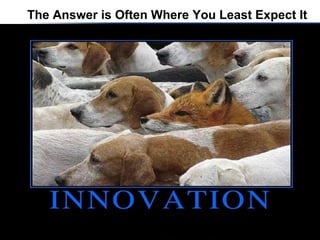
The Answer is Often Where You Least Expect It
Agenda Introduction to Open Innovation Introduction Prize Based Innovation Case Studies Characteristics of an Open Innovation Leader Organizational Implementation Guidelines Q & A
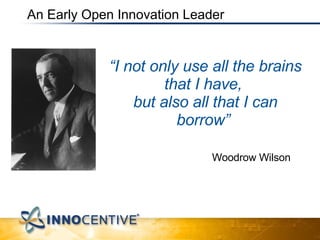
“ I not only use all the brains that I have,  but also all that I can borrow”  Woodrow Wilson An Early Open Innovation Leader
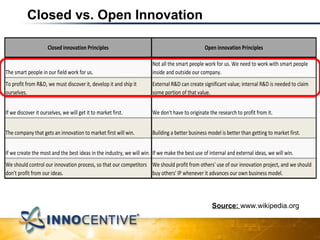
Closed vs. Open Innovation Source:  www.wikipedia.org
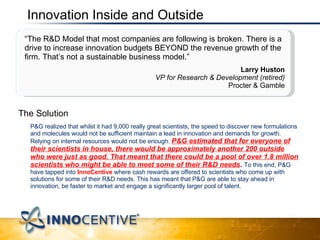
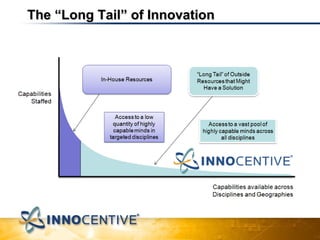
Innovation Inside and Outside The Solution P&G realized that whilst it had 9,000 really great scientists, the speed to discover new formulations and molecules would not be sufficient maintain a lead in innovation and demands for growth. Relying on internal resources would not be enough.  P&G estimated that for everyone of their scientists in house, there would be approximately another 200 outside who were just as good. That meant that there could be a pool of over 1.8 million scientists who might be able to meet some of their R&D needs .  To this end, P&G have tapped into  InnoCentive  where cash rewards are offered to scientists who come up with solutions for some of their R&D needs. This has meant that P&G are able to stay ahead in innovation, be faster to market and engage a significantly larger pool of talent.  Adventures in Knowledge Coming to the Edge: The future of knowledge in a network centric world “ The R&D Model that most companies are following is broken. There is a drive to increase innovation budgets BEYOND the revenue growth of the firm. That’s not a sustainable business model.”  Larry Huston VP for Research & Development (retired) Procter & Gamble
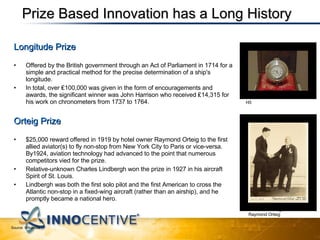
Prize Based Innovation has a Long History Longitude Prize Offered by the British government through an Act of Parliament in 1714 for a simple and practical method for the precise determination of a ship's longitude.  In total, over ₤100,000 was given in the form of encouragements and awards, the significant winner was John Harrison who received ₤14,315 for his work on chronometers from 1737 to 1764. Orteig Prize $25,000 reward offered in 1919 by hotel owner Raymond Orteig to the first allied aviator(s) to fly non-stop from New York City to Paris or vice-versa. By1924, aviation technology had advanced to the point that numerous competitors vied for the prize. Relative-unknown Charles Lindbergh won the prize in 1927 in his aircraft Spirit of St. Louis.  Lindbergh was both the first solo pilot and the first American to cross the Atlantic non-stop in a fixed-wing aircraft (rather than an airship), and he promptly became a national hero.  Charles Lindbergh and Raymond Orteig John Harrison’s Chronometer H5 Source: Wikipedia
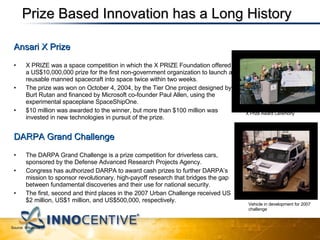
Ansari X Prize X PRIZE was a space competition in which the X PRIZE Foundation offered a US$10,000,000 prize for the first non-government organization to launch a reusable manned spacecraft into space twice within two weeks. The prize was won on October 4, 2004, by the Tier One project designed by Burt Rutan and financed by Microsoft co-founder Paul Allen, using the experimental spaceplane SpaceShipOne.  $10 million was awarded to the winner, but more than $100 million was invested in new technologies in pursuit of the prize. DARPA Grand Challenge  The DARPA Grand Challenge is a prize competition for driverless cars, sponsored by the Defense Advanced Research Projects Agency.  Congress has authorized DARPA to award cash prizes to further DARPA’s mission to sponsor revolutionary, high-payoff research that bridges the gap between fundamental discoveries and their use for national security.  The first, second and third places in the 2007 Urban Challenge received US$2 million, US$1 million, and US$500,000, respectively. Vehicle in development for 2007 challenge X Prize Award Ceremony Source: Wikipedia Prize Based Innovation has a Long History
The “Long Tail” of Innovation
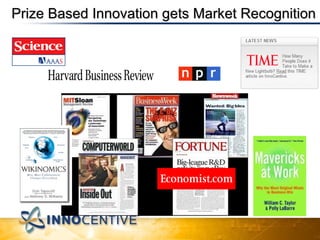
Prize Based Innovation gets Market Recognition
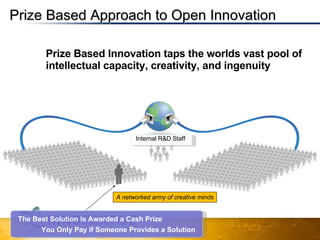
A networked army of creative minds The Best Solution is Awarded a Cash Prize You Only Pay if Someone Provides a Solution Internal R&D Staff Prize Based Approach to Open Innovation Prize Based Innovation taps the worlds vast pool of intellectual capacity, creativity, and ingenuity
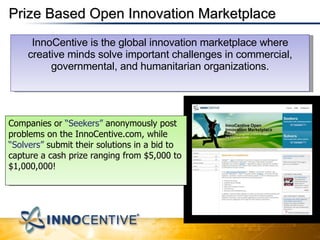
Prize Based Open Innovation Marketplace InnoCentive is the global innovation marketplace where creative minds solve important challenges in commercial, governmental, and humanitarian organizations. Companies or  “Seekers”  anonymously post problems on the InnoCentive.com, while  “Solvers”  submit their solutions in a bid to capture a cash prize ranging from $5,000 to $1,000,000!
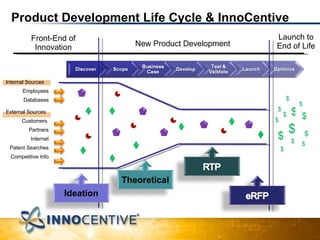
Product Development Life Cycle & InnoCentive Internal Sources Employees Databases External Sources Customers  Partners Internet Patent Searches Competitive Info Front-End of Innovation New Product Development Launch to End of Life $ $ $ $ $ $ $ $ $ $ $ $ $ Ideation Theoretical
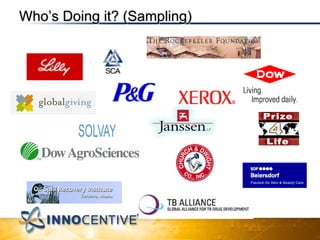
Who’s Doing it? (Sampling)
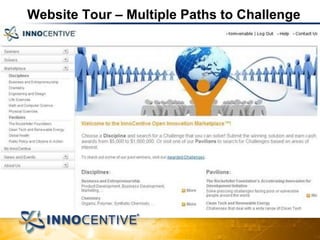
Website Tour – Multiple Paths to Challenge
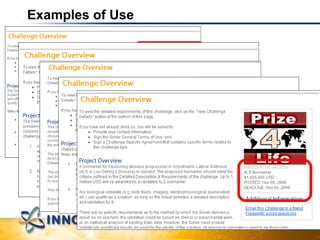
Examples of Use
Prize Based Innovation Case Studies
The Answer is in Left Field – a case study Ocean Spill Recovery Institute (OSRI) Focused on recovery of oil and reduction of environmental damage related to Exxon Valdez Oil Spill Problem  – Could not separate frozen oil from water in collection barges.  (aka -  Breaking Viscous Shear of Crude Oil) Solution  – An Illinois Chemist from the Concrete Industry wrote the award winning abstract based on a technique that has been used for years to move liquid concrete. Result  – The chemist won $20,000 and the oil industry solved a 30+ year problem within 2 months after posting in on the Web “ If this Challenge were easily solved by the people within the industry, it would have been solved earlier. The InnoCentive process allows us to step outside the box and look at more creative solutions ” – Scott Pegau, OSRI
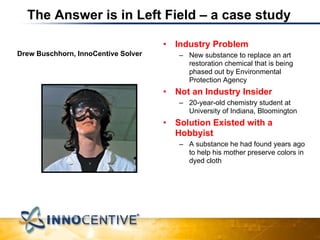
Drew Buschhorn, InnoCentive Solver The Answer is in Left Field – a case study Industry Problem New substance to replace an art restoration chemical that is being phased out by Environmental Protection Agency Not an Industry Insider 20-year-old chemistry student at University of Indiana, Bloomington Solution Existed with a Hobbyist A substance he had found years ago to help his mother preserve colors in dyed cloth Source:  Business Week , June 20, 2005
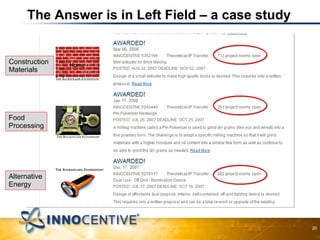
The Answer is in Left Field – a case study Construction  Materials Food Processing Alternative Energy
Open Innovation Leadership
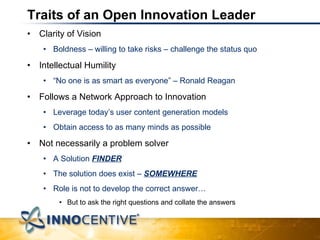
Traits of an Open Innovation Leader Clarity of Vision Boldness – willing to take risks – challenge the status quo Intellectual Humility “ No one is as smart as everyone” – Ronald Reagan Follows a Network Approach to Innovation Leverage today’s user content generation models Obtain access to as many minds as possible Not necessarily a problem solver A Solution  FINDER The solution does exist –  SOMEWHERE Role is not to develop the correct answer… But to ask the right questions and collate the answers
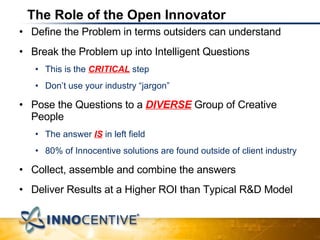
The Role of the Open Innovator Define the Problem in terms outsiders can understand Break the Problem up into Intelligent Questions This is the  CRITICAL  step  Don’t use your industry “jargon” Pose the Questions to a  DIVERSE  Group of Creative People The answer  IS  in left field 80% of Innocentive solutions are found outside of client industry Collect, assemble and combine the answers Deliver Results at a Higher ROI than Typical R&D Model
Open Innovation –  Implementation Strategy
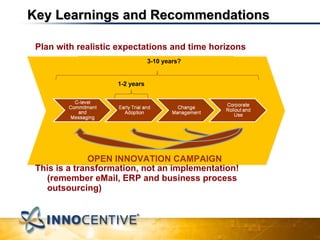
Key Learnings and Recommendations Plan with realistic expectations and time horizons This is a transformation, not an implementation! (remember eMail, ERP and business process outsourcing) 1-2 years 3-10 years?  OPEN INNOVATION CAMPAIGN
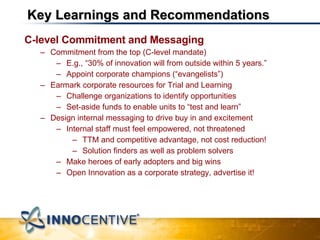
Key Learnings and Recommendations C-level Commitment and Messaging Commitment from the top (C-level mandate) E.g., “30% of innovation will from outside within 5 years.” Appoint corporate champions (“evangelists”) Earmark corporate resources for Trial and Learning Challenge organizations to identify opportunities Set-aside funds to enable units to “test and learn” Design internal messaging to drive buy in and excitement Internal staff must feel empowered, not threatened TTM and competitive advantage, not cost reduction! Solution finders as well as problem solvers Make heroes of early adopters and big wins Open Innovation as a corporate strategy, advertise it!
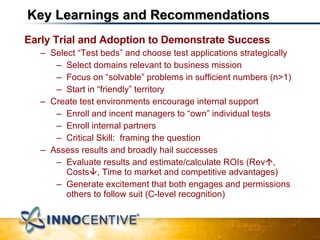
Key Learnings and Recommendations Early Trial and Adoption to Demonstrate Success Select “Test beds” and choose test applications strategically Select domains relevant to business mission Focus on “solvable” problems in sufficient numbers (n>1) Start in “friendly” territory Create test environments encourage internal support Enroll and incent managers to “own” individual tests Enroll internal partners Critical Skill:  framing the question Assess results and broadly hail successes Evaluate results and estimate/calculate ROIs (Rev  , Costs  , Time to market and competitive advantages) Generate excitement that both engages and permissions others to follow suit (C-level recognition)
Key Learnings and Recommendations Change Management  Open Innovation is a Paradigm shift Encourage “open” behaviors and risk taking Must be solution finders as well as problem solvers Empower Scientists/Engineers act independently Redefine roles and  reward/recognition systems Identify “change makers” across key functions Buy in critical to successfully changing the “not invented here” culture to an “open innovation” culture Address structural barriers to adoption Legal, Finance, Alliances, etc. Middle Management can make reality or doom to failure
Key Learnings and Recommendations Corporate Rollout and Use Leverage successful internal successes as beachheads Repurpose evangelists and “owners” to spread open innovation through out the organization Cull the “passive aggressive”s and the naysayers – this is fundamental cultural change Build, buy, and certify “solution finders” and brand within organization as key positions  Cross unit and cross border cultural change is difficult Engage local evangelists and planners early Often necessary retrial locally and re-structure/ re-implement change mgmt approach

iCitizen 2008: Tom Venable

  • 1.
    Tom Venable, ExecutiveVice President, InnoCentive, Inc
  • 2.
    The Answer isOften Where You Least Expect It
  • 3.
    Agenda Introduction toOpen Innovation Introduction Prize Based Innovation Case Studies Characteristics of an Open Innovation Leader Organizational Implementation Guidelines Q & A
  • 4.
    “ I notonly use all the brains that I have, but also all that I can borrow” Woodrow Wilson An Early Open Innovation Leader
  • 5.
    Closed vs. OpenInnovation Source: www.wikipedia.org
  • 6.
    Innovation Inside andOutside The Solution P&G realized that whilst it had 9,000 really great scientists, the speed to discover new formulations and molecules would not be sufficient maintain a lead in innovation and demands for growth. Relying on internal resources would not be enough. P&G estimated that for everyone of their scientists in house, there would be approximately another 200 outside who were just as good. That meant that there could be a pool of over 1.8 million scientists who might be able to meet some of their R&D needs . To this end, P&G have tapped into InnoCentive where cash rewards are offered to scientists who come up with solutions for some of their R&D needs. This has meant that P&G are able to stay ahead in innovation, be faster to market and engage a significantly larger pool of talent. Adventures in Knowledge Coming to the Edge: The future of knowledge in a network centric world “ The R&D Model that most companies are following is broken. There is a drive to increase innovation budgets BEYOND the revenue growth of the firm. That’s not a sustainable business model.” Larry Huston VP for Research & Development (retired) Procter & Gamble
  • 7.
    Prize Based Innovationhas a Long History Longitude Prize Offered by the British government through an Act of Parliament in 1714 for a simple and practical method for the precise determination of a ship's longitude. In total, over ₤100,000 was given in the form of encouragements and awards, the significant winner was John Harrison who received ₤14,315 for his work on chronometers from 1737 to 1764. Orteig Prize $25,000 reward offered in 1919 by hotel owner Raymond Orteig to the first allied aviator(s) to fly non-stop from New York City to Paris or vice-versa. By1924, aviation technology had advanced to the point that numerous competitors vied for the prize. Relative-unknown Charles Lindbergh won the prize in 1927 in his aircraft Spirit of St. Louis. Lindbergh was both the first solo pilot and the first American to cross the Atlantic non-stop in a fixed-wing aircraft (rather than an airship), and he promptly became a national hero. Charles Lindbergh and Raymond Orteig John Harrison’s Chronometer H5 Source: Wikipedia
  • 8.
    Ansari X PrizeX PRIZE was a space competition in which the X PRIZE Foundation offered a US$10,000,000 prize for the first non-government organization to launch a reusable manned spacecraft into space twice within two weeks. The prize was won on October 4, 2004, by the Tier One project designed by Burt Rutan and financed by Microsoft co-founder Paul Allen, using the experimental spaceplane SpaceShipOne. $10 million was awarded to the winner, but more than $100 million was invested in new technologies in pursuit of the prize. DARPA Grand Challenge The DARPA Grand Challenge is a prize competition for driverless cars, sponsored by the Defense Advanced Research Projects Agency. Congress has authorized DARPA to award cash prizes to further DARPA’s mission to sponsor revolutionary, high-payoff research that bridges the gap between fundamental discoveries and their use for national security. The first, second and third places in the 2007 Urban Challenge received US$2 million, US$1 million, and US$500,000, respectively. Vehicle in development for 2007 challenge X Prize Award Ceremony Source: Wikipedia Prize Based Innovation has a Long History
  • 9.
    The “Long Tail”of Innovation
  • 10.
    Prize Based Innovationgets Market Recognition
  • 11.
    A networked armyof creative minds The Best Solution is Awarded a Cash Prize You Only Pay if Someone Provides a Solution Internal R&D Staff Prize Based Approach to Open Innovation Prize Based Innovation taps the worlds vast pool of intellectual capacity, creativity, and ingenuity
  • 12.
    Prize Based OpenInnovation Marketplace InnoCentive is the global innovation marketplace where creative minds solve important challenges in commercial, governmental, and humanitarian organizations. Companies or “Seekers” anonymously post problems on the InnoCentive.com, while “Solvers” submit their solutions in a bid to capture a cash prize ranging from $5,000 to $1,000,000!
  • 13.
    Product Development LifeCycle & InnoCentive Internal Sources Employees Databases External Sources Customers Partners Internet Patent Searches Competitive Info Front-End of Innovation New Product Development Launch to End of Life $ $ $ $ $ $ $ $ $ $ $ $ $ Ideation Theoretical
  • 14.
  • 15.
    Website Tour –Multiple Paths to Challenge
  • 16.
  • 17.
  • 18.
    The Answer isin Left Field – a case study Ocean Spill Recovery Institute (OSRI) Focused on recovery of oil and reduction of environmental damage related to Exxon Valdez Oil Spill Problem – Could not separate frozen oil from water in collection barges. (aka - Breaking Viscous Shear of Crude Oil) Solution – An Illinois Chemist from the Concrete Industry wrote the award winning abstract based on a technique that has been used for years to move liquid concrete. Result – The chemist won $20,000 and the oil industry solved a 30+ year problem within 2 months after posting in on the Web “ If this Challenge were easily solved by the people within the industry, it would have been solved earlier. The InnoCentive process allows us to step outside the box and look at more creative solutions ” – Scott Pegau, OSRI
  • 19.
    Drew Buschhorn, InnoCentiveSolver The Answer is in Left Field – a case study Industry Problem New substance to replace an art restoration chemical that is being phased out by Environmental Protection Agency Not an Industry Insider 20-year-old chemistry student at University of Indiana, Bloomington Solution Existed with a Hobbyist A substance he had found years ago to help his mother preserve colors in dyed cloth Source: Business Week , June 20, 2005
  • 20.
    The Answer isin Left Field – a case study Construction Materials Food Processing Alternative Energy
  • 21.
  • 22.
    Traits of anOpen Innovation Leader Clarity of Vision Boldness – willing to take risks – challenge the status quo Intellectual Humility “ No one is as smart as everyone” – Ronald Reagan Follows a Network Approach to Innovation Leverage today’s user content generation models Obtain access to as many minds as possible Not necessarily a problem solver A Solution FINDER The solution does exist – SOMEWHERE Role is not to develop the correct answer… But to ask the right questions and collate the answers
  • 23.
    The Role ofthe Open Innovator Define the Problem in terms outsiders can understand Break the Problem up into Intelligent Questions This is the CRITICAL step Don’t use your industry “jargon” Pose the Questions to a DIVERSE Group of Creative People The answer IS in left field 80% of Innocentive solutions are found outside of client industry Collect, assemble and combine the answers Deliver Results at a Higher ROI than Typical R&D Model
  • 24.
    Open Innovation – Implementation Strategy
  • 25.
    Key Learnings andRecommendations Plan with realistic expectations and time horizons This is a transformation, not an implementation! (remember eMail, ERP and business process outsourcing) 1-2 years 3-10 years? OPEN INNOVATION CAMPAIGN
  • 26.
    Key Learnings andRecommendations C-level Commitment and Messaging Commitment from the top (C-level mandate) E.g., “30% of innovation will from outside within 5 years.” Appoint corporate champions (“evangelists”) Earmark corporate resources for Trial and Learning Challenge organizations to identify opportunities Set-aside funds to enable units to “test and learn” Design internal messaging to drive buy in and excitement Internal staff must feel empowered, not threatened TTM and competitive advantage, not cost reduction! Solution finders as well as problem solvers Make heroes of early adopters and big wins Open Innovation as a corporate strategy, advertise it!
  • 27.
    Key Learnings andRecommendations Early Trial and Adoption to Demonstrate Success Select “Test beds” and choose test applications strategically Select domains relevant to business mission Focus on “solvable” problems in sufficient numbers (n>1) Start in “friendly” territory Create test environments encourage internal support Enroll and incent managers to “own” individual tests Enroll internal partners Critical Skill: framing the question Assess results and broadly hail successes Evaluate results and estimate/calculate ROIs (Rev  , Costs  , Time to market and competitive advantages) Generate excitement that both engages and permissions others to follow suit (C-level recognition)
  • 28.
    Key Learnings andRecommendations Change Management Open Innovation is a Paradigm shift Encourage “open” behaviors and risk taking Must be solution finders as well as problem solvers Empower Scientists/Engineers act independently Redefine roles and reward/recognition systems Identify “change makers” across key functions Buy in critical to successfully changing the “not invented here” culture to an “open innovation” culture Address structural barriers to adoption Legal, Finance, Alliances, etc. Middle Management can make reality or doom to failure
  • 29.
    Key Learnings andRecommendations Corporate Rollout and Use Leverage successful internal successes as beachheads Repurpose evangelists and “owners” to spread open innovation through out the organization Cull the “passive aggressive”s and the naysayers – this is fundamental cultural change Build, buy, and certify “solution finders” and brand within organization as key positions Cross unit and cross border cultural change is difficult Engage local evangelists and planners early Often necessary retrial locally and re-structure/ re-implement change mgmt approach