Open Data in Africa
François van Schalkwyk
ICEDEG, Quito, 08 April 2015
Impact
• Governance: increased transparency of institutions
leading to improvements in accountability
• Economic: job creation and innovation; data as a
resource
• Social: increased sense of participation and
empowerment; accountability as a driver of
improved service delivery
• Evidence?
• Dark side…
Context
5 stars of open data scheme
𝑂𝑂𝑂𝑂𝑂𝑂𝑂𝑂 𝑑𝑑𝑑𝑑𝑑𝑑𝑑𝑑 = Open definition +
impact
context
Open Definition: “A piece of data or content is open if anyone is free to use, reuse, and redistribute it –
subject only, at most, to the requirement to attribute and/or share-alike.” http://opendefinition.org/#sthash.h042nQvT.dpuf
ODDC Open Data 10-point Evaluation 8 principles of Open Government Data McKinsey
1 Does the data exist? Data must be complete Data must be accessible
2 Is it available online in digital form? Data must be primary Data must be machine readable
3 Is the data machine readable? Data must be timely Data accessible free or at negligible cost
4 Is the data available in bulk? Data must be accessible Data must be license-free
5 Is the dataset available free of charge? Data must be machine readable
6 Is the data openly licensed? Access must be non-discriminatory
7 Is the dataset up-to-date? Data formats must be non-proprietary
8 Is the publication of the dataset sustainable? Data must be license-free
9 Was it easy to find information on the dataset?
10 Are linked data URIs provided?
IMPACT Development Transparency & accountability Economic
CONTEXT Developing countries National Economic domains (transport, healthcare, etc.)
Problematising the definition
Open data in Africa
• Africa is not a country
• Linguistic/colonial-cultural clusters:
Anglophone, Lusophone, Francophone
• Regional clusters: East, West, South, North
• Economic zones: ECOWAS, SADC, etc.
Open data challenges in Africa
• Government inertia
• Easier to “sell” the economic benefits of open data to government
• Poor levels of co-ordination between government ministries
• Disconnect between data supply and demand
• Importation of definitions and standards into local contexts versus
the aspirational benefits of globally accepted definitions and
standards
• Poor understanding of the differences between open data, big data
and crowd-sourced data – each has unique benefits and challenges
• Limited expertise and/or access to expertise wrt data
• Low levels of data literacy
• Low levels of internet access
From notes taken at the UN Economic Commission for Africa ‘Open Data Revolution’ meeting, Addis Ababa, 27 March 2015
Leveraging change
• African NGOs often do not enjoy social backing +
funding is most often from international donors
(Neubert 2015)
• The public sphere is a critical space for civil society activities
• The media lacks independence in many African countries
• Without strong social backing and freedom of the press,
NGOs need to rely on independent public institutions
(e.g. judiciary) to leverage change in government
• And to ensure/enforce open government practice, including
the release of open data, strong institutions are required
• Example: “Iron fist in a velvet glove” – Section 27
• Therefore, there is a possible positive correlation between
strong institutions and open government/open data – see
following slide
48
55
44
56
46
25
53
50
46
45
27
43 43
46
36
44
64
55
62
48
31
50
36
51
36
33
0 0
51 51
78 78
90
74
92
CORRUPTION INSTITUTIONS TECH READINESS OPEN GOV OD READINESS,
IMPLEMENTATION & IMPACT
Ghana Kenya Nigeria South Africa Tanzania Ecuador UK
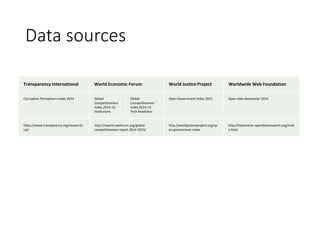
Data sources
Transparency International World Economic Forum World Justice Project Worldwide Web Foundation
Corruption Perceptions Index 2014 Global
Competitiveness
Index 2014-15:
Institutions
Global
Competitiveness
Index 2014-15:
Tech Readiness
Open Government Index 2015 Open Data Barometer 2014
https://www.transparency.org/research/
cpi/
http://reports.weforum.org/global-
competitiveness-report-2014-2015/
http://worldjusticeproject.org/op
en-government-index
http://barometer.opendataresearch.org/inde
x.html
End. Thank you.
François van Schalkwyk
francois@compressdsl.com
@francois_fvs2

Open Data in Africa, ICEDEG 2015

  • 1.
    Open Data inAfrica François van Schalkwyk ICEDEG, Quito, 08 April 2015
  • 2.
    Impact • Governance: increasedtransparency of institutions leading to improvements in accountability • Economic: job creation and innovation; data as a resource • Social: increased sense of participation and empowerment; accountability as a driver of improved service delivery • Evidence? • Dark side…
  • 3.
  • 7.
    5 stars ofopen data scheme
  • 8.
    𝑂𝑂𝑂𝑂𝑂𝑂𝑂𝑂 𝑑𝑑𝑑𝑑𝑑𝑑𝑑𝑑 =Open definition + impact context Open Definition: “A piece of data or content is open if anyone is free to use, reuse, and redistribute it – subject only, at most, to the requirement to attribute and/or share-alike.” http://opendefinition.org/#sthash.h042nQvT.dpuf ODDC Open Data 10-point Evaluation 8 principles of Open Government Data McKinsey 1 Does the data exist? Data must be complete Data must be accessible 2 Is it available online in digital form? Data must be primary Data must be machine readable 3 Is the data machine readable? Data must be timely Data accessible free or at negligible cost 4 Is the data available in bulk? Data must be accessible Data must be license-free 5 Is the dataset available free of charge? Data must be machine readable 6 Is the data openly licensed? Access must be non-discriminatory 7 Is the dataset up-to-date? Data formats must be non-proprietary 8 Is the publication of the dataset sustainable? Data must be license-free 9 Was it easy to find information on the dataset? 10 Are linked data URIs provided? IMPACT Development Transparency & accountability Economic CONTEXT Developing countries National Economic domains (transport, healthcare, etc.) Problematising the definition
  • 9.
    Open data inAfrica • Africa is not a country • Linguistic/colonial-cultural clusters: Anglophone, Lusophone, Francophone • Regional clusters: East, West, South, North • Economic zones: ECOWAS, SADC, etc.
  • 10.
    Open data challengesin Africa • Government inertia • Easier to “sell” the economic benefits of open data to government • Poor levels of co-ordination between government ministries • Disconnect between data supply and demand • Importation of definitions and standards into local contexts versus the aspirational benefits of globally accepted definitions and standards • Poor understanding of the differences between open data, big data and crowd-sourced data – each has unique benefits and challenges • Limited expertise and/or access to expertise wrt data • Low levels of data literacy • Low levels of internet access From notes taken at the UN Economic Commission for Africa ‘Open Data Revolution’ meeting, Addis Ababa, 27 March 2015
  • 11.
    Leveraging change • AfricanNGOs often do not enjoy social backing + funding is most often from international donors (Neubert 2015) • The public sphere is a critical space for civil society activities • The media lacks independence in many African countries • Without strong social backing and freedom of the press, NGOs need to rely on independent public institutions (e.g. judiciary) to leverage change in government • And to ensure/enforce open government practice, including the release of open data, strong institutions are required • Example: “Iron fist in a velvet glove” – Section 27 • Therefore, there is a possible positive correlation between strong institutions and open government/open data – see following slide
  • 12.
    48 55 44 56 46 25 53 50 46 45 27 43 43 46 36 44 64 55 62 48 31 50 36 51 36 33 0 0 5151 78 78 90 74 92 CORRUPTION INSTITUTIONS TECH READINESS OPEN GOV OD READINESS, IMPLEMENTATION & IMPACT Ghana Kenya Nigeria South Africa Tanzania Ecuador UK
  • 13.
    Data sources Transparency InternationalWorld Economic Forum World Justice Project Worldwide Web Foundation Corruption Perceptions Index 2014 Global Competitiveness Index 2014-15: Institutions Global Competitiveness Index 2014-15: Tech Readiness Open Government Index 2015 Open Data Barometer 2014 https://www.transparency.org/research/ cpi/ http://reports.weforum.org/global- competitiveness-report-2014-2015/ http://worldjusticeproject.org/op en-government-index http://barometer.opendataresearch.org/inde x.html
  • 14.
    End. Thank you. Françoisvan Schalkwyk francois@compressdsl.com @francois_fvs2