Stockholm
February 2015
2
• New technologies leading to exponential
increase in volume and types of data
available
• Much greater and demand for data on a
continuous basis from new actors
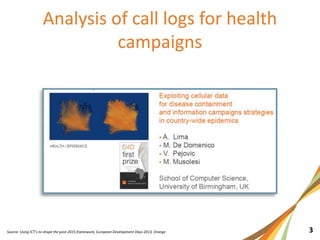
3Source: Using ICT’s to shape the post-2015 framework, European Development Days 2013, Orange
4
• Too many developing countries still have poor data for
MDGs… and SDGs are coming
• There are too many gaps in current data, making some
people and some issues almost invisible
• Data arrives too late
• Too many issues are still barely covered by existing data
• Entire groups of people, regions and key issues remain
invisible
5
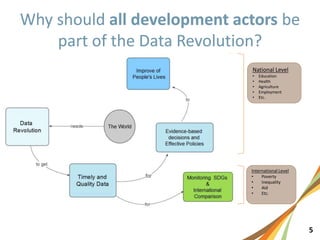
International Level
• Poverty
• Inequality
• Aid
• Etc.
National Level
• Education
• Health
• Agriculture
• Employment
• Etc.
6
• BAPS call ”to enhance capacity for statistics to monitor
progress, evaluate impact, ensure sound, results-focused
public sector management, and highlight strategic issues for
policy decisions”
• SDG 17.18: “By 2020, enhance capacity building support to
developing countries, including for LDCs and SIDS, to
increase significantly the availability of high-quality, timely
and reliable data disaggregated by income, gender, age,
race, ethnicity, migratory status, disability, geographic
location and other characteristics relevant in national
contexts”
7
“A true data revolution would draw on existing and
new sources of data to fully integrate statistics into
decision making, promote open access to, and use
of, data and ensure increased support for statistical
systems.”
A new global partnership: eradicate poverty and transform economies through sustainable
development: The Report of the High-Level Panel of Eminent Persons on the Post-2015
Development Agenda, 30 May 2013, Chapter 4
8
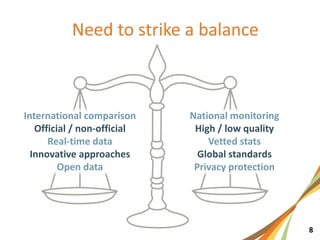
International comparison
Official / non-official
Real-time data
Innovative approaches
Open data
National monitoring
High / low quality
Vetted stats
Global standards
Privacy protection
91
• Country-led data revolution
• Getting the right data to the right people at
the right time and in the right format
• Focus on 139 developing countries – we need
139 data revolutions not just one
10
• Stock taking of supply, demand, and gaps
• Pilot technical and institutional innovation
• Prepare a Road Map for a Data Revolution
11
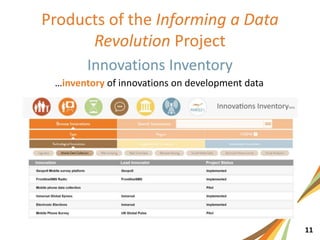
…inventory of innovations on development data
12
• Investment in Human Resources: Design of
methodologies & processes, Analysis, Strategic planning
• Investment in Statistical infrastructure: GIS, Database
Structure, Registers and Sampling frames for
establishments and businesses
• Need for technical assistance: Technical planning and
design, Data processing and analysis, Data dissemination
and use
13
• PRESS Report showed that:
• $394 M were dedicated to aid to Statistics in 2013
• 0.16% of ODA
• World Bank, United Kingdom, European Commission,
African Development Bank, and UNFPA are the top 5
Funders with 89% of total aid
• Information from CRESS of some countries:
• Benin (2010-12): 56% from the Government
• Cameroon (2009-11): 55% from the Donors
• Malawi (2009-12): 27% from the Government
141
• Regional Centers
• Public-Private Partnerships
• User promotion and civil society involvement
• Promoting open source solutions
• Monitoring international initiatives / Fragmented
system
151
• To be staffed with highly trained personnel to
support and introduce adequate new technology
applicable for regional conditions
• Serve as a key reference point for countries
• Would leverage economies of scale and serve as
clearinghouses of methodologies, practice and
technical assistance to countries.
 e.g. on use of mobile devices for data collection;
development of data portals; expertise in data curation
and anonymization and integrating big data into statistical
analysis.
161
We need a data revolution that finally
improves people’s lives…so all actors
need to be on-board
twitter.com/ContactPARIS21
facebook.com/ContactPARIS21
youtube.com/PARIS21OECD
PARIS21 Secretariat
OECD/DCD
4 Quai du Point du Jour
92100 Boulogne-Billancourt, France
contact@paris21.org
www.paris21.org

El-Iza Mohamedou (PARIS21): Why all actors should join the Data Revolution

  • 1.
  • 2.
    2 • New technologiesleading to exponential increase in volume and types of data available • Much greater and demand for data on a continuous basis from new actors
  • 3.
    3Source: Using ICT’sto shape the post-2015 framework, European Development Days 2013, Orange
  • 4.
    4 • Too manydeveloping countries still have poor data for MDGs… and SDGs are coming • There are too many gaps in current data, making some people and some issues almost invisible • Data arrives too late • Too many issues are still barely covered by existing data • Entire groups of people, regions and key issues remain invisible
  • 5.
    5 International Level • Poverty •Inequality • Aid • Etc. National Level • Education • Health • Agriculture • Employment • Etc.
  • 6.
    6 • BAPS call”to enhance capacity for statistics to monitor progress, evaluate impact, ensure sound, results-focused public sector management, and highlight strategic issues for policy decisions” • SDG 17.18: “By 2020, enhance capacity building support to developing countries, including for LDCs and SIDS, to increase significantly the availability of high-quality, timely and reliable data disaggregated by income, gender, age, race, ethnicity, migratory status, disability, geographic location and other characteristics relevant in national contexts”
  • 7.
    7 “A true datarevolution would draw on existing and new sources of data to fully integrate statistics into decision making, promote open access to, and use of, data and ensure increased support for statistical systems.” A new global partnership: eradicate poverty and transform economies through sustainable development: The Report of the High-Level Panel of Eminent Persons on the Post-2015 Development Agenda, 30 May 2013, Chapter 4
  • 8.
    8 International comparison Official /non-official Real-time data Innovative approaches Open data National monitoring High / low quality Vetted stats Global standards Privacy protection
  • 9.
    91 • Country-led datarevolution • Getting the right data to the right people at the right time and in the right format • Focus on 139 developing countries – we need 139 data revolutions not just one
  • 10.
    10 • Stock takingof supply, demand, and gaps • Pilot technical and institutional innovation • Prepare a Road Map for a Data Revolution
  • 11.
    11 …inventory of innovationson development data
  • 12.
    12 • Investment inHuman Resources: Design of methodologies & processes, Analysis, Strategic planning • Investment in Statistical infrastructure: GIS, Database Structure, Registers and Sampling frames for establishments and businesses • Need for technical assistance: Technical planning and design, Data processing and analysis, Data dissemination and use
  • 13.
    13 • PRESS Reportshowed that: • $394 M were dedicated to aid to Statistics in 2013 • 0.16% of ODA • World Bank, United Kingdom, European Commission, African Development Bank, and UNFPA are the top 5 Funders with 89% of total aid • Information from CRESS of some countries: • Benin (2010-12): 56% from the Government • Cameroon (2009-11): 55% from the Donors • Malawi (2009-12): 27% from the Government
  • 14.
    141 • Regional Centers •Public-Private Partnerships • User promotion and civil society involvement • Promoting open source solutions • Monitoring international initiatives / Fragmented system
  • 15.
    151 • To bestaffed with highly trained personnel to support and introduce adequate new technology applicable for regional conditions • Serve as a key reference point for countries • Would leverage economies of scale and serve as clearinghouses of methodologies, practice and technical assistance to countries.  e.g. on use of mobile devices for data collection; development of data portals; expertise in data curation and anonymization and integrating big data into statistical analysis.
  • 16.
    161 We need adata revolution that finally improves people’s lives…so all actors need to be on-board
  • 17.
    twitter.com/ContactPARIS21 facebook.com/ContactPARIS21 youtube.com/PARIS21OECD PARIS21 Secretariat OECD/DCD 4 Quaidu Point du Jour 92100 Boulogne-Billancourt, France contact@paris21.org www.paris21.org

Editor's Notes

  • #15 1. Major and sustained increase in the supply and use of data to help countries and the world as a whole deal with the major challenges of eliminating extreme poverty and leaving no-one behind 2. Promoting real institutional change and much more effective use of technology to improve the performance of the agencies involved in the production and use of data. 3. making data accessible to everyone in ways that they are able to understand so that they can use the data to hold governments and decisions makers to account.