Digital Continuity: Planning for Action. Stephen Clarke Senior Advisor, Digital Continuity
http://www.youtube.com/watch?v=Yun9hkPPF9M
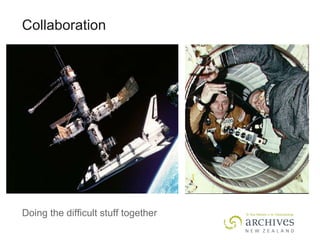
Collaboration Doing the difficult stuff together
Digital information lasts forever,  or five years,  whichever comes first. Jeff Rothenberg, Scientific American, January 1995.
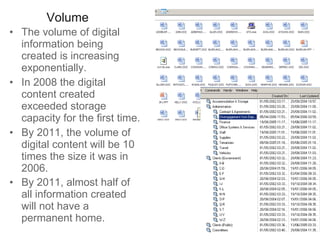
Volume The volume of digital information being created is increasing exponentially.  In 2008 the digital content created exceeded storage capacity for the first time.  By 2011, the volume of digital content will be 10 times the size it was in 2006.  By 2011, almost half of all information created will not have a permanent home.
 
74%   of New Zealand public sector agencies hold records they can no longer access 2009 Govt. Recordkeeping Survey
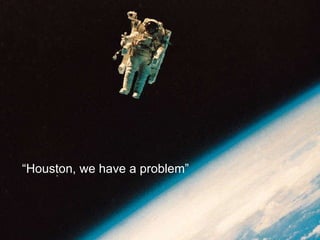
“ Houston, we have a problem”
 
What is the Digital Continuity Action Plan? The plan is an all-of-public sector approach to digital continuity 6 goals and 15 actions areas for implementation over the next 3 years Covers all public sector digital information
Key messages There when you need it .  Public sector digital information will be maintained so that it can be accessed when it is needed.  Authentic and reliable .  Public sector digital information is tamper-proof and free of technological digital rights restrictions. Trusted access.   New Zealanders can be confident that they will be able to find, retrieve and use public sector digital information, and sensitive information is protected from unauthorised access. Do nothing, lose everything .  If no action is taken, public sector digital information will be lost.
6 High level goals 1. Understanding: Those responsible for public sector digital continuity communicate effectively with each other and have a common understanding of the problem space. 2. Well-managed from Day One: All public sector digital information is well-managed from the point of creation onwards. 3. Infrastructure: Robust cross-agency infrastructure exists to support the interoperability of systems and efficient digital continuity.
6 High level goals – cont. 4. High-value information kept: High-value information is identified, so that business critical information is not concealed in the digital landfill. 5. Trusted access: The public sector and citizens are able to access digital information now and in the future, and information is protected from unauthorised access and use. 6. Establish Good governance: Information management across the public sector is characterised by good governance, leadership and accountability
Collaboration The DCAP is a collaborative initiative. We are focussing on cross-agency and cross-discipline solutions, working together to achieve positive outcomes.  Archives New Zealand’s role is to provide leadership, support and advice to agencies on this issue.
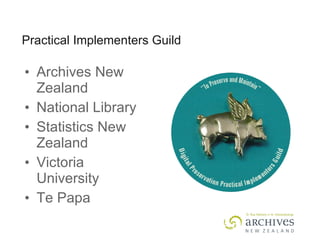
Practical Implementers Guild Archives New Zealand National Library Statistics New Zealand Victoria University Te Papa
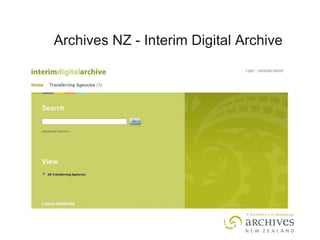
Archives NZ - Interim Digital Archive
 
 
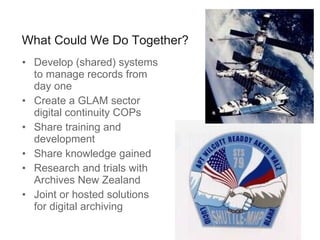
What Could We Do Together? Develop (shared) systems to manage records from day one Create a GLAM sector digital continuity COPs Share training and development Share knowledge gained Research and trials with Archives New Zealand Joint or hosted solutions for digital archiving
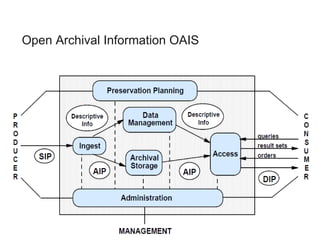
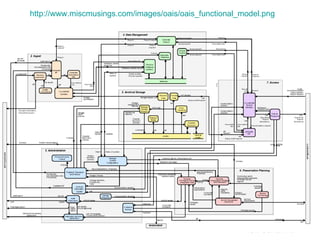
Open Archival Information OAIS
http:// www.miscmusings.com/images/oais/oais_functional_model.png
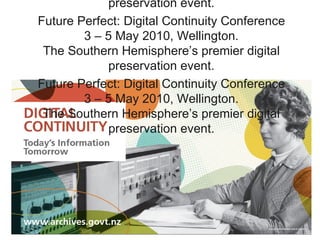
Future Perfect: Digital Continuity Conference 3 – 5 May 2010, Wellington. The Southern Hemisphere’s premier digital preservation event. Future Perfect: Digital Continuity Conference 3 – 5 May 2010, Wellington. The Southern Hemisphere’s premier digital preservation event. Future Perfect: Digital Continuity Conference 3 – 5 May 2010, Wellington. The Southern Hemisphere’s premier digital preservation event.

Stephen Clarke - Digital Continuity Launching into Action

  • 1.
    Digital Continuity: Planningfor Action. Stephen Clarke Senior Advisor, Digital Continuity
  • 2.
  • 3.
    Collaboration Doing thedifficult stuff together
  • 4.
    Digital information lastsforever, or five years, whichever comes first. Jeff Rothenberg, Scientific American, January 1995.
  • 5.
    Volume The volumeof digital information being created is increasing exponentially. In 2008 the digital content created exceeded storage capacity for the first time. By 2011, the volume of digital content will be 10 times the size it was in 2006. By 2011, almost half of all information created will not have a permanent home.
  • 6.
  • 7.
    74% of New Zealand public sector agencies hold records they can no longer access 2009 Govt. Recordkeeping Survey
  • 8.
    “ Houston, wehave a problem”
  • 9.
  • 10.
    What is theDigital Continuity Action Plan? The plan is an all-of-public sector approach to digital continuity 6 goals and 15 actions areas for implementation over the next 3 years Covers all public sector digital information
  • 11.
    Key messages Therewhen you need it . Public sector digital information will be maintained so that it can be accessed when it is needed. Authentic and reliable . Public sector digital information is tamper-proof and free of technological digital rights restrictions. Trusted access. New Zealanders can be confident that they will be able to find, retrieve and use public sector digital information, and sensitive information is protected from unauthorised access. Do nothing, lose everything . If no action is taken, public sector digital information will be lost.
  • 12.
    6 High levelgoals 1. Understanding: Those responsible for public sector digital continuity communicate effectively with each other and have a common understanding of the problem space. 2. Well-managed from Day One: All public sector digital information is well-managed from the point of creation onwards. 3. Infrastructure: Robust cross-agency infrastructure exists to support the interoperability of systems and efficient digital continuity.
  • 13.
    6 High levelgoals – cont. 4. High-value information kept: High-value information is identified, so that business critical information is not concealed in the digital landfill. 5. Trusted access: The public sector and citizens are able to access digital information now and in the future, and information is protected from unauthorised access and use. 6. Establish Good governance: Information management across the public sector is characterised by good governance, leadership and accountability
  • 14.
    Collaboration The DCAPis a collaborative initiative. We are focussing on cross-agency and cross-discipline solutions, working together to achieve positive outcomes. Archives New Zealand’s role is to provide leadership, support and advice to agencies on this issue.
  • 15.
    Practical Implementers GuildArchives New Zealand National Library Statistics New Zealand Victoria University Te Papa
  • 16.
    Archives NZ -Interim Digital Archive
  • 17.
  • 18.
  • 19.
    What Could WeDo Together? Develop (shared) systems to manage records from day one Create a GLAM sector digital continuity COPs Share training and development Share knowledge gained Research and trials with Archives New Zealand Joint or hosted solutions for digital archiving
  • 20.
  • 21.
  • 22.
    Future Perfect: DigitalContinuity Conference 3 – 5 May 2010, Wellington. The Southern Hemisphere’s premier digital preservation event. Future Perfect: Digital Continuity Conference 3 – 5 May 2010, Wellington. The Southern Hemisphere’s premier digital preservation event. Future Perfect: Digital Continuity Conference 3 – 5 May 2010, Wellington. The Southern Hemisphere’s premier digital preservation event.

Editor's Notes

  • #6 Not a given as storage media have changed a lot in a short space of time. Think about how many computers still have the right drive for these!
  • #9 Did you know? In 1975, NASA sent two Viking space probes to Mars. The data generated by these unrepeatable missions – produced at a total mission cost of approximately $1 billion - was recorded onto magnetic tape. Two decades later, the tapes were cracking and brittle, despite climate-controlled storage, and the formats were unreadable. To access to the data, NASA had to track down old printouts and retype everything. NASA has subsequently become one of the world’s biggest supporters of digital continuity projects. The average life of a piece of digital information is just 5-7 years. The chances of being able to read a document created on a computer in 1997 and stored digitally are just about zero if no active management strategies have been implemented.
  • #15 We can’t do all this alone