International Civil Aviation
Organization (ICAO)
Professional Education Workshop
Chicago Convention
Presented by: [Your Name]
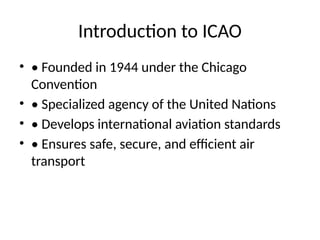
Introduction to ICAO
• • Founded in 1944 under the Chicago
Convention
• • Specialized agency of the United Nations
• • Develops international aviation standards
• • Ensures safe, secure, and efficient air
transport
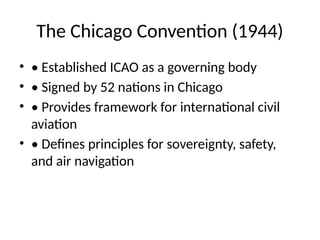
The Chicago Convention (1944)
• • Established ICAO as a governing body
• • Signed by 52 nations in Chicago
• • Provides framework for international civil
aviation
• • Defines principles for sovereignty, safety,
and air navigation
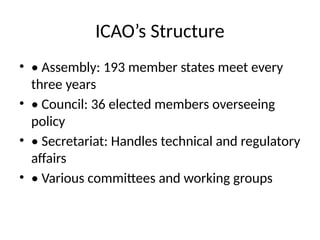
ICAO’s Structure
• • Assembly: 193 member states meet every
three years
• • Council: 36 elected members overseeing
policy
• • Secretariat: Handles technical and regulatory
affairs
• • Various committees and working groups
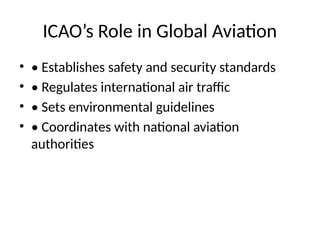
ICAO’s Role in Global Aviation
• • Establishes safety and security standards
• • Regulates international air traffic
• • Sets environmental guidelines
• • Coordinates with national aviation
authorities
Annexes to the Chicago Convention
• • 19 Annexes covering aviation safety, security,
and operations
• • Standards and Recommended Practices
(SARPs)
• • Key annexes include:
• - Annex 1: Personnel Licensing
• - Annex 6: Operation of Aircraft
• - Annex 14: Aerodromes
ICAO and Sustainability
• • Carbon Offsetting and Reduction Scheme for
International Aviation (CORSIA)
• • Focus on sustainable aviation fuels (SAF)
• • Goal: Net-zero emissions by 2050
• • Advancing green technologies and policies
ICAO’s Future and Challenges
• • Adoption of new aviation technologies
• • Cybersecurity threats in aviation
• • Climate change adaptation
• • Increasing air traffic demand
Conclusion & Q&A
• • ICAO plays a vital role in global aviation
safety
• • International cooperation is key for future
advancements
• • Thank you for attending!
• • Questions?
Introduction to EASA
• • European Union Aviation Safety Agency
(EASA)
• • Established in 2002 to ensure aviation safety
in Europe
• • Regulates civil aviation across EU member
states
• • Works in coordination with ICAO
EASA vs. ICAO
• • ICAO sets global standards, while EASA
regulates European aviation
• • EASA enforces stricter EU regulations and
compliance measures
• • ICAO SARPs influence EASA rules and
policies
• • Both organizations collaborate on aviation
safety and environmental goals
Key EASA Regulations
• • Part-66: Aircraft Maintenance Licensing
• • Part-145: Maintenance Organizations
• • Part-21: Certification of Aircraft and Products
• • Part-FCL: Flight Crew Licensing
• • Part-M: Continuing Airworthiness
• • Safety Management Systems (SMS)
compliance
EASA and Aviation Safety
• • Implements risk-based oversight
• • Regular audits and safety assessments
• • Develops new safety initiatives based on
data analysis
• • Strengthens European air traffic
management
EASA’s Environmental Initiatives
• • Supports sustainable aviation fuels (SAF)
• • Reducing CO2 emissions through technology
and policy
• • Noise reduction regulations for aircraft
• • Research on electric and hydrogen-powered
aviation
Conclusion & Q&A
• • ICAO and EASA play key roles in global and
European aviation
• • Regulations ensure safety, efficiency, and
environmental responsibility
• • Thank you for attending!
• • Questions?

ICAO_EASA_ regulations Presentation.pptx

  • 1.
    International Civil Aviation Organization(ICAO) Professional Education Workshop Chicago Convention Presented by: [Your Name]
  • 2.
    Introduction to ICAO •• Founded in 1944 under the Chicago Convention • • Specialized agency of the United Nations • • Develops international aviation standards • • Ensures safe, secure, and efficient air transport
  • 3.
    The Chicago Convention(1944) • • Established ICAO as a governing body • • Signed by 52 nations in Chicago • • Provides framework for international civil aviation • • Defines principles for sovereignty, safety, and air navigation
  • 4.
    ICAO’s Structure • •Assembly: 193 member states meet every three years • • Council: 36 elected members overseeing policy • • Secretariat: Handles technical and regulatory affairs • • Various committees and working groups
  • 5.
    ICAO’s Role inGlobal Aviation • • Establishes safety and security standards • • Regulates international air traffic • • Sets environmental guidelines • • Coordinates with national aviation authorities
  • 6.
    Annexes to theChicago Convention • • 19 Annexes covering aviation safety, security, and operations • • Standards and Recommended Practices (SARPs) • • Key annexes include: • - Annex 1: Personnel Licensing • - Annex 6: Operation of Aircraft • - Annex 14: Aerodromes
  • 7.
    ICAO and Sustainability •• Carbon Offsetting and Reduction Scheme for International Aviation (CORSIA) • • Focus on sustainable aviation fuels (SAF) • • Goal: Net-zero emissions by 2050 • • Advancing green technologies and policies
  • 8.
    ICAO’s Future andChallenges • • Adoption of new aviation technologies • • Cybersecurity threats in aviation • • Climate change adaptation • • Increasing air traffic demand
  • 9.
    Conclusion & Q&A •• ICAO plays a vital role in global aviation safety • • International cooperation is key for future advancements • • Thank you for attending! • • Questions?
  • 10.
    Introduction to EASA •• European Union Aviation Safety Agency (EASA) • • Established in 2002 to ensure aviation safety in Europe • • Regulates civil aviation across EU member states • • Works in coordination with ICAO
  • 11.
    EASA vs. ICAO •• ICAO sets global standards, while EASA regulates European aviation • • EASA enforces stricter EU regulations and compliance measures • • ICAO SARPs influence EASA rules and policies • • Both organizations collaborate on aviation safety and environmental goals
  • 12.
    Key EASA Regulations •• Part-66: Aircraft Maintenance Licensing • • Part-145: Maintenance Organizations • • Part-21: Certification of Aircraft and Products • • Part-FCL: Flight Crew Licensing • • Part-M: Continuing Airworthiness • • Safety Management Systems (SMS) compliance
  • 13.
    EASA and AviationSafety • • Implements risk-based oversight • • Regular audits and safety assessments • • Develops new safety initiatives based on data analysis • • Strengthens European air traffic management
  • 14.
    EASA’s Environmental Initiatives •• Supports sustainable aviation fuels (SAF) • • Reducing CO2 emissions through technology and policy • • Noise reduction regulations for aircraft • • Research on electric and hydrogen-powered aviation
  • 15.
    Conclusion & Q&A •• ICAO and EASA play key roles in global and European aviation • • Regulations ensure safety, efficiency, and environmental responsibility • • Thank you for attending! • • Questions?