Download to read offline


![Introduction
Model (topology) of interconnection networks
is an important part for parallel processing or
distributed system [1]. Several metrics are
coomonly used to describe the performance
of interconnection networks are: Connectivity
or degree, Diameter, Average Distance and
Bisection Width [2].](https://image.slidesharecdn.com/icaetlatifahppt-150122082637-conversion-gate02/85/Icaet-latifah-ppt-4-320.jpg)
![ A good model of the interconnection network
must have the symmetry properties,
measured (scalable), has a small diameter
[3], and also has a constant and a limited
degree [4, 5]. Torus – Butterfly has this good
properties that is has constant degree and
small diameter [6].](https://image.slidesharecdn.com/icaetlatifahppt-150122082637-conversion-gate02/85/Icaet-latifah-ppt-5-320.jpg)
![ Bisection Width of interconnection networks
has always been important in parallel
computing, since it bounds the speed at
which information can be moved from one
side of a network to another [7].](https://image.slidesharecdn.com/icaetlatifahppt-150122082637-conversion-gate02/85/Icaet-latifah-ppt-6-320.jpg)
![ There are research that measured the
bisection width of interconnection network
such as bisection width of Chained- Cubic
Tree interconnection network [8], bisection
width of Product Networks with application to
Data Centers [7].](https://image.slidesharecdn.com/icaetlatifahppt-150122082637-conversion-gate02/85/Icaet-latifah-ppt-7-320.jpg)
![ Definition 1: A graph G = (V, E) is called
connected if for any two nodes of a graph G
there is always the path that connects the
second node [9].](https://image.slidesharecdn.com/icaetlatifahppt-150122082637-conversion-gate02/85/Icaet-latifah-ppt-8-320.jpg)
![ Definition 2: The degree of a node x VG,∈
denoted by deg (x), is connected arc from x
to nodes y VG, y ≠ x [10].∈
Definition 3: The diameter of the connected
graph G (VG, EG) is the maximum distance
of all pairs of vertices [9].](https://image.slidesharecdn.com/icaetlatifahppt-150122082637-conversion-gate02/85/Icaet-latifah-ppt-9-320.jpg)
![ Definition 4: Bisection Width of a network is
the smallest number of wires you have to cut
to disconnect the network into two equal
halves [2].](https://image.slidesharecdn.com/icaetlatifahppt-150122082637-conversion-gate02/85/Icaet-latifah-ppt-10-320.jpg)
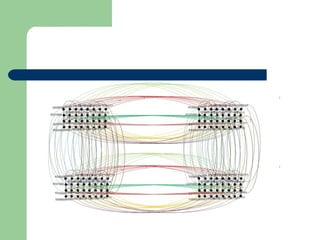
![ Definition 5: If G = (V1, E1) is the Torus
interconnection network model of size ml and H =
(V2, E2) is the Enhanced Butterfly interconnection
network model dimension n [11], then the Torus-
Butterfly interconnection network model, denoted as
TB (m, l , n), is the Cartesian product of Torus and
Enhanced Butterfly, with m and l is the size of Torus
interconnection network model and n is the
dimension of the Enhanced Butterfly interconnection
network model. This is hold for n ≥ 3, m ≥ 2 and l ≥ 2
[6].](https://image.slidesharecdn.com/icaetlatifahppt-150122082637-conversion-gate02/85/Icaet-latifah-ppt-11-320.jpg)
![ Lemma 1: The degree of each node in the Torus
-Butterfly interconnection network model is 9 [6].
Lemma 2: The diameter of the interconnection
network Torus-Butterfly TB (m, l, n) is = max { m /⌊
2 , l / 2 } + n [6].⌋ ⌊ ⌋
From the above degree and diameter of Torus-
Butterfly interconnections network formula, the
following network cost: of Torus-Butterfly
interconnection network model is
9 (max { m / 2 , l / 2 } + n) [6].⌊ ⌋ ⌊ ⌋](https://image.slidesharecdn.com/icaetlatifahppt-150122082637-conversion-gate02/85/Icaet-latifah-ppt-13-320.jpg)
![ Furthermore bisection width (Bw) of a d-
dimensional array is given by:
Bw (Ad
) = ∑i= 1 to d ki , (1) [12].
Linear array can be embedded into Torus –
Butterfly interconnection network [13].](https://image.slidesharecdn.com/icaetlatifahppt-150122082637-conversion-gate02/85/Icaet-latifah-ppt-14-320.jpg)


This document discusses the bisection width of the Torus-Butterfly interconnection network. It defines the Torus-Butterfly network as the Cartesian product of a Torus network and an Enhanced Butterfly network. It states that the degree of each node in the Torus-Butterfly network is 9, and provides formulas for the diameter and network cost. It then derives a formula showing that the bisection width of the Torus-Butterfly network is the sum of 9n^2 over n, where n is the dimension of the Enhanced Butterfly network. The conclusion is that the Torus-Butterfly network has a large enough bisection width for good interconnection network


