1
Seminar OnSeminar On
IBM & It’s ToolsIBM & It’s Tools
Presented ByPresented By
K.Rajesh KumarK.Rajesh Kumar
2
 IntroductionIntroduction
 Inventions Of IBMInventions Of IBM
 B2B Integration toolsB2B Integration tools
 Sterling IntegratorSterling Integrator
 Uses Of Sterling IntegratorUses Of Sterling Integrator
 Components Of S.I.Components Of S.I.
 EDI StandardEDI Standard
 Architecture of EDI CommunicationArchitecture of EDI Communication
 X12 Standard Document FormX12 Standard Document Form
3
INTRODUCTIONINTRODUCTION

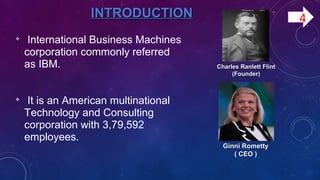
International Business Machines
corporation commonly referred
as IBM.

It is an American multinational
Technology and Consulting
corporation with 3,79,592
employees.
Charles Ranlett FlintCharles Ranlett Flint
(Founder)(Founder)
Ginni RomettyGinni Rometty
( CEO )( CEO )
4

The company was established in 1911 as the Computing-
Tabulating-Recording company.

It was renamed “International Business Machines” in 1924.

It’s Headquarters in Armonk, New York.

IBM manufactures and markets computer Hardware,
Middleware, Software.

It offers Infrastructure, Hosting and Consulting services in areas
from mainframe computers to Nanotechnology.
5
 Automated Teller Machine ( ATM )
 Floppy Disk
 Hard Disk Drive
 Electronic Keypunch
 Magnetic Stripe Card
 Virtual Machine
 Scanning Tunneling Microscope
 Reduced Instruction set Computing
 Relational Database
 Universal Product Code ( UPC )
 Financial Swap
 SABRE Airline Reservation System
 Dynamic Random Access Memory ( DRAM )
 Watson Artificial Intelligence
Inventions Of IBMInventions Of IBM
6
B2B Integration ToolsB2B Integration Tools
 ETL Data stageETL Data stage
 WMQ – WebSphere Message QueueWMQ – WebSphere Message Queue
 WTX – WebSphere Transformation ExtenderWTX – WebSphere Transformation Extender
 WMB – WebSphere Message BrokerWMB – WebSphere Message Broker
 WESB – WebSphere Enterprise Service BusWESB – WebSphere Enterprise Service Bus
 WPS – WebSphere Process ServerWPS – WebSphere Process Server
 Data PowerData Power
 Cast IronCast Iron
 Sterling IntegratorSterling Integrator
7
o It is a transaction engine for Modeling and Managing BusinessIt is a transaction engine for Modeling and Managing Business
Processes.Processes.
o It support high volume Electronic Message exchange, complexIt support high volume Electronic Message exchange, complex
routing, translation and flexiblerouting, translation and flexible
integration.integration.
o Also support real time interaction with multiple internal systemsAlso support real time interaction with multiple internal systems
and external Business partners.and external Business partners.
8
Sterling Integrator is used as :Sterling Integrator is used as : 9
Web based interface to the processing engine
to store & execute business processes.
This tool enables to create business maps that
convert one data format into another.
This tool enables to create business process
models using Drag & Drop Technology.
This tool enables to create interactive forms to
exchange business data with the customers
10
EDI StandardEDI Standard
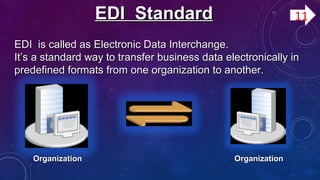
EDI is called as Electronic Data Interchange.EDI is called as Electronic Data Interchange.
It’s a standard way to transfer business data electronically inIt’s a standard way to transfer business data electronically in
predefined formats from one organization to another.predefined formats from one organization to another.
OrganizationOrganization OrganizationOrganization
11
Why we need EDI :Why we need EDI :
Customer
Print & Paper
Charges
Purchase OrderPurchase Order
Time Consuming
& Postal Charges
Postal ServicesPostal Services
Reentering of
Purchase Order in
Local System.
• May cause errors.
• Leads to rework
• Cost incurred
• Time Consuming
SupplierSupplier
SupplierSupplier
Purchase Order sent through
EDI directly enters into
Supplier's Order Processing
System from Customer’s
Purchasing system using
EDI system.
12
13
14
Where EDI was used :Where EDI was used : 15
EDI Standards are defined by many Organizations..EDI Standards are defined by many Organizations..
Agency :Agency : Standards:Standards:
Above are just few examples. The ANSI’s X12 is
most commonly used EDI standard.
16
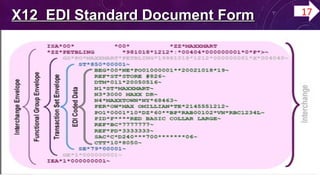
X12 EDI Standard Document FormX12 EDI Standard Document Form 17
18
X12 EDI document form consists 3 Envelopes:-
oTop level of Envelope is called as “ Interchange Envelope ”.
oInterchange Envelope contains information about the Sender, Receiver,
EDI standard, sequence number etc.
oThis is like a postal envelope, as Postal Envelope have sender address
and receiver address, similarly in Interchange Envelope has Sender ID and
Receiver ID.
oTo route the document from source to destination address you need
Interchange Envelope.
19
 Second level of Envelope is called as “Functional
Group Envelope”.
 This Envelope is similar to Interchange Envelope.
 It has the functional statements of the document.
20
 Third level of Envelope is called as “Transaction
Envelope”.
 The Transaction Envelope is describes the types of envelope
Document.
 It contains the no. of segments included in the Document.
21
• Speed up the business process.
• No paper work
• Accuracy.
• Reduces Cost & Increases Revenue
• Flexible
• Scalability
Advantages Of EDIAdvantages Of EDI 22
Disadvantages Of EDIDisadvantages Of EDI
 Too many StandardsToo many Standards
 Changes in StandardsChanges in Standards
 EDI is too ExpensiveEDI is too Expensive
 Needs Internet ProtocolsNeeds Internet Protocols
23
24

IBM B2B tools

  • 1.
  • 2.
    Seminar OnSeminar On IBM& It’s ToolsIBM & It’s Tools Presented ByPresented By K.Rajesh KumarK.Rajesh Kumar 2
  • 3.
     IntroductionIntroduction  InventionsOf IBMInventions Of IBM  B2B Integration toolsB2B Integration tools  Sterling IntegratorSterling Integrator  Uses Of Sterling IntegratorUses Of Sterling Integrator  Components Of S.I.Components Of S.I.  EDI StandardEDI Standard  Architecture of EDI CommunicationArchitecture of EDI Communication  X12 Standard Document FormX12 Standard Document Form 3
  • 4.
    INTRODUCTIONINTRODUCTION  International Business Machines corporationcommonly referred as IBM.  It is an American multinational Technology and Consulting corporation with 3,79,592 employees. Charles Ranlett FlintCharles Ranlett Flint (Founder)(Founder) Ginni RomettyGinni Rometty ( CEO )( CEO ) 4
  • 5.
     The company wasestablished in 1911 as the Computing- Tabulating-Recording company.  It was renamed “International Business Machines” in 1924.  It’s Headquarters in Armonk, New York.  IBM manufactures and markets computer Hardware, Middleware, Software.  It offers Infrastructure, Hosting and Consulting services in areas from mainframe computers to Nanotechnology. 5
  • 6.
     Automated TellerMachine ( ATM )  Floppy Disk  Hard Disk Drive  Electronic Keypunch  Magnetic Stripe Card  Virtual Machine  Scanning Tunneling Microscope  Reduced Instruction set Computing  Relational Database  Universal Product Code ( UPC )  Financial Swap  SABRE Airline Reservation System  Dynamic Random Access Memory ( DRAM )  Watson Artificial Intelligence Inventions Of IBMInventions Of IBM 6
  • 7.
    B2B Integration ToolsB2BIntegration Tools  ETL Data stageETL Data stage  WMQ – WebSphere Message QueueWMQ – WebSphere Message Queue  WTX – WebSphere Transformation ExtenderWTX – WebSphere Transformation Extender  WMB – WebSphere Message BrokerWMB – WebSphere Message Broker  WESB – WebSphere Enterprise Service BusWESB – WebSphere Enterprise Service Bus  WPS – WebSphere Process ServerWPS – WebSphere Process Server  Data PowerData Power  Cast IronCast Iron  Sterling IntegratorSterling Integrator 7
  • 8.
    o It isa transaction engine for Modeling and Managing BusinessIt is a transaction engine for Modeling and Managing Business Processes.Processes. o It support high volume Electronic Message exchange, complexIt support high volume Electronic Message exchange, complex routing, translation and flexiblerouting, translation and flexible integration.integration. o Also support real time interaction with multiple internal systemsAlso support real time interaction with multiple internal systems and external Business partners.and external Business partners. 8
  • 9.
    Sterling Integrator isused as :Sterling Integrator is used as : 9
  • 10.
    Web based interfaceto the processing engine to store & execute business processes. This tool enables to create business maps that convert one data format into another. This tool enables to create business process models using Drag & Drop Technology. This tool enables to create interactive forms to exchange business data with the customers 10
  • 11.
    EDI StandardEDI Standard EDIis called as Electronic Data Interchange.EDI is called as Electronic Data Interchange. It’s a standard way to transfer business data electronically inIt’s a standard way to transfer business data electronically in predefined formats from one organization to another.predefined formats from one organization to another. OrganizationOrganization OrganizationOrganization 11
  • 12.
    Why we needEDI :Why we need EDI : Customer Print & Paper Charges Purchase OrderPurchase Order Time Consuming & Postal Charges Postal ServicesPostal Services Reentering of Purchase Order in Local System. • May cause errors. • Leads to rework • Cost incurred • Time Consuming SupplierSupplier SupplierSupplier Purchase Order sent through EDI directly enters into Supplier's Order Processing System from Customer’s Purchasing system using EDI system. 12
  • 13.
  • 14.
  • 15.
    Where EDI wasused :Where EDI was used : 15
  • 16.
    EDI Standards aredefined by many Organizations..EDI Standards are defined by many Organizations.. Agency :Agency : Standards:Standards: Above are just few examples. The ANSI’s X12 is most commonly used EDI standard. 16
  • 17.
    X12 EDI StandardDocument FormX12 EDI Standard Document Form 17
  • 18.
  • 19.
    X12 EDI documentform consists 3 Envelopes:- oTop level of Envelope is called as “ Interchange Envelope ”. oInterchange Envelope contains information about the Sender, Receiver, EDI standard, sequence number etc. oThis is like a postal envelope, as Postal Envelope have sender address and receiver address, similarly in Interchange Envelope has Sender ID and Receiver ID. oTo route the document from source to destination address you need Interchange Envelope. 19
  • 20.
     Second levelof Envelope is called as “Functional Group Envelope”.  This Envelope is similar to Interchange Envelope.  It has the functional statements of the document. 20
  • 21.
     Third levelof Envelope is called as “Transaction Envelope”.  The Transaction Envelope is describes the types of envelope Document.  It contains the no. of segments included in the Document. 21
  • 22.
    • Speed upthe business process. • No paper work • Accuracy. • Reduces Cost & Increases Revenue • Flexible • Scalability Advantages Of EDIAdvantages Of EDI 22
  • 23.
    Disadvantages Of EDIDisadvantagesOf EDI  Too many StandardsToo many Standards  Changes in StandardsChanges in Standards  EDI is too ExpensiveEDI is too Expensive  Needs Internet ProtocolsNeeds Internet Protocols 23
  • 24.