IBDP Sciences: Internal Investigation Student Planning Framework Name:____________
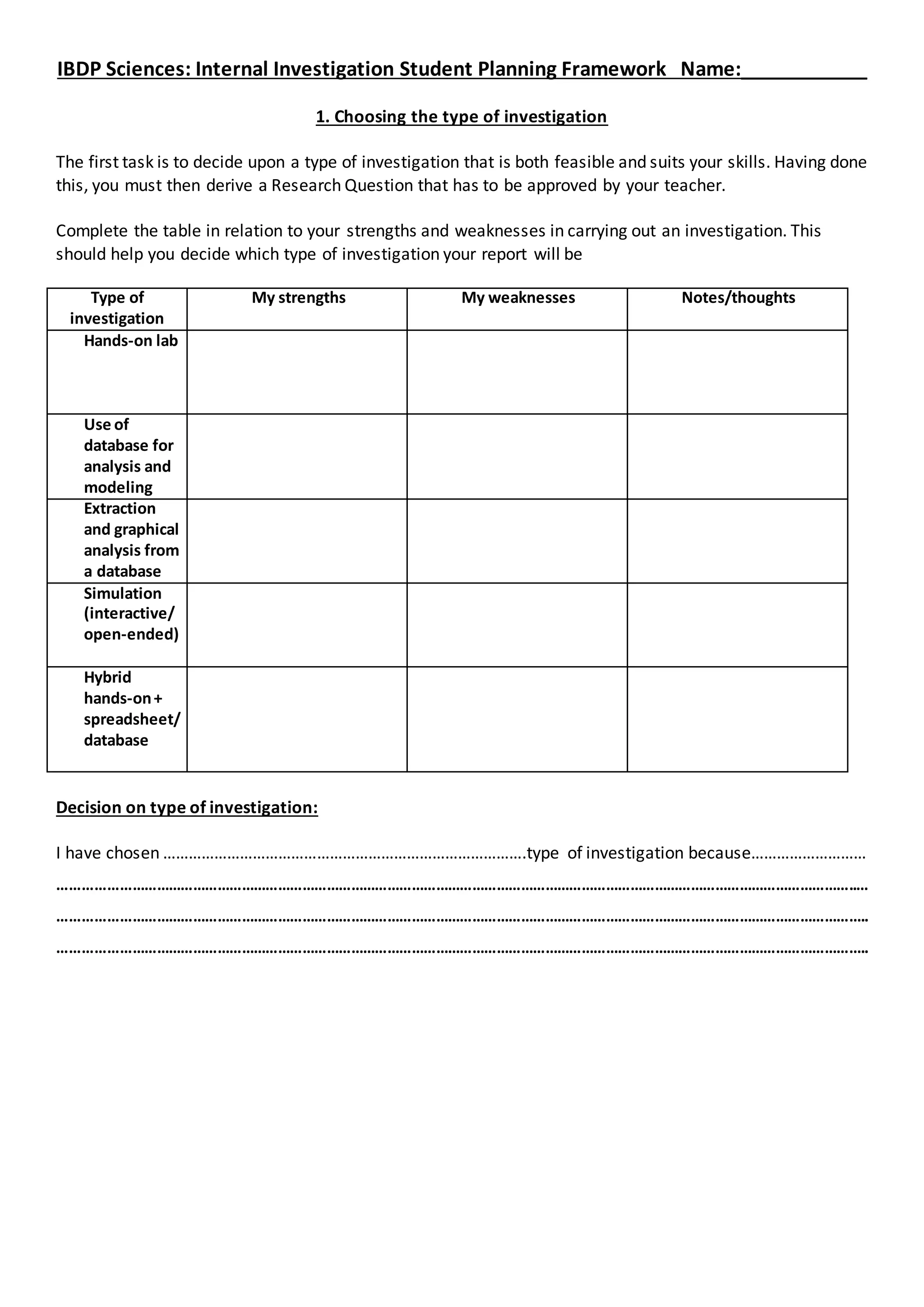
1. Choosing the type of investigation
The first task is to decide upon a type of investigation that is both feasible and suits your skills. Having done
this, you must then derive a Research Question that has to be approved by your teacher.
Complete the table in relation to your strengths and weaknesses in carrying out an investigation. This
should help you decide which type of investigation your report will be
Type of
investigation
My strengths My weaknesses Notes/thoughts
Hands-on lab
Use of
database for
analysis and
modeling
Extraction
and graphical
analysis from
a database
Simulation
(interactive/
open-ended)
Hybrid
hands-on+
spreadsheet/
database
Decision on type of investigation:
I have chosen ………………………………………………………………………….type of investigation because………………………
……………………………………………………………………………………………………………………………………………………………………………..…
………………………………………………………………………………………………………………………………………………………………………………..
………………………………………………………………………………………………………………………………………………………………………………..
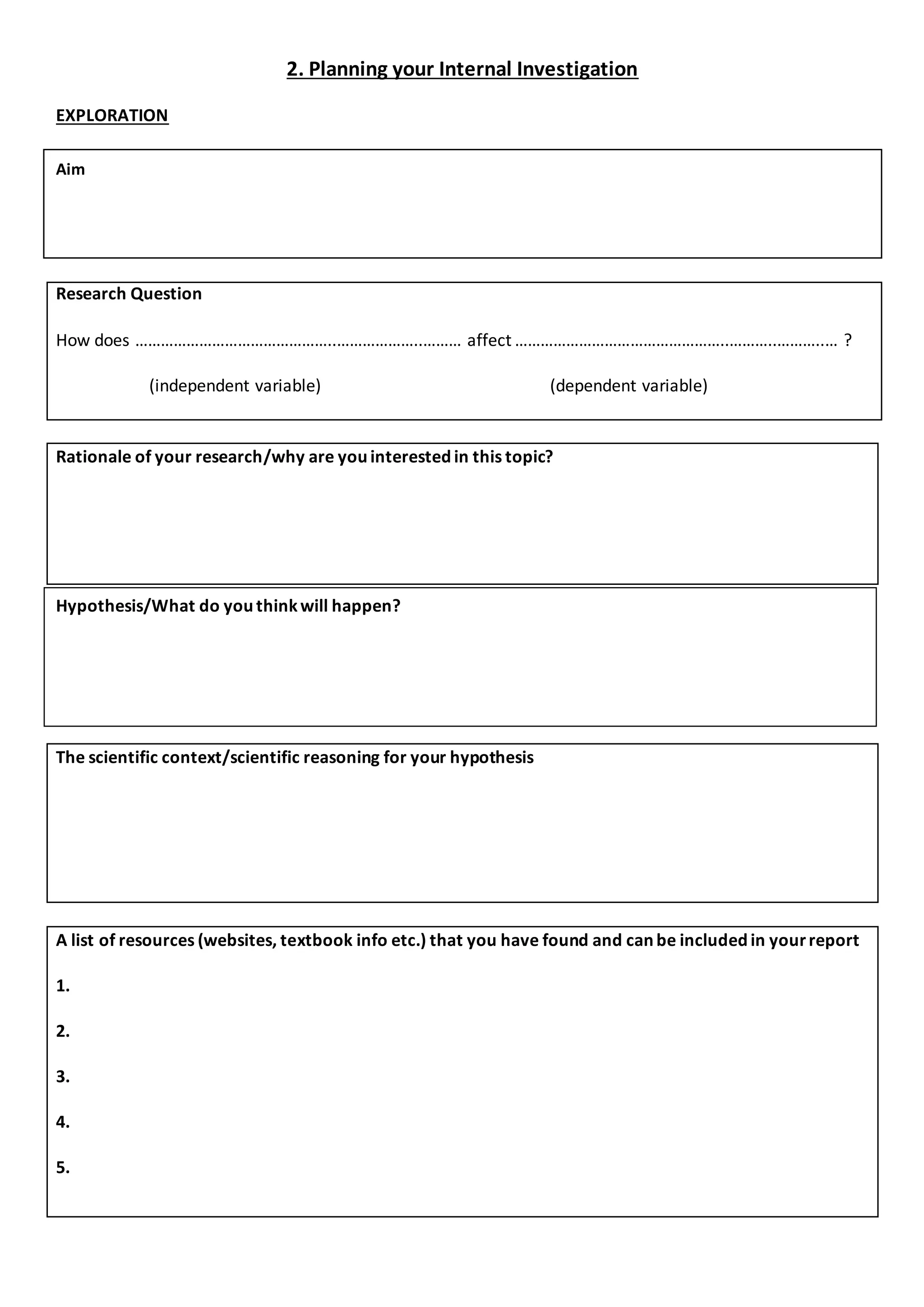
2. Planning your Internal Investigation
EXPLORATION
Aim
Research Question
How does ………………………………………..………………..……… affect …………………………………………..………..………..… ?
(independent variable) (dependent variable)
Rationale of your research/why are you interested in this topic?
The scientific context/scientific reasoning for your hypothesis
A list of resources (websites, textbook info etc.) that you have found and can be included in yourreport
1.
2.
3.
4.
5.
Hypothesis/What do you thinkwill happen?
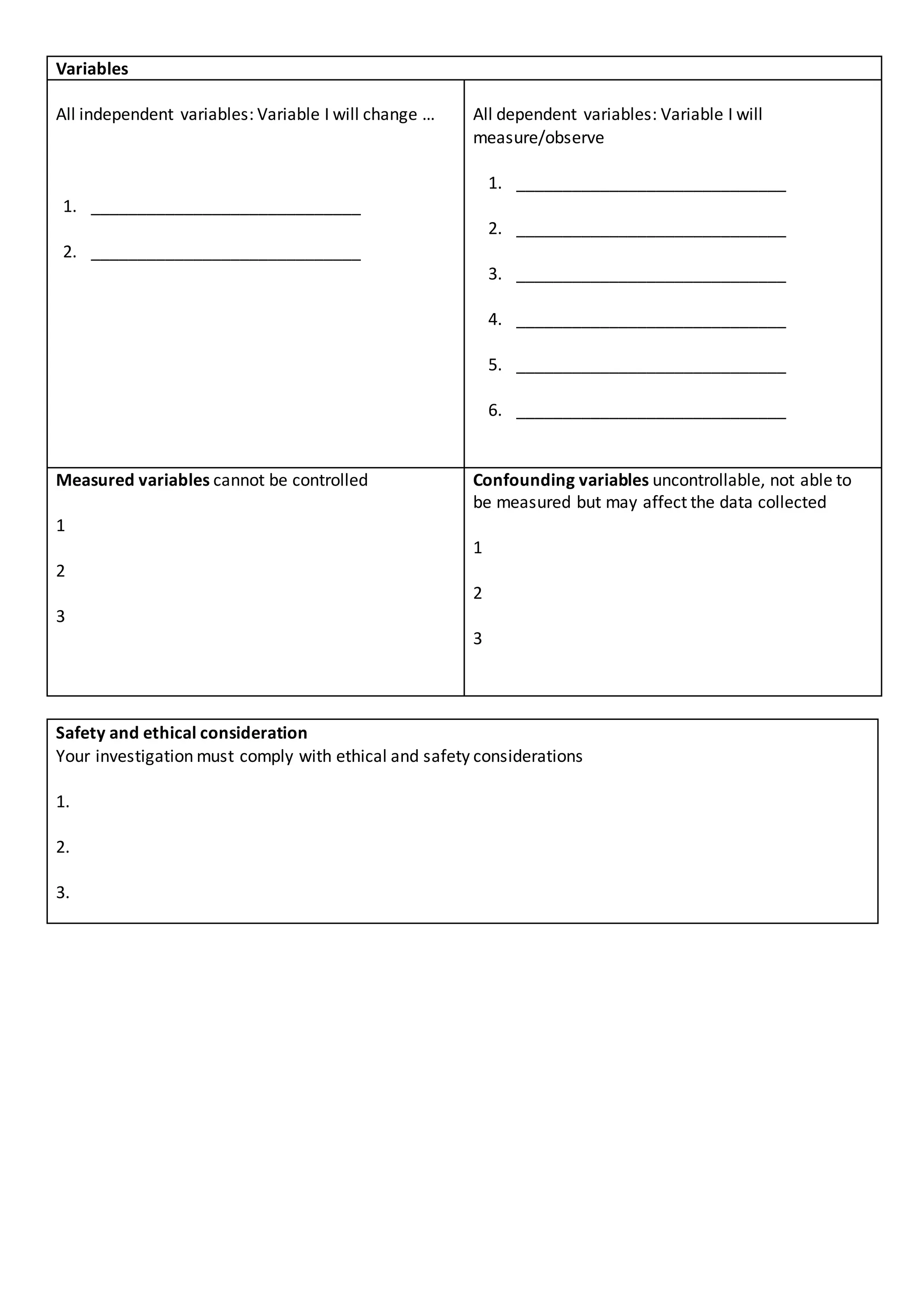
Variables
All independent variables: Variable I will change …
1. _____________________________
2. _____________________________
All dependent variables: Variable I will
measure/observe
1. _____________________________
2. _____________________________
3. _____________________________
4. _____________________________
5. _____________________________
6. _____________________________
Measured variables cannot be controlled
1
2
3
Confounding variables uncontrollable, not able to
be measured but may affect the data collected
1
2
3
Safety and ethical consideration
Your investigation must comply with ethical and safety considerations
1.
2.
3.
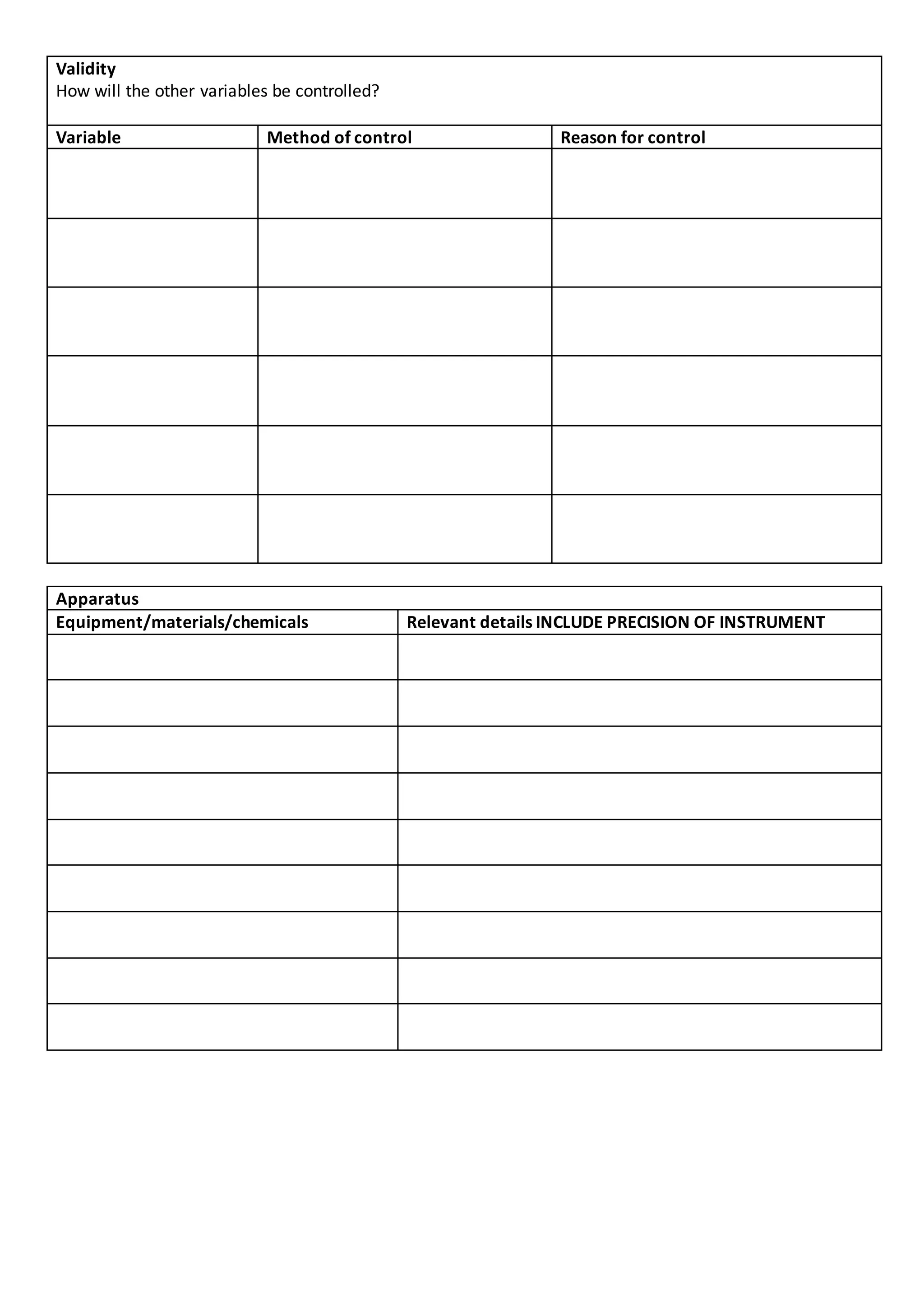
Validity
How will the other variables be controlled?
Variable Method of control Reason for control
Apparatus
Equipment/materials/chemicals Relevant details INCLUDE PRECISION OF INSTRUMENT
Diagram of how apparatus is set up
Method- Procedure
Include details of the range and number of readings to be taken
1. ___________________________________________________________________
2. ___________________________________________________________________
3. ___________________________________________________________________
4. ___________________________________________________________________
5. ___________________________________________________________________
6. ___________________________________________________________________
7. ___________________________________________________________________
8. ___________________________________________________________________
9. ___________________________________________________________________
10. _____________________________________________________________________
Method 2: Processing data
How will you process you data and what statistical tests will do?
 How will you process the raw data? Mean, SD, t test, chi squared etc?
 Show all calculations clearly and how you have got your results
DATA COLLECTION AND PRESENTATION
Results/observations:qualitative or quantitative?
_____________________________________________________________________
_____________________________________________________________________
_____________________________________________________________________
_____________________________________________________________________
Results table
Include all raw data recorded, headings, units and uncertainty (See below)
Processed Data
 How will you process the raw data? Mean, SD, t test, chi squared etc?
 Show all calculations clearly and how you have got your results
 Make sure that all tables have a FULL title and descriptions. A table to show………
 All tables must include headings, units and uncertainties (+/- x)
Presentation
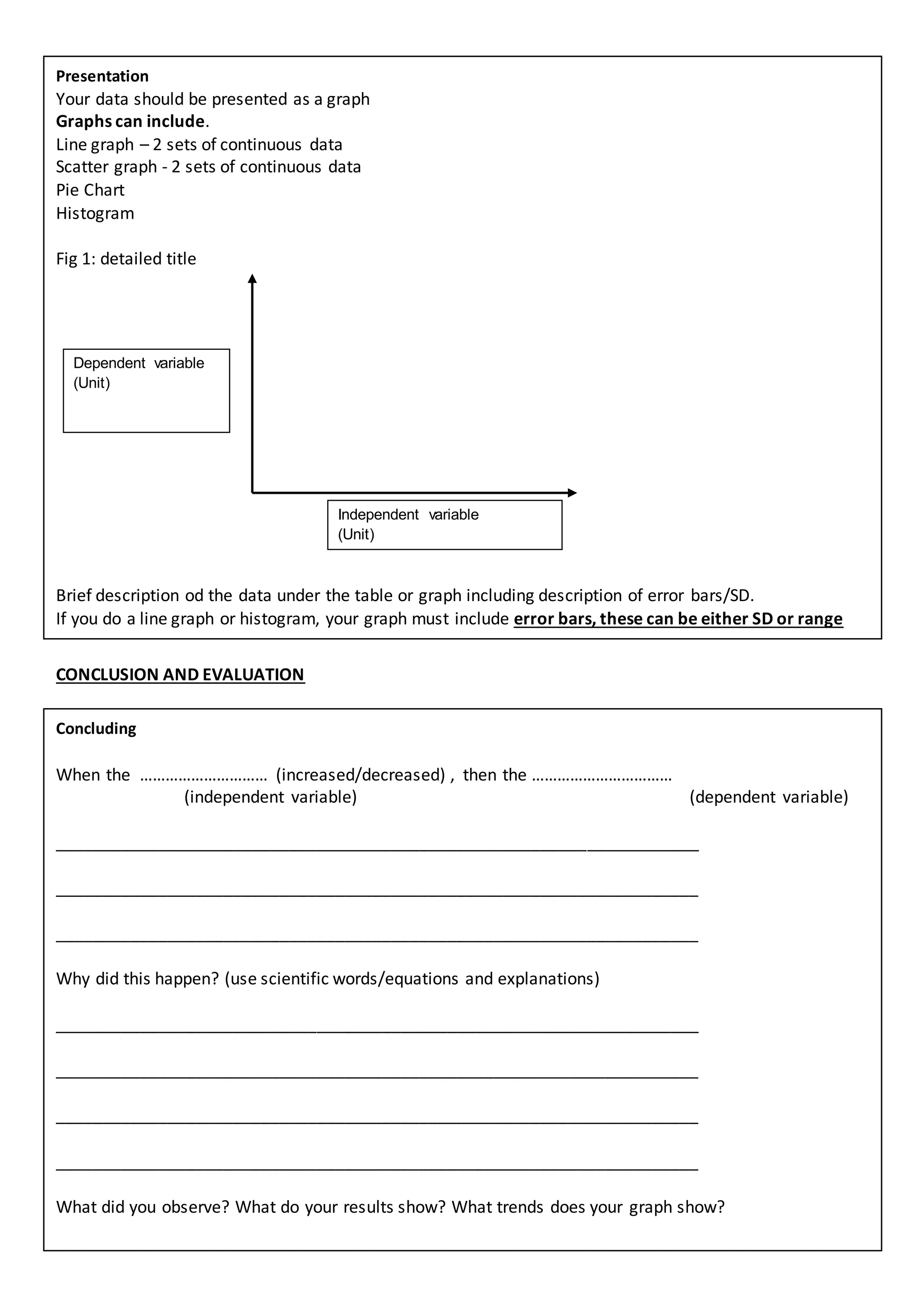
Your data should be presented as a graph
Graphs can include.
Line graph – 2 sets of continuous data
Scatter graph - 2 sets of continuous data
Pie Chart
Histogram
Fig 1: detailed title
Brief description od the data under the table or graph including description of error bars/SD.
If you do a line graph or histogram, your graph must include error bars, these can be either SD or range
CONCLUSION AND EVALUATION
Concluding
When the ………………………… (increased/decreased) , then the ……………………………
(independent variable) (dependent variable)
_____________________________________________________________________
_____________________________________________________________________
_____________________________________________________________________
Why did this happen? (use scientific words/equations and explanations)
_____________________________________________________________________
_____________________________________________________________________
_____________________________________________________________________
_____________________________________________________________________
What did you observe? What do your results show? What trends does your graph show?
Dependent variable
(Unit)
Independent variable
(Unit)
_____________________________________________________________________
_____________________________________________________________________
_____________________________________________________________________
_____________________________________________________________________
_____________________________________________________________________
_____________________________________________________________________
What did your qualitative data show?
Uncertainty
Types of uncertainty
Absolute uncertainty The accuracy of the measuring instruments
Random uncertainty is a measurement error caused by changes in the material used or environmental
factor. These can be kept to a minimum by careful control of variables.
Systematic uncertainty is an error in the equipment used or in your use of the aparatus; by calibrating
equipment regularly this can be reduced.
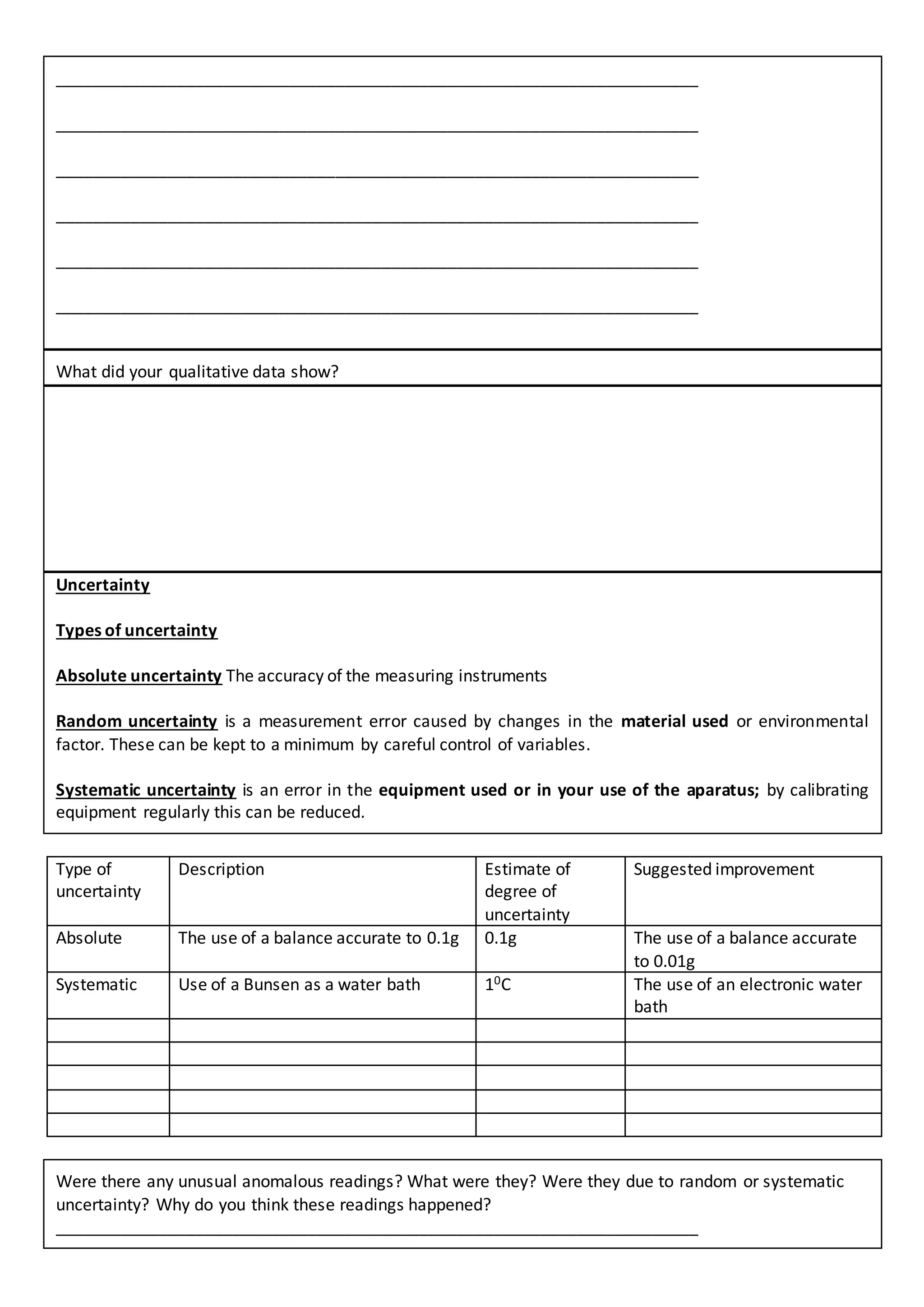
Type of
uncertainty
Description Estimate of
degree of
uncertainty
Suggested improvement
Absolute The use of a balance accurate to 0.1g 0.1g The use of a balance accurate
to 0.01g
Systematic Use of a Bunsen as a water bath 10C The use of an electronic water
bath
Were there any unusual anomalous readings? What were they? Were they due to random or systematic
uncertainty? Why do you think these readings happened?
_____________________________________________________________________
_____________________________________________________________________
_____________________________________________________________________
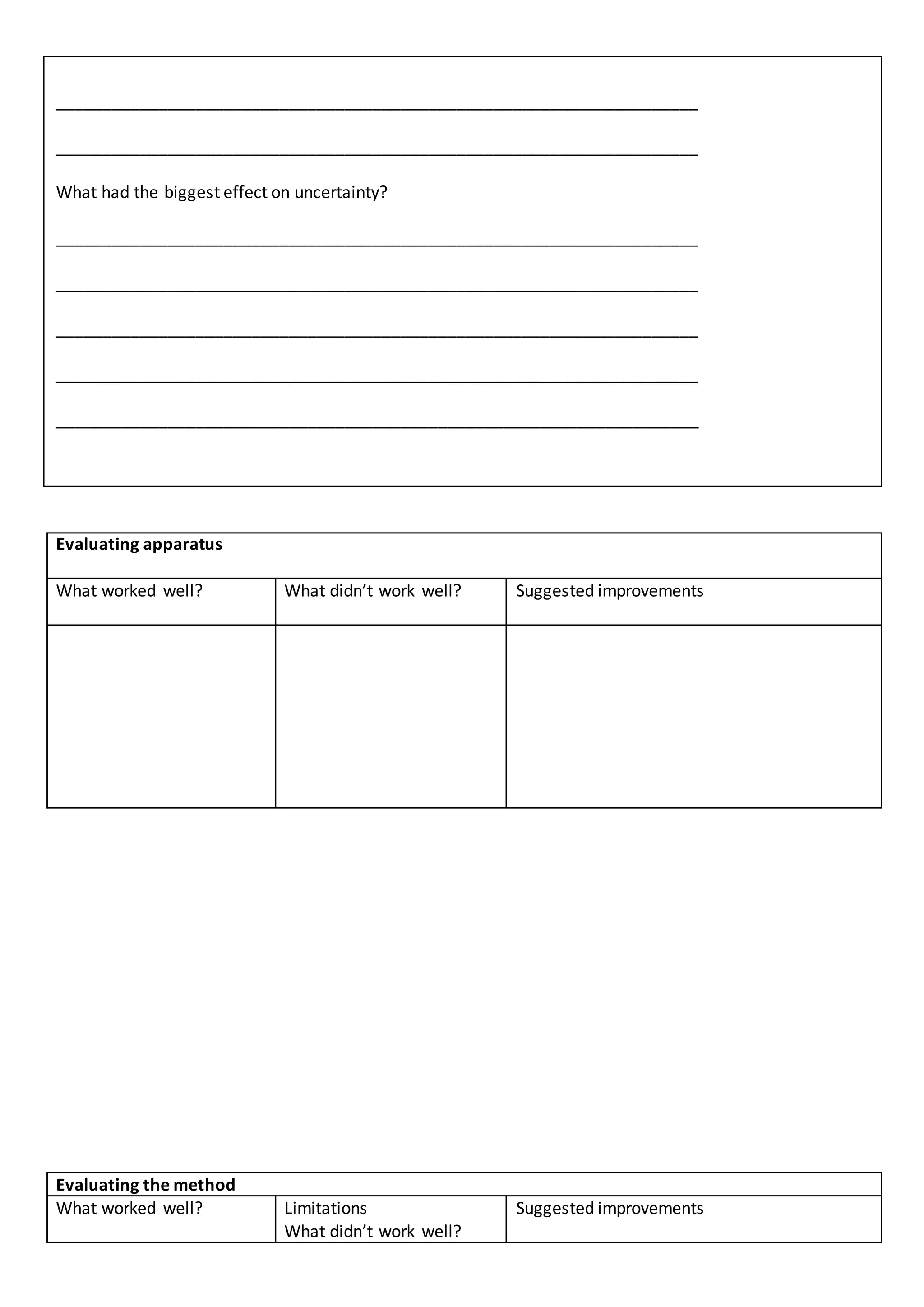
What had the biggest effect on uncertainty?
_____________________________________________________________________
_____________________________________________________________________
_____________________________________________________________________
_____________________________________________________________________
_____________________________________________________________________
Evaluating apparatus
What worked well? What didn’t work well? Suggested improvements
Evaluating the method
What worked well? Limitations
What didn’t work well?
Suggested improvements
If appropriate, how does your calculated value compare with the accepted value? What is the %
discrepancy? Link with research
_____________________________________________________________________
_____________________________________________________________________
_____________________________________________________________________
_____________________________________________________________________
Did you have enough data and were your results consistent to write a meaningful conclusion?
_____________________________________________________________________
_____________________________________________________________________
_____________________________________________________________________
_____________________________________________________________________
What could you investigate next, as a follow up to this practical?
_____________________________________________________________________
_____________________________________________________________________
_____________________________________________________________________
_____________________________________________________________________

IBDP Science Internal Investigation Proposal and Planning form

  • 1.
    IBDP Sciences: InternalInvestigation Student Planning Framework Name:____________ 1. Choosing the type of investigation The first task is to decide upon a type of investigation that is both feasible and suits your skills. Having done this, you must then derive a Research Question that has to be approved by your teacher. Complete the table in relation to your strengths and weaknesses in carrying out an investigation. This should help you decide which type of investigation your report will be Type of investigation My strengths My weaknesses Notes/thoughts Hands-on lab Use of database for analysis and modeling Extraction and graphical analysis from a database Simulation (interactive/ open-ended) Hybrid hands-on+ spreadsheet/ database Decision on type of investigation: I have chosen ………………………………………………………………………….type of investigation because……………………… ……………………………………………………………………………………………………………………………………………………………………………..… ……………………………………………………………………………………………………………………………………………………………………………….. ………………………………………………………………………………………………………………………………………………………………………………..
  • 2.
    2. Planning yourInternal Investigation EXPLORATION Aim Research Question How does ………………………………………..………………..……… affect …………………………………………..………..………..… ? (independent variable) (dependent variable) Rationale of your research/why are you interested in this topic? The scientific context/scientific reasoning for your hypothesis A list of resources (websites, textbook info etc.) that you have found and can be included in yourreport 1. 2. 3. 4. 5. Hypothesis/What do you thinkwill happen?
  • 3.
    Variables All independent variables:Variable I will change … 1. _____________________________ 2. _____________________________ All dependent variables: Variable I will measure/observe 1. _____________________________ 2. _____________________________ 3. _____________________________ 4. _____________________________ 5. _____________________________ 6. _____________________________ Measured variables cannot be controlled 1 2 3 Confounding variables uncontrollable, not able to be measured but may affect the data collected 1 2 3 Safety and ethical consideration Your investigation must comply with ethical and safety considerations 1. 2. 3.
  • 4.
    Validity How will theother variables be controlled? Variable Method of control Reason for control Apparatus Equipment/materials/chemicals Relevant details INCLUDE PRECISION OF INSTRUMENT
  • 5.
    Diagram of howapparatus is set up Method- Procedure Include details of the range and number of readings to be taken 1. ___________________________________________________________________ 2. ___________________________________________________________________ 3. ___________________________________________________________________ 4. ___________________________________________________________________ 5. ___________________________________________________________________ 6. ___________________________________________________________________ 7. ___________________________________________________________________ 8. ___________________________________________________________________ 9. ___________________________________________________________________ 10. _____________________________________________________________________ Method 2: Processing data How will you process you data and what statistical tests will do?  How will you process the raw data? Mean, SD, t test, chi squared etc?  Show all calculations clearly and how you have got your results
  • 6.
    DATA COLLECTION ANDPRESENTATION Results/observations:qualitative or quantitative? _____________________________________________________________________ _____________________________________________________________________ _____________________________________________________________________ _____________________________________________________________________ Results table Include all raw data recorded, headings, units and uncertainty (See below) Processed Data  How will you process the raw data? Mean, SD, t test, chi squared etc?  Show all calculations clearly and how you have got your results  Make sure that all tables have a FULL title and descriptions. A table to show………  All tables must include headings, units and uncertainties (+/- x)
  • 7.
    Presentation Your data shouldbe presented as a graph Graphs can include. Line graph – 2 sets of continuous data Scatter graph - 2 sets of continuous data Pie Chart Histogram Fig 1: detailed title Brief description od the data under the table or graph including description of error bars/SD. If you do a line graph or histogram, your graph must include error bars, these can be either SD or range CONCLUSION AND EVALUATION Concluding When the ………………………… (increased/decreased) , then the …………………………… (independent variable) (dependent variable) _____________________________________________________________________ _____________________________________________________________________ _____________________________________________________________________ Why did this happen? (use scientific words/equations and explanations) _____________________________________________________________________ _____________________________________________________________________ _____________________________________________________________________ _____________________________________________________________________ What did you observe? What do your results show? What trends does your graph show? Dependent variable (Unit) Independent variable (Unit)
  • 8.
    _____________________________________________________________________ _____________________________________________________________________ _____________________________________________________________________ _____________________________________________________________________ _____________________________________________________________________ _____________________________________________________________________ What did yourqualitative data show? Uncertainty Types of uncertainty Absolute uncertainty The accuracy of the measuring instruments Random uncertainty is a measurement error caused by changes in the material used or environmental factor. These can be kept to a minimum by careful control of variables. Systematic uncertainty is an error in the equipment used or in your use of the aparatus; by calibrating equipment regularly this can be reduced. Type of uncertainty Description Estimate of degree of uncertainty Suggested improvement Absolute The use of a balance accurate to 0.1g 0.1g The use of a balance accurate to 0.01g Systematic Use of a Bunsen as a water bath 10C The use of an electronic water bath Were there any unusual anomalous readings? What were they? Were they due to random or systematic uncertainty? Why do you think these readings happened? _____________________________________________________________________
  • 9.
    _____________________________________________________________________ _____________________________________________________________________ What had thebiggest effect on uncertainty? _____________________________________________________________________ _____________________________________________________________________ _____________________________________________________________________ _____________________________________________________________________ _____________________________________________________________________ Evaluating apparatus What worked well? What didn’t work well? Suggested improvements Evaluating the method What worked well? Limitations What didn’t work well? Suggested improvements
  • 10.
    If appropriate, howdoes your calculated value compare with the accepted value? What is the % discrepancy? Link with research _____________________________________________________________________ _____________________________________________________________________ _____________________________________________________________________ _____________________________________________________________________ Did you have enough data and were your results consistent to write a meaningful conclusion? _____________________________________________________________________ _____________________________________________________________________ _____________________________________________________________________ _____________________________________________________________________ What could you investigate next, as a follow up to this practical? _____________________________________________________________________ _____________________________________________________________________ _____________________________________________________________________ _____________________________________________________________________