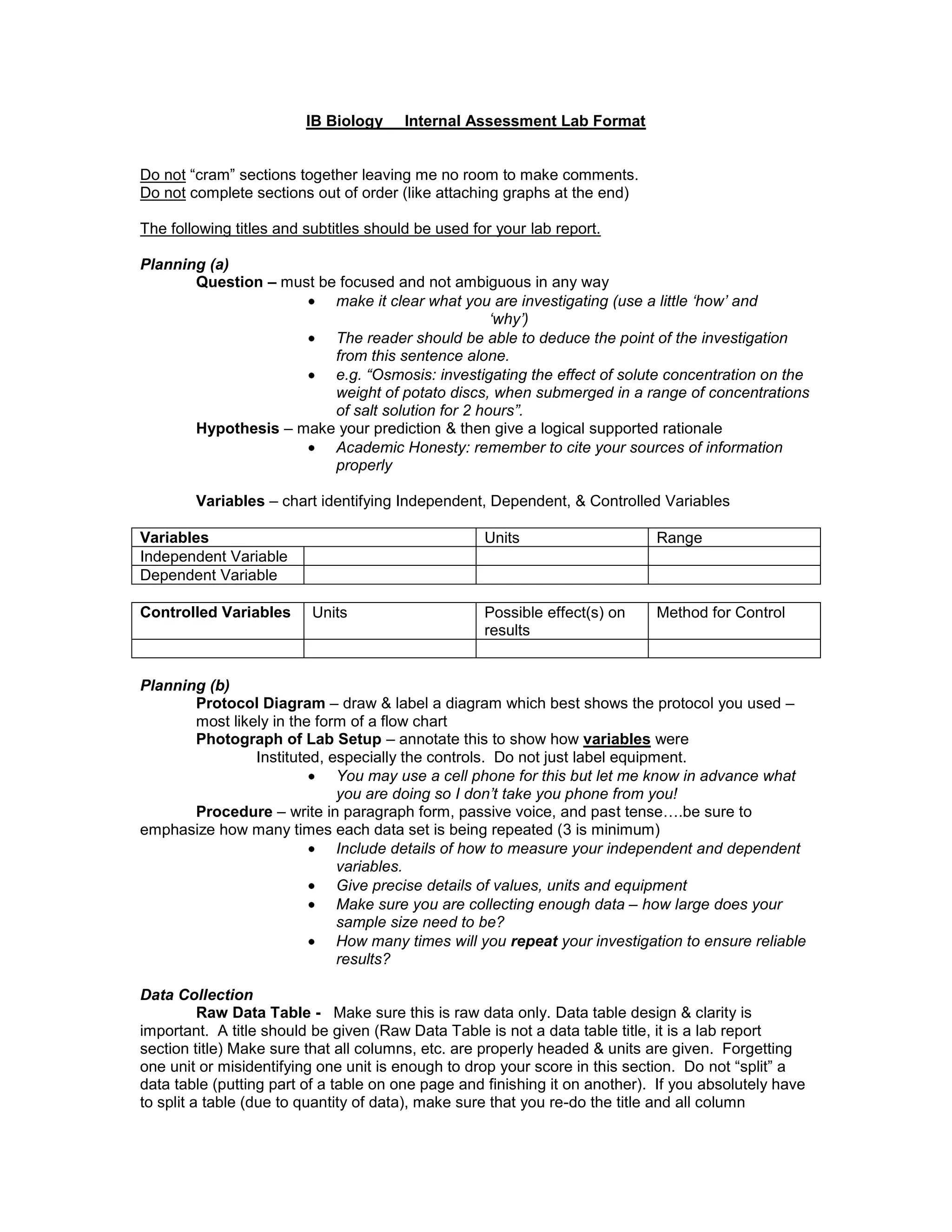
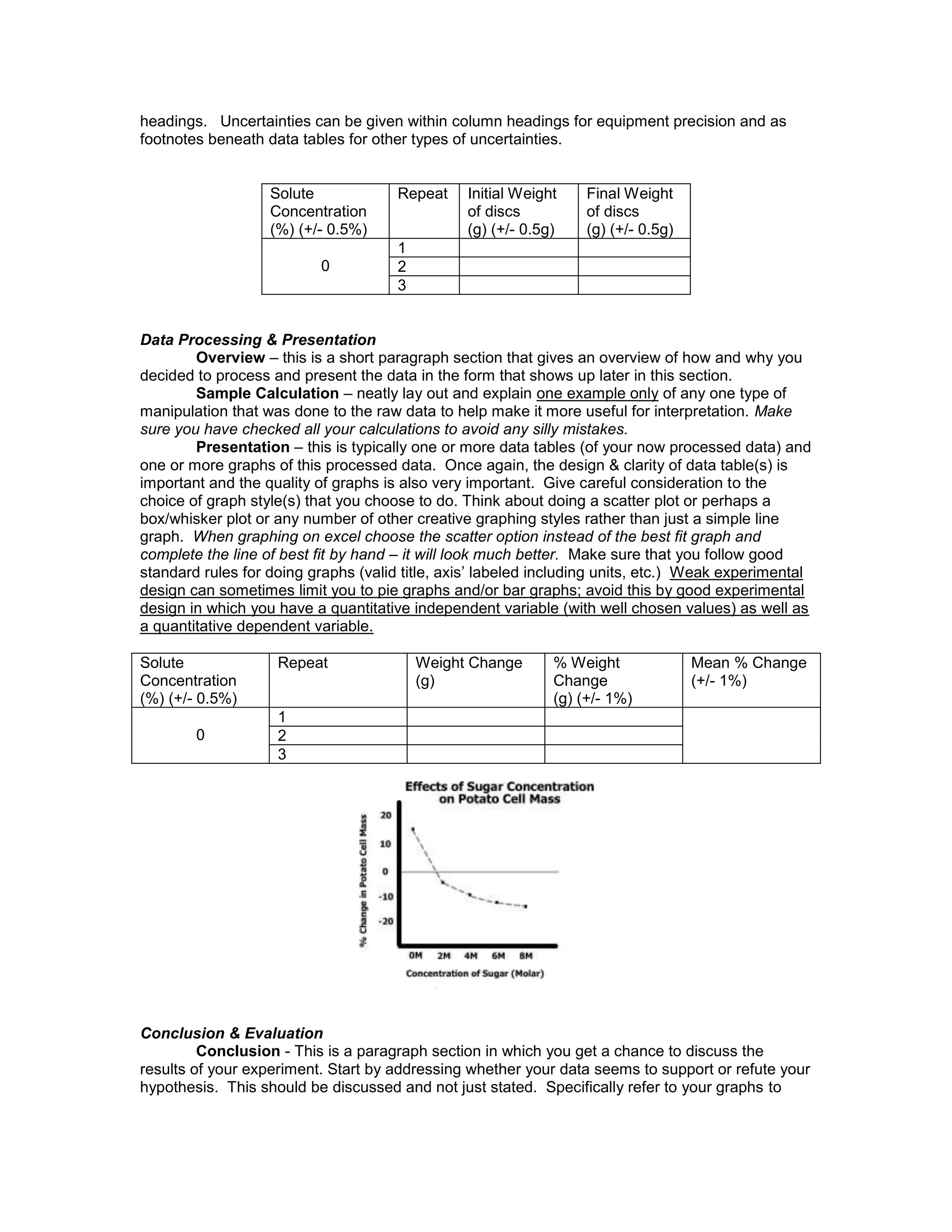
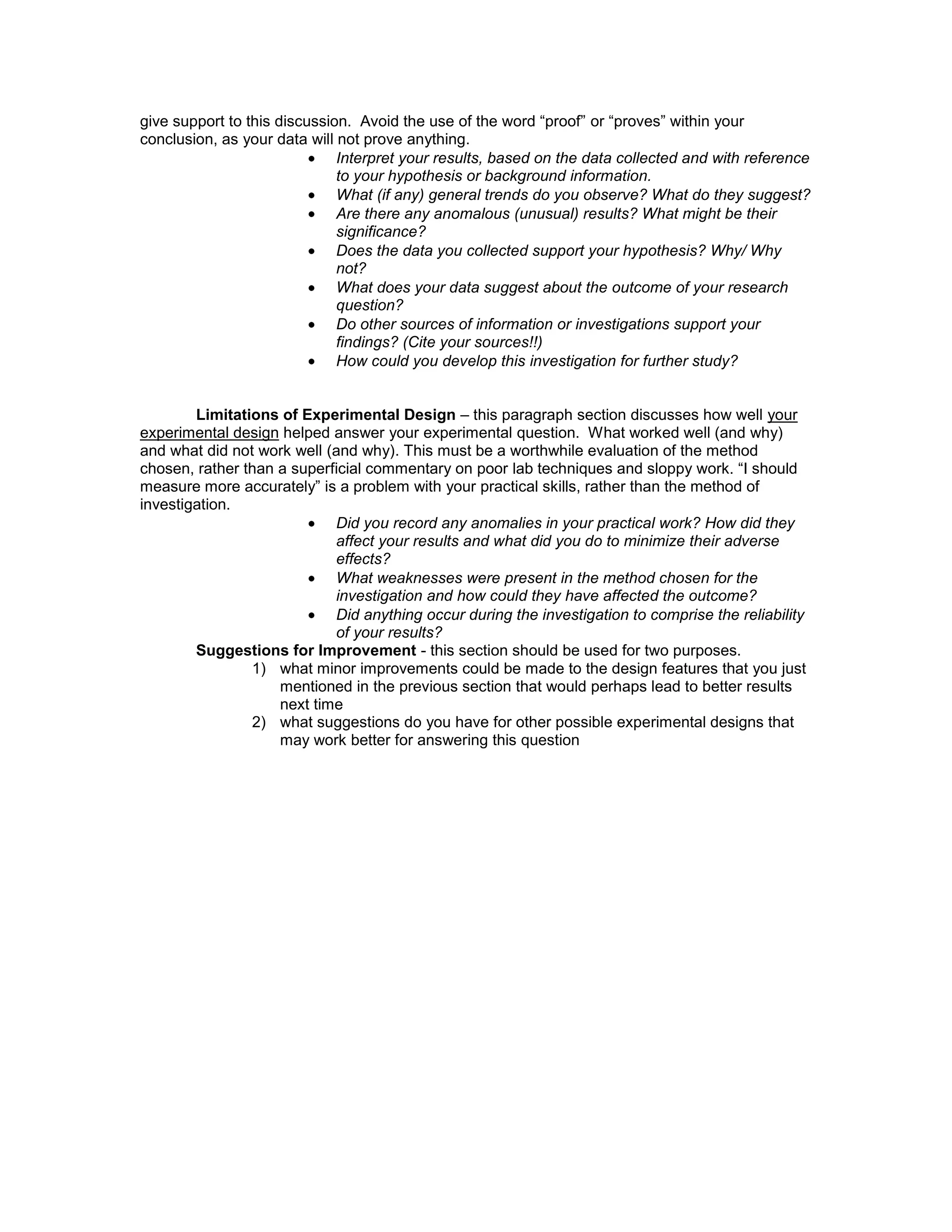
IB Biology     Internal Assessment Lab Format


Do not “cram” sections together leaving me no room to make comments.
Do not complete sections out of order (like attaching graphs at the end)

The following titles and subtitles should be used for your lab report.

Planning (a)
       Question – must be focused and not ambiguous in any way
                         make it clear what you are investigating (use a little „how‟ and
                                                  „why‟)
                         The reader should be able to deduce the point of the investigation
                         from this sentence alone.
                         e.g. “Osmosis: investigating the effect of solute concentration on the
                         weight of potato discs, when submerged in a range of concentrations
                         of salt solution for 2 hours”.
       Hypothesis – make your prediction & then give a logical supported rationale
                         Academic Honesty: remember to cite your sources of information
                         properly

        Variables – chart identifying Independent, Dependent, & Controlled Variables

Variables                                           Units                    Range
Independent Variable
Dependent Variable

Controlled Variables      Units                     Possible effect(s) on    Method for Control
                                                    results


Planning (b)
       Protocol Diagram – draw & label a diagram which best shows the protocol you used –
       most likely in the form of a flow chart
       Photograph of Lab Setup – annotate this to show how variables were
                Instituted, especially the controls. Do not just label equipment.
                             You may use a cell phone for this but let me know in advance what
                             you are doing so I don‟t take you phone from you!
       Procedure – write in paragraph form, passive voice, and past tense….be sure to
emphasize how many times each data set is being repeated (3 is minimum)
                             Include details of how to measure your independent and dependent
                             variables.
                             Give precise details of values, units and equipment
                             Make sure you are collecting enough data – how large does your
                             sample size need to be?
                             How many times will you repeat your investigation to ensure reliable
                             results?

Data Collection
          Raw Data Table - Make sure this is raw data only. Data table design & clarity is
important. A title should be given (Raw Data Table is not a data table title, it is a lab report
section title) Make sure that all columns, etc. are properly headed & units are given. Forgetting
one unit or misidentifying one unit is enough to drop your score in this section. Do not “split” a
data table (putting part of a table on one page and finishing it on another). If you absolutely have
to split a table (due to quantity of data), make sure that you re-do the title and all column
headings. Uncertainties can be given within column headings for equipment precision and as
footnotes beneath data tables for other types of uncertainties.


                   Solute             Repeat    Initial Weight    Final Weight
                   Concentration                of discs          of discs
                   (%) (+/- 0.5%)               (g) (+/- 0.5g)    (g) (+/- 0.5g)
                                      1
                          0           2
                                      3


Data Processing & Presentation
        Overview – this is a short paragraph section that gives an overview of how and why you
decided to process and present the data in the form that shows up later in this section.
        Sample Calculation – neatly lay out and explain one example only of any one type of
manipulation that was done to the raw data to help make it more useful for interpretation. Make
sure you have checked all your calculations to avoid any silly mistakes.
        Presentation – this is typically one or more data tables (of your now processed data) and
one or more graphs of this processed data. Once again, the design & clarity of data table(s) is
important and the quality of graphs is also very important. Give careful consideration to the
choice of graph style(s) that you choose to do. Think about doing a scatter plot or perhaps a
box/whisker plot or any number of other creative graphing styles rather than just a simple line
graph. When graphing on excel choose the scatter option instead of the best fit graph and
complete the line of best fit by hand – it will look much better. Make sure that you follow good
standard rules for doing graphs (valid title, axis’ labeled including units, etc.) Weak experimental
design can sometimes limit you to pie graphs and/or bar graphs; avoid this by good experimental
design in which you have a quantitative independent variable (with well chosen values) as well as
a quantitative dependent variable.

Solute              Repeat                Weight Change      % Weight              Mean % Change
Concentration                             (g)                Change                (+/- 1%)
(%) (+/- 0.5%)                                               (g) (+/- 1%)
                    1
        0           2
                    3


Conclusion & Evaluation
         Conclusion - This is a paragraph section in which you get a chance to discuss the
results of your experiment. Start by addressing whether your data seems to support or refute your
hypothesis. This should be discussed and not just stated. Specifically refer to your graphs to
give support to this discussion. Avoid the use of the word “proof” or “proves” within your
conclusion, as your data will not prove anything.
                              Interpret your results, based on the data collected and with reference
                              to your hypothesis or background information.
                              What (if any) general trends do you observe? What do they suggest?
                              Are there any anomalous (unusual) results? What might be their
                              significance?
                              Does the data you collected support your hypothesis? Why/ Why
                              not?
                              What does your data suggest about the outcome of your research
                              question?
                              Do other sources of information or investigations support your
                              findings? (Cite your sources!!)
                              How could you develop this investigation for further study?


        Limitations of Experimental Design – this paragraph section discusses how well your
experimental design helped answer your experimental question. What worked well (and why)
and what did not work well (and why). This must be a worthwhile evaluation of the method
chosen, rather than a superficial commentary on poor lab techniques and sloppy work. “I should
measure more accurately” is a problem with your practical skills, rather than the method of
investigation.
                            Did you record any anomalies in your practical work? How did they
                            affect your results and what did you do to minimize their adverse
                            effects?
                            What weaknesses were present in the method chosen for the
                            investigation and how could they have affected the outcome?
                            Did anything occur during the investigation to comprise the reliability
                            of your results?
        Suggestions for Improvement - this section should be used for two purposes.
                1) what minor improvements could be made to the design features that you just
                    mentioned in the previous section that would perhaps lead to better results
                    next time
                2) what suggestions do you have for other possible experimental designs that
                    may work better for answering this question

D51630 new ia lab format 09 (1)

  • 1.
    IB Biology Internal Assessment Lab Format Do not “cram” sections together leaving me no room to make comments. Do not complete sections out of order (like attaching graphs at the end) The following titles and subtitles should be used for your lab report. Planning (a) Question – must be focused and not ambiguous in any way make it clear what you are investigating (use a little „how‟ and „why‟) The reader should be able to deduce the point of the investigation from this sentence alone. e.g. “Osmosis: investigating the effect of solute concentration on the weight of potato discs, when submerged in a range of concentrations of salt solution for 2 hours”. Hypothesis – make your prediction & then give a logical supported rationale Academic Honesty: remember to cite your sources of information properly Variables – chart identifying Independent, Dependent, & Controlled Variables Variables Units Range Independent Variable Dependent Variable Controlled Variables Units Possible effect(s) on Method for Control results Planning (b) Protocol Diagram – draw & label a diagram which best shows the protocol you used – most likely in the form of a flow chart Photograph of Lab Setup – annotate this to show how variables were Instituted, especially the controls. Do not just label equipment. You may use a cell phone for this but let me know in advance what you are doing so I don‟t take you phone from you! Procedure – write in paragraph form, passive voice, and past tense….be sure to emphasize how many times each data set is being repeated (3 is minimum) Include details of how to measure your independent and dependent variables. Give precise details of values, units and equipment Make sure you are collecting enough data – how large does your sample size need to be? How many times will you repeat your investigation to ensure reliable results? Data Collection Raw Data Table - Make sure this is raw data only. Data table design & clarity is important. A title should be given (Raw Data Table is not a data table title, it is a lab report section title) Make sure that all columns, etc. are properly headed & units are given. Forgetting one unit or misidentifying one unit is enough to drop your score in this section. Do not “split” a data table (putting part of a table on one page and finishing it on another). If you absolutely have to split a table (due to quantity of data), make sure that you re-do the title and all column
  • 2.
    headings. Uncertainties canbe given within column headings for equipment precision and as footnotes beneath data tables for other types of uncertainties. Solute Repeat Initial Weight Final Weight Concentration of discs of discs (%) (+/- 0.5%) (g) (+/- 0.5g) (g) (+/- 0.5g) 1 0 2 3 Data Processing & Presentation Overview – this is a short paragraph section that gives an overview of how and why you decided to process and present the data in the form that shows up later in this section. Sample Calculation – neatly lay out and explain one example only of any one type of manipulation that was done to the raw data to help make it more useful for interpretation. Make sure you have checked all your calculations to avoid any silly mistakes. Presentation – this is typically one or more data tables (of your now processed data) and one or more graphs of this processed data. Once again, the design & clarity of data table(s) is important and the quality of graphs is also very important. Give careful consideration to the choice of graph style(s) that you choose to do. Think about doing a scatter plot or perhaps a box/whisker plot or any number of other creative graphing styles rather than just a simple line graph. When graphing on excel choose the scatter option instead of the best fit graph and complete the line of best fit by hand – it will look much better. Make sure that you follow good standard rules for doing graphs (valid title, axis’ labeled including units, etc.) Weak experimental design can sometimes limit you to pie graphs and/or bar graphs; avoid this by good experimental design in which you have a quantitative independent variable (with well chosen values) as well as a quantitative dependent variable. Solute Repeat Weight Change % Weight Mean % Change Concentration (g) Change (+/- 1%) (%) (+/- 0.5%) (g) (+/- 1%) 1 0 2 3 Conclusion & Evaluation Conclusion - This is a paragraph section in which you get a chance to discuss the results of your experiment. Start by addressing whether your data seems to support or refute your hypothesis. This should be discussed and not just stated. Specifically refer to your graphs to
  • 3.
    give support tothis discussion. Avoid the use of the word “proof” or “proves” within your conclusion, as your data will not prove anything. Interpret your results, based on the data collected and with reference to your hypothesis or background information. What (if any) general trends do you observe? What do they suggest? Are there any anomalous (unusual) results? What might be their significance? Does the data you collected support your hypothesis? Why/ Why not? What does your data suggest about the outcome of your research question? Do other sources of information or investigations support your findings? (Cite your sources!!) How could you develop this investigation for further study? Limitations of Experimental Design – this paragraph section discusses how well your experimental design helped answer your experimental question. What worked well (and why) and what did not work well (and why). This must be a worthwhile evaluation of the method chosen, rather than a superficial commentary on poor lab techniques and sloppy work. “I should measure more accurately” is a problem with your practical skills, rather than the method of investigation. Did you record any anomalies in your practical work? How did they affect your results and what did you do to minimize their adverse effects? What weaknesses were present in the method chosen for the investigation and how could they have affected the outcome? Did anything occur during the investigation to comprise the reliability of your results? Suggestions for Improvement - this section should be used for two purposes. 1) what minor improvements could be made to the design features that you just mentioned in the previous section that would perhaps lead to better results next time 2) what suggestions do you have for other possible experimental designs that may work better for answering this question