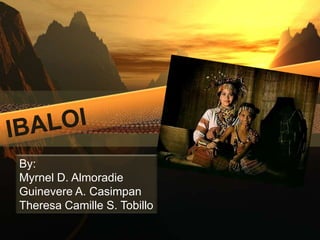
By:
Myrnel D. Almoradie
Guinevere A. Casimpan
Theresa Camille S. Tobillo
GENERAL INFORMATION
             THE       THE                  THE
THE TRIBE                      THE DEAD
            PEOPLE   CULTURE              PLANTS


 •Ibaloi = “from Baloy”
 •first settled in a place in the town of
 Kabayan known as Embosi
GENERAL INFORMATION
             THE       THE                  THE
THE TRIBE                      THE DEAD
 •one of the Igorot tribes from North
            PEOPLE   CULTURE              PLANTS


 Luzon
 •inhabit Central and Southern
 Benguet and Western Nueva
 Vizcaya
 •in 1975, population is about 89,
 000
 •religion centered on ancestral
 worship
GENERAL INFORMATION
             THE       THE                  THE
THE TRIBE                      THE DEAD
            PEOPLE   CULTURE              PLANTS


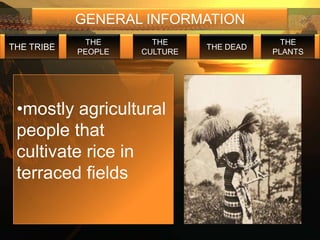
 •mostly agricultural
 people that
 cultivate rice in
 terraced fields
HOUSES
             THE        THE                    THE
THE TRIBE                         THE DEAD
            PEOPLE    CULTURE                PLANTS

 •generally scattered in the fields or on hillsides
 •raised on posts for protection against animals
 and pests and covered with a pyramidal thatched
 roof
 •some of the typical things inside their houses
 are the shapolon (cooking place), shakiran
 (three stones that serve as a stove), safatan
 (rafter for tools) and so-olan (storage for
 firewood)
 •compact; easier to keep oneself warm in the
 cold mountains of Benguet
HOUSES
             THE        THE                  THE
THE TRIBE                       THE DEAD
            PEOPLE    CULTURE              PLANTS
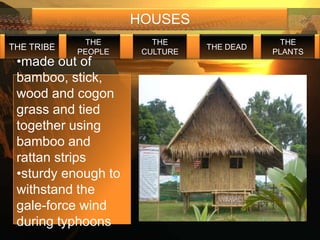
 •made out of
 bamboo, stick,
 wood and cogon
 grass and tied
 together using
 bamboo and
 rattan strips
 •sturdy enough to
 withstand the
 gale-force wind
 during typhoons
FOOD
             THE       THE                  THE
THE TRIBE                      THE DEAD
            PEOPLE   CULTURE              PLANTS


 •subsistence is based on wet rice,
 tubers, beans and maize
 •occasionally, they also eat meat the
 meat of pigs, dogs, chickens, carabaos,
 horses and cattle
CLOTHES OF MEN
             THE       THE                  THE
THE TRIBE                      THE DEAD
            PEOPLE   CULTURE              PLANTS


 •kubal or bahag (G-string)
 •kubal is called tinuto, after a tree bark
 and is of different types, depending on
 the social status of the wearer
 •a piece of bright-colored cloth twisted
 and tied around the crown called a
 kundiman is worn
KINDS OF KUBAL
             THE       THE                  THE
THE TRIBE                      THE DEAD
            PEOPLE   CULTURE              PLANTS

 •padasan – black G-string used by the rich
 •kolibao – white and black colors in
 straight horizontal lines
 •pinlak – plain white colors in straight
 horizontal lines
 •sinalibubo – combination of red, white
 and black thread linings
 •lunas – red or white G-strings used by
 young people
CLOTHES OF WOMEN
             THE       THE                   THE
THE TRIBE                       THE DEAD
            PEOPLE   CULTURE               PLANTS


 •from the age of 12, they wear a piece of
 cloth called a libet or tapis and the kambal or
 sadey or sadi
 •during the cold season, they sometimes
 wear a blanket called the shindi or dil-il and
 tinwang for the common people, and the
 sinakwit and al-laddang for the rich people
 •a headwear of two varieties, the shinalibubo
 and the binayyek, is worn
LIBET
             THE       THE                  THE
THE TRIBE                      THE DEAD
            PEOPLE   CULTURE              PLANTS

 •full-waisted, long and wrapped around the
 waist to serve as a skirt
 • made of Ilocano, loom-woven material
 with colored stripes of green, black, yellow
 and white
 •colors run horizontally in parallel lines
 •when worn, it produces a plaid effect that
 give the impression of stability, solidity and
 serenity
 •balkes – belt that holds the libet in place
KAMBAL
             THE        THE                  THE
THE TRIBE                       THE DEAD
            PEOPLE    CULTURE              PLANTS


 •jacket worn to complete the dress
 ensemble
ACCESSORIES
             THE       THE                  THE
THE TRIBE                      THE DEAD
            PEOPLE   CULTURE              PLANTS


 •necklaces of beads around the
 head, gold earrings, armlets or
 bracelets, and leglets
GIRLS
             THE        THE                  THE
THE TRIBE                       THE DEAD
            PEOPLE    CULTURE              PLANTS

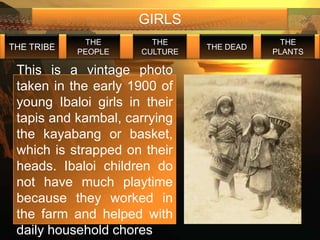
 This is a vintage photo
 taken in the early 1900 of
 young Ibaloi girls in their
 tapis and kambal, carrying
 the kayabang or basket,
 which is strapped on their
 heads. Ibaloi children do
 not have much playtime
 because they worked in
 the farm and helped with
 daily household chores
MAN AND WOMAN
             THE       THE                  THE
THE TRIBE                      THE DEAD
            PEOPLE   CULTURE              PLANTS


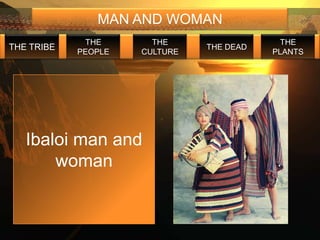
   Ibaloi man and
       woman
THE PEOPLE
             THE         THE                   THE
THE TRIBE                         THE DEAD
            PEOPLE     CULTURE               PLANTS


 •shy and timid (“shiyay ak”)
 •engaged in headhunting forages in
 the past
 •sacred rice wine and human brain
 beverage
 •known for their gallantry and valor
 during wars like the Japanese
 occupation
SOCIAL CLASSES
             THE       THE                  THE
THE TRIBE                      THE DEAD
            PEOPLE   CULTURE              PLANTS


 There is a big differentiation
 between the rich and the poor. The
 rich class usually holds the power
 and influence of the tribe.
TRIBAL PRIESTS/HEALERS
              THE       THE                  THE
THE TRIBE                       THE DEAD
             PEOPLE   CULTURE              PLANTS


 1. mansip-ok/mansib-ok
 2. mambunong
 3. mankotom
MANSIP-OK/MANSIB-OK
             THE       THE                  THE
THE TRIBE                      THE DEAD
            PEOPLE   CULTURE              PLANTS


 •given the power to determine the cause
 of a person’s illness, death or misfortune
 •prescribes the appropriate ritual to
 counteract these misfortunes, like killing
 a number of carabao, cows, pigs or
 chicken
MAMBUNONG
             THE         THE                  THE
THE TRIBE                        THE DEAD
            PEOPLE     CULTURE              PLANTS

 •performs the bunong or ritual prayer and
 administers the appropriate ritual
 prescribed by the mansib-ok
 •acts as the medium between the spirits
 and the afflicted
 •asks Kabunyan to heal the person's
 illness
 •gives assurance to the afflicted that the
 ritual was performed well according to the
 requirement of the spirit
MANKOTOM
             THE         THE                  THE
THE TRIBE                        THE DEAD
            PEOPLE     CULTURE              PLANTS


 •group of elders oriented to the ways
 and practices of the people in the
 community
 •keepers and guardians of customs and
 tradition with high regards for the strict
 observance of rituals
 •capable of performing both the jobs of
 the mansip-ok and mambunong
TEN TYPES OF FOLK HEALERS
             THE       THE                   THE
THE TRIBE                       THE DEAD
            PEOPLE   CULTURE               PLANTS

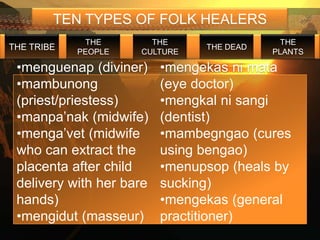
 •menguenap (diviner)     •mengekas ni mata
 •mambunong               (eye doctor)
 (priest/priestess)       •mengkal ni sangi
 •manpa’nak (midwife)     (dentist)
 •menga’vet (midwife      •mambegngao (cures
 who can extract the      using bengao)
 placenta after child     •menupsop (heals by
 delivery with her bare   sucking)
 hands)                   •mengekas (general
 •mengidut (masseur)      practitioner)
HEALING WITH RITUALS
             THE       THE                  THE
THE TRIBE                      THE DEAD
            PEOPLE   CULTURE              PLANTS


 •they believe that their Mengos-
 Osdong, the highest and powerful of
 all the spirits, is the omnipotent
 authority who can treat diseases
DAWDAWAK/ANAWANG
             THE       THE                  THE
THE TRIBE                      THE DEAD
            PEOPLE   CULTURE              PLANTS


 •ritual involving an appeal to the
 Kabunyan to extend his healing
 power to the mother for a quick
 recovery
PAKDE
             THE       THE                  THE
THE TRIBE                      THE DEAD
            PEOPLE   CULTURE              PLANTS


 •performed by the mambunong to
 drive away death and disease-
 causing spirits
KIAD
             THE       THE                  THE
THE TRIBE                      THE DEAD
            PEOPLE   CULTURE              PLANTS


 •performed to appease the departed
 ancestor who is causing sickness to
 the family
POCPOCLEY
             THE         THE                  THE
THE TRIBE                        THE DEAD
            PEOPLE     CULTURE              PLANTS


 •ritual performed to treat a man who
 loses sexual vitality
TATTOO
             THE       THE                  THE
THE TRIBE                      THE DEAD
            PEOPLE   CULTURE              PLANTS


 •putting on tattoos is now rare but
 Ibaloi mummies show that they
 used to practice full body suits of
 tattooing
MALES
             THE       THE                  THE
THE TRIBE                      THE DEAD
            PEOPLE   CULTURE              PLANTS


 •symbol of male valor, strength, rank
 and prestige
 •tattoos on the body are records of their
 headhunting and battle exploits
 •the more body tattoos, the more they
 are desirable as husbands
FEMALES
             THE        THE                  THE
THE TRIBE                       THE DEAD
            PEOPLE    CULTURE              PLANTS


 •usually get tattoos at a young age to
 make them more beautiful and
 attractive, as well as to get the respect
 of their tribe
 •placed on their arms and legs
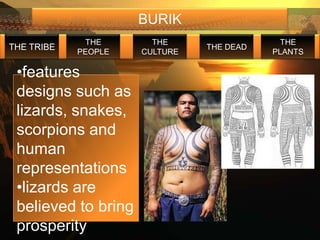
BURIK
             THE       THE                  THE
THE TRIBE                      THE DEAD
            PEOPLE   CULTURE              PLANTS

 •features
 designs such as
 lizards, snakes,
 scorpions and
 human
 representations
 •lizards are
 believed to bring
 prosperity
COURTSHIP AND MARRIAGE
              THE       THE                  THE
THE TRIBE                       THE DEAD
             PEOPLE   CULTURE              PLANTS


 •Kalon and Kaising
 •Both were practiced since the early
 50’s until the early 80’s
 •These traditions are not that practiced
 anymore because the modern youth
 believe that they should marry the
 person that they love
KALON
             THE       THE                  THE
THE TRIBE                      THE DEAD
            PEOPLE   CULTURE              PLANTS

 •the man chooses a woman he wants for a
 wife and expresses his love through an
 intermediary with a good reputation in the
 community and through parental
 agreement
 •the intermediary talks about the man’s
 good qualities
 •the woman agrees to drink the tapey (rice
 wine) offered by the intermediary if she
 agrees to marry the man
KASING
             THE         THE                    THE
THE TRIBE                         THE DEAD
            PEOPLE     CULTURE                PLANTS

 •the marriage of a man and a woman is pre-
 arranged by their parents even before they were
 born (tongtong)
 •usually done by rich clans to keep their wealth
 within their class
 •in cases where one party retracts, that party will
 have to butcher a pig, cow or carabao and pay
 for all the expenses incurred during the tongtong
 •during the preparation for the marriage, the
 woman and the man are locked in a room for
 them to get to know each other
NABALOI/INIBALOY
             THE       THE                  THE
THE TRIBE                      THE DEAD
            PEOPLE   CULTURE              PLANTS


 •dialect of the Ibalois
 •part of the Hesperonesian Group of the
 Austronesian language family
 •among the Ilocanos, the term means
 “language of strangers”
 •some Ilocano and Pangasinan words
 have infiltrated the dialect
BREAKING NEWS
             THE       THE                  THE
THE TRIBE                      THE DEAD
            PEOPLE   CULTURE              PLANTS


 •a group of Ibalois called the Makniba is
 planning to put up an Ibaloi academy to
 preserve their dialect and culture
 •a Makniba member, Sandy Calado,
 said that in 10 – 20 years, the dialect
 may vanish
 •present Ibalois seldom speak their
 native tongue, unlike the other Igorot
 tribes
LITERATURE
             THE         THE                   THE
THE TRIBE                         THE DEAD
            PEOPLE     CULTURE               PLANTS


 •oral literature of riddles and fables that
 reflect their societal problems
 •legends usually pertain to their mythical
 world and reflect their beliefs and
 practices
 •poetry consists of songs, ballads,
 elegies and prayers
 •famous epics: Kabuniyan and Bindian
UL-ULIT
             THE        THE                  THE
THE TRIBE                       THE DEAD
            PEOPLE    CULTURE              PLANTS


 •stories handed down from generation
 to generation
 •Ilocano word referring to the things that
 are repeated time after time
 •used by the Ibaloi, it means “twice told
 tales retold manyfold”
KABAYAN/FIRE MUMMIES
             THE       THE                  THE
THE TRIBE                      THE DEAD
            PEOPLE   CULTURE              PLANTS


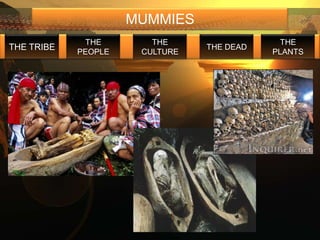
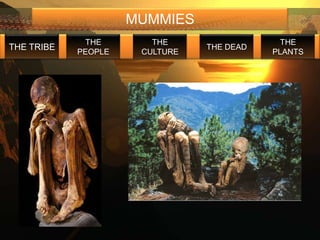
 •group of mummies found in caves
 around Kabayan, a town in Benguet
 •there are around 200 man-made burial
 caves, 15 of which contain mummies
 •the Ibaloi tribe is the only tribal group
 that creates mummies in the Philippines
 •only tribal leaders were mummified
 •most mummies are heavily tattooed
KABAYAN/FIRE MUMMIES
             THE       THE                  THE
THE TRIBE                      THE DEAD
            PEOPLE   CULTURE              PLANTS


 •many were stolen, including the
 “smiling mummy”
 •caves are designated as one of the 100
 Most Endangered Sites in the World by
 Monument Watch and is in the list of
 UNESCO’s World Heritage Sites
 •under Presidential Decree 374, the
 mummies were proclaimed “Philippine
 National Cultural Treasures”
WHEN THEY WERE MADE
             THE       THE                  THE
THE TRIBE                      THE DEAD
            PEOPLE   CULTURE              PLANTS


 •scientists believe they were
 created between 1200 and 1500
 A.D.
 •when the Spaniards came, they
 discouraged the making of
 mummies, thus the practice died out
HOW THEY WERE MADE
             THE         THE                    THE
THE TRIBE                         THE DEAD
            PEOPLE     CULTURE                PLANTS


 1. Person swallows a very salty drink.
 2. After death, the body is washed and seated in a
 chair over a glowing fire.
 3. The body is brought out to the sun to hasten
 drying and the outer skin is peeled off by elders.
 3. Tobacco smoke is blown into the person’s mouth
 to dry the internal organ.
 4. Herbs are rubbed on the body.
 5. After a number of months or even years, the
 mummy is placed inside a pinewood coffin and
 buried in a cave.
MUMMIES
             THE        THE                  THE
THE TRIBE                       THE DEAD
            PEOPLE    CULTURE              PLANTS
MUMMIES
             THE        THE                  THE
THE TRIBE                       THE DEAD
            PEOPLE    CULTURE              PLANTS
•a

                     APO ANNU
             THE        THE                  THE
THE TRIBE                       THE DEAD
            PEOPLE    CULTURE              PLANTS


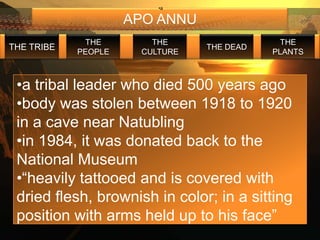
 •a tribal leader who died 500 years ago
 •body was stolen between 1918 to 1920
 in a cave near Natubling
 •in 1984, it was donated back to the
 National Museum
 •“heavily tattooed and is covered with
 dried flesh, brownish in color; in a sitting
 position with arms held up to his face”
APO ANNU
             THE        THE                  THE
THE TRIBE                       THE DEAD
            PEOPLE    CULTURE              PLANTS


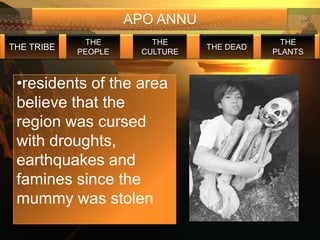
 •residents of the area
 believe that the
 region was cursed
 with droughts,
 earthquakes and
 famines since the
 mummy was stolen
MEDICINAL PLANTS
             THE       THE                  THE
THE TRIBE                      THE DEAD
            PEOPLE   CULTURE              PLANTS


 •the Ibalois have 75 plants that have the
 capability to cure 44 ailments
 •only the mengidot, manpa’nak,
 menga’vet and mengekas prescribe
 medical plants
 •they use all the parts of the plants, but
 the leaves are the most commonly used
MEDICINAL PLANTS
             THE       THE                  THE
THE TRIBE                      THE DEAD
            PEOPLE   CULTURE              PLANTS


 •boiling and pounding/mashing are the
 most commonly used procedure of
 preparing the plants
 •drinking the decoction as tea and
 applying the preparation directly on the
 affected areas as poultice are the usual
 modes of administration
SOURCES
                 THE               THE                              THE
THE TRIBE                                        THE DEAD
                PEOPLE           CULTURE                          PLANTS

 •Barnett, Milton L. (1967). "Subsistence and Transition of Agricultural
 Development among the Ibaloi." In Studies in Philippine Anthropology,
 edited by Mario D. Zamora, 299323. Quezon City: Alemar-Phoenix.
 •http://carian.wikispaces.com/Medical+Practices-+Ibaloi-+Benguet
 •http://ofwlayf.com/kabayan-mummies-in-benguet-philippines/98/
 •http://newsinfo.inquirer.net/inquirerheadlines/nation/view/20090427-
 201614/Respect-mummies-Pulag-trekkers-told
 •http://www.mummytombs.com/mummylocator/group/kabayan.htm
 •http://www.sunstar.com.ph/static/net/2008/06/11/ibaloi.group.seeks.herit
 age.revival.html
 •http://demouser.i.ph/blogs/bluephoenix/2007/04/02/ibaloi-cultures/
 •http://www.flixya.com/photo/276204/Philippines,_Ibaloi_tribe
 •http://www.vanishingtattoo.com/tattoos_in_Philippines.htm
 •http://www.baguio.gov.ph/index.php?q=content/ibaloi-dress
 •http://www.everyculture.com/East-Southeast-
 Asia/Ibaloi.html#ixzz0yYpnbOLS

Ibaloi

  • 1.
    By: Myrnel D. Almoradie GuinevereA. Casimpan Theresa Camille S. Tobillo
  • 3.
    GENERAL INFORMATION THE THE THE THE TRIBE THE DEAD PEOPLE CULTURE PLANTS •Ibaloi = “from Baloy” •first settled in a place in the town of Kabayan known as Embosi
  • 4.
    GENERAL INFORMATION THE THE THE THE TRIBE THE DEAD •one of the Igorot tribes from North PEOPLE CULTURE PLANTS Luzon •inhabit Central and Southern Benguet and Western Nueva Vizcaya •in 1975, population is about 89, 000 •religion centered on ancestral worship
  • 5.
    GENERAL INFORMATION THE THE THE THE TRIBE THE DEAD PEOPLE CULTURE PLANTS •mostly agricultural people that cultivate rice in terraced fields
  • 6.
    HOUSES THE THE THE THE TRIBE THE DEAD PEOPLE CULTURE PLANTS •generally scattered in the fields or on hillsides •raised on posts for protection against animals and pests and covered with a pyramidal thatched roof •some of the typical things inside their houses are the shapolon (cooking place), shakiran (three stones that serve as a stove), safatan (rafter for tools) and so-olan (storage for firewood) •compact; easier to keep oneself warm in the cold mountains of Benguet
  • 7.
    HOUSES THE THE THE THE TRIBE THE DEAD PEOPLE CULTURE PLANTS •made out of bamboo, stick, wood and cogon grass and tied together using bamboo and rattan strips •sturdy enough to withstand the gale-force wind during typhoons
  • 8.
    FOOD THE THE THE THE TRIBE THE DEAD PEOPLE CULTURE PLANTS •subsistence is based on wet rice, tubers, beans and maize •occasionally, they also eat meat the meat of pigs, dogs, chickens, carabaos, horses and cattle
  • 9.
    CLOTHES OF MEN THE THE THE THE TRIBE THE DEAD PEOPLE CULTURE PLANTS •kubal or bahag (G-string) •kubal is called tinuto, after a tree bark and is of different types, depending on the social status of the wearer •a piece of bright-colored cloth twisted and tied around the crown called a kundiman is worn
  • 10.
    KINDS OF KUBAL THE THE THE THE TRIBE THE DEAD PEOPLE CULTURE PLANTS •padasan – black G-string used by the rich •kolibao – white and black colors in straight horizontal lines •pinlak – plain white colors in straight horizontal lines •sinalibubo – combination of red, white and black thread linings •lunas – red or white G-strings used by young people
  • 11.
    CLOTHES OF WOMEN THE THE THE THE TRIBE THE DEAD PEOPLE CULTURE PLANTS •from the age of 12, they wear a piece of cloth called a libet or tapis and the kambal or sadey or sadi •during the cold season, they sometimes wear a blanket called the shindi or dil-il and tinwang for the common people, and the sinakwit and al-laddang for the rich people •a headwear of two varieties, the shinalibubo and the binayyek, is worn
  • 12.
    LIBET THE THE THE THE TRIBE THE DEAD PEOPLE CULTURE PLANTS •full-waisted, long and wrapped around the waist to serve as a skirt • made of Ilocano, loom-woven material with colored stripes of green, black, yellow and white •colors run horizontally in parallel lines •when worn, it produces a plaid effect that give the impression of stability, solidity and serenity •balkes – belt that holds the libet in place
  • 13.
    KAMBAL THE THE THE THE TRIBE THE DEAD PEOPLE CULTURE PLANTS •jacket worn to complete the dress ensemble
  • 14.
    ACCESSORIES THE THE THE THE TRIBE THE DEAD PEOPLE CULTURE PLANTS •necklaces of beads around the head, gold earrings, armlets or bracelets, and leglets
  • 15.
    GIRLS THE THE THE THE TRIBE THE DEAD PEOPLE CULTURE PLANTS This is a vintage photo taken in the early 1900 of young Ibaloi girls in their tapis and kambal, carrying the kayabang or basket, which is strapped on their heads. Ibaloi children do not have much playtime because they worked in the farm and helped with daily household chores
  • 16.
    MAN AND WOMAN THE THE THE THE TRIBE THE DEAD PEOPLE CULTURE PLANTS Ibaloi man and woman
  • 18.
    THE PEOPLE THE THE THE THE TRIBE THE DEAD PEOPLE CULTURE PLANTS •shy and timid (“shiyay ak”) •engaged in headhunting forages in the past •sacred rice wine and human brain beverage •known for their gallantry and valor during wars like the Japanese occupation
  • 19.
    SOCIAL CLASSES THE THE THE THE TRIBE THE DEAD PEOPLE CULTURE PLANTS There is a big differentiation between the rich and the poor. The rich class usually holds the power and influence of the tribe.
  • 20.
    TRIBAL PRIESTS/HEALERS THE THE THE THE TRIBE THE DEAD PEOPLE CULTURE PLANTS 1. mansip-ok/mansib-ok 2. mambunong 3. mankotom
  • 21.
    MANSIP-OK/MANSIB-OK THE THE THE THE TRIBE THE DEAD PEOPLE CULTURE PLANTS •given the power to determine the cause of a person’s illness, death or misfortune •prescribes the appropriate ritual to counteract these misfortunes, like killing a number of carabao, cows, pigs or chicken
  • 22.
    MAMBUNONG THE THE THE THE TRIBE THE DEAD PEOPLE CULTURE PLANTS •performs the bunong or ritual prayer and administers the appropriate ritual prescribed by the mansib-ok •acts as the medium between the spirits and the afflicted •asks Kabunyan to heal the person's illness •gives assurance to the afflicted that the ritual was performed well according to the requirement of the spirit
  • 23.
    MANKOTOM THE THE THE THE TRIBE THE DEAD PEOPLE CULTURE PLANTS •group of elders oriented to the ways and practices of the people in the community •keepers and guardians of customs and tradition with high regards for the strict observance of rituals •capable of performing both the jobs of the mansip-ok and mambunong
  • 24.
    TEN TYPES OFFOLK HEALERS THE THE THE THE TRIBE THE DEAD PEOPLE CULTURE PLANTS •menguenap (diviner) •mengekas ni mata •mambunong (eye doctor) (priest/priestess) •mengkal ni sangi •manpa’nak (midwife) (dentist) •menga’vet (midwife •mambegngao (cures who can extract the using bengao) placenta after child •menupsop (heals by delivery with her bare sucking) hands) •mengekas (general •mengidut (masseur) practitioner)
  • 25.
    HEALING WITH RITUALS THE THE THE THE TRIBE THE DEAD PEOPLE CULTURE PLANTS •they believe that their Mengos- Osdong, the highest and powerful of all the spirits, is the omnipotent authority who can treat diseases
  • 26.
    DAWDAWAK/ANAWANG THE THE THE THE TRIBE THE DEAD PEOPLE CULTURE PLANTS •ritual involving an appeal to the Kabunyan to extend his healing power to the mother for a quick recovery
  • 27.
    PAKDE THE THE THE THE TRIBE THE DEAD PEOPLE CULTURE PLANTS •performed by the mambunong to drive away death and disease- causing spirits
  • 28.
    KIAD THE THE THE THE TRIBE THE DEAD PEOPLE CULTURE PLANTS •performed to appease the departed ancestor who is causing sickness to the family
  • 29.
    POCPOCLEY THE THE THE THE TRIBE THE DEAD PEOPLE CULTURE PLANTS •ritual performed to treat a man who loses sexual vitality
  • 31.
    TATTOO THE THE THE THE TRIBE THE DEAD PEOPLE CULTURE PLANTS •putting on tattoos is now rare but Ibaloi mummies show that they used to practice full body suits of tattooing
  • 32.
    MALES THE THE THE THE TRIBE THE DEAD PEOPLE CULTURE PLANTS •symbol of male valor, strength, rank and prestige •tattoos on the body are records of their headhunting and battle exploits •the more body tattoos, the more they are desirable as husbands
  • 33.
    FEMALES THE THE THE THE TRIBE THE DEAD PEOPLE CULTURE PLANTS •usually get tattoos at a young age to make them more beautiful and attractive, as well as to get the respect of their tribe •placed on their arms and legs
  • 34.
    BURIK THE THE THE THE TRIBE THE DEAD PEOPLE CULTURE PLANTS •features designs such as lizards, snakes, scorpions and human representations •lizards are believed to bring prosperity
  • 35.
    COURTSHIP AND MARRIAGE THE THE THE THE TRIBE THE DEAD PEOPLE CULTURE PLANTS •Kalon and Kaising •Both were practiced since the early 50’s until the early 80’s •These traditions are not that practiced anymore because the modern youth believe that they should marry the person that they love
  • 36.
    KALON THE THE THE THE TRIBE THE DEAD PEOPLE CULTURE PLANTS •the man chooses a woman he wants for a wife and expresses his love through an intermediary with a good reputation in the community and through parental agreement •the intermediary talks about the man’s good qualities •the woman agrees to drink the tapey (rice wine) offered by the intermediary if she agrees to marry the man
  • 37.
    KASING THE THE THE THE TRIBE THE DEAD PEOPLE CULTURE PLANTS •the marriage of a man and a woman is pre- arranged by their parents even before they were born (tongtong) •usually done by rich clans to keep their wealth within their class •in cases where one party retracts, that party will have to butcher a pig, cow or carabao and pay for all the expenses incurred during the tongtong •during the preparation for the marriage, the woman and the man are locked in a room for them to get to know each other
  • 38.
    NABALOI/INIBALOY THE THE THE THE TRIBE THE DEAD PEOPLE CULTURE PLANTS •dialect of the Ibalois •part of the Hesperonesian Group of the Austronesian language family •among the Ilocanos, the term means “language of strangers” •some Ilocano and Pangasinan words have infiltrated the dialect
  • 39.
    BREAKING NEWS THE THE THE THE TRIBE THE DEAD PEOPLE CULTURE PLANTS •a group of Ibalois called the Makniba is planning to put up an Ibaloi academy to preserve their dialect and culture •a Makniba member, Sandy Calado, said that in 10 – 20 years, the dialect may vanish •present Ibalois seldom speak their native tongue, unlike the other Igorot tribes
  • 40.
    LITERATURE THE THE THE THE TRIBE THE DEAD PEOPLE CULTURE PLANTS •oral literature of riddles and fables that reflect their societal problems •legends usually pertain to their mythical world and reflect their beliefs and practices •poetry consists of songs, ballads, elegies and prayers •famous epics: Kabuniyan and Bindian
  • 41.
    UL-ULIT THE THE THE THE TRIBE THE DEAD PEOPLE CULTURE PLANTS •stories handed down from generation to generation •Ilocano word referring to the things that are repeated time after time •used by the Ibaloi, it means “twice told tales retold manyfold”
  • 43.
    KABAYAN/FIRE MUMMIES THE THE THE THE TRIBE THE DEAD PEOPLE CULTURE PLANTS •group of mummies found in caves around Kabayan, a town in Benguet •there are around 200 man-made burial caves, 15 of which contain mummies •the Ibaloi tribe is the only tribal group that creates mummies in the Philippines •only tribal leaders were mummified •most mummies are heavily tattooed
  • 44.
    KABAYAN/FIRE MUMMIES THE THE THE THE TRIBE THE DEAD PEOPLE CULTURE PLANTS •many were stolen, including the “smiling mummy” •caves are designated as one of the 100 Most Endangered Sites in the World by Monument Watch and is in the list of UNESCO’s World Heritage Sites •under Presidential Decree 374, the mummies were proclaimed “Philippine National Cultural Treasures”
  • 45.
    WHEN THEY WEREMADE THE THE THE THE TRIBE THE DEAD PEOPLE CULTURE PLANTS •scientists believe they were created between 1200 and 1500 A.D. •when the Spaniards came, they discouraged the making of mummies, thus the practice died out
  • 46.
    HOW THEY WEREMADE THE THE THE THE TRIBE THE DEAD PEOPLE CULTURE PLANTS 1. Person swallows a very salty drink. 2. After death, the body is washed and seated in a chair over a glowing fire. 3. The body is brought out to the sun to hasten drying and the outer skin is peeled off by elders. 3. Tobacco smoke is blown into the person’s mouth to dry the internal organ. 4. Herbs are rubbed on the body. 5. After a number of months or even years, the mummy is placed inside a pinewood coffin and buried in a cave.
  • 47.
    MUMMIES THE THE THE THE TRIBE THE DEAD PEOPLE CULTURE PLANTS
  • 48.
    MUMMIES THE THE THE THE TRIBE THE DEAD PEOPLE CULTURE PLANTS
  • 49.
    •a APO ANNU THE THE THE THE TRIBE THE DEAD PEOPLE CULTURE PLANTS •a tribal leader who died 500 years ago •body was stolen between 1918 to 1920 in a cave near Natubling •in 1984, it was donated back to the National Museum •“heavily tattooed and is covered with dried flesh, brownish in color; in a sitting position with arms held up to his face”
  • 50.
    APO ANNU THE THE THE THE TRIBE THE DEAD PEOPLE CULTURE PLANTS •residents of the area believe that the region was cursed with droughts, earthquakes and famines since the mummy was stolen
  • 52.
    MEDICINAL PLANTS THE THE THE THE TRIBE THE DEAD PEOPLE CULTURE PLANTS •the Ibalois have 75 plants that have the capability to cure 44 ailments •only the mengidot, manpa’nak, menga’vet and mengekas prescribe medical plants •they use all the parts of the plants, but the leaves are the most commonly used
  • 53.
    MEDICINAL PLANTS THE THE THE THE TRIBE THE DEAD PEOPLE CULTURE PLANTS •boiling and pounding/mashing are the most commonly used procedure of preparing the plants •drinking the decoction as tea and applying the preparation directly on the affected areas as poultice are the usual modes of administration
  • 54.
    SOURCES THE THE THE THE TRIBE THE DEAD PEOPLE CULTURE PLANTS •Barnett, Milton L. (1967). "Subsistence and Transition of Agricultural Development among the Ibaloi." In Studies in Philippine Anthropology, edited by Mario D. Zamora, 299323. Quezon City: Alemar-Phoenix. •http://carian.wikispaces.com/Medical+Practices-+Ibaloi-+Benguet •http://ofwlayf.com/kabayan-mummies-in-benguet-philippines/98/ •http://newsinfo.inquirer.net/inquirerheadlines/nation/view/20090427- 201614/Respect-mummies-Pulag-trekkers-told •http://www.mummytombs.com/mummylocator/group/kabayan.htm •http://www.sunstar.com.ph/static/net/2008/06/11/ibaloi.group.seeks.herit age.revival.html •http://demouser.i.ph/blogs/bluephoenix/2007/04/02/ibaloi-cultures/ •http://www.flixya.com/photo/276204/Philippines,_Ibaloi_tribe •http://www.vanishingtattoo.com/tattoos_in_Philippines.htm •http://www.baguio.gov.ph/index.php?q=content/ibaloi-dress •http://www.everyculture.com/East-Southeast- Asia/Ibaloi.html#ixzz0yYpnbOLS