Understanding the
Impact Investor
Marketplace
1. What’s taken place so far?
2. What’s attracted those investors?
3. What’s been a challenge in building the market?
4. The future - how do we grow this market?
Overview
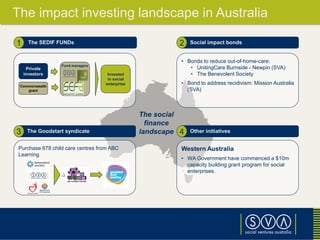
The impact investing landscape in Australia
The SEDIF FUNDs1
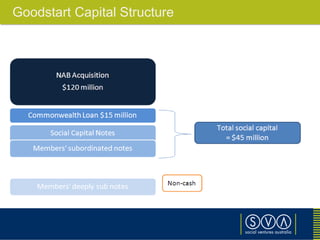
The Goodstart syndicate
Purchase 678 child care centres from ABC
Learning
3
Social impact bonds
• Bonds to reduce out-of-home-care:
• UnitingCare Burnside - Newpin (SVA)
• The Benevolent Society
• Bond to address recidivism: Mission Australia
(SVA)
2
Other initiatives
Western Australia
• WA Government have commenced a $10m
capacity building grant program for social
enterprises.
4
The social
finance
landscape
Private
investors
Commonwealth
grant
Fund managers
Invested
in social
enterprise
Goodstart Capital Structure
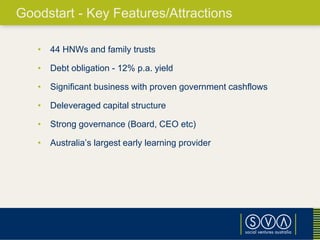
• 44 HNWs and family trusts
• Debt obligation - 12% p.a. yield
• Significant business with proven government cashflows
• Deleveraged capital structure
• Strong governance (Board, CEO etc)
• Australia’s largest early learning provider
Goodstart - Key Features/Attractions
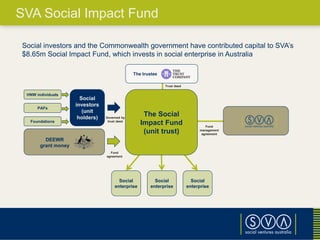
SVA Social Impact Fund
Social investors and the Commonwealth government have contributed capital to SVA’s
$8.65m Social Impact Fund, which invests in social enterprise in Australia
The Social
Impact Fund
(unit trust)
Social
enterprise
Social
enterprise
Social
enterprise
Social
investors
(unit
holders)
HNW individuals
PAFs
Foundations
DEEWR
grant money
The trustee
Fund
management
agreement
Trust deed
Governed by
trust deed
Fund
agreement
• Requirement for matched funding
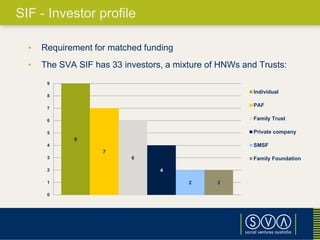
• The SVA SIF has 33 investors, a mixture of HNWs and Trusts:
SIF - Investor profile
9
7
6
4
2 2
0
1
2
3
4
5
6
7
8
9
Individual
PAF
Family Trust
Private company
SMSF
Family Foundation
• Min $50,000
• Only open to ‘wholesale investors’ (Net Worth $2.5m and/or
earnings >$250,000)
• Government funds are ‘subordinated’ to investor monies
• Expected returns potentially in excess of 9% p.a.
• Supporting social enterprise
SIF - Key Features/Attractions
10
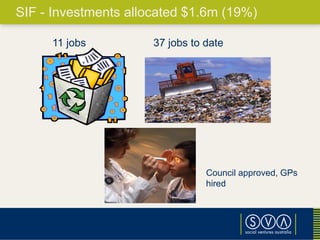
SIF - Investments allocated $1.6m (19%)
11 jobs
Council approved, GPs
hired
37 jobs to date
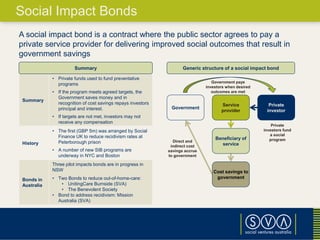
Social Impact Bonds
A social impact bond is a contract where the public sector agrees to pay a
private service provider for delivering improved social outcomes that result in
government savings
Generic structure of a social impact bond
Government
Service
provider
Private
investor
Beneficiary of
service
Cost savings to
government
Government pays
investors when desired
outcomes are met
Summary
• Private funds used to fund preventative
programs
• If the program meets agreed targets, the
Government saves money and in
recognition of cost savings repays investors
principal and interest.
• If targets are not met, investors may not
receive any compensation
History
• The first (GBP 5m) was arranged by Social
Finance UK to reduce recidivism rates at
Peterborough prison
• A number of new SIB programs are
underway in NYC and Boston
Bonds in
Australia
Three pilot impacts bonds are in progress in
NSW
• Two Bonds to reduce out-of-home-care:
• UnitingCare Burnside (SVA)
• The Benevolent Society
• Bond to address recidivism: Mission
Australia (SVA)
Private
investors fund
a social
programDirect and
indirect cost
savings accrue
to government
Summary
Text slide may show a series of bullets
Sample of 24 pt text bullet
• Single spacing with 0 pt before line and 0.3 after line
• Text box size is 12.4 cm Height and 21.6 cm Width
• Text box position is 3 cm Horizontal and 3.4 cm
Vertical from top left corner
Newpin Social Benefit Bond
13
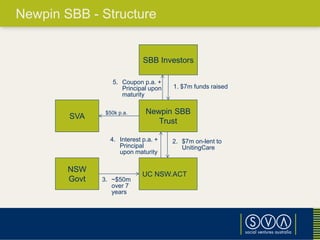
Newpin SBB - Structure
Newpin SBB
Trust
SVA
UC NSW.ACT
NSW
Govt
1. $7m funds raised
2. $7m on-lent to
UnitingCare
$50k p.a.
3. ~$50m
over 7
years
4. Interest p.a. +
Principal
upon maturity
5. Coupon p.a. +
Principal upon
maturity
SBB Investors
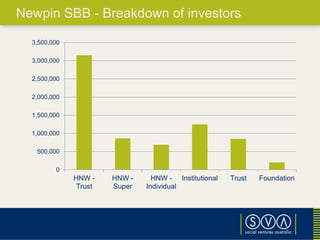
Newpin SBB - Breakdown of investors
0
500,000
1,000,000
1,500,000
2,000,000
2,500,000
3,000,000
3,500,000
HNW -
Trust
HNW -
Super
HNW -
Individual
Institutional Trust Foundation
15
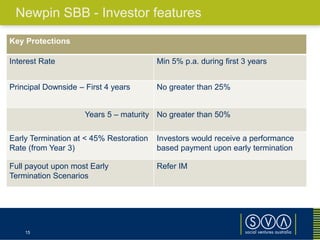
Newpin SBB - Investor features
Key Protections
Interest Rate Min 5% p.a. during first 3 years
Principal Downside – First 4 years No greater than 25%
Years 5 – maturity No greater than 50%
Early Termination at < 45% Restoration
Rate (from Year 3)
Investors would receive a performance
based payment upon early termination
Full payout upon most Early
Termination Scenarios
Refer IM
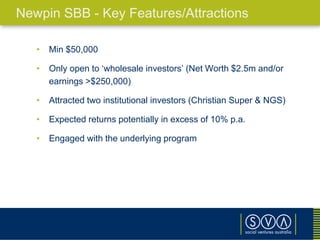
• Min $50,000
• Only open to ‘wholesale investors’ (Net Worth $2.5m and/or
earnings >$250,000)
• Attracted two institutional investors (Christian Super & NGS)
• Expected returns potentially in excess of 10% p.a.
• Engaged with the underlying program
Newpin SBB - Key Features/Attractions
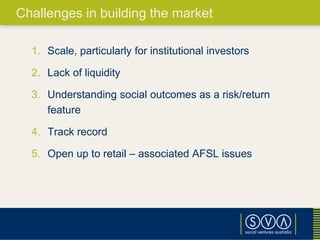
1. Scale, particularly for institutional investors
2. Lack of liquidity
3. Understanding social outcomes as a risk/return
feature
4. Track record
5. Open up to retail – associated AFSL issues
Challenges in building the market
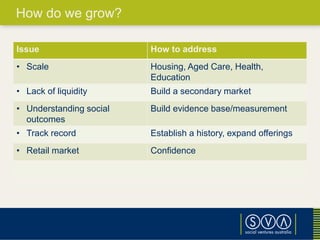
How do we grow?
Issue How to address
• Scale Housing, Aged Care, Health,
Education
• Lack of liquidity Build a secondary market
• Understanding social
outcomes
Build evidence base/measurement
• Track record Establish a history, expand offerings
• Retail market Confidence
Investor Market place
Questions?

Ian Learmonth

  • 2.
  • 3.
    1. What’s takenplace so far? 2. What’s attracted those investors? 3. What’s been a challenge in building the market? 4. The future - how do we grow this market? Overview
  • 4.
    The impact investinglandscape in Australia The SEDIF FUNDs1 The Goodstart syndicate Purchase 678 child care centres from ABC Learning 3 Social impact bonds • Bonds to reduce out-of-home-care: • UnitingCare Burnside - Newpin (SVA) • The Benevolent Society • Bond to address recidivism: Mission Australia (SVA) 2 Other initiatives Western Australia • WA Government have commenced a $10m capacity building grant program for social enterprises. 4 The social finance landscape Private investors Commonwealth grant Fund managers Invested in social enterprise
  • 5.
  • 6.
    • 44 HNWsand family trusts • Debt obligation - 12% p.a. yield • Significant business with proven government cashflows • Deleveraged capital structure • Strong governance (Board, CEO etc) • Australia’s largest early learning provider Goodstart - Key Features/Attractions
  • 7.
    SVA Social ImpactFund Social investors and the Commonwealth government have contributed capital to SVA’s $8.65m Social Impact Fund, which invests in social enterprise in Australia The Social Impact Fund (unit trust) Social enterprise Social enterprise Social enterprise Social investors (unit holders) HNW individuals PAFs Foundations DEEWR grant money The trustee Fund management agreement Trust deed Governed by trust deed Fund agreement
  • 8.
    • Requirement formatched funding • The SVA SIF has 33 investors, a mixture of HNWs and Trusts: SIF - Investor profile 9 7 6 4 2 2 0 1 2 3 4 5 6 7 8 9 Individual PAF Family Trust Private company SMSF Family Foundation
  • 9.
    • Min $50,000 •Only open to ‘wholesale investors’ (Net Worth $2.5m and/or earnings >$250,000) • Government funds are ‘subordinated’ to investor monies • Expected returns potentially in excess of 9% p.a. • Supporting social enterprise SIF - Key Features/Attractions
  • 10.
    10 SIF - Investmentsallocated $1.6m (19%) 11 jobs Council approved, GPs hired 37 jobs to date
  • 11.
    Social Impact Bonds Asocial impact bond is a contract where the public sector agrees to pay a private service provider for delivering improved social outcomes that result in government savings Generic structure of a social impact bond Government Service provider Private investor Beneficiary of service Cost savings to government Government pays investors when desired outcomes are met Summary • Private funds used to fund preventative programs • If the program meets agreed targets, the Government saves money and in recognition of cost savings repays investors principal and interest. • If targets are not met, investors may not receive any compensation History • The first (GBP 5m) was arranged by Social Finance UK to reduce recidivism rates at Peterborough prison • A number of new SIB programs are underway in NYC and Boston Bonds in Australia Three pilot impacts bonds are in progress in NSW • Two Bonds to reduce out-of-home-care: • UnitingCare Burnside (SVA) • The Benevolent Society • Bond to address recidivism: Mission Australia (SVA) Private investors fund a social programDirect and indirect cost savings accrue to government Summary
  • 12.
    Text slide mayshow a series of bullets Sample of 24 pt text bullet • Single spacing with 0 pt before line and 0.3 after line • Text box size is 12.4 cm Height and 21.6 cm Width • Text box position is 3 cm Horizontal and 3.4 cm Vertical from top left corner Newpin Social Benefit Bond
  • 13.
    13 Newpin SBB -Structure Newpin SBB Trust SVA UC NSW.ACT NSW Govt 1. $7m funds raised 2. $7m on-lent to UnitingCare $50k p.a. 3. ~$50m over 7 years 4. Interest p.a. + Principal upon maturity 5. Coupon p.a. + Principal upon maturity SBB Investors
  • 14.
    Newpin SBB -Breakdown of investors 0 500,000 1,000,000 1,500,000 2,000,000 2,500,000 3,000,000 3,500,000 HNW - Trust HNW - Super HNW - Individual Institutional Trust Foundation
  • 15.
    15 Newpin SBB -Investor features Key Protections Interest Rate Min 5% p.a. during first 3 years Principal Downside – First 4 years No greater than 25% Years 5 – maturity No greater than 50% Early Termination at < 45% Restoration Rate (from Year 3) Investors would receive a performance based payment upon early termination Full payout upon most Early Termination Scenarios Refer IM
  • 16.
    • Min $50,000 •Only open to ‘wholesale investors’ (Net Worth $2.5m and/or earnings >$250,000) • Attracted two institutional investors (Christian Super & NGS) • Expected returns potentially in excess of 10% p.a. • Engaged with the underlying program Newpin SBB - Key Features/Attractions
  • 17.
    1. Scale, particularlyfor institutional investors 2. Lack of liquidity 3. Understanding social outcomes as a risk/return feature 4. Track record 5. Open up to retail – associated AFSL issues Challenges in building the market
  • 18.
    How do wegrow? Issue How to address • Scale Housing, Aged Care, Health, Education • Lack of liquidity Build a secondary market • Understanding social outcomes Build evidence base/measurement • Track record Establish a history, expand offerings • Retail market Confidence
  • 19.