Social Impact Bonds 
opportunities and challenges for The Netherlands 
Björn Vennema 
Ruben Koekoek 
Amsterdam, 
September 2013
Social Impacts Bonds 2 
Abstract 
With decreasing governmental budgets, social interventions are not getting 
enough funding, while investors are looking for new opportunities to make 
investments, which will have a positive impact on society and the environment. 
These developments create room for growth and new products in the impact 
investing sector, of which Social Impact Bonds (SIB) is one. SIBs are multi-stakeholder 
partnerships, which provide upfront funding for social service 
providers by private investors instead of the government. Based on the savings 
that the service generates for the government, the government repays the 
investors, giving investors a possible return on their investment. 
The number of SIBs being issued is growing rapidly, with the United 
Kingdom as the clear fi rst mover having started the fi rst SIB in Peter-borough. 
The UK has a social investment sector of £163 billion. Before 
launching a SIB in The Netherlands, it is important to use the lessons 
learned from earlier SIBs. Even though those SIBs are not fi nished yet, 
there are already some important points to take into consideration. For 
instance, the profi tability, transfer of risk from government to individuals 
and the ways to measure the outcome are still unsure. That said, the poten-tial 
benefi ts for the three main stakeholders are good enough to consider 
SIBs as a serious alternative for the future funding of social interventions. 
In the Netherlands, unemployment, criminal activity and healthcare are 
three issues, which could be interesting for a fi rst pilot of a SIB. This is 
because they have the possibility to obtain concrete savings, which are 
relatively easy to measure and because they are big societal problems that 
are rapidly growing. For all three it is possible to structure a SIB. While 
other topics are of interest for SIBs as well, it is most likely that one of the 
three mentioned subjects will form the basis for the fi rst SIB issued in 
The Netherlands. 
Banks can take up an important role within SIBs. While banks are so 
diverse that they can take up different roles within a SIB, it is not likely nor 
wise to do so. It is important to fi nd the best role for a bank. In the fi rst 
stages it seems likely that the bank will facilitate SIBs by giving their 
(wealthy) clients the opportunity to invest in SIBs. In the latter case, it is 
likely that more local investors will take up a big amount of the investments 
because of the social bonding with their environment. 
Acknowledgements 
The authors of this paper would like to thank Rosanne Koning for her help 
in discovering the topic of Social Impact Bonds. Social Finance UK for 
giving us insight in their organisation of Social Impact Bonds and for their 
feedback on our research. We would like to thank Dr. Paul Iske, Jaspar 
Roos, Hans Cremer, Eric Buckens, Elizabeth Kleinveld, Neles van Raalten 
and Laurens Hamerlinck for their valuable feedback as well.
3
Social Impacts Bonds 4 
Introduction 4 
Reasoning behind report 4 
From donating and investing to impact investing 4 
What is a Social Impact Bond? 5 
Current situation Dutch public sector 6 
Current developments Dutch public sector 6 
Current result-based payments in the Netherlands 6 
The do’s and don’ts for stakeholders 7 
Risk transferring 7 
Measuring the outcomes 8 
Importance of a track-record 9 
Profi tability of Social Impact Bonds 10 
Analysis by sector 10 
Unemployment 11 
Criminal activity 12 
Healthcare 12 
Suitability of SIBs for the Dutch government 13 
The possible role for banks 14 
Banks as investors 14 
The network of a bank 15 
What if SIBs became actual bonds? 16 
Conclusions 17
5 
Reasoning behind report 
Can social problems be solved by governments alone? How 
can innovative solutions arise for societies’ most pressing 
issues in times of major budget constraints? How can the 
private and public sector work together to initiate cross-sec-torial 
solutions? Those are common questions that are 
currently being asked by multiple stakeholders in society. 
Social interventions are facing tough times to fund their 
programs. Governments face signifi cant budget cuts, 
which are being felt in municipalities and on a national 
level. Directors of social delivery programs are spending 
more time writing investment proposals and applying for 
subsidies and less on running their program and realizing 
social impact, thereby reducing the effectiveness of their 
interventions. 
Various solutions are being tried to face the aforementi-oned 
challenge, mostly based on a Payment By Results 
(PBR) structure. A PBR allows governments to pay directly 
for the results of public services instead of paying for the 
service itself. Payment is not made upfront but rather 
when results are realized. Only then does the service 
provider receive payment. Because of this, small service 
providers have major diffi culties footing the initial bill 
upfront. Furthermore, municipalities struggle to set up 
objective measurement procedures to make sure they 
only pay for real results. 
From donating and investing to impact investing 
The social sector is facing major 
changes. Social enterprises are on 
the rise, with the UK as the fi rst 
mover. The number of these new 
types of enterprises is growing in 
The Netherlands as well1, creating an entire new sector. 
Social enterprises are primarily focused on delivering social 
outcomes, but they do so in a fi nancially sustainable way. 
They are not dependent on subsidies or grants, because 
they run an enterprise that makes a fi nancial profi t. This 
new view on improving social challenges is seen as a 
major trend and is likely to continue to grow in the Nether-lands. 
To illustrate the growth that the sector has already 
experienced, the UK already has 688.000 social enter-prises, 
which employ two million employees and have 
created total revenues of £163 billion a year2. 
Social Enterprises also require funding, opening a new invest-ment 
category called impact investing. Investors are investing 
in social enterprises or interventions and sacrifi ce part of the 
fi nancial return to obtain social return. With the growing social 
enterprise sector, the impact investing sector is increasing as 
well. Leading to the launch of the Big Society Capital (BSC) 
fund by the UK government. For the BSC an amount of 
£600mln has been allocated to help the impact investing 
sector grow. It is expected that the total yearly demand for 
impact investing in 2016 will be approximately £1 billion3. 
1 Opportunities for the Dutch Social Enterprise sector, McKinsey & Company, November 2011, p.5 
2 G8 factsheet: social investment and social enterprise, UK Cabinet Offi ce, 3 June 2013 
3 The fi rst billion: a forecast of social investment demand, Boston Consulting Group, 2012
Social Impacts Bonds 6 
David Cameron arranged a special G8 meeting around 
social impact investing earlier in 2013 and announced next 
steps towards the facilitation of the sector4, highlighting 
the importance of impact investing. 
The basic principles behind investments in social enter-prises 
can also apply to social interventions. The difference 
is that the enterprises earn their own money, where the 
interventions don’t. But they do realize savings for the 
government on a number of levels. If we can relate those 
savings directly to the intervention, then impact investing 
might apply to interventions as well. Therefore, Social 
Impact Bonds can be of importance to developing the 
impact investing sector. 
What is a Social Impact Bond? 
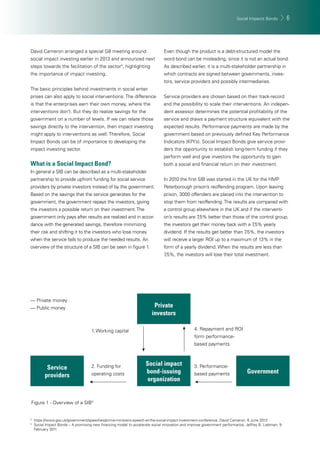
In general a SIB can be described as a multi-stakeholder 
partnership to provide upfront funding for social service 
providers by private investors instead of by the government. 
Based on the savings that the service generates for the 
government, the government repays the investors, giving 
the investors a possible return on their investment. The 
government only pays after results are realized and in accor-dance 
with the generated savings, therefore minimizing 
their risk and shifting it to the investors who lose money 
when the service fails to produce the needed results. An 
overview of the structure of a SIB can be seen in fi gure 1. 
Even though the product is a debt-structured model the 
word bond can be misleading, since it is not an actual bond. 
As described earlier, it is a multi-stakeholder partnership in 
which contracts are signed between governments, inves-tors, 
service providers and possibly intermediaries. 
Service providers are chosen based on their track-record 
and the possibility to scale their interventions. An indepen-dent 
assessor determines the potential profi tability of the 
service and draws a payment structure equivalent with the 
expected results. Performance payments are made by the 
government based on previously defi ned Key Performance 
Indicators (KPI’s). Social Impact Bonds give service provi-ders 
the opportunity to establish long-term funding if they 
perform well and give investors the opportunity to gain 
both a social and fi nancial return on their investment. 
In 2010 the fi rst SIB was started in the UK for the HMP 
Peterborough prison’s reoffending program. Upon leaving 
prison, 3000 offenders are placed into the intervention to 
stop them from reoffending. The results are compared with 
a control group elsewhere in the UK and if the interventi-on’s 
results are 7,5% better than those of the control group, 
the investors get their money back with a 7,5% yearly 
dividend. If the results get better than 7,5%, the investors 
will receive a larger ROI up to a maximum of 13% in the 
form of a yearly dividend. When the results are less than 
7,5%, the investors will lose their total investment. 
Private 
investors 
Social impact 
bond-issuing 
organization 
1. Working capital 
2. Funding for 
operating costs 
__ Private money 
__ Public money 
4. Repayment and ROI 
form performance-based 
payments 
3. Performance-based 
Service 
providers payments 
Government 
Figure 1 - Overview of a SIB5 
4 https://www.gov.uk/government/speeches/prime-ministers-speech-at-the-social-impact-investment-conference, David Cameron, 6 June 2013 
5 Social Impact Bonds – A promising new fi nancing model to accelerate social innovation and improve government performance, Jeffrey B. Liebman, 9 
February 2011
7 
Current developments Dutch public sector 
The developments in the world economy are not promising, 
leading to signifi cant budget cuts by governments. The 
Dutch government is no exception, and seeks opportunities 
to save money. Due to this, the government is withdrawing 
from a lot of subsidies, transferring more responsibility to 
civilians. The result is that a lot of projects that were depen-dent 
on subsidies are now in troubled waters because they 
are short on money and most of them lack the experience 
or knowledge to obtain funding on their own. 
Most social interventions were fully funded by the govern-ment. 
Now they either have to stop their intervention or 
dramatically reduce their efforts because of the funding 
gap. The lack of measurement exacerbates the problem, 
making it very diffi cult to see which interventions have 
really succeeded, and hence are well performing. This 
makes it diffi cult to select the ones to put the limited 
funding towards. Therefore, both the government and 
service providers are desperately looking for alternative 
funding options. Impact Investing and particularly SIBs can 
possibly fi ll the gap that the Dutch government leaves 
behind. 
Current result-based payments 
in the Netherlands 
The defi nition of subsidies used in this white paper is ‘a 
claim on fi nancial resources provided by governmental 
organizations for the purpose of certain activities of the 
applicant, other than as a payment for delivered services 
or products to that governmental organization.’6 There is a 
lot of room for different treatment of those subsidies. 
Recently in the Netherlands a lot of municipalities made 
performance agreements with social service providers 
changing from paying for services to fully paying for 
results and combinations of the two. 
Governments see the change in the way social services 
are funded, but have a tradition of making compromises. 
Therefore, they end up compromising between paying for 
services and paying for results. As a result, governments 
still end up footing the bill upfront and rarely pay for actual 
performance, thereby failing to reduce the risk on their 
‘investment’. 
Another problem for result-based payments in the Nether-lands 
is the inability to measure the outcome of the inter-vention 
successfully. Because governments often lack the 
resources or ability to track results on a more detailed 
level, there is a lack of clarity into the intervention’s real 
results. For instance, when an unemployed citizen stops 
his or her allowance, it is often not registered whether 
they did so because they got a job, went to prison or 
moved to another city. Not knowing the actual results 
makes it impossible to pay for performance. 
6 Beleidsnota – Resultaat met subsidie, Provinciaal Blad 2012, 23 November 2012, p. 34
Social Impacts Bonds 8 
Current Social Impact Bonds have shown some essential 
do’s and don’ts that are important to consider when laun-ching 
a successful SIB. Governments contemplating SIBs 
should take these into consideration while putting their 
program together. 
Risk transferring 
Since there are multiple partners involved in a Social Impact 
Bond, it is important to determine who bears the risk if the 
results are worse than expected. A major reason for govern-ments 
to use SIBs is to transfer the risk that they were fully 
bearing, to investors or to the service providers. It is important 
to confi gure the risk setup in a way that all stakeholders are 
satisfi ed and can be held accountable for the different targets. 
In the UK Peterborough pilot, investors accounted for all of 
the risk in setting up the program. However, the fi rst evalua-tion 
of the project states the following. “The data gathered 
in interviews suggest that there has been a transfer of risk 
from the government to the private investors. However, this 
transfer, and the contracts themselves, are untested in 
many respects: issues that challenge the contractual arran-gements 
and/or require clarifi cation through the contracts 
could still arise in the course of implementation and deter-mining 
outcomes and payments for this SIB.”7 Also the next 
paragraph states, “drawing on experience with private 
fi nance initiative contracts, complexity sometimes meant 
that the actual transfer of risk is not clear.”8 
These quotes suggest that even though a risk transfer 
was facilitated, accountability for project failure remains 
unclear. For example, to what degree private investors are 
able to pull the plug on the fi nancing if they don’t see 
enough results at interim reports is unknown. Of course, 
this will be less of a problem with more charitable or 
impact fi rst investors, but with investors that are more 
focused on fi nancial return it remains an issue. While the 
fi rst category will probably fi nance the fi rst few projects, 
Social Impact Bonds will only become scalable when also 
the latter investors will participate in a later stage. 
“Drawing on experience with private fi nance 
initiative contracts, complexity sometimes meant 
that the actual transfer of risk is not clear.” 
While risk-transferring is not yet fully covered by Social 
Impact Bonds, the SIB will dramatically decrease the risk 
taken by the government. In the current situation, the 
Dutch government takes on the full risk since the support 
of social services is seen as their responsibility. Therefore 
it is a move in the right direction when they share the 
responsibility with investors. 
7 Lessons learned from the planning and early implementation of the Social Impact Bond at HMP Peterborough, Emma Disley et al., May 2011, p. 54 
8 Ibid.
9 
Measuring the outcomes 
To be able to transform social impact into fi nancial return it is 
essential for SIBs that the outcomes of the delivered 
services are measured correctly and that it is clear which 
revenues the investors get in return for the outcome. 
Various local governments already use general tests to 
confi rm whether services have positive outcomes to make 
payments based on performance possible9. This shows that 
Dutch governments are willing to measure social impact and 
value the projects that they fund with performance indica-tors. 
However, to obtain a full fi nancial view, these tests are 
not suffi cient. To implement a SIB, the measurements 
should contain strong quantitative KPI’s, agreed upon in 
advance, valued by all stakeholders and measured by an 
independent party. 
The exact measurement of the full impact scope is nearly 
impossible. To illustrate this, it is interesting to examine a 
relatively simple re-employment intervention for youth in 
the age group of 18-27. The primary objective is to help 
participants fi nd a job, thereby stopping their govern-mental 
allowance. It also could be the case that they 
were previously engaged in a criminal activity. If criminal 
activity is reduced, it could account for savings as well. 
But what if they go back to school or participate in volun-tary 
work? Although everyone agrees these changes have 
a positive value, it is nearly impossible to make an objec-tive 
quantitative qualifi cation. Therefore, it is hard to put a 
defi nitive price on every outcome and determine all the 
savings in such a simple intervention. Choosing the 
factors that are the best and easiest to measure fi rst can 
simplify the process when these 
combine for enough savings to 
create a solid business case. 
Other effects will be presented as 
positive side-effects. 
Can the factors that actually contribute to the results of an 
intervention be determined? If a participant fi nds a job, 
can it be established that the intervention was the original 
cause of the result? When measuring the results of the 
intervention, it should be taken into account what 
happens when a participant becomes unemployment 
again and after what time period this occurs. Furthermore, 
there are several external factors that can infl uence 
outcome as well. For example, stress to the local and 
national economy or big unexpected events could have a 
disruptive effect on the outcome. In addition if too many 
similar projects are running at the same time, the control 
group will be infl uenced by other projects, making it 
harder to establish the actual cause of the result. Trying to 
do so can possibly be a waste of time and resources. 
Most of these problems can be overcome by using the 
tariff payment structure, which will be discussed in the 
next part of this chapter. 
To determine the scale on which measurements should 
be done, it is important to understand the objectives of 
the three main stakeholders of a SIB. It is the government 
that has to decide what they want to pay for each inter-vention. 
However, if the government is satisfi ed with the 
current measurements, why not take current measure-ments 
as a baseline for future reference. From there going 
forward, the fi nal structure can be the result of a negotia-tion 
process between the stakeholders. 
Importance of a track-record 
The importance of a track record is stated in a research 
about bringing SIBs to the United States. ‘SIBs offer a 
new option for expanding proven preventive programs’10. 
The previous statement suggests that service providers 
need a well-established track-record to be eligible for a 
SIB. This makes a lot of sense, since both investors and 
governments are putting up large sums of money to scale 
a service and without any track-record the risks are 
untenable. 
The biggest issue is that, as discussed in the previous 
paragraph, measurement has been done poorly up till 
now, both by the government and by the service provi-ders. 
Therefore it is hard to match service providers with 
proven track-records with the needs of a basic SIB. This of 
course serves as an obstacle during the process of fi nding 
the right service provider. 
Two options can be chosen to solve this problem. The fi rst 
is a traditional tender. If the scope of a project and the 
desired savings are determined, then a tender can be 
carried out. Since the tendering process is designed to 
come up with the best suitable provider for the desired 
service, this should result in the best social intervention 
for the best price. 
9 Prestatiesubsidies, http://www.rotterdam.nl/tekst:prestatiesubsidiecharlois, Retrieved on: 14 May 2013 
10 From potential to action: Bringing Social Impact Bonds to the US, Laura Callanen et al., May 2012, p. 12
Social Impacts Bonds 10 
One question remains whether the tender will be received 
with as much enthusiasm by the other stakeholders 
because tendering processes are not known for their fl exibi-lity 
and the results are not always what was anticipated. 
The second option will keep the responsibility of coming 
up with the potential savings at the government level. The 
government determines, based on all the available statis-tics, 
a tariff that they are willing to pay for each person 
helped by the intervention. The tariff also takes into 
account the amount of people that would’ve been helped 
anyway, resulting in approximately the same break-even 
point as with a control group. Service providers can apply 
or bid on the tariffs and the government will choose the 
best provider based on a combination of quality and price, 
creating possibilities for a tender within the tariff structure. 
Using a tariff-based structure will also solve some other 
issues. For example, softer problems (attendance in 
school, improved behaviour) are diffi cult to turn into clear 
cash savings while they still are of infl uence. When the 
government is able to make an ‘educated guess’ and 
determines a value that they are willing to pay for those 
softer results as well, it will be easier to include all the 
factors of a social intervention in a SIB. Furthermore, there 
is no control group needed to compare the results, making 
it easier to scale the interventions. 
It will make the SIB more convenient fi nancially as well. 
With a control group, the results can only be determined 
after the intervention is completed. Therefore, the inter-vention 
has to be pre-fi nanced for the project’s full 
duration. While the tariff structure gives the opportunity to 
pay directly when a result is obtained, making it possible 
to refi nance the intervention with profi t based on its own 
results during the timeframe of the SIB. Thus, less pre-fi - 
nancing is needed, reducing the risk for investors. 
Based on the aforementioned advantages it is very reaso-nable 
to assume that the fi rst SIBs will make use of the 
tariff structure when the track-record is not yet established. 
Profi tability of Social Impact Bonds 
First evaluations in the US show that re-entry programs in 
general are not necessarily profi table. Showing that with 
the current structure it will not be possible to have a 
re-entry SIB that is budget neutral for the government and 
at the same time pays enough dividend to the investors to 
make it profi table for them. 
The fi rst results of the evaluation delivered the following 
conclusions11: 
“A re-entry program fi nanced using a SIB 
would not produce suffi cient benefi ts to justify 
the operational costs or risks of engaging in 
this form of high-stakes contracting.” 
“A Social Impact Bond fi nanced program would 
not produce cost savings when outcomes 
are achieved, even under highly optimistic 
assumptions.” 
These conclusions should be taken seriously. While it 
might not be necessary to have a social solution that is 
fully cost-free for the government, signifi cantly reducing 
those costs should be the fi rst concern and is essential for 
the success of SIBs. The biggest problem is the extra 
organizational costs to set up the accounting and interme-diary 
structure. While these costs are relatively high for the 
current SIB pilots, with bigger SIBs (€20-30mln) the costs 
will become affordable. Even though allowances and social 
standards are high in the Netherlands compared with the 
US, it is hard to launch such a big SIB in such a small 
country. It is much more likely that SIBs will be packaged. 
This will create a more profi table SIB, but also more risk 
diversion because of the different projects that can be 
packaged, to make it more interesting for investors. 
11 Evaluating Social Impact Bonds as a new reentry fi nancing mechanism: A case study on reentry programming in Maryland, Kyle McKay, January 2013, p. 17
11 
Even though the Netherlands is a 
relatively small country, the social 
issues are very diverse through the 
different regions. While the basic 
topics will overlap, there are also different challenges for 
different cities. SIBs have to be scalable and of a signifi cant 
size to become fi nancially sustainable. Therefore it is impor-tant 
that the intervention commissioned by a SIB is scalable 
throughout the entire country. 
In this paper three different topics will be considered for a 
SIB, unemployment, criminal activity and healthcare. Besides 
unemployment and healthcare costs, which have risen 
exponentially in the last few years, it would also be interes-ting 
to see whether a SIB related to decreasing the number 
of reoffenders, like the HMP Peterborough SIB, would appli-cable 
in the Netherlands. 
As the review of the three different sectors will show, 
choosing the subject can also infl uence the type of inves-tors 
and play a big role in expanding the range of investors 
for social good, which is one of the primary goals for SIBs. 
Unemployment 
As most countries are experiencing during the current 
economic and political crisis, unemployment is also rising 
sharply in the Netherlands. Now up to a total of 650.000 
citizens are unemployed (8,2% unemployment rate12), 
while the unemployment rate for youth is already up to 
15,5%13. The city of Rotterdam stands out with a general 
unemployment rate of 13,9%14. These numbers have been 
rising steadily since mid-2011 and more than doubled 
since the start of the crisis in 2008. 
Just a 1% improvement on the number 
of unemployed can save €56mln for 
the Dutch government 
People who are unemployed in the Netherlands have the 
right to apply for an allowance to pay their expenses. The 
allowance per person is €14.400 per year. With 390.000 
people receiving an allowance15, a total of €5.616.000.000 in 
governmental expenses is spent on these yearly allowances. 
This does not account for the indirect costs incurred due to 
increased healthcare costs and increased criminal activity. 
Just a 1% improvement on that total number of unemployed 
people in the Netherlands can save the government €56mln, 
which shows the potential for SIBs on the market of unem-ployment. 
An overview of the basic factors that determine 
the potential measurements for an unemployment SIB are 
shown, together with their (dis)advantages. 
12 Totaalbeeld arbeidsmarkt: werkloosheid gestegen tot 12 procent, http://www.cbs.nl/nl-NL/menu/themas/arbeid-sociale-zekerheid/publicaties/arbeidsmarkt-vogelvlucht/ 
korte-termijn-ontw/2006-arbeidsmarkt-vv-totaal-art.htm, Retrieved on: 15 May 2013 
13 Jeugdwerkloosheid fl inke kluif, http://nos.nl/artikel/491545-jeugdwerkloosheid-fl inke-kluif.html, Retrieved on: 19 June 2013 
14 http://statline.cbs.nl/StatWeb/publication/?DM=SLNL&PA=71761ned&D1=1-3,7&D2=0,5-20&D3=l&VW=T 
15 Sterkere stijging aantal bijstandsontvangers, Centraal Bureau voor Statistiek, 31 May 2013
Social Impacts Bonds 12 
Unemployment itself 
The easiest statistic to use would be the percentage of 
unemployed people who fi nd a job. Since unemployed 
persons receive a monthly allowance of €1200, for a total 
of €14.400 per year, every person who fi nds a job, would 
result in a yearly savings of €14.400 (not taking extra orga-nizational 
costs into account). In the fi rst stages, these 
organizational costs are not taken into account. It is not 
certain whether small decreases of unemployed will lead to 
a smaller or more effi cient governmental organization. 
Criminal activity16 
Citizens who are unemployed are more likely to engage in 
criminal activities, hence reducing the number of unemployed 
people should lead to a reduction in the local criminal activity, 
resulting in cost savings related to decreased use of the police 
force and detention facilities. While the size of the police force 
will not be reduced as a result of these outcomes, it can lead 
to focus being given to other areas that require attention. In 
SIBs the savings related to a decrease in use of the police 
force and detention facilities will be directly related to the 
reduced deployment for the targeted population. 
Education 
The level of completed education has a major infl uence on 
the probability of unemployment. People without education 
are unemployed or in contact with the police fi ve times more 
than those who have completed an education17. Therefore, 
education is an important factor in unemployment. 
Income taxes 
Often overlooked as a benefi t, but once people get a job 
and an income, they start to pay taxes, also adding extra 
income for the government. Although this benefi t is hard 
to measure precisely, an estimate can be made or the 
people in the program can be followed to come up with 
more exact results. It is reasonable to assume that 
benefi ts may increase yearly with the rise in a person’s 
salary, which entails a big future benefi t. These benefi ts 
could also compensate for the small amount of risk taken 
by the government and the not fully profi table SIB. 
Criminal activity 
While criminality in itself is a problem worth looking into, 
recidivism, or a relapse into crime, comes to mind fi rst, 
because of the fi rst SIB started in Peterborough, UK. 
While the number of citizens that engage in any form of 
criminal activity is relatively low, the two-year reoffending 
rate of former prisoners is 47,7% and for juvenile prisoners it 
is 57,2%18. As these statistics show, the majority of 
convicted criminals will reoffend, which accounts for an 
increase of problems. In the UK this striking problem was 
recognized and formed the basis for the fi rst ever SIB. 
Should other countries start with recidivism SIBs right away? 
Not necessarily. Research shows that a re-entry SIB will not 
necessarily turn into a profi table project for the government 
and thus not realize net savings19. But the profi tability of a 
project is probably not a primary concern. If the government 
is willing to pay these costs knowing that they fund a scaled 
and well-performing intervention, there is no problem what-soever. 
Especially since they will have shifted risk away even 
when there is a slight project loss and therefore lose less 
money than they would have done by subsidizing it. The 
same factors that apply for the unemployment sector would 
also apply in determining the savings for a criminality SIB. 
Healthcare 
With the aging population the healthcare costs are rising 
exponentially. Turning healthcare costs into the single largest 
cost to the government, resulting in spending €5535 per 
Dutch citizen per year on healthcare20. This amount is 
expected to rise dramatically in the near future. Hence 
these costs could become the biggest societal problem in 
the future. It is not surprising that there are numerous 
start-ups trying to solve these problems by launching new 
services and products in the healthcare sector 
Other interesting topics for SIB’s in 
the Netherlands include care for the 
elderly, fi ghting obesity and/or 
caring for the homeless. There are 
enough topics to consider, however, determining which 
one is the most suitable is outside the scope of this paper. 
It would be an interesting topic for future research. SIBs in 
healthcare create opportunities for investors to benefi t in 
multiple ways. Health insurance companies would benefi t 
from clients whom are healthier and therefore fi le fewer 
claims. Large corporates could also consider investing in a 
SIB that includes their own workforce, as improving the 
health of their employees should lead to fewer sick days 
and better performance. Hence, investing in such a SIB 
would be very interesting. 
16 Unemployment, Inequality, and Crime. Spatial Distribution Patterns of Criminal Acts in Belgium 2001-2006, Marc Hooghe et al., British Journal of 
Criminology 51, 2011, pp. 1-20 
17 Voortijdig schoolverlaten, werkloosheid en delinquentie: cumulatie van risicogedrag onder jongeren in Nederland, Sociaal economische trends, Tanja Traag 
and Olivier Marie, Q4 1022 
18 Recidivebericht 2012, B.S.J. Wantra et al., Wetenschappelijk Onderzoek- en Documentatiecentrum, December 2012 
19 Evaluation Social Impact Bonds as a new reentry fi nancing mechanism: A case study on reentry programming in Maryland, Kyle McKay, January 2013, 
pp. 4-11 
20 http://statline.cbs.nl/StatWeb/publication/?VW=T&DM=SLNL&PA=71914NED&D1=0-23,37-45&D2=9-l&HD=101210-0925&HDR=G1&STB=T, Retrieved 
on: 16 May 2013
13 
The Dutch government is very bureaucratic with multiple 
agencies holding different cost structures, responsibilities 
and different approaches to problems. Because the local 
and national governmental agencies have different depart-ments 
with different responsibilities, both should be 
involved. That said, this makes it more diffi cult to deter-mine 
which payment should go to which department. For 
instance, if an intervention helps juveniles to get out of 
criminal circles or to become employed, then costs related 
to detaining and policing them will be reduced. In addition, 
certain allowances will also be saved. While the allo-wances 
are paid and registered separately by every muni-cipality, 
the detention and police costs are paid by different 
departments within the national government. Therefore, 
every department has to agree on the structure of 
payments or at least the negotiation of terms. This may 
bring some additional challenges in structuring a SIB. 
If the intervention is successful and is scaled to multiple 
cities, the municipality of every city has to agree on paying 
for the savings, as well as the different national depart-ments. 
This can easily become overly complex with too 
many stakeholders to be easily managed. This brings us 
back to the same problems that these organizations are 
facing currently, therefore these agencies may think that 
they are not garnering enough value by using a SIB. 
To create the right environment for Social Impact Bonds, 
structural changes are needed. If the government is willing 
to involve private investors to invest in fi nancial models 
like SIBs, they have to ensure that bureaucracy doesn’t 
get in the way. If investors and/or intermediaries are 
forced to go through the lengthy process of involving all 
the departments, creating an affordable SIB would be 
almost impossible. 
Hence, assigning one governmental department oversight 
for Social Investment is needed. This department should 
be able to sign off on multi-department deals, enabling 
them to be completed in a timely fashion and improving 
scalability. In so doing, there will be many more opportuni-ties 
to fully leverage the advantages of SIBs.
Social Impacts Bonds 14 
There are very different roles 
required to originate a SIB; all can 
be fi lled by different kinds of people 
and/or organizations. Because 
banks are so diverse, they could be multiple stakeholders 
in creating a SIB, however, this is not a sustainable model 
since confl icts of interest could arise. Therefore, it is 
important to determine the most suitable role for them. 
As a result of the current economic crisis, banks have been 
asked to ensure that they manage the tension between 
their interests and the interest of their various stakeholders 
better. Both the public and politicians believe that banks 
should become more socially involved. In addition, they are 
being required by the regulators to maintain larger fi nancial 
buffers. Impact investing could be a way for banks to show 
their commitment to society by creating investment 
vehicles aimed at solving societal problems. 
Banks as investors 
Attracting capital and lending it out are two of the most 
important functions of a bank, so naturally seeing a bank as 
one of the investors seems reasonable. SIBs are concerned 
with a relatively small amount of money and it gives huge 
opportunities for banks to put their money where their 
mouth is in building a better, more sustainable world. 
Accepting a much lower return on investment can be a 
great trade-off for investing in the society and actually help. 
The fi rst bank to invest in SIBs was Goldman Sachs, who 
funded a $10 mln SIB in New York21. While some may say 
that this is a minor step, since $7.2mln of their $10 mln 
investment was guaranteed by the Bloomberg foundation, 
it does shows that Goldman Sachs has an interest in explo-ring 
this terrain. This may be the fi rst step, signaling other 
banks to become involved in SIBs as investors. 
If banks are sincere about investing in social impact and are 
willing to generate lower fi nancial returns for these invest-ments, 
they can be valuable investors and should be 
approached when starting a SIB. That said, the major 
benefi ts for “related” or local investors shouldn’t be over-looked 
and are probably both more appealing and better 
suited to the originators of a SIB. 
By related investors we refer to companies, such as health 
insurers that directly benefi t from the improved health of 
their customers or companies who benefi t from the 
improved health and productivity of their employees. 
Furthermore, we should not forget the target group of 
high net worth individuals. Many high net worth indivi-duals 
invest in various types of business opportunities, 
with different reward structures. They are very often very 
interested in impact investing and may be even more 
determined to ensure that the project achieves actual 
results. 
21 Goldman belegt in delinquenten, Joris Kooiman, Het Financieel Dagblad, 23 August 2012, p. 11
15 
Herein lies a perfect opportunity for them to invest in 
interventions that are active in their own community and/ 
or those dealing with societal issues for which they have a 
close affi nity. Many of these people are already involved in 
their local communities and have an emotional bond with 
specifi c locations or areas. A good example is the invest-ment 
of a group of local individuals in the football club 
Feyenoord. They “donated” their money by putting up 
capital because of their bond with the city and the club. 
The same could apply for SIBs, making local high net 
worth individuals the best-suited target group as investors. 
Certainly one of the roles a bank could play would be in 
putting their network of wealthy clients in touch with SIB 
investment opportunities. 
If SIBs are developed on a smaller scale, other opportuni-ties 
for local investors may be possible, including the 
opportunity to crowdfund part of the project. It may not be 
possible to fund complete projects in this manner, since 
often the investment needed for these projects is so large, 
yet offering to develop parts of the project via crowdfun-ding 
could be very interesting, especially since involving 
local population more increases the odds of success 
signifi cantly. 
The network of a bank 
As previously mentioned, if high net worth individuals are 
the most obvious investors for particular SIBs, a bank will 
be able to play a major role as a facilitator. Most banks 
have departments which provide special services to 
wealthy individuals and families, helping them even to 
become angel investors and sometimes to set up their 
own investment funds. Because these clients are very 
important for banks, the bankers know their individual 
profi le and preferences. Hence, they will know who is 
willing to invest in social interventions and in what type of 
intervention they’d be most interested in investing. When 
a bank is involved with a SIB, it can directly link the SIBs 
needs to the right investors and even package SIBs to 
propose a diverse and more scalable investment opportu-nity 
for their clients. As a facilitator, banks can increase the 
speed in which SIBs will go up and running. This can help 
fuel growth in impact investing. 
An interesting opportunity for banks would certainly be 
taking on the role of a facilitator. One way to do this would 
be to develop a platform where they can combine their 
internal and external networks without incurring issues 
related to privacy. 
What if SIBs became actual bonds? 
From a fi nancial point of view, originating actual bonds could 
be very interesting. SIBs are called bonds, but are not actually 
bonds. But what if they were, what opportunities would that 
create? 
Essentially, SIBs are debt-structured 
products with pre-fi nancing and 
dividend payments, just like bonds. 
But the results of SIBs are much 
more uncertain and deemed riskier 
than normal bonds. It is almost impossible to defi ne a 
standard rate for the dividend payments, since that is 
determined based on the results of the actual intervention. 
Hypothetically, when a fi xed return rate can be guaran-teed, 
packaging SIBs as bonds can attract a lot of intere-sted 
investors that are attracted by the relatively low risk 
return on investment. Furthermore, banks are already 
issuing bonds on a huge scale, so SIBs could be a minor 
addition to their portfolio. Making it easier to involve banks 
in SIBs, but also to scale SIBs. Once the bonds are up and 
running, it can be easily duplicated. If bonds are issued, it 
immediately creates a secondary market for SIBs. Laun-ching 
SIBs within a huge pool of potential investors and a 
lot of potential to scale fast. 
Another major problem with issuing bonds is that it fails to 
shift away some of the risk to investors, which was one of 
the intended benefi ts of SIBs. In Minnesota, USA, they 
are trying to shift most of the risk over to the service 
providers using Human Capital Performance Bonds22. It 
remains to be seen if service providers will agree with 
such a structure, but also the government needs to know 
for sure that they are willing to partner up with a construc-tion 
in which social fi nance providers can have their invest-ment 
practically destroyed when an intervention fails to 
reach their targets. This doesn’t sound sustainable and it is 
not very likely that the Dutch government is going to 
embrace such a construction. 
While issuing actual bonds might appear interesting for 
fi nancial institutions at fi rst, it doesn’t seem to be a reaso-nable 
and sustainable option in the longrun. 
22 Human Capital Performance Bonds, Invest in Outcomes, www.investinoutcomes.org
Social Impacts Bonds 16 
Social Impact Bonds can be a very interesting instrument 
for fi nding alternative sources of fi nancing societal issues 
in the Netherlands. This may require a paradigm shift for 
both the government and service providers. If that is 
achieved, then SIBs may provide an impetus for improving 
the social sector in the long term. Seeing that the interest 
for SIBs is growing rapidly, we may see some of the fi rst 
pilots being launched in the near future. 
While this paper shows that there are still challenges to 
overcome, it also shows numerous opportunities for a 
variety of stakeholders. One of those challenges is how to 
transfer risk. How to do this may not become evident until 
the fi rst SIB fails. As measurements improve and service 
providers build better track records, the way in which to 
measure the success and payment structure will become 
more apparent. 
From our discussions we believe that the fi rst pilots in the 
Netherlands will probably be with a SIB related to 
reducing unemployment or re-offending criminality. Once 
the structure is in place, it will not be diffi cult to add other 
sectors with social issues as SIBs candidates as well. 
This is especially true when the Dutch government 
supports SIBs on a larger scale, streamlining partners and 
the process of measuring and paying for agreed upon 
results. 
From the perspective of the banks SIBs can be very 
interesting as well, especially when they can offer this 
opportunity to their clients. While the fi rst step has been 
made by Goldman Sachs, it is unclear which role(s) banks 
will end up taking. At the very least, this paper has made 
the case for banks supporting the development of new 
SIBs so they can offer them as a social investment oppor-tunity 
to their clients. 
Even though there are no SIBs in the Netherlands, laun-ching 
a SIB is still viewed as a very interesting opportunity 
and one could possibly be launched in 2013 or 2014. From 
the time of the launch of the fi rst Dutch SIB, it will be very 
interesting to see whether the concept will take off or 
whether there will be a holding period, in which others 
wait in the background until more is understood about the 
SiB structure as well as its associated benefi ts and pitfalls.

Social Impacts Bonds by ABN Amro

  • 1.
    Social Impact Bonds opportunities and challenges for The Netherlands Björn Vennema Ruben Koekoek Amsterdam, September 2013
  • 2.
    Social Impacts Bonds2 Abstract With decreasing governmental budgets, social interventions are not getting enough funding, while investors are looking for new opportunities to make investments, which will have a positive impact on society and the environment. These developments create room for growth and new products in the impact investing sector, of which Social Impact Bonds (SIB) is one. SIBs are multi-stakeholder partnerships, which provide upfront funding for social service providers by private investors instead of the government. Based on the savings that the service generates for the government, the government repays the investors, giving investors a possible return on their investment. The number of SIBs being issued is growing rapidly, with the United Kingdom as the clear fi rst mover having started the fi rst SIB in Peter-borough. The UK has a social investment sector of £163 billion. Before launching a SIB in The Netherlands, it is important to use the lessons learned from earlier SIBs. Even though those SIBs are not fi nished yet, there are already some important points to take into consideration. For instance, the profi tability, transfer of risk from government to individuals and the ways to measure the outcome are still unsure. That said, the poten-tial benefi ts for the three main stakeholders are good enough to consider SIBs as a serious alternative for the future funding of social interventions. In the Netherlands, unemployment, criminal activity and healthcare are three issues, which could be interesting for a fi rst pilot of a SIB. This is because they have the possibility to obtain concrete savings, which are relatively easy to measure and because they are big societal problems that are rapidly growing. For all three it is possible to structure a SIB. While other topics are of interest for SIBs as well, it is most likely that one of the three mentioned subjects will form the basis for the fi rst SIB issued in The Netherlands. Banks can take up an important role within SIBs. While banks are so diverse that they can take up different roles within a SIB, it is not likely nor wise to do so. It is important to fi nd the best role for a bank. In the fi rst stages it seems likely that the bank will facilitate SIBs by giving their (wealthy) clients the opportunity to invest in SIBs. In the latter case, it is likely that more local investors will take up a big amount of the investments because of the social bonding with their environment. Acknowledgements The authors of this paper would like to thank Rosanne Koning for her help in discovering the topic of Social Impact Bonds. Social Finance UK for giving us insight in their organisation of Social Impact Bonds and for their feedback on our research. We would like to thank Dr. Paul Iske, Jaspar Roos, Hans Cremer, Eric Buckens, Elizabeth Kleinveld, Neles van Raalten and Laurens Hamerlinck for their valuable feedback as well.
  • 3.
  • 4.
    Social Impacts Bonds4 Introduction 4 Reasoning behind report 4 From donating and investing to impact investing 4 What is a Social Impact Bond? 5 Current situation Dutch public sector 6 Current developments Dutch public sector 6 Current result-based payments in the Netherlands 6 The do’s and don’ts for stakeholders 7 Risk transferring 7 Measuring the outcomes 8 Importance of a track-record 9 Profi tability of Social Impact Bonds 10 Analysis by sector 10 Unemployment 11 Criminal activity 12 Healthcare 12 Suitability of SIBs for the Dutch government 13 The possible role for banks 14 Banks as investors 14 The network of a bank 15 What if SIBs became actual bonds? 16 Conclusions 17
  • 5.
    5 Reasoning behindreport Can social problems be solved by governments alone? How can innovative solutions arise for societies’ most pressing issues in times of major budget constraints? How can the private and public sector work together to initiate cross-sec-torial solutions? Those are common questions that are currently being asked by multiple stakeholders in society. Social interventions are facing tough times to fund their programs. Governments face signifi cant budget cuts, which are being felt in municipalities and on a national level. Directors of social delivery programs are spending more time writing investment proposals and applying for subsidies and less on running their program and realizing social impact, thereby reducing the effectiveness of their interventions. Various solutions are being tried to face the aforementi-oned challenge, mostly based on a Payment By Results (PBR) structure. A PBR allows governments to pay directly for the results of public services instead of paying for the service itself. Payment is not made upfront but rather when results are realized. Only then does the service provider receive payment. Because of this, small service providers have major diffi culties footing the initial bill upfront. Furthermore, municipalities struggle to set up objective measurement procedures to make sure they only pay for real results. From donating and investing to impact investing The social sector is facing major changes. Social enterprises are on the rise, with the UK as the fi rst mover. The number of these new types of enterprises is growing in The Netherlands as well1, creating an entire new sector. Social enterprises are primarily focused on delivering social outcomes, but they do so in a fi nancially sustainable way. They are not dependent on subsidies or grants, because they run an enterprise that makes a fi nancial profi t. This new view on improving social challenges is seen as a major trend and is likely to continue to grow in the Nether-lands. To illustrate the growth that the sector has already experienced, the UK already has 688.000 social enter-prises, which employ two million employees and have created total revenues of £163 billion a year2. Social Enterprises also require funding, opening a new invest-ment category called impact investing. Investors are investing in social enterprises or interventions and sacrifi ce part of the fi nancial return to obtain social return. With the growing social enterprise sector, the impact investing sector is increasing as well. Leading to the launch of the Big Society Capital (BSC) fund by the UK government. For the BSC an amount of £600mln has been allocated to help the impact investing sector grow. It is expected that the total yearly demand for impact investing in 2016 will be approximately £1 billion3. 1 Opportunities for the Dutch Social Enterprise sector, McKinsey & Company, November 2011, p.5 2 G8 factsheet: social investment and social enterprise, UK Cabinet Offi ce, 3 June 2013 3 The fi rst billion: a forecast of social investment demand, Boston Consulting Group, 2012
  • 6.
    Social Impacts Bonds6 David Cameron arranged a special G8 meeting around social impact investing earlier in 2013 and announced next steps towards the facilitation of the sector4, highlighting the importance of impact investing. The basic principles behind investments in social enter-prises can also apply to social interventions. The difference is that the enterprises earn their own money, where the interventions don’t. But they do realize savings for the government on a number of levels. If we can relate those savings directly to the intervention, then impact investing might apply to interventions as well. Therefore, Social Impact Bonds can be of importance to developing the impact investing sector. What is a Social Impact Bond? In general a SIB can be described as a multi-stakeholder partnership to provide upfront funding for social service providers by private investors instead of by the government. Based on the savings that the service generates for the government, the government repays the investors, giving the investors a possible return on their investment. The government only pays after results are realized and in accor-dance with the generated savings, therefore minimizing their risk and shifting it to the investors who lose money when the service fails to produce the needed results. An overview of the structure of a SIB can be seen in fi gure 1. Even though the product is a debt-structured model the word bond can be misleading, since it is not an actual bond. As described earlier, it is a multi-stakeholder partnership in which contracts are signed between governments, inves-tors, service providers and possibly intermediaries. Service providers are chosen based on their track-record and the possibility to scale their interventions. An indepen-dent assessor determines the potential profi tability of the service and draws a payment structure equivalent with the expected results. Performance payments are made by the government based on previously defi ned Key Performance Indicators (KPI’s). Social Impact Bonds give service provi-ders the opportunity to establish long-term funding if they perform well and give investors the opportunity to gain both a social and fi nancial return on their investment. In 2010 the fi rst SIB was started in the UK for the HMP Peterborough prison’s reoffending program. Upon leaving prison, 3000 offenders are placed into the intervention to stop them from reoffending. The results are compared with a control group elsewhere in the UK and if the interventi-on’s results are 7,5% better than those of the control group, the investors get their money back with a 7,5% yearly dividend. If the results get better than 7,5%, the investors will receive a larger ROI up to a maximum of 13% in the form of a yearly dividend. When the results are less than 7,5%, the investors will lose their total investment. Private investors Social impact bond-issuing organization 1. Working capital 2. Funding for operating costs __ Private money __ Public money 4. Repayment and ROI form performance-based payments 3. Performance-based Service providers payments Government Figure 1 - Overview of a SIB5 4 https://www.gov.uk/government/speeches/prime-ministers-speech-at-the-social-impact-investment-conference, David Cameron, 6 June 2013 5 Social Impact Bonds – A promising new fi nancing model to accelerate social innovation and improve government performance, Jeffrey B. Liebman, 9 February 2011
  • 7.
    7 Current developmentsDutch public sector The developments in the world economy are not promising, leading to signifi cant budget cuts by governments. The Dutch government is no exception, and seeks opportunities to save money. Due to this, the government is withdrawing from a lot of subsidies, transferring more responsibility to civilians. The result is that a lot of projects that were depen-dent on subsidies are now in troubled waters because they are short on money and most of them lack the experience or knowledge to obtain funding on their own. Most social interventions were fully funded by the govern-ment. Now they either have to stop their intervention or dramatically reduce their efforts because of the funding gap. The lack of measurement exacerbates the problem, making it very diffi cult to see which interventions have really succeeded, and hence are well performing. This makes it diffi cult to select the ones to put the limited funding towards. Therefore, both the government and service providers are desperately looking for alternative funding options. Impact Investing and particularly SIBs can possibly fi ll the gap that the Dutch government leaves behind. Current result-based payments in the Netherlands The defi nition of subsidies used in this white paper is ‘a claim on fi nancial resources provided by governmental organizations for the purpose of certain activities of the applicant, other than as a payment for delivered services or products to that governmental organization.’6 There is a lot of room for different treatment of those subsidies. Recently in the Netherlands a lot of municipalities made performance agreements with social service providers changing from paying for services to fully paying for results and combinations of the two. Governments see the change in the way social services are funded, but have a tradition of making compromises. Therefore, they end up compromising between paying for services and paying for results. As a result, governments still end up footing the bill upfront and rarely pay for actual performance, thereby failing to reduce the risk on their ‘investment’. Another problem for result-based payments in the Nether-lands is the inability to measure the outcome of the inter-vention successfully. Because governments often lack the resources or ability to track results on a more detailed level, there is a lack of clarity into the intervention’s real results. For instance, when an unemployed citizen stops his or her allowance, it is often not registered whether they did so because they got a job, went to prison or moved to another city. Not knowing the actual results makes it impossible to pay for performance. 6 Beleidsnota – Resultaat met subsidie, Provinciaal Blad 2012, 23 November 2012, p. 34
  • 8.
    Social Impacts Bonds8 Current Social Impact Bonds have shown some essential do’s and don’ts that are important to consider when laun-ching a successful SIB. Governments contemplating SIBs should take these into consideration while putting their program together. Risk transferring Since there are multiple partners involved in a Social Impact Bond, it is important to determine who bears the risk if the results are worse than expected. A major reason for govern-ments to use SIBs is to transfer the risk that they were fully bearing, to investors or to the service providers. It is important to confi gure the risk setup in a way that all stakeholders are satisfi ed and can be held accountable for the different targets. In the UK Peterborough pilot, investors accounted for all of the risk in setting up the program. However, the fi rst evalua-tion of the project states the following. “The data gathered in interviews suggest that there has been a transfer of risk from the government to the private investors. However, this transfer, and the contracts themselves, are untested in many respects: issues that challenge the contractual arran-gements and/or require clarifi cation through the contracts could still arise in the course of implementation and deter-mining outcomes and payments for this SIB.”7 Also the next paragraph states, “drawing on experience with private fi nance initiative contracts, complexity sometimes meant that the actual transfer of risk is not clear.”8 These quotes suggest that even though a risk transfer was facilitated, accountability for project failure remains unclear. For example, to what degree private investors are able to pull the plug on the fi nancing if they don’t see enough results at interim reports is unknown. Of course, this will be less of a problem with more charitable or impact fi rst investors, but with investors that are more focused on fi nancial return it remains an issue. While the fi rst category will probably fi nance the fi rst few projects, Social Impact Bonds will only become scalable when also the latter investors will participate in a later stage. “Drawing on experience with private fi nance initiative contracts, complexity sometimes meant that the actual transfer of risk is not clear.” While risk-transferring is not yet fully covered by Social Impact Bonds, the SIB will dramatically decrease the risk taken by the government. In the current situation, the Dutch government takes on the full risk since the support of social services is seen as their responsibility. Therefore it is a move in the right direction when they share the responsibility with investors. 7 Lessons learned from the planning and early implementation of the Social Impact Bond at HMP Peterborough, Emma Disley et al., May 2011, p. 54 8 Ibid.
  • 9.
    9 Measuring theoutcomes To be able to transform social impact into fi nancial return it is essential for SIBs that the outcomes of the delivered services are measured correctly and that it is clear which revenues the investors get in return for the outcome. Various local governments already use general tests to confi rm whether services have positive outcomes to make payments based on performance possible9. This shows that Dutch governments are willing to measure social impact and value the projects that they fund with performance indica-tors. However, to obtain a full fi nancial view, these tests are not suffi cient. To implement a SIB, the measurements should contain strong quantitative KPI’s, agreed upon in advance, valued by all stakeholders and measured by an independent party. The exact measurement of the full impact scope is nearly impossible. To illustrate this, it is interesting to examine a relatively simple re-employment intervention for youth in the age group of 18-27. The primary objective is to help participants fi nd a job, thereby stopping their govern-mental allowance. It also could be the case that they were previously engaged in a criminal activity. If criminal activity is reduced, it could account for savings as well. But what if they go back to school or participate in volun-tary work? Although everyone agrees these changes have a positive value, it is nearly impossible to make an objec-tive quantitative qualifi cation. Therefore, it is hard to put a defi nitive price on every outcome and determine all the savings in such a simple intervention. Choosing the factors that are the best and easiest to measure fi rst can simplify the process when these combine for enough savings to create a solid business case. Other effects will be presented as positive side-effects. Can the factors that actually contribute to the results of an intervention be determined? If a participant fi nds a job, can it be established that the intervention was the original cause of the result? When measuring the results of the intervention, it should be taken into account what happens when a participant becomes unemployment again and after what time period this occurs. Furthermore, there are several external factors that can infl uence outcome as well. For example, stress to the local and national economy or big unexpected events could have a disruptive effect on the outcome. In addition if too many similar projects are running at the same time, the control group will be infl uenced by other projects, making it harder to establish the actual cause of the result. Trying to do so can possibly be a waste of time and resources. Most of these problems can be overcome by using the tariff payment structure, which will be discussed in the next part of this chapter. To determine the scale on which measurements should be done, it is important to understand the objectives of the three main stakeholders of a SIB. It is the government that has to decide what they want to pay for each inter-vention. However, if the government is satisfi ed with the current measurements, why not take current measure-ments as a baseline for future reference. From there going forward, the fi nal structure can be the result of a negotia-tion process between the stakeholders. Importance of a track-record The importance of a track record is stated in a research about bringing SIBs to the United States. ‘SIBs offer a new option for expanding proven preventive programs’10. The previous statement suggests that service providers need a well-established track-record to be eligible for a SIB. This makes a lot of sense, since both investors and governments are putting up large sums of money to scale a service and without any track-record the risks are untenable. The biggest issue is that, as discussed in the previous paragraph, measurement has been done poorly up till now, both by the government and by the service provi-ders. Therefore it is hard to match service providers with proven track-records with the needs of a basic SIB. This of course serves as an obstacle during the process of fi nding the right service provider. Two options can be chosen to solve this problem. The fi rst is a traditional tender. If the scope of a project and the desired savings are determined, then a tender can be carried out. Since the tendering process is designed to come up with the best suitable provider for the desired service, this should result in the best social intervention for the best price. 9 Prestatiesubsidies, http://www.rotterdam.nl/tekst:prestatiesubsidiecharlois, Retrieved on: 14 May 2013 10 From potential to action: Bringing Social Impact Bonds to the US, Laura Callanen et al., May 2012, p. 12
  • 10.
    Social Impacts Bonds10 One question remains whether the tender will be received with as much enthusiasm by the other stakeholders because tendering processes are not known for their fl exibi-lity and the results are not always what was anticipated. The second option will keep the responsibility of coming up with the potential savings at the government level. The government determines, based on all the available statis-tics, a tariff that they are willing to pay for each person helped by the intervention. The tariff also takes into account the amount of people that would’ve been helped anyway, resulting in approximately the same break-even point as with a control group. Service providers can apply or bid on the tariffs and the government will choose the best provider based on a combination of quality and price, creating possibilities for a tender within the tariff structure. Using a tariff-based structure will also solve some other issues. For example, softer problems (attendance in school, improved behaviour) are diffi cult to turn into clear cash savings while they still are of infl uence. When the government is able to make an ‘educated guess’ and determines a value that they are willing to pay for those softer results as well, it will be easier to include all the factors of a social intervention in a SIB. Furthermore, there is no control group needed to compare the results, making it easier to scale the interventions. It will make the SIB more convenient fi nancially as well. With a control group, the results can only be determined after the intervention is completed. Therefore, the inter-vention has to be pre-fi nanced for the project’s full duration. While the tariff structure gives the opportunity to pay directly when a result is obtained, making it possible to refi nance the intervention with profi t based on its own results during the timeframe of the SIB. Thus, less pre-fi - nancing is needed, reducing the risk for investors. Based on the aforementioned advantages it is very reaso-nable to assume that the fi rst SIBs will make use of the tariff structure when the track-record is not yet established. Profi tability of Social Impact Bonds First evaluations in the US show that re-entry programs in general are not necessarily profi table. Showing that with the current structure it will not be possible to have a re-entry SIB that is budget neutral for the government and at the same time pays enough dividend to the investors to make it profi table for them. The fi rst results of the evaluation delivered the following conclusions11: “A re-entry program fi nanced using a SIB would not produce suffi cient benefi ts to justify the operational costs or risks of engaging in this form of high-stakes contracting.” “A Social Impact Bond fi nanced program would not produce cost savings when outcomes are achieved, even under highly optimistic assumptions.” These conclusions should be taken seriously. While it might not be necessary to have a social solution that is fully cost-free for the government, signifi cantly reducing those costs should be the fi rst concern and is essential for the success of SIBs. The biggest problem is the extra organizational costs to set up the accounting and interme-diary structure. While these costs are relatively high for the current SIB pilots, with bigger SIBs (€20-30mln) the costs will become affordable. Even though allowances and social standards are high in the Netherlands compared with the US, it is hard to launch such a big SIB in such a small country. It is much more likely that SIBs will be packaged. This will create a more profi table SIB, but also more risk diversion because of the different projects that can be packaged, to make it more interesting for investors. 11 Evaluating Social Impact Bonds as a new reentry fi nancing mechanism: A case study on reentry programming in Maryland, Kyle McKay, January 2013, p. 17
  • 11.
    11 Even thoughthe Netherlands is a relatively small country, the social issues are very diverse through the different regions. While the basic topics will overlap, there are also different challenges for different cities. SIBs have to be scalable and of a signifi cant size to become fi nancially sustainable. Therefore it is impor-tant that the intervention commissioned by a SIB is scalable throughout the entire country. In this paper three different topics will be considered for a SIB, unemployment, criminal activity and healthcare. Besides unemployment and healthcare costs, which have risen exponentially in the last few years, it would also be interes-ting to see whether a SIB related to decreasing the number of reoffenders, like the HMP Peterborough SIB, would appli-cable in the Netherlands. As the review of the three different sectors will show, choosing the subject can also infl uence the type of inves-tors and play a big role in expanding the range of investors for social good, which is one of the primary goals for SIBs. Unemployment As most countries are experiencing during the current economic and political crisis, unemployment is also rising sharply in the Netherlands. Now up to a total of 650.000 citizens are unemployed (8,2% unemployment rate12), while the unemployment rate for youth is already up to 15,5%13. The city of Rotterdam stands out with a general unemployment rate of 13,9%14. These numbers have been rising steadily since mid-2011 and more than doubled since the start of the crisis in 2008. Just a 1% improvement on the number of unemployed can save €56mln for the Dutch government People who are unemployed in the Netherlands have the right to apply for an allowance to pay their expenses. The allowance per person is €14.400 per year. With 390.000 people receiving an allowance15, a total of €5.616.000.000 in governmental expenses is spent on these yearly allowances. This does not account for the indirect costs incurred due to increased healthcare costs and increased criminal activity. Just a 1% improvement on that total number of unemployed people in the Netherlands can save the government €56mln, which shows the potential for SIBs on the market of unem-ployment. An overview of the basic factors that determine the potential measurements for an unemployment SIB are shown, together with their (dis)advantages. 12 Totaalbeeld arbeidsmarkt: werkloosheid gestegen tot 12 procent, http://www.cbs.nl/nl-NL/menu/themas/arbeid-sociale-zekerheid/publicaties/arbeidsmarkt-vogelvlucht/ korte-termijn-ontw/2006-arbeidsmarkt-vv-totaal-art.htm, Retrieved on: 15 May 2013 13 Jeugdwerkloosheid fl inke kluif, http://nos.nl/artikel/491545-jeugdwerkloosheid-fl inke-kluif.html, Retrieved on: 19 June 2013 14 http://statline.cbs.nl/StatWeb/publication/?DM=SLNL&PA=71761ned&D1=1-3,7&D2=0,5-20&D3=l&VW=T 15 Sterkere stijging aantal bijstandsontvangers, Centraal Bureau voor Statistiek, 31 May 2013
  • 12.
    Social Impacts Bonds12 Unemployment itself The easiest statistic to use would be the percentage of unemployed people who fi nd a job. Since unemployed persons receive a monthly allowance of €1200, for a total of €14.400 per year, every person who fi nds a job, would result in a yearly savings of €14.400 (not taking extra orga-nizational costs into account). In the fi rst stages, these organizational costs are not taken into account. It is not certain whether small decreases of unemployed will lead to a smaller or more effi cient governmental organization. Criminal activity16 Citizens who are unemployed are more likely to engage in criminal activities, hence reducing the number of unemployed people should lead to a reduction in the local criminal activity, resulting in cost savings related to decreased use of the police force and detention facilities. While the size of the police force will not be reduced as a result of these outcomes, it can lead to focus being given to other areas that require attention. In SIBs the savings related to a decrease in use of the police force and detention facilities will be directly related to the reduced deployment for the targeted population. Education The level of completed education has a major infl uence on the probability of unemployment. People without education are unemployed or in contact with the police fi ve times more than those who have completed an education17. Therefore, education is an important factor in unemployment. Income taxes Often overlooked as a benefi t, but once people get a job and an income, they start to pay taxes, also adding extra income for the government. Although this benefi t is hard to measure precisely, an estimate can be made or the people in the program can be followed to come up with more exact results. It is reasonable to assume that benefi ts may increase yearly with the rise in a person’s salary, which entails a big future benefi t. These benefi ts could also compensate for the small amount of risk taken by the government and the not fully profi table SIB. Criminal activity While criminality in itself is a problem worth looking into, recidivism, or a relapse into crime, comes to mind fi rst, because of the fi rst SIB started in Peterborough, UK. While the number of citizens that engage in any form of criminal activity is relatively low, the two-year reoffending rate of former prisoners is 47,7% and for juvenile prisoners it is 57,2%18. As these statistics show, the majority of convicted criminals will reoffend, which accounts for an increase of problems. In the UK this striking problem was recognized and formed the basis for the fi rst ever SIB. Should other countries start with recidivism SIBs right away? Not necessarily. Research shows that a re-entry SIB will not necessarily turn into a profi table project for the government and thus not realize net savings19. But the profi tability of a project is probably not a primary concern. If the government is willing to pay these costs knowing that they fund a scaled and well-performing intervention, there is no problem what-soever. Especially since they will have shifted risk away even when there is a slight project loss and therefore lose less money than they would have done by subsidizing it. The same factors that apply for the unemployment sector would also apply in determining the savings for a criminality SIB. Healthcare With the aging population the healthcare costs are rising exponentially. Turning healthcare costs into the single largest cost to the government, resulting in spending €5535 per Dutch citizen per year on healthcare20. This amount is expected to rise dramatically in the near future. Hence these costs could become the biggest societal problem in the future. It is not surprising that there are numerous start-ups trying to solve these problems by launching new services and products in the healthcare sector Other interesting topics for SIB’s in the Netherlands include care for the elderly, fi ghting obesity and/or caring for the homeless. There are enough topics to consider, however, determining which one is the most suitable is outside the scope of this paper. It would be an interesting topic for future research. SIBs in healthcare create opportunities for investors to benefi t in multiple ways. Health insurance companies would benefi t from clients whom are healthier and therefore fi le fewer claims. Large corporates could also consider investing in a SIB that includes their own workforce, as improving the health of their employees should lead to fewer sick days and better performance. Hence, investing in such a SIB would be very interesting. 16 Unemployment, Inequality, and Crime. Spatial Distribution Patterns of Criminal Acts in Belgium 2001-2006, Marc Hooghe et al., British Journal of Criminology 51, 2011, pp. 1-20 17 Voortijdig schoolverlaten, werkloosheid en delinquentie: cumulatie van risicogedrag onder jongeren in Nederland, Sociaal economische trends, Tanja Traag and Olivier Marie, Q4 1022 18 Recidivebericht 2012, B.S.J. Wantra et al., Wetenschappelijk Onderzoek- en Documentatiecentrum, December 2012 19 Evaluation Social Impact Bonds as a new reentry fi nancing mechanism: A case study on reentry programming in Maryland, Kyle McKay, January 2013, pp. 4-11 20 http://statline.cbs.nl/StatWeb/publication/?VW=T&DM=SLNL&PA=71914NED&D1=0-23,37-45&D2=9-l&HD=101210-0925&HDR=G1&STB=T, Retrieved on: 16 May 2013
  • 13.
    13 The Dutchgovernment is very bureaucratic with multiple agencies holding different cost structures, responsibilities and different approaches to problems. Because the local and national governmental agencies have different depart-ments with different responsibilities, both should be involved. That said, this makes it more diffi cult to deter-mine which payment should go to which department. For instance, if an intervention helps juveniles to get out of criminal circles or to become employed, then costs related to detaining and policing them will be reduced. In addition, certain allowances will also be saved. While the allo-wances are paid and registered separately by every muni-cipality, the detention and police costs are paid by different departments within the national government. Therefore, every department has to agree on the structure of payments or at least the negotiation of terms. This may bring some additional challenges in structuring a SIB. If the intervention is successful and is scaled to multiple cities, the municipality of every city has to agree on paying for the savings, as well as the different national depart-ments. This can easily become overly complex with too many stakeholders to be easily managed. This brings us back to the same problems that these organizations are facing currently, therefore these agencies may think that they are not garnering enough value by using a SIB. To create the right environment for Social Impact Bonds, structural changes are needed. If the government is willing to involve private investors to invest in fi nancial models like SIBs, they have to ensure that bureaucracy doesn’t get in the way. If investors and/or intermediaries are forced to go through the lengthy process of involving all the departments, creating an affordable SIB would be almost impossible. Hence, assigning one governmental department oversight for Social Investment is needed. This department should be able to sign off on multi-department deals, enabling them to be completed in a timely fashion and improving scalability. In so doing, there will be many more opportuni-ties to fully leverage the advantages of SIBs.
  • 14.
    Social Impacts Bonds14 There are very different roles required to originate a SIB; all can be fi lled by different kinds of people and/or organizations. Because banks are so diverse, they could be multiple stakeholders in creating a SIB, however, this is not a sustainable model since confl icts of interest could arise. Therefore, it is important to determine the most suitable role for them. As a result of the current economic crisis, banks have been asked to ensure that they manage the tension between their interests and the interest of their various stakeholders better. Both the public and politicians believe that banks should become more socially involved. In addition, they are being required by the regulators to maintain larger fi nancial buffers. Impact investing could be a way for banks to show their commitment to society by creating investment vehicles aimed at solving societal problems. Banks as investors Attracting capital and lending it out are two of the most important functions of a bank, so naturally seeing a bank as one of the investors seems reasonable. SIBs are concerned with a relatively small amount of money and it gives huge opportunities for banks to put their money where their mouth is in building a better, more sustainable world. Accepting a much lower return on investment can be a great trade-off for investing in the society and actually help. The fi rst bank to invest in SIBs was Goldman Sachs, who funded a $10 mln SIB in New York21. While some may say that this is a minor step, since $7.2mln of their $10 mln investment was guaranteed by the Bloomberg foundation, it does shows that Goldman Sachs has an interest in explo-ring this terrain. This may be the fi rst step, signaling other banks to become involved in SIBs as investors. If banks are sincere about investing in social impact and are willing to generate lower fi nancial returns for these invest-ments, they can be valuable investors and should be approached when starting a SIB. That said, the major benefi ts for “related” or local investors shouldn’t be over-looked and are probably both more appealing and better suited to the originators of a SIB. By related investors we refer to companies, such as health insurers that directly benefi t from the improved health of their customers or companies who benefi t from the improved health and productivity of their employees. Furthermore, we should not forget the target group of high net worth individuals. Many high net worth indivi-duals invest in various types of business opportunities, with different reward structures. They are very often very interested in impact investing and may be even more determined to ensure that the project achieves actual results. 21 Goldman belegt in delinquenten, Joris Kooiman, Het Financieel Dagblad, 23 August 2012, p. 11
  • 15.
    15 Herein liesa perfect opportunity for them to invest in interventions that are active in their own community and/ or those dealing with societal issues for which they have a close affi nity. Many of these people are already involved in their local communities and have an emotional bond with specifi c locations or areas. A good example is the invest-ment of a group of local individuals in the football club Feyenoord. They “donated” their money by putting up capital because of their bond with the city and the club. The same could apply for SIBs, making local high net worth individuals the best-suited target group as investors. Certainly one of the roles a bank could play would be in putting their network of wealthy clients in touch with SIB investment opportunities. If SIBs are developed on a smaller scale, other opportuni-ties for local investors may be possible, including the opportunity to crowdfund part of the project. It may not be possible to fund complete projects in this manner, since often the investment needed for these projects is so large, yet offering to develop parts of the project via crowdfun-ding could be very interesting, especially since involving local population more increases the odds of success signifi cantly. The network of a bank As previously mentioned, if high net worth individuals are the most obvious investors for particular SIBs, a bank will be able to play a major role as a facilitator. Most banks have departments which provide special services to wealthy individuals and families, helping them even to become angel investors and sometimes to set up their own investment funds. Because these clients are very important for banks, the bankers know their individual profi le and preferences. Hence, they will know who is willing to invest in social interventions and in what type of intervention they’d be most interested in investing. When a bank is involved with a SIB, it can directly link the SIBs needs to the right investors and even package SIBs to propose a diverse and more scalable investment opportu-nity for their clients. As a facilitator, banks can increase the speed in which SIBs will go up and running. This can help fuel growth in impact investing. An interesting opportunity for banks would certainly be taking on the role of a facilitator. One way to do this would be to develop a platform where they can combine their internal and external networks without incurring issues related to privacy. What if SIBs became actual bonds? From a fi nancial point of view, originating actual bonds could be very interesting. SIBs are called bonds, but are not actually bonds. But what if they were, what opportunities would that create? Essentially, SIBs are debt-structured products with pre-fi nancing and dividend payments, just like bonds. But the results of SIBs are much more uncertain and deemed riskier than normal bonds. It is almost impossible to defi ne a standard rate for the dividend payments, since that is determined based on the results of the actual intervention. Hypothetically, when a fi xed return rate can be guaran-teed, packaging SIBs as bonds can attract a lot of intere-sted investors that are attracted by the relatively low risk return on investment. Furthermore, banks are already issuing bonds on a huge scale, so SIBs could be a minor addition to their portfolio. Making it easier to involve banks in SIBs, but also to scale SIBs. Once the bonds are up and running, it can be easily duplicated. If bonds are issued, it immediately creates a secondary market for SIBs. Laun-ching SIBs within a huge pool of potential investors and a lot of potential to scale fast. Another major problem with issuing bonds is that it fails to shift away some of the risk to investors, which was one of the intended benefi ts of SIBs. In Minnesota, USA, they are trying to shift most of the risk over to the service providers using Human Capital Performance Bonds22. It remains to be seen if service providers will agree with such a structure, but also the government needs to know for sure that they are willing to partner up with a construc-tion in which social fi nance providers can have their invest-ment practically destroyed when an intervention fails to reach their targets. This doesn’t sound sustainable and it is not very likely that the Dutch government is going to embrace such a construction. While issuing actual bonds might appear interesting for fi nancial institutions at fi rst, it doesn’t seem to be a reaso-nable and sustainable option in the longrun. 22 Human Capital Performance Bonds, Invest in Outcomes, www.investinoutcomes.org
  • 16.
    Social Impacts Bonds16 Social Impact Bonds can be a very interesting instrument for fi nding alternative sources of fi nancing societal issues in the Netherlands. This may require a paradigm shift for both the government and service providers. If that is achieved, then SIBs may provide an impetus for improving the social sector in the long term. Seeing that the interest for SIBs is growing rapidly, we may see some of the fi rst pilots being launched in the near future. While this paper shows that there are still challenges to overcome, it also shows numerous opportunities for a variety of stakeholders. One of those challenges is how to transfer risk. How to do this may not become evident until the fi rst SIB fails. As measurements improve and service providers build better track records, the way in which to measure the success and payment structure will become more apparent. From our discussions we believe that the fi rst pilots in the Netherlands will probably be with a SIB related to reducing unemployment or re-offending criminality. Once the structure is in place, it will not be diffi cult to add other sectors with social issues as SIBs candidates as well. This is especially true when the Dutch government supports SIBs on a larger scale, streamlining partners and the process of measuring and paying for agreed upon results. From the perspective of the banks SIBs can be very interesting as well, especially when they can offer this opportunity to their clients. While the fi rst step has been made by Goldman Sachs, it is unclear which role(s) banks will end up taking. At the very least, this paper has made the case for banks supporting the development of new SIBs so they can offer them as a social investment oppor-tunity to their clients. Even though there are no SIBs in the Netherlands, laun-ching a SIB is still viewed as a very interesting opportunity and one could possibly be launched in 2013 or 2014. From the time of the launch of the fi rst Dutch SIB, it will be very interesting to see whether the concept will take off or whether there will be a holding period, in which others wait in the background until more is understood about the SiB structure as well as its associated benefi ts and pitfalls.