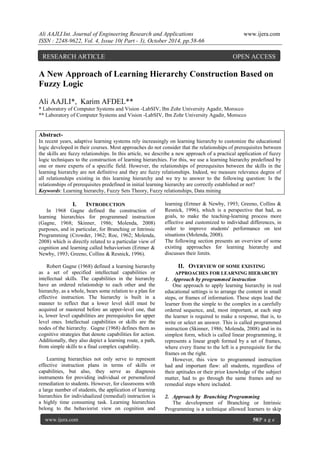
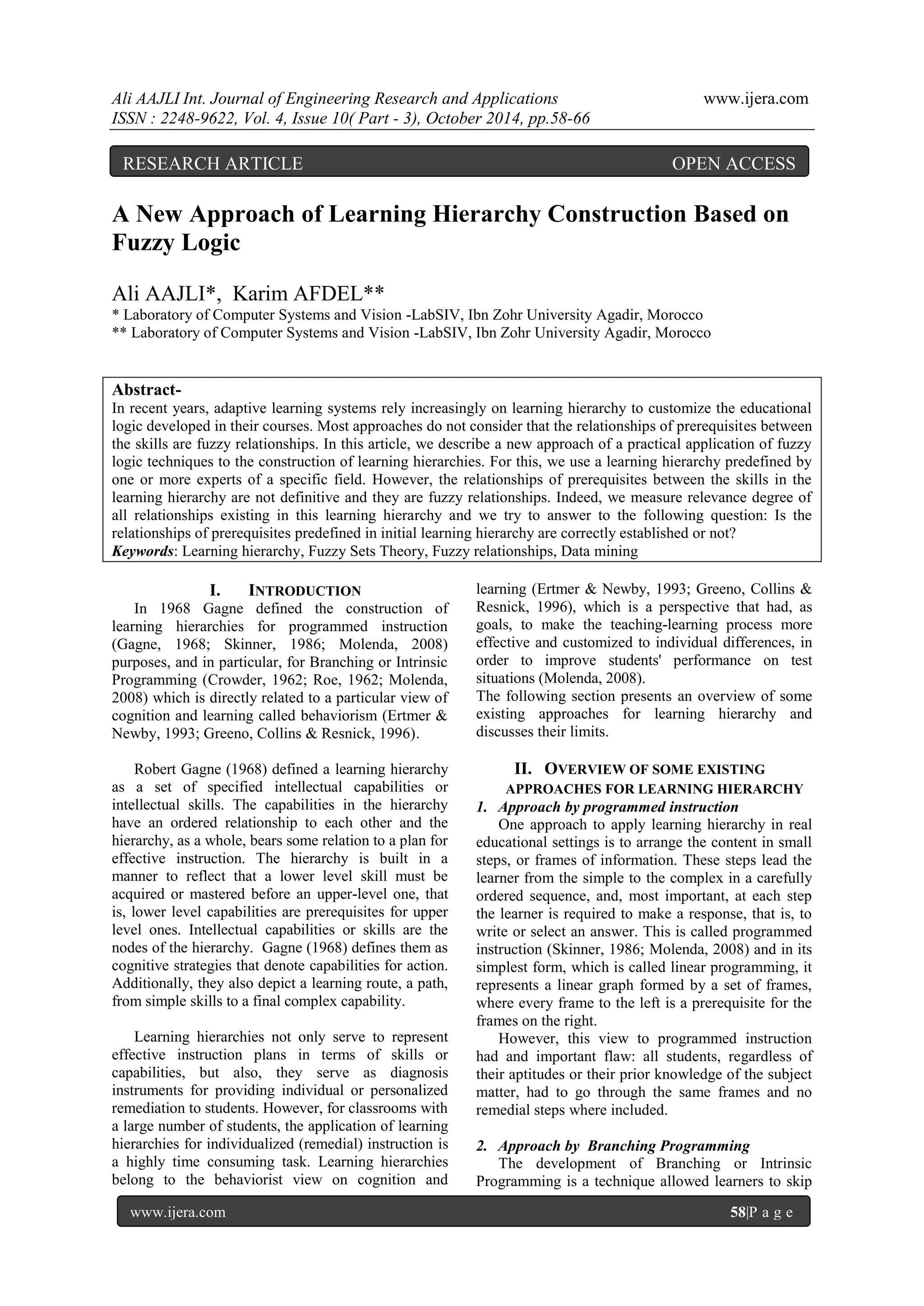
Ali AAJLI Int. Journal of Engineering Research and Applications www.ijera.com
ISSN : 2248-9622, Vol. 4, Issue 10( Part - 3), October 2014, pp.58-66
www.ijera.com 58|P a g e
A New Approach of Learning Hierarchy Construction Based on
Fuzzy Logic
Ali AAJLI*, Karim AFDEL**
* Laboratory of Computer Systems and Vision -LabSIV, Ibn Zohr University Agadir, Morocco
** Laboratory of Computer Systems and Vision -LabSIV, Ibn Zohr University Agadir, Morocco
Abstract-
In recent years, adaptive learning systems rely increasingly on learning hierarchy to customize the educational
logic developed in their courses. Most approaches do not consider that the relationships of prerequisites between
the skills are fuzzy relationships. In this article, we describe a new approach of a practical application of fuzzy
logic techniques to the construction of learning hierarchies. For this, we use a learning hierarchy predefined by
one or more experts of a specific field. However, the relationships of prerequisites between the skills in the
learning hierarchy are not definitive and they are fuzzy relationships. Indeed, we measure relevance degree of
all relationships existing in this learning hierarchy and we try to answer to the following question: Is the
relationships of prerequisites predefined in initial learning hierarchy are correctly established or not?
Keywords: Learning hierarchy, Fuzzy Sets Theory, Fuzzy relationships, Data mining
I. INTRODUCTION
In 1968 Gagne defined the construction of
learning hierarchies for programmed instruction
(Gagne, 1968; Skinner, 1986; Molenda, 2008)
purposes, and in particular, for Branching or Intrinsic
Programming (Crowder, 1962; Roe, 1962; Molenda,
2008) which is directly related to a particular view of
cognition and learning called behaviorism (Ertmer &
Newby, 1993; Greeno, Collins & Resnick, 1996).
Robert Gagne (1968) defined a learning hierarchy
as a set of specified intellectual capabilities or
intellectual skills. The capabilities in the hierarchy
have an ordered relationship to each other and the
hierarchy, as a whole, bears some relation to a plan for
effective instruction. The hierarchy is built in a
manner to reflect that a lower level skill must be
acquired or mastered before an upper-level one, that
is, lower level capabilities are prerequisites for upper
level ones. Intellectual capabilities or skills are the
nodes of the hierarchy. Gagne (1968) defines them as
cognitive strategies that denote capabilities for action.
Additionally, they also depict a learning route, a path,
from simple skills to a final complex capability.
Learning hierarchies not only serve to represent
effective instruction plans in terms of skills or
capabilities, but also, they serve as diagnosis
instruments for providing individual or personalized
remediation to students. However, for classrooms with
a large number of students, the application of learning
hierarchies for individualized (remedial) instruction is
a highly time consuming task. Learning hierarchies
belong to the behaviorist view on cognition and
learning (Ertmer & Newby, 1993; Greeno, Collins &
Resnick, 1996), which is a perspective that had, as
goals, to make the teaching-learning process more
effective and customized to individual differences, in
order to improve students' performance on test
situations (Molenda, 2008).
The following section presents an overview of some
existing approaches for learning hierarchy and
discusses their limits.
II. OVERVIEW OF SOME EXISTING
APPROACHES FOR LEARNING HIERARCHY
1. Approach by programmed instruction
One approach to apply learning hierarchy in real
educational settings is to arrange the content in small
steps, or frames of information. These steps lead the
learner from the simple to the complex in a carefully
ordered sequence, and, most important, at each step
the learner is required to make a response, that is, to
write or select an answer. This is called programmed
instruction (Skinner, 1986; Molenda, 2008) and in its
simplest form, which is called linear programming, it
represents a linear graph formed by a set of frames,
where every frame to the left is a prerequisite for the
frames on the right.
However, this view to programmed instruction
had and important flaw: all students, regardless of
their aptitudes or their prior knowledge of the subject
matter, had to go through the same frames and no
remedial steps where included.
2. Approach by Branching Programming
The development of Branching or Intrinsic
Programming is a technique allowed learners to skip
RESEARCH ARTICLE OPEN ACCESS
Ali AAJLI Int. Journal of Engineering Research and Applications www.ijera.com
ISSN : 2248-9622, Vol. 4, Issue 10( Part - 3), October 2014, pp.58-66
www.ijera.com 59|P a g e
ahead through material that was easy for them or to
branch off to remedial frames when they had
difficulty (Crowder, 1962; Roe, 1962; Molenda,
2008). The ultimate goal of branching programming
is to take care of the individual differences of
students, in terms of prior knowledge of the subject
matter and other abilities that the learner brings (Roe,
1962), and provide personalized paths of learning.
It has to be stated that just as with linear
programming, the frames in branching programming,
including the remedial ones, had to be designed a
priori. This proved to be a very difficult task and led
to the design of very complex branching
programming graphs and procedures such as:
backward branching to missed items, backward
branching to review an entire sequence of items,
backward branching to alternate form items, lateral
branching to supplemental or prerequisite material,
lateral branching to supplemental practice items,
branching down to a lower level or more detailed
items for slow students, branching up to a faster
program for bright students, and finally, forward
branching by skipping items (Roe, 1962). The
complexity of the graphs makes this approach very
difficult its practical application.
3. Approach by Fuzzy logic
Several learning systems build their learning
hierarchies by using a number of different methods of
fuzzy logic (Al-Sarem et al, 2010 and Chu et al.,
2010 and Chen and Bai, 2008). Sue et al., 2010, used
a two-phase method that extracts the association rules
between the skills by applying fuzzy logic to convert
the grades learners into three levels of difficulty and
construct a learning hierarchy. Bai and Chen, 2010,
simplified and improved the latter method in adaptive
way.
These methods considered grades obtained by
learners during the process learning is a fuzzy notion.
However, they don’t take into account the possibility
of using a learning hierarchy predefined by one or
more experts of a specific field.
Before introducing our approach, the following
section describes some concepts of fuzzy logic which
we use later in this paper.
III. FUZZY SETS THEORY (FST)
Since 1965, the Fuzzy Sets Theory has advanced
in a variety of ways and in many disciplines. Fuzzy
sets were introduced by Zadeh to represent
mathematically the vagueness on certain classes of
objects and provide the basis for fuzzy logic.
The fuzzy sets were introduced to model human
knowledge representation, and thus improve the
performance of systems that use this modelling
decision. Fuzzy sets admit gradation such as all tones
between black and white. A fuzzy set has a graphical
description that expresses how the transition from one
to another takes place. This graphical description is
called a membership function.
A fuzzy part (or fuzzy set) of a set E is an application
µA(x): E  [0, 1]:
x
µA(x)
1
0
Fig. 1. µA(x) : A membership function
IV. OUR PROPOSED APPROACH
In our approach, we describe a new approach of a
practical application of fuzzy logic techniques to the
construction of Learning Hierarchies.
For this, we use a learning hierarchy predefined by
one or more experts of a specific field.
However, the relationships of prerequisites between
the skills in the learning hierarchy are not definitive
and they are fuzzy relationships.
Indeed, we try -with using fuzzy logic- to answer to
the following question: Is the relationships of
prerequisites predefined in initial learning hierarchy
are correctly established or not?
To respond to this question, we follow the
following phases: The first phase determines an initial
predefined learning hierarchy, the second phase
measure the variation of grades of learners, the next
phase transformed the data by using the fuzzification
technique, then the next phase mine the association
rules between the skills. In the last two phases we
propose to build the final learning hierarchy.
Initial
learning
hierarchy
•Define a
Learning
Hierarchybyone
ormoreexperts
ofaspecificfield
Measureof
variationof
grades
•Inputs
•Grades of
learners
Fuzzification
•Inputs
•Relationshipsof
prerequisites
Minethe
association
rules
•Data
•Grades of
learners
•Relationshipsof
prerequisites
Calculof
M-FPR
•Output
•matrixoffuzzy
prerequisite
relationships
(M-FPR)
Buildfinal
Learning
Hierarchy
•Input
•InitialL.H
•M-FPR
•Output
•FinalL.H
Fig. 2. Phases of our approach
1. Define an initial learning hierarchy
For an expert in a particular field, the
presentation of the methodology and sequence to be
used for the construction of learning hierarchy is
Ali AAJLI Int. Journal of Engineering Research and Applications www.ijera.com
ISSN : 2248-9622, Vol. 4, Issue 10( Part - 3), October 2014, pp.58-66
www.ijera.com 60|P a g e
achievable by following the steps below described by
Gagne (1968):
Defined a learning hierarchy as a set of specified
intellectual capabilities or intellectual skills.
The capabilities in the hierarchy have an ordered
relationship to each other and the hierarchy, as a
whole, bears some relation to a plan for effective
instruction.
The hierarchy is built in a manner to reflect that a
lower level skill must be acquired or mastered before
an upper-level one, that is, lower level capabilities are
prerequisites for upper level ones. Intellectual
capabilities or skills are the nodes of the hierarchy.
At the end we will have an initial learning hierarchy
as shown in figure below:
Fig. 3. Example of an initial learning hierarchy prepared by an
expert in a specific field
The Figure 2 shows an example of a learning
hierarchy of a course containing 10 relevant skills, and
prerequisite relationships among them.
From the links of the learning hierarchy we define the
matrix M of prerequisites between skills, where the
value of each element Mij is calculated as below:
Mij = 1 means the skill « i » is a prerequisite of the
skill « j ».
Mij = 0 means the skill « i » is not a prerequisite of the
skill « j ».
« i » represents the rows and « j » the columns.
Table 1 below, shows a matrix representation (Mij) of
initial predefined learning hierarchy of the figure 2.
For example, the first line means that the skill A is a
prerequisite of the skills B and C.
TABLE I. MATRIX REPRESENTATION OF INITIAL PREDEFINED
LEARNING HIERARCHY
Mij A B C D E F G
A 0 1 1 0 0 0 0
B 0 0 0 0 0 1 0
C 0 0 0 1 1 0 0
D 0 0 0 0 1 1 1
E 0 0 0 0 0 0 1
F 0 0 0 0 0 0 0
G 0 0 0 0 0 0 0
2. Variation of grades
A. Retrieving digital data
In this sub-phase, we retrieve the numerical grades
obtained during assessments of each student in each
skill in a learning process. These grades are collected
in a matrix called the matrix grades: Grades (Learner
(Si), Skill (i)) such as:
TABLE II. EXAMPLE OF MATRIX GRADES OF 10
STUDENTS
Grades A B C D E F G
S1 10 10 1 3 7 9 3
S2 11 12 5 7 11 11 7
S3 10 11 5 3 8 10 5
S4 13 10 6 6 10 10 10
S5 15 18 10 12 16 16 15
S6 19 18 6 10 14 19 13
S7 12 11 1 5 6 10 4
S8 3 4 0 2 5 7 5
S9 15 16 6 10 11 18 13
S10 12 14 5 3 0 13 0
Table 2 shows an example of 10 students and their
grades within 7 skills that constitute initial learning
hierarchy.
Where:
The maximum score that a student can have in an
assessment is equal to 20.
B. Measure of variation of grades
In this sub-phase, we measure the variation of grades
of all prerequisite relationships of initial predefined
learning hierarchy.
The Matrix of variation of grades ∆Grades (i, j) is
calculated using the both matrix:
 Matrix Grades (Learner (Si), Skill (i))
 Matrix Mij
∆Grades (i, j) Learner = [Grade (j) – Grade (i)] with Mij
= 1 i.e the skill « i » is a prerequisite of the skill « j ».
And 20Grades20 
In table bellow we proposer an example of matrix
∆Grades (i, j) based on the data of the tables 1 and 2:
A
B C
D E
F G
Ali AAJLI Int. Journal of Engineering Research and Applications www.ijera.com
ISSN : 2248-9622, Vol. 4, Issue 10( Part - 3), October 2014, pp.58-66
www.ijera.com 61|P a g e
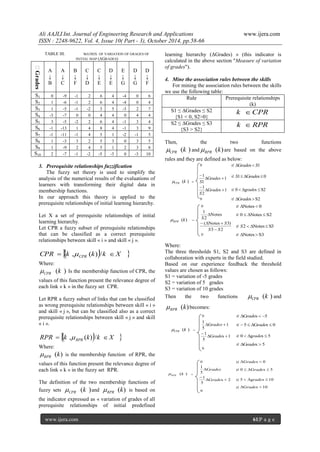
TABLE III. MATRIX OF VARIATION OF GRAGES OF
INITIAL MAP (ΔGRADES)
∆Grades
A
↓
B
A
↓
C
B
↓
F
C
↓
D
C
↓
E
D
↓
E
E
↓
G
D
↓
G
D
↓
F
S1 0 -9 -1 2 6 4 -4 0 6
S2 1 -6 -1 2 6 4 -4 0 4
S3 1 -5 -1 -2 3 5 -3 2 7
S4 -3 -7 0 0 4 4 0 4 4
S5 3 -5 -2 2 6 4 -1 3 4
S6 -1 -13 1 4 8 4 -1 3 9
S7 -1 -11 -1 4 5 1 -2 -1 5
S8 1 -3 3 2 5 3 0 3 5
S9 1 -9 2 4 5 1 2 3 8
S10 2 -7 -1 -2 -5 -3 0 -3 10
3. Prerequisite relationships fuzzification
The fuzzy set theory is used to simplify the
analysis of the numerical results of the evaluations of
learners with transforming their digital data in
membership functions.
In our approach this theory is applied to the
prerequisite relationships of initial learning hierarchy.
Let X a set of prerequisite relationships of initial
learning hierarchy.
Let CPR a fuzzy subset of prerequisite relationships
that can be classified as a correct prerequisite
relationships between skill « i » and skill « j ».
  XkkkCPR CPR  /)(,
Where:
)(kCPR Is the membership function of CPR, the
values of this function present the relevance degree of
each link « k » in the fuzzy set CPR.
Let RPR a fuzzy subset of links that can be classified
as wrong prerequisite relationships between skill « i »
and skill « j », but can be classified also as a correct
prerequisite relationships between skill « j » and skill
« i ».
  XkkkRPR RPR  /)(,
Where:
)(kRPR is the membership function of RPR, the
values of this function present the relevance degree of
each link « k » in the fuzzy set RPR.
The definition of the two membership functions of
fuzzy sets )(kCPR and )(kRPR is based on
the indicator expressed as « variation of grades of all
prerequisite relationships of initial predefined
learning hierarchy (ΔGrades) » (this indicator is
calculated in the above section "Measure of variation
of grades").
4. Mine the association rules between the skills
For mining the association rules between the skills
we use the following table:
Rule Prerequisite relationships
(k)
S1 ≤ ∆Grades ≤ S2
{S1 < 0, S2>0}
CPRk 
S2 ≤ ∆Grades ≤ S3
{S3 > S2}
RPRk 
Then, the two functions
)(kCPR and )(kRPR are based on the above
rules and they are defined as below:
0 if 1sG Srade 
1G
1
1


rades
S
if 0sG1  radeS
)(kCPR =
1sG
2
1


rade
S
if 2Ssg0  rade
0 if S2sG  rade
0 if 0Notes 
Notes
2
1

S
if S2Notes0 
)(kRPR =
23
)3Notes(
SS
S


if 3SNotes2 S
0 if S3Notes
Where:
The three thresholds S1, S2 and S3 are defined in
collaboration with experts in the field studied.
Based on our experience feedback the threshold
values are chosen as follows:
S1 = variation of -5 grades
S2 = variation of 5 grades
S3 = variation of 10 grades
Then the two functions )(kCPR and
)(kRPR becomes:
0 if 5sG  rade
1G
5
1
 rades if 0sG5  rade
)(kCPR =
1sG
5
1


rade if 5sg0  rade
0
if 5sG  rade
0 if 0sG  rade
radesG
5
1
 if 5sG0  rade
)(kRPR =
2sG
5
1


rade if 10sg5  rade
0
if 10sG  rade
Ali AAJLI Int. Journal of Engineering Research and Applications www.ijera.com
ISSN : 2248-9622, Vol. 4, Issue 10( Part - 3), October 2014, pp.58-66
www.ijera.com 62|P a g e
1
0
-20 S1 0 S2 S3 20
CPR
Prerequisite relationships Levels
∆Grades
RPR
Fig. 4. membership functions
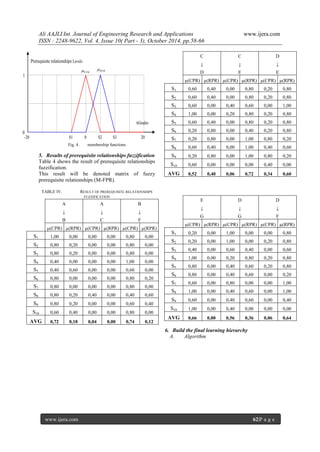
5. Results of prerequisite relationships fuzzification
Table 4 shows the result of prerequisite relationships
fuzzification.
This result will be denoted matrix of fuzzy
prerequisite relationships (M-FPR).
TABLE IV. RESULT OF PREREQUISITE RELATIONSHIPS
FUZZIFICATION
A A B
↓ ↓ ↓
B C F
µ(CPR) µ(RPR) µ(CPR) µ(RPR) µ(CPR) µ(RPR)
S1 1,00 0,00 0,00 0,00 0,80 0,00
S2 0,80 0,20 0,00 0,00 0,80 0,00
S3 0,80 0,20 0,00 0,00 0,80 0,00
S4 0,40 0,00 0,00 0,00 1,00 0,00
S5 0,40 0,60 0,00 0,00 0,60 0,00
S6 0,80 0,00 0,00 0,00 0,80 0,20
S7 0,80 0,00 0,00 0,00 0,80 0,00
S8 0,80 0,20 0,40 0,00 0,40 0,60
S9 0,80 0,20 0,00 0,00 0,60 0,40
S10 0,60 0,40 0,00 0,00 0,80 0,00
AVG 0,72 0,18 0,04 0,00 0,74 0,12
C C D
↓ ↓ ↓
D E E
µ(CPR) µ(RPR) µ(CPR) µ(RPR) µ(CPR) µ(RPR)
S1 0,60 0,40 0,00 0,80 0,20 0,80
S2 0,60 0,40 0,00 0,80 0,20 0,80
S3 0,60 0,00 0,40 0,60 0,00 1,00
S4 1,00 0,00 0,20 0,80 0,20 0,80
S5 0,60 0,40 0,00 0,80 0,20 0,80
S6 0,20 0,80 0,00 0,40 0,20 0,80
S7 0,20 0,80 0,00 1,00 0,80 0,20
S8 0,60 0,40 0,00 1,00 0,40 0,60
S9 0,20 0,80 0,00 1,00 0,80 0,20
S10 0,60 0,00 0,00 0,00 0,40 0,00
AVG 0,52 0,40 0,06 0,72 0,34 0,60
E D D
↓ ↓ ↓
G G F
µ(CPR) µ(RPR) µ(CPR) µ(RPR) µ(CPR) µ(RPR)
S1 0,20 0,00 1,00 0,00 0,00 0,80
S2 0,20 0,00 1,00 0,00 0,20 0,80
S3 0,40 0,00 0,60 0,40 0,00 0,60
S4 1,00 0,00 0,20 0,80 0,20 0,80
S5 0,80 0,00 0,40 0,60 0,20 0,80
S6 0,80 0,00 0,40 0,60 0,00 0,20
S7 0,60 0,00 0,80 0,00 0,00 1,00
S8 1,00 0,00 0,40 0,60 0,00 1,00
S9 0,60 0,00 0,40 0,60 0,00 0,40
S10 1,00 0,00 0,40 0,00 0,00 0,00
AVG 0,66 0,00 0,56 0,36 0,06 0,64
6. Build the final learning hierarchy
A. Algorithm
Ali AAJLI Int. Journal of Engineering Research and Applications www.ijera.com
ISSN : 2248-9622, Vol. 4, Issue 10( Part - 3), October 2014, pp.58-66
www.ijera.com 63|P a g e
Inputs :
1 : Matrix of Fuzzy prerequisite relationships (M-FPR)
Final Learning Hierarchy (FLH) Empty
Choose a link k = (i, j) in M-FPR
Add the link k(i,j, αk) into final Learning
Hierarchy
N
Delete the link k(i,j)
Y
Output: Learning Hierarchy (FLH)
(1)
(2)
(3)
(4)))](),(([ kkMoyMax RPRCPRk  
N
min k
))(( kMoy CPRk  
Y
Y Y
))(( kMoy RPRk  
Add the link k(j,i, αk) into final Learning
Hierarchy
Y
(5)
(6)
(7)
(8)
(9)
min)_threshold(:2 min
M-FPR Empty
Fig. 5. Algorithm of learning hierarchy constructing process
B. Final learning hierarchy
In last step we use the algorithm above for mining the
prerequisite relationships with their relevance degree
and generate the final learning hierarchy.
Input data of the algorithm are:
 Matrix of fuzzy prerequisite relationships
(M-FPR)
 A threshold minimum of prerequisite
relationships is a threshold that indicates the
prerequisite relationships meaningful in the
construction process.
At first, the final learning hierarchy is empty.
For each link « k » existing in the matrix of fuzzy
prerequisite relationships we test:
If the value of maximum of average of each
membership functions )(kCPR and )(kRPR is
greater or not than the threshold minimum.
At the end, the link (k) may be:
 Add in the final learning hierarchy in the same
direction between his two skills with a
relevance degree equal to k.
 Add in the final learning hierarchy in the
opposite direction of the initial link with a
relevance degree equal to k.
 Delete and it is not included in the final
learning hierarchy.
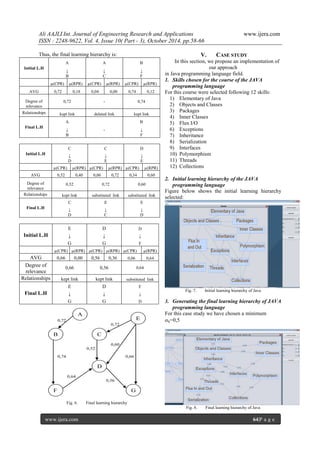
7. Example of learning hierarchy constructing
process
We apply this algorithm to the data (M-FPR) of the
table 4
Input data of the algorithm are:
 Matrix of fuzzy prerequisite relationships
(M-FPR) of table 4.
 A threshold minimum k=0,5
Ali AAJLI Int. Journal of Engineering Research and Applications www.ijera.com
ISSN : 2248-9622, Vol. 4, Issue 10( Part - 3), October 2014, pp.58-66
www.ijera.com 64|P a g e
Thus, the final learning hierarchy is:
Initial L.H
A A B
↓ ↓ ↓
B C F
µ(CPR) µ(RPR) µ(CPR) µ(RPR) µ(CPR) µ(RPR)
AVG 0,72 0,18 0,04 0,00 0,74 0,12
Degree of
relevance
0,72 - 0,74
Relationships kept link deleted link kept link
Final L.H
A B
↓ - ↓
B F
Initial L.H
C C D
↓ ↓ ↓
D E E
µ(CPR) µ(RPR) µ(CPR) µ(RPR) µ(CPR) µ(RPR)
AVG 0,52 0,40 0,06 0,72 0,34 0,60
Degree of
relevance
0,52 0,72 0,60
Relationships kept link substituted link substituted link
Final L.H
C E E
↓ ↓ ↓
D C D
Initial L.H
E D D
↓ ↓ ↓
G G F
µ(CPR) µ(RPR) µ(CPR) µ(RPR) µ(CPR) µ(RPR)
AVG 0,66 0,00 0,56 0,36 0,06 0,64
Degree of
relevance
0,66 0,56 0,64
Relationships kept link kept link substituted link
Final L.H
E D F
↓ ↓ ↓
G G D
A
B
D
E
F G
C
0,72
0,74
0,52
0,72
0,60
0,66
0,56
0,64
Fig. 6. Final learning hierarchy
V. CASE STUDY
In this section, we propose an implementation of
our approach
in Java programming language field.
1. Skills chosen for the course of the JAVA
programming language
For this course were selected following 12 skills:
1) Elementary of Java
2) Objects and Classes
3) Packages
4) Inner Classes
5) Flux I/O
6) Exceptions
7) Inheritance
8) Serialization
9) Interfaces
10) Polymorphism
11) Threads
12) Collections
2. Initial learning hierarchy of the JAVA
programming language
Figure below shows the initial learning hierarchy
selected:
Fig. 7. Initial learning hierarchy of Java
3. Generating the final learning hierarchy of JAVA
programming language
For this case study we have chosen a minimum
k=0,5
Fig. 8. Final learning hierarchy of Java
Ali AAJLI Int. Journal of Engineering Research and Applications www.ijera.com
ISSN : 2248-9622, Vol. 4, Issue 10( Part - 3), October 2014, pp.58-66
www.ijera.com 65|P a g e
VI. CONCLUSION
In this paper we present a new hybrid approach to
construct the learning hierarchy of a specific field,
this approach is based on using a predefined expert
learning hierarchy and we measure the degree of
relevance of all relationships existing in this
predefined expert learning hierarchy. This new
approach improves the educational protocol to obtain
two kinds of prerequisite relationships, the first type
can be classified as relationships correctly established
by the expert. These relationships must be kept in the
final learning hierarchy. The second type can be
considered as relations incorrectly established by the
expert, these relations must be deleted or substituted
with the inverse of the original relationships. For the
second type we conclude that there is no
correlation between the results obtained and the skills
of learners, which can be explained by one or both of
the following reasons:
 The use of inappropriate items in the tests of
the two skills
 The two skills of this relationship are
completely independent.
The results obtained from the application of this new
approach on the course of JAVA programming
language are good.
REFERENCES
[1] Aajli and Afdel, “A computer adaptive
assessment system for E-Learning and E-
Recruitment based on a new measuring skills
approach International”, Journal of Educational
Technology Letters Volume 3, Number 1, June,
2013
P. 42-51, Online: http://www.ier-
institute.org/2163‐4246.html
[2] Alkhazaleh and Salleh, “Fuzzy Soft Multiset
Theory, Abstract and Applied Analysis”, 2012,
article ID 350600, 20 p.
[3] Al-Sarem, Bellafkih and Ramdani “Mining
Concepts’ Relationship Based on Numeric
Grades”, JCSI International Journal of Computer
Science Issues, Vol. 8, Issue 4, No 2, July 2011
[4] Ana J. Viamonte, The Computer in the
Mathematics Teaching, WSEAS Transactions on
Advances in Engineering Education, 2010, Vol.
7, No. 3, pp.63-72.
[5] Anohina, A., & Grundspenkis, J. (2009, June).
Scoring concept maps: an overview. In
Proceedings of the International Conference on
Computer Systems and Technologies and
Workshop for PhD Students in Computing P.78.
[6] Bai and Chen, “A New Method for
Automatically Constructing Concept Maps
Based on Data Mining Techniques”, In:
Proceedings of the Seventh International
Conference on Machine Learning and
Cybernetics, 2008, pp.
3078 - 3083.
[7] Bai and Chen, “A New Method for Learning
Barriers Diagnosis Based on Fuzzy Rules”, In:
Proceedings of the Seventh International
Conference on Machine Learning and
Cybernetics, 2008, pp.3090 – 3095
[8] Bai and Chen, “Automatically constructing
concept maps based on fuzzy rules for adapting
learning systems”, Expert Syst. Appl.,vol. 35, pp.
41–49, July
2008.
[9] Bai and Chen, “Using data mining techniques to
automatically construct concept maps for
adaptive learning systems”, Expert Systems with
Applications, Vol. 37, 2010, pp. 4496–4503.
[10] Berlin Heidelberg. Crowder, N. A. Intrinsic and
extrinsic programming. Programmed Learning
and Computer-Based Instruction. New York:
John Wffley, (1962).
[11] Cañas, A. J et al. “Concept maps”, Integrating
knowledge and information visualization. In
Knowledge and information visualization,
Springer, 2005 (pp. 205-219).
[12] Chen and Sue, “A New Method to Construct
Concept Maps for Adaptive Learning Systems”,
In: Proceedings of the Ninth International
Conference on Machine Learning and
Cybernetics, 2010, pp. 2489 – 2494
[13] Chu, Hwang, and Huang, “An Enhanced
Learning Diagnosis Model Based on Concept-
Effect Relationships with Multiple Knowledge
Levels”, Innovations in Education and Teaching
International, Vol. 47, No. 1, 2010, pp. 53 - 67.
[14] Das and Martins, “A survey on automatic text
summarization”,2007.
Online:http://www.cs.cmu.edu/_afm/Home_files/
Das_Martins_survey_summarization.pdf
[15] Danis, Schubauer-Leoni and Weil-Barais,
“Interaction, Acquisition de connaissances et
Développement”, Bulletin de Psychologie, 2003.
[16] De Cock, Bodenhofer, and Kerre, “Modelling
Linguistic Expressions Using Fuzzy Relations”,
Proceedings 6th International Conference on Soft
Computing, Iizuka, Japan, 1-4 october 2000, p.
353-360.
[17] Ertmer, P. A., & Newby, T. J. Behaviorism,
cognitivism, constructivism: Comparing critical
features from an instructional design perspective.
Performance improvement quarterly, (1993) , P.
50-72.
[18] Gagne, R. M, “Learning hierarchies”,
Educational psychologist, 1968, P. 1-9.
[19] Greeno, J. G., & Collins, A., Resnick. L.B,
“Cognition and learning”, Handbook of
educational psychology, 1996, 15-16.
[20] Hsu, C. S., Tu, S. F., & Hwang, G. J, “A concept
inheritance method for learning diagnosis of a
network-based testing and evaluation system”. In
Ali AAJLI Int. Journal of Engineering Research and Applications www.ijera.com
ISSN : 2248-9622, Vol. 4, Issue 10( Part - 3), October 2014, pp.58-66
www.ijera.com 66|P a g e
Proceedings of the 7th international conference
on computer-assisted instructions, 1998 (pp. 602-
609).
[21] Hwang, G. J, “A conceptual map model for
developing intelligent tutoring systems”.
Computers & Education, 2003, P. 217-235.
[22] Molenda, M, “The Programmed Instruction Era:
When Effectiveness Mattered”, TechTrends,
2008, 52(2), 53.
Manning and Schütze, Foundations of Statistical
Natural Language Processing. Cambridge
University Press, 1999.
Novak, “Meaningful learning: The essential
factor for conceptual change in limited or
appropriate propositional hierarchies (liphs)
leading to empowerment of learners”, Science
Education, 2002, 86(4), 548-571.
[23] Novak and Gowin, “Learning how to learn”,
Cambridge, London: Cambridge University
Press, 1984.
[24] Novak and Joseph, “Learning, Creating, and
Using Knowledge: Concept Maps as Facilitative
Tools in Schools and Corporations”, Ausubel’s
Assimilation Learning Theory, 1998, pp. 49-78.
[25] P. Toth, “Online learning behavior and web
usage mining,” WSEAS Transactions on
Advances in Engineering Education, vol. 10, no.
2, 2013, pp. 71-81.
R. Rahamat, P. M. Shah, R. Din, S. N. Puteh,
J.A. Aziz, H. Norman, M. A.Embi, “Measuring
learners’ perceived satisfaction towards e-
learning materials and environment,” WSEAS
Transactions on Advances in Engineering
Education, 2012, vol. 9, no. 3, pp. 72-83.
[26] Skinner, B. F, “Programmed Instruction
Revisited”. Phi Delta Kappan, 1986, 103.
[27] Tseng, Sue, Su, Weng, and Tsai, “A new
approach for constructing the concept map”,
Computers & Education, Vol. 49, 2007, pp. 691–
707.
Wang, Cheung, Lee, and Kwok, “Mining
knowledge from natural language texts using
fuzzy associated concept mapping”, Information
Processing & Management, vol. 44, no. 5, pp.
1707–1719, 2008.
Zadeh, “The concept of a linguistic variable and
its application to approximate reasoning–I”,
Inform. Sci., v. 8, pp. 199–249, 1975.
[28] Zubrinic et al. “Automatic creation of a concept
map” International Journal Expert Systems with
Applications, Volume 39 Issue 16, November,
2012

A New Approach of Learning Hierarchy Construction Based on Fuzzy Logic

  • 1.
    Ali AAJLI Int.Journal of Engineering Research and Applications www.ijera.com ISSN : 2248-9622, Vol. 4, Issue 10( Part - 3), October 2014, pp.58-66 www.ijera.com 58|P a g e A New Approach of Learning Hierarchy Construction Based on Fuzzy Logic Ali AAJLI*, Karim AFDEL** * Laboratory of Computer Systems and Vision -LabSIV, Ibn Zohr University Agadir, Morocco ** Laboratory of Computer Systems and Vision -LabSIV, Ibn Zohr University Agadir, Morocco Abstract- In recent years, adaptive learning systems rely increasingly on learning hierarchy to customize the educational logic developed in their courses. Most approaches do not consider that the relationships of prerequisites between the skills are fuzzy relationships. In this article, we describe a new approach of a practical application of fuzzy logic techniques to the construction of learning hierarchies. For this, we use a learning hierarchy predefined by one or more experts of a specific field. However, the relationships of prerequisites between the skills in the learning hierarchy are not definitive and they are fuzzy relationships. Indeed, we measure relevance degree of all relationships existing in this learning hierarchy and we try to answer to the following question: Is the relationships of prerequisites predefined in initial learning hierarchy are correctly established or not? Keywords: Learning hierarchy, Fuzzy Sets Theory, Fuzzy relationships, Data mining I. INTRODUCTION In 1968 Gagne defined the construction of learning hierarchies for programmed instruction (Gagne, 1968; Skinner, 1986; Molenda, 2008) purposes, and in particular, for Branching or Intrinsic Programming (Crowder, 1962; Roe, 1962; Molenda, 2008) which is directly related to a particular view of cognition and learning called behaviorism (Ertmer & Newby, 1993; Greeno, Collins & Resnick, 1996). Robert Gagne (1968) defined a learning hierarchy as a set of specified intellectual capabilities or intellectual skills. The capabilities in the hierarchy have an ordered relationship to each other and the hierarchy, as a whole, bears some relation to a plan for effective instruction. The hierarchy is built in a manner to reflect that a lower level skill must be acquired or mastered before an upper-level one, that is, lower level capabilities are prerequisites for upper level ones. Intellectual capabilities or skills are the nodes of the hierarchy. Gagne (1968) defines them as cognitive strategies that denote capabilities for action. Additionally, they also depict a learning route, a path, from simple skills to a final complex capability. Learning hierarchies not only serve to represent effective instruction plans in terms of skills or capabilities, but also, they serve as diagnosis instruments for providing individual or personalized remediation to students. However, for classrooms with a large number of students, the application of learning hierarchies for individualized (remedial) instruction is a highly time consuming task. Learning hierarchies belong to the behaviorist view on cognition and learning (Ertmer & Newby, 1993; Greeno, Collins & Resnick, 1996), which is a perspective that had, as goals, to make the teaching-learning process more effective and customized to individual differences, in order to improve students' performance on test situations (Molenda, 2008). The following section presents an overview of some existing approaches for learning hierarchy and discusses their limits. II. OVERVIEW OF SOME EXISTING APPROACHES FOR LEARNING HIERARCHY 1. Approach by programmed instruction One approach to apply learning hierarchy in real educational settings is to arrange the content in small steps, or frames of information. These steps lead the learner from the simple to the complex in a carefully ordered sequence, and, most important, at each step the learner is required to make a response, that is, to write or select an answer. This is called programmed instruction (Skinner, 1986; Molenda, 2008) and in its simplest form, which is called linear programming, it represents a linear graph formed by a set of frames, where every frame to the left is a prerequisite for the frames on the right. However, this view to programmed instruction had and important flaw: all students, regardless of their aptitudes or their prior knowledge of the subject matter, had to go through the same frames and no remedial steps where included. 2. Approach by Branching Programming The development of Branching or Intrinsic Programming is a technique allowed learners to skip RESEARCH ARTICLE OPEN ACCESS
  • 2.
    Ali AAJLI Int.Journal of Engineering Research and Applications www.ijera.com ISSN : 2248-9622, Vol. 4, Issue 10( Part - 3), October 2014, pp.58-66 www.ijera.com 59|P a g e ahead through material that was easy for them or to branch off to remedial frames when they had difficulty (Crowder, 1962; Roe, 1962; Molenda, 2008). The ultimate goal of branching programming is to take care of the individual differences of students, in terms of prior knowledge of the subject matter and other abilities that the learner brings (Roe, 1962), and provide personalized paths of learning. It has to be stated that just as with linear programming, the frames in branching programming, including the remedial ones, had to be designed a priori. This proved to be a very difficult task and led to the design of very complex branching programming graphs and procedures such as: backward branching to missed items, backward branching to review an entire sequence of items, backward branching to alternate form items, lateral branching to supplemental or prerequisite material, lateral branching to supplemental practice items, branching down to a lower level or more detailed items for slow students, branching up to a faster program for bright students, and finally, forward branching by skipping items (Roe, 1962). The complexity of the graphs makes this approach very difficult its practical application. 3. Approach by Fuzzy logic Several learning systems build their learning hierarchies by using a number of different methods of fuzzy logic (Al-Sarem et al, 2010 and Chu et al., 2010 and Chen and Bai, 2008). Sue et al., 2010, used a two-phase method that extracts the association rules between the skills by applying fuzzy logic to convert the grades learners into three levels of difficulty and construct a learning hierarchy. Bai and Chen, 2010, simplified and improved the latter method in adaptive way. These methods considered grades obtained by learners during the process learning is a fuzzy notion. However, they don’t take into account the possibility of using a learning hierarchy predefined by one or more experts of a specific field. Before introducing our approach, the following section describes some concepts of fuzzy logic which we use later in this paper. III. FUZZY SETS THEORY (FST) Since 1965, the Fuzzy Sets Theory has advanced in a variety of ways and in many disciplines. Fuzzy sets were introduced by Zadeh to represent mathematically the vagueness on certain classes of objects and provide the basis for fuzzy logic. The fuzzy sets were introduced to model human knowledge representation, and thus improve the performance of systems that use this modelling decision. Fuzzy sets admit gradation such as all tones between black and white. A fuzzy set has a graphical description that expresses how the transition from one to another takes place. This graphical description is called a membership function. A fuzzy part (or fuzzy set) of a set E is an application µA(x): E  [0, 1]: x µA(x) 1 0 Fig. 1. µA(x) : A membership function IV. OUR PROPOSED APPROACH In our approach, we describe a new approach of a practical application of fuzzy logic techniques to the construction of Learning Hierarchies. For this, we use a learning hierarchy predefined by one or more experts of a specific field. However, the relationships of prerequisites between the skills in the learning hierarchy are not definitive and they are fuzzy relationships. Indeed, we try -with using fuzzy logic- to answer to the following question: Is the relationships of prerequisites predefined in initial learning hierarchy are correctly established or not? To respond to this question, we follow the following phases: The first phase determines an initial predefined learning hierarchy, the second phase measure the variation of grades of learners, the next phase transformed the data by using the fuzzification technique, then the next phase mine the association rules between the skills. In the last two phases we propose to build the final learning hierarchy. Initial learning hierarchy •Define a Learning Hierarchybyone ormoreexperts ofaspecificfield Measureof variationof grades •Inputs •Grades of learners Fuzzification •Inputs •Relationshipsof prerequisites Minethe association rules •Data •Grades of learners •Relationshipsof prerequisites Calculof M-FPR •Output •matrixoffuzzy prerequisite relationships (M-FPR) Buildfinal Learning Hierarchy •Input •InitialL.H •M-FPR •Output •FinalL.H Fig. 2. Phases of our approach 1. Define an initial learning hierarchy For an expert in a particular field, the presentation of the methodology and sequence to be used for the construction of learning hierarchy is
  • 3.
    Ali AAJLI Int.Journal of Engineering Research and Applications www.ijera.com ISSN : 2248-9622, Vol. 4, Issue 10( Part - 3), October 2014, pp.58-66 www.ijera.com 60|P a g e achievable by following the steps below described by Gagne (1968): Defined a learning hierarchy as a set of specified intellectual capabilities or intellectual skills. The capabilities in the hierarchy have an ordered relationship to each other and the hierarchy, as a whole, bears some relation to a plan for effective instruction. The hierarchy is built in a manner to reflect that a lower level skill must be acquired or mastered before an upper-level one, that is, lower level capabilities are prerequisites for upper level ones. Intellectual capabilities or skills are the nodes of the hierarchy. At the end we will have an initial learning hierarchy as shown in figure below: Fig. 3. Example of an initial learning hierarchy prepared by an expert in a specific field The Figure 2 shows an example of a learning hierarchy of a course containing 10 relevant skills, and prerequisite relationships among them. From the links of the learning hierarchy we define the matrix M of prerequisites between skills, where the value of each element Mij is calculated as below: Mij = 1 means the skill « i » is a prerequisite of the skill « j ». Mij = 0 means the skill « i » is not a prerequisite of the skill « j ». « i » represents the rows and « j » the columns. Table 1 below, shows a matrix representation (Mij) of initial predefined learning hierarchy of the figure 2. For example, the first line means that the skill A is a prerequisite of the skills B and C. TABLE I. MATRIX REPRESENTATION OF INITIAL PREDEFINED LEARNING HIERARCHY Mij A B C D E F G A 0 1 1 0 0 0 0 B 0 0 0 0 0 1 0 C 0 0 0 1 1 0 0 D 0 0 0 0 1 1 1 E 0 0 0 0 0 0 1 F 0 0 0 0 0 0 0 G 0 0 0 0 0 0 0 2. Variation of grades A. Retrieving digital data In this sub-phase, we retrieve the numerical grades obtained during assessments of each student in each skill in a learning process. These grades are collected in a matrix called the matrix grades: Grades (Learner (Si), Skill (i)) such as: TABLE II. EXAMPLE OF MATRIX GRADES OF 10 STUDENTS Grades A B C D E F G S1 10 10 1 3 7 9 3 S2 11 12 5 7 11 11 7 S3 10 11 5 3 8 10 5 S4 13 10 6 6 10 10 10 S5 15 18 10 12 16 16 15 S6 19 18 6 10 14 19 13 S7 12 11 1 5 6 10 4 S8 3 4 0 2 5 7 5 S9 15 16 6 10 11 18 13 S10 12 14 5 3 0 13 0 Table 2 shows an example of 10 students and their grades within 7 skills that constitute initial learning hierarchy. Where: The maximum score that a student can have in an assessment is equal to 20. B. Measure of variation of grades In this sub-phase, we measure the variation of grades of all prerequisite relationships of initial predefined learning hierarchy. The Matrix of variation of grades ∆Grades (i, j) is calculated using the both matrix:  Matrix Grades (Learner (Si), Skill (i))  Matrix Mij ∆Grades (i, j) Learner = [Grade (j) – Grade (i)] with Mij = 1 i.e the skill « i » is a prerequisite of the skill « j ». And 20Grades20  In table bellow we proposer an example of matrix ∆Grades (i, j) based on the data of the tables 1 and 2: A B C D E F G
  • 4.
    Ali AAJLI Int.Journal of Engineering Research and Applications www.ijera.com ISSN : 2248-9622, Vol. 4, Issue 10( Part - 3), October 2014, pp.58-66 www.ijera.com 61|P a g e TABLE III. MATRIX OF VARIATION OF GRAGES OF INITIAL MAP (ΔGRADES) ∆Grades A ↓ B A ↓ C B ↓ F C ↓ D C ↓ E D ↓ E E ↓ G D ↓ G D ↓ F S1 0 -9 -1 2 6 4 -4 0 6 S2 1 -6 -1 2 6 4 -4 0 4 S3 1 -5 -1 -2 3 5 -3 2 7 S4 -3 -7 0 0 4 4 0 4 4 S5 3 -5 -2 2 6 4 -1 3 4 S6 -1 -13 1 4 8 4 -1 3 9 S7 -1 -11 -1 4 5 1 -2 -1 5 S8 1 -3 3 2 5 3 0 3 5 S9 1 -9 2 4 5 1 2 3 8 S10 2 -7 -1 -2 -5 -3 0 -3 10 3. Prerequisite relationships fuzzification The fuzzy set theory is used to simplify the analysis of the numerical results of the evaluations of learners with transforming their digital data in membership functions. In our approach this theory is applied to the prerequisite relationships of initial learning hierarchy. Let X a set of prerequisite relationships of initial learning hierarchy. Let CPR a fuzzy subset of prerequisite relationships that can be classified as a correct prerequisite relationships between skill « i » and skill « j ».   XkkkCPR CPR  /)(, Where: )(kCPR Is the membership function of CPR, the values of this function present the relevance degree of each link « k » in the fuzzy set CPR. Let RPR a fuzzy subset of links that can be classified as wrong prerequisite relationships between skill « i » and skill « j », but can be classified also as a correct prerequisite relationships between skill « j » and skill « i ».   XkkkRPR RPR  /)(, Where: )(kRPR is the membership function of RPR, the values of this function present the relevance degree of each link « k » in the fuzzy set RPR. The definition of the two membership functions of fuzzy sets )(kCPR and )(kRPR is based on the indicator expressed as « variation of grades of all prerequisite relationships of initial predefined learning hierarchy (ΔGrades) » (this indicator is calculated in the above section "Measure of variation of grades"). 4. Mine the association rules between the skills For mining the association rules between the skills we use the following table: Rule Prerequisite relationships (k) S1 ≤ ∆Grades ≤ S2 {S1 < 0, S2>0} CPRk  S2 ≤ ∆Grades ≤ S3 {S3 > S2} RPRk  Then, the two functions )(kCPR and )(kRPR are based on the above rules and they are defined as below: 0 if 1sG Srade  1G 1 1   rades S if 0sG1  radeS )(kCPR = 1sG 2 1   rade S if 2Ssg0  rade 0 if S2sG  rade 0 if 0Notes  Notes 2 1  S if S2Notes0  )(kRPR = 23 )3Notes( SS S   if 3SNotes2 S 0 if S3Notes Where: The three thresholds S1, S2 and S3 are defined in collaboration with experts in the field studied. Based on our experience feedback the threshold values are chosen as follows: S1 = variation of -5 grades S2 = variation of 5 grades S3 = variation of 10 grades Then the two functions )(kCPR and )(kRPR becomes: 0 if 5sG  rade 1G 5 1  rades if 0sG5  rade )(kCPR = 1sG 5 1   rade if 5sg0  rade 0 if 5sG  rade 0 if 0sG  rade radesG 5 1  if 5sG0  rade )(kRPR = 2sG 5 1   rade if 10sg5  rade 0 if 10sG  rade
  • 5.
    Ali AAJLI Int.Journal of Engineering Research and Applications www.ijera.com ISSN : 2248-9622, Vol. 4, Issue 10( Part - 3), October 2014, pp.58-66 www.ijera.com 62|P a g e 1 0 -20 S1 0 S2 S3 20 CPR Prerequisite relationships Levels ∆Grades RPR Fig. 4. membership functions 5. Results of prerequisite relationships fuzzification Table 4 shows the result of prerequisite relationships fuzzification. This result will be denoted matrix of fuzzy prerequisite relationships (M-FPR). TABLE IV. RESULT OF PREREQUISITE RELATIONSHIPS FUZZIFICATION A A B ↓ ↓ ↓ B C F µ(CPR) µ(RPR) µ(CPR) µ(RPR) µ(CPR) µ(RPR) S1 1,00 0,00 0,00 0,00 0,80 0,00 S2 0,80 0,20 0,00 0,00 0,80 0,00 S3 0,80 0,20 0,00 0,00 0,80 0,00 S4 0,40 0,00 0,00 0,00 1,00 0,00 S5 0,40 0,60 0,00 0,00 0,60 0,00 S6 0,80 0,00 0,00 0,00 0,80 0,20 S7 0,80 0,00 0,00 0,00 0,80 0,00 S8 0,80 0,20 0,40 0,00 0,40 0,60 S9 0,80 0,20 0,00 0,00 0,60 0,40 S10 0,60 0,40 0,00 0,00 0,80 0,00 AVG 0,72 0,18 0,04 0,00 0,74 0,12 C C D ↓ ↓ ↓ D E E µ(CPR) µ(RPR) µ(CPR) µ(RPR) µ(CPR) µ(RPR) S1 0,60 0,40 0,00 0,80 0,20 0,80 S2 0,60 0,40 0,00 0,80 0,20 0,80 S3 0,60 0,00 0,40 0,60 0,00 1,00 S4 1,00 0,00 0,20 0,80 0,20 0,80 S5 0,60 0,40 0,00 0,80 0,20 0,80 S6 0,20 0,80 0,00 0,40 0,20 0,80 S7 0,20 0,80 0,00 1,00 0,80 0,20 S8 0,60 0,40 0,00 1,00 0,40 0,60 S9 0,20 0,80 0,00 1,00 0,80 0,20 S10 0,60 0,00 0,00 0,00 0,40 0,00 AVG 0,52 0,40 0,06 0,72 0,34 0,60 E D D ↓ ↓ ↓ G G F µ(CPR) µ(RPR) µ(CPR) µ(RPR) µ(CPR) µ(RPR) S1 0,20 0,00 1,00 0,00 0,00 0,80 S2 0,20 0,00 1,00 0,00 0,20 0,80 S3 0,40 0,00 0,60 0,40 0,00 0,60 S4 1,00 0,00 0,20 0,80 0,20 0,80 S5 0,80 0,00 0,40 0,60 0,20 0,80 S6 0,80 0,00 0,40 0,60 0,00 0,20 S7 0,60 0,00 0,80 0,00 0,00 1,00 S8 1,00 0,00 0,40 0,60 0,00 1,00 S9 0,60 0,00 0,40 0,60 0,00 0,40 S10 1,00 0,00 0,40 0,00 0,00 0,00 AVG 0,66 0,00 0,56 0,36 0,06 0,64 6. Build the final learning hierarchy A. Algorithm
  • 6.
    Ali AAJLI Int.Journal of Engineering Research and Applications www.ijera.com ISSN : 2248-9622, Vol. 4, Issue 10( Part - 3), October 2014, pp.58-66 www.ijera.com 63|P a g e Inputs : 1 : Matrix of Fuzzy prerequisite relationships (M-FPR) Final Learning Hierarchy (FLH) Empty Choose a link k = (i, j) in M-FPR Add the link k(i,j, αk) into final Learning Hierarchy N Delete the link k(i,j) Y Output: Learning Hierarchy (FLH) (1) (2) (3) (4)))](),(([ kkMoyMax RPRCPRk   N min k ))(( kMoy CPRk   Y Y Y ))(( kMoy RPRk   Add the link k(j,i, αk) into final Learning Hierarchy Y (5) (6) (7) (8) (9) min)_threshold(:2 min M-FPR Empty Fig. 5. Algorithm of learning hierarchy constructing process B. Final learning hierarchy In last step we use the algorithm above for mining the prerequisite relationships with their relevance degree and generate the final learning hierarchy. Input data of the algorithm are:  Matrix of fuzzy prerequisite relationships (M-FPR)  A threshold minimum of prerequisite relationships is a threshold that indicates the prerequisite relationships meaningful in the construction process. At first, the final learning hierarchy is empty. For each link « k » existing in the matrix of fuzzy prerequisite relationships we test: If the value of maximum of average of each membership functions )(kCPR and )(kRPR is greater or not than the threshold minimum. At the end, the link (k) may be:  Add in the final learning hierarchy in the same direction between his two skills with a relevance degree equal to k.  Add in the final learning hierarchy in the opposite direction of the initial link with a relevance degree equal to k.  Delete and it is not included in the final learning hierarchy. 7. Example of learning hierarchy constructing process We apply this algorithm to the data (M-FPR) of the table 4 Input data of the algorithm are:  Matrix of fuzzy prerequisite relationships (M-FPR) of table 4.  A threshold minimum k=0,5
  • 7.
    Ali AAJLI Int.Journal of Engineering Research and Applications www.ijera.com ISSN : 2248-9622, Vol. 4, Issue 10( Part - 3), October 2014, pp.58-66 www.ijera.com 64|P a g e Thus, the final learning hierarchy is: Initial L.H A A B ↓ ↓ ↓ B C F µ(CPR) µ(RPR) µ(CPR) µ(RPR) µ(CPR) µ(RPR) AVG 0,72 0,18 0,04 0,00 0,74 0,12 Degree of relevance 0,72 - 0,74 Relationships kept link deleted link kept link Final L.H A B ↓ - ↓ B F Initial L.H C C D ↓ ↓ ↓ D E E µ(CPR) µ(RPR) µ(CPR) µ(RPR) µ(CPR) µ(RPR) AVG 0,52 0,40 0,06 0,72 0,34 0,60 Degree of relevance 0,52 0,72 0,60 Relationships kept link substituted link substituted link Final L.H C E E ↓ ↓ ↓ D C D Initial L.H E D D ↓ ↓ ↓ G G F µ(CPR) µ(RPR) µ(CPR) µ(RPR) µ(CPR) µ(RPR) AVG 0,66 0,00 0,56 0,36 0,06 0,64 Degree of relevance 0,66 0,56 0,64 Relationships kept link kept link substituted link Final L.H E D F ↓ ↓ ↓ G G D A B D E F G C 0,72 0,74 0,52 0,72 0,60 0,66 0,56 0,64 Fig. 6. Final learning hierarchy V. CASE STUDY In this section, we propose an implementation of our approach in Java programming language field. 1. Skills chosen for the course of the JAVA programming language For this course were selected following 12 skills: 1) Elementary of Java 2) Objects and Classes 3) Packages 4) Inner Classes 5) Flux I/O 6) Exceptions 7) Inheritance 8) Serialization 9) Interfaces 10) Polymorphism 11) Threads 12) Collections 2. Initial learning hierarchy of the JAVA programming language Figure below shows the initial learning hierarchy selected: Fig. 7. Initial learning hierarchy of Java 3. Generating the final learning hierarchy of JAVA programming language For this case study we have chosen a minimum k=0,5 Fig. 8. Final learning hierarchy of Java
  • 8.
    Ali AAJLI Int.Journal of Engineering Research and Applications www.ijera.com ISSN : 2248-9622, Vol. 4, Issue 10( Part - 3), October 2014, pp.58-66 www.ijera.com 65|P a g e VI. CONCLUSION In this paper we present a new hybrid approach to construct the learning hierarchy of a specific field, this approach is based on using a predefined expert learning hierarchy and we measure the degree of relevance of all relationships existing in this predefined expert learning hierarchy. This new approach improves the educational protocol to obtain two kinds of prerequisite relationships, the first type can be classified as relationships correctly established by the expert. These relationships must be kept in the final learning hierarchy. The second type can be considered as relations incorrectly established by the expert, these relations must be deleted or substituted with the inverse of the original relationships. For the second type we conclude that there is no correlation between the results obtained and the skills of learners, which can be explained by one or both of the following reasons:  The use of inappropriate items in the tests of the two skills  The two skills of this relationship are completely independent. The results obtained from the application of this new approach on the course of JAVA programming language are good. REFERENCES [1] Aajli and Afdel, “A computer adaptive assessment system for E-Learning and E- Recruitment based on a new measuring skills approach International”, Journal of Educational Technology Letters Volume 3, Number 1, June, 2013 P. 42-51, Online: http://www.ier- institute.org/2163‐4246.html [2] Alkhazaleh and Salleh, “Fuzzy Soft Multiset Theory, Abstract and Applied Analysis”, 2012, article ID 350600, 20 p. [3] Al-Sarem, Bellafkih and Ramdani “Mining Concepts’ Relationship Based on Numeric Grades”, JCSI International Journal of Computer Science Issues, Vol. 8, Issue 4, No 2, July 2011 [4] Ana J. Viamonte, The Computer in the Mathematics Teaching, WSEAS Transactions on Advances in Engineering Education, 2010, Vol. 7, No. 3, pp.63-72. [5] Anohina, A., & Grundspenkis, J. (2009, June). Scoring concept maps: an overview. In Proceedings of the International Conference on Computer Systems and Technologies and Workshop for PhD Students in Computing P.78. [6] Bai and Chen, “A New Method for Automatically Constructing Concept Maps Based on Data Mining Techniques”, In: Proceedings of the Seventh International Conference on Machine Learning and Cybernetics, 2008, pp. 3078 - 3083. [7] Bai and Chen, “A New Method for Learning Barriers Diagnosis Based on Fuzzy Rules”, In: Proceedings of the Seventh International Conference on Machine Learning and Cybernetics, 2008, pp.3090 – 3095 [8] Bai and Chen, “Automatically constructing concept maps based on fuzzy rules for adapting learning systems”, Expert Syst. Appl.,vol. 35, pp. 41–49, July 2008. [9] Bai and Chen, “Using data mining techniques to automatically construct concept maps for adaptive learning systems”, Expert Systems with Applications, Vol. 37, 2010, pp. 4496–4503. [10] Berlin Heidelberg. Crowder, N. A. Intrinsic and extrinsic programming. Programmed Learning and Computer-Based Instruction. New York: John Wffley, (1962). [11] Cañas, A. J et al. “Concept maps”, Integrating knowledge and information visualization. In Knowledge and information visualization, Springer, 2005 (pp. 205-219). [12] Chen and Sue, “A New Method to Construct Concept Maps for Adaptive Learning Systems”, In: Proceedings of the Ninth International Conference on Machine Learning and Cybernetics, 2010, pp. 2489 – 2494 [13] Chu, Hwang, and Huang, “An Enhanced Learning Diagnosis Model Based on Concept- Effect Relationships with Multiple Knowledge Levels”, Innovations in Education and Teaching International, Vol. 47, No. 1, 2010, pp. 53 - 67. [14] Das and Martins, “A survey on automatic text summarization”,2007. Online:http://www.cs.cmu.edu/_afm/Home_files/ Das_Martins_survey_summarization.pdf [15] Danis, Schubauer-Leoni and Weil-Barais, “Interaction, Acquisition de connaissances et Développement”, Bulletin de Psychologie, 2003. [16] De Cock, Bodenhofer, and Kerre, “Modelling Linguistic Expressions Using Fuzzy Relations”, Proceedings 6th International Conference on Soft Computing, Iizuka, Japan, 1-4 october 2000, p. 353-360. [17] Ertmer, P. A., & Newby, T. J. Behaviorism, cognitivism, constructivism: Comparing critical features from an instructional design perspective. Performance improvement quarterly, (1993) , P. 50-72. [18] Gagne, R. M, “Learning hierarchies”, Educational psychologist, 1968, P. 1-9. [19] Greeno, J. G., & Collins, A., Resnick. L.B, “Cognition and learning”, Handbook of educational psychology, 1996, 15-16. [20] Hsu, C. S., Tu, S. F., & Hwang, G. J, “A concept inheritance method for learning diagnosis of a network-based testing and evaluation system”. In
  • 9.
    Ali AAJLI Int.Journal of Engineering Research and Applications www.ijera.com ISSN : 2248-9622, Vol. 4, Issue 10( Part - 3), October 2014, pp.58-66 www.ijera.com 66|P a g e Proceedings of the 7th international conference on computer-assisted instructions, 1998 (pp. 602- 609). [21] Hwang, G. J, “A conceptual map model for developing intelligent tutoring systems”. Computers & Education, 2003, P. 217-235. [22] Molenda, M, “The Programmed Instruction Era: When Effectiveness Mattered”, TechTrends, 2008, 52(2), 53. Manning and Schütze, Foundations of Statistical Natural Language Processing. Cambridge University Press, 1999. Novak, “Meaningful learning: The essential factor for conceptual change in limited or appropriate propositional hierarchies (liphs) leading to empowerment of learners”, Science Education, 2002, 86(4), 548-571. [23] Novak and Gowin, “Learning how to learn”, Cambridge, London: Cambridge University Press, 1984. [24] Novak and Joseph, “Learning, Creating, and Using Knowledge: Concept Maps as Facilitative Tools in Schools and Corporations”, Ausubel’s Assimilation Learning Theory, 1998, pp. 49-78. [25] P. Toth, “Online learning behavior and web usage mining,” WSEAS Transactions on Advances in Engineering Education, vol. 10, no. 2, 2013, pp. 71-81. R. Rahamat, P. M. Shah, R. Din, S. N. Puteh, J.A. Aziz, H. Norman, M. A.Embi, “Measuring learners’ perceived satisfaction towards e- learning materials and environment,” WSEAS Transactions on Advances in Engineering Education, 2012, vol. 9, no. 3, pp. 72-83. [26] Skinner, B. F, “Programmed Instruction Revisited”. Phi Delta Kappan, 1986, 103. [27] Tseng, Sue, Su, Weng, and Tsai, “A new approach for constructing the concept map”, Computers & Education, Vol. 49, 2007, pp. 691– 707. Wang, Cheung, Lee, and Kwok, “Mining knowledge from natural language texts using fuzzy associated concept mapping”, Information Processing & Management, vol. 44, no. 5, pp. 1707–1719, 2008. Zadeh, “The concept of a linguistic variable and its application to approximate reasoning–I”, Inform. Sci., v. 8, pp. 199–249, 1975. [28] Zubrinic et al. “Automatic creation of a concept map” International Journal Expert Systems with Applications, Volume 39 Issue 16, November, 2012