Science Research Opportunities  through Web Browsers: The I2U2 e-Lab suite Tom Loughran University of Notre Dame
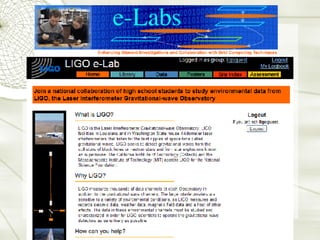
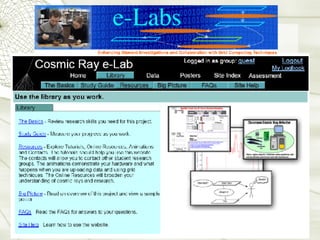
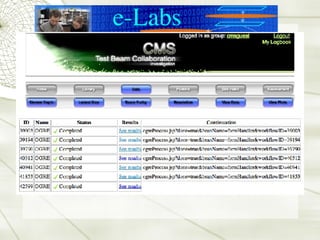
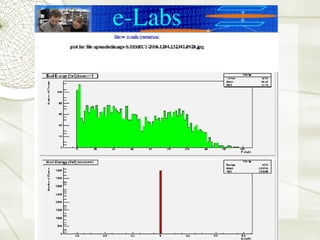
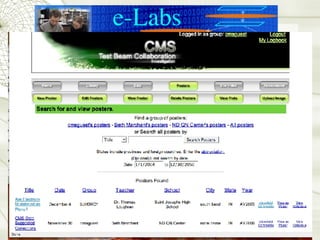
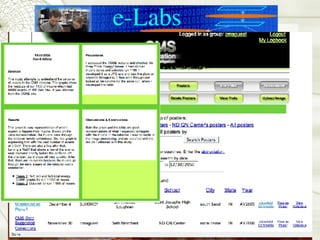
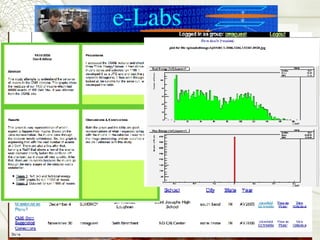
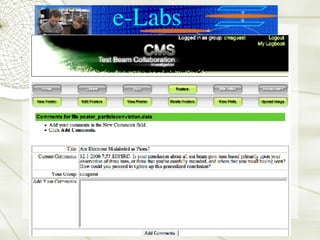
What do e-Labs do?  Provide students with real science data and data analysis tools Enable students and teachers to enter into scientific collaborations with other schools Can involve scientists with students Require only web browser access--no other software Are available for Middle and High School Students Are 100% free of charge (NSF-supported) Provide one-stop shopping for teachers
Earth science LIGO data Seismic, weather, solar activity Cosmic Ray detection Classroom cosmic ray detectors Particle physics LHC data coming What e-Labs are available?
 
 
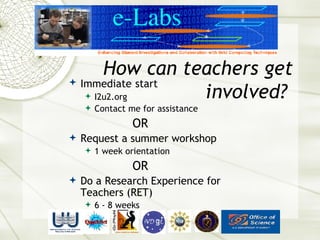
Immediate   start I2u2.org Contact me for assistance OR Request a summer workshop 1 week orientation OR Do a Research Experience for Teachers (RET) 6 - 8 weeks How can teachers get involved?
www.i2u2.org


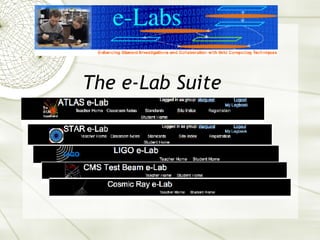
The e-Lab Suite

I2U2

  • 1.
    Science Research Opportunities through Web Browsers: The I2U2 e-Lab suite Tom Loughran University of Notre Dame
  • 2.
    What do e-Labsdo? Provide students with real science data and data analysis tools Enable students and teachers to enter into scientific collaborations with other schools Can involve scientists with students Require only web browser access--no other software Are available for Middle and High School Students Are 100% free of charge (NSF-supported) Provide one-stop shopping for teachers
  • 3.
    Earth science LIGOdata Seismic, weather, solar activity Cosmic Ray detection Classroom cosmic ray detectors Particle physics LHC data coming What e-Labs are available?
  • 4.
  • 5.
  • 6.
    Immediate start I2u2.org Contact me for assistance OR Request a summer workshop 1 week orientation OR Do a Research Experience for Teachers (RET) 6 - 8 weeks How can teachers get involved?
  • 7.
  • 8.
  • 9.
  • 10.
  • 11.
  • 12.
  • 13.
  • 14.
  • 15.
  • 16.
  • 17.
  • 18.
  • 19.
  • 20.
  • 21.
  • 22.

Editor's Notes

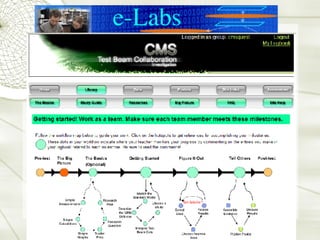
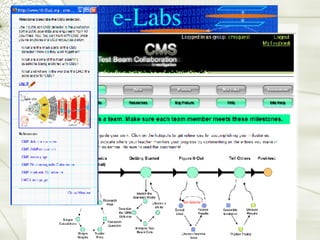
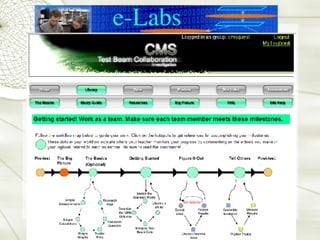
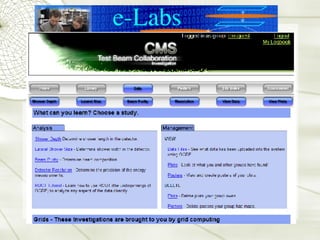
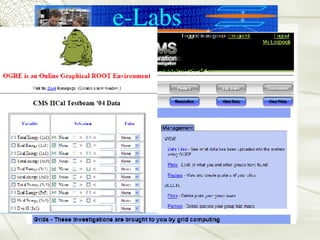
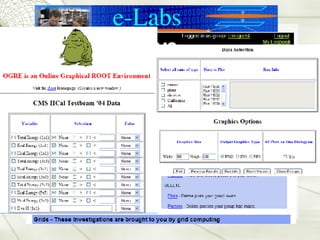
  • #2 --E-labs are online research environments connecting HS students with large collaborative science expermiments. --Data and analysis tools from experiments like the CMS detector under construction at CERN are made available to students, supported by the sameGrid computing tools which were built to facilitate scientific collaboration. --these tools are rendered accessible to students (who can check boxes and pull down menus, instead of writing code); --At the same time, a sketch of the learning curve is made available together with resources enabling students to climb it efficiently