QuarkNet and Physics RET How can particle physics research help me to become a better teacher? Beth Marchant
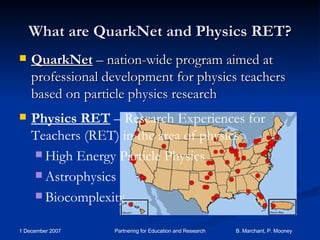
What are QuarkNet and Physics RET? QuarkNet  – nation-wide program aimed at professional development for physics teachers based on particle physics research Physics RET  – Research Experiences for Teachers (RET) in the area of physics High Energy Particle Physics Astrophysics Biocomplexity
Why scientific research? Scientific research calls for a particular way of thinking that is often not practiced by teachers or students Learn how the world works by figuring it out Easy to forget what science is about when you haven’t done it for awhile
What about Standards? Indiana Standards for K-12 science classes: The Nature of Science and Technology Scientific Thinking The Physical Setting/The Living Environment The Mathematical World Historical Perspectives Common Themes
What about Standards? Indiana Standards for K-12 science classes: The Nature of Science and Technology Scientific Inquiry K.1.1 Raise questions about the natural world. Scientific Enterprise K.1.2 Begin to demonstrate that everyone can do science.
What about Standards? Indiana Standards for K-12 science classes: The Nature of Science and Technology Scientific Thinking Computation and Estimation K.2.1 Use whole numbers, up to 10, in counting, identifying, sorting, and describing objects and experiences. Communication K.2.2 Draw pictures and write words to describe objects and experiences.
What about Standards? Indiana Standards for K-12 science classes: The Nature of Science and Technology Scientific Thinking The Physical Setting/The Living Environment Matter and Energy K.3.1 Describe objects in terms of the materials they are made of, such as clay, cloth, paper, etc. Forces of Nature K.3.2 Investigate that things move in different ways, such as fast, slow, etc. Diversity of Life K.4.1 Give examples of plants and animals. K.4.2 Observe plants and animals, describing how they are alike and how they are different in the way they look and in the things they do.
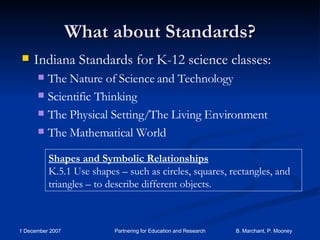
What about Standards? Indiana Standards for K-12 science classes: The Nature of Science and Technology Scientific Thinking The Physical Setting/The Living Environment The Mathematical World Shapes and Symbolic Relationships K.5.1 Use shapes – such as circles, squares, rectangles, and triangles – to describe different objects.
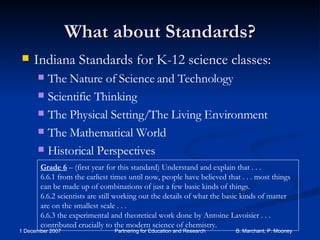
What about Standards? Indiana Standards for K-12 science classes: The Nature of Science and Technology Scientific Thinking The Physical Setting/The Living Environment The Mathematical World Historical Perspectives Grade 6  – (first year for this standard) Understand and explain that . . . 6.6.1 from the earliest times until now, people have believed that . . . most things can be made up of combinations of just a few basic kinds of things. 6.6.2 scientists are still working out the details of what the basic kinds of matter are on the smallest scale . . .  6.6.3 the experimental and theoretical work done by Antoine Lavoisier . . . contributed crucially to the modern science of chemistry.
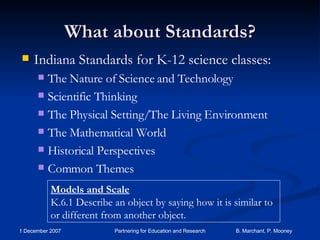
What about Standards? Indiana Standards for K-12 science classes: The Nature of Science and Technology Scientific Thinking The Physical Setting/The Living Environment The Mathematical World Historical Perspectives Common Themes Models and Scale K.6.1 Describe an object by saying how it is similar to or different from another object.
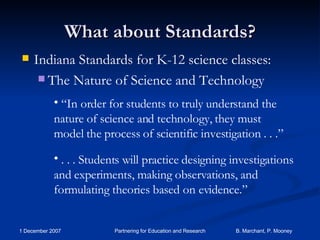
What about Standards? Indiana Standards for K-12 science classes: The Nature of Science and Technology “ In order for students to truly understand the nature of science and technology, they must model the process of scientific investigation . . .” . . . Students will practice designing investigations and experiments, making observations, and formulating theories based on evidence.”
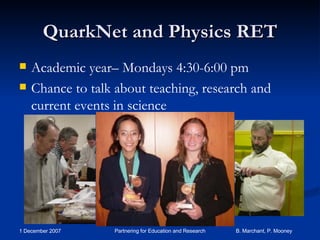
QuarkNet and Physics RET Academic year– Mondays 4:30-6:00 pm Chance to talk about teaching, research and current events in science
QuarkNet and Physics RET Research projects may include:  Scintillator and waveshifter R&D Cosmic Ray Detectors and Project GRAND CMS Grid Data Analysis Photosensor R & D Astrophysics – search for meteoroids and supernovae Biocomplexity – modeling of physical attributes of biological phenomena
How to Apply for Summer, 2008 Summer 4-8 week research program for teachers  $6200 for 8 weeks 3 hours graduate credit for 8 weeks On-line at:  http://ret.nd.edu Choose “Physics RET” OR, contact me, Beth Marchant
QuarkNet and Physics RET For more information: Beth Marchant – Director, QuarkNet QuarkNet Booth today [email_address] 574-631-3343 http://www.nd.edu/~quarknet
 
Notre Dame  extended  Research Community (ND e RC) A 5 Year NSF GK-12 Project – 1 st  Year Currently 6 Graduate Fellows from Science and Engineering and 7 K-12 Teachers Teams often include a graduate fellow, a teacher and several high school students Teams concentrate on research during the summer and on educational activities during the academic year
Notre Dame  extended  Research Community (ND e RC) Approach Research is Important – complementary approach to learning The Teacher is the Professional in the Classroom Develop Effective and Collegial Relationships - Meals Begin Slowly – An extra pair of hands and eyes Proceed Judiciously with Energy Aim Establish an Enduring Community of Researchers/Educators Foster a Rich Culture in Engineering, Science and Mathematics Enduring Community and Rich Culture are Mutually Enhancing
Notre Dame  extended  Research Community (ND e RC) A Variety of Opportunities for Teachers Become a Team Member Research – primarily during the summer Classroom Activities – primarily during the AY Research Class Graduate Fellow can be a mentor/colleague for a student Classroom Activities Extra pair of hands and eyes Develop/Implement Activities – BioEyes & Imaging Clubs – Robotics, Science, Math … Make a Suggestion – maybe we can collaborate in a way we haven’t thought of yet
Notre Dame  extended  Research Community (ND e RC) Benefits for K-12 Teachers Experience the collegiality and excitement of collaborating with fellow teachers and Notre Dame researchers Work with fellow teachers and Notre Dame researchers to enhance STEM education in the local area  Salaried research positions at Notre Dame during the summer  Academic credit for graduate research at Notre Dame
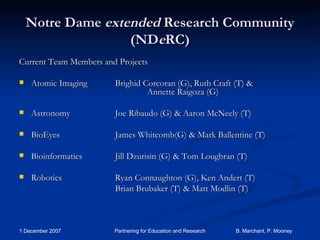
Notre Dame  extended  Research Community (ND e RC) Current Team Members and Projects Atomic Imaging  Brighid Corcoran (G), Ruth Craft (T) &  Annette Raigoza (G) Astronomy Joe Ribaudo (G) & Aaron McNeely (T) BioEyes James Whitcomb(G) & Mark Ballentine (T) Bioinformatics  Jill Dzurisin (G) & Tom Loughran (T) Robotics Ryan Connaughton (G), Ken Andert (T) Brian Brubaker (T) & Matt Modlin (T)

QuarkNet

  • 1.
    QuarkNet and PhysicsRET How can particle physics research help me to become a better teacher? Beth Marchant
  • 2.
    What are QuarkNetand Physics RET? QuarkNet – nation-wide program aimed at professional development for physics teachers based on particle physics research Physics RET – Research Experiences for Teachers (RET) in the area of physics High Energy Particle Physics Astrophysics Biocomplexity
  • 3.
    Why scientific research?Scientific research calls for a particular way of thinking that is often not practiced by teachers or students Learn how the world works by figuring it out Easy to forget what science is about when you haven’t done it for awhile
  • 4.
    What about Standards?Indiana Standards for K-12 science classes: The Nature of Science and Technology Scientific Thinking The Physical Setting/The Living Environment The Mathematical World Historical Perspectives Common Themes
  • 5.
    What about Standards?Indiana Standards for K-12 science classes: The Nature of Science and Technology Scientific Inquiry K.1.1 Raise questions about the natural world. Scientific Enterprise K.1.2 Begin to demonstrate that everyone can do science.
  • 6.
    What about Standards?Indiana Standards for K-12 science classes: The Nature of Science and Technology Scientific Thinking Computation and Estimation K.2.1 Use whole numbers, up to 10, in counting, identifying, sorting, and describing objects and experiences. Communication K.2.2 Draw pictures and write words to describe objects and experiences.
  • 7.
    What about Standards?Indiana Standards for K-12 science classes: The Nature of Science and Technology Scientific Thinking The Physical Setting/The Living Environment Matter and Energy K.3.1 Describe objects in terms of the materials they are made of, such as clay, cloth, paper, etc. Forces of Nature K.3.2 Investigate that things move in different ways, such as fast, slow, etc. Diversity of Life K.4.1 Give examples of plants and animals. K.4.2 Observe plants and animals, describing how they are alike and how they are different in the way they look and in the things they do.
  • 8.
    What about Standards?Indiana Standards for K-12 science classes: The Nature of Science and Technology Scientific Thinking The Physical Setting/The Living Environment The Mathematical World Shapes and Symbolic Relationships K.5.1 Use shapes – such as circles, squares, rectangles, and triangles – to describe different objects.
  • 9.
    What about Standards?Indiana Standards for K-12 science classes: The Nature of Science and Technology Scientific Thinking The Physical Setting/The Living Environment The Mathematical World Historical Perspectives Grade 6 – (first year for this standard) Understand and explain that . . . 6.6.1 from the earliest times until now, people have believed that . . . most things can be made up of combinations of just a few basic kinds of things. 6.6.2 scientists are still working out the details of what the basic kinds of matter are on the smallest scale . . . 6.6.3 the experimental and theoretical work done by Antoine Lavoisier . . . contributed crucially to the modern science of chemistry.
  • 10.
    What about Standards?Indiana Standards for K-12 science classes: The Nature of Science and Technology Scientific Thinking The Physical Setting/The Living Environment The Mathematical World Historical Perspectives Common Themes Models and Scale K.6.1 Describe an object by saying how it is similar to or different from another object.
  • 11.
    What about Standards?Indiana Standards for K-12 science classes: The Nature of Science and Technology “ In order for students to truly understand the nature of science and technology, they must model the process of scientific investigation . . .” . . . Students will practice designing investigations and experiments, making observations, and formulating theories based on evidence.”
  • 12.
    QuarkNet and PhysicsRET Academic year– Mondays 4:30-6:00 pm Chance to talk about teaching, research and current events in science
  • 13.
    QuarkNet and PhysicsRET Research projects may include: Scintillator and waveshifter R&D Cosmic Ray Detectors and Project GRAND CMS Grid Data Analysis Photosensor R & D Astrophysics – search for meteoroids and supernovae Biocomplexity – modeling of physical attributes of biological phenomena
  • 14.
    How to Applyfor Summer, 2008 Summer 4-8 week research program for teachers $6200 for 8 weeks 3 hours graduate credit for 8 weeks On-line at: http://ret.nd.edu Choose “Physics RET” OR, contact me, Beth Marchant
  • 15.
    QuarkNet and PhysicsRET For more information: Beth Marchant – Director, QuarkNet QuarkNet Booth today [email_address] 574-631-3343 http://www.nd.edu/~quarknet
  • 16.
  • 17.
    Notre Dame extended Research Community (ND e RC) A 5 Year NSF GK-12 Project – 1 st Year Currently 6 Graduate Fellows from Science and Engineering and 7 K-12 Teachers Teams often include a graduate fellow, a teacher and several high school students Teams concentrate on research during the summer and on educational activities during the academic year
  • 18.
    Notre Dame extended Research Community (ND e RC) Approach Research is Important – complementary approach to learning The Teacher is the Professional in the Classroom Develop Effective and Collegial Relationships - Meals Begin Slowly – An extra pair of hands and eyes Proceed Judiciously with Energy Aim Establish an Enduring Community of Researchers/Educators Foster a Rich Culture in Engineering, Science and Mathematics Enduring Community and Rich Culture are Mutually Enhancing
  • 19.
    Notre Dame extended Research Community (ND e RC) A Variety of Opportunities for Teachers Become a Team Member Research – primarily during the summer Classroom Activities – primarily during the AY Research Class Graduate Fellow can be a mentor/colleague for a student Classroom Activities Extra pair of hands and eyes Develop/Implement Activities – BioEyes & Imaging Clubs – Robotics, Science, Math … Make a Suggestion – maybe we can collaborate in a way we haven’t thought of yet
  • 20.
    Notre Dame extended Research Community (ND e RC) Benefits for K-12 Teachers Experience the collegiality and excitement of collaborating with fellow teachers and Notre Dame researchers Work with fellow teachers and Notre Dame researchers to enhance STEM education in the local area Salaried research positions at Notre Dame during the summer Academic credit for graduate research at Notre Dame
  • 21.
    Notre Dame extended Research Community (ND e RC) Current Team Members and Projects Atomic Imaging Brighid Corcoran (G), Ruth Craft (T) & Annette Raigoza (G) Astronomy Joe Ribaudo (G) & Aaron McNeely (T) BioEyes James Whitcomb(G) & Mark Ballentine (T) Bioinformatics Jill Dzurisin (G) & Tom Loughran (T) Robotics Ryan Connaughton (G), Ken Andert (T) Brian Brubaker (T) & Matt Modlin (T)