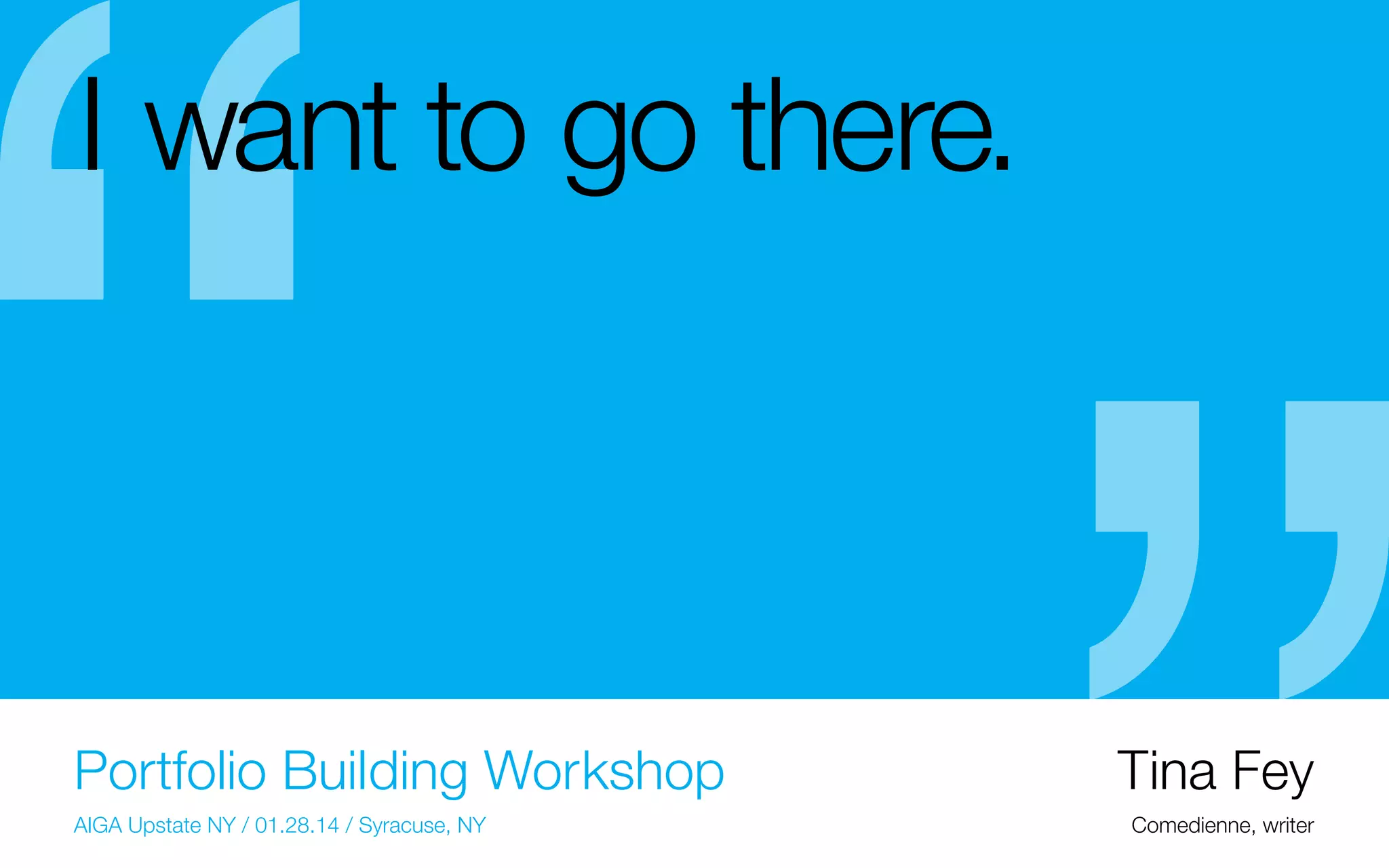
I want to go there.
-	My name is Mitzie Testani and I’m an illustrator and interaction designer
-	Tonight I want to talk about how to find your path as a designer, and give you
some advice I wish I would have gotten along the way to my own path.

Portfolio Building Workshop
AIGA Upstate NY / 01.28.14 / Syracuse, NY

Tina Fey
Comedienne, writer
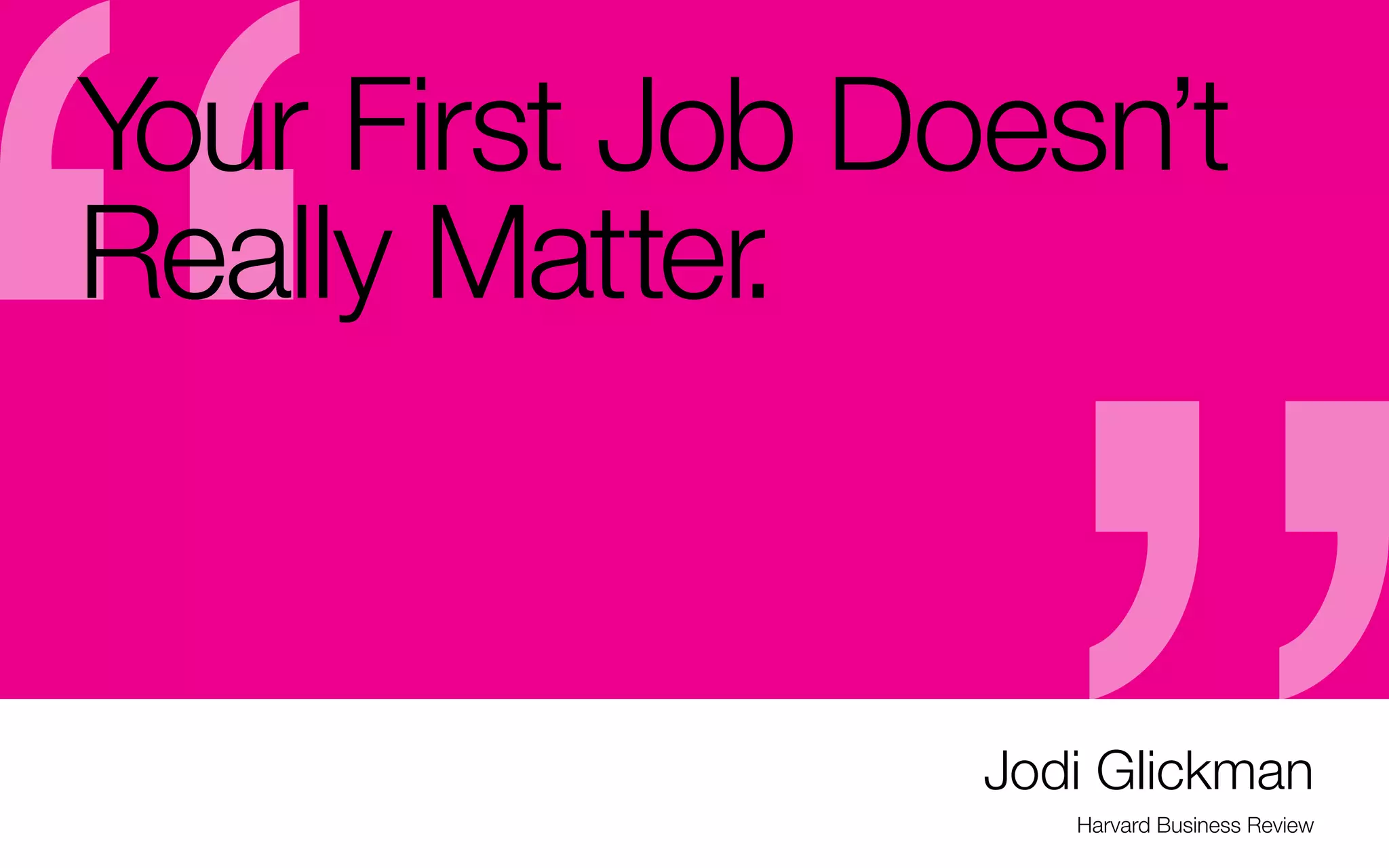
Your First Job Doesn’t
Really Matter.
According to the Harvard Business Review, 10 years
after we graduate college:
- 20% stay in our chosen field
- Only 3% remain in a similar job and industry
- A rare person lands in the first job that they will love
forever
- In fact, many people are disappointed when they
find themselves doing a lot of production in their
first job, and not a lot of “design” work
- Use your first job(s) to experiment and to build
bridges to where you might want to go

- Learn about business, too. They just can’t take the
time to teach everything in school (there’s a great
post by David Airey on “what design schools are
lacking.” Google it.)
- Learn how to fail (gracefully); it’s a safer place than
through freelance mistakes

Jodi Glickman
Harvard Business Review
You’re only as good as
your last [project].

- This will help you to discover niches through a
- In my experience, it’s your first portfolio that doesn’t
wide variety of projects. Maybe you will work with
really matter, because it should be changing regularly
a hired specialist for film, animation, illustration,
- Goal of your first portfolio is only to get your first job
sound, photography, responsive websites, etc.) From
(or 2)
there, you will meet people who can help you to find
- It’s supposed to show you know the fundamentals:
resources for a specialized path
typography, hierarchy, grid, composition, and
- In my first studio experience, we took on a huge range
understanding of color, and a wide variety of
of work and I always found that my favorite projects
applications (hopefully deep and not just posters or
involved illustration. But my illustration, was too
book covers)
broad to do it professionally at the time. It was a good
- it’s HEAVILY art directed, it does not necessarily show
lesson and started me on my path.
that you know how to think or what you’re capable of
on your own
- It’s filled mostly with “lessons,” not “real” applications
- To grow, try taking on multiple roles whenever you can
(which is a reality in today’s economy anyway)

Paula Scher
Partner, Pentagram
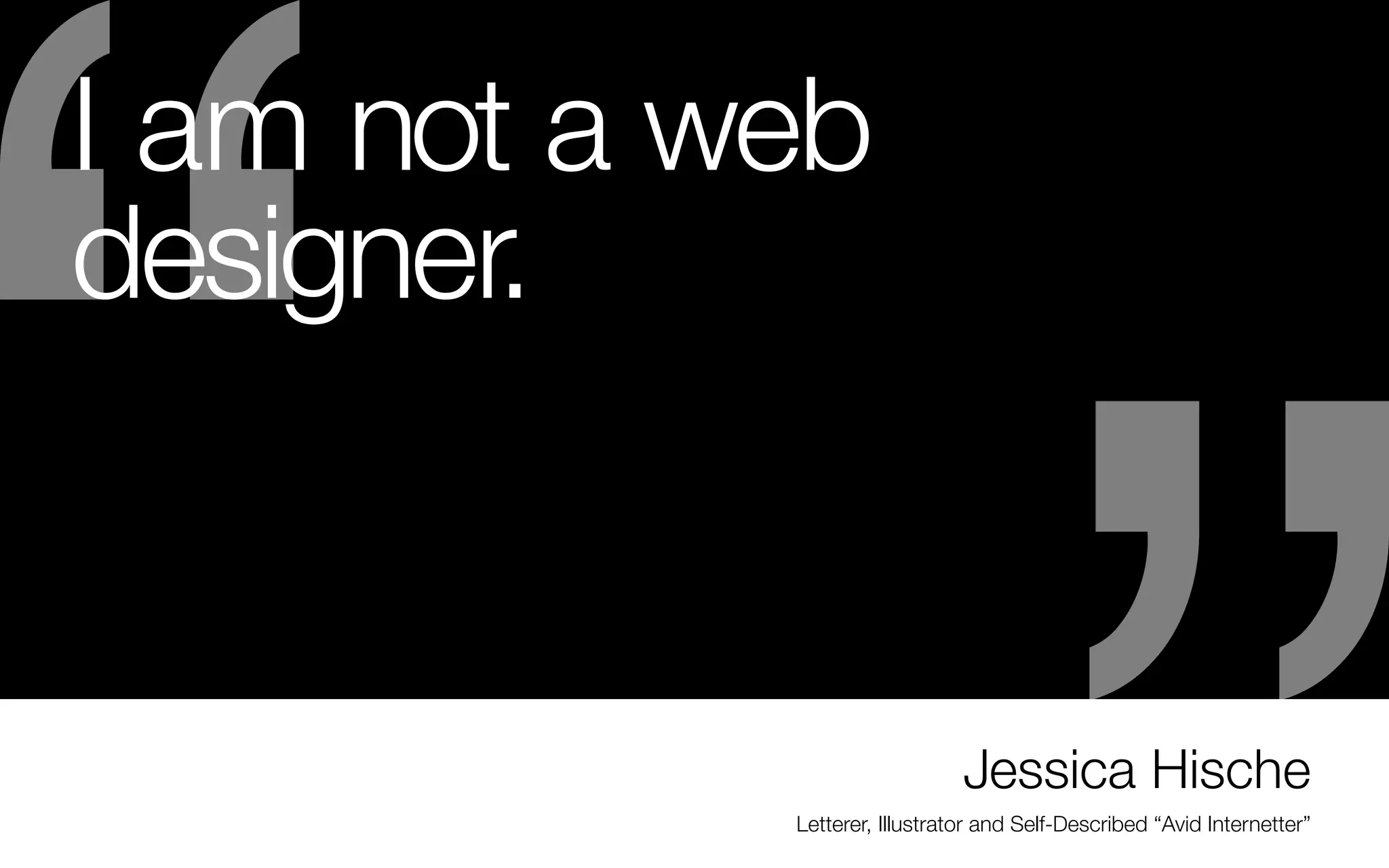
I am not a web
designer.

-	Once you want to specialize, saying no to the wrong
work will take some discipline. And it will be more
difficult the further entrenched you become in the
“wrong path.”

website. She was literally called out if the blue and
recruited for a job because of her lettering portfolio.
-	Another alumn from my school got her start from
selling her work on Etsy. Her work got better and
better and now she does a lot of publishing work

But saying yes to the right projects eventually pay off:
-	Jess Hische’s career skyrocketed after she did a side
project for fun called “Daily Drop Cap”
- I also have a friend who has a passion for hand
lettering but was really restricted in her job designing
for an environmental design firm - so she made a
hobby of lettering for fun and posted it in places like
letterplayground.com. She entered competitions for
lettering. She posted things she did for fun on her own

Jessica Hische
Letterer, Illustrator and Self-Described “Avid Internetter”
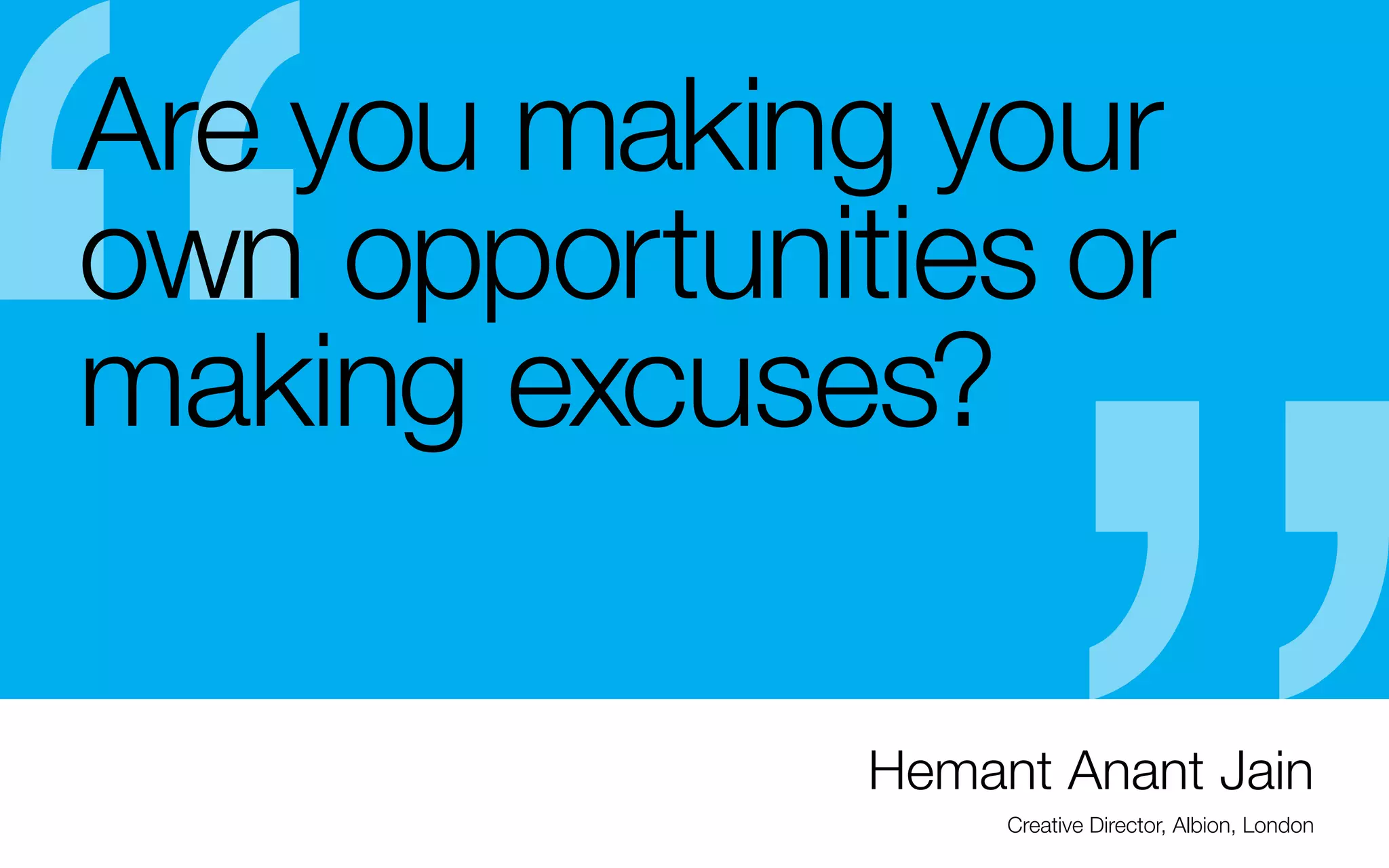
Are you making your
own opportunities or
making excuses?
So even if you’re not that good in the beginning:
- Keep in mind that kids with no experience are
making great YouTube videos and indie-band
posters, silk screen Ts, websites, etc., so don’t let
lack of experience stop you
- “talent is one thing, drive is another. A combination
of both is what is going to make you successful.”	
—Hemant Anat Jain

- It’s okay to show experimentation in your portfolio
even unfinished work (you can put it in the back —
make sure it’s significant enough to show the draft.
You can move it up as it improves) I was once asked
if I had anything “edgier” to show, after showing a
LOT of work. The unfinished “experiments” is what
got me the job.

Hemant Anant Jain
Creative Director, Albion, London
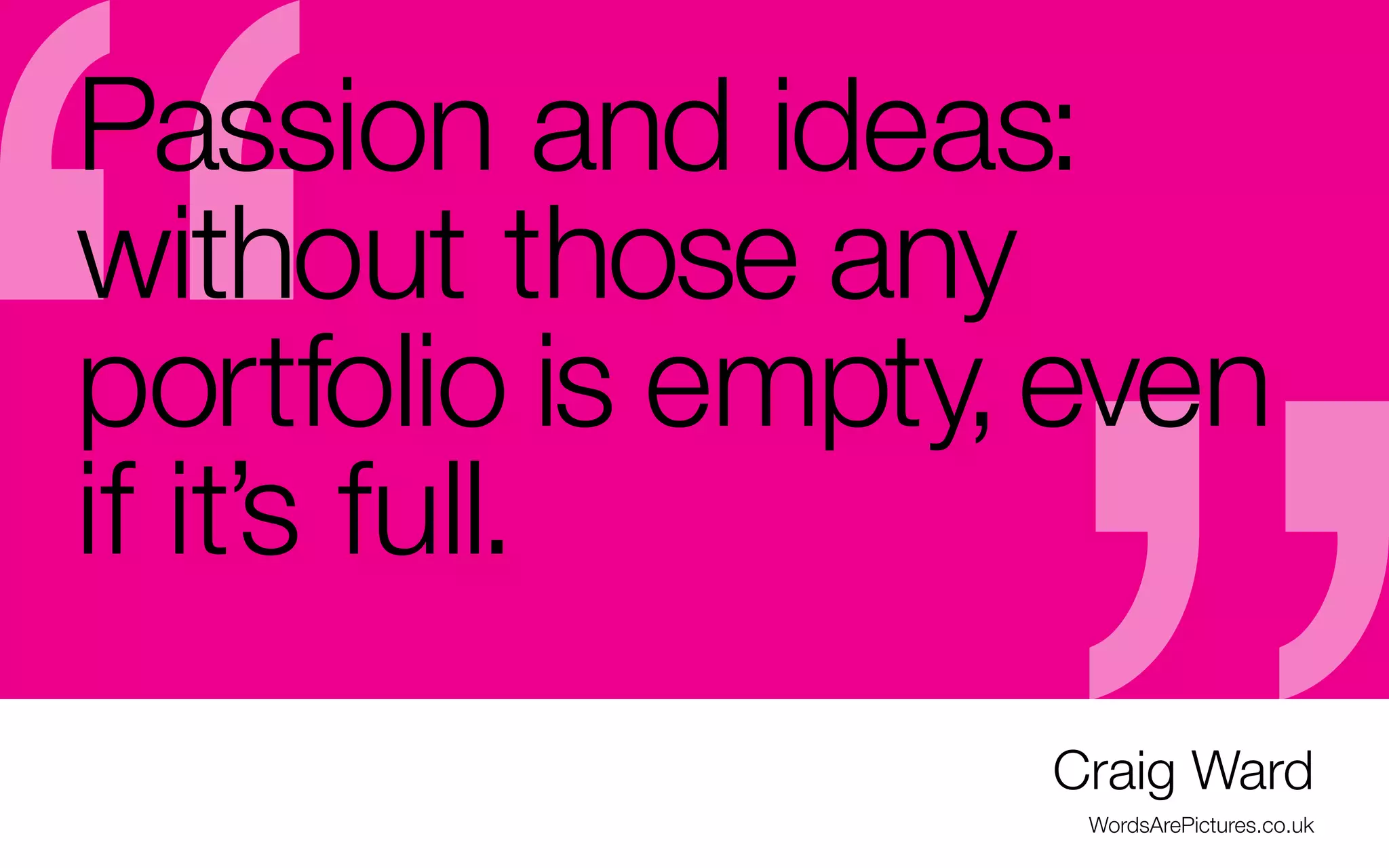
Passion and ideas:
without those any
portfolio is empty, even
if it’s full.

-	How can your work show passion if you’re not excited about it?
-	It’s easier to be excited and show some “wow” if you are specializing
-	Plus, wouldn’t it be wonderful to love what you do every day?
-	Stand up for your passions/your path, even if you’re better at something else
-	If you can’t get an opportunity at work, do it on the side.
-	It my take a lot of practice, but you can get there, eventually

Craig Ward
WordsArePictures.co.uk
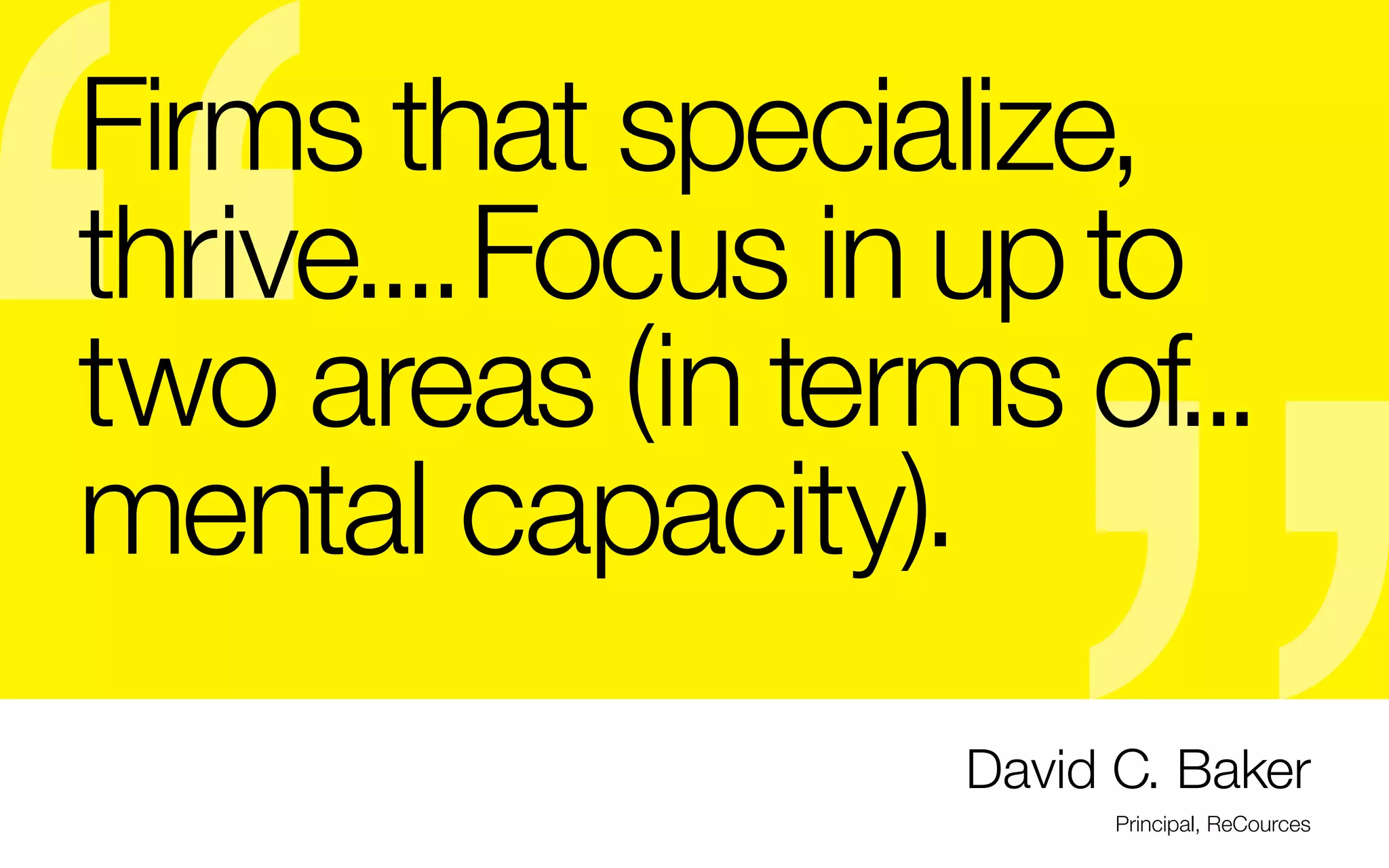
Firms that specialize,
thrive.... Focus in up to
two areas (in terms of...
mental capacity).

Why does specialization matter?

-	As a new graduate, know that 62% of
jobs are posted to niche job sites

-	You’ll get really good (important since

-	Advantage when pitted against a more
experienced “generalist” designer

-	You can charge more

- Competition with similar niche-

specialists will become a smaller pool
and so will your networking

-	This doesn’t mean do only 1 type of

graphic design is highly competitive,

project: ie: hand letterers can work on

with a seemingly low point of entry for

all kinds of projects from magazines, to

amateurs, ie: crowdsourcing, Elance,

food packaging, clothing, wayfinding,

easy access to software & tools)

theater posters, etc., but their main
focus is in perfecting their lettering.

David C. Baker
Principal, ReCources
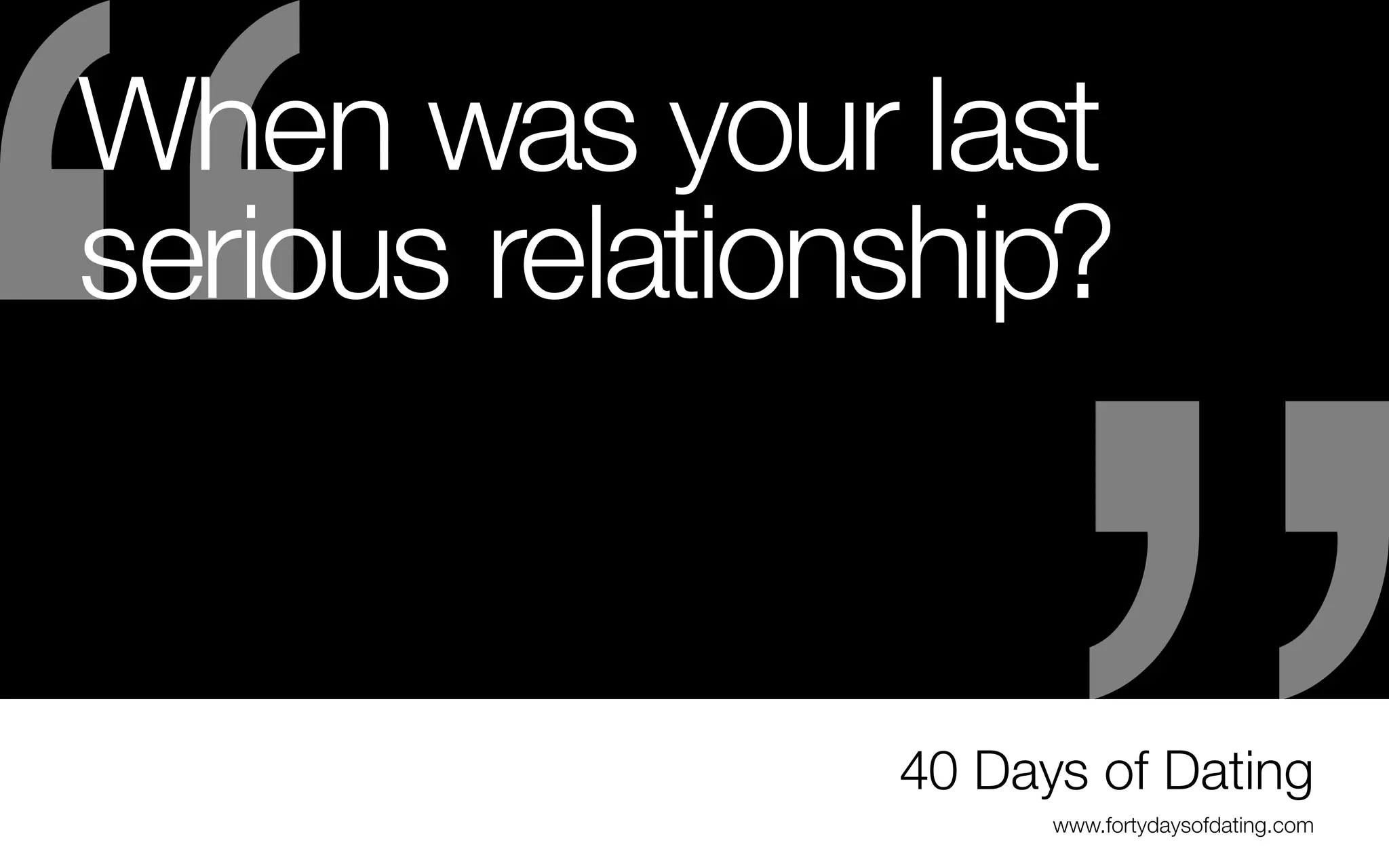
When was your last
serious relationship?
-	The law of attraction: like attracts like
- Fill your portfolio with the type of work you
want to do, not necessarily the work you’ve
done at your first job(s) or in school
- Get the stuff you don’t want to do again
out of there, so you won’t attract the wrong
opportunities
-	The more repeat clients with the wrong
projects, the harder it will be to say no

- You may have to create your own opportunities
(volunteer, freelance, personal project/selfpromotion)
-	The stronger your portfolio becomes, the more
your client base will grow
-	Soon you will have enough work to customize
your portfolio for specific interviews (i.e. all
websites or all publishing pieces.)

40 Days of Dating
www.fortydaysofdating.com
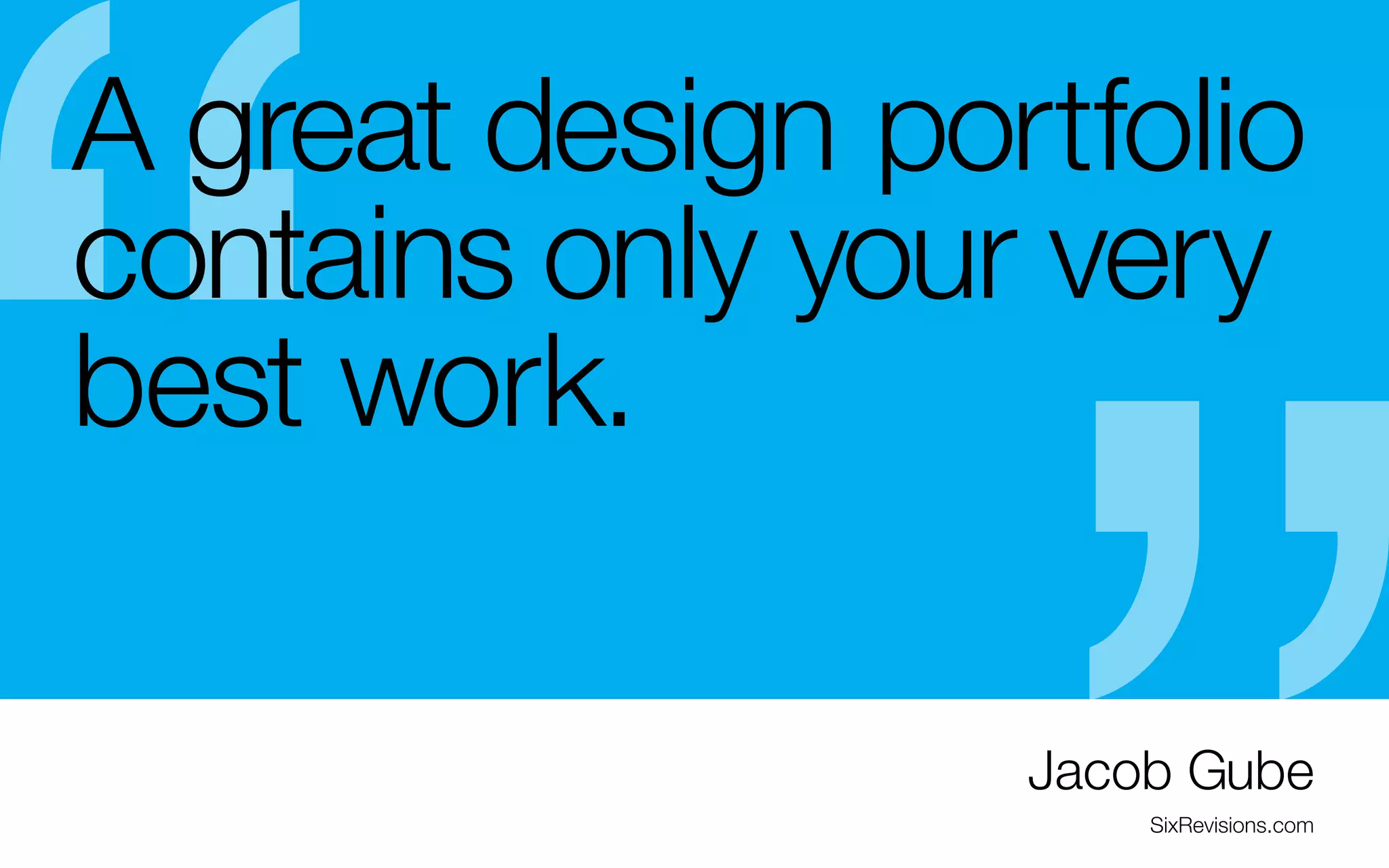
A great design portfolio
contains only your very
best work.
-	It may be tempting to put everything you do into your 6 months (obviously, big projects like websites will
take longer)
portfolio, when you are getting started
- Don’t be afraid to continually update your best
-	it’s better to have a small portfolio composed of a
pieces as you get better
few of your best pieces rather vs. a big portfolio
- Try to replace all of your student projects in the next
containing a lot of mediocre work
3-5 years.
- Choose pieces that can be good talking points
during an interview.
- Keep it fresh. As a new graduate, your goal should
be to add to your portfolio at least every 3 to

Jacob Gube
SixRevisions.com
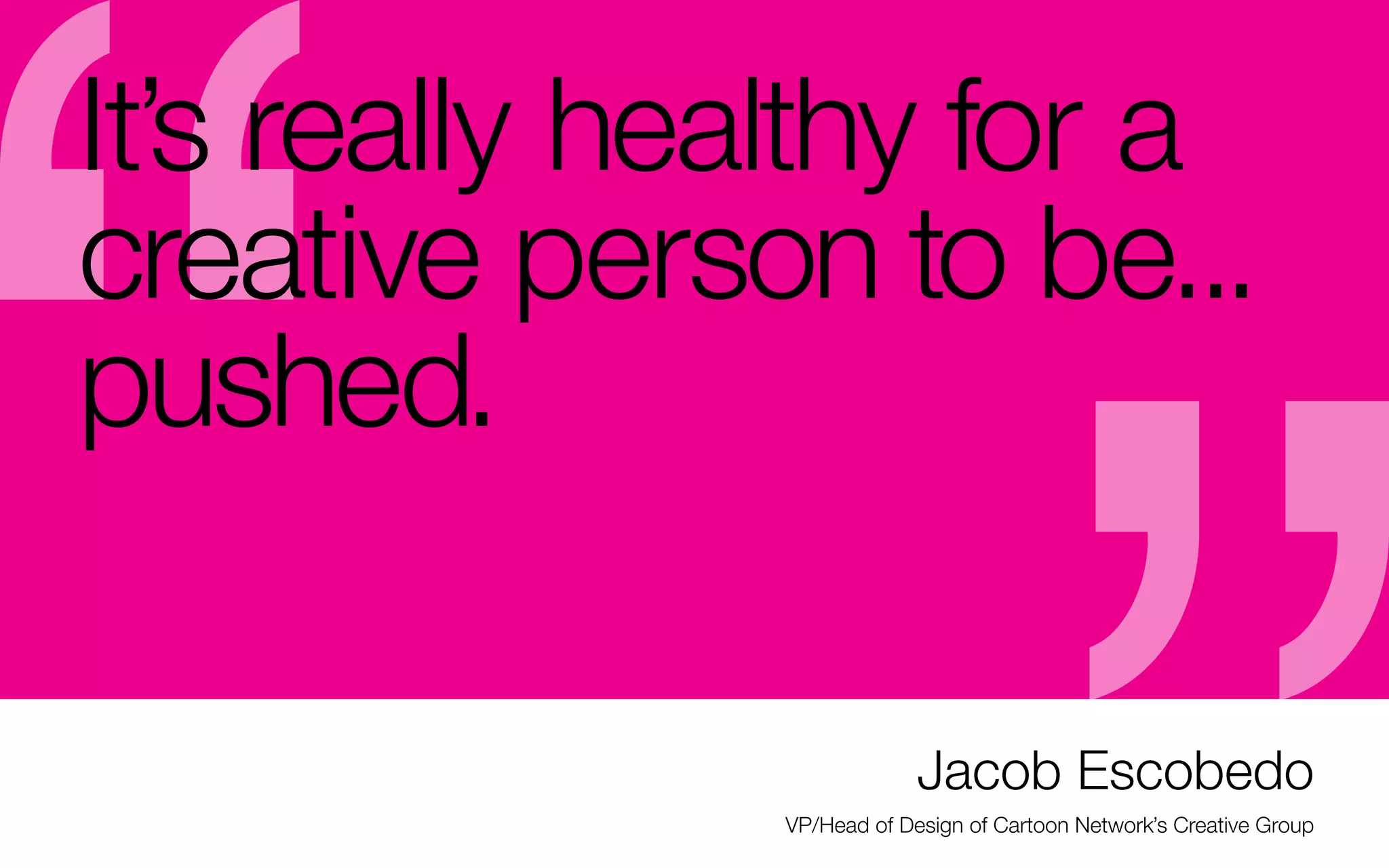
It’s really healthy for a
creative person to be...
pushed.
what you will have in your portfolio

you are trying to discover your niche

after school will be critiques –

when you graduate (Remember? Lots

and need practice talking about new

especially if you freelance

of “lessons” & not “real” work)

work in your portfolio

-	The first thing you’re going to miss

- If you’re not a generous critiquer

- Befriend others who can critique

- Your critiquers can include former

now, learn how to be — that includes

mercilessly for an objective opinion –

employers you really respect (and it

listening and regularly participating to

& keep in touch

can lead to freelance with them)

others’ critiques
- Critiquing skills are the only way you
will be able to kill your own work that’s
not working (especially considering

- If you start to succeed, spend your
time working, not boasting about it on
social media
-	A critique network is also great when

Jacob Escobedo
VP/Head of Design of Cartoon Network’s Creative Group
Everyone poops.
-	Don’t be jealous of someone else’s success, be
inspired if they’ve found their path. But remember,
it’s THEIR path. Find your own.
- Don’t compare your work to others’, your path
should be unique

work YOU like.
- Once you do this, then look for your audience

Some more Victore wisdom:
-	“If your work appeals to everyone, then it moves no
one.”
- Your own voice comes through when you make the

James Victore
independent artist and designer, New York
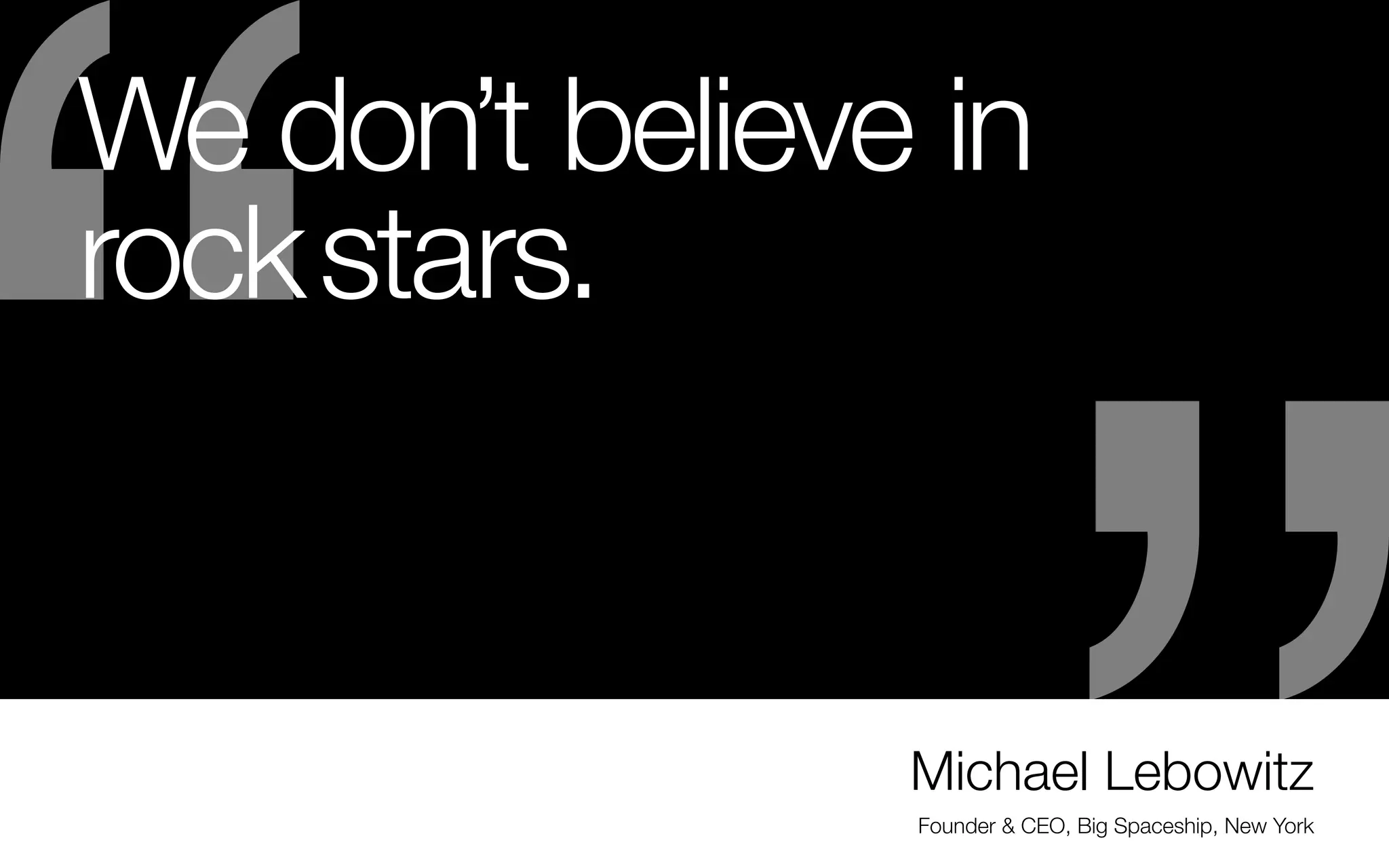
We don’t believe in
rock stars.
- Even if you become amazing at your path & craft
— you still need to be able to work well with others
(whether freelance or on a team or directly with
clients)
- Explain how you collaborated on a piece when you
interview
- Talk about your process, your role and have one
complete case study or set of process samples
ready. Or how about a full sheet with completely
developed & different identity experiments?

-	Even sketch books are great (to have when asked to
show your process)
- Talk about the project’s challenges
- How did you impact the solution?
- Give credit to everyone you worked with
- Make sure credits are listed on your website, too

Michael Lebowitz
Founder & CEO, Big Spaceship, New York
I haven’t seen a
physical book for
a year.
[2013]

-	Keep in mind that most people want to see your
work before they see you – it might even decide
whether or not you get the interview.
- The flip book is an “optional” interview tool now
- Leave-behinds are always useful, especially if it
reinforces what you specialize in.
- If you want to work on your own: Google your
favorite designer who is on a similar path you want
to be on. See where they are active (Etsy, Society 6,
Zazzle, Krop, Creative Hotlist, etc.) this will give you
an idea where you can try

-	Email past professors or sucessfull former students
that have followed a similar path to yours and ask
smart questions (don’t waste their time with things
you can figure out on your own.)
- Take advantage of cross marketing (linkedin &
behance & AIGA)
- Enter competitions once you love your work,
but don’t let it change your work (don’t compare
yourself.)

Andy Fackrell
Executive Creative Director, DDB Group, New Zealand
Thanks.
-	That’s it from me. This presentation will be up on
slideshare later (with my notes)
-	feel free to email me with questions if we don’t have
time to get to them tonight.	
mitzie@nonperishable.com (put AIGA Upstate NY
Portfolio Building Workshop in the subject so I don’t
spam folder you!)

Mitzie Testani
Illustrator and interactive designer / mitzie@nonperishable.com
Sources
Your First Job Doesn’t (Really) Matter HARVARD BUSINESS REVIEW	
http://blogs.hbr.org/2011/10/your-first-job-doesnt-really-m

I am not a web designer. Jessica Hische	
http://jessicahische.is/thinkingthoughtsaboutwebdesign

Why Breaking Free From Expectations Is The Key To Good Design FREE RADICALS	
http://www.psfk.com/2014/01/paula-scher-pentagram-istock.html?utm_content=buffer59c4d&utm_medium=social&utm_source=twitter.com&utm_campaign=buffer#!teFSW

40 Days of dating
http://fortydaysofdating.com/about

Interview: Jacob Escobedo The Great Discontent	
http://thegreatdiscontent.com/jacob-escobedo

A dozen common mistakes DAVID C. BAKER
http://www.aiga.org/a-dozen-common-mistakes/

16 Tips to Improve Your Design Portfolio & Get Hired Weekly Design Grind	
http://weeklydesigngrind.com/design-portfolio-tips-and-advice/

10 Essential Tips for Creating that Killer Portfolio DESIGN SOJOURN	
http://www.designsojourn.com/10-essential-tips-for-creating-that-killer-portfolio

Breaking In By William Burks Spencer	
http://breakinginbook.com: Over 100 Advertising Insiders Reveal How To Build A Portfolio That Will Get You Hired

Specialization: a designer’s key to success in the future DESIGN BLENDer	
http://www.graphicdesignblender.com/specialization-a-designers-key-to-success-in-the-future

I want to go there - how to find your path as a designer

  • 1.
    I want togo there. - My name is Mitzie Testani and I’m an illustrator and interaction designer - Tonight I want to talk about how to find your path as a designer, and give you some advice I wish I would have gotten along the way to my own path. Portfolio Building Workshop AIGA Upstate NY / 01.28.14 / Syracuse, NY Tina Fey Comedienne, writer
  • 2.
    Your First JobDoesn’t Really Matter. According to the Harvard Business Review, 10 years after we graduate college: - 20% stay in our chosen field - Only 3% remain in a similar job and industry - A rare person lands in the first job that they will love forever - In fact, many people are disappointed when they find themselves doing a lot of production in their first job, and not a lot of “design” work - Use your first job(s) to experiment and to build bridges to where you might want to go - Learn about business, too. They just can’t take the time to teach everything in school (there’s a great post by David Airey on “what design schools are lacking.” Google it.) - Learn how to fail (gracefully); it’s a safer place than through freelance mistakes Jodi Glickman Harvard Business Review
  • 3.
    You’re only asgood as your last [project]. - This will help you to discover niches through a - In my experience, it’s your first portfolio that doesn’t wide variety of projects. Maybe you will work with really matter, because it should be changing regularly a hired specialist for film, animation, illustration, - Goal of your first portfolio is only to get your first job sound, photography, responsive websites, etc.) From (or 2) there, you will meet people who can help you to find - It’s supposed to show you know the fundamentals: resources for a specialized path typography, hierarchy, grid, composition, and - In my first studio experience, we took on a huge range understanding of color, and a wide variety of of work and I always found that my favorite projects applications (hopefully deep and not just posters or involved illustration. But my illustration, was too book covers) broad to do it professionally at the time. It was a good - it’s HEAVILY art directed, it does not necessarily show lesson and started me on my path. that you know how to think or what you’re capable of on your own - It’s filled mostly with “lessons,” not “real” applications - To grow, try taking on multiple roles whenever you can (which is a reality in today’s economy anyway) Paula Scher Partner, Pentagram
  • 4.
    I am nota web designer. - Once you want to specialize, saying no to the wrong work will take some discipline. And it will be more difficult the further entrenched you become in the “wrong path.” website. She was literally called out if the blue and recruited for a job because of her lettering portfolio. - Another alumn from my school got her start from selling her work on Etsy. Her work got better and better and now she does a lot of publishing work But saying yes to the right projects eventually pay off: - Jess Hische’s career skyrocketed after she did a side project for fun called “Daily Drop Cap” - I also have a friend who has a passion for hand lettering but was really restricted in her job designing for an environmental design firm - so she made a hobby of lettering for fun and posted it in places like letterplayground.com. She entered competitions for lettering. She posted things she did for fun on her own Jessica Hische Letterer, Illustrator and Self-Described “Avid Internetter”
  • 5.
    Are you makingyour own opportunities or making excuses? So even if you’re not that good in the beginning: - Keep in mind that kids with no experience are making great YouTube videos and indie-band posters, silk screen Ts, websites, etc., so don’t let lack of experience stop you - “talent is one thing, drive is another. A combination of both is what is going to make you successful.” —Hemant Anat Jain - It’s okay to show experimentation in your portfolio even unfinished work (you can put it in the back — make sure it’s significant enough to show the draft. You can move it up as it improves) I was once asked if I had anything “edgier” to show, after showing a LOT of work. The unfinished “experiments” is what got me the job. Hemant Anant Jain Creative Director, Albion, London
  • 6.
    Passion and ideas: withoutthose any portfolio is empty, even if it’s full. - How can your work show passion if you’re not excited about it? - It’s easier to be excited and show some “wow” if you are specializing - Plus, wouldn’t it be wonderful to love what you do every day? - Stand up for your passions/your path, even if you’re better at something else - If you can’t get an opportunity at work, do it on the side. - It my take a lot of practice, but you can get there, eventually Craig Ward WordsArePictures.co.uk
  • 7.
    Firms that specialize, thrive....Focus in up to two areas (in terms of... mental capacity). Why does specialization matter? - As a new graduate, know that 62% of jobs are posted to niche job sites - You’ll get really good (important since - Advantage when pitted against a more experienced “generalist” designer - You can charge more - Competition with similar niche- specialists will become a smaller pool and so will your networking - This doesn’t mean do only 1 type of graphic design is highly competitive, project: ie: hand letterers can work on with a seemingly low point of entry for all kinds of projects from magazines, to amateurs, ie: crowdsourcing, Elance, food packaging, clothing, wayfinding, easy access to software & tools) theater posters, etc., but their main focus is in perfecting their lettering. David C. Baker Principal, ReCources
  • 8.
    When was yourlast serious relationship? - The law of attraction: like attracts like - Fill your portfolio with the type of work you want to do, not necessarily the work you’ve done at your first job(s) or in school - Get the stuff you don’t want to do again out of there, so you won’t attract the wrong opportunities - The more repeat clients with the wrong projects, the harder it will be to say no - You may have to create your own opportunities (volunteer, freelance, personal project/selfpromotion) - The stronger your portfolio becomes, the more your client base will grow - Soon you will have enough work to customize your portfolio for specific interviews (i.e. all websites or all publishing pieces.) 40 Days of Dating www.fortydaysofdating.com
  • 9.
    A great designportfolio contains only your very best work. - It may be tempting to put everything you do into your 6 months (obviously, big projects like websites will take longer) portfolio, when you are getting started - Don’t be afraid to continually update your best - it’s better to have a small portfolio composed of a pieces as you get better few of your best pieces rather vs. a big portfolio - Try to replace all of your student projects in the next containing a lot of mediocre work 3-5 years. - Choose pieces that can be good talking points during an interview. - Keep it fresh. As a new graduate, your goal should be to add to your portfolio at least every 3 to Jacob Gube SixRevisions.com
  • 10.
    It’s really healthyfor a creative person to be... pushed. what you will have in your portfolio you are trying to discover your niche after school will be critiques – when you graduate (Remember? Lots and need practice talking about new especially if you freelance of “lessons” & not “real” work) work in your portfolio - The first thing you’re going to miss - If you’re not a generous critiquer - Befriend others who can critique - Your critiquers can include former now, learn how to be — that includes mercilessly for an objective opinion – employers you really respect (and it listening and regularly participating to & keep in touch can lead to freelance with them) others’ critiques - Critiquing skills are the only way you will be able to kill your own work that’s not working (especially considering - If you start to succeed, spend your time working, not boasting about it on social media - A critique network is also great when Jacob Escobedo VP/Head of Design of Cartoon Network’s Creative Group
  • 11.
    Everyone poops. - Don’t bejealous of someone else’s success, be inspired if they’ve found their path. But remember, it’s THEIR path. Find your own. - Don’t compare your work to others’, your path should be unique work YOU like. - Once you do this, then look for your audience Some more Victore wisdom: - “If your work appeals to everyone, then it moves no one.” - Your own voice comes through when you make the James Victore independent artist and designer, New York
  • 12.
    We don’t believein rock stars. - Even if you become amazing at your path & craft — you still need to be able to work well with others (whether freelance or on a team or directly with clients) - Explain how you collaborated on a piece when you interview - Talk about your process, your role and have one complete case study or set of process samples ready. Or how about a full sheet with completely developed & different identity experiments? - Even sketch books are great (to have when asked to show your process) - Talk about the project’s challenges - How did you impact the solution? - Give credit to everyone you worked with - Make sure credits are listed on your website, too Michael Lebowitz Founder & CEO, Big Spaceship, New York
  • 13.
    I haven’t seena physical book for a year. [2013] - Keep in mind that most people want to see your work before they see you – it might even decide whether or not you get the interview. - The flip book is an “optional” interview tool now - Leave-behinds are always useful, especially if it reinforces what you specialize in. - If you want to work on your own: Google your favorite designer who is on a similar path you want to be on. See where they are active (Etsy, Society 6, Zazzle, Krop, Creative Hotlist, etc.) this will give you an idea where you can try - Email past professors or sucessfull former students that have followed a similar path to yours and ask smart questions (don’t waste their time with things you can figure out on your own.) - Take advantage of cross marketing (linkedin & behance & AIGA) - Enter competitions once you love your work, but don’t let it change your work (don’t compare yourself.) Andy Fackrell Executive Creative Director, DDB Group, New Zealand
  • 14.
    Thanks. - That’s it fromme. This presentation will be up on slideshare later (with my notes) - feel free to email me with questions if we don’t have time to get to them tonight. mitzie@nonperishable.com (put AIGA Upstate NY Portfolio Building Workshop in the subject so I don’t spam folder you!) Mitzie Testani Illustrator and interactive designer / mitzie@nonperishable.com
  • 15.
    Sources Your First JobDoesn’t (Really) Matter HARVARD BUSINESS REVIEW http://blogs.hbr.org/2011/10/your-first-job-doesnt-really-m I am not a web designer. Jessica Hische http://jessicahische.is/thinkingthoughtsaboutwebdesign Why Breaking Free From Expectations Is The Key To Good Design FREE RADICALS http://www.psfk.com/2014/01/paula-scher-pentagram-istock.html?utm_content=buffer59c4d&utm_medium=social&utm_source=twitter.com&utm_campaign=buffer#!teFSW 40 Days of dating http://fortydaysofdating.com/about Interview: Jacob Escobedo The Great Discontent http://thegreatdiscontent.com/jacob-escobedo A dozen common mistakes DAVID C. BAKER http://www.aiga.org/a-dozen-common-mistakes/ 16 Tips to Improve Your Design Portfolio & Get Hired Weekly Design Grind http://weeklydesigngrind.com/design-portfolio-tips-and-advice/ 10 Essential Tips for Creating that Killer Portfolio DESIGN SOJOURN http://www.designsojourn.com/10-essential-tips-for-creating-that-killer-portfolio Breaking In By William Burks Spencer http://breakinginbook.com: Over 100 Advertising Insiders Reveal How To Build A Portfolio That Will Get You Hired Specialization: a designer’s key to success in the future DESIGN BLENDer http://www.graphicdesignblender.com/specialization-a-designers-key-to-success-in-the-future