“I don’t trust AI”:
the role of Explainability in
Responsible AI
Overview and Examples
31st March 2021
Erika Agostinelli
IBM Data Scientist – Data Science & AI Elite
Agenda
2
• Context: Responsible AI
• Considerations
• Personas: Explanations for whom?
• Direct Interpretability vs Post-hoc
explanations
• Global vs Local explanations
• Type of your data
Some Open-Source tools
• AIX360
• What if Tool
• Examples
• Loan Application
Overview (~15min) Examples (~10min)
Women in Data Science Bristol 2021 | Erika Agostinelli | The role of Explainability in Responsible AI
Responsible AI
3
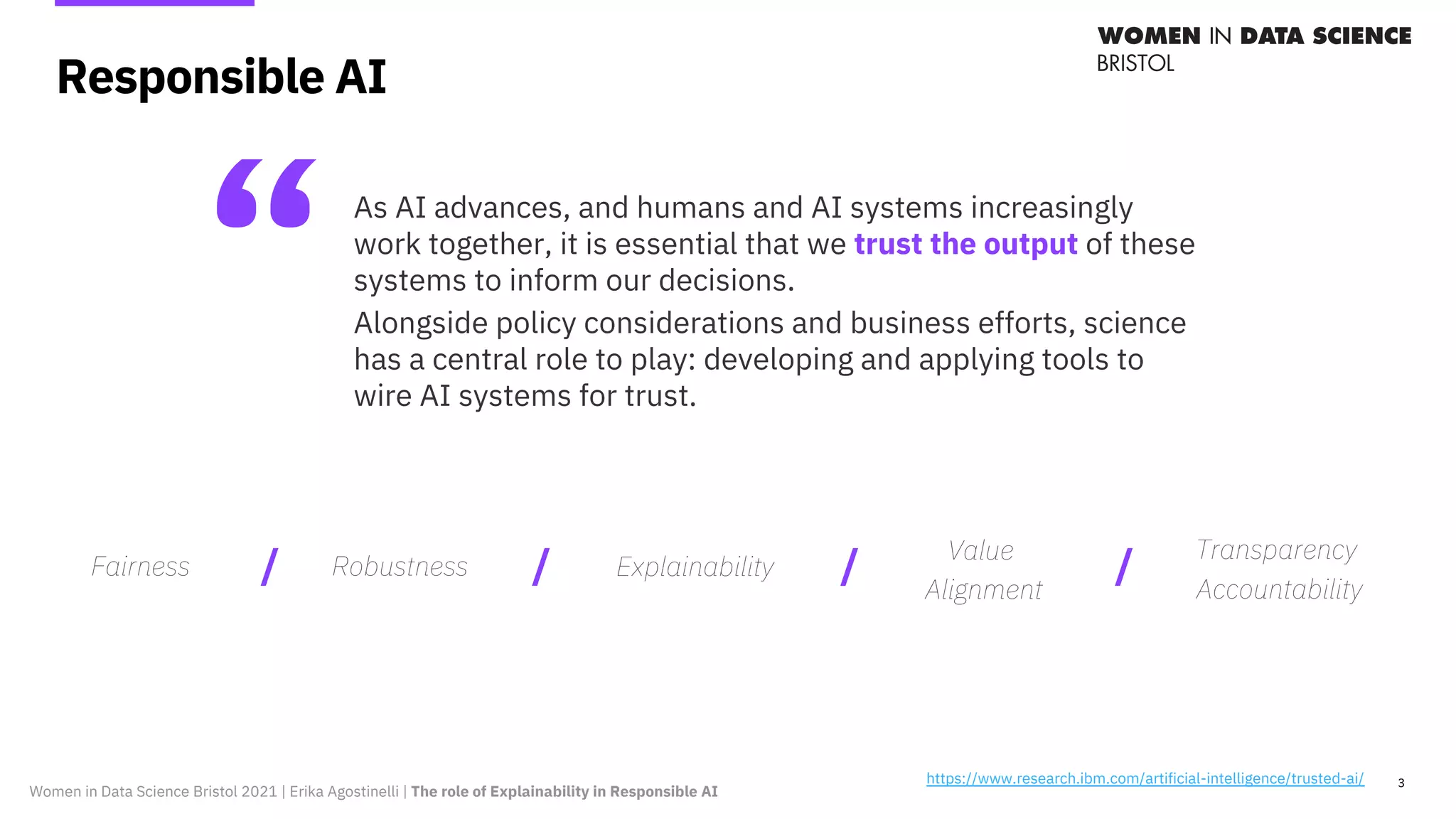
“As AI advances, and humans and AI systems increasingly
work together, it is essential that we trust the output of these
systems to inform our decisions.
Alongside policy considerations and business efforts, science
has a central role to play: developing and applying tools to
wire AI systems for trust.
https://www.research.ibm.com/artificial-intelligence/trusted-ai/
Fairness Robustness Explainability
Value
Alignment
Transparency
Accountability
/ / / /
Women in Data Science Bristol 2021 | Erika Agostinelli | The role of Explainability in Responsible AI
Personas
Explanation for whom?
4
👩🦰
🧓
🧑🦰
🧔
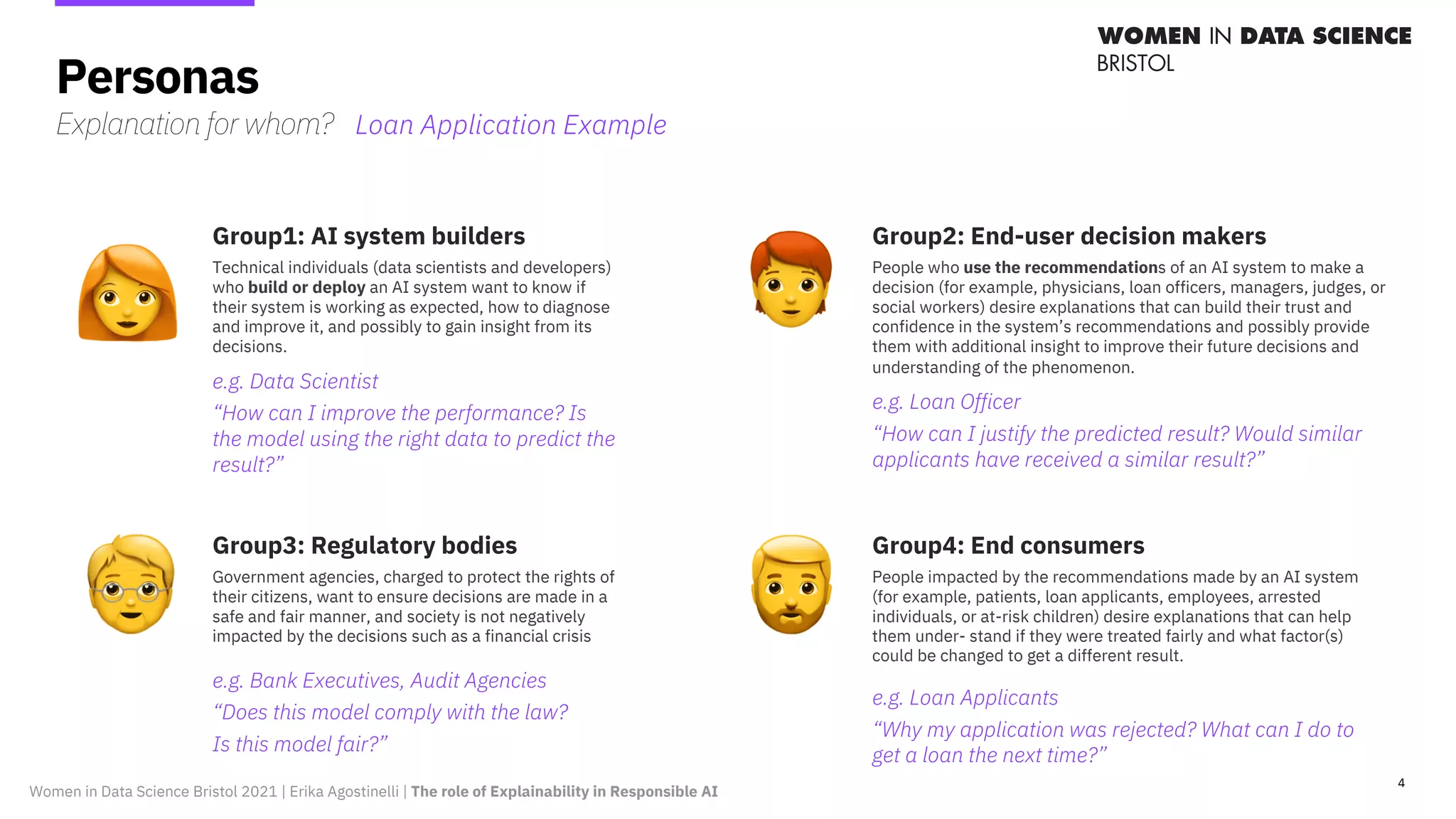
Group1: AI system builders
Technical individuals (data scientists and developers)
who build or deploy an AI system want to know if
their system is working as expected, how to diagnose
and improve it, and possibly to gain insight from its
decisions.
Group3: Regulatory bodies
Government agencies, charged to protect the rights of
their citizens, want to ensure decisions are made in a
safe and fair manner, and society is not negatively
impacted by the decisions such as a financial crisis
Group2: End-user decision makers
People who use the recommendations of an AI system to make a
decision (for example, physicians, loan officers, managers, judges, or
social workers) desire explanations that can build their trust and
confidence in the system’s recommendations and possibly provide
them with additional insight to improve their future decisions and
understanding of the phenomenon.
Group4: End consumers
People impacted by the recommendations made by an AI system
(for example, patients, loan applicants, employees, arrested
individuals, or at-risk children) desire explanations that can help
them under- stand if they were treated fairly and what factor(s)
could be changed to get a different result.
e.g. Data Scientist
“How can I improve the performance? Is
the model using the right data to predict the
result?”
e.g. Loan Officer
“How can I justify the predicted result? Would similar
applicants have received a similar result?”
e.g. Loan Applicants
“Why my application was rejected? What can I do to
get a loan the next time?”
e.g. Bank Executives, Audit Agencies
“Does this model comply with the law?
Is this model fair?”
Loan Application Example
Women in Data Science Bristol 2021 | Erika Agostinelli | The role of Explainability in Responsible AI
Interpretability vs Explainability
Different approaches
5
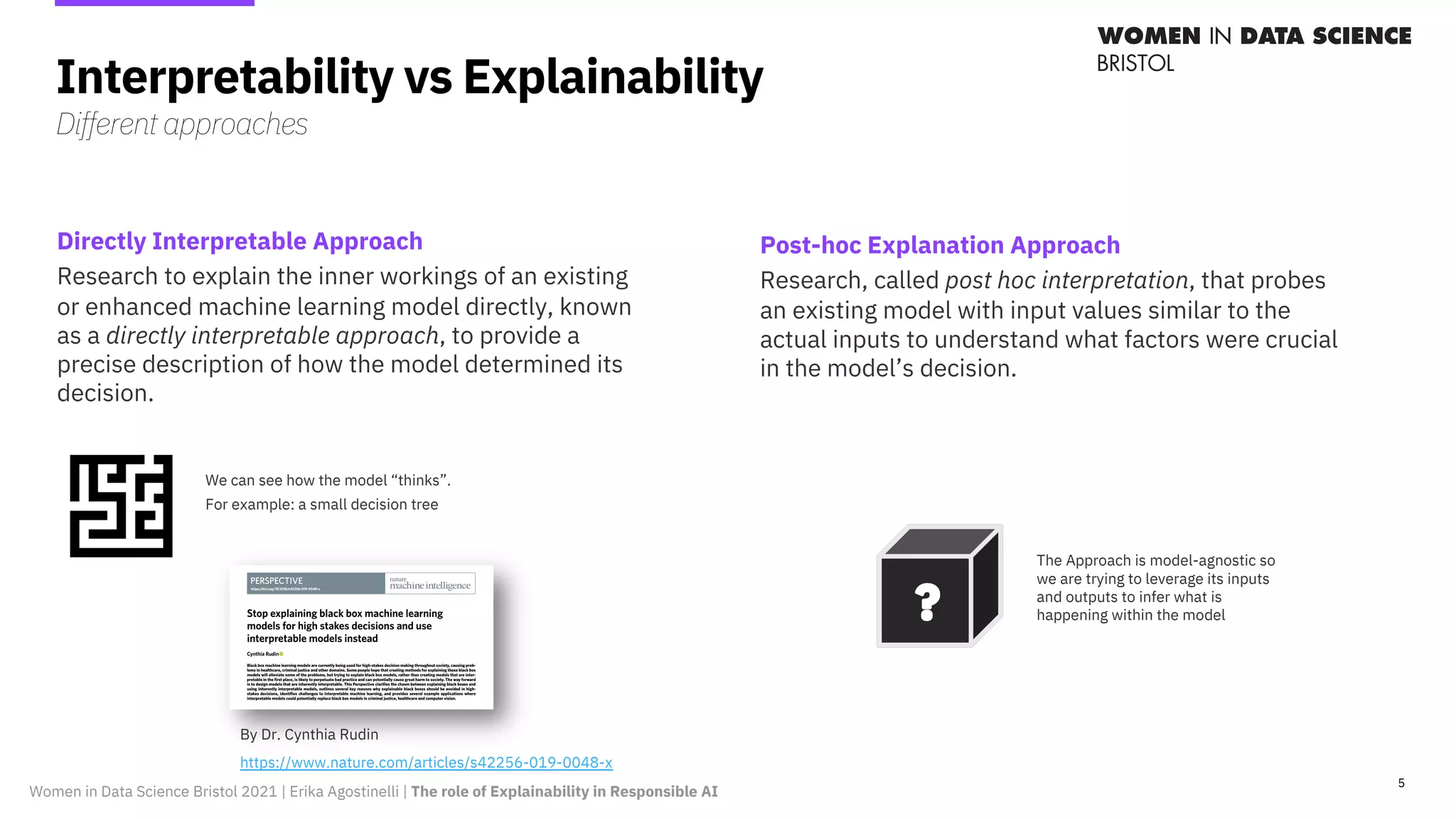
Directly Interpretable Approach
Research to explain the inner workings of an existing
or enhanced machine learning model directly, known
as a directly interpretable approach, to provide a
precise description of how the model determined its
decision.
Post-hoc Explanation Approach
Research, called post hoc interpretation, that probes
an existing model with input values similar to the
actual inputs to understand what factors were crucial
in the model’s decision.
We can see how the model “thinks”.
For example: a small decision tree
The Approach is model-agnostic so
we are trying to leverage its inputs
and outputs to infer what is
happening within the model
By Dr. Cynthia Rudin
https://www.nature.com/articles/s42256-019-0048-x
Women in Data Science Bristol 2021 | Erika Agostinelli | The role of Explainability in Responsible AI
Global vs Local
Model or Instance level approach
6
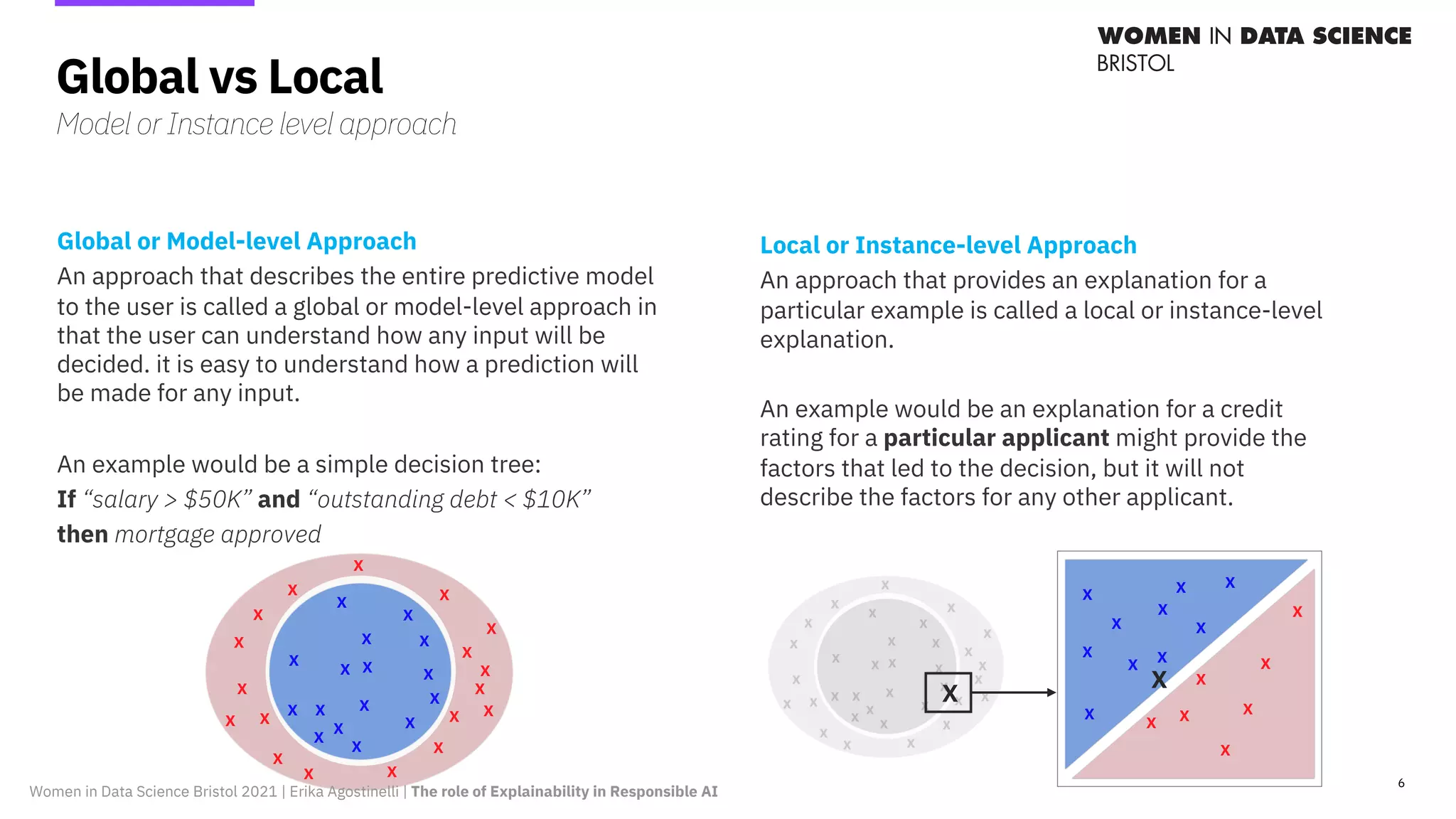
Global or Model-level Approach
An approach that describes the entire predictive model
to the user is called a global or model-level approach in
that the user can understand how any input will be
decided. it is easy to understand how a prediction will
be made for any input.
An example would be a simple decision tree:
If “salary > $50K” and “outstanding debt < $10K”
then mortgage approved
Local or Instance-level Approach
An approach that provides an explanation for a
particular example is called a local or instance-level
explanation.
An example would be an explanation for a credit
rating for a particular applicant might provide the
factors that led to the decision, but it will not
describe the factors for any other applicant.
X
X X
X
X
X
X
X
X
X
X
X
X
X
X
X
X
X
X
X
X
X
X
X
X
X
X
X
X X
X
X
X
X
X
X
X
X
X
X
X
X
X
X
X X
X
X
X
X
X
X
X
Women in Data Science Bristol 2021 | Erika Agostinelli | The role of Explainability in Responsible AI
Type of Data
How to visualize your explanations
7
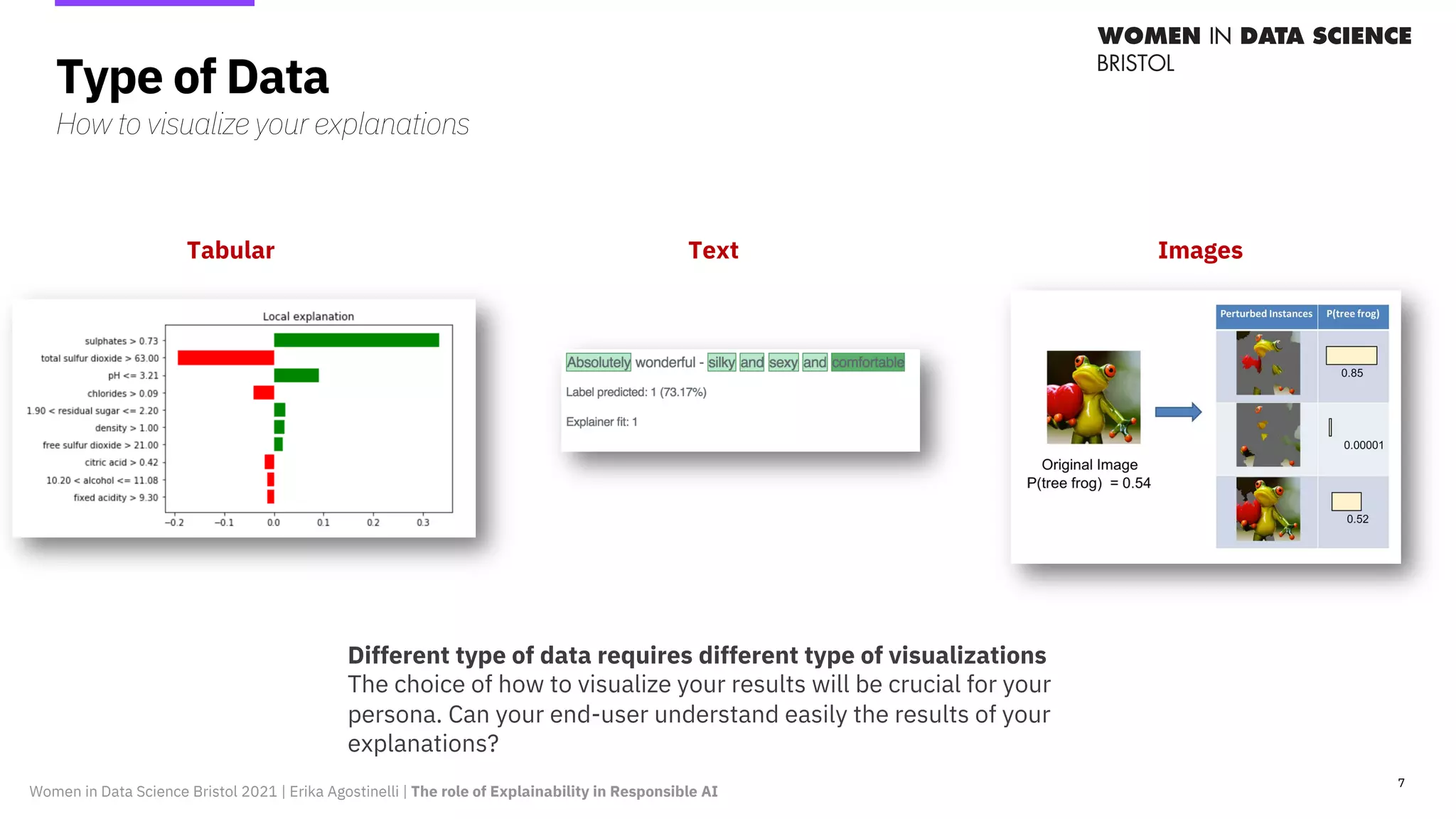
Tabular Text Images
Different type of data requires different type of visualizations
The choice of how to visualize your results will be crucial for your
persona. Can your end-user understand easily the results of your
explanations?
Women in Data Science Bristol 2021 | Erika Agostinelli | The role of Explainability in Responsible AI
Open-Source Tools – Example in Action
non exhaustive list
8
AI Explainability 360 (AIX360)
This toolkit is an open-source library developed by IBM
Research in support of interpretability and
explainability of datasets and machine learning models.
The AI Explainability 360 is released as a Python
package that includes a comprehensive set of
algorithms that cover different dimensions of
explanations along with proxy explainability metrics.
pip install aix360
https://aix360.mybluemix.net/
What If Tool
This toolkit is an interactive visual interface
developed by Google Research and designed to help
visualize datasets and better understand the output
of models.
pip install witwidget
https://pair-code.github.io/what-if-tool/
Women in Data Science Bristol 2021 | Erika Agostinelli | The role of Explainability in Responsible AI
9
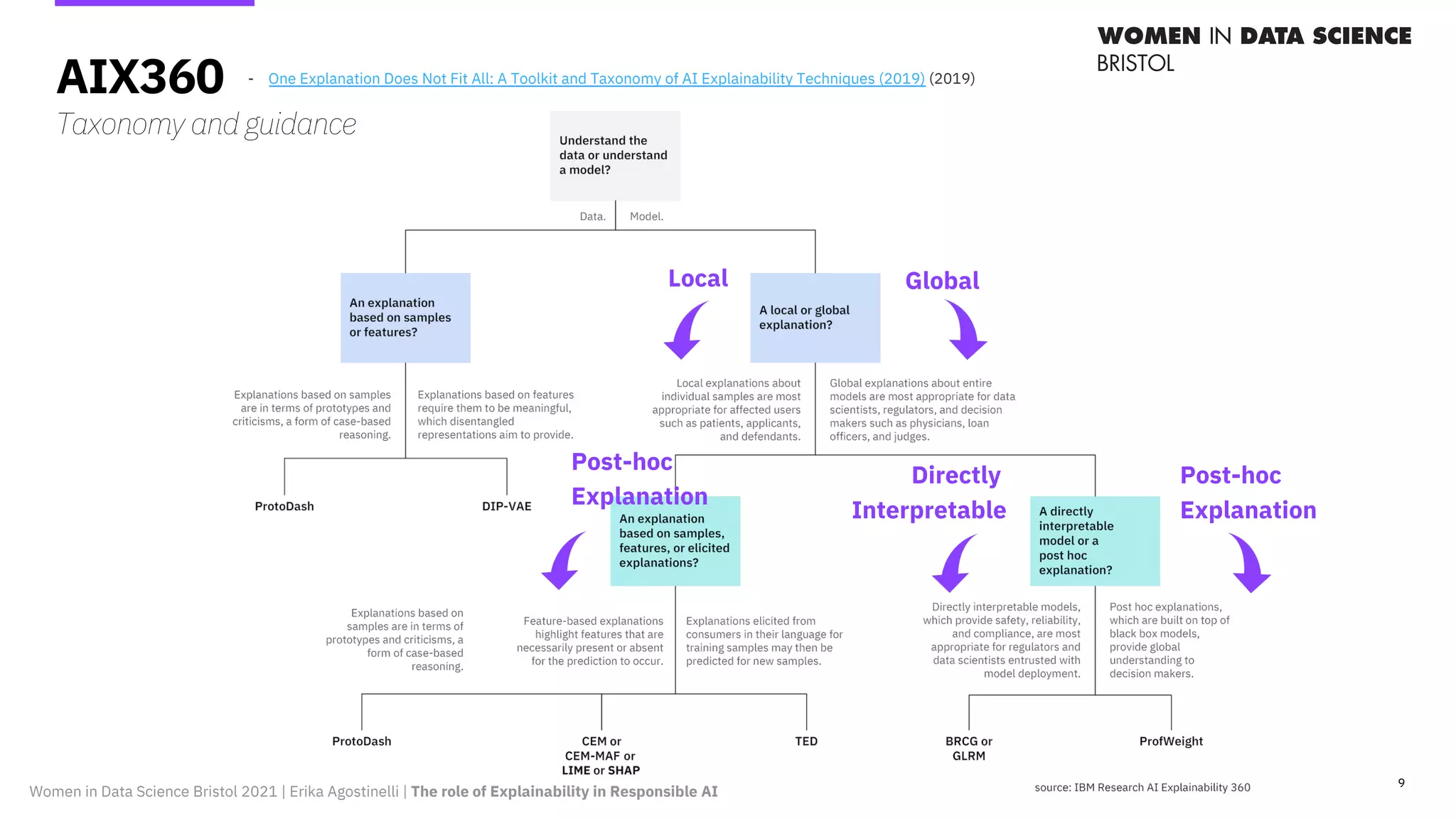
Local Global
Directly
Interpretable
Post-hoc
Explanation
AIX360
Taxonomy and guidance
Post-hoc
Explanation
- One Explanation Does Not Fit All: A Toolkit and Taxonomy of AI Explainability Techniques (2019) (2019)
Women in Data Science Bristol 2021 | Erika Agostinelli | The role of Explainability in Responsible AI
AIX360 Example
Loan Application – HELOC Dataset
10
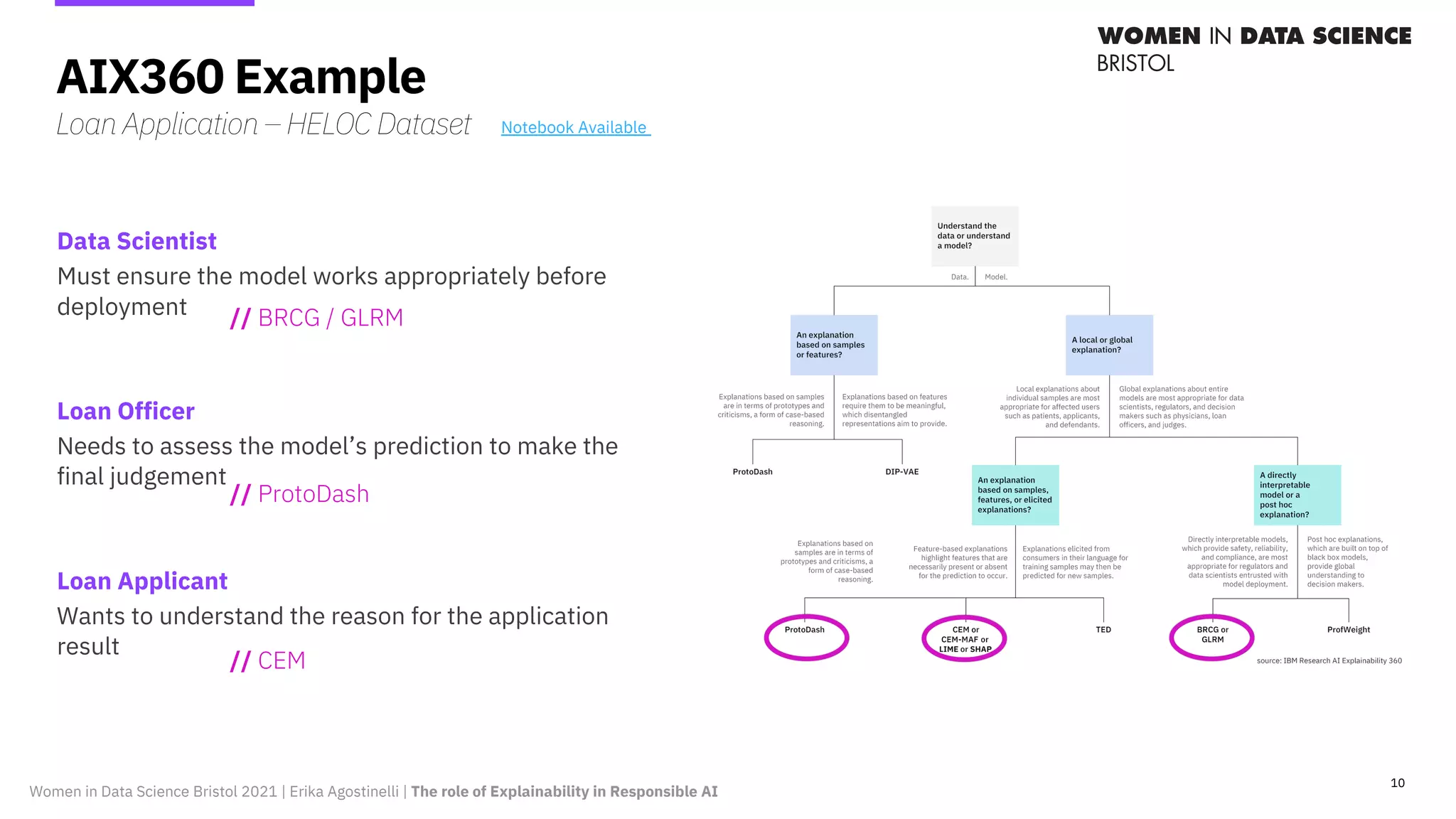
Data Scientist
Must ensure the model works appropriately before
deployment
Loan Officer
Needs to assess the model’s prediction to make the
final judgement
Loan Applicant
Wants to understand the reason for the application
result
// BRCG / GLRM
// ProtoDash
// CEM
Notebook Available
Women in Data Science Bristol 2021 | Erika Agostinelli | The role of Explainability in Responsible AI
AIX360 Example – Loan Application
Directly Interpretable Models for Global Understanding
11
Data Scientist
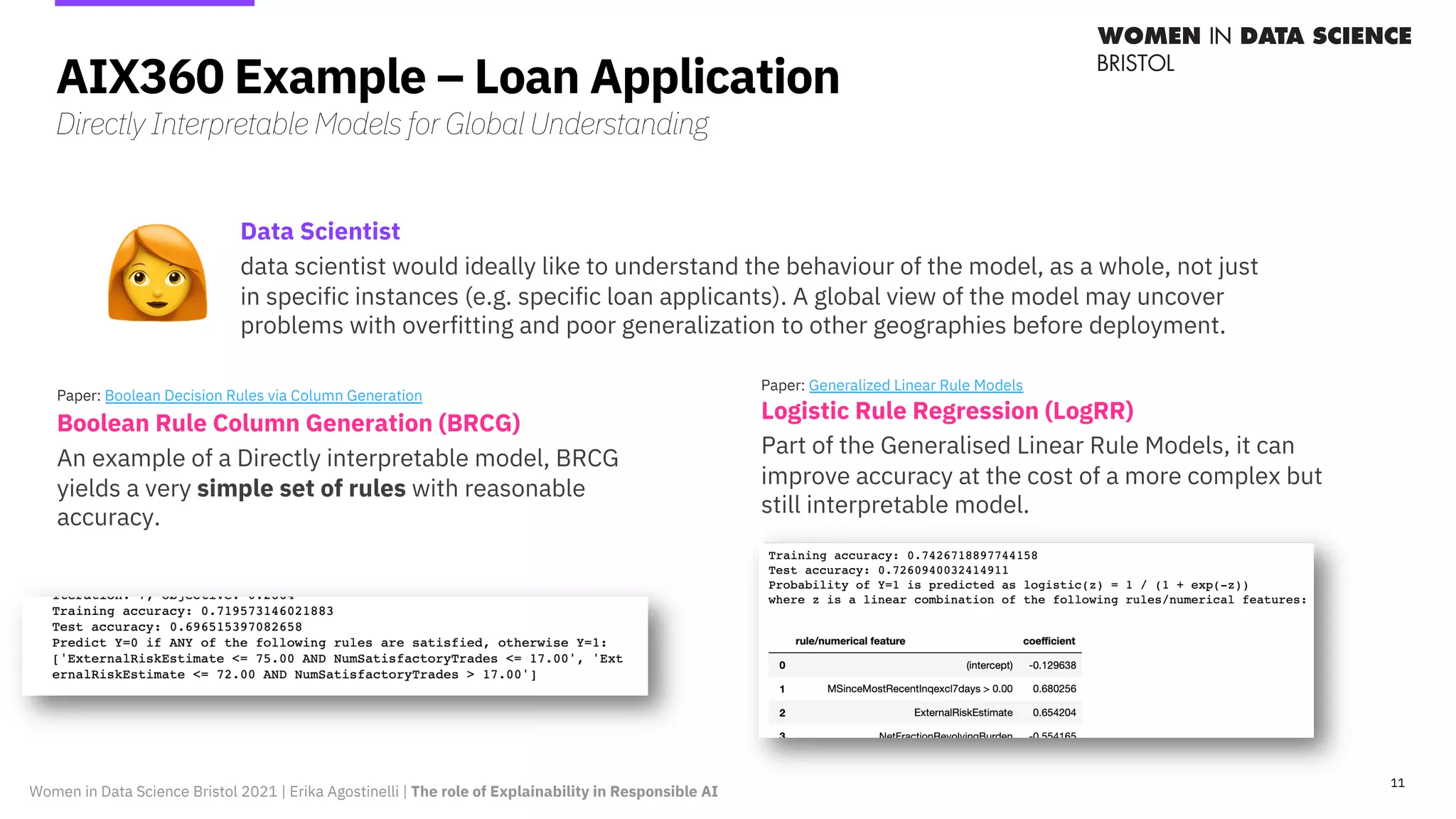
data scientist would ideally like to understand the behaviour of the model, as a whole, not just
in specific instances (e.g. specific loan applicants). A global view of the model may uncover
problems with overfitting and poor generalization to other geographies before deployment.
Boolean Rule Column Generation (BRCG)
An example of a Directly interpretable model, BRCG
yields a very simple set of rules with reasonable
accuracy.
Logistic Rule Regression (LogRR)
Part of the Generalised Linear Rule Models, it can
improve accuracy at the cost of a more complex but
still interpretable model.
Paper: Boolean Decision Rules via Column Generation
Paper: Generalized Linear Rule Models
👩🦰
Women in Data Science Bristol 2021 | Erika Agostinelli | The role of Explainability in Responsible AI
AIX360 Example – Loan Application
Using Similar Examples to Inform a Loan Decision
12
Loan Officer
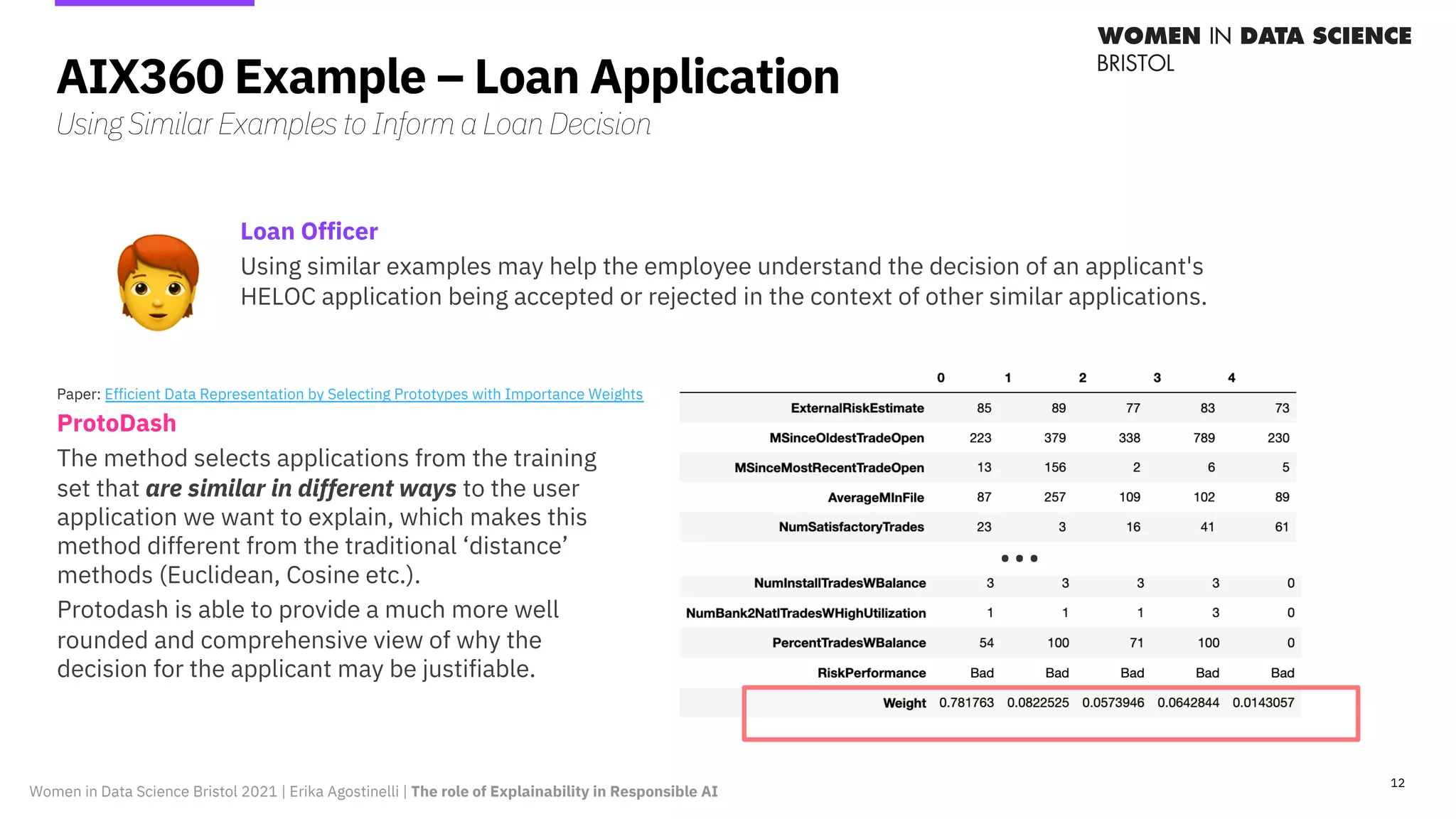
Using similar examples may help the employee understand the decision of an applicant's
HELOC application being accepted or rejected in the context of other similar applications.
ProtoDash
The method selects applications from the training
set that are similar in different ways to the user
application we want to explain, which makes this
method different from the traditional ‘distance’
methods (Euclidean, Cosine etc.).
Protodash is able to provide a much more well
rounded and comprehensive view of why the
decision for the applicant may be justifiable.
Paper: Efficient Data Representation by Selecting Prototypes with Importance Weights
🧑🦰
…
Women in Data Science Bristol 2021 | Erika Agostinelli | The role of Explainability in Responsible AI
AIX360 Example – Loan Application
Using Similar Examples to Inform a Loan Decision
13
Loan Applicant
He would like to understand why he does not qualify for a line of credit and if so, what changes
in his application would qualify him.
Contrastive Explanation Method (CEM)
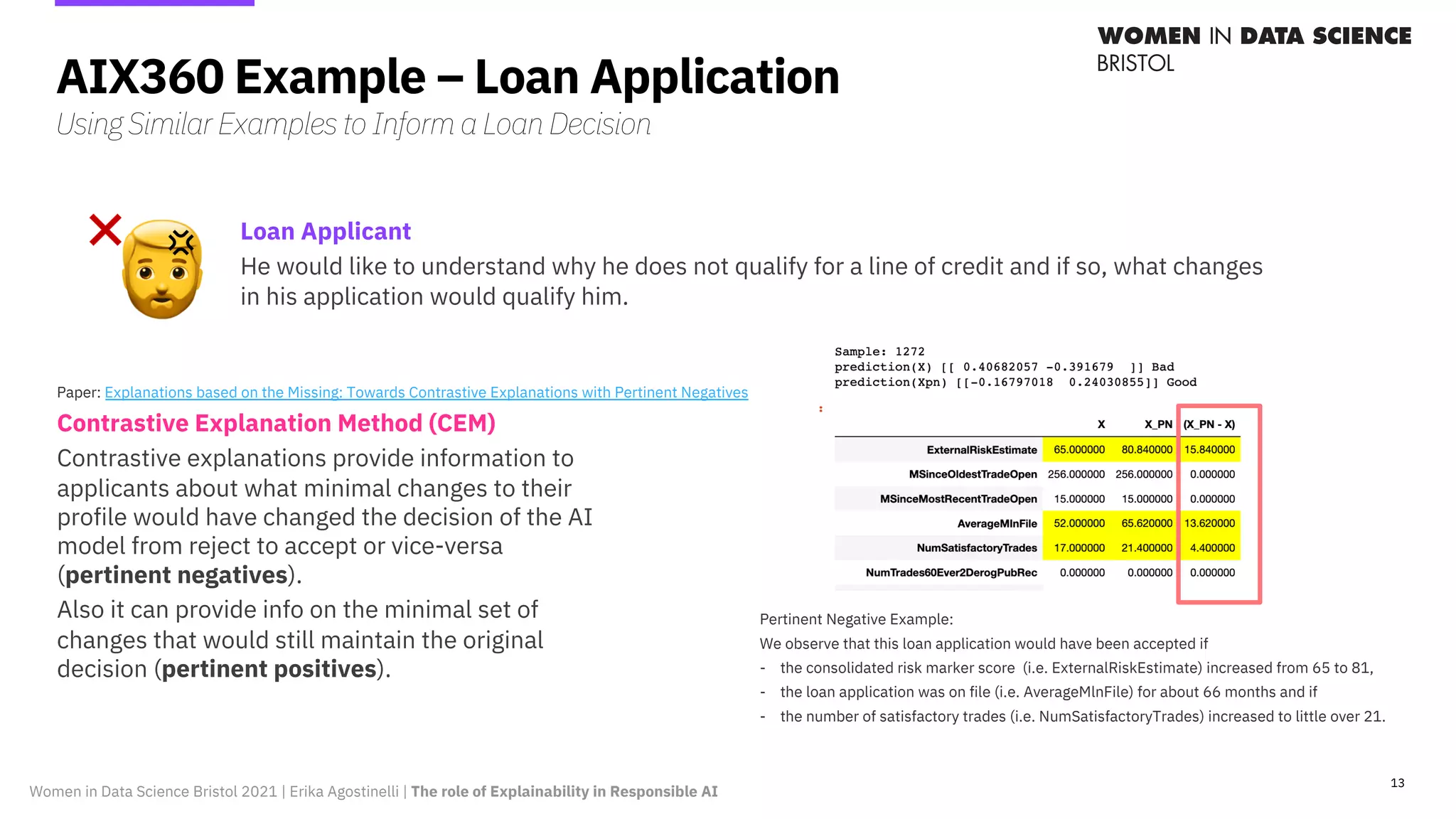
Contrastive explanations provide information to
applicants about what minimal changes to their
profile would have changed the decision of the AI
model from reject to accept or vice-versa
(pertinent negatives).
Also it can provide info on the minimal set of
changes that would still maintain the original
decision (pertinent positives).
Paper: Explanations based on the Missing: Towards Contrastive Explanations with Pertinent Negatives
🧔
Pertinent Negative Example:
We observe that this loan application would have been accepted if
- the consolidated risk marker score (i.e. ExternalRiskEstimate) increased from 65 to 81,
- the loan application was on file (i.e. AverageMlnFile) for about 66 months and if
- the number of satisfactory trades (i.e. NumSatisfactoryTrades) increased to little over 21.
Women in Data Science Bristol 2021 | Erika Agostinelli | The role of Explainability in Responsible AI
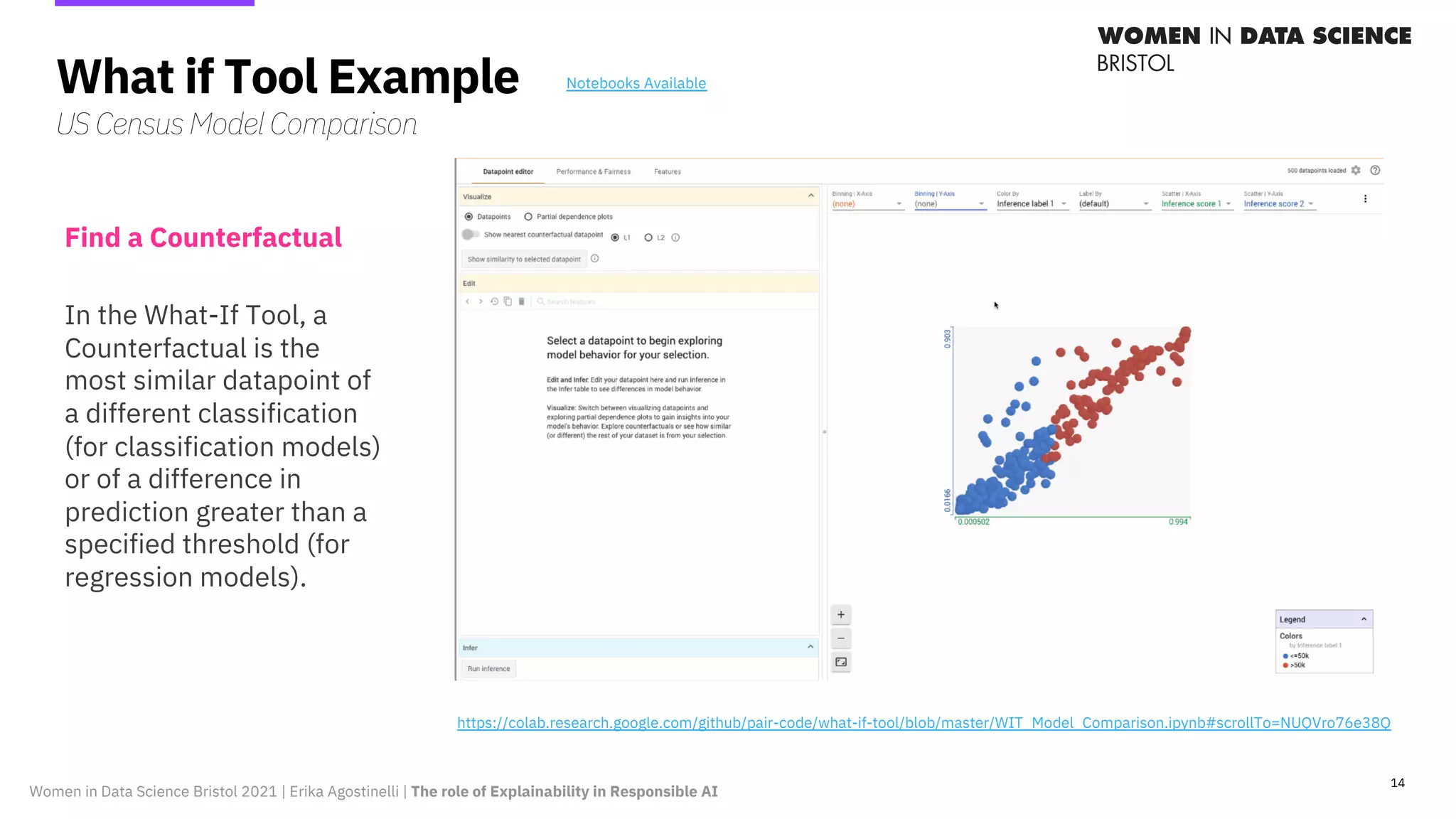
What if Tool Example
US Census Model Comparison
14
https://colab.research.google.com/github/pair-code/what-if-tool/blob/master/WIT_Model_Comparison.ipynb#scrollTo=NUQVro76e38Q
Find a Counterfactual
In the What-If Tool, a
Counterfactual is the
most similar datapoint of
a different classification
(for classification models)
or of a difference in
prediction greater than a
specified threshold (for
regression models).
Notebooks Available
Women in Data Science Bristol 2021 | Erika Agostinelli | The role of Explainability in Responsible AI
Other Resources
Useful Links
15
In addition to the Links in the slides +
Websites-Articles
- https://www.research.ibm.com/artificial-intelligence/trusted-ai/
- Understanding how LIME explains predictions
- Explain Any Models with the SHAP Values — Use the KernelExplainer
- Interpretability part 3: opening the black box with LIME and SHAP
- AI Explainability 360 Documentation
- What if tool Documentation
- The Mathematics of Decision Trees, Random Forest and Feature Importance in Scikit-learn and Spark
- An Introduction to ProtoDash — An Algorithm to Better Understand Datasets and Machine Learning Models
Papers
- Questioning the AI: Informing Design Practices for Explainable AI User Experiences (2020)
- One Explanation Does Not Fit All: A Toolkit and Taxonomy of AI Explainability Techniques (2019) (2019)
- Explaining explainable AI (2019)
- Questioning the AI: Informing Design Practices for Explainable AI User Experiences (2020)
Women in Data Science Bristol 2021 | Erika Agostinelli | The role of Explainability in Responsible AI
https://www.linkedin.com/in/erikaagostinelli/
www.erikaagostinelli.com
Thank you!
Women in Data Science Bristol 2021 | Erika Agostinelli | The role of Explainability in Responsible AI

"I don't trust AI": the role of explainability in responsible AI

  • 1.
    “I don’t trustAI”: the role of Explainability in Responsible AI Overview and Examples 31st March 2021 Erika Agostinelli IBM Data Scientist – Data Science & AI Elite
  • 2.
    Agenda 2 • Context: ResponsibleAI • Considerations • Personas: Explanations for whom? • Direct Interpretability vs Post-hoc explanations • Global vs Local explanations • Type of your data Some Open-Source tools • AIX360 • What if Tool • Examples • Loan Application Overview (~15min) Examples (~10min) Women in Data Science Bristol 2021 | Erika Agostinelli | The role of Explainability in Responsible AI
  • 3.
    Responsible AI 3 “As AIadvances, and humans and AI systems increasingly work together, it is essential that we trust the output of these systems to inform our decisions. Alongside policy considerations and business efforts, science has a central role to play: developing and applying tools to wire AI systems for trust. https://www.research.ibm.com/artificial-intelligence/trusted-ai/ Fairness Robustness Explainability Value Alignment Transparency Accountability / / / / Women in Data Science Bristol 2021 | Erika Agostinelli | The role of Explainability in Responsible AI
  • 4.
    Personas Explanation for whom? 4 👩🦰 🧓 🧑🦰 🧔 Group1:AI system builders Technical individuals (data scientists and developers) who build or deploy an AI system want to know if their system is working as expected, how to diagnose and improve it, and possibly to gain insight from its decisions. Group3: Regulatory bodies Government agencies, charged to protect the rights of their citizens, want to ensure decisions are made in a safe and fair manner, and society is not negatively impacted by the decisions such as a financial crisis Group2: End-user decision makers People who use the recommendations of an AI system to make a decision (for example, physicians, loan officers, managers, judges, or social workers) desire explanations that can build their trust and confidence in the system’s recommendations and possibly provide them with additional insight to improve their future decisions and understanding of the phenomenon. Group4: End consumers People impacted by the recommendations made by an AI system (for example, patients, loan applicants, employees, arrested individuals, or at-risk children) desire explanations that can help them under- stand if they were treated fairly and what factor(s) could be changed to get a different result. e.g. Data Scientist “How can I improve the performance? Is the model using the right data to predict the result?” e.g. Loan Officer “How can I justify the predicted result? Would similar applicants have received a similar result?” e.g. Loan Applicants “Why my application was rejected? What can I do to get a loan the next time?” e.g. Bank Executives, Audit Agencies “Does this model comply with the law? Is this model fair?” Loan Application Example Women in Data Science Bristol 2021 | Erika Agostinelli | The role of Explainability in Responsible AI
  • 5.
    Interpretability vs Explainability Differentapproaches 5 Directly Interpretable Approach Research to explain the inner workings of an existing or enhanced machine learning model directly, known as a directly interpretable approach, to provide a precise description of how the model determined its decision. Post-hoc Explanation Approach Research, called post hoc interpretation, that probes an existing model with input values similar to the actual inputs to understand what factors were crucial in the model’s decision. We can see how the model “thinks”. For example: a small decision tree The Approach is model-agnostic so we are trying to leverage its inputs and outputs to infer what is happening within the model By Dr. Cynthia Rudin https://www.nature.com/articles/s42256-019-0048-x Women in Data Science Bristol 2021 | Erika Agostinelli | The role of Explainability in Responsible AI
  • 6.
    Global vs Local Modelor Instance level approach 6 Global or Model-level Approach An approach that describes the entire predictive model to the user is called a global or model-level approach in that the user can understand how any input will be decided. it is easy to understand how a prediction will be made for any input. An example would be a simple decision tree: If “salary > $50K” and “outstanding debt < $10K” then mortgage approved Local or Instance-level Approach An approach that provides an explanation for a particular example is called a local or instance-level explanation. An example would be an explanation for a credit rating for a particular applicant might provide the factors that led to the decision, but it will not describe the factors for any other applicant. X X X X X X X X X X X X X X X X X X X X X X X X X X X X X X X X X X X X X X X X X X X X X X X X X X X X X Women in Data Science Bristol 2021 | Erika Agostinelli | The role of Explainability in Responsible AI
  • 7.
    Type of Data Howto visualize your explanations 7 Tabular Text Images Different type of data requires different type of visualizations The choice of how to visualize your results will be crucial for your persona. Can your end-user understand easily the results of your explanations? Women in Data Science Bristol 2021 | Erika Agostinelli | The role of Explainability in Responsible AI
  • 8.
    Open-Source Tools –Example in Action non exhaustive list 8 AI Explainability 360 (AIX360) This toolkit is an open-source library developed by IBM Research in support of interpretability and explainability of datasets and machine learning models. The AI Explainability 360 is released as a Python package that includes a comprehensive set of algorithms that cover different dimensions of explanations along with proxy explainability metrics. pip install aix360 https://aix360.mybluemix.net/ What If Tool This toolkit is an interactive visual interface developed by Google Research and designed to help visualize datasets and better understand the output of models. pip install witwidget https://pair-code.github.io/what-if-tool/ Women in Data Science Bristol 2021 | Erika Agostinelli | The role of Explainability in Responsible AI
  • 9.
    9 Local Global Directly Interpretable Post-hoc Explanation AIX360 Taxonomy andguidance Post-hoc Explanation - One Explanation Does Not Fit All: A Toolkit and Taxonomy of AI Explainability Techniques (2019) (2019) Women in Data Science Bristol 2021 | Erika Agostinelli | The role of Explainability in Responsible AI
  • 10.
    AIX360 Example Loan Application– HELOC Dataset 10 Data Scientist Must ensure the model works appropriately before deployment Loan Officer Needs to assess the model’s prediction to make the final judgement Loan Applicant Wants to understand the reason for the application result // BRCG / GLRM // ProtoDash // CEM Notebook Available Women in Data Science Bristol 2021 | Erika Agostinelli | The role of Explainability in Responsible AI
  • 11.
    AIX360 Example –Loan Application Directly Interpretable Models for Global Understanding 11 Data Scientist data scientist would ideally like to understand the behaviour of the model, as a whole, not just in specific instances (e.g. specific loan applicants). A global view of the model may uncover problems with overfitting and poor generalization to other geographies before deployment. Boolean Rule Column Generation (BRCG) An example of a Directly interpretable model, BRCG yields a very simple set of rules with reasonable accuracy. Logistic Rule Regression (LogRR) Part of the Generalised Linear Rule Models, it can improve accuracy at the cost of a more complex but still interpretable model. Paper: Boolean Decision Rules via Column Generation Paper: Generalized Linear Rule Models 👩🦰 Women in Data Science Bristol 2021 | Erika Agostinelli | The role of Explainability in Responsible AI
  • 12.
    AIX360 Example –Loan Application Using Similar Examples to Inform a Loan Decision 12 Loan Officer Using similar examples may help the employee understand the decision of an applicant's HELOC application being accepted or rejected in the context of other similar applications. ProtoDash The method selects applications from the training set that are similar in different ways to the user application we want to explain, which makes this method different from the traditional ‘distance’ methods (Euclidean, Cosine etc.). Protodash is able to provide a much more well rounded and comprehensive view of why the decision for the applicant may be justifiable. Paper: Efficient Data Representation by Selecting Prototypes with Importance Weights 🧑🦰 … Women in Data Science Bristol 2021 | Erika Agostinelli | The role of Explainability in Responsible AI
  • 13.
    AIX360 Example –Loan Application Using Similar Examples to Inform a Loan Decision 13 Loan Applicant He would like to understand why he does not qualify for a line of credit and if so, what changes in his application would qualify him. Contrastive Explanation Method (CEM) Contrastive explanations provide information to applicants about what minimal changes to their profile would have changed the decision of the AI model from reject to accept or vice-versa (pertinent negatives). Also it can provide info on the minimal set of changes that would still maintain the original decision (pertinent positives). Paper: Explanations based on the Missing: Towards Contrastive Explanations with Pertinent Negatives 🧔 Pertinent Negative Example: We observe that this loan application would have been accepted if - the consolidated risk marker score (i.e. ExternalRiskEstimate) increased from 65 to 81, - the loan application was on file (i.e. AverageMlnFile) for about 66 months and if - the number of satisfactory trades (i.e. NumSatisfactoryTrades) increased to little over 21. Women in Data Science Bristol 2021 | Erika Agostinelli | The role of Explainability in Responsible AI
  • 14.
    What if ToolExample US Census Model Comparison 14 https://colab.research.google.com/github/pair-code/what-if-tool/blob/master/WIT_Model_Comparison.ipynb#scrollTo=NUQVro76e38Q Find a Counterfactual In the What-If Tool, a Counterfactual is the most similar datapoint of a different classification (for classification models) or of a difference in prediction greater than a specified threshold (for regression models). Notebooks Available Women in Data Science Bristol 2021 | Erika Agostinelli | The role of Explainability in Responsible AI
  • 15.
    Other Resources Useful Links 15 Inaddition to the Links in the slides + Websites-Articles - https://www.research.ibm.com/artificial-intelligence/trusted-ai/ - Understanding how LIME explains predictions - Explain Any Models with the SHAP Values — Use the KernelExplainer - Interpretability part 3: opening the black box with LIME and SHAP - AI Explainability 360 Documentation - What if tool Documentation - The Mathematics of Decision Trees, Random Forest and Feature Importance in Scikit-learn and Spark - An Introduction to ProtoDash — An Algorithm to Better Understand Datasets and Machine Learning Models Papers - Questioning the AI: Informing Design Practices for Explainable AI User Experiences (2020) - One Explanation Does Not Fit All: A Toolkit and Taxonomy of AI Explainability Techniques (2019) (2019) - Explaining explainable AI (2019) - Questioning the AI: Informing Design Practices for Explainable AI User Experiences (2020) Women in Data Science Bristol 2021 | Erika Agostinelli | The role of Explainability in Responsible AI
  • 16.
    https://www.linkedin.com/in/erikaagostinelli/ www.erikaagostinelli.com Thank you! Women inData Science Bristol 2021 | Erika Agostinelli | The role of Explainability in Responsible AI