Explainable Artificial
Intelligence (XAI):A
Deep Dive
Artificial intelligence (AI) has become increasingly important in our lives, shaping decisions
across industries. However, the opaque nature of many AI systems, especially those relying
on complex machine learning (ML) algorithms, has raised concerns about transparency,
accountability, and trust. Enter Explainable AI (XAI), a burgeoning field aimed at bridging
the gap between human understanding and the complex inner workings of AI models.
This seminar report will delve into the motivations, methods, applications, and future
directions of XAI, exploring its crucial role in building responsible and trustworthy AI
systems.
by Mahaveer V Pandit
Methodology
1. Data Collection:
•Use of standard datasets (ImageNet, MNIST) or domain-specific datasets. Preprocessing includes normalization and clea
2. Model Selection:
• Black-box models (neural networks, SVMs) and interpretable models (decision trees, linear models) are tested
for varying complexity.
3. Explainability Techniques:
• Applied techniques: LIME, SHAP for model-agnostic methods, and layer-wise relevance for neural networks.
4. Evaluation Metrics:
• Metrics: fidelity, interpretability, completeness. Evaluated using accuracy and user feedback.
5. Experiment Setup:
• Experiments compare performance and explanations across models. Statistical significance tests used for validation.
6. Challenges:
• Trade-off between accuracy and interpretability; scalability issues for large datasets.
7.
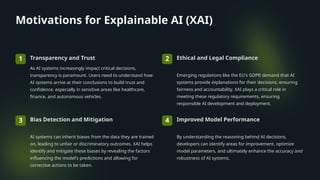
Motivations for ExplainableAI (XAI)
1 Transparency and Trust
As AI systems increasingly impact critical decisions,
transparency is paramount. Users need to understand how
AI systems arrive at their conclusions to build trust and
confidence, especially in sensitive areas like healthcare,
finance, and autonomous vehicles.
2 Ethical and Legal Compliance
Emerging regulations like the EU's GDPR demand that AI
systems provide explanations for their decisions, ensuring
fairness and accountability. XAI plays a critical role in
meeting these regulatory requirements, ensuring
responsible AI development and deployment.
3 Bias Detection and Mitigation
AI systems can inherit biases from the data they are trained
on, leading to unfair or discriminatory outcomes. XAI helps
identify and mitigate these biases by revealing the factors
influencing the model's predictions and allowing for
corrective actions to be taken.
4 Improved Model Performance
By understanding the reasoning behind AI decisions,
developers can identify areas for improvement, optimize
model parameters, and ultimately enhance the accuracy and
robustness of AI systems.
8.
Approaches to Explainability
IntrinsicExplainability
Models like decision trees, linear regression, and rule-
based systems are inherently interpretable. These
models provide clear reasoning paths and are often
easier to understand, making them suitable for
simpler tasks where transparency is crucial.
Post-hoc Explainability
This approach focuses on generating explanations
after the model has been trained and deployed.
Techniques like LIME (Local Interpretable Model-
agnostic Explanations) and SHAP (Shapley Additive
Explanations) are used to approximate complex black-
box models locally and provide insights into the
model's predictions.
9.
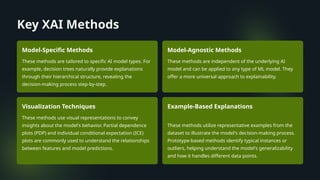
Key XAI Methods
Model-SpecificMethods
These methods are tailored to specific AI model types. For
example, decision trees naturally provide explanations
through their hierarchical structure, revealing the
decision-making process step-by-step.
Model-Agnostic Methods
These methods are independent of the underlying AI
model and can be applied to any type of ML model. They
offer a more universal approach to explainability.
Visualization Techniques
These methods use visual representations to convey
insights about the model's behavior. Partial dependence
plots (PDP) and individual conditional expectation (ICE)
plots are commonly used to understand the relationships
between features and model predictions.
Example-Based Explanations
These methods utilize representative examples from the
dataset to illustrate the model's decision-making process.
Prototype-based methods identify typical instances or
outliers, helping understand the model's generalizability
and how it handles different data points.
10.
Human-Centered XAI
1 ContrastiveExplanations
Humans naturally seek explanations for why something happened, focusing on
the "why" rather than the "why not." Explanations should address these
questions by providing a clear contrast between the chosen outcome and other
possible outcomes.
2 Selective Explanations
Humans prefer simple, concise explanations that highlight the most relevant
factors influencing the decision. Instead of overwhelming users with complex
details, XAI should focus on presenting the most impactful information.
3 Interactive Explanations
Explanations should be designed to allow for user interaction. Users may have
specific questions or require further clarification, and interactive explanations
enable them to explore different aspects of the model's decision-making
process.
11.
Applications of XAI
Healthcare
XAIis essential for building trust in AI
systems used for disease diagnosis and
treatment planning. Explanations help
healthcare professionals understand
the AI's reasoning and make informed
decisions, promoting patient safety
and well-being.
Finance
In financial risk assessment and credit
scoring, XAI helps explain decisions to
borrowers, fostering transparency and
fairness. It enables users to
understand why a loan was approved
or rejected, addressing concerns about
discriminatory practices.
Autonomous Systems
Self-driving cars rely on AI models to
make real-time decisions. XAI plays a
crucial role in explaining the AI's
actions, ensuring transparency and
accountability, and providing valuable
insights for improving safety and
performance.
12.
Challenges in XAI
Trade-offbetween Accuracy and
Interpretability
Many high-performance models, like
deep neural networks, are complex and
difficult to interpret. Conversely, simpler,
more interpretable models may not
achieve the same accuracy on complex
tasks.
Scalability As AI models become more intricate,
generating accurate, understandable
explanations becomes increasingly
challenging, requiring efficient and
scalable XAI methods.
Bias in Explanations Even the explanations themselves can
introduce biases if they focus on easily
interpretable features that may not be
the most relevant factors influencing the
model's predictions.
13.
Evaluating XAI
Evaluating thequality of explanations is an ongoing challenge. Some of the approaches include:
• Application-grounded evaluation: Testing the explanation’s effectiveness in real-world applications with
domain experts.
• Human-grounded evaluation: Running experiments with users to assess whether they can understand
and use the explanations provided by AI models.
• Functionally-grounded evaluation: Using internal metrics (like model fidelity) to determine how closely
the explanation reflects the original AI model’s decision-making
14.
Future Trends inXAI
Interdisciplinary Research
Combining AI with psychology, human-computer interaction (HCI), and other disciplines will lead to more effective
and human-centered XAI systems.
Balancing Accuracy and Explainability
Research is focused on developing hybrid models and techniques that combine the accuracy of complex models with
the interpretability of simpler ones.
Explainability Standards and Benchmarks
Developing common standards and benchmarks will help measure and evaluate different XAI methods, ensuring
consistency and facilitating comparisons.
Explainable AI as a Service (XaaS)
XaaS platforms are emerging, providing readily accessible tools and services for generating explanations,
democratizing XAI and making it easier for developers to implement.
15.
Conclusion
Explainable AI iscritical for fostering trust and ensuring the responsible use of AI in society. As AI becomes more
deeply integrated into decision-making processes, making these systems transparent and understandable is a
necessity. By addressing the technical, ethical, and human-centered challenges of XAI, we can ensure that AI
systems continue to innovate without sacrificing transparency and accountability.
16.
References
1. Adadi, A.& Berrada, M., "Peeking Inside the Black-Box: A Survey on Explainable Artificial Intelligence (XAI),"
IEEE Access, 2018.
2. Ribeiro, M. T., Singh, S., & Guestrin, C., "Why Should I Trust You? Explaining the Predictions of Any Classifier,"
KDD, 2016.
3. Lundberg, S. M., & Lee, S.-I., "A Unified Approach to Interpreting Model Predictions," NIPS, 2017.
4. Doshi-Velez, F., & Kim, B., "Towards a Rigorous Science of Interpretable Machine Learning," arXiv preprint
arXiv:1702.08608, 2017.
5. Lipton, Z. C., "The Mythos of Model Interpretability," arXiv preprint arXiv:1606.03490, 2016.