Downloaded 73 times
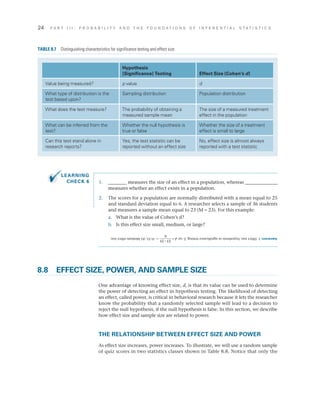
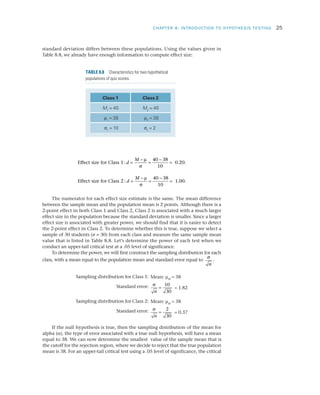
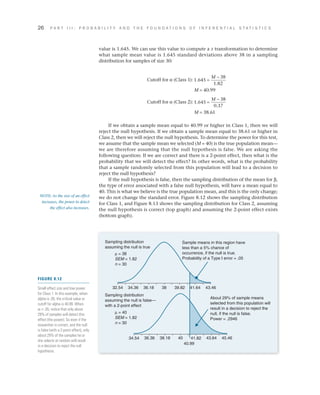
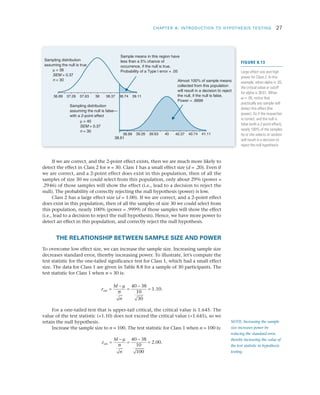
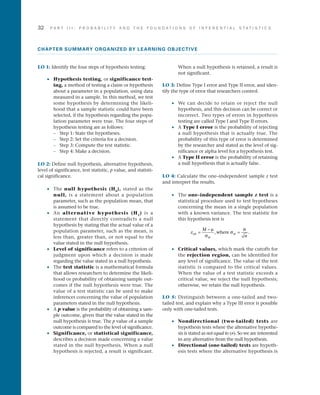
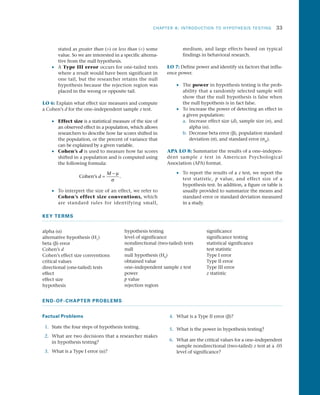
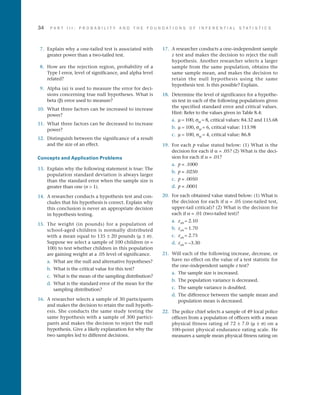
![CHAPTER 8: INTRODUCTION TO HYPOTHESIS TESTING 35
this scale equal to 74. He conducts a one–independent
sample z test to determine whether physical
endurance increased at a .05 level of significance.
a. State the value of the test statistic and whether
to retain or reject the null hypothesis.
b. Compute effect size using Cohen’s d.
23. A cheerleading squad received a mean rating (out
of 100 possible points) of 75 ± 12 (m ± s) in com
petitions over the previous three seasons. The
same cheerleading squad performed in 36 local
competitions this season with a mean rating
equal to 78 in competitions. Suppose we conduct
a one–independent sample z test to determine
whether mean ratings increased this season
(compared to the previous three seasons) at a .05
level of significance.
a. State the value of the test statistic and whether
to retain or reject the null hypothesis.
b. Compute effect size using Cohen’s d.
24. A local school reports that its average GPA is
2.66 ± 0.40 (m ± s). The school announces that it
will be introducing a new program designed to
improve GPA scores at the school. What is the
effect size (d) for this program if it is expected to
improve GPA by:
a. .05 points?
b. .10 points?
c. .40 points?
25. Will each of the following increase, decrease, or
have no effect on the value of Cohen’s d?
a. The sample size is decreased.
b. The population variance is increased.
c. The sample variance is reduced.
d. The difference between the sample and popu
lation mean is increased.
26. State whether the effect size for a 1-point effect
(M – m = 1) is small, medium, or large given the
following population variances:
a. s = 1
b. s = 2
c. s = 4
d. s = 6
27. As a increases, so does the power to detect an
effect. Why, then, do we restrict a from being
larger than .05?
28. Will increasing sample size (n) and decreasing the
population standard deviation (s) increase or
decrease the value of standard error? Will this
increase or decrease power?
Problems in Research
29. Directional vs. nondirectional hypothesis
testing. In an article reviewing directional and
nondirectional tests, Leventhal (1999) stated the
following hypotheses concerning the difference
between two population means.
A B
m1 – m2 = 0 m1 – m2 = 0
m1 – m2 0 m1 – m2 ≠ 0
a. Which did he identify as nondirectional?
b. Which did he identify as directional?
30. The one-tailed tests. In their book, Common
Errors in Statistics (and How to Avoid Them), Good
and Hardin (2003) wrote, “No one will know
whether your [one-tailed] hypothesis was con
ceived before you started or only after you’d
examined the data” (p. 347). Why do the
authors state this as a concern for one-tailed
tests?
31. The hopes of a researcher. Hayne Reese
(1999) wrote, “The standard method of statistical
inference involves testing a null hypothesis that
the researcher usually hopes to reject” (p. 39).
Why does the researcher usually hope to reject
the null hypothesis?
32. Describing the z test. In an article describing
hypothesis testing with small sample sizes,
Collins and Morris (2008) provided the following
description for a z test: “Z is considered signifi
cant if the difference is more than roughly two
standard deviations above or below zero (or more](https://image.slidesharecdn.com/hypothesistesting-140422041435-phpapp02/85/Hypothesis-testing-Primer-35-320.jpg)
![36 P A R T I I I : P R O B A B I L I T Y A N D T H E F O U N D A T I O N S O F I N F E R E N T I A L S T A T I S T I C S
precisely, |Z| 1.96)” (p. 464). Based on this
description:
a. Are the authors referring to critical values for a
one- or two-tailed z test?
b. What alpha level are the authors referring to?
33. Sample size and power. Collins and Morris
(2008) simulated selecting thousands of samples
and analyzed the results using many different
test statistics. With regard to the power for these
samples, they reported that “generally speaking,
all tests became more powerful as sample size
increased” (p. 468). How did increasing the sam
ple size in this study increase power?
34. Describing hypothesis testing. Blouin and
Riopelle (2004) made the following statement
concerning how scientists select test statistics:
“[This] test is the norm for conducting a test of H0
,
when . . . the population(s) are normal with
known variance(s)” (p. 78). Based on this descrip
tion, what test statistic are they describing as the
norm? How do you know this?](https://image.slidesharecdn.com/hypothesistesting-140422041435-phpapp02/85/Hypothesis-testing-Primer-36-320.jpg)
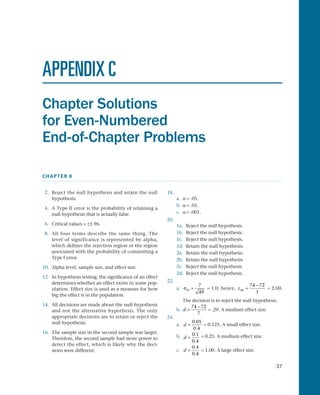

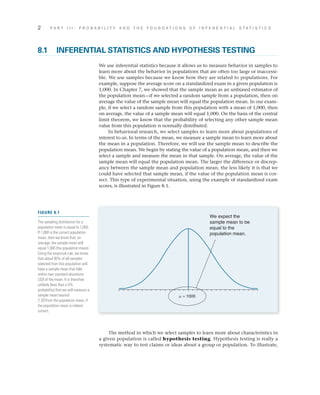
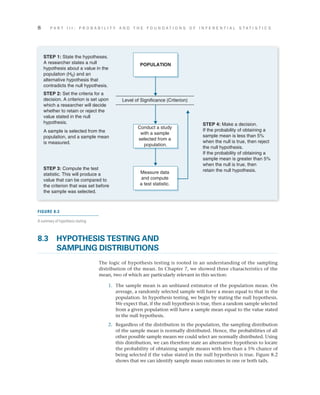
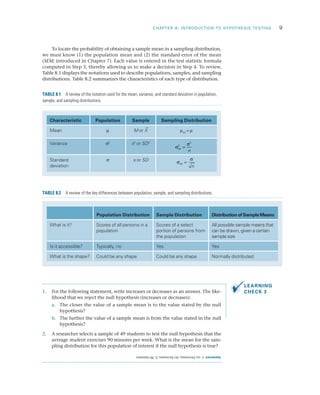
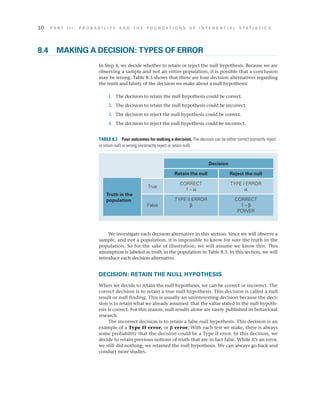
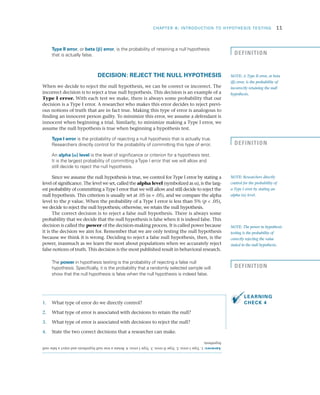
Researchers use hypothesis testing to evaluate claims about populations by taking samples and analyzing the results. The four steps of hypothesis testing are: 1) stating the null and alternative hypotheses, 2) setting the significance level typically at 5%, 3) computing a test statistic to quantify how unlikely the sample results would be if the null was true, and 4) making a decision to either reject or fail to reject the null hypothesis based on comparing the test statistic to the significance level. The goal is to systematically evaluate whether a hypothesized population parameter, such as a mean, is likely to be true based on the sample results.


