Déficit de Testoterona
Eduard García Cruz
Urología y Salud del Hombre
Servicio de Urología
Barnaclínic
Hospital Clínic de Barcelona
ecruz@clinic.ub.es
@drgarciacruz
www.reisho.com
Conflict of interest: he recibido fondos para investigación de BAYER, Lilly, Pfizer, Auxilium y Janssen, he formado parte de comités asesores para
Bayer, Lilly, Gebro, Almirall, Janssen, Italpharmaco y Menarini. Soy ponente para Lilly, Pierre Fabre y Bayer.
Fisiología de la testosterona
GnRH
(hipotálamo)
LH
(hipófisis)
FSH
(hipófisis)
Testosterona
(células de Leydig)
Espermatogénesis
(células de Sertoli)
Hipogonadismo primarioHipogonadismo secundario
T
DHT
5- -reductasaɑ
(finasteride, dutasteride)
Morley JE. Metabolism 46(4) 1997:410-3
Harman SM J Clin Endocrinol Metab 86 (2) 2000: 724-731 Leifke Clin Endocrinol 53 2000: 689-695
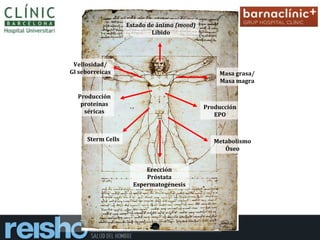
Estado de ánimo (mood)
Libido
Masa grasa/
Masa magra
Vellosidad/
Gl seborreicas
Producción
EPO
Sterm Cells
Producción
proteínas
séricas
Erección
Próstata
Espermatogénesis
Metabolismo
Óseo
TDS: definición, clínica
y diagnóstico
“Tempus irrefutabile fugit” Virgilio
Testosterona > 346 ng/dL
Testosterona 231 – 346 ng/dL
Testosterona < 231 ng/dL
Total Testosterone
Free Testosterone
SHBG
LH
Prolactin
Total Testosterone >346ng/dL
Low calculated testosterone
Total Testosterone 231-346ng/dL
Total Testosterone <231ng/dL
Total Testosterone >346ng/dL
Normal calculated testostosterone
Confirm results:
Total Testosterone
Free Testosterone
SHBG 2nd low free testosterone
2nd total T 231-346
TESTOSTERONE
TREATMENT
NO
TESTOSTERONE
TREATMENT
García-Cruz E, ESSM Newsletter 2010.
3. Prevalencia y etiología.
PREVALENCIA Y FACTORES DE RIESGO DEL SÍNDROME DE
DEFICIENCIA DE TESTOSTERONA.
García-Cruz E, García Larrosa A, Franco de Castro A, Alcaraz Asensio A.
Hospital Clínic de Barcelona-
Introducción: el síndrome de deficiencia de testosterona
(TDS) es una entidad clínica y bioquímica que puede alterar
múltiples órganos y sistemas, y que puede deteriorar la
calidad de vida. La prevalencia de TDS en mayores de 50
años es de 10%, aumentando hasta el 25-30% en mayores
de 70 años.
Objetivo: conocer la incidencia de TDS en nuestra población
y la comorbilidad asociada.
Material y Métodos: análisis prospectivo de los 469
pacientes consecutivos sometidos a biopsia transrectal de
próstata durante el periodo entre Junio de 2007 y Diciembre
de 2008 en el Hospital Clínic de Barcelona. Tras la biopsia
transrectal de solicitó analítica hormonal a los pacientes,
incluyendo Testosterona, LH, SHBG y DHT. La
determinación se realizó en ayunas entre las 7h00AM y las
11h00AM. Se analizaron prospectivamente edad, peso, talla,
IMC, hábitos tóxicos y antecedentes patológicos. Se
utilizaron los valores de testosterona recomendados por la
ISA-ISSAM-EAU para el diagnóstico de TDS, 231 y 346
ng/dL.
Resultados: Edad media 66,33±10,98 años. Testosterona
media 448±168 ng/dL. Tasa TDS (Testosterona <231ng/mL)
7,5%. Tasa TDS (Testosterona <346 ng/dL) 28%. Tasa de
TDS: <50 años TDS231 0% TDS346 20%; 50-60 años
TDS231 7,8% TDS 346 24,7%; 60-70 años TDS231 7,4%
TDS346 31,1%, 70-80 años TDS231 8,1% TDS346 27,9% y
>80 años TDS231 7,1% TDS346 28,5%.
En el análisis univariante, las variables IMC (p=0,007), HTA
(p=0,027), Dislipemia (p=0,000) e Infección por VIH/VHC
(p=0,000) correlacionaron con el nivel de testosterona sérica.
En el análisis multivariante, las variables IMC (p=0,005) y
Dislipemia correlacionaron con el nivel de testosterona sérica
(465±171 ng/dL testosterona en pacientes sin dislipemia vs
384±136 ng/dL testosterona en pacientes con dislipemia,
p=0,002).
En el análisis univariante, las variables Dislipemia (p=0,031),
Insuficiencia Renal (p=0,018) y Antecedente de Trasplante
(p=0,037) correlacionaron con la presencia de TDS
(Testosterona<346ng/dL). En el análisis multivariante, la
variable Dislipemia correlacionó con la presencia de TDS
(Testosterona<346ng/dL) (23,1% en pacientes sin dislipemia
vs 42,2% en pacientes con dislipemia, p=0,002).
Conclusiones: La tasa de TDS es de entre el 7,5 y el 28% en función del valor de corte. La dislipemia
representa un factor de riesgo para el TDS. La dislipemia y el IMC correlacionaron con los niveles de
testosterona.
10 % de los hombres >50 años
20 % de los hombres >60 años
Araujo et al. J Clin Endocrinol Metab 2004;89:5920-5960
25-30 % de los hombres >70 años
Vermeulen. Ann Endocrinol 2003;64:109-114
11,5 % de hombres entre 60-90 años
Wu et al –estudio EMAS- I J Androl 2005;28 (Suppl. 1):36
<231 <346
<50 0 20
50-60 8 25
60-70 7 31
70-80 8 28
>80 7 28
total 7 28
•Edad
•Enfermedades crónicas: Diabetes Mellitus, Enfermedad Pulmonar Obstructiva
Crónica, Enfermedades Inflamatorias Sistémicas, Insuficiencia Renal Crónica, Infección
crónica por VIH, Insuficiencia Hepática.
•Obesidad
•Farmacológico: corticoides, inmunosupresores, 5ARI, castración química.
•Patología testicular
Relación D2:D4, testosterona y sd.Relación D2:D4, testosterona y sd.
de deficiencia de testosterona.de deficiencia de testosterona.
Eduard García-CruzEduard García-Cruz, Huguet Pérez J,, Huguet Pérez J,
Pérez Márquez M, Piqueras Bartolomé M, Alcaraz APérez Márquez M, Piqueras Bartolomé M, Alcaraz A
Hospital Clínic de BarcelonaHospital Clínic de Barcelona
D2D4
♂ D4 > D2
D4 D2
♀ D4 ≤ D2
Testosterone (ng/dL)
125010007505002500
RatioD2:D4
1,150
1,100
1,050
1,000
0,950
0,900
0,850
Sq r lineal = 0,027
TDS (Testosterone >346 ng/dL)
T<346T>346
Ratio2D:4D
1,100
1,050
1,000
0,950
0,900
76
34
22
La Testosterona es más baja
a medida que la relación
índice/anular aumenta.
Relación entre T y D2:D4, B -741, ß -0,165, p=0,045 T<346 ng/dL 0,993±0,043 vs T>346 ng/dL 0,979±0,037, p=0,049
Resultados:
2D>4D2D<4D
Testosterone(ng/dL)
1000
800
600
400
200
0
122
168
D2<D4 476±185 vs D2>D4 404±158, p=0,017
0%
10%
20%
30%
40%
50%
D2>D4 D2<D4
Prevalencia TDS
D2>D4 TDS 41.7% vs. D2<D4 TDS 23%, p=0.013
Los varones con D2≥D4 tienen menor Testosterona
y mayor incidencia de TDS.
Conclusiones:
1. La ratio D2/D4 está relacionada con los niveles de testosterona.
2. La testosterona es mayor en aquellos pacientes con ratios D2:D4
bajos.
3. Los varones con D2>D4 presentan mayor riesgo de TDS.
4. Esta relación podría indicar una predisposición congénita a sufrir
TDS.
4. Fisiopatología.
Men with higher levels of bioavailable
testosterone had better scores…
…low estradiol and high testosterone
levels predicted better performance on
several tests of cognitive function.
“…higher levels of bioavailable testosterone, but not of
bioavailable estradiol, are associated with better cognitive
function in older men. “
“In addition, bioavailable measures
of testosterone may better reflect hormone levels available
to the brain and thus be more closely associated with central
nervous system outcomes such as cognition.”
“Hypogonadal men showed an increased incidence of
depressive illness and a shorter time to diagnosis
of depression.”
“The mean score on the test
increased after 12 weeks’
treatment with testosterone by an
average of 32.6%...”
.
“This confirms that the effects of
testosterone on spatial cognition are not
mediated by estradiol. However, the
precise mechanism by which testosterone
enhances spatial cognition is not known.”
“…benefited both psychological aspects of depression
(such as depressed mood, guilt and psychological
anxiety) and somatic aspects of depression (such as
sleep, appetite, and libido).”
“…male hypogonadism is associated with marked deterioration
of trabecular architecture and toa greater degree than
bone densitometry of the spine and hip suggests.”
“…serum SHBG concentration is increased in middle-aged men
with primary or secondary osteoporosis and is correlated with
bone remodeling markers, hip bone mineral density,
and vertebral fracture risk.”
“Transdermal testosterone gel application for 6
months decreased bone resorption markers and
increased osteoblastic activity markers for a
short period, which resulted in a small but
significant increase in BMD.”
Niveles bajos de andrógenos
se relacionan con rigidez arterial
Niveles bajos de DHEA
se relacionan con DM/DLP/CI
Niveles bajos de andrógenos
se relacionan con riesgo CV↑
El tratamiento con Testosterona
mejora los síntomas de angina de pecho y
reduce la isquemia miocárdica inducida por ejercicio.
Niveles bajos de testosterona están relacionados
con mayor mortalidad
Regulación de eNOS, PDE5.
Metabolismo del tejido conjuntivo del pene.
↓cél musculares lisas elasticidad colágeno III colágeno↓ ↑ ↓
I
Traish A J Sex Med 2006; 3: 382-407
• El nivel de deseo sexual (IIEF-12) se asocia con el
nivel de testosterona sérica.
• Los pacientes con testosterona sérica baja tienen
menor nivel de deseo sexual.
• El tratamiento con testosterona aumenta el nivel
de deseo sexual, las erecciones nocturnas y la
frecuencia de las relaciones sexuales.
Ansong KS J Urol. 1999;162:719-21
Zitzmann M J Clin Endorinol Metab. 2006;91:4335-43
Wang C J Clin Endocrinol Metab. 2004;89:2085-98
Seftel AD J Androl. 2004;25:963-72.
SÍNDROME DE DEFICIENCIA DE TESTOSTERONA,
TESTOSTERONA Y PRÓSTATA.
Eduardo García Cruz
Servicio de Urología
Hospital Clínic de Barcelona
The great enemy of the truth is very often not the lie... But the myth, persistent,
persuasive and unrealistic!
I. The effect of estrogens and androgen injection on serum phosphatases in
metastatic carcinoma of the prostate
Cancer Res., 1941
II. The effect of castration on advanced carcinoma of the prostate gland
Arch. Surg., 1941
Testosterone level is related to diagnose of adenocarcinoma of the prostate in
hypogonadic patients but not in eugonadal patients.
García-Cruz E, Huguet Pérez J, Ribal Caparrós MJ, Pérez Márquez M, Piqueras Bartolomé M,
Alcaraz A
Hospital Clínic de Barcelona
Introduction and Objectives:
Prostate development is ruled by testosterone. On one hand, it is well known that testosterone
deprivation induces PCa regression. On the other hand, previous data does not support the
idea of high testosterone levels causing PCa to develop.
Saturation Model might be the answer for this paradoxical relationship, in which relative small
testosterone concentration is able to fully activate testosterone receptor.
We prospectively analyzed 705 consecutive patients who underwent TRUS-guided prostate
biopsies in the Department of Urology of the Hospital Clínic de Barcelona from September
2007 to June 2009. Indication for prostate biopsy was suspicious DRE or PSA elevation.
Screening was carried out with 5+5 cores TRUS-guided prostate biopsy. As part of our clinical
protocol, we determined hormonal pattern (Testosterone and SHBG) in this patients. Serum
samples were obtained by puncture of fasting patients between 7:00-11:00 AM. Testosterone
was determined with radioimmunoassay method. Patients who were receiving LH-releasing
hormone analogues or testosterone replacement therapy were excluded from the analysis.
Following ISA-ISSAM-EAU Guidelines recommendations, we considered T cutpoints 231 and
346 ng/dL as diagnosis of biochemical hypogonadism. 124 patients had a total testosterone
below 346 ng/dL and were considered biochemically hypogonadal. We prospectively record
age, BMI, toxic habits, number of previous biopsies, PSA, free-to-total PSA, dPSA, DRE, prostate
volume and final pathology report.
Results:
Testosterone 443±167 ng/dL in non-PCa patients vs 439±171ng/dL in PCa patients, p=0,831;
SHBG: 44±19 ng/dL in non-PCa patients vs 52±27 ng/dL in PCa patients, p=0,000). In relation
to PCa diagnose, variables free PSA (p=0,008), dPSA (p=0,039), Prostate volume (p=0,016),
DRE (p=0,033) and Number of previous biopsies (p=0,037) remained statistically significant
after multivariate analysis.
In low testosterone patients (TT<346 ng/dL), testosterone levels were related to PCa diagnose
(272±55 in non PCa patients ng/dL vs 235±94 ng/dL in PCa patients, p=0,004). In low
testosterone patients (TT<346 ng/dL), SHBG was in relationship to PCa (non-PCa 32±10 vs
PCa 38±15, p=0,016). Variables DRE (p=0,003), Prostate Volume (p=0,037), Testosterone
(p=0,006) and SHBG (p=0,014) remained statistically significant after multivariate analysis in
low testosterone patients.
Conclusions:
Testosterone levels are not related to PCa diagnose, although PCa patients had higher SHBG
levels. In low testosterone patients, low testosterone levels and high SHBG levels were related
to PCa diagnose.
Testosterone (ng/dL): Non Adenocarcinoma
457,08±167,17 vs Adenocarcinoma
431,31±173,19, P=0,196; SHBG (nmol/L): Non
adenocarcinoma 45,06±19,15 vs
Adenocarcinoma 47,25±18,54, p=0,336
Adenocarcinoma
AdenocarcinomaNo adenocarcinoma
Testosterone(ng/dL)
350
300
250
200
150
100
50
0
Testosterone levels are not related to PCa
diagnose, although PCa patients had higher
SHBG levels. In low testosterone patients, low
testosterone levels and high SHBG levels were
related to PCa diagnose.
Área bajo la curva
,542
,548
Variables resultado
de contrastePSA/Testosterona
PSA
Área
La variable (o variables) de resultado de contraste:
PSA tiene al menos un empate entre el grupo de
estado real positivo y el grupo de estado real
negativo. Los estadísticos pueden estar sesgados .
PSA/Testosterona
No PCa 2,34±2,1
PCa 8,2±24,8
P=0,002
LOW TESTOSTERONE LEVELS ARE ASSOCIATED WITH POOR
PROGNOSIS RISK FACTORS ON NEEDLE PROSTATE CANCER
BIOPSIES.
M Pérez Márquez; E García-Cruz; M Piqueras Bartolomé; A Ciudin; J Huguet Pérez; MJ Ribal Caparrós; A Alcaraz Asensio.
Urology Department. Hospital Clínic de Barcelona. Spain.
Methods:
Between June 2007 and May 2009, we prospectively recorded 179
consecutive patients diagnosed of Prostate Cancer in our centre with
TRUS prostate needle biopsies.
Hormonal pattern was determined in our centre as part of our clinical
protocol in patients diagnosed of prostate cancer.
Variables age, BMI, PSA, free to total PSA, number of previous biopsies,
DRE, Gleason score, bilaterality of tumour in both prostate lobes samples
and percentage of tumour compared to total tissue sample were
prospectively recorded.
We subclassified patients using D’Amico criteria to predict risk of
progression.
Testosterone cutpoints (231/346 ng/dL) were used to define TDS
following ISA-ISSAM-EAU Guidelines recommendations.
Conclusion:
Patients with adenocarcinoma of the prostate and lower testosterone level are affected by more extensive disease and are at higher risk of progression.
These findings reinforce the idea that testosterone deficiency is in relation with poor prognosis factors in patients with prostate cancer.
Background:
Low testosterone levels have been related to poor prognosis factors in
prostate cancer. The aim of our study was to determine relationship
between testosterone levels and prognosis factors in patients diagnosed
of prostate cancer with TRUS needle biopsies.
r
e
s
Results: Age 68+/-9; PSA 58+/-464 (median 8.14); DRE T1 61%, T2 33%,
T3 or more 6%; Gleason score 2-6 59%, Gleason 7 28%, Gleason 8-10
13%; First biopsy 78%, Second biopsy 11%, Third or further 11%;
Prostate volume 43+/-23 cc,
Testosterone (ng/dl) 435+/-171; Testosterone>346ng/dL 73%,
Testosterone 231-346 ng/dL 18.5% and Testosterone <231ng/dL 8.5%.
In univariate analysis, testosterone was related to risk of progression (Low
risk 482±193, intermediate risk 452±163 and high risk 340±131
(p=0.012)), bilaterality of the tumour (unilateral 483±161 and bilateral
354±161 (p=0.000)) and percentage of the tumour in biopsy sample (B
-0.988, β -0.254, p=0,004). Testosterone was not in relationship with DRE
staging (T1 448±176, T2 451±105, T3 or more 335±202 (p=0.296)), PSA
(PSA <10 462±168, PSA 10-20 425±167, PSA≥20 350±174 (p=0.09)) or
Gleason score (Gleason 2-6 458±187, Gleason 7 445±151, Gleason 8-10
347±115 (p=0.066)).
<7 7 >7
Se debería determinar Testosterona a todos los pacientes con
Adenocarcinoma de Próstata.
Es planteable determinar Testosterona a los pacientes en
screening por elevación del PSA.
Es planteable considerar pacientes de mal pronóstico a
pacientes con Adenocarcinoma de próstata y T<346 ng/dL.
Esto podría tener implicaciones en el tratamiento.
5. Tratamiento.
Iniciar tratamiento tópico. Pasar a tratamiento
parenteral.
Control trimestral (Hematocrito/perfil
hepático/PSA-PSA libre/TR).
Objetivo: niveles de testosterona normales.
Objetivo: mejoría clínica.
“These data suggest that acute exercise enhances the local
bioactive androgen metabolism in the skeletal muscle of
both sexes.”
“…gastric bypass-induced weight loss
improves hormonal and EFs in morbidly obese men
compared with non-surgical weight loss.”
“Mean body weight decreased more in patients in the intervention group (−4.0 [1.1]
kg) than in those in the control group (−1.2 [0.6] kg) . Compared with patients
consuming the control diet, patients consuming the intervention diet had
significantly reduced serum concentrations of hs-CRP.”
“Lifestyle changes are associated with improvement in sexual function
in about one third of obese men with erectile dysfunction at baseline.”
1. Fisiología de la testosterona
2. TDS: definición, clínica y diagnóstico
3. Prevalencia y etiología
4. Fisiopatología
5. Tratamiento
edu_garcia_cruz@yahoo.com
SÍNDROME DE
DEFICIENCIA DE
TESTOSTERONA
Eduard García Cruz
Urologia
Hospital Clínic de Barcelona
Déficit de Testosterona
Eduard García Cruz
Urología y Salud del Hombre
Servicio de Urología
Barnaclínic
Hospital Clínic de Barcelona
ecruz@clinic.ub.es
@drgarciacruz
www.reisho.com
Conflict of interest: he recibido fondos para investigación de BAYER, Lilly, Pfizer, Auxilium y Janssen, he formado parte de comités asesores para
Bayer, Lilly, Gebro, Almirall, Janssen, Italpharmaco y Menarini. Soy ponente para Lilly, Pierre Fabre y Bayer.

Hypogonadism

  • 1.
    Déficit de Testoterona EduardGarcía Cruz Urología y Salud del Hombre Servicio de Urología Barnaclínic Hospital Clínic de Barcelona ecruz@clinic.ub.es @drgarciacruz www.reisho.com Conflict of interest: he recibido fondos para investigación de BAYER, Lilly, Pfizer, Auxilium y Janssen, he formado parte de comités asesores para Bayer, Lilly, Gebro, Almirall, Janssen, Italpharmaco y Menarini. Soy ponente para Lilly, Pierre Fabre y Bayer.
  • 5.
    Fisiología de latestosterona
  • 6.
  • 7.
  • 8.
    Morley JE. Metabolism46(4) 1997:410-3 Harman SM J Clin Endocrinol Metab 86 (2) 2000: 724-731 Leifke Clin Endocrinol 53 2000: 689-695
  • 9.
    Estado de ánimo(mood) Libido Masa grasa/ Masa magra Vellosidad/ Gl seborreicas Producción EPO Sterm Cells Producción proteínas séricas Erección Próstata Espermatogénesis Metabolismo Óseo
  • 12.
  • 14.
  • 15.
    Testosterona > 346ng/dL Testosterona 231 – 346 ng/dL Testosterona < 231 ng/dL Total Testosterone Free Testosterone SHBG LH Prolactin Total Testosterone >346ng/dL Low calculated testosterone Total Testosterone 231-346ng/dL Total Testosterone <231ng/dL Total Testosterone >346ng/dL Normal calculated testostosterone Confirm results: Total Testosterone Free Testosterone SHBG 2nd low free testosterone 2nd total T 231-346 TESTOSTERONE TREATMENT NO TESTOSTERONE TREATMENT García-Cruz E, ESSM Newsletter 2010.
  • 16.
    3. Prevalencia yetiología.
  • 17.
    PREVALENCIA Y FACTORESDE RIESGO DEL SÍNDROME DE DEFICIENCIA DE TESTOSTERONA. García-Cruz E, García Larrosa A, Franco de Castro A, Alcaraz Asensio A. Hospital Clínic de Barcelona- Introducción: el síndrome de deficiencia de testosterona (TDS) es una entidad clínica y bioquímica que puede alterar múltiples órganos y sistemas, y que puede deteriorar la calidad de vida. La prevalencia de TDS en mayores de 50 años es de 10%, aumentando hasta el 25-30% en mayores de 70 años. Objetivo: conocer la incidencia de TDS en nuestra población y la comorbilidad asociada. Material y Métodos: análisis prospectivo de los 469 pacientes consecutivos sometidos a biopsia transrectal de próstata durante el periodo entre Junio de 2007 y Diciembre de 2008 en el Hospital Clínic de Barcelona. Tras la biopsia transrectal de solicitó analítica hormonal a los pacientes, incluyendo Testosterona, LH, SHBG y DHT. La determinación se realizó en ayunas entre las 7h00AM y las 11h00AM. Se analizaron prospectivamente edad, peso, talla, IMC, hábitos tóxicos y antecedentes patológicos. Se utilizaron los valores de testosterona recomendados por la ISA-ISSAM-EAU para el diagnóstico de TDS, 231 y 346 ng/dL. Resultados: Edad media 66,33±10,98 años. Testosterona media 448±168 ng/dL. Tasa TDS (Testosterona <231ng/mL) 7,5%. Tasa TDS (Testosterona <346 ng/dL) 28%. Tasa de TDS: <50 años TDS231 0% TDS346 20%; 50-60 años TDS231 7,8% TDS 346 24,7%; 60-70 años TDS231 7,4% TDS346 31,1%, 70-80 años TDS231 8,1% TDS346 27,9% y >80 años TDS231 7,1% TDS346 28,5%. En el análisis univariante, las variables IMC (p=0,007), HTA (p=0,027), Dislipemia (p=0,000) e Infección por VIH/VHC (p=0,000) correlacionaron con el nivel de testosterona sérica. En el análisis multivariante, las variables IMC (p=0,005) y Dislipemia correlacionaron con el nivel de testosterona sérica (465±171 ng/dL testosterona en pacientes sin dislipemia vs 384±136 ng/dL testosterona en pacientes con dislipemia, p=0,002). En el análisis univariante, las variables Dislipemia (p=0,031), Insuficiencia Renal (p=0,018) y Antecedente de Trasplante (p=0,037) correlacionaron con la presencia de TDS (Testosterona<346ng/dL). En el análisis multivariante, la variable Dislipemia correlacionó con la presencia de TDS (Testosterona<346ng/dL) (23,1% en pacientes sin dislipemia vs 42,2% en pacientes con dislipemia, p=0,002). Conclusiones: La tasa de TDS es de entre el 7,5 y el 28% en función del valor de corte. La dislipemia representa un factor de riesgo para el TDS. La dislipemia y el IMC correlacionaron con los niveles de testosterona. 10 % de los hombres >50 años 20 % de los hombres >60 años Araujo et al. J Clin Endocrinol Metab 2004;89:5920-5960 25-30 % de los hombres >70 años Vermeulen. Ann Endocrinol 2003;64:109-114 11,5 % de hombres entre 60-90 años Wu et al –estudio EMAS- I J Androl 2005;28 (Suppl. 1):36 <231 <346 <50 0 20 50-60 8 25 60-70 7 31 70-80 8 28 >80 7 28 total 7 28
  • 18.
    •Edad •Enfermedades crónicas: DiabetesMellitus, Enfermedad Pulmonar Obstructiva Crónica, Enfermedades Inflamatorias Sistémicas, Insuficiencia Renal Crónica, Infección crónica por VIH, Insuficiencia Hepática. •Obesidad •Farmacológico: corticoides, inmunosupresores, 5ARI, castración química. •Patología testicular
  • 21.
    Relación D2:D4, testosteronay sd.Relación D2:D4, testosterona y sd. de deficiencia de testosterona.de deficiencia de testosterona. Eduard García-CruzEduard García-Cruz, Huguet Pérez J,, Huguet Pérez J, Pérez Márquez M, Piqueras Bartolomé M, Alcaraz APérez Márquez M, Piqueras Bartolomé M, Alcaraz A Hospital Clínic de BarcelonaHospital Clínic de Barcelona
  • 22.
    D2D4 ♂ D4 >D2 D4 D2 ♀ D4 ≤ D2
  • 23.
    Testosterone (ng/dL) 125010007505002500 RatioD2:D4 1,150 1,100 1,050 1,000 0,950 0,900 0,850 Sq rlineal = 0,027 TDS (Testosterone >346 ng/dL) T<346T>346 Ratio2D:4D 1,100 1,050 1,000 0,950 0,900 76 34 22 La Testosterona es más baja a medida que la relación índice/anular aumenta. Relación entre T y D2:D4, B -741, ß -0,165, p=0,045 T<346 ng/dL 0,993±0,043 vs T>346 ng/dL 0,979±0,037, p=0,049 Resultados:
  • 24.
    2D>4D2D<4D Testosterone(ng/dL) 1000 800 600 400 200 0 122 168 D2<D4 476±185 vsD2>D4 404±158, p=0,017 0% 10% 20% 30% 40% 50% D2>D4 D2<D4 Prevalencia TDS D2>D4 TDS 41.7% vs. D2<D4 TDS 23%, p=0.013 Los varones con D2≥D4 tienen menor Testosterona y mayor incidencia de TDS.
  • 25.
    Conclusiones: 1. La ratioD2/D4 está relacionada con los niveles de testosterona. 2. La testosterona es mayor en aquellos pacientes con ratios D2:D4 bajos. 3. Los varones con D2>D4 presentan mayor riesgo de TDS. 4. Esta relación podría indicar una predisposición congénita a sufrir TDS.
  • 26.
  • 28.
    Men with higherlevels of bioavailable testosterone had better scores… …low estradiol and high testosterone levels predicted better performance on several tests of cognitive function.
  • 29.
    “…higher levels ofbioavailable testosterone, but not of bioavailable estradiol, are associated with better cognitive function in older men. “ “In addition, bioavailable measures of testosterone may better reflect hormone levels available to the brain and thus be more closely associated with central nervous system outcomes such as cognition.”
  • 30.
    “Hypogonadal men showedan increased incidence of depressive illness and a shorter time to diagnosis of depression.”
  • 31.
    “The mean scoreon the test increased after 12 weeks’ treatment with testosterone by an average of 32.6%...” . “This confirms that the effects of testosterone on spatial cognition are not mediated by estradiol. However, the precise mechanism by which testosterone enhances spatial cognition is not known.” “…benefited both psychological aspects of depression (such as depressed mood, guilt and psychological anxiety) and somatic aspects of depression (such as sleep, appetite, and libido).”
  • 34.
    “…male hypogonadism isassociated with marked deterioration of trabecular architecture and toa greater degree than bone densitometry of the spine and hip suggests.”
  • 35.
    “…serum SHBG concentrationis increased in middle-aged men with primary or secondary osteoporosis and is correlated with bone remodeling markers, hip bone mineral density, and vertebral fracture risk.”
  • 36.
    “Transdermal testosterone gelapplication for 6 months decreased bone resorption markers and increased osteoblastic activity markers for a short period, which resulted in a small but significant increase in BMD.”
  • 43.
    Niveles bajos deandrógenos se relacionan con rigidez arterial Niveles bajos de DHEA se relacionan con DM/DLP/CI Niveles bajos de andrógenos se relacionan con riesgo CV↑
  • 45.
    El tratamiento conTestosterona mejora los síntomas de angina de pecho y reduce la isquemia miocárdica inducida por ejercicio.
  • 47.
    Niveles bajos detestosterona están relacionados con mayor mortalidad
  • 49.
    Regulación de eNOS,PDE5. Metabolismo del tejido conjuntivo del pene. ↓cél musculares lisas elasticidad colágeno III colágeno↓ ↑ ↓ I Traish A J Sex Med 2006; 3: 382-407
  • 51.
    • El nivelde deseo sexual (IIEF-12) se asocia con el nivel de testosterona sérica. • Los pacientes con testosterona sérica baja tienen menor nivel de deseo sexual. • El tratamiento con testosterona aumenta el nivel de deseo sexual, las erecciones nocturnas y la frecuencia de las relaciones sexuales. Ansong KS J Urol. 1999;162:719-21 Zitzmann M J Clin Endorinol Metab. 2006;91:4335-43 Wang C J Clin Endocrinol Metab. 2004;89:2085-98 Seftel AD J Androl. 2004;25:963-72.
  • 54.
    SÍNDROME DE DEFICIENCIADE TESTOSTERONA, TESTOSTERONA Y PRÓSTATA. Eduardo García Cruz Servicio de Urología Hospital Clínic de Barcelona
  • 56.
    The great enemyof the truth is very often not the lie... But the myth, persistent, persuasive and unrealistic! I. The effect of estrogens and androgen injection on serum phosphatases in metastatic carcinoma of the prostate Cancer Res., 1941 II. The effect of castration on advanced carcinoma of the prostate gland Arch. Surg., 1941
  • 59.
    Testosterone level isrelated to diagnose of adenocarcinoma of the prostate in hypogonadic patients but not in eugonadal patients. García-Cruz E, Huguet Pérez J, Ribal Caparrós MJ, Pérez Márquez M, Piqueras Bartolomé M, Alcaraz A Hospital Clínic de Barcelona Introduction and Objectives: Prostate development is ruled by testosterone. On one hand, it is well known that testosterone deprivation induces PCa regression. On the other hand, previous data does not support the idea of high testosterone levels causing PCa to develop. Saturation Model might be the answer for this paradoxical relationship, in which relative small testosterone concentration is able to fully activate testosterone receptor. We prospectively analyzed 705 consecutive patients who underwent TRUS-guided prostate biopsies in the Department of Urology of the Hospital Clínic de Barcelona from September 2007 to June 2009. Indication for prostate biopsy was suspicious DRE or PSA elevation. Screening was carried out with 5+5 cores TRUS-guided prostate biopsy. As part of our clinical protocol, we determined hormonal pattern (Testosterone and SHBG) in this patients. Serum samples were obtained by puncture of fasting patients between 7:00-11:00 AM. Testosterone was determined with radioimmunoassay method. Patients who were receiving LH-releasing hormone analogues or testosterone replacement therapy were excluded from the analysis. Following ISA-ISSAM-EAU Guidelines recommendations, we considered T cutpoints 231 and 346 ng/dL as diagnosis of biochemical hypogonadism. 124 patients had a total testosterone below 346 ng/dL and were considered biochemically hypogonadal. We prospectively record age, BMI, toxic habits, number of previous biopsies, PSA, free-to-total PSA, dPSA, DRE, prostate volume and final pathology report. Results: Testosterone 443±167 ng/dL in non-PCa patients vs 439±171ng/dL in PCa patients, p=0,831; SHBG: 44±19 ng/dL in non-PCa patients vs 52±27 ng/dL in PCa patients, p=0,000). In relation to PCa diagnose, variables free PSA (p=0,008), dPSA (p=0,039), Prostate volume (p=0,016), DRE (p=0,033) and Number of previous biopsies (p=0,037) remained statistically significant after multivariate analysis. In low testosterone patients (TT<346 ng/dL), testosterone levels were related to PCa diagnose (272±55 in non PCa patients ng/dL vs 235±94 ng/dL in PCa patients, p=0,004). In low testosterone patients (TT<346 ng/dL), SHBG was in relationship to PCa (non-PCa 32±10 vs PCa 38±15, p=0,016). Variables DRE (p=0,003), Prostate Volume (p=0,037), Testosterone (p=0,006) and SHBG (p=0,014) remained statistically significant after multivariate analysis in low testosterone patients. Conclusions: Testosterone levels are not related to PCa diagnose, although PCa patients had higher SHBG levels. In low testosterone patients, low testosterone levels and high SHBG levels were related to PCa diagnose. Testosterone (ng/dL): Non Adenocarcinoma 457,08±167,17 vs Adenocarcinoma 431,31±173,19, P=0,196; SHBG (nmol/L): Non adenocarcinoma 45,06±19,15 vs Adenocarcinoma 47,25±18,54, p=0,336 Adenocarcinoma AdenocarcinomaNo adenocarcinoma Testosterone(ng/dL) 350 300 250 200 150 100 50 0 Testosterone levels are not related to PCa diagnose, although PCa patients had higher SHBG levels. In low testosterone patients, low testosterone levels and high SHBG levels were related to PCa diagnose. Área bajo la curva ,542 ,548 Variables resultado de contrastePSA/Testosterona PSA Área La variable (o variables) de resultado de contraste: PSA tiene al menos un empate entre el grupo de estado real positivo y el grupo de estado real negativo. Los estadísticos pueden estar sesgados . PSA/Testosterona No PCa 2,34±2,1 PCa 8,2±24,8 P=0,002
  • 64.
    LOW TESTOSTERONE LEVELSARE ASSOCIATED WITH POOR PROGNOSIS RISK FACTORS ON NEEDLE PROSTATE CANCER BIOPSIES. M Pérez Márquez; E García-Cruz; M Piqueras Bartolomé; A Ciudin; J Huguet Pérez; MJ Ribal Caparrós; A Alcaraz Asensio. Urology Department. Hospital Clínic de Barcelona. Spain. Methods: Between June 2007 and May 2009, we prospectively recorded 179 consecutive patients diagnosed of Prostate Cancer in our centre with TRUS prostate needle biopsies. Hormonal pattern was determined in our centre as part of our clinical protocol in patients diagnosed of prostate cancer. Variables age, BMI, PSA, free to total PSA, number of previous biopsies, DRE, Gleason score, bilaterality of tumour in both prostate lobes samples and percentage of tumour compared to total tissue sample were prospectively recorded. We subclassified patients using D’Amico criteria to predict risk of progression. Testosterone cutpoints (231/346 ng/dL) were used to define TDS following ISA-ISSAM-EAU Guidelines recommendations. Conclusion: Patients with adenocarcinoma of the prostate and lower testosterone level are affected by more extensive disease and are at higher risk of progression. These findings reinforce the idea that testosterone deficiency is in relation with poor prognosis factors in patients with prostate cancer. Background: Low testosterone levels have been related to poor prognosis factors in prostate cancer. The aim of our study was to determine relationship between testosterone levels and prognosis factors in patients diagnosed of prostate cancer with TRUS needle biopsies. r e s Results: Age 68+/-9; PSA 58+/-464 (median 8.14); DRE T1 61%, T2 33%, T3 or more 6%; Gleason score 2-6 59%, Gleason 7 28%, Gleason 8-10 13%; First biopsy 78%, Second biopsy 11%, Third or further 11%; Prostate volume 43+/-23 cc, Testosterone (ng/dl) 435+/-171; Testosterone>346ng/dL 73%, Testosterone 231-346 ng/dL 18.5% and Testosterone <231ng/dL 8.5%. In univariate analysis, testosterone was related to risk of progression (Low risk 482±193, intermediate risk 452±163 and high risk 340±131 (p=0.012)), bilaterality of the tumour (unilateral 483±161 and bilateral 354±161 (p=0.000)) and percentage of the tumour in biopsy sample (B -0.988, β -0.254, p=0,004). Testosterone was not in relationship with DRE staging (T1 448±176, T2 451±105, T3 or more 335±202 (p=0.296)), PSA (PSA <10 462±168, PSA 10-20 425±167, PSA≥20 350±174 (p=0.09)) or Gleason score (Gleason 2-6 458±187, Gleason 7 445±151, Gleason 8-10 347±115 (p=0.066)). <7 7 >7
  • 67.
    Se debería determinarTestosterona a todos los pacientes con Adenocarcinoma de Próstata. Es planteable determinar Testosterona a los pacientes en screening por elevación del PSA. Es planteable considerar pacientes de mal pronóstico a pacientes con Adenocarcinoma de próstata y T<346 ng/dL. Esto podría tener implicaciones en el tratamiento.
  • 68.
  • 71.
    Iniciar tratamiento tópico.Pasar a tratamiento parenteral. Control trimestral (Hematocrito/perfil hepático/PSA-PSA libre/TR). Objetivo: niveles de testosterona normales. Objetivo: mejoría clínica.
  • 73.
    “These data suggestthat acute exercise enhances the local bioactive androgen metabolism in the skeletal muscle of both sexes.”
  • 74.
    “…gastric bypass-induced weightloss improves hormonal and EFs in morbidly obese men compared with non-surgical weight loss.”
  • 75.
    “Mean body weightdecreased more in patients in the intervention group (−4.0 [1.1] kg) than in those in the control group (−1.2 [0.6] kg) . Compared with patients consuming the control diet, patients consuming the intervention diet had significantly reduced serum concentrations of hs-CRP.”
  • 76.
    “Lifestyle changes areassociated with improvement in sexual function in about one third of obese men with erectile dysfunction at baseline.”
  • 77.
    1. Fisiología dela testosterona 2. TDS: definición, clínica y diagnóstico 3. Prevalencia y etiología 4. Fisiopatología 5. Tratamiento edu_garcia_cruz@yahoo.com
  • 80.
    SÍNDROME DE DEFICIENCIA DE TESTOSTERONA EduardGarcía Cruz Urologia Hospital Clínic de Barcelona
  • 87.
    Déficit de Testosterona EduardGarcía Cruz Urología y Salud del Hombre Servicio de Urología Barnaclínic Hospital Clínic de Barcelona ecruz@clinic.ub.es @drgarciacruz www.reisho.com Conflict of interest: he recibido fondos para investigación de BAYER, Lilly, Pfizer, Auxilium y Janssen, he formado parte de comités asesores para Bayer, Lilly, Gebro, Almirall, Janssen, Italpharmaco y Menarini. Soy ponente para Lilly, Pierre Fabre y Bayer.