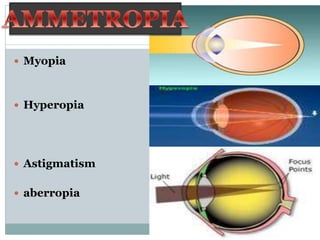
 Myopia
 Hyperopia
 Astigmatism
 aberropia
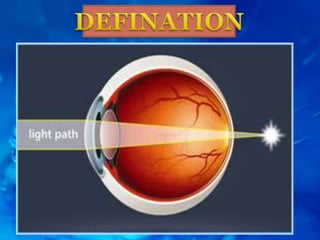
 The term hypermetropia is derived from
hyper meaning “In excess” met meaning
“measure” & opia meaning “of the eye”.
 First suggested in 1755 by KASTNER
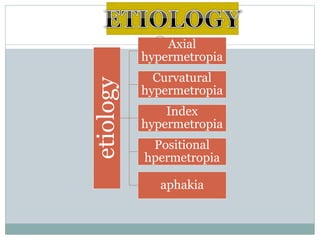
etiology
Axial
hypermetropia
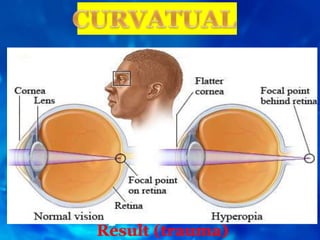
Curvatural
hypermetropia
Index
hypermetropia
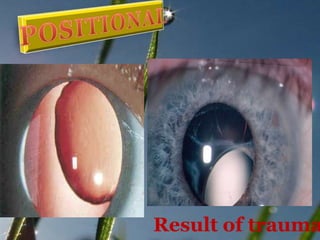
Positional
hpermetropia
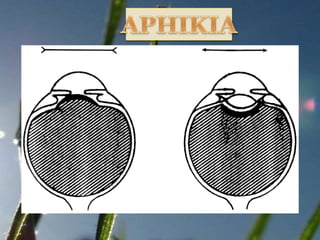
aphakia
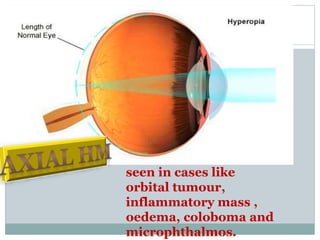
seen in cases like
orbital tumour,
inflammatory mass ,
oedema, coloboma and
microphthalmos.
Result (trauma)
Change in refractive index with age
Pathologically in diabetics under
treatment
Result of trauma
 the refractive power will lower than required
 Far point will be in behind of the eye(retina)
 more amount of accommodation
(uncorrected)
Clinicaltypes
Simple/developmental
pathological
functional
 Commonest form
 Results from normal biological variations in the
development of eyeball
 Include axial and curvatural HM
 May be hereditary
• Congenital/acquired
• Index hypermetropia(cortical sclerosis)
• Positional hypermetropia(postr subluxn of
lens)
• Aphakia
• Consecutive (overcorrection of myopia)
pathological
Paralysis of accommodation
in pts with3rd nerve palsy
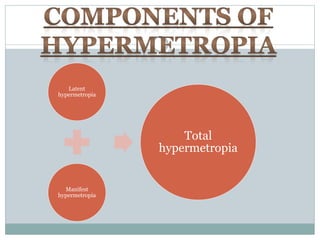
Latent
hypermetropia
Manifest
hypermetropia
Total
hypermetropia
 It is the total amount of refractive error,estimated
after complete cycloplegia with atropine
 Divided into latent & manifest
 Corrected by inherent tone of ciliary muscle
 High in children
 Decreases with age
 Revealed after abolishing tone of ciliary muscle with
atropine
 Remaining part of total hypermetropia
 Correct by accommodation and convex lens
 Measure by add strongest lens with max. vision
 Consists of facultative & absolute
FACULTATIVE HYPERMETROPIA
 Corrected by patients accommodative effort
ABSOLUTE HYPERMETROPIA
 Residual part not corrected by patients
accommodative effort
Absolute hypermetropia can be measured by the
weakest convex lens with which maximum visual
acuity
• Manifest HM – absolute HM = Facultative HM
(Strongest lens) – (weakest lens)
• Total HM – Manifest HM = Latent HM
 1. Asymptomatic
 2. Asthenopic symptoms
 3. Defective vision with asthenopic symptoms
 4. Defective vision only
Associated with near work &
increase in evening
• Tiredness of eyes
• Frontal / frontotemporal head
ache
• Watering
• photophobia
Not fully corrected with
voluntary accomodation
 Size of eye ball may appear small as a whole
 Cornea may be flattern
 Anterior chamber is comparatively shallow
 Fundus examinationsmall optic disc
pseudopapilitis
 retina as a whole
may shine due to greater brilliance
of light reflections (shot silk
appearance).
• SPECTACLES
• CONTACT LENS
• SURGICAL
Optical treatment
Basic principle
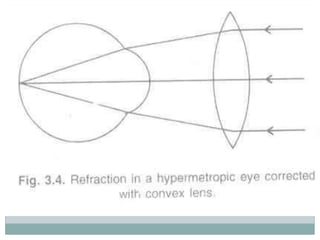
Prescribe convex lenses(Plus lenses) so that
rays are brought to focus on the retina
Advantages
• Comfortable
• Easier method
• Less expensive
• Safe idea
ADVANTAGES
Cosmetically good
Increased field of view
Less magnification
Elimination of aberrations & prismatic effect
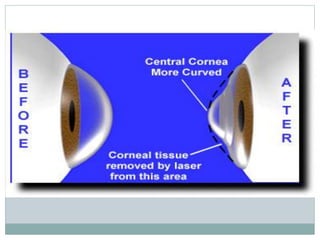
 Refractive surgery is not as effective as in myopia
TYPES:
1) LASER THERMAL KERATOPLASTY(LTK)
2) PHOTOREFRACTIVE KERATECTOMY(PRK)
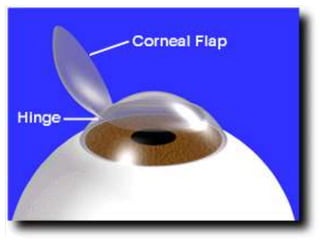
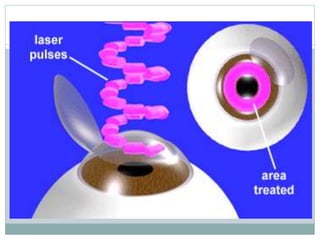
3) LASER IN SITU KERATOMILEUSIS(LASIK)
4) PHAKIC IOL AND CLEAR LENS EXTRACTION
5) VISUAL HYGIENE
 Images are taken from the google image
 Duke-Elder’s PRACTICE OF REFRACTION
REVISED BY
David Abrams
TENTH EDITION
hypermetropia

hypermetropia

  • 3.
     Myopia  Hyperopia Astigmatism  aberropia
  • 4.
     The termhypermetropia is derived from hyper meaning “In excess” met meaning “measure” & opia meaning “of the eye”.  First suggested in 1755 by KASTNER
  • 7.
  • 8.
    seen in caseslike orbital tumour, inflammatory mass , oedema, coloboma and microphthalmos.
  • 9.
  • 10.
    Change in refractiveindex with age Pathologically in diabetics under treatment
  • 11.
  • 13.
     the refractivepower will lower than required  Far point will be in behind of the eye(retina)  more amount of accommodation (uncorrected)
  • 15.
  • 16.
     Commonest form Results from normal biological variations in the development of eyeball  Include axial and curvatural HM  May be hereditary
  • 17.
    • Congenital/acquired • Indexhypermetropia(cortical sclerosis) • Positional hypermetropia(postr subluxn of lens) • Aphakia • Consecutive (overcorrection of myopia) pathological
  • 18.
    Paralysis of accommodation inpts with3rd nerve palsy
  • 19.
  • 20.
     It isthe total amount of refractive error,estimated after complete cycloplegia with atropine  Divided into latent & manifest
  • 21.
     Corrected byinherent tone of ciliary muscle  High in children  Decreases with age  Revealed after abolishing tone of ciliary muscle with atropine
  • 22.
     Remaining partof total hypermetropia  Correct by accommodation and convex lens  Measure by add strongest lens with max. vision  Consists of facultative & absolute FACULTATIVE HYPERMETROPIA  Corrected by patients accommodative effort ABSOLUTE HYPERMETROPIA  Residual part not corrected by patients accommodative effort Absolute hypermetropia can be measured by the weakest convex lens with which maximum visual acuity
  • 23.
    • Manifest HM– absolute HM = Facultative HM (Strongest lens) – (weakest lens) • Total HM – Manifest HM = Latent HM
  • 24.
     1. Asymptomatic 2. Asthenopic symptoms  3. Defective vision with asthenopic symptoms  4. Defective vision only Associated with near work & increase in evening • Tiredness of eyes • Frontal / frontotemporal head ache • Watering • photophobia Not fully corrected with voluntary accomodation
  • 25.
     Size ofeye ball may appear small as a whole  Cornea may be flattern  Anterior chamber is comparatively shallow  Fundus examinationsmall optic disc pseudopapilitis  retina as a whole may shine due to greater brilliance of light reflections (shot silk appearance).
  • 26.
    • SPECTACLES • CONTACTLENS • SURGICAL Optical treatment
  • 27.
    Basic principle Prescribe convexlenses(Plus lenses) so that rays are brought to focus on the retina Advantages • Comfortable • Easier method • Less expensive • Safe idea
  • 29.
    ADVANTAGES Cosmetically good Increased fieldof view Less magnification Elimination of aberrations & prismatic effect
  • 30.
     Refractive surgeryis not as effective as in myopia TYPES: 1) LASER THERMAL KERATOPLASTY(LTK) 2) PHOTOREFRACTIVE KERATECTOMY(PRK) 3) LASER IN SITU KERATOMILEUSIS(LASIK) 4) PHAKIC IOL AND CLEAR LENS EXTRACTION 5) VISUAL HYGIENE
  • 34.
     Images aretaken from the google image  Duke-Elder’s PRACTICE OF REFRACTION REVISED BY David Abrams TENTH EDITION