

INTERVENTION STUDY OF EARLY DETECTION OF HYPERTENSIVE PATIENTS IN FAMILY PRACTICE Janko Kersnik Department of family medicine, University Ljubljana
Why? Early detection and timely treatment    better long term outcomes Case finding is an important means in detecting hypertensive patients GPs do not use this practices in the extend they should Practice can be changed
Methods Baseline measurement of practices Results presented at a regular staff meetings The intervention introduced: guidelines on opportunistic blood pressure measurements, patients were encouraged by posters Follow up assessment
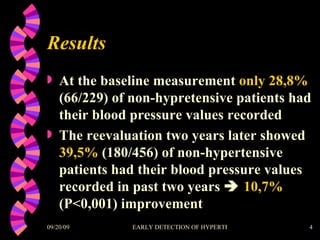
Results At the baseline measurement  only 28,8%  (66/229) of non-hypretensive patients had their blood pressure values recorded The reevaluation two years later showed  39,5%  (180/456) of non-hypertensive patients had their blood pressure values recorded in past two years     10,7%  (P<0,001) improvement
Conclusions A significant  improvement  in the number of general practice patients having their blood pressure measured There is still room for improvement    new interventions  By  empowering patients : leaflets Workshops  on prevention and management of chronic disease in family practice

Earyl dectection of hypertension in family practice

  • 1.
    INTERVENTION STUDY OFEARLY DETECTION OF HYPERTENSIVE PATIENTS IN FAMILY PRACTICE Janko Kersnik Department of family medicine, University Ljubljana
  • 2.
    Why? Early detectionand timely treatment  better long term outcomes Case finding is an important means in detecting hypertensive patients GPs do not use this practices in the extend they should Practice can be changed
  • 3.
    Methods Baseline measurementof practices Results presented at a regular staff meetings The intervention introduced: guidelines on opportunistic blood pressure measurements, patients were encouraged by posters Follow up assessment
  • 4.
    Results At thebaseline measurement only 28,8% (66/229) of non-hypretensive patients had their blood pressure values recorded The reevaluation two years later showed 39,5% (180/456) of non-hypertensive patients had their blood pressure values recorded in past two years  10,7% (P<0,001) improvement
  • 5.
    Conclusions A significant improvement in the number of general practice patients having their blood pressure measured There is still room for improvement  new interventions By empowering patients : leaflets Workshops on prevention and management of chronic disease in family practice