Under the Guidance
PRAMOD VB
ASSISTANT PROFESSOR
Dept. of Mechanical Engineering
AIET, Mijar
“INTRODUCTION TO HYDROPONICS”
Alva’s Institute Of Engineering And Technology Moodbidri, Mijar
Department Of Mechanical Engineering
A SEMINAR TOPIC ON
PRESENTED BY
D JAYKUMAR
7th SEM
CONTENTS
 Introduction
 History of hydroponics
 Hydroponics system
 Why should we grow things hydroponically?
 Working of hydroponics
 Types of hydroponic system
 Materials used and Nutrients solution
 System requirements
 Advantages and Disadvantages CDBPV5013Q
INTRODUCTION
 Technique for growing plants without soil.
 Utilizing this method, roots absorb balanced nutrient dissolved in water that meets all the plant
developmental requirements.
 Many aggregates and media supports the plant growth.
 Mainly used to grow vegetables like tomatoes, cucumber, pepper, etc and herbs like roses, foliage
plants, etc.
HISTORY
 Hydroponics was popularized in media’s and newspapers in 1920’s.
 Dr William F. Gericke, professor from University of California began to develop plants commercially
using this technique which was initially a laboratory technique.
 During World War II,US army used hydroponics to grow fresh food for the troops.
 By 1950’s,this was commercially grown in America, Europe, Asia, Africa.
HYDROPONICS SYSTEM
 System involves growing of plants usually crops using water based mineral nutrients solutions and
without any soil.
 Roots are exposed to nutritious liquid and mechanically supported by an inert medium such as
pearlite, gravel and other substance.
 Nutrients used can be from different organic and inorganic sources, which includes fish excrement,
duck manure or fertilizers, artificial nutrient solutions.
 Plants are grown hydroponically in greenhouse or contained environment.
Why should we grow things hydroponically?
 Nutrients to the plants are easily supplied through nutrients-rich solutions.
 Smaller roots, occupies less area and more yield.
 Many pests can be stopped by growing plants using this technique.
 Less water is used for farming.
TYPES OF HYDROPONIC SYSTEM
 Wick system
 Water culture
 Nutrient film technique(N.F.T)
 Ebb and flow(drain and flow)
 Drip system
WICK SYSTEM
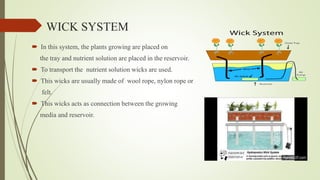
 In this system, the plants growing are placed on
the tray and nutrient solution are placed in the reservoir.
 To transport the nutrient solution wicks are used.
 This wicks are usually made of wool rope, nylon rope or
felt.
 This wicks acts as connection between the growing
media and reservoir.
WATER CULTURE SYSTEM
 It is also called as Deep water culture system(DWC system).
 In this system, the plants roots and nutrient solution both are in
connect.
 Since they are always in connect, the roots usually are less
exposed to the oxygen.
 Therefore,an airstone which is in turn connected to the air pump
is placed in the reservoir.
 This air stone function is to provide oxygen to the plants roots.
NUTRIENT FILM TECHNIQUE SYSTEM
 In this system,the roots in growing tray exposed to
continuously flowing nutrient solution.
 The growing tray is tilted by an angle, so that solution
is not stayed or remained in tray itself.
 After the solution is passed over the plants roots, they
are directed back to the reservoir.
 Here, they are nutritionized and again pumped back
to the growing tray using a pump.
EBB AND FLOW SYSTEM
 In this system,the grow bed and reservoir are not
in connect.
 The nutrient solution from the reservoir pumped to
the grow bed.
 According to the timer, the pumping action takes
place.
 After pump is stopped, due to gravity the nutrient
solution is dripped back to the reservoir.
 An overflow pipe is connected from grow bed to
reservoir in case of any overflow occurs.
DRIP SYSTEM
 In this system,the nutrient solution is supplied through
drips.
 Each individual plants are supplied with enough nutrient
solution to keep itself moist and well-nourished.
 If there is any excess nutrient solution, this are flown through
the overflow pipe.
MATERIALS AND NUTRIENT SOLUTION USED
 Materials like COCA COIR,EXPANDED CLAY PELLETS AND POTTING SOIL(PERLITE) are used
as an grown bed in few systems.
 Solution which are rich in NITROGEN are used for growing and solution of PHOSPHOROUS AND
POTASSIUM rich are used for blooming the flowers.
ADVANTAGES AND DISADVANTAGES
ADVANTAGES DISADVANTAGES
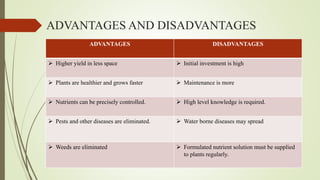
 Higher yield in less space  Initial investment is high
 Plants are healthier and grows faster  Maintenance is more
 Nutrients can be precisely controlled.  High level knowledge is required.
 Pests and other diseases are eliminated.  Water borne diseases may spread
 Weeds are eliminated  Formulated nutrient solution must be supplied
to plants regularly.
REFERENCES

HYDOPONICS.pptx

  • 1.
    Under the Guidance PRAMODVB ASSISTANT PROFESSOR Dept. of Mechanical Engineering AIET, Mijar “INTRODUCTION TO HYDROPONICS” Alva’s Institute Of Engineering And Technology Moodbidri, Mijar Department Of Mechanical Engineering A SEMINAR TOPIC ON PRESENTED BY D JAYKUMAR 7th SEM
  • 2.
    CONTENTS  Introduction  Historyof hydroponics  Hydroponics system  Why should we grow things hydroponically?  Working of hydroponics  Types of hydroponic system  Materials used and Nutrients solution  System requirements  Advantages and Disadvantages CDBPV5013Q
  • 3.
    INTRODUCTION  Technique forgrowing plants without soil.  Utilizing this method, roots absorb balanced nutrient dissolved in water that meets all the plant developmental requirements.  Many aggregates and media supports the plant growth.  Mainly used to grow vegetables like tomatoes, cucumber, pepper, etc and herbs like roses, foliage plants, etc.
  • 4.
    HISTORY  Hydroponics waspopularized in media’s and newspapers in 1920’s.  Dr William F. Gericke, professor from University of California began to develop plants commercially using this technique which was initially a laboratory technique.  During World War II,US army used hydroponics to grow fresh food for the troops.  By 1950’s,this was commercially grown in America, Europe, Asia, Africa.
  • 5.
    HYDROPONICS SYSTEM  Systeminvolves growing of plants usually crops using water based mineral nutrients solutions and without any soil.  Roots are exposed to nutritious liquid and mechanically supported by an inert medium such as pearlite, gravel and other substance.  Nutrients used can be from different organic and inorganic sources, which includes fish excrement, duck manure or fertilizers, artificial nutrient solutions.  Plants are grown hydroponically in greenhouse or contained environment.
  • 6.
    Why should wegrow things hydroponically?  Nutrients to the plants are easily supplied through nutrients-rich solutions.  Smaller roots, occupies less area and more yield.  Many pests can be stopped by growing plants using this technique.  Less water is used for farming.
  • 7.
    TYPES OF HYDROPONICSYSTEM  Wick system  Water culture  Nutrient film technique(N.F.T)  Ebb and flow(drain and flow)  Drip system
  • 8.
    WICK SYSTEM  Inthis system, the plants growing are placed on the tray and nutrient solution are placed in the reservoir.  To transport the nutrient solution wicks are used.  This wicks are usually made of wool rope, nylon rope or felt.  This wicks acts as connection between the growing media and reservoir.
  • 9.
    WATER CULTURE SYSTEM It is also called as Deep water culture system(DWC system).  In this system, the plants roots and nutrient solution both are in connect.  Since they are always in connect, the roots usually are less exposed to the oxygen.  Therefore,an airstone which is in turn connected to the air pump is placed in the reservoir.  This air stone function is to provide oxygen to the plants roots.
  • 10.
    NUTRIENT FILM TECHNIQUESYSTEM  In this system,the roots in growing tray exposed to continuously flowing nutrient solution.  The growing tray is tilted by an angle, so that solution is not stayed or remained in tray itself.  After the solution is passed over the plants roots, they are directed back to the reservoir.  Here, they are nutritionized and again pumped back to the growing tray using a pump.
  • 11.
    EBB AND FLOWSYSTEM  In this system,the grow bed and reservoir are not in connect.  The nutrient solution from the reservoir pumped to the grow bed.  According to the timer, the pumping action takes place.  After pump is stopped, due to gravity the nutrient solution is dripped back to the reservoir.  An overflow pipe is connected from grow bed to reservoir in case of any overflow occurs.
  • 12.
    DRIP SYSTEM  Inthis system,the nutrient solution is supplied through drips.  Each individual plants are supplied with enough nutrient solution to keep itself moist and well-nourished.  If there is any excess nutrient solution, this are flown through the overflow pipe.
  • 13.
    MATERIALS AND NUTRIENTSOLUTION USED  Materials like COCA COIR,EXPANDED CLAY PELLETS AND POTTING SOIL(PERLITE) are used as an grown bed in few systems.  Solution which are rich in NITROGEN are used for growing and solution of PHOSPHOROUS AND POTASSIUM rich are used for blooming the flowers.
  • 14.
    ADVANTAGES AND DISADVANTAGES ADVANTAGESDISADVANTAGES  Higher yield in less space  Initial investment is high  Plants are healthier and grows faster  Maintenance is more  Nutrients can be precisely controlled.  High level knowledge is required.  Pests and other diseases are eliminated.  Water borne diseases may spread  Weeds are eliminated  Formulated nutrient solution must be supplied to plants regularly.
  • 15.