L.... i
ELSEVIER Hydrometallurgy43 (1996) 265-275
hydrometallurgy
Electrolytic recovery of antimony from natural
stibnite ore
Loutfy H. Madkour a, *, Ibrahim A. Salem b
a Chemistry Department, Faculty of Science, Tanta University, Tanta, Egypt
b Geology Department, Faculty of Science, Tanta University, Tanta, Egypt
Received l0 November 1995;accepted 6 December 1995
Abstract
Stibnite ore at Wadi Abu Quraiya, situated in the central Eastern Desert of Egypt has been
subjected to petrographical, mineralogical, infrared, X-ray diffraction, chemical and spectral
analyses. Hydrometallurgical treatment based on leaching with acids, precipitation and electrode-
position of metal values from the ore have been developed. Studies to investigate suitable
electrolytic baths for the cathodic deposition of metallic antimony either directly from the leach
liquor or in the presence of complexing agents have been carded out. The influence of various
factors on the electrodeposition process of the element from its electrolyte solutions is discussed.
Advantages of the flowsheet and various approaches depending on convenient electrolytes for the
deposition of antimony from the stibnite ore have been investigated. The results of spectrophoto-
metric and chemical analyses revealed that the purity of the metal is > 99%.
Keywords: stibnite; leaching; antimony extraction
1. Introduction
The occurrence of stibnite in Egypt is not common. Therefore, the stibnite mineraliza-
tion located at Wadi Abu Quraiya in the central Eastern Desert is considered [1] to be
the most important source of antimony in Egypt. More detailed studies are needed to
evaluate its potential. The stibnite-bearing quartz vein in the area is hosted in grey
granite in the form of a fissure vein deposit striking NE-SW and dipping 50°NW. It is
extends about 180 m in length and has a thickness ranging between 20 and 50 cm. The
stibnite is surrounded and encrusted by antimony oxides. The geology of the Abu
* Correspondingauthor.
0304-386X/96/$15.00 Copyright © 1996Elsevier Science B.V. All rights reserved.
SSDI 0304-386X(95)00113- 1
266 L.H.Madkour,1.4.Salem/ Hydrometallurgy43 (1996)265-275
Quraiya area has been studied in a number of reviews and research reports over the
years [2-4]. Most antimony deposits principally occur as either stibnite or native
antimony in siliceous gangue minerals commonly associated with pyrite and are formed
from hydrothermal solutions [5]. Antimony is recovered by reduction of the stibnite with
iron scrap, direct reduction of natural oxide ores and also from lead base battery scrap
metal. Antimony metal finds extensive industrial applications in the preparation of
hardening alloys for lead, pyrotechnics and semiconductor technology (99.999% grade).
Electrodeposition of metallic antimony (cathodically) might be possible from suitable
electrolyte solutions [6-8]. The aim of the present work was to develop a simple and
rapid method for the electrolytic extraction of antimony metal from stibnite, through
acid leaching and the use of complexing agents.
2. Experimental
2.1. Sampling
A total of 10 surface samples were collected along two traverses crossing the
stibnite-bearing quartz vein. Samples were split, crushed and then ground to pass 100
mesh (0.15 mm). The ground samples were analysed for the quantitative determination
of some major and trace elements. Mineralised stibnite ore was crushed to 100% minus
1.0 mm.
2.2. Chemical and spectral analyses
Spectrographic analysis of the ore sample was carried out at the Geology and
Prospecting Institute, Moscow, Russia. Ore mineralogical studies using polarized and
reflected light microscopy, scanning electron microscopy, X-ray diffraction and infrared
spectroscopic analysis were carried out on the stibnite ore sample in the Central
Laboratory at Tanta University, Egypt.
2.3. Leaching methods
Three different direct leaching agents were used for treatment of the stibnite ore:
Mixture of hydrochloric and tartaric acids: A sample of 1 g of the ore was
decomposed by boiling in 25 ml concentrated hydrochloric acid and 25 ml (20%)
tartaric acid until the mineral was completely decomposed. The insoluble residue was
removed by filtration and washed with a 0.5% tartaric acid solution in 5% HC1.
Mixture of nitric and tartaric acids: 20 ml (20%) tartaric acid was poured over a 0.5
g sample of the ore followed by 20 ml of concentrated HNO3 acid and the mixture
allowed to stand for 12 h at room temperature, followed by heating on a water bath for 3
h, until the sample had been completely decomposed. The insoluble residue was
separated by filtration and washed with a 0.3% tartaric acid solution in 2% nitric acid.
Hot concentrated sulphuric acid: The decomposition was carried out in a small
conical flask covered with a short-stem funnel; 20 ml of concentrated H2SO4 was
L.H.Madkour,1.,4.Salem/Hydrometallurgy43 (1996)265-275 267
poured over a 0.5 g sample and spread over the bottom of the flask by a rotating motion.
The flask was heated gently at first, the temperature was then gradually raised to boiling
point. The decomposition was complete when the dark-coloured ore sample disappeared
and the residue was white. After cooling, the mixture was carefully diluted with about
100 ml H20 added in small portions. A small amount of tartaric acid was added to the
solution to avoid the hydrolysis of antimony and tin in the mineral. The solution was
boiled for about 30 min to dissolve the sulphates of iron and non-ferrous metals
completely. The insoluble residue was filtered and washed well with 1% H2SO4
solution.
2.4. Preparation of antimony complex salt ore electrolytes
Antimony exists in the leach liquor as trichloride, which forms antimony oxychloride
with water. A standard solution of antimony oxychloride (SbOC1) was prepared and its
concentration determined [9]. For each experiment 0.35-0.90 g antimony chloride in
solution was electrolysed in the presence of the appropriate quantity of a complexing
agent with constant agitation. The total volume of the electrolyte was 100 ml.
2.5. Analytical methods
X-ray diffraction analyses were carried out using a PW 1840 Phillips diffractometer
with CuK~ radiation (hl.5418). Infrared absorption analysis was done using a Perkin
Elmer 683 infrared spectrophotometer; the potassium bromide pellet method was used.
These analyses were carried out at the Central Laboratory, Tanta University, Egypt.
2.6. Apparatus and working procedures for electrolysis
The electrolytic cell design and general experimental procedure were the same as
described elsewhere [10-14]. The cathode was a platinum sheet with an area of 10 cm2.
The electrolyte temperature was maintained at 25 + I°C with constant stirring in all
experiments. All chemicals used were of Analar quality and were used without further
purification.
3. Results and discussion
3.1. Characteristics of stibnite ore sample
Mineralogically, the stibnite vein lode has a simple mineral assemblage and consists
exclusively of quartz and stibnite. Tetrahedrite, pyrite, chalcopyrite and sphalerite are
sparse and present as inclusions in the quartz and stibnite. Cervantite is a secondary
mineral formed from the oxidation of stibnite. Goethite also occurs. Quartz is the
predominant gangue mineral and occurs as subhedral to anhedral crystals ranging from
0.2 to 0.6 mm in diameter. Quartz may be colourless or stained yellow due to
replacement by goethite. It is frequently fractured, brecciated and exhibits wavy
extinction.
268 L.H. Madkour, LA. Salem/Hydrometallurgy 43 (1996)265-275
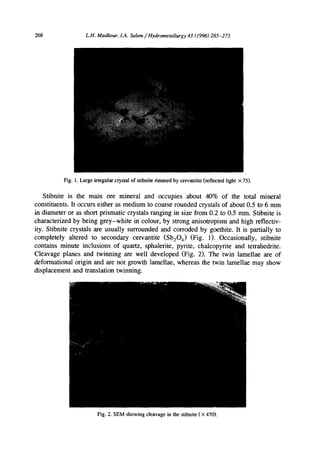
Fig. 1. Large irregular crystal of stibnite rimmed by cervantite (reflected light × 75).
Stibnite is the main ore mineral and occupies about 40% of the total mineral
constituents. It occurs either as medium to coarse rounded crystals of about 0.5 to 6 mm
in diameter or as short prismatic crystals ranging in size from 0.2 to 0.5 mm. Stibnite is
characterized by being grey-white in colour, by strong anisotropism and high reflectiv-
ity. Stibnite crystals are usually surrounded and corroded by goethite. It is partially to
completely altered to secondary cervantite (Sb204) (Fig. 1). Occasionally, stibnite
contains minute inclusions of quartz, sphalerite, pyrite, chalcopyrite and tetrahedrite.
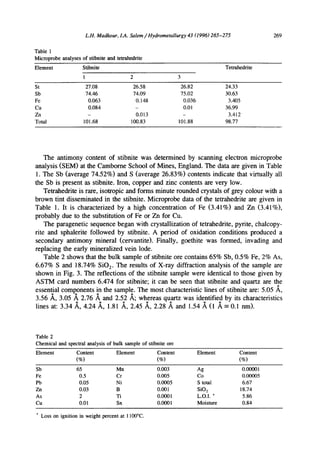
Cleavage planes and twinning are well developed (Fig. 2). The twin lamellae are of
deformational origin and are not growth lamellae, whereas the twin lamellae may show
displacement and translation twinning.
Fig. 2. SEM showing cleavage in the stibnite ( X470).
L.H. Madkour, LA. Salem / Hydrometallurgy 43 (1996) 265-275
Table 1
Microprobe analyses of stibnite and tetrahedrite
269
Element Stibnite
1 2 3
Tetrahedfite
St 27.08 26.58 26.82 24.33
Sb 74.46 74.09 75.02 30.63
Fe 0.063 0.148 0.036 3.405
Cu 0.084 - 0.01 36.99
Zn - 0.013 - 3.412
Total 101.68 100.83 101.88 98.77
The antimony content of stibnite was determined by scanning electron microprobe
analysis (SEM) at the Camborne School of Mines, England. The data are given in Table
1. The Sb (average 74.52%) and S (average 26.83%) contents indicate that virtually all
the Sb is present as stibnite. Iron, copper and zinc contents are very low.
Tetrahedrite is rare, isotropic and forms minute rounded crystals of grey colour with a
brown tint disseminated in the stibnite. Microprobe data of the tetrahedrite are given in
Table 1. It is characterized by a high concentration of Fe (3.41%) and Zn (3.41%),
probably due to the substitution of Fe or Zn for Cu.
The paragenetic sequence began with crystallization of tetrahedrite, pyrite, chalcopy-
rite and sphalerite followed by stibnite. A period of oxidation conditions produced a
secondary antimony mineral (cervantite). Finally, goethite was formed, invading and
replacing the early mineralized vein lode.
Table 2 shows that the bulk sample of stibnite ore contains 65% Sb, 0.5% Fe, 2% As,
6.67% S and 18.74% SiO2. The results of X-ray diffraction analysis of the sample are
shown in Fig. 3. The reflections of the stibnite sample were identical to those given by
ASTM card numbers 6.474 for stibnite; it can be seen that stibnite and quartz are the
o
essentialo comp.onents in the sample. The most characteristic lines of stibnite are: 5.05 A,
3.56 A, 3.05 A 2.76 A and 2.52 A; whereas quartz was identified by its characteristics
lines at: 3.34 ,~, 4.24 ,~, 1.81 .~, 2.45 ,~, 2.28 ,~ and 1.54 ,~ (1 ,~ = 0.I nm).
Table 2
Chemical and spectral analysis of bulk sample of stibnite ore
Element Content Element Content Element Content
(%) (%) (%)
Sb 65 Mn 0.003 Ag 0.00001
Fe 0.5 Cr 0.005 Co 0.00(~5
Pb 0.05 Ni 0.0005 S total 6.67
Zn 0.03 B 0.001 SiO2 18.74
As 2 Ti 0.0001 L.O.I. * 5.86
Cu 0.01 Sn 0.0001 Moisture 0.84
* Loss on ignition in weight percent at 1100°C.
270 L.H.Madkour,I.A. Salem/Hydrometallurgy43 (1996)265-275
Sti bnite
N
N N J~ .O
q~' m ill .D i~ N Ii~J j3 ..C)
m N O ~
m m
6B 60 50 40 30 20 14
Fig. 3. X-raydiffractionpatternfor separatedcrystalsof stibnite.
The infrared absorption spectrum of the sample of stibnite ore is represented
graphically in Fig. 4. Stibnite was detected by 2 moderate to weak absorption bands at
675 cm- ~ and 460 cm- ~. The band at about 1070 cm- ~ is characteristic of quartz.
3.2. Acid leaching treatment of sfibnite ore sample
3.2.1. Hydrochloric acid leaching
Stibnite dissolved very slowly and incompletely when boiled with concentrated
hydrochloric acid with the evolution of hydrogen sulphide, but decomposition with a
mixture of concentrated hydrochloric and tartaric acid has been recommended [15]. The
reaction is accompanied by intensive evolution of gases, so the oxidation was performed
in a conical flask or a high beaker, covered by a watch glass. Antimony ores are
decomposed easily by bromine solvents [16]. Whereas direct oxidation of sulphidic
Stibnite
I I I I 8100 I I I I I I
4000 3500 2S00 I 1400 1000 600
WAVENUMBE R ( C f61 )
Fig. 4. Infraredabsorptionspectrumforseparatedcrystalsofstibnite.
I
200
L.H. Madkour, LA. Salem / Hydrometallurgy 43 (1996) 265-275 271
sulphur to sulphate takes place at room temperature, the method is not used generally to
determine the main components, but it has been found useful for the determination of
trace elements.
3.2.2. Nitric acid leaching
Nitric acid, dilute as well as concentrated, is a powerful solvent for a number of
minerals, especially for sulphides [10,11]. The acid alone is used only in a limited
number of cases; mixtures with other mineral acids are more frequently used. Being a
strong oxidant, it oxidises sulphides to sulphates; antimony sulphosalts are converted to
the respective metal acids of the higher oxidation states, which are generally only poorly
soluble. Sulphur in sulphide ores must be oxidised at room temperature, with the dilute
acid only. The metal acids precipitated adsorb a large amount of foreign ions in an
acidic medium. Therefore, hydrolysis must be suppressed by adding other mineral acids
or complexing agents.
A mixture of nitric and tartaric acid [17] was used in the present work to decompose
the stibnite ore sample. This method was proposed by Hampe [18] and has found wide
application in the analysis of minerals containing antimony and tin, as well as of
metallurgical products. Thus, tartaric acid is used mainly for the analysis of antimony
ores. After dissolving the ore in concentrated acids, tartaric acid is added to the solution
before dilution with water, to avoid the hydrolysis of antimony; tartaric acid alone
dissolves some oxidized antimony minerals.
3.2.3. Sulphuric acid leaching
Concentrated H2SO 4 is an efficient solvent for the decomposition of sulphide and
oxide antimony ores [19] and gives good recovery when used alone or, more frequently,
in mixtures with other solvents.
Hot concentrated H2SO 4 was employed here for the decomposition of the stibnite ore
sample in the presence of small amounts of tartaric acid. Antimony and arsenic were
easily precipitated from sulphate solution as sulphides, in a form easy to filter. Boiling
with concentrated H2SO4 at the same time also causes complete dehydration of silicic
acid, which is thus converted to a suitable form for quantitative precipitation. Any
antimony trisulphate Sb2(SO4)3 formed decomposes in water. The efficiency of the
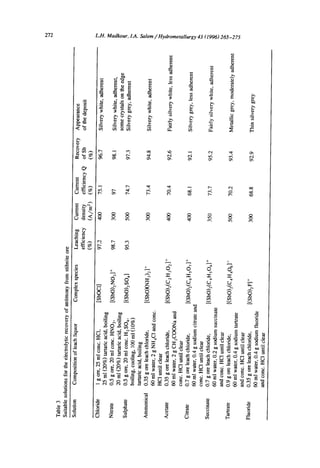
various reagents for leaching and treatment of the stibnite ore are compared in Table 3.
3.3. Electrodeposition of antimony
The effects of concentration of antimony ions in the leach liquor, the nature of the
complexing agents, the current density, temperature and the presence of other impurities
were studied. The optimum conditions for the electrodeposition of metallic antimony
from its mother liquor and the various electrolyte solutions are summarized in Table 3.
Characterization of the solid complexes was investigated using elemental analysis,
conductance, magnetic susceptibility and spectroscopic methods. For each experiment,
the results of chemical and spectrophotometric analyses indicate that the purity of the
electrodeposited metal was 99%.
272 L.H. Madkour, I.A. Salem/Hydrometallurgy 43 (1996)265-275
c~
o
.o
o _~
~. 0
~o
~1 °
°l.-~ .o
~ "6
- - - - .~ z .~, :~
~r~
~ ~ ~ ~ ~ •
"2. t"- ~ ,~ ~. ~ ~ ~
~. ~ ~ c~ " c~ "
~. t-. m.
+ + + +
e.,
+
o_~oo ~_ _ ~ ~
"~ ~-~ ~.~" -~ ~ ~- -~ ~ ~-
~ ~ o ~ "~ ~ ~ o ~ ~o ~ ~ "~ c~ ~ "~ ~
~c5 = • " •
L.H. Madkour, 1.4. Salem/Hydrometallurgy 43 (1996)265-275 273
Effect of the concentration of Sb ions: Silvery white, adherent deposition was found
to take place in the concentration range >_0.05 M. At very low concentrations of
antimony ions in electrolyte solution (< 0.05 M solution) no deposition takes place,
owing to the very small concentration of ions in solution. The results show that there is a
critical concentration at which one obtains the maximum rate of deposition.
Effect of complexing agents: Cathodic deposition takes place in the absence of
complexing agents, so the effect of the complexing agent [20] in rendering differences
between the reversible potential of antimony and its standard potential is important.
Table 3 shows the existence of the antimony complex species prepared from the leach
liquor chloride. These complex species in solution have recently been identified by
conductometric titrations using 0.001 M antimonyl chloride with 0.01 M complexing
solution. The measured conductance of the solution was plotted against the volume of
complexing agent (NaF, NaNO3, CH3COONa, C6HsO7Na 3, C4HsO4Na or NH4C1)
added. The conductance curves showed breaks at certain molar metal/complexing
agents ratios, corresponding to the formation of 2:1 antimony complexes with all ligands
used. Experiments using an ion-exchange resin technique [21,22] confirmed the presence
of positively charged complex species. The formation of the cationic complexes
indicated above has previously been reported [8]. Furthermore, complexing agents have
an important role in ensuring the presence of a sufficiently small SbO ÷ ion concentra-
tion at the cathode, suitable for the reduction and the smooth deposition of the metal.
Table 3 shows the most suitable concentrations of Sb ions and complexing agent
required in order to reach high current efficiency.
Effect of temperature: Increasing the temperature of the solution from 25°C to 60°C
favours the cathodic deposition of the metal. This is due to the improved mass transport
[23] of complex species towards the platinum cathode.
Effect of current density: At low current density (less than 100 A/m 2) only a thin
layer of antimony was deposited, owing to the low rate of cathodic reactions occurring
at the cathode. At higher current density (> 1000 A/m 2) the deposit formed was not
adherent. This is attributed to the rapid discharge of hydrogen ion.
Current efficiency: The decrease in the cathodic current efficiency (Q%) is related to
several factors, including a decrease in hydrogen overvoltage on certain areas of the
antimony electrodeposition [24], or an increase in the evolution of hydrogen; the
presence of other metal cations during the deposition process and the possible alteration
in the growth morphology of the antimony deposited by impurities originally present in
the leach liquor. The lower current efficiency values are attributed to the platinum plate
used as the cathode and the dilute solution of antimony [25] in the electrolyte.
3.4. Kinetics and mechanism
The rate of deposition (using electrolyses with controlled electric potential) increases
slowly at first and then increases sharply to attain a maximum value at 40 rain and then
decreases sharply. This may be attributed to the lower concentration of metal ion around
the cathode and the rapid formation of Sb powder in the bottom of the cathode
compartment. The cathodic deposition of antimony proceeds at first by the formation of
the corresponding complex species, followed by migration of the complex species
towards the platinum cathode and, finally, deposition of the antimony.
274 L.H. Madkour, I.A. Salem/Hydrometallurgy 43 (1996)265-275
3.5. Recommended flowsheet
The various steps required for the hydro- and electrometallurgical treatment of
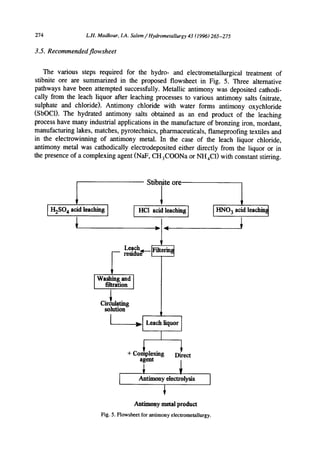
stibnite ore are summarized in the proposed flowsheet in Fig. 5. Three alternative
pathways have been attempted successfully. Metallic antimony was deposited cathodi-
cally from the leach liquor after leaching processes to various antimony salts (nitrate,
sulphate and chloride). Antimony chloride with water forms antimony oxychloride
(SbOCI). The hydrated antimony salts obtained as an end product of the leaching
process have many industrial applications in the manufacture of bronzing iron, mordant,
manufacturing lakes, matches, pyrotechnics, pharmaceuticals, flameproofing textiles and
in the electrowinning of antimony metal. In the case of the leach liquor chloride,
antimony metal was cathodically electrodeposited either directly from the liquor or in
the presence of a complexing agent (NaF, CH3COONa or NH4CI) with constant stirring.
1-12SOacidleachingI
Stibnite ore
HC1 acid leaching I
Leach4__~~ residue I'-
Washingand
mtrationI
I "-I~I Leachliquor I
I
L *+ Co lexing Direct
agent
Antimony electrolysis I
Antimony metal product
Fig. 5. Flowsheetfor antimonyelectrometallurgy.
HNO acid leachin~
L.H. Madkour, LA. Salem/Hydrometallurgy 43 (1996)265-275 275
It can be noticed that the reagents used either in the leaching treatment or in the
electrolysis process, such as hydrochloric acid, nitric acid, sulphuric acid and tartaric
acid, are relatively cheap and common reagents. The advantages of this flowsheet are
concerned also with the low temperature used for both the leaching and electrodeposi-
tion processes and, hence, the low energy consumption.
References
[1] Salem, I.A., The occurrence of stibnite mineralization at Wadi Abu Quraiya, Central Eastern Desert,
Egypt. Mineralogical Society of Egypt Conf. (1989).
[2] Moustafa, G.A., et al., Geology of Gebel El-ineigi District. Geol. Surv. Cairo, Egypt (1954).
[3] El-Ramly, M.F., et al., The Basement complex in the Central Eastern Desert, between latitudes 24° 30'
and 25° 40'. Geol. Surv. Cairo, 8 (1960): 35.
[4] Saber, A.H, et al., The intrusive complexes of Central Eastern Desert of Egypt. Ann. Geol. Surv. Egypt,
1 (1976): 53-73.
[5] Jensen, M.L., et al., Economic Mineral Deposits. Wiley, New York (1981), p. 953.
[6] del Boca, M.C., HeN. Chim. Acta, 16 (1933): 565.
[7] Emeleus, H.J. and Anderson, J.S., Modem Aspects of Inorganic Chemistry. Routledge and Kegan Paul,
London (1952), p. 470.
[8] Fouda, A.S., et al., Bull. Electrochem., 6(7) (1990): 677-678.
[9] Vogel, A.I., Quantitative Inorganic Analysis. Longmans, London, 3rd ed. (1968) p. 503.
[10] Afifi, S.E. and Madkour, L.H., Electrolytic deposition of metal values from Umm. Samiuki polymetal
ore. Egypt. J. Chem., 27(3) (1984): 275-296.
[11] Madkour, L.H., J. Chem. Tech. Biotecb., 35(A3) (1985): 108-114.
[12] Madkour, L.H., et al., J. Electroanal. Chem., 199 (1986): 207.
[13] Madkour, L.H., J. Erzmetal, 48 (1995): 104.
[14] Madkour, L.H., Indian J. Chem. Technol., 2 (1995): 343.
[15] Groenewald, I.D., Analyst, 89 (1964): 140.
[16] Allen, W.S., et al., Ind. Eng. Chem. (1919), 11, 46.
[17] Rubeska, I., et al., Anal. Chim. Acta, 37 (1967): 27.
[18] Hampe, W., Chem. Z., 15: (t891): 443.
[19] Zakharov, V.A., et al., Zavodskaya Lab., 28: (1962): 27.
[20] Fouda, A.S., J. Electroanal. Chem., 114 (1980): 83.
[21] Fouda, A.S., J. Electroanal. Chem., 110 (1980): 357.
[22] Elsemongy, M.M., et al., J. Electroanal. Chem., 76 (1977): 376.
[23] Fouda, A.S., et al., Indian J. Technol., 20 (1982): 139.
[24] Kerby, R.C. and Ingraham, I.R., Can. Mines Bur. Res. Rep., 35 (1971): 243.
[25] Fouda, A.S., et al., J. Electroanal. Chem., 124 (1981): 301.

Hydro-Complete

  • 1.
    L.... i ELSEVIER Hydrometallurgy43(1996) 265-275 hydrometallurgy Electrolytic recovery of antimony from natural stibnite ore Loutfy H. Madkour a, *, Ibrahim A. Salem b a Chemistry Department, Faculty of Science, Tanta University, Tanta, Egypt b Geology Department, Faculty of Science, Tanta University, Tanta, Egypt Received l0 November 1995;accepted 6 December 1995 Abstract Stibnite ore at Wadi Abu Quraiya, situated in the central Eastern Desert of Egypt has been subjected to petrographical, mineralogical, infrared, X-ray diffraction, chemical and spectral analyses. Hydrometallurgical treatment based on leaching with acids, precipitation and electrode- position of metal values from the ore have been developed. Studies to investigate suitable electrolytic baths for the cathodic deposition of metallic antimony either directly from the leach liquor or in the presence of complexing agents have been carded out. The influence of various factors on the electrodeposition process of the element from its electrolyte solutions is discussed. Advantages of the flowsheet and various approaches depending on convenient electrolytes for the deposition of antimony from the stibnite ore have been investigated. The results of spectrophoto- metric and chemical analyses revealed that the purity of the metal is > 99%. Keywords: stibnite; leaching; antimony extraction 1. Introduction The occurrence of stibnite in Egypt is not common. Therefore, the stibnite mineraliza- tion located at Wadi Abu Quraiya in the central Eastern Desert is considered [1] to be the most important source of antimony in Egypt. More detailed studies are needed to evaluate its potential. The stibnite-bearing quartz vein in the area is hosted in grey granite in the form of a fissure vein deposit striking NE-SW and dipping 50°NW. It is extends about 180 m in length and has a thickness ranging between 20 and 50 cm. The stibnite is surrounded and encrusted by antimony oxides. The geology of the Abu * Correspondingauthor. 0304-386X/96/$15.00 Copyright © 1996Elsevier Science B.V. All rights reserved. SSDI 0304-386X(95)00113- 1
  • 2.
    266 L.H.Madkour,1.4.Salem/ Hydrometallurgy43(1996)265-275 Quraiya area has been studied in a number of reviews and research reports over the years [2-4]. Most antimony deposits principally occur as either stibnite or native antimony in siliceous gangue minerals commonly associated with pyrite and are formed from hydrothermal solutions [5]. Antimony is recovered by reduction of the stibnite with iron scrap, direct reduction of natural oxide ores and also from lead base battery scrap metal. Antimony metal finds extensive industrial applications in the preparation of hardening alloys for lead, pyrotechnics and semiconductor technology (99.999% grade). Electrodeposition of metallic antimony (cathodically) might be possible from suitable electrolyte solutions [6-8]. The aim of the present work was to develop a simple and rapid method for the electrolytic extraction of antimony metal from stibnite, through acid leaching and the use of complexing agents. 2. Experimental 2.1. Sampling A total of 10 surface samples were collected along two traverses crossing the stibnite-bearing quartz vein. Samples were split, crushed and then ground to pass 100 mesh (0.15 mm). The ground samples were analysed for the quantitative determination of some major and trace elements. Mineralised stibnite ore was crushed to 100% minus 1.0 mm. 2.2. Chemical and spectral analyses Spectrographic analysis of the ore sample was carried out at the Geology and Prospecting Institute, Moscow, Russia. Ore mineralogical studies using polarized and reflected light microscopy, scanning electron microscopy, X-ray diffraction and infrared spectroscopic analysis were carried out on the stibnite ore sample in the Central Laboratory at Tanta University, Egypt. 2.3. Leaching methods Three different direct leaching agents were used for treatment of the stibnite ore: Mixture of hydrochloric and tartaric acids: A sample of 1 g of the ore was decomposed by boiling in 25 ml concentrated hydrochloric acid and 25 ml (20%) tartaric acid until the mineral was completely decomposed. The insoluble residue was removed by filtration and washed with a 0.5% tartaric acid solution in 5% HC1. Mixture of nitric and tartaric acids: 20 ml (20%) tartaric acid was poured over a 0.5 g sample of the ore followed by 20 ml of concentrated HNO3 acid and the mixture allowed to stand for 12 h at room temperature, followed by heating on a water bath for 3 h, until the sample had been completely decomposed. The insoluble residue was separated by filtration and washed with a 0.3% tartaric acid solution in 2% nitric acid. Hot concentrated sulphuric acid: The decomposition was carried out in a small conical flask covered with a short-stem funnel; 20 ml of concentrated H2SO4 was
  • 3.
    L.H.Madkour,1.,4.Salem/Hydrometallurgy43 (1996)265-275 267 pouredover a 0.5 g sample and spread over the bottom of the flask by a rotating motion. The flask was heated gently at first, the temperature was then gradually raised to boiling point. The decomposition was complete when the dark-coloured ore sample disappeared and the residue was white. After cooling, the mixture was carefully diluted with about 100 ml H20 added in small portions. A small amount of tartaric acid was added to the solution to avoid the hydrolysis of antimony and tin in the mineral. The solution was boiled for about 30 min to dissolve the sulphates of iron and non-ferrous metals completely. The insoluble residue was filtered and washed well with 1% H2SO4 solution. 2.4. Preparation of antimony complex salt ore electrolytes Antimony exists in the leach liquor as trichloride, which forms antimony oxychloride with water. A standard solution of antimony oxychloride (SbOC1) was prepared and its concentration determined [9]. For each experiment 0.35-0.90 g antimony chloride in solution was electrolysed in the presence of the appropriate quantity of a complexing agent with constant agitation. The total volume of the electrolyte was 100 ml. 2.5. Analytical methods X-ray diffraction analyses were carried out using a PW 1840 Phillips diffractometer with CuK~ radiation (hl.5418). Infrared absorption analysis was done using a Perkin Elmer 683 infrared spectrophotometer; the potassium bromide pellet method was used. These analyses were carried out at the Central Laboratory, Tanta University, Egypt. 2.6. Apparatus and working procedures for electrolysis The electrolytic cell design and general experimental procedure were the same as described elsewhere [10-14]. The cathode was a platinum sheet with an area of 10 cm2. The electrolyte temperature was maintained at 25 + I°C with constant stirring in all experiments. All chemicals used were of Analar quality and were used without further purification. 3. Results and discussion 3.1. Characteristics of stibnite ore sample Mineralogically, the stibnite vein lode has a simple mineral assemblage and consists exclusively of quartz and stibnite. Tetrahedrite, pyrite, chalcopyrite and sphalerite are sparse and present as inclusions in the quartz and stibnite. Cervantite is a secondary mineral formed from the oxidation of stibnite. Goethite also occurs. Quartz is the predominant gangue mineral and occurs as subhedral to anhedral crystals ranging from 0.2 to 0.6 mm in diameter. Quartz may be colourless or stained yellow due to replacement by goethite. It is frequently fractured, brecciated and exhibits wavy extinction.
  • 4.
    268 L.H. Madkour,LA. Salem/Hydrometallurgy 43 (1996)265-275 Fig. 1. Large irregular crystal of stibnite rimmed by cervantite (reflected light × 75). Stibnite is the main ore mineral and occupies about 40% of the total mineral constituents. It occurs either as medium to coarse rounded crystals of about 0.5 to 6 mm in diameter or as short prismatic crystals ranging in size from 0.2 to 0.5 mm. Stibnite is characterized by being grey-white in colour, by strong anisotropism and high reflectiv- ity. Stibnite crystals are usually surrounded and corroded by goethite. It is partially to completely altered to secondary cervantite (Sb204) (Fig. 1). Occasionally, stibnite contains minute inclusions of quartz, sphalerite, pyrite, chalcopyrite and tetrahedrite. Cleavage planes and twinning are well developed (Fig. 2). The twin lamellae are of deformational origin and are not growth lamellae, whereas the twin lamellae may show displacement and translation twinning. Fig. 2. SEM showing cleavage in the stibnite ( X470).
  • 5.
    L.H. Madkour, LA.Salem / Hydrometallurgy 43 (1996) 265-275 Table 1 Microprobe analyses of stibnite and tetrahedrite 269 Element Stibnite 1 2 3 Tetrahedfite St 27.08 26.58 26.82 24.33 Sb 74.46 74.09 75.02 30.63 Fe 0.063 0.148 0.036 3.405 Cu 0.084 - 0.01 36.99 Zn - 0.013 - 3.412 Total 101.68 100.83 101.88 98.77 The antimony content of stibnite was determined by scanning electron microprobe analysis (SEM) at the Camborne School of Mines, England. The data are given in Table 1. The Sb (average 74.52%) and S (average 26.83%) contents indicate that virtually all the Sb is present as stibnite. Iron, copper and zinc contents are very low. Tetrahedrite is rare, isotropic and forms minute rounded crystals of grey colour with a brown tint disseminated in the stibnite. Microprobe data of the tetrahedrite are given in Table 1. It is characterized by a high concentration of Fe (3.41%) and Zn (3.41%), probably due to the substitution of Fe or Zn for Cu. The paragenetic sequence began with crystallization of tetrahedrite, pyrite, chalcopy- rite and sphalerite followed by stibnite. A period of oxidation conditions produced a secondary antimony mineral (cervantite). Finally, goethite was formed, invading and replacing the early mineralized vein lode. Table 2 shows that the bulk sample of stibnite ore contains 65% Sb, 0.5% Fe, 2% As, 6.67% S and 18.74% SiO2. The results of X-ray diffraction analysis of the sample are shown in Fig. 3. The reflections of the stibnite sample were identical to those given by ASTM card numbers 6.474 for stibnite; it can be seen that stibnite and quartz are the o essentialo comp.onents in the sample. The most characteristic lines of stibnite are: 5.05 A, 3.56 A, 3.05 A 2.76 A and 2.52 A; whereas quartz was identified by its characteristics lines at: 3.34 ,~, 4.24 ,~, 1.81 .~, 2.45 ,~, 2.28 ,~ and 1.54 ,~ (1 ,~ = 0.I nm). Table 2 Chemical and spectral analysis of bulk sample of stibnite ore Element Content Element Content Element Content (%) (%) (%) Sb 65 Mn 0.003 Ag 0.00001 Fe 0.5 Cr 0.005 Co 0.00(~5 Pb 0.05 Ni 0.0005 S total 6.67 Zn 0.03 B 0.001 SiO2 18.74 As 2 Ti 0.0001 L.O.I. * 5.86 Cu 0.01 Sn 0.0001 Moisture 0.84 * Loss on ignition in weight percent at 1100°C.
  • 6.
    270 L.H.Madkour,I.A. Salem/Hydrometallurgy43(1996)265-275 Sti bnite N N N J~ .O q~' m ill .D i~ N Ii~J j3 ..C) m N O ~ m m 6B 60 50 40 30 20 14 Fig. 3. X-raydiffractionpatternfor separatedcrystalsof stibnite. The infrared absorption spectrum of the sample of stibnite ore is represented graphically in Fig. 4. Stibnite was detected by 2 moderate to weak absorption bands at 675 cm- ~ and 460 cm- ~. The band at about 1070 cm- ~ is characteristic of quartz. 3.2. Acid leaching treatment of sfibnite ore sample 3.2.1. Hydrochloric acid leaching Stibnite dissolved very slowly and incompletely when boiled with concentrated hydrochloric acid with the evolution of hydrogen sulphide, but decomposition with a mixture of concentrated hydrochloric and tartaric acid has been recommended [15]. The reaction is accompanied by intensive evolution of gases, so the oxidation was performed in a conical flask or a high beaker, covered by a watch glass. Antimony ores are decomposed easily by bromine solvents [16]. Whereas direct oxidation of sulphidic Stibnite I I I I 8100 I I I I I I 4000 3500 2S00 I 1400 1000 600 WAVENUMBE R ( C f61 ) Fig. 4. Infraredabsorptionspectrumforseparatedcrystalsofstibnite. I 200
  • 7.
    L.H. Madkour, LA.Salem / Hydrometallurgy 43 (1996) 265-275 271 sulphur to sulphate takes place at room temperature, the method is not used generally to determine the main components, but it has been found useful for the determination of trace elements. 3.2.2. Nitric acid leaching Nitric acid, dilute as well as concentrated, is a powerful solvent for a number of minerals, especially for sulphides [10,11]. The acid alone is used only in a limited number of cases; mixtures with other mineral acids are more frequently used. Being a strong oxidant, it oxidises sulphides to sulphates; antimony sulphosalts are converted to the respective metal acids of the higher oxidation states, which are generally only poorly soluble. Sulphur in sulphide ores must be oxidised at room temperature, with the dilute acid only. The metal acids precipitated adsorb a large amount of foreign ions in an acidic medium. Therefore, hydrolysis must be suppressed by adding other mineral acids or complexing agents. A mixture of nitric and tartaric acid [17] was used in the present work to decompose the stibnite ore sample. This method was proposed by Hampe [18] and has found wide application in the analysis of minerals containing antimony and tin, as well as of metallurgical products. Thus, tartaric acid is used mainly for the analysis of antimony ores. After dissolving the ore in concentrated acids, tartaric acid is added to the solution before dilution with water, to avoid the hydrolysis of antimony; tartaric acid alone dissolves some oxidized antimony minerals. 3.2.3. Sulphuric acid leaching Concentrated H2SO 4 is an efficient solvent for the decomposition of sulphide and oxide antimony ores [19] and gives good recovery when used alone or, more frequently, in mixtures with other solvents. Hot concentrated H2SO 4 was employed here for the decomposition of the stibnite ore sample in the presence of small amounts of tartaric acid. Antimony and arsenic were easily precipitated from sulphate solution as sulphides, in a form easy to filter. Boiling with concentrated H2SO4 at the same time also causes complete dehydration of silicic acid, which is thus converted to a suitable form for quantitative precipitation. Any antimony trisulphate Sb2(SO4)3 formed decomposes in water. The efficiency of the various reagents for leaching and treatment of the stibnite ore are compared in Table 3. 3.3. Electrodeposition of antimony The effects of concentration of antimony ions in the leach liquor, the nature of the complexing agents, the current density, temperature and the presence of other impurities were studied. The optimum conditions for the electrodeposition of metallic antimony from its mother liquor and the various electrolyte solutions are summarized in Table 3. Characterization of the solid complexes was investigated using elemental analysis, conductance, magnetic susceptibility and spectroscopic methods. For each experiment, the results of chemical and spectrophotometric analyses indicate that the purity of the electrodeposited metal was 99%.
  • 8.
    272 L.H. Madkour,I.A. Salem/Hydrometallurgy 43 (1996)265-275 c~ o .o o _~ ~. 0 ~o ~1 ° °l.-~ .o ~ "6 - - - - .~ z .~, :~ ~r~ ~ ~ ~ ~ ~ • "2. t"- ~ ,~ ~. ~ ~ ~ ~. ~ ~ c~ " c~ " ~. t-. m. + + + + e., + o_~oo ~_ _ ~ ~ "~ ~-~ ~.~" -~ ~ ~- -~ ~ ~- ~ ~ o ~ "~ ~ ~ o ~ ~o ~ ~ "~ c~ ~ "~ ~ ~c5 = • " •
  • 9.
    L.H. Madkour, 1.4.Salem/Hydrometallurgy 43 (1996)265-275 273 Effect of the concentration of Sb ions: Silvery white, adherent deposition was found to take place in the concentration range >_0.05 M. At very low concentrations of antimony ions in electrolyte solution (< 0.05 M solution) no deposition takes place, owing to the very small concentration of ions in solution. The results show that there is a critical concentration at which one obtains the maximum rate of deposition. Effect of complexing agents: Cathodic deposition takes place in the absence of complexing agents, so the effect of the complexing agent [20] in rendering differences between the reversible potential of antimony and its standard potential is important. Table 3 shows the existence of the antimony complex species prepared from the leach liquor chloride. These complex species in solution have recently been identified by conductometric titrations using 0.001 M antimonyl chloride with 0.01 M complexing solution. The measured conductance of the solution was plotted against the volume of complexing agent (NaF, NaNO3, CH3COONa, C6HsO7Na 3, C4HsO4Na or NH4C1) added. The conductance curves showed breaks at certain molar metal/complexing agents ratios, corresponding to the formation of 2:1 antimony complexes with all ligands used. Experiments using an ion-exchange resin technique [21,22] confirmed the presence of positively charged complex species. The formation of the cationic complexes indicated above has previously been reported [8]. Furthermore, complexing agents have an important role in ensuring the presence of a sufficiently small SbO ÷ ion concentra- tion at the cathode, suitable for the reduction and the smooth deposition of the metal. Table 3 shows the most suitable concentrations of Sb ions and complexing agent required in order to reach high current efficiency. Effect of temperature: Increasing the temperature of the solution from 25°C to 60°C favours the cathodic deposition of the metal. This is due to the improved mass transport [23] of complex species towards the platinum cathode. Effect of current density: At low current density (less than 100 A/m 2) only a thin layer of antimony was deposited, owing to the low rate of cathodic reactions occurring at the cathode. At higher current density (> 1000 A/m 2) the deposit formed was not adherent. This is attributed to the rapid discharge of hydrogen ion. Current efficiency: The decrease in the cathodic current efficiency (Q%) is related to several factors, including a decrease in hydrogen overvoltage on certain areas of the antimony electrodeposition [24], or an increase in the evolution of hydrogen; the presence of other metal cations during the deposition process and the possible alteration in the growth morphology of the antimony deposited by impurities originally present in the leach liquor. The lower current efficiency values are attributed to the platinum plate used as the cathode and the dilute solution of antimony [25] in the electrolyte. 3.4. Kinetics and mechanism The rate of deposition (using electrolyses with controlled electric potential) increases slowly at first and then increases sharply to attain a maximum value at 40 rain and then decreases sharply. This may be attributed to the lower concentration of metal ion around the cathode and the rapid formation of Sb powder in the bottom of the cathode compartment. The cathodic deposition of antimony proceeds at first by the formation of the corresponding complex species, followed by migration of the complex species towards the platinum cathode and, finally, deposition of the antimony.
  • 10.
    274 L.H. Madkour,I.A. Salem/Hydrometallurgy 43 (1996)265-275 3.5. Recommended flowsheet The various steps required for the hydro- and electrometallurgical treatment of stibnite ore are summarized in the proposed flowsheet in Fig. 5. Three alternative pathways have been attempted successfully. Metallic antimony was deposited cathodi- cally from the leach liquor after leaching processes to various antimony salts (nitrate, sulphate and chloride). Antimony chloride with water forms antimony oxychloride (SbOCI). The hydrated antimony salts obtained as an end product of the leaching process have many industrial applications in the manufacture of bronzing iron, mordant, manufacturing lakes, matches, pyrotechnics, pharmaceuticals, flameproofing textiles and in the electrowinning of antimony metal. In the case of the leach liquor chloride, antimony metal was cathodically electrodeposited either directly from the liquor or in the presence of a complexing agent (NaF, CH3COONa or NH4CI) with constant stirring. 1-12SOacidleachingI Stibnite ore HC1 acid leaching I Leach4__~~ residue I'- Washingand mtrationI I "-I~I Leachliquor I I L *+ Co lexing Direct agent Antimony electrolysis I Antimony metal product Fig. 5. Flowsheetfor antimonyelectrometallurgy. HNO acid leachin~
  • 11.
    L.H. Madkour, LA.Salem/Hydrometallurgy 43 (1996)265-275 275 It can be noticed that the reagents used either in the leaching treatment or in the electrolysis process, such as hydrochloric acid, nitric acid, sulphuric acid and tartaric acid, are relatively cheap and common reagents. The advantages of this flowsheet are concerned also with the low temperature used for both the leaching and electrodeposi- tion processes and, hence, the low energy consumption. References [1] Salem, I.A., The occurrence of stibnite mineralization at Wadi Abu Quraiya, Central Eastern Desert, Egypt. Mineralogical Society of Egypt Conf. (1989). [2] Moustafa, G.A., et al., Geology of Gebel El-ineigi District. Geol. Surv. Cairo, Egypt (1954). [3] El-Ramly, M.F., et al., The Basement complex in the Central Eastern Desert, between latitudes 24° 30' and 25° 40'. Geol. Surv. Cairo, 8 (1960): 35. [4] Saber, A.H, et al., The intrusive complexes of Central Eastern Desert of Egypt. Ann. Geol. Surv. Egypt, 1 (1976): 53-73. [5] Jensen, M.L., et al., Economic Mineral Deposits. Wiley, New York (1981), p. 953. [6] del Boca, M.C., HeN. Chim. Acta, 16 (1933): 565. [7] Emeleus, H.J. and Anderson, J.S., Modem Aspects of Inorganic Chemistry. Routledge and Kegan Paul, London (1952), p. 470. [8] Fouda, A.S., et al., Bull. Electrochem., 6(7) (1990): 677-678. [9] Vogel, A.I., Quantitative Inorganic Analysis. Longmans, London, 3rd ed. (1968) p. 503. [10] Afifi, S.E. and Madkour, L.H., Electrolytic deposition of metal values from Umm. Samiuki polymetal ore. Egypt. J. Chem., 27(3) (1984): 275-296. [11] Madkour, L.H., J. Chem. Tech. Biotecb., 35(A3) (1985): 108-114. [12] Madkour, L.H., et al., J. Electroanal. Chem., 199 (1986): 207. [13] Madkour, L.H., J. Erzmetal, 48 (1995): 104. [14] Madkour, L.H., Indian J. Chem. Technol., 2 (1995): 343. [15] Groenewald, I.D., Analyst, 89 (1964): 140. [16] Allen, W.S., et al., Ind. Eng. Chem. (1919), 11, 46. [17] Rubeska, I., et al., Anal. Chim. Acta, 37 (1967): 27. [18] Hampe, W., Chem. Z., 15: (t891): 443. [19] Zakharov, V.A., et al., Zavodskaya Lab., 28: (1962): 27. [20] Fouda, A.S., J. Electroanal. Chem., 114 (1980): 83. [21] Fouda, A.S., J. Electroanal. Chem., 110 (1980): 357. [22] Elsemongy, M.M., et al., J. Electroanal. Chem., 76 (1977): 376. [23] Fouda, A.S., et al., Indian J. Technol., 20 (1982): 139. [24] Kerby, R.C. and Ingraham, I.R., Can. Mines Bur. Res. Rep., 35 (1971): 243. [25] Fouda, A.S., et al., J. Electroanal. Chem., 124 (1981): 301.