Refractory sandstone ores and waste as
     alternative source of uranium

    Skłodowska Aleksandra, Bartosz Rewerski
    Laboratory of Environmental Pollution, Faculty of Biology,
    University of Warsaw, Poland


    Chajduk Ewelina, Kalbarczyk Paweł, Bartosiewicz Iwona
    Laboratory of Nuclear Analytical Methods, Institute of Nuclear
    Chemistry and Technology, Warsaw, Poland
• The uranium exploration and exploitation in the
  South-West Poland (Lower Silesia District) was
  carried out since 1925 when the first 9 Mg of
  uranium ore were mined of which 690 mg of
  radium was extracted
The Frame Program of Activities for Nuclear
Energy predicts the recognition of different way of
uranium source exploitation including the use of
biotechnology.      Biotechnology     opens     the
possibility to obtain uranium as by-product in rare
element recovery process (eg. Co, Au, Re, Rh, Pt)
and positively affects the economical efficiency of
technology.
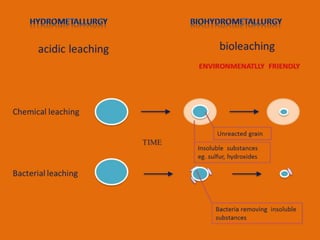
Biotechnology is an effective and environmental
friendly method of waste utilization and poor
refractory ores exploitation, well known since
1949 and successfully developed in many
countries e.g.: Spain, Bulgaria, USA, Sweden.
• In Poland uranium deposits hosted in sandstone
  are located in the Lower Zechstein mineralization
  in Fore-Sudetic Monocline, and in Intra-Sudetic
  Monocline, in the Region of Wałbrzych and
  Jelenia Góra especially in Grzmiąca deposit.
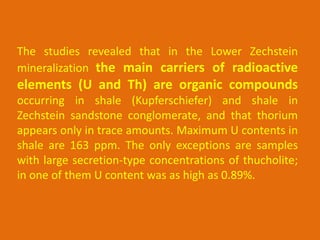
The studies revealed that in the Lower Zechstein
mineralization the main carriers of radioactive
elements (U and Th) are organic compounds
occurring in shale (Kupferschiefer) and shale in
Zechstein sandstone conglomerate, and that thorium
appears only in trace amounts. Maximum U contents in
shale are 163 ppm. The only exceptions are samples
with large secretion-type concentrations of thucholite;
in one of them U content was as high as 0.89%.
Lower Anhydrite
                                                              A   B
                                     Zechstein Limestone


                      Zechstein


                                                                               deposit
            Permian


                                     Kupferschiefer


                                                                                 Cu-Ag
                                     Zechstein Sandstone


                                                                      Gold deposit
                                     Zechstein Conglomerate
                      Rotliegendes


                                     Sandstone

                                     Conglomerates


Dominating geological profile of Fore-Sudetic Monocline deposits.
A. Drill core sample; B. Drill core sample at X-ray image (Ostrowski
and Sklodowska, 1996; Oszczepalski 1999; Piestrzynski et al., 2002).
Selected trace elements concentration in Fore-Sudetic Monocline copper
            deposits (Bechtel et al., 2001; Bechtel et al., 2002)


              Chemical element        Concentration:
                                          ppm
                    Mo                    1 - 290
                    Co                    8 - 485
                    U                     av. 60
                                           ppb
                    Au                   <2 - 1750
                    Pt                    <5 - 883
                    Pd                    <4 - 564
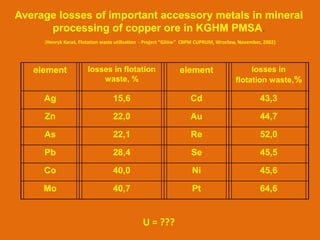
Average losses of important accessory metals in mineral
      processing of copper ore in KGHM PMSA.
     (Henryk Karaś, Flotation waste utilisation - Project “Gilów” CBPM CUPRUM, Wrocław, November, 2002)


   element             losses in flotation                    element                      losses in
                           waste, %                                                   flotation waste,%

     Ag                           15,6                            Cd                            43,3

     Zn                           22,0                            Au                            44,7

     As                           22,1                             Re                           52,0

     Pb                           28,4                             Se                           45,5

     Co                           40,0                             Ni                           45,6

     Mo                           40,7                             Pt                           64,6


                                              U = ???
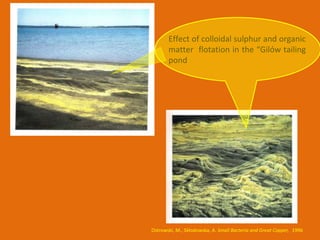
Effect of colloidal sulphur and organic
       matter flotation in the “Gilów tailing
       pond


Ostrowski, M., Skłodowska, A. Small Bacteria and Great Copper, 1996
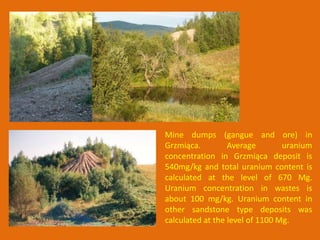
Mine dumps (gangue and ore) in
Grzmiąca.         Average        uranium
concentration in Grzmiąca deposit is
540mg/kg and total uranium content is
calculated at the level of 670 Mg.
Uranium concentration in wastes is
about 100 mg/kg. Uranium content in
other sandstone type deposits was
calculated at the level of 1100 Mg.
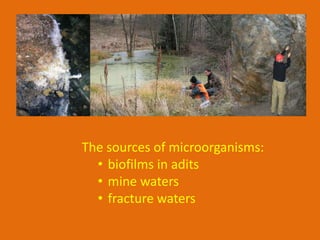
The sources of microorganisms:
  • biofilms in adits
  • mine waters
  • fracture waters
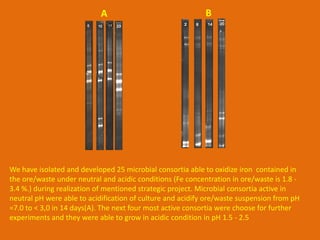
A                               B


We have isolated and developed 25 microbial consortia able to oxidize iron contained in
the ore/waste under neutral and acidic conditions (Fe concentration in ore/waste is 1.8 -
3.4 %.) during realization of mentioned strategic project. Microbial consortia active in
neutral pH were able to acidification of culture and acidify ore/waste suspension from pH
=7.0 to < 3,0 in 14 days(A). The next four most active consortia were choose for further
experiments and they were able to grow in acidic condition in pH 1.5 - 2.5
Leaching efficiency - preliminary results:
• in neutral pH - up to 20% of uranium content in ore/waste
• in acidic conditions without any amendments – 70%
• in acidic conditions with sulphur up to 95% of uranium content in
  ore/waste
• in acidic conditions with pyrite up to 95% of uranium content in
  ore/waste
• sulphuric acid – 10 -60% of uranium content in ore/waste
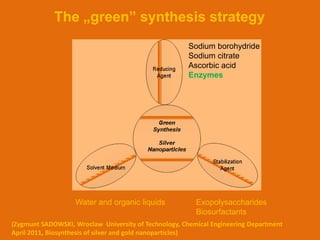
The „green” synthesis strategy
                                                      Sodium borohydride
                                                      Sodium citrate
                                                      Ascorbic acid
                                                      Enzymes


                   Water and organic liquids             Exopolysaccharides
                                                         Biosurfactants
(Zygmunt SADOWSKI, Wroclaw University of Technology, Chemical Engineering Department
April 2011, Biosynthesis of silver and gold nanoparticles)
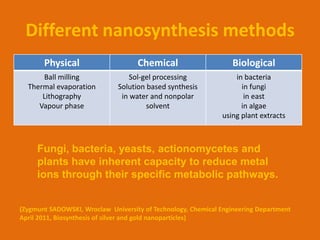
Different nanosynthesis methods
       Physical                     Chemical                     Biological
      Ball milling                Sol-gel processing              in bacteria
  Thermal evaporation         Solution based synthesis              in fungi
      Lithography              in water and nonpolar                 in east
     Vapour phase                      solvent                      in algae
                                                              using plant extracts


     Fungi, bacteria, yeasts, actionomycetes and
     plants have inherent capacity to reduce metal
     ions through their specific metabolic pathways.


(Zygmunt SADOWSKI, Wroclaw University of Technology, Chemical Engineering Department
April 2011, Biosynthesis of silver and gold nanoparticles)
Thank you for your attention

02 iaea2012 sklodowska

  • 1.
    Refractory sandstone oresand waste as alternative source of uranium Skłodowska Aleksandra, Bartosz Rewerski Laboratory of Environmental Pollution, Faculty of Biology, University of Warsaw, Poland Chajduk Ewelina, Kalbarczyk Paweł, Bartosiewicz Iwona Laboratory of Nuclear Analytical Methods, Institute of Nuclear Chemistry and Technology, Warsaw, Poland
  • 2.
    • The uraniumexploration and exploitation in the South-West Poland (Lower Silesia District) was carried out since 1925 when the first 9 Mg of uranium ore were mined of which 690 mg of radium was extracted
  • 3.
    The Frame Programof Activities for Nuclear Energy predicts the recognition of different way of uranium source exploitation including the use of biotechnology. Biotechnology opens the possibility to obtain uranium as by-product in rare element recovery process (eg. Co, Au, Re, Rh, Pt) and positively affects the economical efficiency of technology.
  • 4.
    Biotechnology is aneffective and environmental friendly method of waste utilization and poor refractory ores exploitation, well known since 1949 and successfully developed in many countries e.g.: Spain, Bulgaria, USA, Sweden.
  • 7.
    • In Polanduranium deposits hosted in sandstone are located in the Lower Zechstein mineralization in Fore-Sudetic Monocline, and in Intra-Sudetic Monocline, in the Region of Wałbrzych and Jelenia Góra especially in Grzmiąca deposit.
  • 8.
    The studies revealedthat in the Lower Zechstein mineralization the main carriers of radioactive elements (U and Th) are organic compounds occurring in shale (Kupferschiefer) and shale in Zechstein sandstone conglomerate, and that thorium appears only in trace amounts. Maximum U contents in shale are 163 ppm. The only exceptions are samples with large secretion-type concentrations of thucholite; in one of them U content was as high as 0.89%.
  • 9.
    Lower Anhydrite A B Zechstein Limestone Zechstein deposit Permian Kupferschiefer Cu-Ag Zechstein Sandstone Gold deposit Zechstein Conglomerate Rotliegendes Sandstone Conglomerates Dominating geological profile of Fore-Sudetic Monocline deposits. A. Drill core sample; B. Drill core sample at X-ray image (Ostrowski and Sklodowska, 1996; Oszczepalski 1999; Piestrzynski et al., 2002).
  • 10.
    Selected trace elementsconcentration in Fore-Sudetic Monocline copper deposits (Bechtel et al., 2001; Bechtel et al., 2002) Chemical element Concentration: ppm Mo 1 - 290 Co 8 - 485 U av. 60 ppb Au <2 - 1750 Pt <5 - 883 Pd <4 - 564
  • 11.
    Average losses ofimportant accessory metals in mineral processing of copper ore in KGHM PMSA. (Henryk Karaś, Flotation waste utilisation - Project “Gilów” CBPM CUPRUM, Wrocław, November, 2002) element losses in flotation element losses in waste, % flotation waste,% Ag 15,6 Cd 43,3 Zn 22,0 Au 44,7 As 22,1 Re 52,0 Pb 28,4 Se 45,5 Co 40,0 Ni 45,6 Mo 40,7 Pt 64,6 U = ???
  • 12.
    Effect of colloidalsulphur and organic matter flotation in the “Gilów tailing pond Ostrowski, M., Skłodowska, A. Small Bacteria and Great Copper, 1996
  • 13.
    Mine dumps (gangueand ore) in Grzmiąca. Average uranium concentration in Grzmiąca deposit is 540mg/kg and total uranium content is calculated at the level of 670 Mg. Uranium concentration in wastes is about 100 mg/kg. Uranium content in other sandstone type deposits was calculated at the level of 1100 Mg.
  • 14.
    The sources ofmicroorganisms: • biofilms in adits • mine waters • fracture waters
  • 15.
    A B We have isolated and developed 25 microbial consortia able to oxidize iron contained in the ore/waste under neutral and acidic conditions (Fe concentration in ore/waste is 1.8 - 3.4 %.) during realization of mentioned strategic project. Microbial consortia active in neutral pH were able to acidification of culture and acidify ore/waste suspension from pH =7.0 to < 3,0 in 14 days(A). The next four most active consortia were choose for further experiments and they were able to grow in acidic condition in pH 1.5 - 2.5
  • 16.
    Leaching efficiency -preliminary results: • in neutral pH - up to 20% of uranium content in ore/waste • in acidic conditions without any amendments – 70% • in acidic conditions with sulphur up to 95% of uranium content in ore/waste • in acidic conditions with pyrite up to 95% of uranium content in ore/waste • sulphuric acid – 10 -60% of uranium content in ore/waste
  • 17.
    The „green” synthesisstrategy Sodium borohydride Sodium citrate Ascorbic acid Enzymes Water and organic liquids Exopolysaccharides Biosurfactants (Zygmunt SADOWSKI, Wroclaw University of Technology, Chemical Engineering Department April 2011, Biosynthesis of silver and gold nanoparticles)
  • 18.
    Different nanosynthesis methods Physical Chemical Biological Ball milling Sol-gel processing in bacteria Thermal evaporation Solution based synthesis in fungi Lithography in water and nonpolar in east Vapour phase solvent in algae using plant extracts Fungi, bacteria, yeasts, actionomycetes and plants have inherent capacity to reduce metal ions through their specific metabolic pathways. (Zygmunt SADOWSKI, Wroclaw University of Technology, Chemical Engineering Department April 2011, Biosynthesis of silver and gold nanoparticles)
  • 19.
    Thank you foryour attention