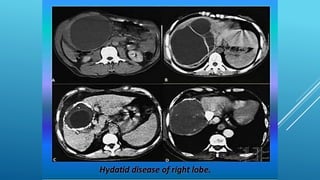
HYDATED CYST LIVER
DR. RAHUL MRIGPURI
ASSISTANT PROFESSOR
GENERAL SURGERY
SURGICAL MANAGEMENT
INDICATIONS
 Large cyst with multiple daughter cyst.
 Superficial liver cyst.
 Cyst of liver with billiary communications or pressure effect.
 Infected cyst.
 Cyst in lung, brain, kidneys, eyes, glands,heart,brain.
SURGERY
• Treatment of choice for uncomplicated hydatid
disease of the liver.
• The objectives of surgical treatment are to:
(1) inactivate the scoleces,
(2) prevent spillage of cyst contents,
(3) eliminate all viable elements of the cyst, and
(4) manage the residual cavity of the cyst.
•Excision ( or pericystectomy)
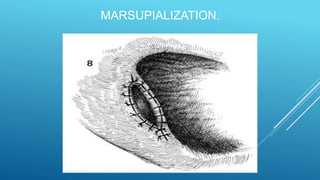
•Marsupialization procedures
•Leaving the cyst open
•Drainage of the cyst
•Omentoplasty
•Partial hepatectomy
OMENTOPLASTY
PERICYSTECTOMY
HEPATECTOMTY
MARSUPIALIZATION.
MARSUPILIZATION
CAPETONAGE
LAPAROSCOPY
LAPAROSCOPIC MANAGEMENT
A specialized apparatus has been developed to remove hydated cyst
through laparoscope calledperforator-grinder-aspirator
appratus.
This instrument perforates the cyst,grinds the particulate matter
and sucks it all out.
The advantage of this instrument over the conventional is that
it does not get blocked by the daughter cyst and laminated
membrane.
PAIR
PAIR PROTOCOL (for hepatic hydated cyst)
 Prophylaxis with albendazole
 Puncture
 Aspiration of cystic fluid (10-15cc).
 Injection of 95% ethanol or hypertonic saline 15%(1/3
of the aspirated fluid)
 Reaspiration of protoscolicidal solution after 15 min.
CONTRAINDICATIONS OF PAIR
 Non co-operative patient.
 Risky location of cyst.
 Cyst in spine brain and heart.
 Calcified cyst
 Cyst in communication with billiary tree
 Ruptured cyst
SCOLECIDAL AGENTS
Early on, surgical management of hydatid cysts via cyst
evacuation resulted in a high rate of peritoneal
implantation. This problem prompted the use of scolecidal
agents for injection into the cyst and for use in the
surrounding peritoneum.
Hypertonic saline,
Cetrimide,
hydrogen peroxide,
povidone-iodine,
silver nitrate,
Ethyl alcohol etc.
PSEUDOCYST PANCREAS
INTERVENTION
Indications fordrainage
Pr esence of symptoms (> 6 wks)
Enlargement of pseudocyst ( >6cm)
Complications
Suspicion ofmalignancy
Intervention
Percutaneous drainage
Endoscopic drainage
Sur gical drainage
PERCUTANEOUS DRAINAGE
Continuous drainage until output <50ml/day+
amylase activity ↓
F a i l u r e rate16%
Recurrence rates7%
Complications
Conversion into an infected pseudocyst (10%)
Catheter-site cellulitis
D a m a g e toadjacent organs
Pancreatico-cutaneous fistula
G I hemorrhage
ENDOSCOPIC MANAGEMENT
Indications
 Mature cyst wall < 1 cm thick
 Adherent to the duodenum or posterior gastric wall
 Previous abd surgery or significant comorbidities
Contraindications
 Bleeding dyscrasias
 Gastric varices
 Acute inflammatory changes that may prevent cyst from adhering to the enteric wall
 CT findings
Thick debris
Multiloculated pseudocysts
ENDOSCOPIC DRAINAGE
Transenteric drainage
Cystogastrostomy
Cystoduodenostomy
Transpapillary drainage
40-70% of pseudocysts communicate with pancreatic
duct
ERCP with sphincterotomy, balloon dilatation of
pancreatic duct strictures, and stent placement beyond
strictures
SURGICAL OPTIONS
Excision
Tail of gland & along with proximal strictures – distal
pancreatectomy & splenectomy
Head of gland with strictures of pancreatic or bile ducts
– pancreaticoduodenectomy
External drainage
Internal drainage
Cystogastrostomy
Cystojejunostomy
Permanent resolution confirmed in b/w 91%–97% of patients*
Cystoduodenostomy
Can be complicated by duodenal fistula and bleeding
at anastomotic site
EXTERNAL DRAINAGE
CYSTO-JEJUNOSTOMY
ENUCLEATION OF PSEUDOCYST
LAPAROSCOPIC MANAGEMENT
The interface b/w the cyst and the enteric lumen must
be ≥ 5 cm for adequate drainage
Approaches
• Pancreatitis 2 to biliary etiology  extraluminal
approach with concurrent laparoscopic
cholecystectomy
• Non-biliary origin  intraluminal (combined
laparoscopic/endoscopic) approach.
WHICH IS THE PREFERRED INTERVENTION?
• Surgical drainage is the traditional approach – gold standard.
• Percutaneous catheter drainage – high chance of persistant
pancreatic fistula.
• Endoscopic drainage - less invasive, becoming more popular,
technically demanding
• Surgery necessary in complicated pseudocyts, failed nonsurgical, and
multiple pseudocysts.
 Cystgastrostomy: In this surgical procedure a connection is
created between the back wall of the stomach and the cyst such
that the cyst drains into the stomach.
 Cystjejunostomy: In this procedure a connection is created
between the cyst and the small intestine so that the cyst fluid
directly into the small intestine.
 Cystduodenostomy: In this procedure a connection is created
between the duodenum (the first part of the intestine) and the
cyst to allow drainage of the cyst content into duodenum
The type of surgical procedure depends on the location of the
cyst. For cysts that occur in the body and tail of the pancreas
either a cystjejunostomy or cystgastrostomy is
performed depending on the location of the cyst in the
abdomen. For pseudocysts that occur in the head of the
pancreas a cystduodenostomy is usually performed.
THANK YOU

Hydated cyst liver

  • 1.
    HYDATED CYST LIVER DR.RAHUL MRIGPURI ASSISTANT PROFESSOR GENERAL SURGERY
  • 9.
    SURGICAL MANAGEMENT INDICATIONS  Largecyst with multiple daughter cyst.  Superficial liver cyst.  Cyst of liver with billiary communications or pressure effect.  Infected cyst.  Cyst in lung, brain, kidneys, eyes, glands,heart,brain.
  • 10.
    SURGERY • Treatment ofchoice for uncomplicated hydatid disease of the liver. • The objectives of surgical treatment are to: (1) inactivate the scoleces, (2) prevent spillage of cyst contents, (3) eliminate all viable elements of the cyst, and (4) manage the residual cavity of the cyst.
  • 11.
    •Excision ( orpericystectomy) •Marsupialization procedures •Leaving the cyst open •Drainage of the cyst •Omentoplasty •Partial hepatectomy
  • 16.
  • 17.
  • 18.
  • 19.
  • 20.
  • 21.
  • 22.
  • 24.
    LAPAROSCOPIC MANAGEMENT A specializedapparatus has been developed to remove hydated cyst through laparoscope calledperforator-grinder-aspirator appratus. This instrument perforates the cyst,grinds the particulate matter and sucks it all out. The advantage of this instrument over the conventional is that it does not get blocked by the daughter cyst and laminated membrane.
  • 25.
  • 26.
    PAIR PROTOCOL (forhepatic hydated cyst)  Prophylaxis with albendazole  Puncture  Aspiration of cystic fluid (10-15cc).  Injection of 95% ethanol or hypertonic saline 15%(1/3 of the aspirated fluid)  Reaspiration of protoscolicidal solution after 15 min.
  • 27.
    CONTRAINDICATIONS OF PAIR Non co-operative patient.  Risky location of cyst.  Cyst in spine brain and heart.  Calcified cyst  Cyst in communication with billiary tree  Ruptured cyst
  • 28.
    SCOLECIDAL AGENTS Early on,surgical management of hydatid cysts via cyst evacuation resulted in a high rate of peritoneal implantation. This problem prompted the use of scolecidal agents for injection into the cyst and for use in the surrounding peritoneum. Hypertonic saline, Cetrimide, hydrogen peroxide, povidone-iodine, silver nitrate, Ethyl alcohol etc.
  • 29.
  • 30.
    INTERVENTION Indications fordrainage Pr esenceof symptoms (> 6 wks) Enlargement of pseudocyst ( >6cm) Complications Suspicion ofmalignancy Intervention Percutaneous drainage Endoscopic drainage Sur gical drainage
  • 31.
    PERCUTANEOUS DRAINAGE Continuous drainageuntil output <50ml/day+ amylase activity ↓ F a i l u r e rate16% Recurrence rates7% Complications Conversion into an infected pseudocyst (10%) Catheter-site cellulitis D a m a g e toadjacent organs Pancreatico-cutaneous fistula G I hemorrhage
  • 32.
    ENDOSCOPIC MANAGEMENT Indications  Maturecyst wall < 1 cm thick  Adherent to the duodenum or posterior gastric wall  Previous abd surgery or significant comorbidities Contraindications  Bleeding dyscrasias  Gastric varices  Acute inflammatory changes that may prevent cyst from adhering to the enteric wall  CT findings Thick debris Multiloculated pseudocysts
  • 33.
    ENDOSCOPIC DRAINAGE Transenteric drainage Cystogastrostomy Cystoduodenostomy Transpapillarydrainage 40-70% of pseudocysts communicate with pancreatic duct ERCP with sphincterotomy, balloon dilatation of pancreatic duct strictures, and stent placement beyond strictures
  • 34.
    SURGICAL OPTIONS Excision Tail ofgland & along with proximal strictures – distal pancreatectomy & splenectomy Head of gland with strictures of pancreatic or bile ducts – pancreaticoduodenectomy External drainage Internal drainage Cystogastrostomy Cystojejunostomy Permanent resolution confirmed in b/w 91%–97% of patients* Cystoduodenostomy Can be complicated by duodenal fistula and bleeding at anastomotic site
  • 35.
  • 36.
  • 37.
  • 38.
    LAPAROSCOPIC MANAGEMENT The interfaceb/w the cyst and the enteric lumen must be ≥ 5 cm for adequate drainage Approaches • Pancreatitis 2 to biliary etiology  extraluminal approach with concurrent laparoscopic cholecystectomy • Non-biliary origin  intraluminal (combined laparoscopic/endoscopic) approach.
  • 39.
    WHICH IS THEPREFERRED INTERVENTION? • Surgical drainage is the traditional approach – gold standard. • Percutaneous catheter drainage – high chance of persistant pancreatic fistula. • Endoscopic drainage - less invasive, becoming more popular, technically demanding • Surgery necessary in complicated pseudocyts, failed nonsurgical, and multiple pseudocysts.
  • 40.
     Cystgastrostomy: Inthis surgical procedure a connection is created between the back wall of the stomach and the cyst such that the cyst drains into the stomach.  Cystjejunostomy: In this procedure a connection is created between the cyst and the small intestine so that the cyst fluid directly into the small intestine.  Cystduodenostomy: In this procedure a connection is created between the duodenum (the first part of the intestine) and the cyst to allow drainage of the cyst content into duodenum
  • 41.
    The type ofsurgical procedure depends on the location of the cyst. For cysts that occur in the body and tail of the pancreas either a cystjejunostomy or cystgastrostomy is performed depending on the location of the cyst in the abdomen. For pseudocysts that occur in the head of the pancreas a cystduodenostomy is usually performed.
  • 42.