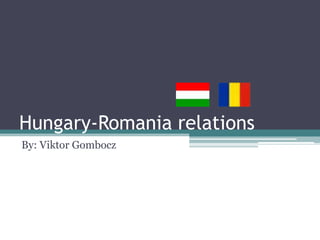
Hungary-Romania relations
By: Viktor Gombocz
Background
• Monday, November 11, 1918: World War I ends with
  armistice agreement between Germany and the Allies.
• Sunday, December 1, 1918: Transylvania unites with
 Romania after incorporation of Bessarabia and Bucovina.
• March-August 1919: Hungarian-Romanian War.
  Romanian Army occupies Budapest; Hungarian Soviet
  Republic falls.
• March 1920: Romanian Army withdraws from Budapest.
  Admiral Miklós Horthy becomes regent of Hungary.
• June 1920: Hungary signs the Treaty of Trianon with the
  Allied Powers. 72% of its territory is lost to
  Romania, Yugoslavia, and Czechoslovakia.
Relations: Interwar years
• June 1920: Hungary and Romania establish diplomatic
  relations.
• November 1938: Under provisions of the First Vienna
  Award, Hungary annexes southern Slovakia.
• March 1939: Hungary annexes southern Carpathian Rus.
Relations: World War II
• Friday, August 30, 1940: Hungary is awarded North
  Transylvania from the Second Vienna Award.
• September 1940: Ion Antonescu becomes the Prime
  Minister and Conducător of Romania.
• Thursday, April 17, 1941: Hungary is awarded Vojvodina
  during the German invasion of Yugoslavia.
• Sunday, June 22, 1941: Hungarian and Romanian troops
  participate in Operation Barbarossa, the German invasion of
  the Soviet Union.
• Monday, December 8, 1941: Hungary and Romania declare
  war on the United States after the declaration of war on
  Japan.
Relations: World War II – cont.
• Sunday, March 19, 1944: Nazi forces invade Hungary.
• Sunday, October 15, 1944: Horthy is deposed from power
  and forced to install a puppet government of Germany.
• Friday, December 29, 1944-Tuesday, February 13, 1945:
  The Siege of Budapest. Budapest is nearly demolished
  when Soviet and Romanian forces occupy Hungary.
• Sunday, December 31, 1944: Hungary declares war on
  Germany.
• Tuesday, May 8/Wednesday, May 9, 1945: World War II
  ends with Germany’s unconditional surrender.
Relations: Cold War – 1940s
• Friday, February 1, 1946: Second Hungarian Republic is
  established.
• Monday, February 10, 1947: Under the Treaty of
  Peace, the Vienna awards are terminated. Hungary loses
  the same territories lost through the Treaty of
  Trianon, restoring pre-1938 borders.
• Tuesday, December 3o, 1947: Abolishment of the
  monarchy- King Michael is forced to abdicate. The
  Communists seize power.
• Saturday, August 20, 1949: Second Hungarian Republic
  falls; rise of the People’s Republic of Hungary.
Relations: Cold War – 1950s
• Tuesday, May 17, 1955: The Warsaw Pact is created to
  guard the Eastern Bloc from the North Atlantic Treaty
  Organization (NATO).
• Tuesday, October 23, 1956: In Budapest, Hungarian
  students initiate an uprising against the Communist
  government.
• Saturday, November 10, 1956: The Hungarian uprising is
  crushed after the Soviet army sends tanks into Budapest.
  The Communists quickly regain power.
• Monday, June 16, 1958: Hungarian Anti-Soviet leader
  Imre Nagy is hanged for taking part in the uprising.
Relations: Cold War – 1960s
• Wednesday, August 21, 1968: The Prague Spring is put
  down by the Warsaw Pact. Hungary participates, but
  Romania does not. Romania’s head of state, Nicolae
  Ceauşescu, openly condemns the Warsaw Pact’s
  intervention.
Relations: Cold War – 1980s
• Monday, December 25, 1989: Nicolae Ceauşescu’s
  government falls with the execution of him and his wife
  by firing squad after they are found guilty of charges of
  committing numerous crimes against the state.
Post Cold War relations: 1990s
• Friday, March 12, 1999: Hungary, together with
  Poland and Czech Republic, joins NATO.
Post Cold War relations: 2000s
• Monday, March 29, 2004: Romania joins NATO.
• Saturday, May 1, 2004: Hungary becomes one of ten new
  member states of the European Union.
• Monday, January 1, 2007: Romania, together with
  Bulgaria, joins the European Union, improving and
  strengthening its ties with Hungary with the latter
  supporting the former’s bid for membership, which, in
  addition to a treaty for laying the foundation for closer
  and friendlier relations signed in 1996, keeps ties
  between the two neighbors warm.
Overall relations beyond 2007
• Hungary-Romania relations, having initially improved
  after the ratification of the treaty for closer
  relations, remain positive to the present day.
• Between 1996 and 2008, and from 2009, Romania’s
  ethnic Hungarian party, Democratic Union of
  Hungarians in Romania (Hungarian name: Romániai
  Magyar Demokrata Szövetség; Romanian name:
  Uniunea Democrată Maghiară din România)
  participated in every government coalition.
• Both nations are full members of NATO and the
  European Union.
Symbols of positive Hungary-
Romania relations
Symbols of positive Hungary-Romania
relations – cont.
Other organizations Hungary and
Romania are in
• Hungary:                   • Romania:
 ▫ Finno-Ugric Union          ▫ Latin Union
 ▫ Organisation for           ▫ Council of Europe
   Economic Co-operation      ▫ Union for the
   and Development              Mediterranean
 ▫ Council of Europe          ▫ Organisation
 ▫ Schengen Agreement           internationale de la
 ▫ Union for the                Francophonie
   Mediterranean
 ▫ Organisation
   internationale de la
   Francophonie (observer)
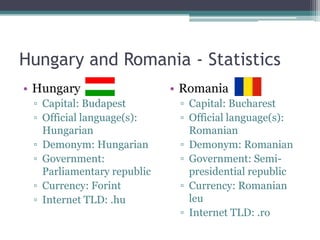
Hungary and Romania - Statistics
• Hungary                   • Romania
 ▫ Capital: Budapest         ▫ Capital: Bucharest
 ▫ Official language(s):     ▫ Official language(s):
   Hungarian                   Romanian
 ▫ Demonym: Hungarian        ▫ Demonym: Romanian
 ▫ Government:               ▫ Government: Semi-
   Parliamentary republic      presidential republic
 ▫ Currency: Forint          ▫ Currency: Romanian
 ▫ Internet TLD: .hu           leu
                             ▫ Internet TLD: .ro
Videos about Hungary-Romania
relations
• Hungarian-Romanian War of 1919:
 http://www.youtube.com/watch?v=mDPshLw0vRQ
• Treaty of Trianon of 1920:
  http://www.youtube.com/watch?v=4Cbe_pOWkGk
• http://www.youtube.com/watch?v=c-1aI6FlZmU
• Hungarian Army in North Transylvania in 1940:
 http://www.youtube.com/watch?v=5kTIPiwi4hw
 http://www.youtube.com/watch?v=vSxsOmrRI58
Languages of Hungary and Romania
Hungary                     Romania
• Official language:        • Official language:
  Hungarian                   Romanian
• Main foreign languages:   • Main foreign languages:
  ▫ German                    ▫ French
  ▫ English                   ▫ English
  ▫ French                    ▫ Italian
Religion in Hungary and Romania
Hungary                       Romania
•   Roman Catholic 51.9%      • Eastern Orthodox
•   Calvinist 15.9%             (including all sub-
                                denominations) 86.8%
•   Lutheran 3%
                              • Protestant (various
•   Greek Catholic 2.6%         denominations including
•   Other Christian 1%          Reformate and
•   Jewish 0.1%                 Pentecostal) 7.5%
•   Other/unspecified 11.1%   • Roman Catholic 4.7%
•   Unaffiliated 14.5%        • Other (mostly Muslim)
                                and unspecified 0.9%
                              • None 0.1%

Hungary-Romania relations

  • 1.
  • 2.
    Background • Monday, November11, 1918: World War I ends with armistice agreement between Germany and the Allies. • Sunday, December 1, 1918: Transylvania unites with Romania after incorporation of Bessarabia and Bucovina. • March-August 1919: Hungarian-Romanian War. Romanian Army occupies Budapest; Hungarian Soviet Republic falls. • March 1920: Romanian Army withdraws from Budapest. Admiral Miklós Horthy becomes regent of Hungary. • June 1920: Hungary signs the Treaty of Trianon with the Allied Powers. 72% of its territory is lost to Romania, Yugoslavia, and Czechoslovakia.
  • 3.
    Relations: Interwar years •June 1920: Hungary and Romania establish diplomatic relations. • November 1938: Under provisions of the First Vienna Award, Hungary annexes southern Slovakia. • March 1939: Hungary annexes southern Carpathian Rus.
  • 4.
    Relations: World WarII • Friday, August 30, 1940: Hungary is awarded North Transylvania from the Second Vienna Award. • September 1940: Ion Antonescu becomes the Prime Minister and Conducător of Romania. • Thursday, April 17, 1941: Hungary is awarded Vojvodina during the German invasion of Yugoslavia. • Sunday, June 22, 1941: Hungarian and Romanian troops participate in Operation Barbarossa, the German invasion of the Soviet Union. • Monday, December 8, 1941: Hungary and Romania declare war on the United States after the declaration of war on Japan.
  • 5.
    Relations: World WarII – cont. • Sunday, March 19, 1944: Nazi forces invade Hungary. • Sunday, October 15, 1944: Horthy is deposed from power and forced to install a puppet government of Germany. • Friday, December 29, 1944-Tuesday, February 13, 1945: The Siege of Budapest. Budapest is nearly demolished when Soviet and Romanian forces occupy Hungary. • Sunday, December 31, 1944: Hungary declares war on Germany. • Tuesday, May 8/Wednesday, May 9, 1945: World War II ends with Germany’s unconditional surrender.
  • 6.
    Relations: Cold War– 1940s • Friday, February 1, 1946: Second Hungarian Republic is established. • Monday, February 10, 1947: Under the Treaty of Peace, the Vienna awards are terminated. Hungary loses the same territories lost through the Treaty of Trianon, restoring pre-1938 borders. • Tuesday, December 3o, 1947: Abolishment of the monarchy- King Michael is forced to abdicate. The Communists seize power. • Saturday, August 20, 1949: Second Hungarian Republic falls; rise of the People’s Republic of Hungary.
  • 7.
    Relations: Cold War– 1950s • Tuesday, May 17, 1955: The Warsaw Pact is created to guard the Eastern Bloc from the North Atlantic Treaty Organization (NATO). • Tuesday, October 23, 1956: In Budapest, Hungarian students initiate an uprising against the Communist government. • Saturday, November 10, 1956: The Hungarian uprising is crushed after the Soviet army sends tanks into Budapest. The Communists quickly regain power. • Monday, June 16, 1958: Hungarian Anti-Soviet leader Imre Nagy is hanged for taking part in the uprising.
  • 8.
    Relations: Cold War– 1960s • Wednesday, August 21, 1968: The Prague Spring is put down by the Warsaw Pact. Hungary participates, but Romania does not. Romania’s head of state, Nicolae Ceauşescu, openly condemns the Warsaw Pact’s intervention.
  • 9.
    Relations: Cold War– 1980s • Monday, December 25, 1989: Nicolae Ceauşescu’s government falls with the execution of him and his wife by firing squad after they are found guilty of charges of committing numerous crimes against the state.
  • 10.
    Post Cold Warrelations: 1990s • Friday, March 12, 1999: Hungary, together with Poland and Czech Republic, joins NATO.
  • 11.
    Post Cold Warrelations: 2000s • Monday, March 29, 2004: Romania joins NATO. • Saturday, May 1, 2004: Hungary becomes one of ten new member states of the European Union. • Monday, January 1, 2007: Romania, together with Bulgaria, joins the European Union, improving and strengthening its ties with Hungary with the latter supporting the former’s bid for membership, which, in addition to a treaty for laying the foundation for closer and friendlier relations signed in 1996, keeps ties between the two neighbors warm.
  • 12.
    Overall relations beyond2007 • Hungary-Romania relations, having initially improved after the ratification of the treaty for closer relations, remain positive to the present day. • Between 1996 and 2008, and from 2009, Romania’s ethnic Hungarian party, Democratic Union of Hungarians in Romania (Hungarian name: Romániai Magyar Demokrata Szövetség; Romanian name: Uniunea Democrată Maghiară din România) participated in every government coalition. • Both nations are full members of NATO and the European Union.
  • 13.
    Symbols of positiveHungary- Romania relations
  • 14.
    Symbols of positiveHungary-Romania relations – cont.
  • 15.
    Other organizations Hungaryand Romania are in • Hungary: • Romania: ▫ Finno-Ugric Union ▫ Latin Union ▫ Organisation for ▫ Council of Europe Economic Co-operation ▫ Union for the and Development Mediterranean ▫ Council of Europe ▫ Organisation ▫ Schengen Agreement internationale de la ▫ Union for the Francophonie Mediterranean ▫ Organisation internationale de la Francophonie (observer)
  • 16.
    Hungary and Romania- Statistics • Hungary • Romania ▫ Capital: Budapest ▫ Capital: Bucharest ▫ Official language(s): ▫ Official language(s): Hungarian Romanian ▫ Demonym: Hungarian ▫ Demonym: Romanian ▫ Government: ▫ Government: Semi- Parliamentary republic presidential republic ▫ Currency: Forint ▫ Currency: Romanian ▫ Internet TLD: .hu leu ▫ Internet TLD: .ro
  • 17.
    Videos about Hungary-Romania relations •Hungarian-Romanian War of 1919: http://www.youtube.com/watch?v=mDPshLw0vRQ • Treaty of Trianon of 1920: http://www.youtube.com/watch?v=4Cbe_pOWkGk • http://www.youtube.com/watch?v=c-1aI6FlZmU • Hungarian Army in North Transylvania in 1940: http://www.youtube.com/watch?v=5kTIPiwi4hw http://www.youtube.com/watch?v=vSxsOmrRI58
  • 18.
    Languages of Hungaryand Romania Hungary Romania • Official language: • Official language: Hungarian Romanian • Main foreign languages: • Main foreign languages: ▫ German ▫ French ▫ English ▫ English ▫ French ▫ Italian
  • 19.
    Religion in Hungaryand Romania Hungary Romania • Roman Catholic 51.9% • Eastern Orthodox • Calvinist 15.9% (including all sub- denominations) 86.8% • Lutheran 3% • Protestant (various • Greek Catholic 2.6% denominations including • Other Christian 1% Reformate and • Jewish 0.1% Pentecostal) 7.5% • Other/unspecified 11.1% • Roman Catholic 4.7% • Unaffiliated 14.5% • Other (mostly Muslim) and unspecified 0.9% • None 0.1%