Hungary
Hungary is a beautiful small country in Central Europe
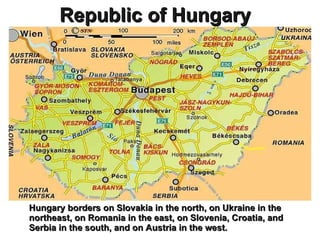
Republic of Hungary   Hungary borders on Slovakia in the north, on Ukraine in the northeast, on Romania in the east, on Slovenia, Croatia, and Serbia in the south, and on Austria in the west.
Historical background Hungary was part of the Austro-Hungarian Empire, which collapsed during World War I. The country fell under Communist rule following World War II. In 1956, a revolt and announced withdrawal from the Warsaw Pact were met with a massive military intervention by Moscow. Hungary held its first multiparty elections in 1990 and initiated a free market economy. It joined NATO in 1999 and the EU in 2004.
Hungary in figures Country name:   Republic of Hungary  Total a rea:  93,030 sq km Landlocked – no coastline Literacy:   t otal population: 99.4%  Government type:   parliamentary democracy  Legal  system:  r ule of law based on Western model  Currency :  forint (HUF)  GDP - per capita:  $14,900  Unemployment rate:  5.9% (2004 est.)  Inflation rate :  7% (2004 est.)  Industries:  mining, metallurgy, construction materials, processed foods, textiles, chemicals (especially pharmaceuticals), motor vehicles
The official language of Hungary is Hungarian
The country has a population of 10 million people
Has four distinctive seasons
Politics The highest organ of state authority is the National Assembly with almost 400 members that initiates and approves legislation with the support of the prime minister. National parliamentary elections are held every 4 years. While the president of the Republic is elected every 5 years and only plays ceremonial roles.
Has one of the greatest capital s  in the world with  2 million inhabitants
Budapest was home to Continental Europe's first subway system, which opened in 1896
Budapest has many impressive bridges   Of which the Chain bridge is the most famous built in 1849
Magnificent architecture
There are several  gorgeous historical  towns in Hungary
… m any small villages, rolling hills and  beautiful countryside
Has  the largest lake in  Central  Europe:  Lake  Balaton Which is also a very famous  wine producing province
Hungary is known for its wines, especially the sweet wines of the Tokay region.
Foods of the Hungarians The best-known ingredient in Hungarian food is the red-powdered spice called paprika. It is used to flavor many dishes. Other staples of Hungarian cooking include onions, cabbage, potatoes, noodles, and caraway seeds. Both cream and sour cream are used heavily in Hungarian food.  Hungarians eat a lot of meat, mostly pork or beef. The Hungarian national dish is meat stew , called  "goulash„ The Hungarians are known throughout the world for their elegant pastries and cakes. Strudel (retes)  is one of them and their  fillings include apples, cherries, and poppy seeds.
    HEALTH Hungary is famous for its abundance of thermal and medicinal waters and as a consequence there are many hotels and clinics specialising in health treatments.  Hungary has a spa culture dating back over 2000 years and was even popular during Roman times.  Medicinal water is mineral water having been shown to produce curative effects .   Hungary is a major center for the promotion of natural well being.  It  is a center for medical excellence with many specialist hospitals, including one of the most respected specialist Heart Centres in Europe.
T he largest religion in Hungary is Roman Catholicism (50% of the population), with a significant Calvinist minority  (16% of the population) and smaller Lutheran (3%) and Greek Catholic (3%) minorities. However, these census figures are representative of religious affiliation rather than practice;  only  an estimated 10-14% of Hungarians attend religious services  on a regular basis
Impressive churches
Beautiful castles from the past
Fine Hungarian Universities ELTE, Debreceni, BME, Szegedi es Pecsi
Hungary is very famous for its excellent mathematics education which has trained numerous outstanding scientists.
Famous Hungarian inventors Asboth Oszkar   Eng i neer, invented the first purposefully   flying helicopter . His helicopter was the first, which was able to elevate vertically with a pilot and to stay and levitate in one place for a longer time  in 1928 .  A Hungarian journalist named  La sz lo Biro , created the first  ballpoint pen  in 1938. Biro noticed the type of ink used in newspaper printing presses dried quickly leaving the paper dry and smudge free.  Dr. Teller  Ede  is most widely known for his significant contributions to the first demonstration of  thermonuclear energy ; in addition he has added to knowledge about quantum theory, molecular physics and astrophysics  E rn o  Rubik  is the inventor of the world famous  Rubik's Cube . This game highly increases logical abilities and conquered the world fast.
Denes Gabor , p hysician an d  electro-eng i neer. From 1927 he worked for Siemens and Halske as a researcher. In 1971 he got the Nobel prize for discovering  holography .  Irinyi Janos,   Chemist, he solved the puzzle of making  silent matches . He wrote several articles on chemistry and published his textbook for schools entitled The Elements of Chemistry.  Puskas Tivadar   For two years he had worked in Edison's laboratory as his colleauge, then went to Paris, where he designed an  electric cab and airship . In 1879  he built Europe's first telephone exchange  in Paris.His other important invention was the telephonograph, predecessor of the wired radio.  Szent-Gyorgyi Albert ,  Biochemist.In 1937 he received the Nobel Prize in physiology and medical science for "discoveries in the area of biological combustion processes, particularly in regard to  vitamin C , and the fumaric acid catalysis".
Chemistry: 5 Physiology/Medicine:4 Physics: 3 Ecomomics: 3 Peace: 2 Literature: 1 In total: 18 prizes A remarkable number of  Nobel  prizes have been awarded to people of Hungarian background...  The "Brain Drain" is particularly evident here as most of these winners received this distinction as nationals of other countries.    Nobel Prize Winners & Famous Hungarians
Famous Hungarian quotes `Discovery consists of seeing what everybody has seen and thinking what nobody has thought` (Albert Szent-Gyorgyi, Hungarian Biochemist's quotes) `Clear thinking requires courage rather than intelligence` (Thomas S. Szasz, Hungarian psychiatrist's quotes) The stupid neither forgive nor forget; the naïve forgive and forget; the wise forgive but do not forget` (Thomas S. Szasz) People often say that this or that person has not yet found himself. But the self is not something one finds, it is something one creates.` There's no sense in being precise when you don`t even know what you're talking about.` The science of today is the technology of tomorrow.` (Edward Teller quotes)
Facts that not many  people know Famous people with  Hungarian origins
… and a few more Hungarian images at last
Countryside
City life
Hope you enjoyed

Hun

  • 1.
  • 2.
    Hungary is abeautiful small country in Central Europe
  • 3.
    Republic of Hungary Hungary borders on Slovakia in the north, on Ukraine in the northeast, on Romania in the east, on Slovenia, Croatia, and Serbia in the south, and on Austria in the west.
  • 4.
    Historical background Hungarywas part of the Austro-Hungarian Empire, which collapsed during World War I. The country fell under Communist rule following World War II. In 1956, a revolt and announced withdrawal from the Warsaw Pact were met with a massive military intervention by Moscow. Hungary held its first multiparty elections in 1990 and initiated a free market economy. It joined NATO in 1999 and the EU in 2004.
  • 5.
    Hungary in figuresCountry name: Republic of Hungary Total a rea: 93,030 sq km Landlocked – no coastline Literacy: t otal population: 99.4% Government type: parliamentary democracy Legal system: r ule of law based on Western model Currency : forint (HUF) GDP - per capita: $14,900 Unemployment rate: 5.9% (2004 est.) Inflation rate : 7% (2004 est.) Industries: mining, metallurgy, construction materials, processed foods, textiles, chemicals (especially pharmaceuticals), motor vehicles
  • 6.
    The official languageof Hungary is Hungarian
  • 7.
    The country hasa population of 10 million people
  • 8.
  • 9.
    Politics The highestorgan of state authority is the National Assembly with almost 400 members that initiates and approves legislation with the support of the prime minister. National parliamentary elections are held every 4 years. While the president of the Republic is elected every 5 years and only plays ceremonial roles.
  • 10.
    Has one ofthe greatest capital s in the world with 2 million inhabitants
  • 11.
    Budapest was hometo Continental Europe's first subway system, which opened in 1896
  • 12.
    Budapest has manyimpressive bridges Of which the Chain bridge is the most famous built in 1849
  • 13.
  • 14.
    There are several gorgeous historical towns in Hungary
  • 15.
    … m anysmall villages, rolling hills and beautiful countryside
  • 16.
    Has thelargest lake in Central Europe: Lake Balaton Which is also a very famous wine producing province
  • 17.
    Hungary is knownfor its wines, especially the sweet wines of the Tokay region.
  • 18.
    Foods of theHungarians The best-known ingredient in Hungarian food is the red-powdered spice called paprika. It is used to flavor many dishes. Other staples of Hungarian cooking include onions, cabbage, potatoes, noodles, and caraway seeds. Both cream and sour cream are used heavily in Hungarian food. Hungarians eat a lot of meat, mostly pork or beef. The Hungarian national dish is meat stew , called "goulash„ The Hungarians are known throughout the world for their elegant pastries and cakes. Strudel (retes) is one of them and their fillings include apples, cherries, and poppy seeds.
  • 19.
        HEALTHHungary is famous for its abundance of thermal and medicinal waters and as a consequence there are many hotels and clinics specialising in health treatments. Hungary has a spa culture dating back over 2000 years and was even popular during Roman times. Medicinal water is mineral water having been shown to produce curative effects . Hungary is a major center for the promotion of natural well being. It is a center for medical excellence with many specialist hospitals, including one of the most respected specialist Heart Centres in Europe.
  • 20.
    T he largestreligion in Hungary is Roman Catholicism (50% of the population), with a significant Calvinist minority (16% of the population) and smaller Lutheran (3%) and Greek Catholic (3%) minorities. However, these census figures are representative of religious affiliation rather than practice; only an estimated 10-14% of Hungarians attend religious services on a regular basis
  • 21.
  • 22.
  • 23.
    Fine Hungarian UniversitiesELTE, Debreceni, BME, Szegedi es Pecsi
  • 24.
    Hungary is veryfamous for its excellent mathematics education which has trained numerous outstanding scientists.
  • 25.
    Famous Hungarian inventorsAsboth Oszkar Eng i neer, invented the first purposefully flying helicopter . His helicopter was the first, which was able to elevate vertically with a pilot and to stay and levitate in one place for a longer time in 1928 . A Hungarian journalist named La sz lo Biro , created the first ballpoint pen in 1938. Biro noticed the type of ink used in newspaper printing presses dried quickly leaving the paper dry and smudge free. Dr. Teller Ede is most widely known for his significant contributions to the first demonstration of thermonuclear energy ; in addition he has added to knowledge about quantum theory, molecular physics and astrophysics E rn o Rubik is the inventor of the world famous Rubik's Cube . This game highly increases logical abilities and conquered the world fast.
  • 26.
    Denes Gabor ,p hysician an d electro-eng i neer. From 1927 he worked for Siemens and Halske as a researcher. In 1971 he got the Nobel prize for discovering holography . Irinyi Janos, Chemist, he solved the puzzle of making silent matches . He wrote several articles on chemistry and published his textbook for schools entitled The Elements of Chemistry. Puskas Tivadar For two years he had worked in Edison's laboratory as his colleauge, then went to Paris, where he designed an electric cab and airship . In 1879 he built Europe's first telephone exchange in Paris.His other important invention was the telephonograph, predecessor of the wired radio. Szent-Gyorgyi Albert , Biochemist.In 1937 he received the Nobel Prize in physiology and medical science for "discoveries in the area of biological combustion processes, particularly in regard to vitamin C , and the fumaric acid catalysis".
  • 27.
    Chemistry: 5 Physiology/Medicine:4Physics: 3 Ecomomics: 3 Peace: 2 Literature: 1 In total: 18 prizes A remarkable number of Nobel prizes have been awarded to people of Hungarian background... The "Brain Drain" is particularly evident here as most of these winners received this distinction as nationals of other countries.   Nobel Prize Winners & Famous Hungarians
  • 28.
    Famous Hungarian quotes`Discovery consists of seeing what everybody has seen and thinking what nobody has thought` (Albert Szent-Gyorgyi, Hungarian Biochemist's quotes) `Clear thinking requires courage rather than intelligence` (Thomas S. Szasz, Hungarian psychiatrist's quotes) The stupid neither forgive nor forget; the naïve forgive and forget; the wise forgive but do not forget` (Thomas S. Szasz) People often say that this or that person has not yet found himself. But the self is not something one finds, it is something one creates.` There's no sense in being precise when you don`t even know what you're talking about.` The science of today is the technology of tomorrow.` (Edward Teller quotes)
  • 29.
    Facts that notmany people know Famous people with Hungarian origins
  • 30.
    … and afew more Hungarian images at last
  • 31.
  • 32.
  • 33.