POLAND
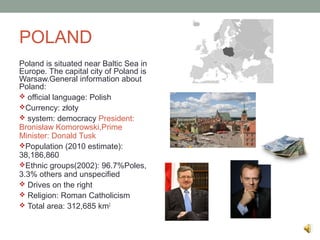
Poland is situated near Baltic Sea in
Europe. The capital city of Poland is
Warsaw.General information about
Poland:
 official language: Polish
Currency: złoty
 system: democracy President:
Bronisław Komorowski,Prime
Minister: Donald Tusk
Population (2010 estimate):
38,186,860
Ethnic groups(2002): 96.7%Poles,
3.3% others and unspecified
 Drives on the right
 Religion: Roman Catholicism
 Total area: 312,685 km2
FOOD

       The most traditional Polish dishes
       are Bigos,Golonka(Stewed pork
       knuckle) ,Pierogi(Polish
       dumplings)Oscypek(Hard, salty
       cheese)
Baltic sea


             Tatry   Vistula
Poland
amazing
country
Portugal
Portugal


Portugal is situated in Europe
It is bordered by the Atlantic Ocean to the west and south and by
Spain to the north and east. General information about Portugal:

Capital: Lisbon
Currency: Euro
Total area: 92,391 km² (including Azores and Madeira Islands)
Population: 10,524,145 people
System:Democracy .President is Aníbal Cavaco Silva,Prime minister
is Pedro Passos Coelho
Religion: Roman Catholic 94%.
Languages: Portuguese (official), Mirandês (spoken in the north)
Climate: Temperate. Temperate and rainy in north and hot and dry in
south
FOOD
In the Portuguese culture, people get together
when they eat, traditional foods:
Caldo Verde Soups (made from a variety of
Vegetable),Cozido à Portugues, Pastéis de nata
(One of the most famous sweets) Bacalhau com
natas (the cod with cream) Dobrada(sausage and
meat also with beans,) Arroz de marisco ( rice,
several kinds of seafood, water, salt, tomato and
parsley.)
Bridge 25 Abril - Lis
                      b on
Lisbon
Marquis of Pombal –
Marquis of Pombal
                  – Lisbon
England
• England is part of Europe. It is
  also part of Great Britain, also
  known as The United Kingdom,
  and is neighbours with Scotland,
  Wales and Ireland.
• England is run by a coalition
  government led by current Prime
  Minister David Cameron
• England is also famous for having
  a monarchy. Current monarch is
  Queen Elizabeth II.

 Where is England?
SPORTS AND FOOD
• England is a very multi-cultural
  country.England is also famous for inventing
  football (soccer), the world’s most popular
  sport.Other sports are popular in England are
  rugby, cricket, tennis, athletics, golf, darts and
  snooker.
• English people enjoy a variety of different food
  multicultural society. However, England does
  have some unique food. These include fish and
  chips, roast dinner, Yorkshire pudding, bangers
  and mash and English breakfast. Yum Yum!!
• Some pictures of Witham


                     Witham
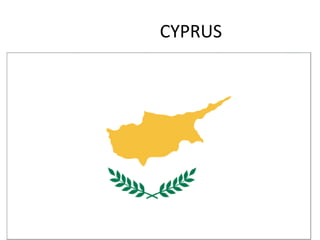
CYPRUS
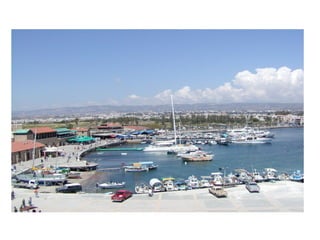
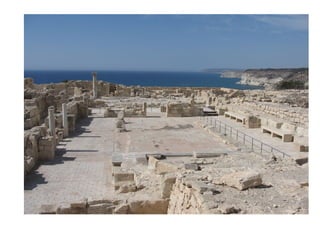
Cyprus is the largest island in the eastern Mediterranean and is situated south of
                                       Turkey.
 Cyprus has long been a crossing point between Europe, Asia and Africa and still
has many traces of civilisations – Roman theatres and villas, Byzantine churches
and monasteries, Crusader castles, Ottoman mosques and pre-historic habitats.


         The island’s main economic activities are tourism, clothing
         and craft exports and merchant shipping. Traditional crafts
               include embroidery, pottery and copperwork.

            Cyprus is well known as the island of Aphrodite, the
         goddess of love and beauty, who, according to legend, was
                                born here.
Cyprus Cuisine
•   Traditional local dishes include the meze – a selection of appetizers served as a
    main dish, halloumi/hellim cheese and the zivania schnapps.
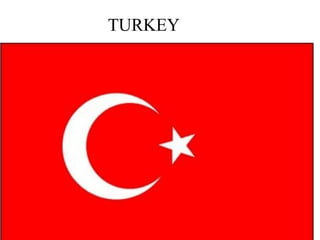
TURKEY
Official Name: The Republic of Turkey (Türkiye Cumhuriyeti)
              Founder: Mustafa Kemal ATATÜRK (1881-1938)
                               Capital: Ankara
                            Population: 81 million
                   Language: Turkish (uses Latin Alphabet)
                            Currency: Turkish Lira
 Location: Eastern Mediterranean. Located between two continents Europe and
                                     Asia.
 Religion: 99 percent of the population is Muslim. Turkey is a secular state that
            assures complete freedom of worship to non- Muslims.
Government: Turkey is democratic, secular and social state governed by the rule
 of law; Legislative Power: The Turkish Grand National Assembly Executive
                Power: President and the Council of Ministers.
 Landmarks: Ayasofya Museum, Topkapi Palace, Blue Mosque, Dolmabahce
    Palace, ancient City of Troy, Ephesus, Pergamon, Pamukkale, Goreme-
                     Cappadocia, Mt. Nemrut, Safranbolu.
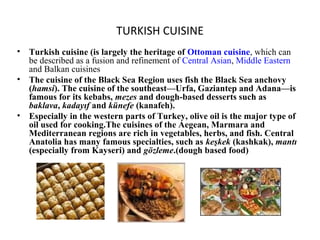
TURKISH CUISINE
•   Turkish cuisine (is largely the heritage of Ottoman cuisine, which can
    be described as a fusion and refinement of Central Asian, Middle Eastern
    and Balkan cuisines
•   The cuisine of the Black Sea Region uses fish the Black Sea anchovy
    (hamsi). The cuisine of the southeast—Urfa, Gaziantep and Adana—is
    famous for its kebabs, mezes and dough-based desserts such as
    baklava, kadayıf and künefe (kanafeh).
•   Especially in the western parts of Turkey, olive oil is the major type of
    oil used for cooking.The cuisines of the Aegean, Marmara and
    Mediterranean regions are rich in vegetables, herbs, and fish. Central
    Anatolia has many famous specialties, such as keşkek (kashkak), mantı
    (especially from Kayseri) and gözleme.(dough based food)
NEMRUT MOUNTAIN(EASTERN
ANATOLİA)
EPHESUS-İZMİR
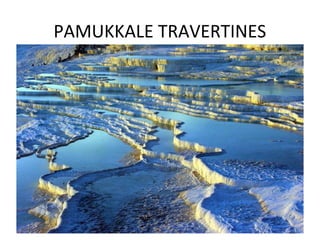
PAMUKKALE TRAVERTINES

Poland - amazing country

  • 2.
    POLAND Poland is situatednear Baltic Sea in Europe. The capital city of Poland is Warsaw.General information about Poland:  official language: Polish Currency: złoty  system: democracy President: Bronisław Komorowski,Prime Minister: Donald Tusk Population (2010 estimate): 38,186,860 Ethnic groups(2002): 96.7%Poles, 3.3% others and unspecified  Drives on the right  Religion: Roman Catholicism  Total area: 312,685 km2
  • 3.
    FOOD The most traditional Polish dishes are Bigos,Golonka(Stewed pork knuckle) ,Pierogi(Polish dumplings)Oscypek(Hard, salty cheese)
  • 4.
    Baltic sea Tatry Vistula
  • 5.
  • 6.
  • 7.
    Portugal Portugal is situatedin Europe It is bordered by the Atlantic Ocean to the west and south and by Spain to the north and east. General information about Portugal: Capital: Lisbon Currency: Euro Total area: 92,391 km² (including Azores and Madeira Islands) Population: 10,524,145 people System:Democracy .President is Aníbal Cavaco Silva,Prime minister is Pedro Passos Coelho Religion: Roman Catholic 94%. Languages: Portuguese (official), Mirandês (spoken in the north) Climate: Temperate. Temperate and rainy in north and hot and dry in south
  • 8.
    FOOD In the Portugueseculture, people get together when they eat, traditional foods: Caldo Verde Soups (made from a variety of Vegetable),Cozido à Portugues, Pastéis de nata (One of the most famous sweets) Bacalhau com natas (the cod with cream) Dobrada(sausage and meat also with beans,) Arroz de marisco ( rice, several kinds of seafood, water, salt, tomato and parsley.)
  • 9.
    Bridge 25 Abril- Lis b on
  • 10.
  • 11.
  • 12.
  • 13.
    • England ispart of Europe. It is also part of Great Britain, also known as The United Kingdom, and is neighbours with Scotland, Wales and Ireland. • England is run by a coalition government led by current Prime Minister David Cameron • England is also famous for having a monarchy. Current monarch is Queen Elizabeth II. Where is England?
  • 14.
    SPORTS AND FOOD •England is a very multi-cultural country.England is also famous for inventing football (soccer), the world’s most popular sport.Other sports are popular in England are rugby, cricket, tennis, athletics, golf, darts and snooker. • English people enjoy a variety of different food multicultural society. However, England does have some unique food. These include fish and chips, roast dinner, Yorkshire pudding, bangers and mash and English breakfast. Yum Yum!!
  • 15.
    • Some picturesof Witham Witham
  • 16.
  • 17.
    Cyprus is thelargest island in the eastern Mediterranean and is situated south of Turkey. Cyprus has long been a crossing point between Europe, Asia and Africa and still has many traces of civilisations – Roman theatres and villas, Byzantine churches and monasteries, Crusader castles, Ottoman mosques and pre-historic habitats. The island’s main economic activities are tourism, clothing and craft exports and merchant shipping. Traditional crafts include embroidery, pottery and copperwork. Cyprus is well known as the island of Aphrodite, the goddess of love and beauty, who, according to legend, was born here.
  • 18.
    Cyprus Cuisine • Traditional local dishes include the meze – a selection of appetizers served as a main dish, halloumi/hellim cheese and the zivania schnapps.
  • 22.
  • 23.
    Official Name: TheRepublic of Turkey (Türkiye Cumhuriyeti) Founder: Mustafa Kemal ATATÜRK (1881-1938) Capital: Ankara Population: 81 million Language: Turkish (uses Latin Alphabet) Currency: Turkish Lira Location: Eastern Mediterranean. Located between two continents Europe and Asia. Religion: 99 percent of the population is Muslim. Turkey is a secular state that assures complete freedom of worship to non- Muslims. Government: Turkey is democratic, secular and social state governed by the rule of law; Legislative Power: The Turkish Grand National Assembly Executive Power: President and the Council of Ministers. Landmarks: Ayasofya Museum, Topkapi Palace, Blue Mosque, Dolmabahce Palace, ancient City of Troy, Ephesus, Pergamon, Pamukkale, Goreme- Cappadocia, Mt. Nemrut, Safranbolu.
  • 24.
    TURKISH CUISINE • Turkish cuisine (is largely the heritage of Ottoman cuisine, which can be described as a fusion and refinement of Central Asian, Middle Eastern and Balkan cuisines • The cuisine of the Black Sea Region uses fish the Black Sea anchovy (hamsi). The cuisine of the southeast—Urfa, Gaziantep and Adana—is famous for its kebabs, mezes and dough-based desserts such as baklava, kadayıf and künefe (kanafeh). • Especially in the western parts of Turkey, olive oil is the major type of oil used for cooking.The cuisines of the Aegean, Marmara and Mediterranean regions are rich in vegetables, herbs, and fish. Central Anatolia has many famous specialties, such as keşkek (kashkak), mantı (especially from Kayseri) and gözleme.(dough based food)
  • 25.
  • 26.
  • 27.

Editor's Notes

  • #11 Fly Through 3-D transition effect and pictures (Basic) To reproduce the picture effects on this slide, do the following: On the Home tab, in the Slides group, click Layout , and then click Blank . On the Insert tab, in the Images group, click Picture . In the Insert Picture dialog box, select a picture and then click Insert . Select the picture. Under Picture Tools , on the Format tab, in the Size group, click the Size and Position dialog box launcher. In the Format Picture dialog box, resize or crop the image so that the height is set to 5.33” and the width is set to 8” . To crop the picture, click Crop in the left pane, and in the right pane, under Crop position , enter values into the Height , Width , Left , and Top boxes. To resize the picture, click Size in the left pane, and in the right pane, under Size and rotate , enter values into the Height and Width boxes. Under Picture Tools , on the Format tab, in the Picture Styles group, click Rotated White . To reproduce the shape effects on this slide, do the following: On the Home tab, in the Drawing group, click Shapes , and then under Block Arrows , click Left-Right Arrow (first row). On the slide, drag to draw a left-right arrow. Select the left-right arrow. Under Drawing Tools , on the Format tab, in the Size group, enter 0.45 ” in the Height box and 3.65 ” in the Width box. Also on the Format tab, in the Shape Styles group, click the Format Shape dialog box launcher. In the Format Shape dialog box, click Fill in the left pane, in the Fill pane, click Gradient fill , and then do the following: In the Type list, select Linear . In the Angle box, enter 0° . Under Gradient stops , click Add gradient stops or Remove gradient stops until two stops appear in the slider. Also under Gradient stops , customize the gradient stops as follows: Select the first stop in the slider, and then do the following: In the Position box, enter 0%. Click the button next to Color , and then under Theme Colors , click White , Background 1, Darker 5%. Select the second stop in the slider, and then do the following: In the Position box, enter 100% . Click the button next to Color , and then under Theme Colors , click White, Background 1, Darker 15% . Also in the Format Shape dialog box, click Line Color in the left pane, in the Line Color pane, click No line . Also in the Format Shape dialog box, click Shadow in the left pane, in the Shadow pane, click the button next to Presets , and then under Outer click Offset Center (second row). Also in the Format Shape dialog box, click Size in the left pane, in the Size pane, under Size and rotate , in the Rotation box, enter 354° . On the slide, select the shape. Begin typing to enter your text into the shape. Select the edge of the shape. On the Home tab, in the Font group, do the following: In the Font list, select Corbel . In the Font Size list, select 20 pt . Click Font Color , and then click Black, Text 1 (first row). Click Italic . Also on the Home tab, in the Paragraph group, click Center . To reproduce the transition effects on this slide, do the following: On the Transitions tab, in the Transition to This Slide group, click More , and then click Fly Through . On the Transitions tab, in the Transition to This Slide , click Effect Options , and then click In with Bounce . Also on the Transitions tab, in the Timing group, do the following: Clear the On Mouse Click box. Select After , and then in the After box enter 2.00 seconds . To reproduce the second, third, and fourth slides, do the following: In the Slides pane, select the slide. On the Home tab, in the Slides group, click the arrow below New Slide , and then click Duplicate Selected Slides . Repeat this process until there are four slides. In the Slides pane, select the second slide. On the slide, select the picture. Under Picture Tools , on the Format tab, in the Adjust group, click Change Picture . In the Insert Picture dialog box, select a picture and then click Insert . Also on the Format tab, in the Size group, click the Size and Position dialog box launcher. In the Format Picture dialog box, click Size in the left pane, in the Size pane, under Size and rotate , in the Rotation box, enter 9° . Select the shape. Under Drawing Tools , on the Format tab, in the Size group, click the Size and Position dialog box launcher. In the Format Shape dialog box, click Size in the left pane, in the Size pane, under Size and rotate , in the Rotation box, enter 3° . In the Slides pane, select the third slide. On the slide, select the picture. Under Picture Tools , on the Format tab, in the Adjust group, click Change Picture . In the Insert Picture dialog box, select a picture and then click Insert . Also on the Format tab, in the Size group, click the Size and Position dialog box launcher. In the Format Picture dialog box, click Size in the left pane, in the Size pane, under Size and rotate , in the Rotation box, enter 5° . Select the shape. Under Drawing Tools , on the Format tab, in the Size group, click the Size and Position dialog box launcher. In the Format Shape dialog box, click Size in the left pane, in the Size pane, under Size and rotate , in the Rotation box, enter 359° . In the Slides pane, select the fourth slide. On the slide, select the picture. Under Picture Tools , on the Format tab, in the Adjust group, click Change Picture . In the Insert Picture dialog box, select a picture and then click Insert . Also on the Format tab, in the Size group, click the Size and Position dialog box launcher. In the Format Picture dialog box, click Size in the left pane, in the Size pane, under Size and rotate , in the Rotation box, enter 8° . Select the shape. Under Drawing Tools , on the Format tab, in the Size group, click the Size and Position dialog box launcher. In the Format Shape dialog box, click Size in the left pane, in the Size pane, under Size and rotate , in the Rotation box, enter 2° . To reproduce the background effects on this slide, do the following: On the Design tab, in the Background group, click Background Styles , and then click Style 4. (Note: Selecting this background style will change the colors on the slide.)