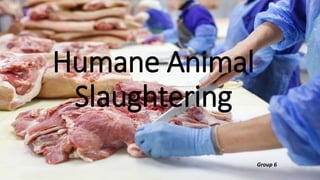
Humane Animal
Slaughtering
Group 6
Introduction of humane animal slaughtering
One of the biggest ethical issues in animal farming, husbandry, and
agriculture more generally, is the welfare of animals during the
process of slaughter. Although most work to date in animal welfare
science has concentrated on improving the living conditions of
animals, there is an increasing focus on finding humane ways to
transport and slaughter animals, in order to minimize the harm
done during this process.
Definition of humane killing is,
When an animal is either killed instantly or rendered insensible
until death ensues, without pain, suffering or distress.
Principles of humane animal slaughtering
There are three ways in which this can be achieved in principle,
1. Killing is instant This is possible by shooting an animal with a free bullet
to the head, some stunkill electrical stunning methods and maceration.
Death will only be instant if the method is properly applied.
2. The animal is instantly made unconscious, stunned- and is then killed
using a second process before the animal can recover consciousness.
Whilst the animal is effectively stunned it is insensible and cannot
experience pain or stress. This is possible with, for example, captive-bolt
stunning or electrical stunning followed as quickly as possible by effective
bleeding or application of an electrical current across the chest to cause
cardiac arrest. There is a risk that the animal will recover consciousness
before death occurs if either the stunning or the killing method is
ineffectively applied, or if there is too long a delay between the stunning
and killing methods.
General recommendations for corporate
policies on humane slaughter
• All animals killed for meat should be slaughtered humanely
• The killing of animals by bleeding without the use of pre-slaughter
stunning is not considered a humane method of slaughter
• All systems for killing animals should be effectively managed and
monitored.
• With electrical methods of stunning and killing
• With controlled atmosphere methods
3. The method of killing is not aversive or unpleasant- This is possible,
for example, if animals are kept in an atmosphere with very low levels
of oxygen where that oxygen is replaced by a nonaversive gas such as
argon or nitrogen. In this case, unconsciousness, followed by death,
can occur without affecting the welfare of the animal.
Methods of slaughtering
1. The main methods of slaughter in use commercially fall into three
categories,01.Electrical-An electrical stunning device (applied to the
head only) must pass sufficient current through the brain of the animal
to interrupt normal brain activity and render the animal immediately
unconscious. Electrical stunning (or electronarcosis) is reversible as it
disrupts normal brain function for a short time only.
2. Percussive-The term 'percussive' describes the principal action of the
captive-bolt, the forcible striking of one solid body against another. The
first percussive instrument specifically designed to stun animals was the
pole-axe, a crude implement which relied on the strength and skill of the
slaughterman to be effective.
3. Controlled Atmosphere -controlled atmosphere stunning (CAS) is a
slaughter method where small groups of animals are placed in a
container with an atmosphere that consists of an asphyxiant gas,
typically argon, nitrogen or carbon dioxide, causing them to lose
consciousness.
Advantages of humane animal slaughtering-
• By performing immediate killing, the animal is insensible and cannot
experience pain or stress.
• Reduced carcass damage and waste and higher value due to less bruising
• Improve the quality of meat by reducing animal stress.
• High value of hides and skins.
• To ensure that animals are killed quickly, painlessly and without suffering.
• no hazard to operator and also in here ,the person who kills the animal is
well trained.
• In here ,occur to perfect bleeding and also it is important of quality of meat
Disadvantages of humane animal slaughtering
• Expensive.
• To need more technical knowledge.
• Poor knowledge about humane methods.
• Need more rooms.
• More time taken.
Group members
• Bagtec/2019/862
• Bagtec/2019/864
• Bagtec/2019/868
• Bagtec/2019/884
• Bagtec/2019/886
• Bagtec/2019/887
• Bagtec/2019/888
• Bagtec/2019/894
• Bagtec/2019/899
• Bagtec/2019/900
• Bagtec/2019/901
• Bagtec/2019/905
• Bagtec/2019/907
• Bagtec/2019/913
• Bagtec/2019/921
Thank you

Humane Animal Slaughtering.pptx

  • 1.
  • 2.
    Introduction of humaneanimal slaughtering One of the biggest ethical issues in animal farming, husbandry, and agriculture more generally, is the welfare of animals during the process of slaughter. Although most work to date in animal welfare science has concentrated on improving the living conditions of animals, there is an increasing focus on finding humane ways to transport and slaughter animals, in order to minimize the harm done during this process. Definition of humane killing is, When an animal is either killed instantly or rendered insensible until death ensues, without pain, suffering or distress.
  • 3.
    Principles of humaneanimal slaughtering There are three ways in which this can be achieved in principle, 1. Killing is instant This is possible by shooting an animal with a free bullet to the head, some stunkill electrical stunning methods and maceration. Death will only be instant if the method is properly applied. 2. The animal is instantly made unconscious, stunned- and is then killed using a second process before the animal can recover consciousness. Whilst the animal is effectively stunned it is insensible and cannot experience pain or stress. This is possible with, for example, captive-bolt stunning or electrical stunning followed as quickly as possible by effective bleeding or application of an electrical current across the chest to cause cardiac arrest. There is a risk that the animal will recover consciousness before death occurs if either the stunning or the killing method is ineffectively applied, or if there is too long a delay between the stunning and killing methods.
  • 4.
    General recommendations forcorporate policies on humane slaughter • All animals killed for meat should be slaughtered humanely • The killing of animals by bleeding without the use of pre-slaughter stunning is not considered a humane method of slaughter • All systems for killing animals should be effectively managed and monitored. • With electrical methods of stunning and killing • With controlled atmosphere methods
  • 5.
    3. The methodof killing is not aversive or unpleasant- This is possible, for example, if animals are kept in an atmosphere with very low levels of oxygen where that oxygen is replaced by a nonaversive gas such as argon or nitrogen. In this case, unconsciousness, followed by death, can occur without affecting the welfare of the animal.
  • 6.
    Methods of slaughtering 1.The main methods of slaughter in use commercially fall into three categories,01.Electrical-An electrical stunning device (applied to the head only) must pass sufficient current through the brain of the animal to interrupt normal brain activity and render the animal immediately unconscious. Electrical stunning (or electronarcosis) is reversible as it disrupts normal brain function for a short time only. 2. Percussive-The term 'percussive' describes the principal action of the captive-bolt, the forcible striking of one solid body against another. The first percussive instrument specifically designed to stun animals was the pole-axe, a crude implement which relied on the strength and skill of the slaughterman to be effective.
  • 7.
    3. Controlled Atmosphere-controlled atmosphere stunning (CAS) is a slaughter method where small groups of animals are placed in a container with an atmosphere that consists of an asphyxiant gas, typically argon, nitrogen or carbon dioxide, causing them to lose consciousness.
  • 8.
    Advantages of humaneanimal slaughtering- • By performing immediate killing, the animal is insensible and cannot experience pain or stress. • Reduced carcass damage and waste and higher value due to less bruising • Improve the quality of meat by reducing animal stress. • High value of hides and skins. • To ensure that animals are killed quickly, painlessly and without suffering. • no hazard to operator and also in here ,the person who kills the animal is well trained. • In here ,occur to perfect bleeding and also it is important of quality of meat
  • 9.
    Disadvantages of humaneanimal slaughtering • Expensive. • To need more technical knowledge. • Poor knowledge about humane methods. • Need more rooms. • More time taken.
  • 10.
    Group members • Bagtec/2019/862 •Bagtec/2019/864 • Bagtec/2019/868 • Bagtec/2019/884 • Bagtec/2019/886 • Bagtec/2019/887 • Bagtec/2019/888 • Bagtec/2019/894 • Bagtec/2019/899 • Bagtec/2019/900 • Bagtec/2019/901 • Bagtec/2019/905 • Bagtec/2019/907 • Bagtec/2019/913 • Bagtec/2019/921
  • 11.