HUMAN
CULTURAL
EVOLUTION
HUMAN HAS NO
CONTENTMENT
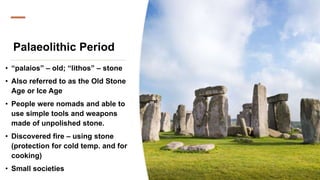
Palaeolithic Period
• “palaios” – old; “lithos” – stone
• Also referred to as the Old Stone
Age or Ice Age
• People were nomads and able to
use simple tools and weapons
made of unpolished stone.
• Discovered fire – using stone
(protection for cold temp. and for
cooking)
• Small societies
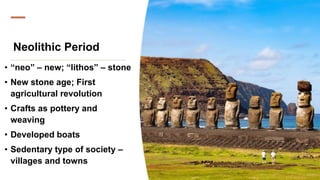
Neolithic Period
• “neo” – new; “lithos” – stone
• New stone age; First
agricultural revolution
• Crafts as pottery and
weaving
• Developed boats
• Sedentary type of society –
villages and towns
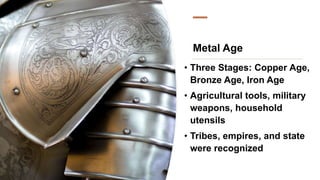
Metal Age
• Three Stages: Copper Age,
Bronze Age, Iron Age
• Agricultural tools, military
weapons, household
utensils
• Tribes, empires, and state
were recognized
Comparing the Periods
• Paleolithic Age
• Unpolished stone
tools
• Hunting and
gathering
• Nomadic way of
living
• Neolithic Age
• Polished stone tools
• Domestication of
plants and animals
• Living in permanent
places
• Metal Age
• Use of metals
• Tribes, empires and
state
• Civilization
Ancient State and
Civilization: Mesopotamia
• Every City in Mesopotamia had its
own government, rulers, warrior,
patron god, and functioned like an
independent country.
• Mesopotamian cities: Ur, Uruk,
Kish, and Lagesh
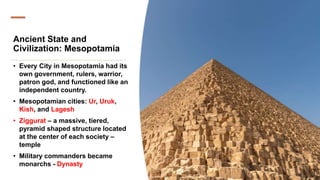
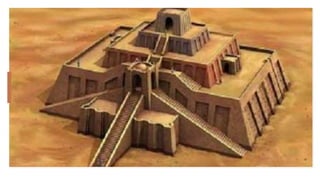
• Ziggurat – a massive, tiered,
pyramid shaped structure located
at the center of each society –
temple
• Military commanders became
monarchs - Dynasty
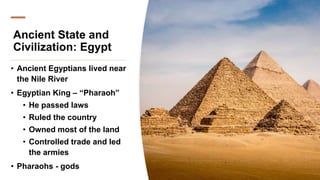
Ancient State and
Civilization: Egypt
• Ancient Egyptians lived near
the Nile River
• Egyptian King – “Pharaoh”
• He passed laws
• Ruled the country
• Owned most of the land
• Controlled trade and led
the armies
• Pharaohs - gods
Modern State and
Civilization
• Spain, 1942 – Spanish monarchs Ferdinand and Isabella took
Spain back from the Muslim (Era of Spain)
• In France, Louis XIV created an absolute monarchy.
• In 1914, World War I
• In 1939, World War II
• In 1945, End of WWII led to the formation of United Nations.
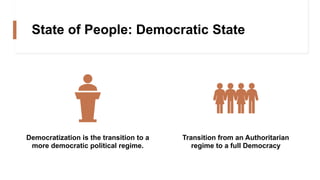
State of People: Democratic State
Democratization is the transition to a
more democratic political regime.
Transition from an Authoritarian
regime to a full Democracy
Types of
Democracy
• (1) a representative democracy – system
where citizens choose government
representatives among their citizens.
• direct democracy – when citizens form a
governing body and vote directly on issues
• constitutional democracy limits the powers
of the government through the nation’s
constitution

Human-Cultural-Evolution.pptx

  • 1.
  • 2.
  • 3.
    Palaeolithic Period • “palaios”– old; “lithos” – stone • Also referred to as the Old Stone Age or Ice Age • People were nomads and able to use simple tools and weapons made of unpolished stone. • Discovered fire – using stone (protection for cold temp. and for cooking) • Small societies
  • 4.
    Neolithic Period • “neo”– new; “lithos” – stone • New stone age; First agricultural revolution • Crafts as pottery and weaving • Developed boats • Sedentary type of society – villages and towns
  • 5.
    Metal Age • ThreeStages: Copper Age, Bronze Age, Iron Age • Agricultural tools, military weapons, household utensils • Tribes, empires, and state were recognized
  • 6.
    Comparing the Periods •Paleolithic Age • Unpolished stone tools • Hunting and gathering • Nomadic way of living • Neolithic Age • Polished stone tools • Domestication of plants and animals • Living in permanent places • Metal Age • Use of metals • Tribes, empires and state • Civilization
  • 7.
    Ancient State and Civilization:Mesopotamia • Every City in Mesopotamia had its own government, rulers, warrior, patron god, and functioned like an independent country. • Mesopotamian cities: Ur, Uruk, Kish, and Lagesh • Ziggurat – a massive, tiered, pyramid shaped structure located at the center of each society – temple • Military commanders became monarchs - Dynasty
  • 9.
    Ancient State and Civilization:Egypt • Ancient Egyptians lived near the Nile River • Egyptian King – “Pharaoh” • He passed laws • Ruled the country • Owned most of the land • Controlled trade and led the armies • Pharaohs - gods
  • 11.
    Modern State and Civilization •Spain, 1942 – Spanish monarchs Ferdinand and Isabella took Spain back from the Muslim (Era of Spain) • In France, Louis XIV created an absolute monarchy. • In 1914, World War I • In 1939, World War II • In 1945, End of WWII led to the formation of United Nations.
  • 12.
    State of People:Democratic State Democratization is the transition to a more democratic political regime. Transition from an Authoritarian regime to a full Democracy
  • 13.
    Types of Democracy • (1)a representative democracy – system where citizens choose government representatives among their citizens. • direct democracy – when citizens form a governing body and vote directly on issues • constitutional democracy limits the powers of the government through the nation’s constitution