Human-Aware Sensor Network Ontology
(HASNetO): Semantic Support for Empirical
Data Collection
Paulo Pinheiro1
, Deborah McGuinness1
,
Henrique Santos1,2
1
Rensselaer Polytechnic Institute, USA
2
Universidade de Fortaleza, Brazil
ISWC/LISC, October 2015
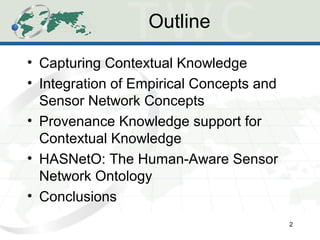
Outline
• Capturing Contextual Knowledge
• Integration of Empirical Concepts and
Sensor Network Concepts
• Provenance Knowledge support for
Contextual Knowledge
• HASNetO: The Human-Aware Sensor
Network Ontology
• Conclusions
2
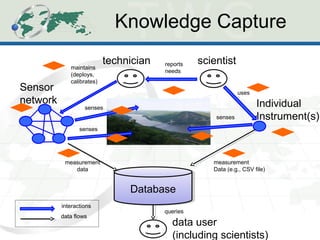
DatabaseDatabase
Sensor
network
technician scientist
data user
(including scientists)
maintains
(deploys,
calibrates)
Individual
Instrument(s)
measurement
data
measurement
Data (e.g., CSV file)
queries
uses
reports
needs
data flows
interactions
senses
senses
senses
Knowledge Capture
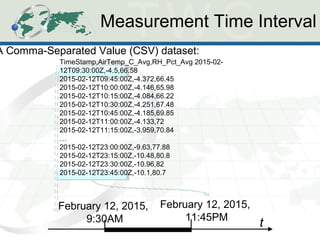
Measurement Time Interval
TimeStamp,AirTemp_C_Avg,RH_Pct_Avg 2015-02-
12T09:30:00Z,-4.5,66.58
2015-02-12T09:45:00Z,-4.372,66.45
2015-02-12T10:00:00Z,-4.146,65.98
2015-02-12T10:15:00Z,-4.084,66.22
2015-02-12T10:30:00Z,-4.251,67.48
2015-02-12T10:45:00Z,-4.185,69.85
2015-02-12T11:00:00Z,-4.133,72
2015-02-12T11:15:00Z,-3.959,70.84
…
2015-02-12T23:00:00Z,-9.63,77.88
2015-02-12T23:15:00Z,-10.48,80.8
2015-02-12T23:30:00Z,-10.96,82
2015-02-12T23:45:00Z,-10.1,80.7
t
A Comma-Separated Value (CSV) dataset:
February 12, 2015,
9:30AM
February 12, 2015,
11:45PM
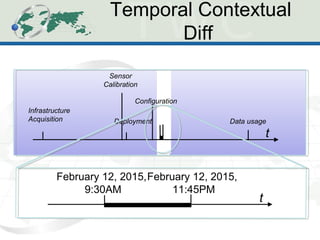
Temporal Contextual
Diff
t
Configuration
Deployment
Sensor
Calibration
Infrastructure
Acquisition
t
February 12, 2015,
9:30AM
February 12, 2015,
11:45PM
Data usage
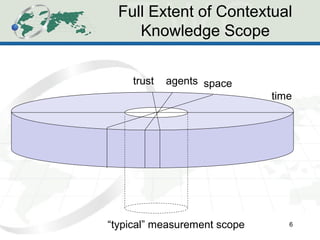
Full Extent of Contextual
Knowledge Scope
6
time
spaceagentstrust
“typical” measurement scope
Selected Observation and
Sensor Network Ontologies
• Sensor Network Knowledge
– Needed to describe the infrastructure of a
sensor network, and the use of sensor
network components in the generation of
datasets
• Observation Knowledge
– Needed to describe observations and their
measurements. Measurements need to be
characterized in terms of physical entities,
entity characteristics, units, and values
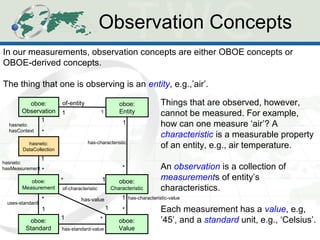
Observation Concepts
In our measurements, observation concepts are either OBOE concepts or
OBOE-derived concepts.
The thing that one is observing is an entity, e.g.,’air’.
Things that are observed, however,
cannot be measured. For example,
how can one measure ‘air’? A
characteristic is a measurable property
of an entity, e.g., air temperature.
An observation is a collection of
measurements of entity’s
characteristics.
Each measurement has a value, e.g,
’45’, and a standard unit, e.g., ‘Celsius’.
oboe:
Entity
oboe:
Observation
of-entity
11
hasneto:
DataCollection
oboe:
Measurement
oboe:
Standard
oboe:
Characteristic
oboe:
Value
of-characteristic
hasneto:
hasMeasurement
uses-standard
has-characteristic
has-characteristic-value
has-standard-value
has-value
hasneto:
hasContext
11
*
1
1
1
1
1
1
*
*
*
*
*
*
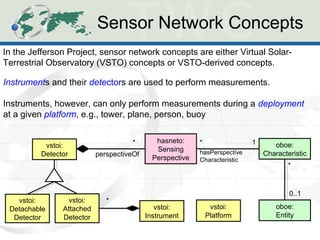
Sensor Network Concepts
In the Jefferson Project, sensor network concepts are either Virtual Solar-
Terrestrial Observatory (VSTO) concepts or VSTO-derived concepts.
Instruments and their detectors are used to perform measurements.
Instruments, however, can only perform measurements during a deployment
at a given platform, e.g., tower, plane, person, buoy
vstoi:
Detector
vstoi:
Instrument
vstoi:
Platform
hasneto:
Sensing
Perspective
oboe:
Characteristic
oboe:
Entity
vstoi:
Detachable
Detector
vstoi:
Attached
Detector
* *
*
1
0..1
*
hasPerspective
Characteristic
perspectiveOf
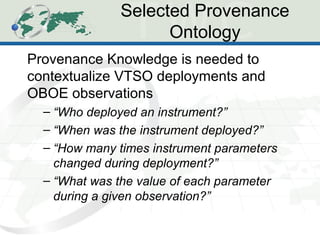
Selected Provenance
Ontology
Provenance Knowledge is needed to
contextualize VTSO deployments and
OBOE observations
– “Who deployed an instrument?”
– “When was the instrument deployed?”
– “How many times instrument parameters
changed during deployment?”
– “What was the value of each parameter
during a given observation?”
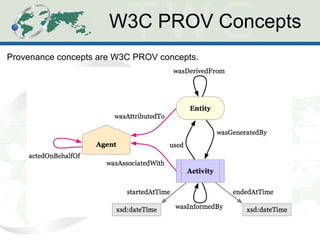
W3C PROV Concepts
Provenance concepts are W3C PROV concepts.
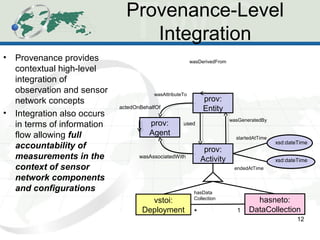
Provenance-Level
Integration
• Provenance provides
contextual high-level
integration of
observation and sensor
network concepts
• Integration also occurs
in terms of information
flow allowing full
accountability of
measurements in the
context of sensor
network components
and configurations
12
prov:
Activity
hasneto:
DataCollection
vstoi:
Deployment
xsd:dateTime
xsd:dateTime
hasData
Collection
1*
prov:
Agent
prov:
Entity
used
wasGeneratedBy
wasAttributeTo
wasAssociatedWith
actedOnBehalfOf
wasDerivedFrom
startedAtTime
endedAtTime
The Human-Aware Sensor
Network Ontology
vstoi:
Detector
vstoi:
Instrument
vstoi:
Platform
hasneto:
Sensing
Perspective
oboe:
Characteristic
oboe:
Entity
vstoi:
Detachable
Detector
vstoi:
Attached
Detector
*
*
*
1
0..1
*
hasPerspective
Characteristic
perspectiveOf
prov:
Activity
hasneto:
DataCollection
vstoi:
Deployment
xsd:dateTime
xsd:dateTime
hasData
Collection
1*
prov:
Agent
wasAssociatedWith
startedAtTime
endedAtTime
1
1
*
*
*
*
oboe:
Measurement
of-characteristic
hasneto:
hasMeasurement 1
1
*
*
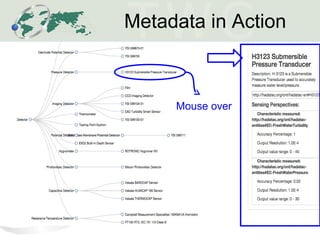
Metadata in Action
14
Mouse over
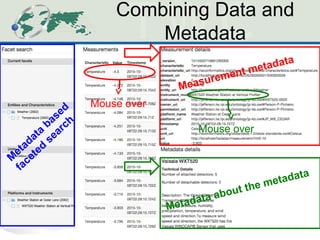
Combining Data and
Metadata
15
Mouse over
Mouse over
M
etadata
based
faceted
search
Measurement metadata
Metadata about the metadata
Conclusions
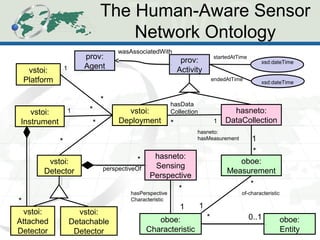
• HASNetO was briefly presented along with its support
for describing sensor networks
• OBOE and VSTO provide concepts required for
encoding observation and sensor network metadata
• Neither OBOE and VSTO provide concepts for
describing contextual knowledge about deployments
and observations
16
HASNetO provides a comprehensive integrated
set of concepts for capturing sensor network
measurements along with contextual knowledge
about these measurements
• Extra
17
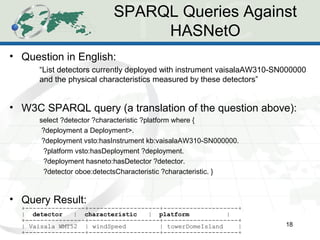
SPARQL Queries Against
HASNetO
• Question in English:
“List detectors currently deployed with instrument vaisalaAW310-SN000000
and the physical characteristics measured by these detectors”
• W3C SPARQL query (a translation of the question above):
select ?detector ?characteristic ?platform where {
?deployment a Deployment>.
?deployment vsto:hasInstrument kb:vaisalaAW310-SN000000.
?platform vsto:hasDeployment ?deployment.
?deployment hasneto:hasDetector ?detector.
?detector oboe:detectsCharacteristic ?characteristic. }
• Query Result:
+----------------+-------------------+--------------------+
| detector | characteristic | platform |
+----------------+-------------------+--------------------+
| Vaisala WMT52 | windSpeed | towerDomeIsland |
+----------------+-------------------+--------------------+
18
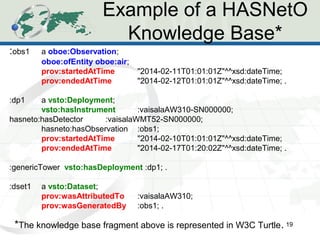
Example of a HASNetO
Knowledge Base*
19
:obs1 a oboe:Observation;
oboe:ofEntity oboe:air;
prov:startedAtTime "2014-02-11T01:01:01Z"^^xsd:dateTime;
prov:endedAtTime "2014-02-12T01:01:01Z"^^xsd:dateTime; .
:dp1 a vsto:Deployment;
vsto:hasInstrument :vaisalaAW310-SN000000;
hasneto:hasDetector :vaisalaWMT52-SN000000;
hasneto:hasObservation :obs1;
prov:startedAtTime "2014-02-10T01:01:01Z"^^xsd:dateTime;
prov:endedAtTime "2014-02-17T01:20:02Z"^^xsd:dateTime; .
:genericTower vsto:hasDeployment :dp1; .
:dset1 a vsto:Dataset;
prov:wasAttributedTo :vaisalaAW310;
prov:wasGeneratedBy :obs1; .
*The knowledge base fragment above is represented in W3C Turtle.
Knowledge About Sensor
Network Operation
• Knowledge about sensor networks, however,
can rarely be inferred from sensor data
themselves.
• The lack of contextual knowledge about
sensor data can render them useless.
Knowledge about sensor networks is as important
as data captured by sensor networks, and sensor
network metadata is as important as sensor data
21
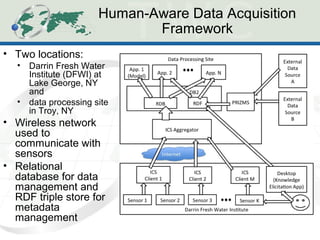
Human-Aware Data Acquisition
Framework
• Two locations:
• Darrin Fresh Water
Institute (DFWI) at
Lake George, NY
and
• data processing site
in Troy, NY
• Wireless network
used to
communicate with
sensors
• Relational
database for data
management and
RDF triple store for
metadata
management
Future Steps
• We will keep refining the HASNetO
vocabulary and testing it over a constantly
growing HASNetO-based knowledge base
• We are in the process of integrating
HASNetO into the HAScO (Human-Aware
Science Ontology) to accommodate
contextual knowledge beyond observation
data to include simulation data and
experimental data
22

Human-Aware Sensor Network Ontology: Semantic Support for Empirical Data Collection

  • 1.
    Human-Aware Sensor NetworkOntology (HASNetO): Semantic Support for Empirical Data Collection Paulo Pinheiro1 , Deborah McGuinness1 , Henrique Santos1,2 1 Rensselaer Polytechnic Institute, USA 2 Universidade de Fortaleza, Brazil ISWC/LISC, October 2015
  • 2.
    Outline • Capturing ContextualKnowledge • Integration of Empirical Concepts and Sensor Network Concepts • Provenance Knowledge support for Contextual Knowledge • HASNetO: The Human-Aware Sensor Network Ontology • Conclusions 2
  • 3.
    DatabaseDatabase Sensor network technician scientist data user (includingscientists) maintains (deploys, calibrates) Individual Instrument(s) measurement data measurement Data (e.g., CSV file) queries uses reports needs data flows interactions senses senses senses Knowledge Capture
  • 4.
    Measurement Time Interval TimeStamp,AirTemp_C_Avg,RH_Pct_Avg2015-02- 12T09:30:00Z,-4.5,66.58 2015-02-12T09:45:00Z,-4.372,66.45 2015-02-12T10:00:00Z,-4.146,65.98 2015-02-12T10:15:00Z,-4.084,66.22 2015-02-12T10:30:00Z,-4.251,67.48 2015-02-12T10:45:00Z,-4.185,69.85 2015-02-12T11:00:00Z,-4.133,72 2015-02-12T11:15:00Z,-3.959,70.84 … 2015-02-12T23:00:00Z,-9.63,77.88 2015-02-12T23:15:00Z,-10.48,80.8 2015-02-12T23:30:00Z,-10.96,82 2015-02-12T23:45:00Z,-10.1,80.7 t A Comma-Separated Value (CSV) dataset: February 12, 2015, 9:30AM February 12, 2015, 11:45PM
  • 5.
  • 6.
    Full Extent ofContextual Knowledge Scope 6 time spaceagentstrust “typical” measurement scope
  • 7.
    Selected Observation and SensorNetwork Ontologies • Sensor Network Knowledge – Needed to describe the infrastructure of a sensor network, and the use of sensor network components in the generation of datasets • Observation Knowledge – Needed to describe observations and their measurements. Measurements need to be characterized in terms of physical entities, entity characteristics, units, and values
  • 8.
    Observation Concepts In ourmeasurements, observation concepts are either OBOE concepts or OBOE-derived concepts. The thing that one is observing is an entity, e.g.,’air’. Things that are observed, however, cannot be measured. For example, how can one measure ‘air’? A characteristic is a measurable property of an entity, e.g., air temperature. An observation is a collection of measurements of entity’s characteristics. Each measurement has a value, e.g, ’45’, and a standard unit, e.g., ‘Celsius’. oboe: Entity oboe: Observation of-entity 11 hasneto: DataCollection oboe: Measurement oboe: Standard oboe: Characteristic oboe: Value of-characteristic hasneto: hasMeasurement uses-standard has-characteristic has-characteristic-value has-standard-value has-value hasneto: hasContext 11 * 1 1 1 1 1 1 * * * * * *
  • 9.
    Sensor Network Concepts Inthe Jefferson Project, sensor network concepts are either Virtual Solar- Terrestrial Observatory (VSTO) concepts or VSTO-derived concepts. Instruments and their detectors are used to perform measurements. Instruments, however, can only perform measurements during a deployment at a given platform, e.g., tower, plane, person, buoy vstoi: Detector vstoi: Instrument vstoi: Platform hasneto: Sensing Perspective oboe: Characteristic oboe: Entity vstoi: Detachable Detector vstoi: Attached Detector * * * 1 0..1 * hasPerspective Characteristic perspectiveOf
  • 10.
    Selected Provenance Ontology Provenance Knowledgeis needed to contextualize VTSO deployments and OBOE observations – “Who deployed an instrument?” – “When was the instrument deployed?” – “How many times instrument parameters changed during deployment?” – “What was the value of each parameter during a given observation?”
  • 11.
    W3C PROV Concepts Provenanceconcepts are W3C PROV concepts.
  • 12.
    Provenance-Level Integration • Provenance provides contextualhigh-level integration of observation and sensor network concepts • Integration also occurs in terms of information flow allowing full accountability of measurements in the context of sensor network components and configurations 12 prov: Activity hasneto: DataCollection vstoi: Deployment xsd:dateTime xsd:dateTime hasData Collection 1* prov: Agent prov: Entity used wasGeneratedBy wasAttributeTo wasAssociatedWith actedOnBehalfOf wasDerivedFrom startedAtTime endedAtTime
  • 13.
    The Human-Aware Sensor NetworkOntology vstoi: Detector vstoi: Instrument vstoi: Platform hasneto: Sensing Perspective oboe: Characteristic oboe: Entity vstoi: Detachable Detector vstoi: Attached Detector * * * 1 0..1 * hasPerspective Characteristic perspectiveOf prov: Activity hasneto: DataCollection vstoi: Deployment xsd:dateTime xsd:dateTime hasData Collection 1* prov: Agent wasAssociatedWith startedAtTime endedAtTime 1 1 * * * * oboe: Measurement of-characteristic hasneto: hasMeasurement 1 1 * *
  • 14.
  • 15.
    Combining Data and Metadata 15 Mouseover Mouse over M etadata based faceted search Measurement metadata Metadata about the metadata
  • 16.
    Conclusions • HASNetO wasbriefly presented along with its support for describing sensor networks • OBOE and VSTO provide concepts required for encoding observation and sensor network metadata • Neither OBOE and VSTO provide concepts for describing contextual knowledge about deployments and observations 16 HASNetO provides a comprehensive integrated set of concepts for capturing sensor network measurements along with contextual knowledge about these measurements
  • 17.
  • 18.
    SPARQL Queries Against HASNetO •Question in English: “List detectors currently deployed with instrument vaisalaAW310-SN000000 and the physical characteristics measured by these detectors” • W3C SPARQL query (a translation of the question above): select ?detector ?characteristic ?platform where { ?deployment a Deployment>. ?deployment vsto:hasInstrument kb:vaisalaAW310-SN000000. ?platform vsto:hasDeployment ?deployment. ?deployment hasneto:hasDetector ?detector. ?detector oboe:detectsCharacteristic ?characteristic. } • Query Result: +----------------+-------------------+--------------------+ | detector | characteristic | platform | +----------------+-------------------+--------------------+ | Vaisala WMT52 | windSpeed | towerDomeIsland | +----------------+-------------------+--------------------+ 18
  • 19.
    Example of aHASNetO Knowledge Base* 19 :obs1 a oboe:Observation; oboe:ofEntity oboe:air; prov:startedAtTime "2014-02-11T01:01:01Z"^^xsd:dateTime; prov:endedAtTime "2014-02-12T01:01:01Z"^^xsd:dateTime; . :dp1 a vsto:Deployment; vsto:hasInstrument :vaisalaAW310-SN000000; hasneto:hasDetector :vaisalaWMT52-SN000000; hasneto:hasObservation :obs1; prov:startedAtTime "2014-02-10T01:01:01Z"^^xsd:dateTime; prov:endedAtTime "2014-02-17T01:20:02Z"^^xsd:dateTime; . :genericTower vsto:hasDeployment :dp1; . :dset1 a vsto:Dataset; prov:wasAttributedTo :vaisalaAW310; prov:wasGeneratedBy :obs1; . *The knowledge base fragment above is represented in W3C Turtle.
  • 20.
    Knowledge About Sensor NetworkOperation • Knowledge about sensor networks, however, can rarely be inferred from sensor data themselves. • The lack of contextual knowledge about sensor data can render them useless. Knowledge about sensor networks is as important as data captured by sensor networks, and sensor network metadata is as important as sensor data
  • 21.
    21 Human-Aware Data Acquisition Framework •Two locations: • Darrin Fresh Water Institute (DFWI) at Lake George, NY and • data processing site in Troy, NY • Wireless network used to communicate with sensors • Relational database for data management and RDF triple store for metadata management
  • 22.
    Future Steps • Wewill keep refining the HASNetO vocabulary and testing it over a constantly growing HASNetO-based knowledge base • We are in the process of integrating HASNetO into the HAScO (Human-Aware Science Ontology) to accommodate contextual knowledge beyond observation data to include simulation data and experimental data 22