Findings from ReBUILD’s
health worker research
Learning lessons for post-conflict contexts
Sophie Witter
HEART seminar, 9th June 2016
Research for stronger health systems post conflict
Overview
• Background on ReBUILD
• Findings on impact of conflict on health staff
• Production, attraction, distribution, retention and motivating health
staff post-conflict/crisis – longer term perspectives
• Gender and HRH
• HRH policy-making and institutions
• Finally, some resources
Research for stronger health systems
post conflict
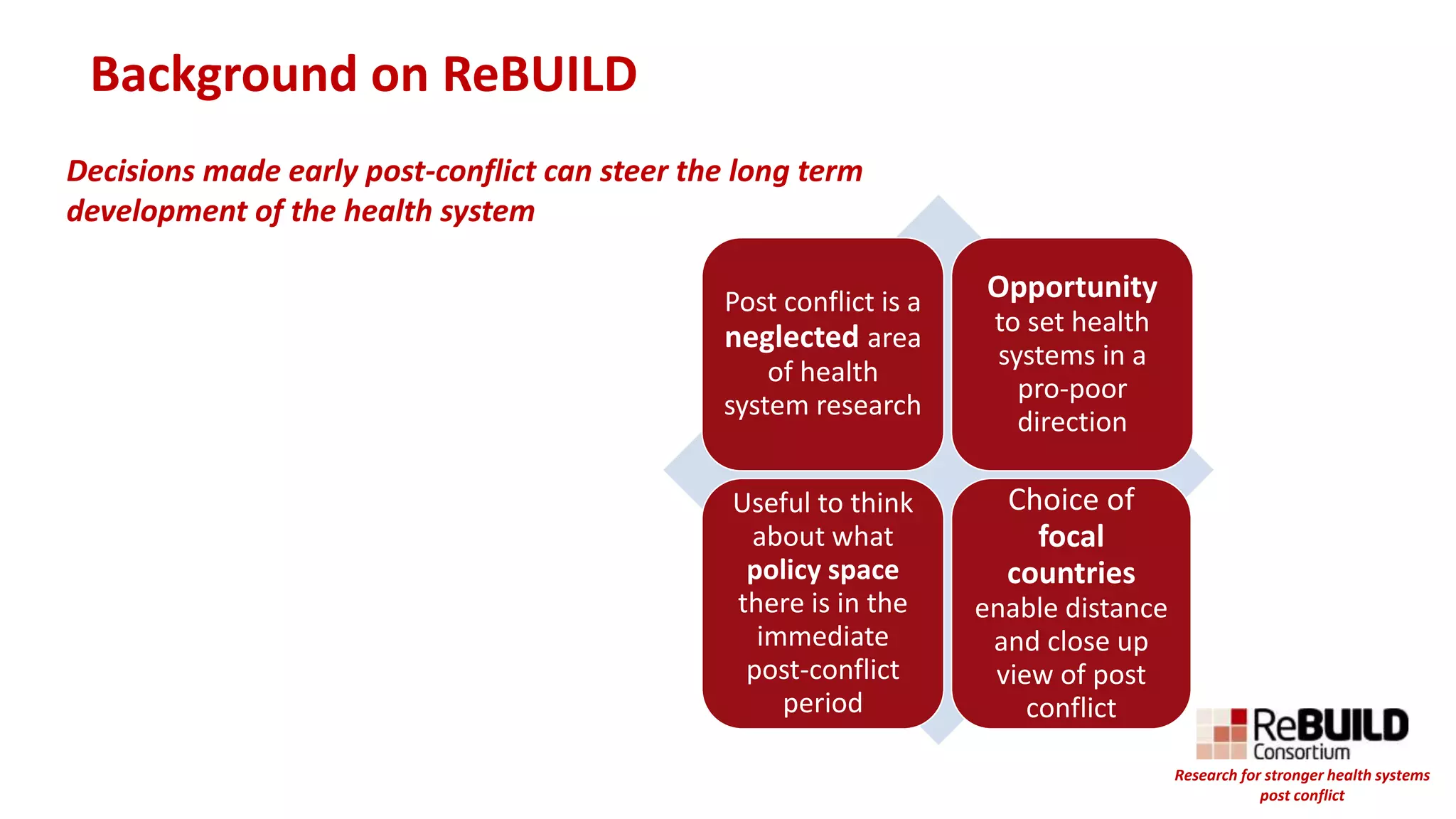
Background on ReBUILD
Post conflict is a
neglected area
of health
system research
Opportunity
to set health
systems in a
pro-poor
direction
Useful to think
about what
policy space
there is in the
immediate
post-conflict
period
Choice of
focal
countries
enable distance
and close up
view of post
conflict
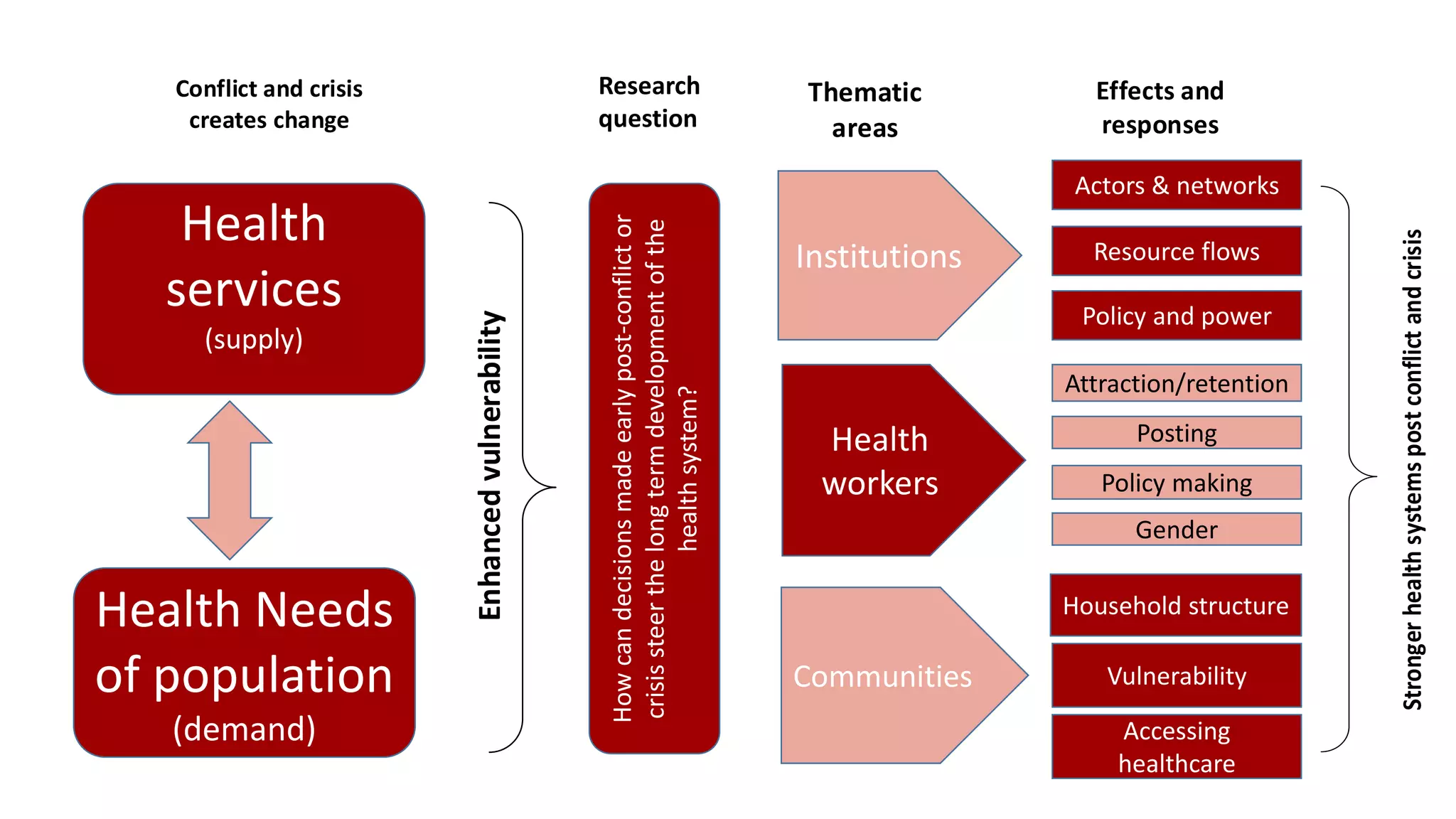
Decisions made early post-conflict can steer the long term
development of the health system
Research for stronger health systems
post conflict
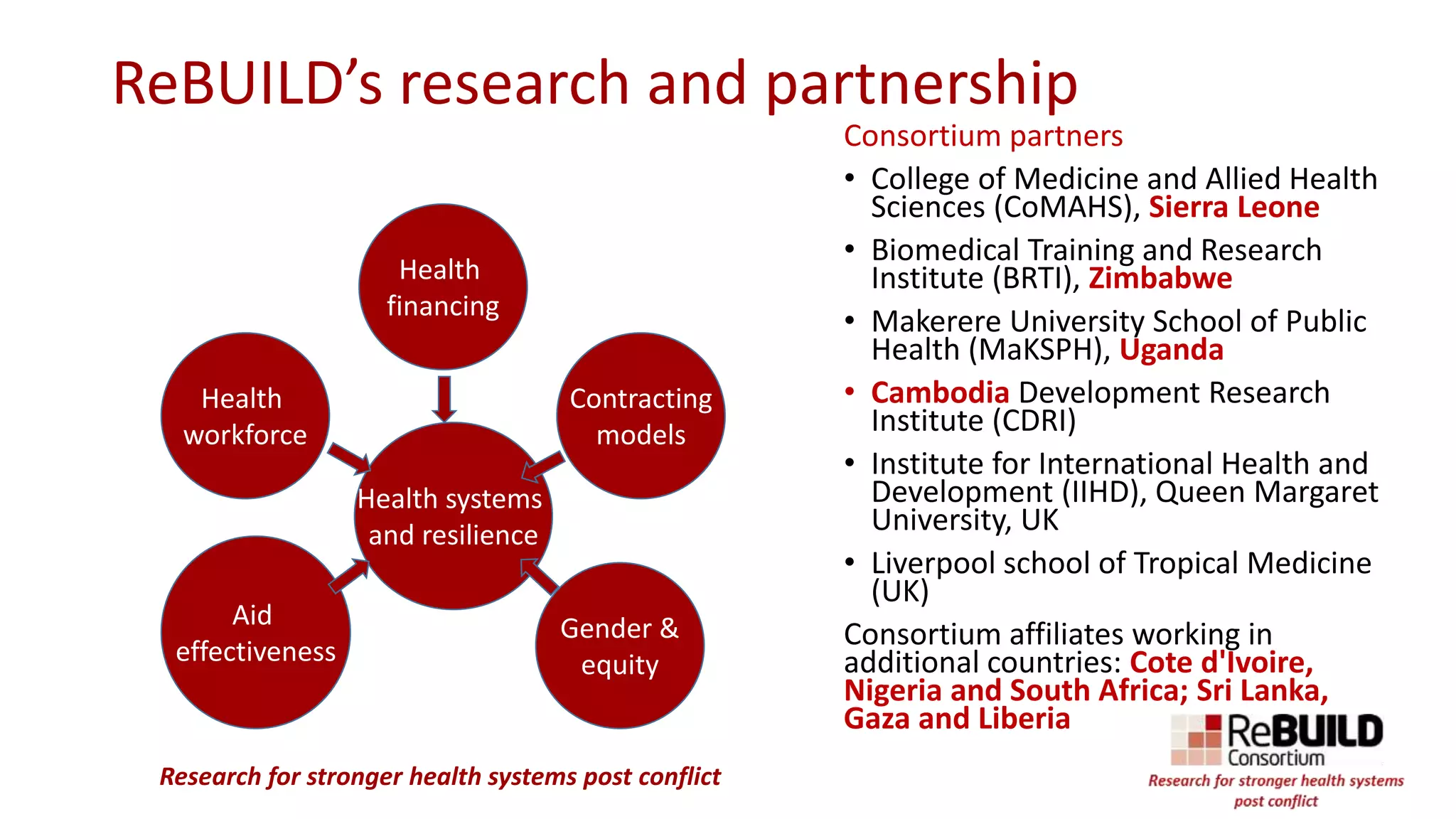
ReBUILD’s research and partnership
Health
financing
Gender &
equity
Health
workforce
Aid
effectiveness
Contracting
models
Health systems
and resilience
Research for stronger health systems post conflict
Consortium partners
• College of Medicine and Allied Health
Sciences (CoMAHS), Sierra Leone
• Biomedical Training and Research
Institute (BRTI), Zimbabwe
• Makerere University School of Public
Health (MaKSPH), Uganda
• Cambodia Development Research
Institute (CDRI)
• Institute for International Health and
Development (IIHD), Queen Margaret
University, UK
• Liverpool school of Tropical Medicine
(UK)
Consortium affiliates working in
additional countries: Cote d'Ivoire,
Nigeria and South Africa; Sri Lanka,
Gaza and Liberia
Health Needs
of population
(demand)
Health
services
(supply)
Conflict and crisis
creates change
Howcandecisionsmadeearlypost-conflictor
crisissteerthelongtermdevelopmentofthe
healthsystem?
Thematic
areas
Actors & networks
Policy and power
Vulnerability
Household structure
Accessing
healthcare
Resource flows
Attraction/retention
Posting
Policy making
Effects and
responses
Institutions
Health
workers
Communities
Strongerhealthsystemspostconflictandcrisis
Research
question
Enhancedvulnerability
Gender
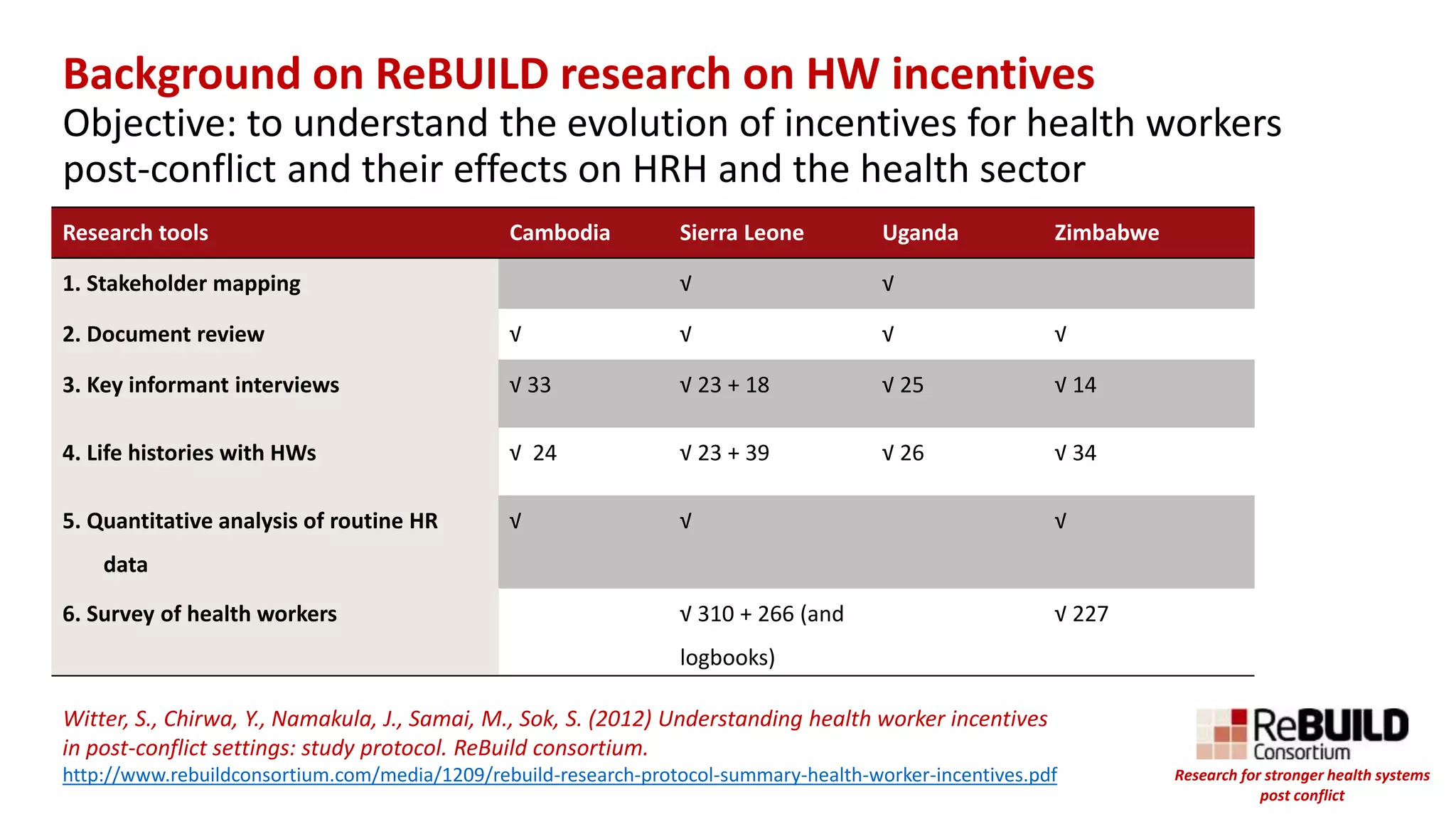
Background on ReBUILD research on HW incentives
Objective: to understand the evolution of incentives for health workers
post-conflict and their effects on HRH and the health sector
Research tools Cambodia Sierra Leone Uganda Zimbabwe
1. Stakeholder mapping √ √
2. Document review √ √ √ √
3. Key informant interviews √ 33 √ 23 + 18 √ 25 √ 14
4. Life histories with HWs √ 24 √ 23 + 39 √ 26 √ 34
5. Quantitative analysis of routine HR
data
√ √ √
6. Survey of health workers √ 310 + 266 (and
logbooks)
√ 227
Witter, S., Chirwa, Y., Namakula, J., Samai, M., Sok, S. (2012) Understanding health worker incentives
in post-conflict settings: study protocol. ReBuild consortium.
http://www.rebuildconsortium.com/media/1209/rebuild-research-protocol-summary-health-worker-incentives.pdf Research for stronger health systems
post conflict
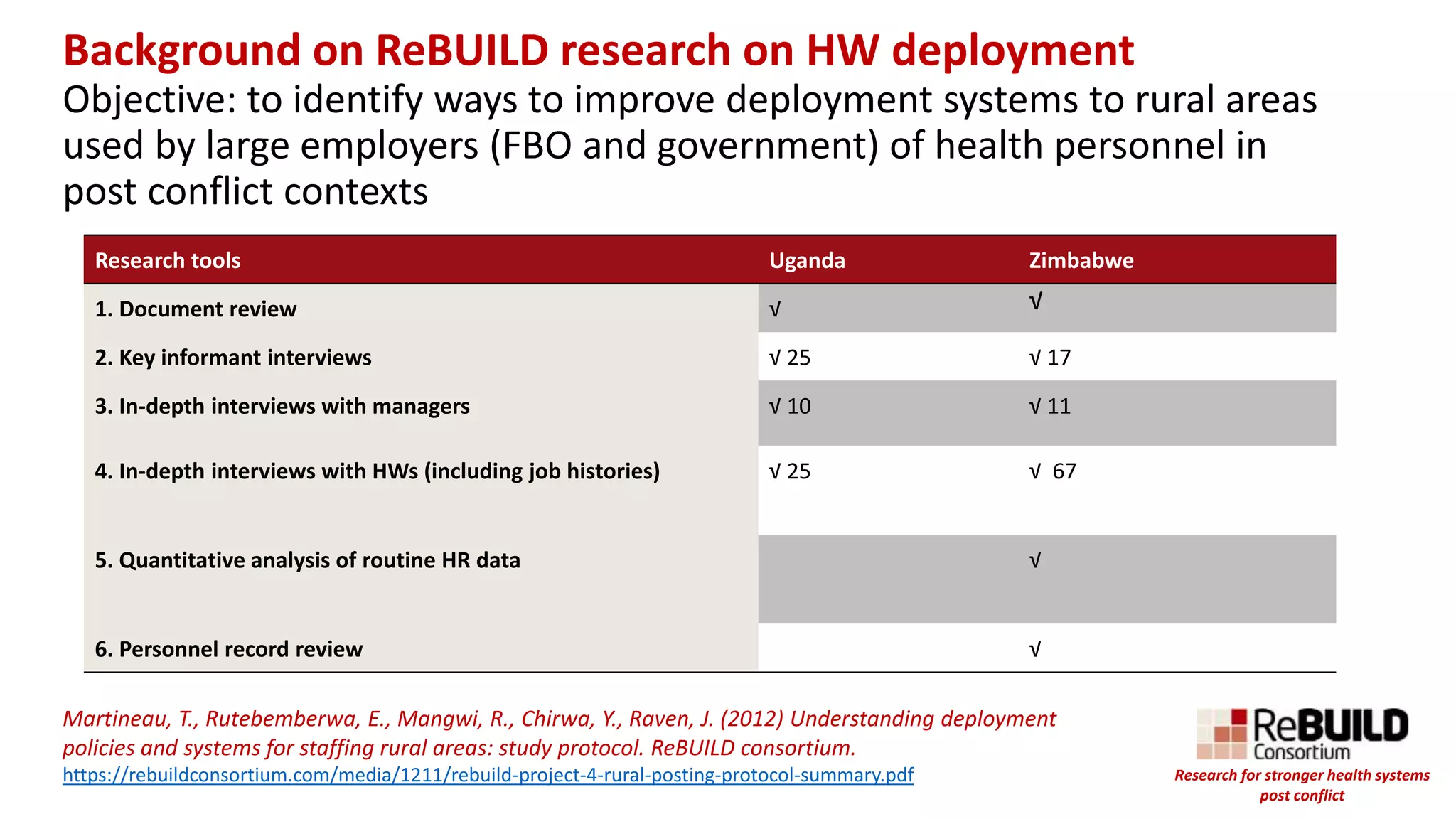
Background on ReBUILD research on HW deployment
Objective: to identify ways to improve deployment systems to rural areas
used by large employers (FBO and government) of health personnel in
post conflict contexts
Research tools Uganda Zimbabwe
1. Document review √ √
2. Key informant interviews √ 25 √ 17
3. In-depth interviews with managers √ 10 √ 11
4. In-depth interviews with HWs (including job histories) √ 25 √ 67
5. Quantitative analysis of routine HR data √
6. Personnel record review √
Martineau, T., Rutebemberwa, E., Mangwi, R., Chirwa, Y., Raven, J. (2012) Understanding deployment
policies and systems for staffing rural areas: study protocol. ReBUILD consortium.
https://rebuildconsortium.com/media/1211/rebuild-project-4-rural-posting-protocol-summary.pdf Research for stronger health systems
post conflict
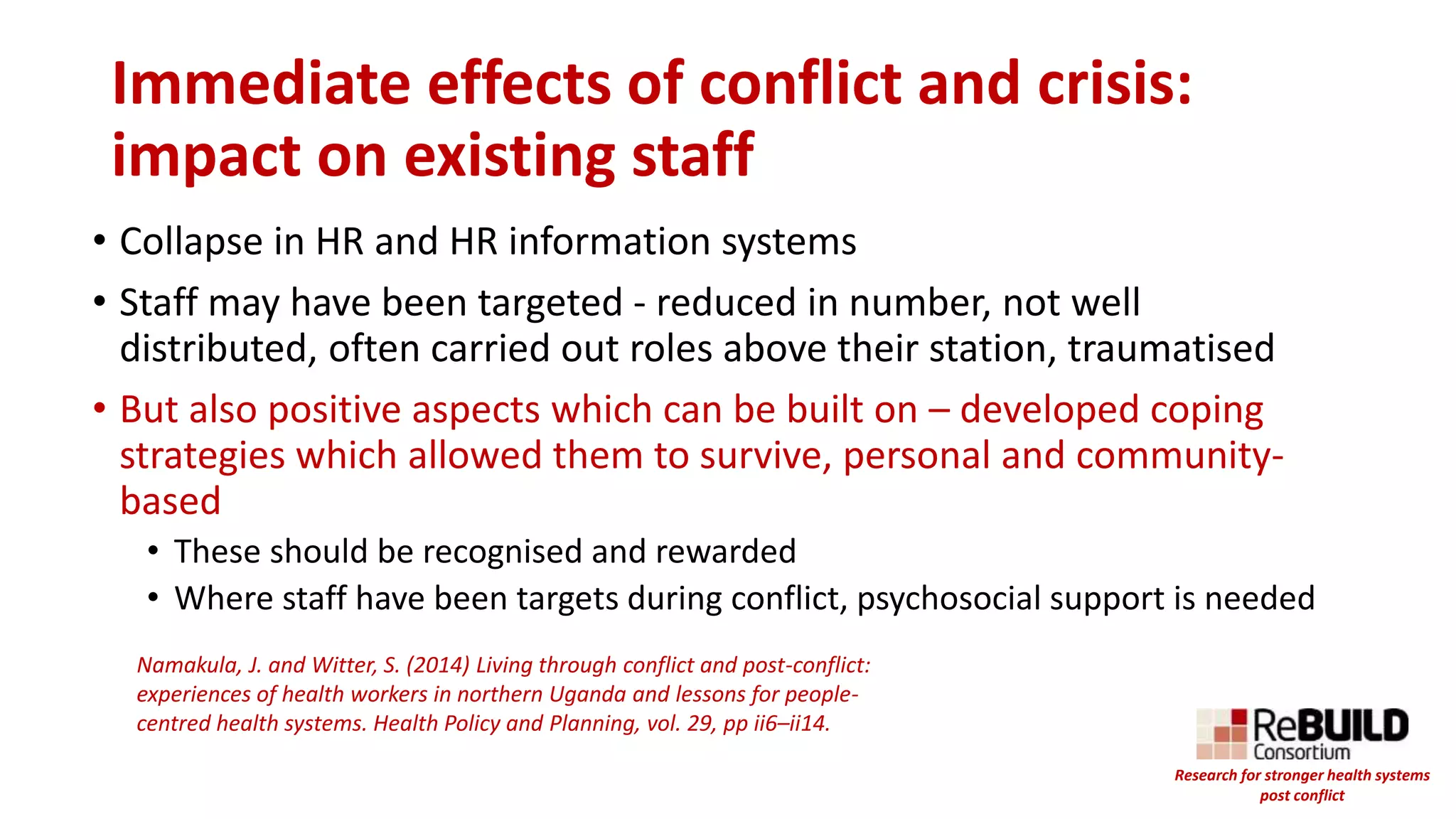
Immediate effects of conflict and crisis:
impact on existing staff
• Collapse in HR and HR information systems
• Staff may have been targeted - reduced in number, not well
distributed, often carried out roles above their station, traumatised
• But also positive aspects which can be built on – developed coping
strategies which allowed them to survive, personal and community-
based
• These should be recognised and rewarded
• Where staff have been targets during conflict, psychosocial support is needed
Namakula, J. and Witter, S. (2014) Living through conflict and post-conflict:
experiences of health workers in northern Uganda and lessons for people-
centred health systems. Health Policy and Planning, vol. 29, pp ii6–ii14.
Research for stronger health systems
post conflict
Staff coping strategies
For conflicts and Ebola:
Health staff targeted in both (but for different reasons)
• Practical – hiding, task shifting, removing uniform, international support
etc.
• Psychosocial – community support, support from colleagues, religious faith
For economic crises:
• Dual practice
• Other income generating strategies
• Informal and formal movements of staff – e.g. to lower cost rural areas
Research for stronger health systems
post conflict
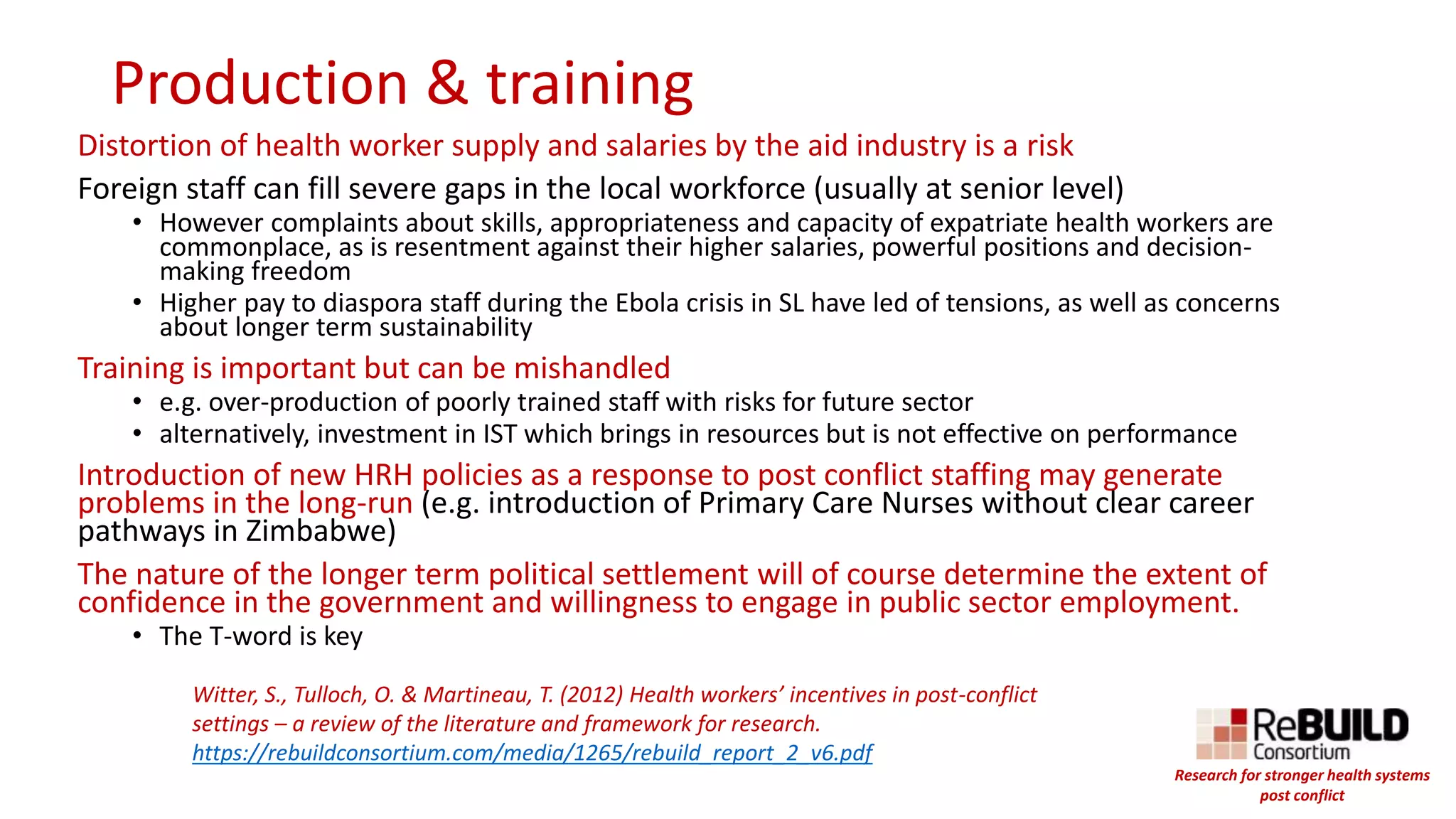
Production & training
Distortion of health worker supply and salaries by the aid industry is a risk
Foreign staff can fill severe gaps in the local workforce (usually at senior level)
• However complaints about skills, appropriateness and capacity of expatriate health workers are
commonplace, as is resentment against their higher salaries, powerful positions and decision-
making freedom
• Higher pay to diaspora staff during the Ebola crisis in SL have led of tensions, as well as concerns
about longer term sustainability
Training is important but can be mishandled
• e.g. over-production of poorly trained staff with risks for future sector
• alternatively, investment in IST which brings in resources but is not effective on performance
Introduction of new HRH policies as a response to post conflict staffing may generate
problems in the long-run (e.g. introduction of Primary Care Nurses without clear career
pathways in Zimbabwe)
The nature of the longer term political settlement will of course determine the extent of
confidence in the government and willingness to engage in public sector employment.
• The T-word is key
Witter, S., Tulloch, O. & Martineau, T. (2012) Health workers’ incentives in post-conflict
settings – a review of the literature and framework for research.
https://rebuildconsortium.com/media/1265/rebuild_report_2_v6.pdf
Research for stronger health systems
post conflict
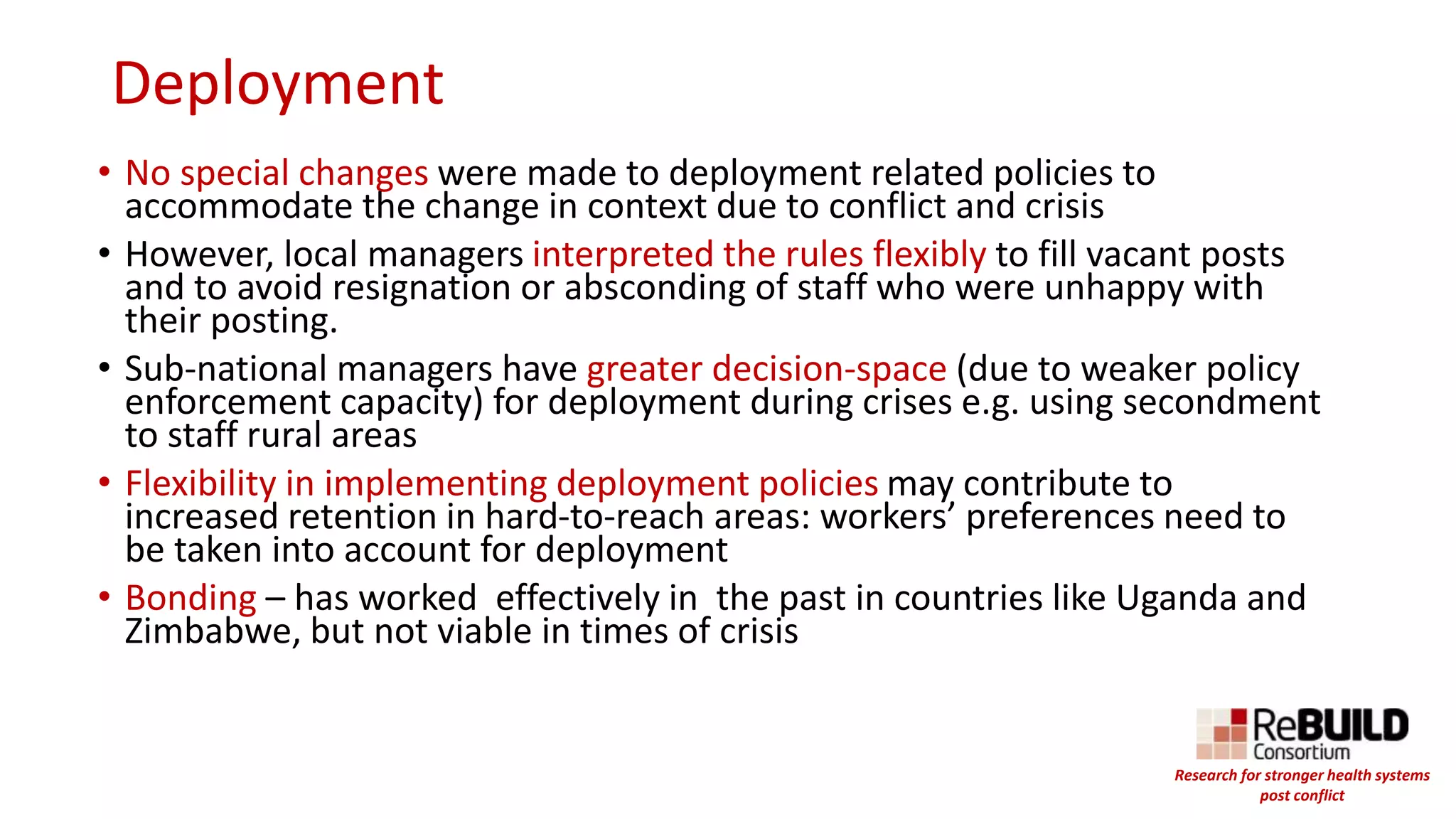
Deployment
• No special changes were made to deployment related policies to
accommodate the change in context due to conflict and crisis
• However, local managers interpreted the rules flexibly to fill vacant posts
and to avoid resignation or absconding of staff who were unhappy with
their posting.
• Sub-national managers have greater decision-space (due to weaker policy
enforcement capacity) for deployment during crises e.g. using secondment
to staff rural areas
• Flexibility in implementing deployment policies may contribute to
increased retention in hard-to-reach areas: workers’ preferences need to
be taken into account for deployment
• Bonding – has worked effectively in the past in countries like Uganda and
Zimbabwe, but not viable in times of crisis
Research for stronger health systems
post conflict
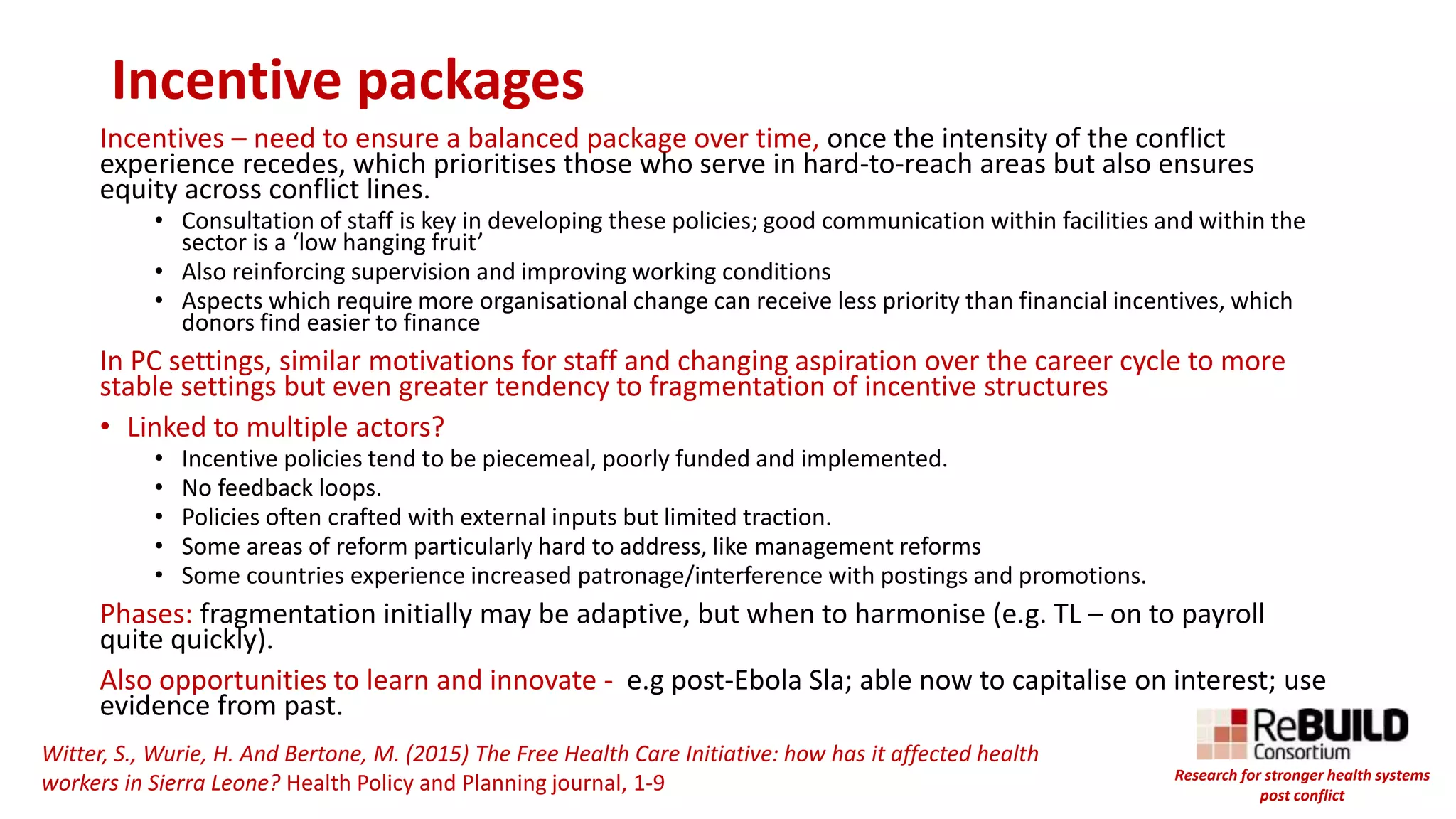
Incentive packages
Incentives – need to ensure a balanced package over time, once the intensity of the conflict
experience recedes, which prioritises those who serve in hard-to-reach areas but also ensures
equity across conflict lines.
• Consultation of staff is key in developing these policies; good communication within facilities and within the
sector is a ‘low hanging fruit’
• Also reinforcing supervision and improving working conditions
• Aspects which require more organisational change can receive less priority than financial incentives, which
donors find easier to finance
In PC settings, similar motivations for staff and changing aspiration over the career cycle to more
stable settings but even greater tendency to fragmentation of incentive structures
• Linked to multiple actors?
• Incentive policies tend to be piecemeal, poorly funded and implemented.
• No feedback loops.
• Policies often crafted with external inputs but limited traction.
• Some areas of reform particularly hard to address, like management reforms
• Some countries experience increased patronage/interference with postings and promotions.
Phases: fragmentation initially may be adaptive, but when to harmonise (e.g. TL – on to payroll
quite quickly).
Also opportunities to learn and innovate - e.g post-Ebola Sla; able now to capitalise on interest; use
evidence from past.
Witter, S., Wurie, H. And Bertone, M. (2015) The Free Health Care Initiative: how has it affected health
workers in Sierra Leone? Health Policy and Planning journal, 1-9 Research for stronger health systems
post conflict
Complex remuneration
Bertone, M. and Witter, S. (2015) The complex remuneration of Human Resources for Health in low income settings: policy implications
and a research agenda for designing effective financial incentives. Human Resources for Health, 13; 62.
Bertone, M., Lagarde, M., Witter, S. (2016) Performance-Based Financing in the context of the complex remuneration of health workers:
findings from a mixed-method study in rural Sierra Leone. Under revision for BMC Health Services Research.
Bertone, MP and Lagarde M. 2016. “Sources, Determinants and Utilization of Health Workers’ Revenues: Evidence from Sierra Leone.”
Health Policy and Planning -
Multiple actors and fragmented incentive policies – need to
understand better what this means for overall remuneration of
health workers, and consequences for health worker motivation and
performance
Some insights from our research into how health workers use and
value different income streams
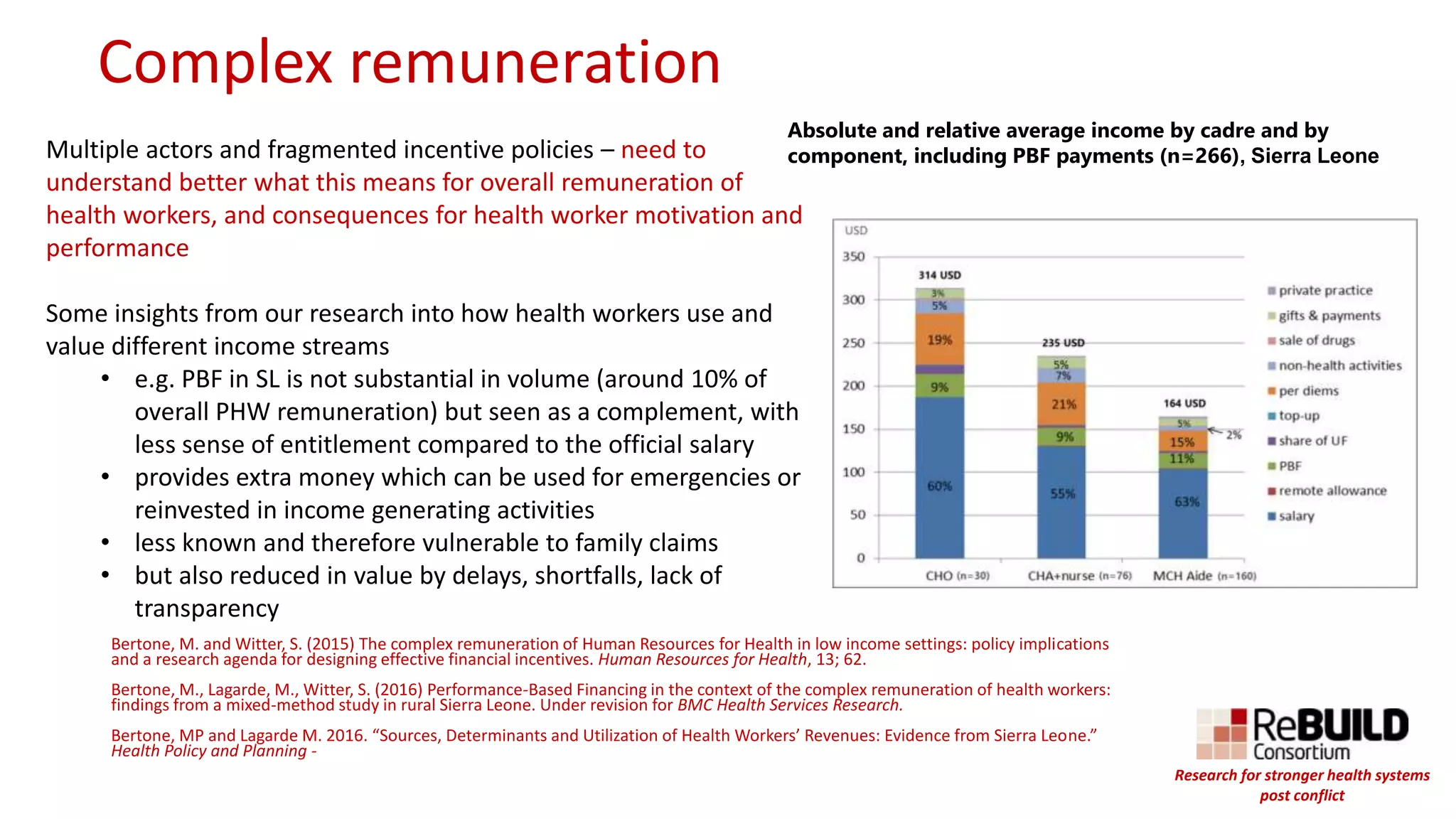
• e.g. PBF in SL is not substantial in volume (around 10% of
overall PHW remuneration) but seen as a complement, with
less sense of entitlement compared to the official salary
• provides extra money which can be used for emergencies or
reinvested in income generating activities
• less known and therefore vulnerable to family claims
• but also reduced in value by delays, shortfalls, lack of
transparency
Absolute and relative average income by cadre and by
component, including PBF payments (n=266), Sierra Leone
Research for stronger health systems
post conflict
Mind the (sectoral) gap
The conflict/post-conflict dynamics can affect the balance of attraction and
retention across sub-sectors within health, distorting the provision of care.
• e.g. in northern Uganda, during the conflict, the PNFP sector remained more functional, including
in terms of supporting staff with pay.
• The public sector was boosted in the post conflict phase due to increased investments under the
PRDP, consolidation of allowances and introduction of hard to reach allowances. The salaries also
became more regular while pension continued to be provided.
• Our findings suggest that retention within the PNFP sector has had to rely on more personal
factors, such as loyalty and family ties, while many still working in the PNFP sector express the
intention to leave, if circumstances permit.
• In Zimbabwe, the public sector has been unable to offer the same terms and conditions for staff,
given the crisis; the municipalities have independent income source and so employ more senior
staff to do less demanding roles in urban clinics, adding to shortages in other areas
Namakula, J., Witter, S. and Ssengooba, F. (2016) Health worker experiences of and movement between public
and private not-for-profit sectors - findings from post conflict Northern Uganda. Human Resources for Health,
14:18. http://www.human-resources-health.com/content/14/1/18
Chirwa, Y., Witter et al. (2016) Understanding health worker incentives in post-crisis settings: policies to attract
and retain health workers in Zimbabwe since 1997: health worker survey findings. ReBUILD report.
Research for stronger health systems
post conflict
Rural retention
Rural health workers face particular challenges, some of which stem from the difficult terrain, which add
to common disadvantages of rural living (poor social amenities etc.).
• Poor working conditions, emotional and financial costs of separation from families, limited access to
training, longer working hours (due to staff shortages) and the inability to earn from other sources
make working in rural areas less attractive.
• Moreover, rules on rotation which should protect staff from being left too long in rural areas are not
reported to be respected.
• Incentives for rural areas limited political focus – especially ineffectual?
• Insecurity
By contrast, poor management had more resonance in urban areas, with reports of poor delegation,
favouritism, and a lack of autonomy for staff. Tensions within the team over unclear roles and absenteeism are
also significant demotivating factors in general.
Local staff & mid-level cadres more likely to work in remote areas
During economic crisis, rural areas can have advantages (e.g. Zim – lower costs, able to subsist etc.)
To work in remote areas workers need:
• recognition of role and achievements in challenging circumstances
• practical measures to improve their security
• provision of decent housing, working conditions, training and pay
• trust, communication and teamwork
Wurie, H., Samai, M., Witter, S. (2016) Retention of health workers in rural and urban Sierra Leone:
findings from life histories. Human Resources for Health, 14 (3).
http://www.human-resources-health.com/content/pdf/s12960-016-0099-6.pdf Research for stronger health systems
post conflict
The gendered health workforce
• Lack of balance: in all contexts women predominate in nursing and midwifery
cadres; are under-represented in management positions and tend to be more
clustered in lower paying positions
• Gender roles, shaped by caring responsibilities at the household level, also affect
attitudes to rural deployment and women in all contexts faced particular
challenges in accessing both pre- and in-service training as compared to their male
counterparts
• Conflict and coping strategies within conflict emerged as a key theme, with
gendered strategies and experiences also shaped by poverty and household
structure
• Most HRH regulatory frameworks did not use the PC moment to address gender.
Key priority areas for addressing gender equity in the health workforce in FCAS
include (1) ensuring gender is integrated into policy and (2) fostering dialogue and
action to support change for gender equity within institutions and households.
Witter, S., Namakula, J., Wurie, H., Chirwa, Y., So, S., Vong, S., Ros, B., Buzuzi, S. and Theobald, S. (2016)
The gendered health workforce: mixed methods analysis from four post-conflict contexts. Submitted to special edition of
Health Policy and Planning on gender and ethics.
Research for stronger health systems
post conflict
HRH policies & institutions
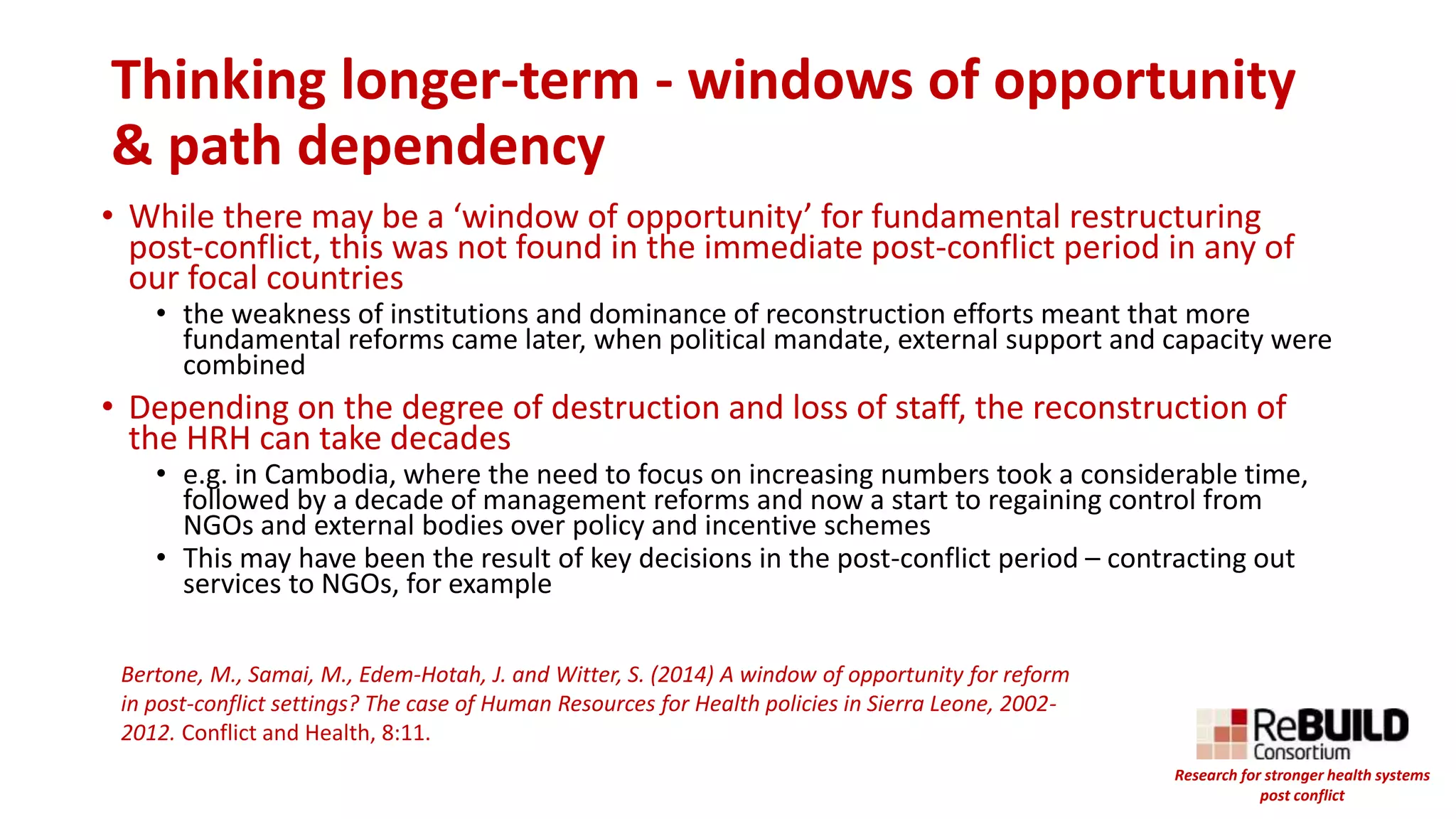
Thinking longer-term - windows of opportunity
& path dependency
• While there may be a ‘window of opportunity’ for fundamental restructuring
post-conflict, this was not found in the immediate post-conflict period in any of
our focal countries
• the weakness of institutions and dominance of reconstruction efforts meant that more
fundamental reforms came later, when political mandate, external support and capacity were
combined
• Depending on the degree of destruction and loss of staff, the reconstruction of
the HRH can take decades
• e.g. in Cambodia, where the need to focus on increasing numbers took a considerable time,
followed by a decade of management reforms and now a start to regaining control from
NGOs and external bodies over policy and incentive schemes
• This may have been the result of key decisions in the post-conflict period – contracting out
services to NGOs, for example
Bertone, M., Samai, M., Edem-Hotah, J. and Witter, S. (2014) A window of opportunity for reform
in post-conflict settings? The case of Human Resources for Health policies in Sierra Leone, 2002-
2012. Conflict and Health, 8:11.
Research for stronger health systems
post conflict
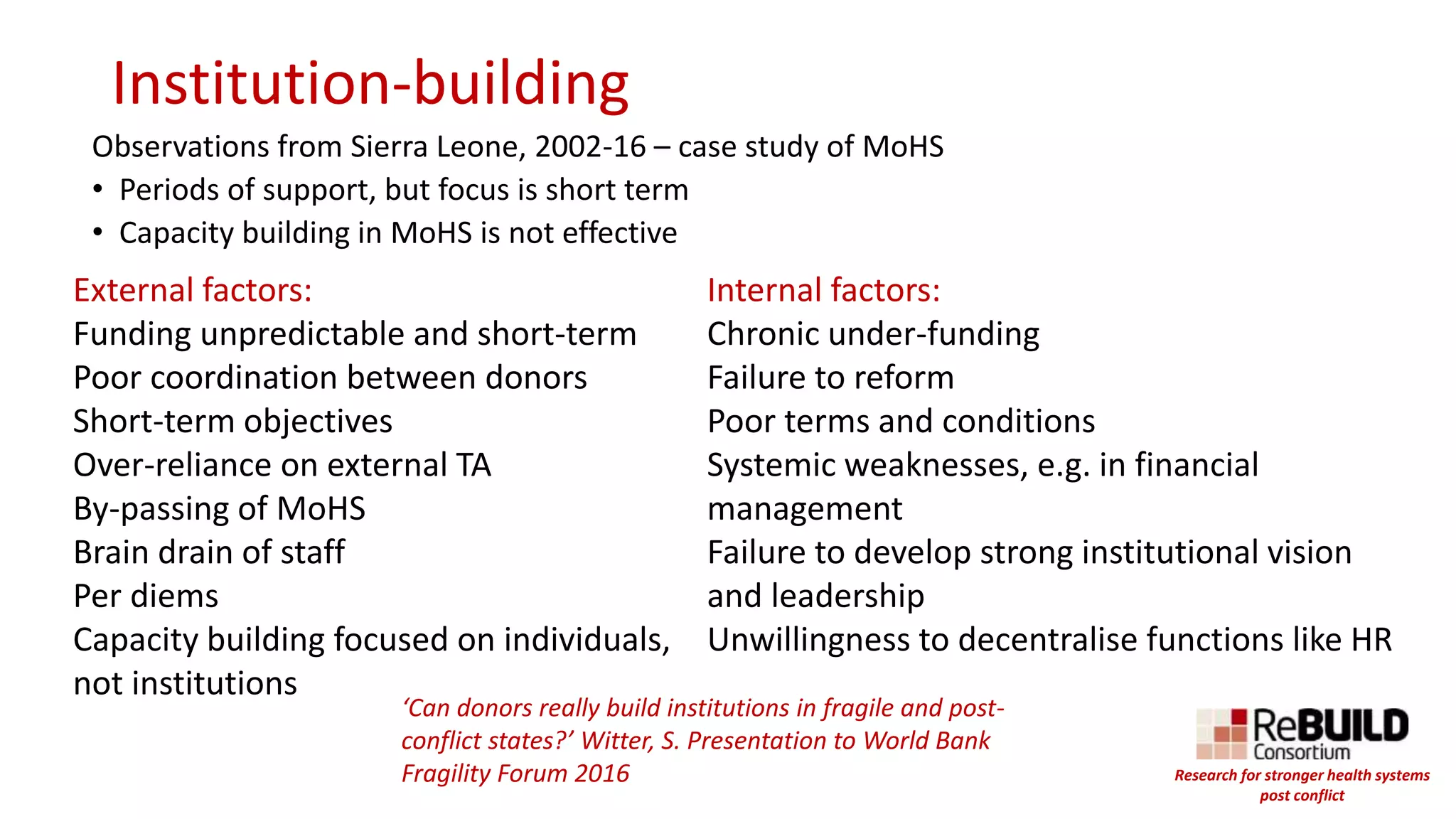
Institution-building
Observations from Sierra Leone, 2002-16 – case study of MoHS
• Periods of support, but focus is short term
• Capacity building in MoHS is not effective
Internal factors:
Chronic under-funding
Failure to reform
Poor terms and conditions
Systemic weaknesses, e.g. in financial
management
Failure to develop strong institutional vision
and leadership
Unwillingness to decentralise functions like HR
External factors:
Funding unpredictable and short-term
Poor coordination between donors
Short-term objectives
Over-reliance on external TA
By-passing of MoHS
Brain drain of staff
Per diems
Capacity building focused on individuals,
not institutions
‘Can donors really build institutions in fragile and post-
conflict states?’ Witter, S. Presentation to World Bank
Fragility Forum 2016 Research for stronger health systems
post conflict
Do no harm….
Fundamentally, institutions have to be internally constructed BUT
donors have a duty to not disrupt:
• Not creating parallel structures and power bases
• Not offering salaries that attract all of talent out of core institutions
• Not circumventing mandated decision-makers in MoHS (donors
commonly play off different stakeholders in MoHS)
• Providing funds in a way that does not undermine role of MOHS
(direct to NGOs, with no MoHS oversight etc.)
Witter, S. (2015) Universal Health Coverage amid conflict and fragility: ten lessons from research.
http://globalhealth.thelancet.com/2015/12/14/universal-health-coverage-amid-conflict-and-fragility-
ten-lessons-research
Bertone, M. and Witter, S. (2015) An exploration of the political economy dynamics shaping health
worker incentives in three districts in Sierra Leone. Social Science and Medicine, volume 141, pp56-
63.
Research for stronger health systems
post conflict
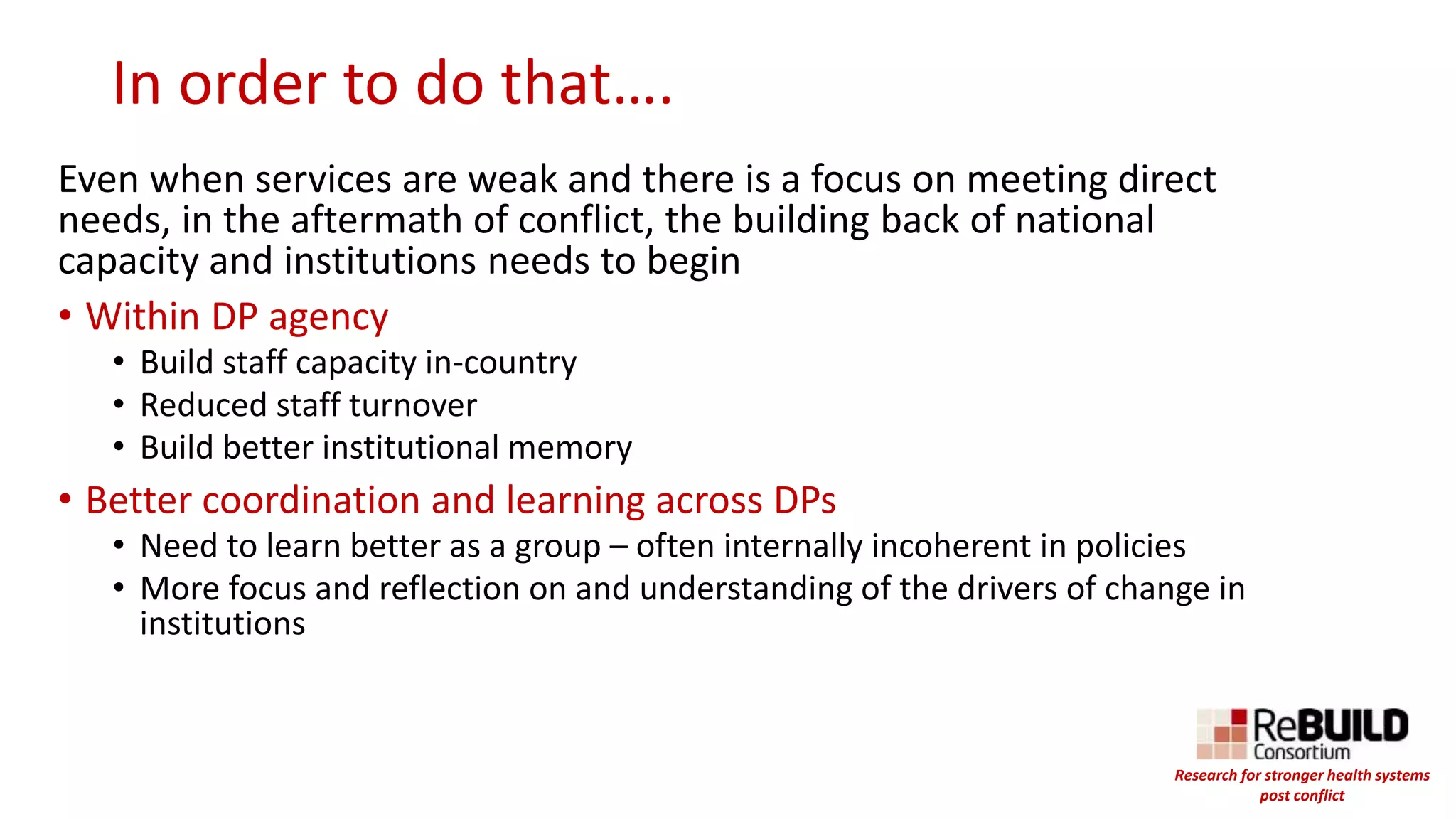
In order to do that….
Even when services are weak and there is a focus on meeting direct
needs, in the aftermath of conflict, the building back of national
capacity and institutions needs to begin
• Within DP agency
• Build staff capacity in-country
• Reduced staff turnover
• Build better institutional memory
• Better coordination and learning across DPs
• Need to learn better as a group – often internally incoherent in policies
• More focus and reflection on and understanding of the drivers of change in
institutions
Research for stronger health systems
post conflict
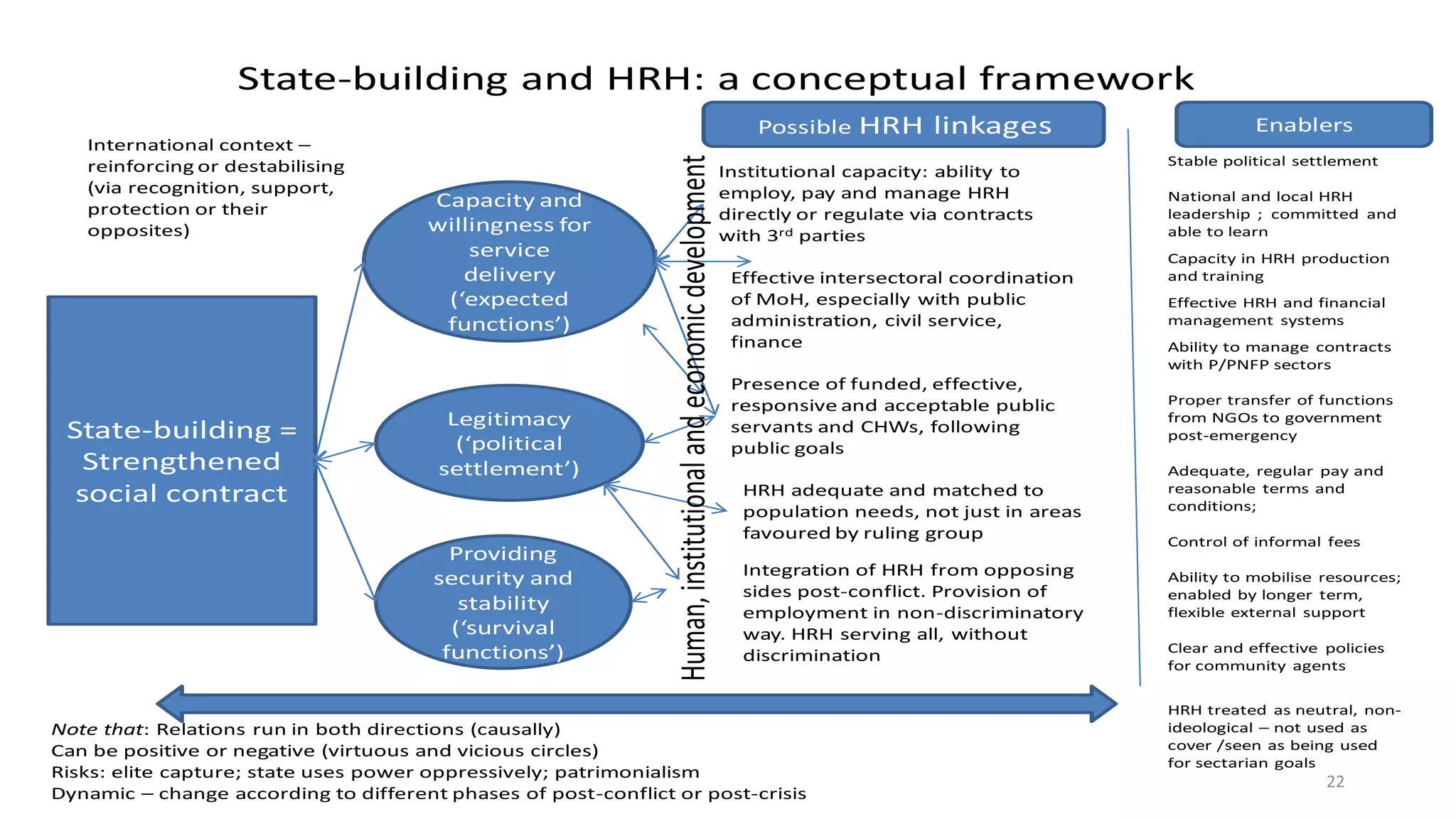
State-building and HRH: a conceptual framework
State-building =
Strengthened
social contract
Capacity and
willingness for
service
delivery
(‘expected
functions’)
Legitimacy
(‘political
settlement’)
Providing
security and
stability
(‘survival
functions’)
Possible HRH linkages Enablers
Institutional capacity: ability to
employ, pay and manage HRH
directly or regulate via contracts
with 3rd parties
Effective intersectoral coordination
of MoH, especially with public
administration, civil service,
finance
Presence of funded, effective,
responsive and acceptable public
servants and CHWs, following
public goals
HRH adequate and matched to
population needs, not just in areas
favoured by ruling group
Integration of HRH from opposing
sides post-conflict. Provision of
employment in non-discriminatory
way. HRH serving all, without
discrimination
Capacity in HRH production
and training
Effective HRH and financial
management systems
Ability to manage contracts
with P/PNFP sectors
Proper transfer of functions
from NGOs to government
post-emergency
Adequate, regular pay and
reasonable terms and
conditions;
Control of informal fees
Clear and effective policies
for community agents
HRH treated as neutral, non-
ideological – not used as
cover /seen as being used
for sectarian goals
International context –
reinforcing or destabilising
(via recognition, support,
protection or their
opposites)
Note that: Relations run in both directions (causally)
Can be positive or negative (virtuous and vicious circles)
Risks: elite capture; state uses power oppressively; patrimonialism
Dynamic – change according to different phases of post-conflict or post-crisis
Ability to mobilise resources;
enabled by longer term,
flexible external support
National and local HRH
leadership ; committed and
able to learn
Human,institutionalandeconomicdevelopment
Stable political settlement
22
HRH and state-building
• The concept of state-building itself is highly contested, with a rich vein of scepticism
about the wisdom or feasibility of this as an external project
• Empirical evidence for most of the linkages is not strong, which is not surprising,
given the complexity of (and of measuring) the relationships.
• Nevertheless, some of the posited relationships are plausible, especially:
• between development of health cadres and a strengthened public administration,
which in the long run underlies a number of state-building features
• reintegration of factional health staff post-conflict is also plausibly linked to
reconciliation and peace-building
Witter, S., Benoit, J-B, Bertone, M, Alonso-Garbayo, A., Martins, J., Salehi, A.,
Pavignani, E., Martineau, T. (2015) State-building and human resources for
health in fragile and conflict-affected states: exploring the linkages. Human
Resources for Health special edition.
Research for stronger health systems
post conflict
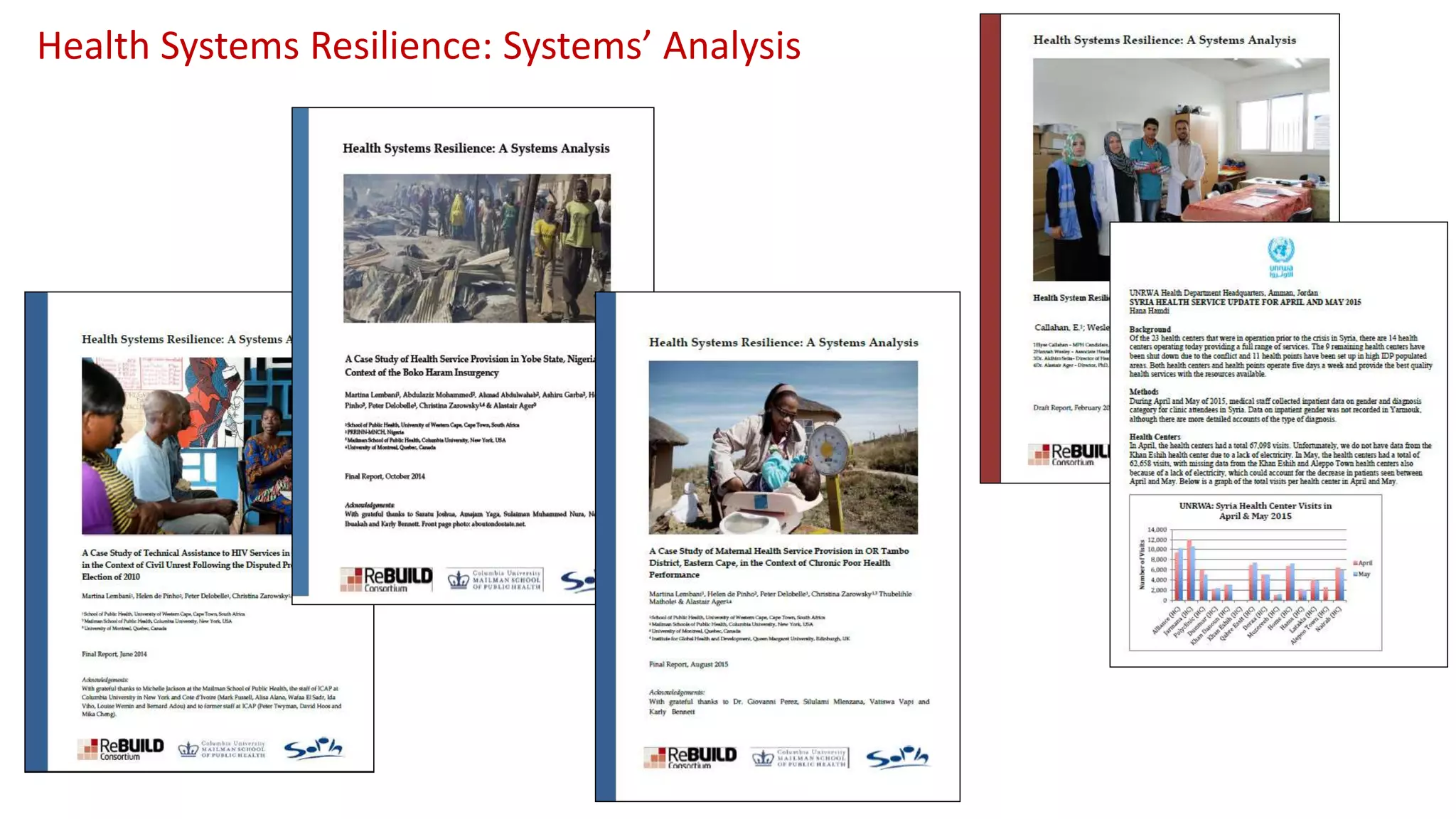
Health Systems Resilience: Systems’ Analysis
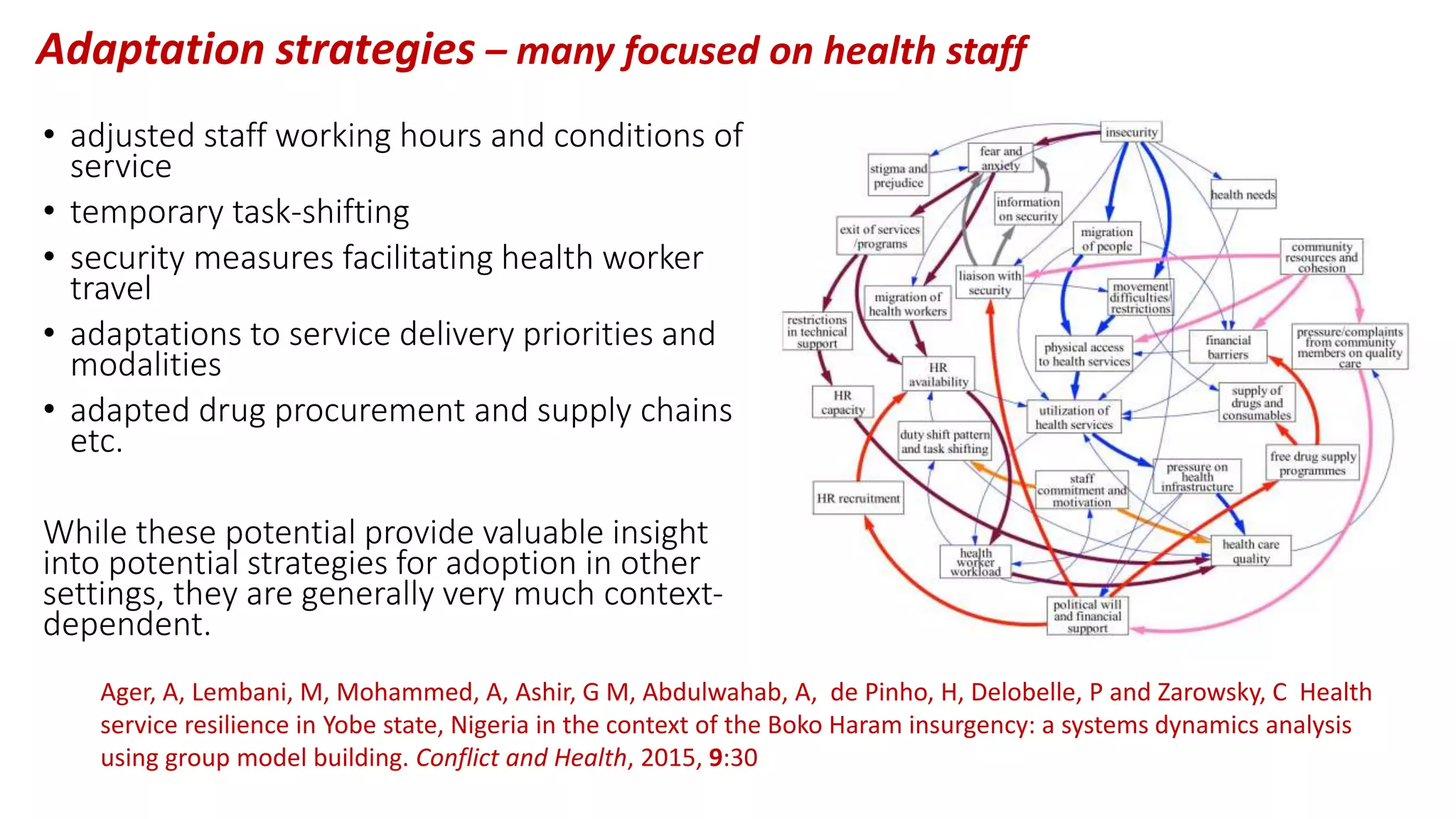
Adaptation strategies – many focused on health staff
• adjusted staff working hours and conditions of
service
• temporary task-shifting
• security measures facilitating health worker
travel
• adaptations to service delivery priorities and
modalities
• adapted drug procurement and supply chains
etc.
While these potential provide valuable insight
into potential strategies for adoption in other
settings, they are generally very much context-
dependent.
Ager, A, Lembani, M, Mohammed, A, Ashir, G M, Abdulwahab, A, de Pinho, H, Delobelle, P and Zarowsky, C Health
service resilience in Yobe state, Nigeria in the context of the Boko Haram insurgency: a systems dynamics analysis
using group model building. Conflict and Health, 2015, 9:30
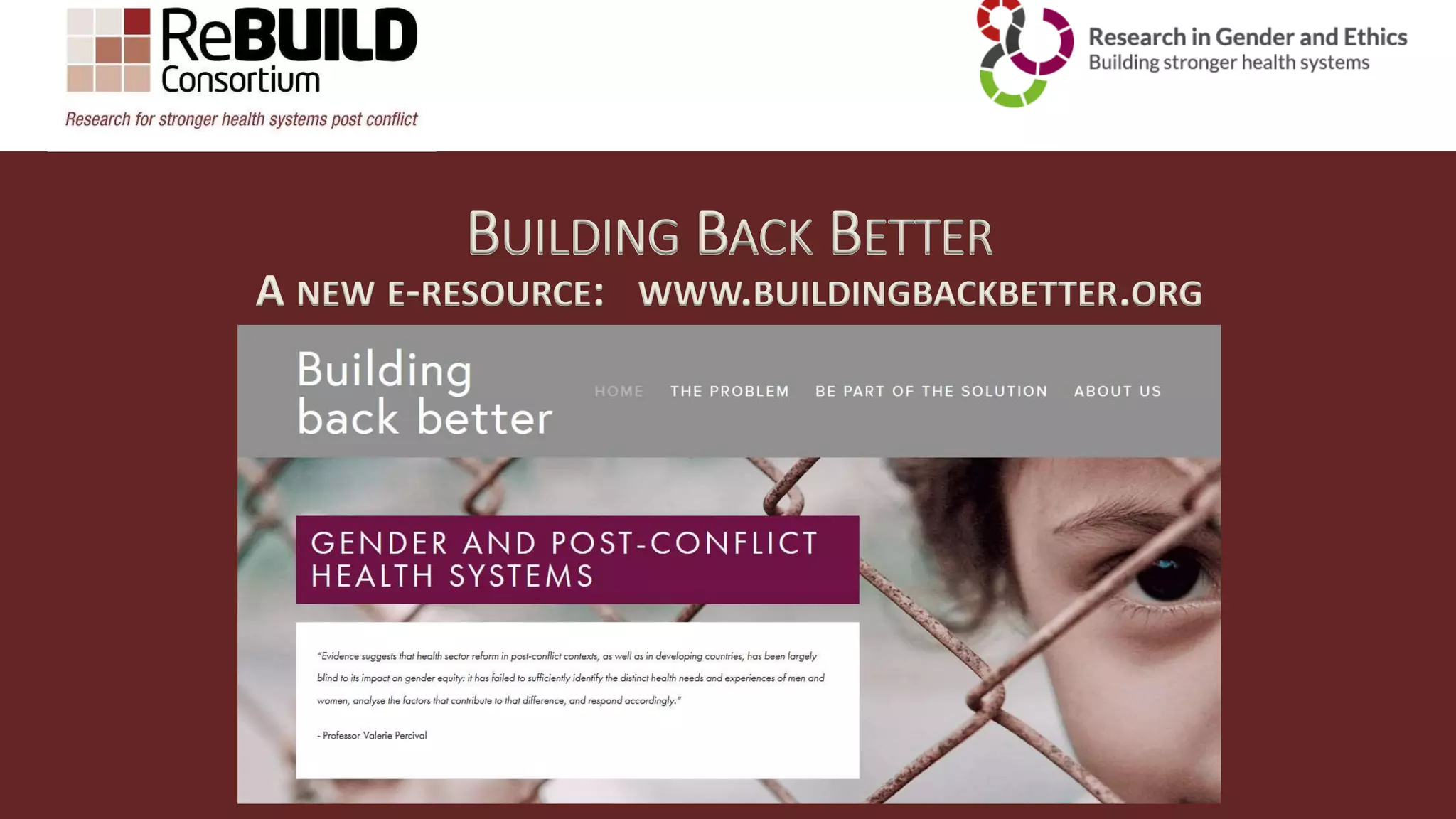
BUILDING BACK BETTER
A NEW E-RESOURCE: WWW.BUILDINGBACKBETTER.ORG
Thank you
Website:
www.rebuildconsortium.com
Contact:
nick.hooton@lstmed.ac.uk
@ReBUILDRPC

Human Resources for Health in Post-Conflict settings - Findings from ReBUILD research

  • 1.
    Findings from ReBUILD’s healthworker research Learning lessons for post-conflict contexts Sophie Witter HEART seminar, 9th June 2016 Research for stronger health systems post conflict
  • 2.
    Overview • Background onReBUILD • Findings on impact of conflict on health staff • Production, attraction, distribution, retention and motivating health staff post-conflict/crisis – longer term perspectives • Gender and HRH • HRH policy-making and institutions • Finally, some resources Research for stronger health systems post conflict
  • 3.
    Background on ReBUILD Postconflict is a neglected area of health system research Opportunity to set health systems in a pro-poor direction Useful to think about what policy space there is in the immediate post-conflict period Choice of focal countries enable distance and close up view of post conflict Decisions made early post-conflict can steer the long term development of the health system Research for stronger health systems post conflict
  • 4.
    ReBUILD’s research andpartnership Health financing Gender & equity Health workforce Aid effectiveness Contracting models Health systems and resilience Research for stronger health systems post conflict Consortium partners • College of Medicine and Allied Health Sciences (CoMAHS), Sierra Leone • Biomedical Training and Research Institute (BRTI), Zimbabwe • Makerere University School of Public Health (MaKSPH), Uganda • Cambodia Development Research Institute (CDRI) • Institute for International Health and Development (IIHD), Queen Margaret University, UK • Liverpool school of Tropical Medicine (UK) Consortium affiliates working in additional countries: Cote d'Ivoire, Nigeria and South Africa; Sri Lanka, Gaza and Liberia
  • 5.
    Health Needs of population (demand) Health services (supply) Conflictand crisis creates change Howcandecisionsmadeearlypost-conflictor crisissteerthelongtermdevelopmentofthe healthsystem? Thematic areas Actors & networks Policy and power Vulnerability Household structure Accessing healthcare Resource flows Attraction/retention Posting Policy making Effects and responses Institutions Health workers Communities Strongerhealthsystemspostconflictandcrisis Research question Enhancedvulnerability Gender
  • 6.
    Background on ReBUILDresearch on HW incentives Objective: to understand the evolution of incentives for health workers post-conflict and their effects on HRH and the health sector Research tools Cambodia Sierra Leone Uganda Zimbabwe 1. Stakeholder mapping √ √ 2. Document review √ √ √ √ 3. Key informant interviews √ 33 √ 23 + 18 √ 25 √ 14 4. Life histories with HWs √ 24 √ 23 + 39 √ 26 √ 34 5. Quantitative analysis of routine HR data √ √ √ 6. Survey of health workers √ 310 + 266 (and logbooks) √ 227 Witter, S., Chirwa, Y., Namakula, J., Samai, M., Sok, S. (2012) Understanding health worker incentives in post-conflict settings: study protocol. ReBuild consortium. http://www.rebuildconsortium.com/media/1209/rebuild-research-protocol-summary-health-worker-incentives.pdf Research for stronger health systems post conflict
  • 7.
    Background on ReBUILDresearch on HW deployment Objective: to identify ways to improve deployment systems to rural areas used by large employers (FBO and government) of health personnel in post conflict contexts Research tools Uganda Zimbabwe 1. Document review √ √ 2. Key informant interviews √ 25 √ 17 3. In-depth interviews with managers √ 10 √ 11 4. In-depth interviews with HWs (including job histories) √ 25 √ 67 5. Quantitative analysis of routine HR data √ 6. Personnel record review √ Martineau, T., Rutebemberwa, E., Mangwi, R., Chirwa, Y., Raven, J. (2012) Understanding deployment policies and systems for staffing rural areas: study protocol. ReBUILD consortium. https://rebuildconsortium.com/media/1211/rebuild-project-4-rural-posting-protocol-summary.pdf Research for stronger health systems post conflict
  • 8.
    Immediate effects ofconflict and crisis: impact on existing staff • Collapse in HR and HR information systems • Staff may have been targeted - reduced in number, not well distributed, often carried out roles above their station, traumatised • But also positive aspects which can be built on – developed coping strategies which allowed them to survive, personal and community- based • These should be recognised and rewarded • Where staff have been targets during conflict, psychosocial support is needed Namakula, J. and Witter, S. (2014) Living through conflict and post-conflict: experiences of health workers in northern Uganda and lessons for people- centred health systems. Health Policy and Planning, vol. 29, pp ii6–ii14. Research for stronger health systems post conflict
  • 9.
    Staff coping strategies Forconflicts and Ebola: Health staff targeted in both (but for different reasons) • Practical – hiding, task shifting, removing uniform, international support etc. • Psychosocial – community support, support from colleagues, religious faith For economic crises: • Dual practice • Other income generating strategies • Informal and formal movements of staff – e.g. to lower cost rural areas Research for stronger health systems post conflict
  • 10.
    Production & training Distortionof health worker supply and salaries by the aid industry is a risk Foreign staff can fill severe gaps in the local workforce (usually at senior level) • However complaints about skills, appropriateness and capacity of expatriate health workers are commonplace, as is resentment against their higher salaries, powerful positions and decision- making freedom • Higher pay to diaspora staff during the Ebola crisis in SL have led of tensions, as well as concerns about longer term sustainability Training is important but can be mishandled • e.g. over-production of poorly trained staff with risks for future sector • alternatively, investment in IST which brings in resources but is not effective on performance Introduction of new HRH policies as a response to post conflict staffing may generate problems in the long-run (e.g. introduction of Primary Care Nurses without clear career pathways in Zimbabwe) The nature of the longer term political settlement will of course determine the extent of confidence in the government and willingness to engage in public sector employment. • The T-word is key Witter, S., Tulloch, O. & Martineau, T. (2012) Health workers’ incentives in post-conflict settings – a review of the literature and framework for research. https://rebuildconsortium.com/media/1265/rebuild_report_2_v6.pdf Research for stronger health systems post conflict
  • 11.
    Deployment • No specialchanges were made to deployment related policies to accommodate the change in context due to conflict and crisis • However, local managers interpreted the rules flexibly to fill vacant posts and to avoid resignation or absconding of staff who were unhappy with their posting. • Sub-national managers have greater decision-space (due to weaker policy enforcement capacity) for deployment during crises e.g. using secondment to staff rural areas • Flexibility in implementing deployment policies may contribute to increased retention in hard-to-reach areas: workers’ preferences need to be taken into account for deployment • Bonding – has worked effectively in the past in countries like Uganda and Zimbabwe, but not viable in times of crisis Research for stronger health systems post conflict
  • 12.
    Incentive packages Incentives –need to ensure a balanced package over time, once the intensity of the conflict experience recedes, which prioritises those who serve in hard-to-reach areas but also ensures equity across conflict lines. • Consultation of staff is key in developing these policies; good communication within facilities and within the sector is a ‘low hanging fruit’ • Also reinforcing supervision and improving working conditions • Aspects which require more organisational change can receive less priority than financial incentives, which donors find easier to finance In PC settings, similar motivations for staff and changing aspiration over the career cycle to more stable settings but even greater tendency to fragmentation of incentive structures • Linked to multiple actors? • Incentive policies tend to be piecemeal, poorly funded and implemented. • No feedback loops. • Policies often crafted with external inputs but limited traction. • Some areas of reform particularly hard to address, like management reforms • Some countries experience increased patronage/interference with postings and promotions. Phases: fragmentation initially may be adaptive, but when to harmonise (e.g. TL – on to payroll quite quickly). Also opportunities to learn and innovate - e.g post-Ebola Sla; able now to capitalise on interest; use evidence from past. Witter, S., Wurie, H. And Bertone, M. (2015) The Free Health Care Initiative: how has it affected health workers in Sierra Leone? Health Policy and Planning journal, 1-9 Research for stronger health systems post conflict
  • 13.
    Complex remuneration Bertone, M.and Witter, S. (2015) The complex remuneration of Human Resources for Health in low income settings: policy implications and a research agenda for designing effective financial incentives. Human Resources for Health, 13; 62. Bertone, M., Lagarde, M., Witter, S. (2016) Performance-Based Financing in the context of the complex remuneration of health workers: findings from a mixed-method study in rural Sierra Leone. Under revision for BMC Health Services Research. Bertone, MP and Lagarde M. 2016. “Sources, Determinants and Utilization of Health Workers’ Revenues: Evidence from Sierra Leone.” Health Policy and Planning - Multiple actors and fragmented incentive policies – need to understand better what this means for overall remuneration of health workers, and consequences for health worker motivation and performance Some insights from our research into how health workers use and value different income streams • e.g. PBF in SL is not substantial in volume (around 10% of overall PHW remuneration) but seen as a complement, with less sense of entitlement compared to the official salary • provides extra money which can be used for emergencies or reinvested in income generating activities • less known and therefore vulnerable to family claims • but also reduced in value by delays, shortfalls, lack of transparency Absolute and relative average income by cadre and by component, including PBF payments (n=266), Sierra Leone Research for stronger health systems post conflict
  • 14.
    Mind the (sectoral)gap The conflict/post-conflict dynamics can affect the balance of attraction and retention across sub-sectors within health, distorting the provision of care. • e.g. in northern Uganda, during the conflict, the PNFP sector remained more functional, including in terms of supporting staff with pay. • The public sector was boosted in the post conflict phase due to increased investments under the PRDP, consolidation of allowances and introduction of hard to reach allowances. The salaries also became more regular while pension continued to be provided. • Our findings suggest that retention within the PNFP sector has had to rely on more personal factors, such as loyalty and family ties, while many still working in the PNFP sector express the intention to leave, if circumstances permit. • In Zimbabwe, the public sector has been unable to offer the same terms and conditions for staff, given the crisis; the municipalities have independent income source and so employ more senior staff to do less demanding roles in urban clinics, adding to shortages in other areas Namakula, J., Witter, S. and Ssengooba, F. (2016) Health worker experiences of and movement between public and private not-for-profit sectors - findings from post conflict Northern Uganda. Human Resources for Health, 14:18. http://www.human-resources-health.com/content/14/1/18 Chirwa, Y., Witter et al. (2016) Understanding health worker incentives in post-crisis settings: policies to attract and retain health workers in Zimbabwe since 1997: health worker survey findings. ReBUILD report. Research for stronger health systems post conflict
  • 15.
    Rural retention Rural healthworkers face particular challenges, some of which stem from the difficult terrain, which add to common disadvantages of rural living (poor social amenities etc.). • Poor working conditions, emotional and financial costs of separation from families, limited access to training, longer working hours (due to staff shortages) and the inability to earn from other sources make working in rural areas less attractive. • Moreover, rules on rotation which should protect staff from being left too long in rural areas are not reported to be respected. • Incentives for rural areas limited political focus – especially ineffectual? • Insecurity By contrast, poor management had more resonance in urban areas, with reports of poor delegation, favouritism, and a lack of autonomy for staff. Tensions within the team over unclear roles and absenteeism are also significant demotivating factors in general. Local staff & mid-level cadres more likely to work in remote areas During economic crisis, rural areas can have advantages (e.g. Zim – lower costs, able to subsist etc.) To work in remote areas workers need: • recognition of role and achievements in challenging circumstances • practical measures to improve their security • provision of decent housing, working conditions, training and pay • trust, communication and teamwork Wurie, H., Samai, M., Witter, S. (2016) Retention of health workers in rural and urban Sierra Leone: findings from life histories. Human Resources for Health, 14 (3). http://www.human-resources-health.com/content/pdf/s12960-016-0099-6.pdf Research for stronger health systems post conflict
  • 16.
    The gendered healthworkforce • Lack of balance: in all contexts women predominate in nursing and midwifery cadres; are under-represented in management positions and tend to be more clustered in lower paying positions • Gender roles, shaped by caring responsibilities at the household level, also affect attitudes to rural deployment and women in all contexts faced particular challenges in accessing both pre- and in-service training as compared to their male counterparts • Conflict and coping strategies within conflict emerged as a key theme, with gendered strategies and experiences also shaped by poverty and household structure • Most HRH regulatory frameworks did not use the PC moment to address gender. Key priority areas for addressing gender equity in the health workforce in FCAS include (1) ensuring gender is integrated into policy and (2) fostering dialogue and action to support change for gender equity within institutions and households. Witter, S., Namakula, J., Wurie, H., Chirwa, Y., So, S., Vong, S., Ros, B., Buzuzi, S. and Theobald, S. (2016) The gendered health workforce: mixed methods analysis from four post-conflict contexts. Submitted to special edition of Health Policy and Planning on gender and ethics. Research for stronger health systems post conflict
  • 17.
    HRH policies &institutions
  • 18.
    Thinking longer-term -windows of opportunity & path dependency • While there may be a ‘window of opportunity’ for fundamental restructuring post-conflict, this was not found in the immediate post-conflict period in any of our focal countries • the weakness of institutions and dominance of reconstruction efforts meant that more fundamental reforms came later, when political mandate, external support and capacity were combined • Depending on the degree of destruction and loss of staff, the reconstruction of the HRH can take decades • e.g. in Cambodia, where the need to focus on increasing numbers took a considerable time, followed by a decade of management reforms and now a start to regaining control from NGOs and external bodies over policy and incentive schemes • This may have been the result of key decisions in the post-conflict period – contracting out services to NGOs, for example Bertone, M., Samai, M., Edem-Hotah, J. and Witter, S. (2014) A window of opportunity for reform in post-conflict settings? The case of Human Resources for Health policies in Sierra Leone, 2002- 2012. Conflict and Health, 8:11. Research for stronger health systems post conflict
  • 19.
    Institution-building Observations from SierraLeone, 2002-16 – case study of MoHS • Periods of support, but focus is short term • Capacity building in MoHS is not effective Internal factors: Chronic under-funding Failure to reform Poor terms and conditions Systemic weaknesses, e.g. in financial management Failure to develop strong institutional vision and leadership Unwillingness to decentralise functions like HR External factors: Funding unpredictable and short-term Poor coordination between donors Short-term objectives Over-reliance on external TA By-passing of MoHS Brain drain of staff Per diems Capacity building focused on individuals, not institutions ‘Can donors really build institutions in fragile and post- conflict states?’ Witter, S. Presentation to World Bank Fragility Forum 2016 Research for stronger health systems post conflict
  • 20.
    Do no harm…. Fundamentally,institutions have to be internally constructed BUT donors have a duty to not disrupt: • Not creating parallel structures and power bases • Not offering salaries that attract all of talent out of core institutions • Not circumventing mandated decision-makers in MoHS (donors commonly play off different stakeholders in MoHS) • Providing funds in a way that does not undermine role of MOHS (direct to NGOs, with no MoHS oversight etc.) Witter, S. (2015) Universal Health Coverage amid conflict and fragility: ten lessons from research. http://globalhealth.thelancet.com/2015/12/14/universal-health-coverage-amid-conflict-and-fragility- ten-lessons-research Bertone, M. and Witter, S. (2015) An exploration of the political economy dynamics shaping health worker incentives in three districts in Sierra Leone. Social Science and Medicine, volume 141, pp56- 63. Research for stronger health systems post conflict
  • 21.
    In order todo that…. Even when services are weak and there is a focus on meeting direct needs, in the aftermath of conflict, the building back of national capacity and institutions needs to begin • Within DP agency • Build staff capacity in-country • Reduced staff turnover • Build better institutional memory • Better coordination and learning across DPs • Need to learn better as a group – often internally incoherent in policies • More focus and reflection on and understanding of the drivers of change in institutions Research for stronger health systems post conflict
  • 22.
    State-building and HRH:a conceptual framework State-building = Strengthened social contract Capacity and willingness for service delivery (‘expected functions’) Legitimacy (‘political settlement’) Providing security and stability (‘survival functions’) Possible HRH linkages Enablers Institutional capacity: ability to employ, pay and manage HRH directly or regulate via contracts with 3rd parties Effective intersectoral coordination of MoH, especially with public administration, civil service, finance Presence of funded, effective, responsive and acceptable public servants and CHWs, following public goals HRH adequate and matched to population needs, not just in areas favoured by ruling group Integration of HRH from opposing sides post-conflict. Provision of employment in non-discriminatory way. HRH serving all, without discrimination Capacity in HRH production and training Effective HRH and financial management systems Ability to manage contracts with P/PNFP sectors Proper transfer of functions from NGOs to government post-emergency Adequate, regular pay and reasonable terms and conditions; Control of informal fees Clear and effective policies for community agents HRH treated as neutral, non- ideological – not used as cover /seen as being used for sectarian goals International context – reinforcing or destabilising (via recognition, support, protection or their opposites) Note that: Relations run in both directions (causally) Can be positive or negative (virtuous and vicious circles) Risks: elite capture; state uses power oppressively; patrimonialism Dynamic – change according to different phases of post-conflict or post-crisis Ability to mobilise resources; enabled by longer term, flexible external support National and local HRH leadership ; committed and able to learn Human,institutionalandeconomicdevelopment Stable political settlement 22
  • 23.
    HRH and state-building •The concept of state-building itself is highly contested, with a rich vein of scepticism about the wisdom or feasibility of this as an external project • Empirical evidence for most of the linkages is not strong, which is not surprising, given the complexity of (and of measuring) the relationships. • Nevertheless, some of the posited relationships are plausible, especially: • between development of health cadres and a strengthened public administration, which in the long run underlies a number of state-building features • reintegration of factional health staff post-conflict is also plausibly linked to reconciliation and peace-building Witter, S., Benoit, J-B, Bertone, M, Alonso-Garbayo, A., Martins, J., Salehi, A., Pavignani, E., Martineau, T. (2015) State-building and human resources for health in fragile and conflict-affected states: exploring the linkages. Human Resources for Health special edition. Research for stronger health systems post conflict
  • 24.
    Health Systems Resilience:Systems’ Analysis
  • 25.
    Adaptation strategies –many focused on health staff • adjusted staff working hours and conditions of service • temporary task-shifting • security measures facilitating health worker travel • adaptations to service delivery priorities and modalities • adapted drug procurement and supply chains etc. While these potential provide valuable insight into potential strategies for adoption in other settings, they are generally very much context- dependent. Ager, A, Lembani, M, Mohammed, A, Ashir, G M, Abdulwahab, A, de Pinho, H, Delobelle, P and Zarowsky, C Health service resilience in Yobe state, Nigeria in the context of the Boko Haram insurgency: a systems dynamics analysis using group model building. Conflict and Health, 2015, 9:30
  • 27.
    BUILDING BACK BETTER ANEW E-RESOURCE: WWW.BUILDINGBACKBETTER.ORG
  • 28.

Editor's Notes

  • #4 Slide 2: Key starting points: decisions made early post-conflict can steer the long-term development of the health system In countries affected by conflict health systems often break down, and emergency assistance is often the main source of care. As recovery begins so should the process of rebuilding health systems. However, in practice not enough is known about the effectiveness of different approaches to health systems strengthening. Consortium purpose: “Decisions on health systems financing and human resources policy in post-conflict countries draws on research evidence from ReBUILD and the wider knowledge generated on post conflict health settings” Explain how we built the ReBUILD partnership and the use of affiliates to broaden our reach Retrospective view – so weve lokked at what ha happened to the health system during the conflict through the experiences of communities and health workers during the conflict and afterwards
  • #6  We have looked at the health system in terms of both demand for health services and supply of appropriate service ReBUILD is in it’s 5th year We have covered the following areas in ReBUILD (follow animations); today we will focus on 4 areas: understanding the impact of conflict/crisis on the demand side – how might these shocks influence this; and understanding the response from the service delivery side – systems to support the health workforce and aid effectiveness; and although all our work deals with health system resilience, we finish with an example of group modelling to understand the operationalisation of health systems resilience But before we move the research, we want to say that we have been working hard to develop links with potential users of the research findings (as we are happy to be doing now). This has been done in the countries where the research has been done. But we have also been developing networks to bring together researchers, implementers, policy-makers and funders to share information on this under-researched area.
  • #29 [notes will be updated] Slide 1: Title slide – with names of team presenting – in order of presentations Introduce team and thanks for We proposed this area of health systems research as we knew – and have subsequently confirmed through our literature reviews – that it was a neglected area of health systems research. The new DFID aid strategy, and those of other donors, has reinforced the importance of this area and we are very pleased to be given the opportunity of sharing our research findings in this important meeting.